

The impact of artificial intelligence on learner–instructor interaction in online learning
Open accessThe DOI matches its Crossref record; 64 of the 64 references it cites were found in a registry or an index.
Abstract
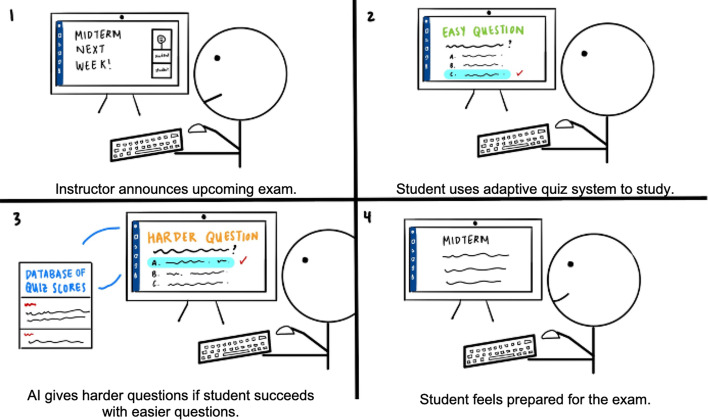
Artificial intelligence (AI) systems offer effective support for online learning and teaching, including personalizing learning for students, automating instructors’ routine tasks, and powering adaptive assessments. However, while the opportunities for AI are promising, the impact of AI systems on the culture of, norms in, and expectations about interactions between students and instructors are still elusive. In online learning, learner–instructor interaction (inter alia, communication, support, and presence) has a profound impact on students’ satisfaction and learning outcomes. Thus, identifying how students and instructors perceive the impact of AI systems on their interaction is important to identify any gaps, challenges, or barriers preventing AI systems from achieving their intended potential and risking the safety of these interactions. To address this need for forward-looking decisions, we used Speed Dating with storyboards to analyze the authentic voices of 12 students and 11 instructors on diverse use cases of possible AI systems in online learning. Findings show that participants envision adopting AI systems in online learning can enable personalized learner–instructor interaction at scale but at the risk of violating social boundaries. Although AI systems have been positively recognized for improving the quantity and quality of communication, for providing just-in-time, personalized support for large-scale settings, and for improving the feeling of connection, there were concerns about responsibility, agency, and surveillance issues. These findings have implications for the design of AI systems to ensure explainability, human-in-the-loop, and careful data collection and presentation. Overall, contributions of this study include the design of AI system storyboards which are technically feasible and positively support learner–instructor interaction, capturing students’ and instructors’ concerns of AI systems through Speed Dating, and suggesting practical implications for maximizing the positive impact of AI systems while minimizing the negative ones.
Overview
The claims and statistics of this paper haven’t been checked yet.
Free: it reads the open-access text and checks the first 5 claims that cite a source we can check. Create a free account to check every claim.
Integrity signals
Registry
Cites
Statistics
Figures
Verification
Claims the paper makes
The claims and statistics of this paper haven’t been checked yet.
Free: it reads the open-access text and checks the first 5 claims that cite a source we can check. Create a free account to check every claim.
Claims other papers make about this one
Each is checked against this paper’s own text: does it say what the citing paper says it does?
The source backs part of the claim, not all of it — or backs it for a different population, condition or comparison.
In the citing paper
“This observation demonstrates the potential of AI as a tool for just-in-time learning in project-based contexts [8, 18], where students can quickly acquire specific expertise needed for their individual projects within compressed timelines.”
From Scaffolding Creativity: Integrating Generative AI Tools and Real-World Experiences in Business Education (2025) · cites this paper as [18]
Experimental — accuracy not yet measuredThe source backs part of the claim, not all of it — or backs it for a different population, condition or comparison.
In the citing paper
“However, teachers may not be digitally ready to use AI-driven educational applications for teaching and learning purposes (e.g., Ally, 2019;Seo et al., 2021).”
From Teachers’ AI digital competencies and twenty-first century skills in the post-pandemic world (2023) · doi:10.1007/s11423-023-10203-6 · cites this paper as Seo et al., 2021
Experimental — accuracy not yet measuredThe cited source says what the claim attributes to it.
In the citing paper
“Interaction between students and instructors has a significant influence on students' happiness and learning results in online learning [92].”
From Adaptive Learning Using Artificial Intelligence in e-Learning: A Literature Review (2023) · cites this paper as [92]
In the citing paper
“They may lack technological experience to conduct data analysis, or to set rules to automatically generate assignments and feedback for students via AI-driven tools (Seo et al., 2021).”
From Teachers’ AI digital competencies and twenty-first century skills in the post-pandemic world (2023) · doi:10.1007/s11423-023-10203-6 · cites this paper as Seo et al., 2021
In the citing paper
“For example, Seo et al. (2021) proposed that AI could facilitate teachers' generation of repetitive questions, and offer students learner-instruction connections, just-in-time personalized support and meaningful automatic communication for classmates.”
From Teachers’ AI digital competencies and twenty-first century skills in the post-pandemic world (2023) · doi:10.1007/s11423-023-10203-6 · cites this paper as Seo et al., 2021
Self-check
Percentages, sums and reported differences re-computed from the paper’s own numbers.
The self-check needs the paper’s full text.
Citations
Cites
Using thematic analysis in psychology
Braun, V., & Clarke, V. (2006) · Qualitative Research in Psychology · doi:10.1191/1478088706qp063oa · Cited by 194,414 · cited 1×
“We used a Reflexive Thematic Analysis approach (Braun & Clarke, 2006; Nowell et al., 2017).”
S., N. L. (2017) · doi:10.1177/1609406917733847 · Cited by 14,051
Zawacki-Richter, O., Marín, V. I., Bond, M., & Gouverneur, F. (2019) · International Journal of Educational Technology in Higher Education · doi:10.1186/s41239-019-0171-0 · Cited by 7,242
What is AI Literacy? Competencies and Design Considerations
Long, D., & Magerko, B. (2020) · Proceedings of the 2020 CHI Conference on Human Factors in Computing Systems · doi:10.1145/3313831.3376727 · Cited by 3,241 · cited 1×
“To address this, it is important to foster AI literacy in students and instructors without a technical background (Long & Magerko, 2020).”
BackgroundAnderson, J. R., Boyle, C. F., & Reiser, B. J. (1985) · Science · doi:10.1126/science.228.4698.456 · Cited by 3,119
Editorial: Three types of interaction
Moore, M. G. (1989) · American Journal of Distance Education · doi:10.1080/08923648909526659 · Cited by 2,471 · cited 1×
“Moore (1989) classified these interactions in online learning into three types: learner–content, learner–learner, and learner–instructor.”
BackgroundVanLEHN, K. (2011) · Educational Psychologist · doi:10.1080/00461520.2011.611369 · Cited by 2,323 · cited 1×
“…artificial intelligence (AI) in online learning and teaching are broad (Anderson et al., 1985; Baker, 2016; Roll et al., 2018; Seo et al., 2020b; VanLehn, 2011), ranging from personalized learning for students and automation of instructors’ routine tasks to AI-powered assessments (Popenici &…”
BackgroundExploring the impact of artificial intelligence on teaching and learning in higher education
Popenici, S. A. D., & Kerr, S. (2017) · Research and Practice in Technology Enhanced Learning · doi:10.1186/s41039-017-0062-8 · Cited by 2,019 · cited 3×
“…intelligence (AI) in online learning and teaching are broad (Anderson et al., 1985; Baker, 2016; Roll et al., 2018; Seo et al., 2020b; VanLehn, 2011), ranging from personalized learning for students and automation of instructors’ routine tasks to AI-powered assessments (Popenici & Kerr, 2017).”
BackgroundMoore, M. G. (1993) · Cited by 1,817
Can we open the black box of AI?
Castelvecchi, D. (2016) · Nature · doi:10.1038/538020a · Cited by 1,773 · cited 1×
“For instance, when communicating with an AI Teaching Assistant, the black-box nature of the AI system leaves no choices for students to check whether the answers from AI are right or wrong (Castelvecchi, 2016).”
Background
Research works printed but not linked: 3
- Shackelford, J. L., & Maxwell, M. (2012). Contribution of learner–instructor interaction to sense of community in graduate online education. MERLOT Journal of Online Learning and Teaching, 8 (4), 248–260.
- Walker, C. H. (2016). The correlation between types of instructor-student communication in online graduate courses and student satisfaction levels in the private university setting. Doctoral dissertation. Carson-Newman University, Tennessee.
- Wogu, I. A. P., Misra, S., Olu-Owolabi, E. F., Assibong, P. A., Udoh, O. D., Ogiri, S. O., & Damasevicius, R. (2018). Artificial intelligence, artificial teachers and the fate of learners in the 21st century education sector: Implications for theory and practice. International Journal of Pure and Applied Mathematics, 119 (16), 2245–2259.
Cited by
Items 201–300 of 787
AI in Teaching and Learning and Intelligent Tutoring Systems
Khine, M. S. (2024) · Springer eBooks · doi:10.1007/978-981-97-9350-1_4 · Cited by 28
Viera, I. A. (2024) · Revista Docentes 2 0 · doi:10.37843/rted.v17i2.539 · Cited by 35
Mudenda, S., Lubinda, R., Kasanga, M., Musakuzi, Z., Mohamed, S., & Mufwambi, W. (2024) · Creative Education · doi:10.4236/ce.2024.1512157 · Cited by 19
Uso de ChatGPT como herramienta en las aulas de clase
Alzate, A. S. (2023) · Revista EIA · doi:10.24050/reia.v20i40.1708 · Cited by 12
“La actualidad ha convertido a la educación basada en matemáticas fundamentales en un terreno fascinante y con retos de alto interés hacia la comunidad académica (Ilkka, 2018; Seo et al, 2021).”
BackgroundEngineered biological neuronal networks as basic logic operators
Küchler, J., Vulić, K., Yao, H., Valmaggia, C., Ihle, S. J., Weaver, S., & Vörös, J. (2025) · Frontiers in Computational Neuroscience · doi:10.3389/fncom.2025.1559936 · Cited by 13
Lu, C. (2025) · PLoS ONE · doi:10.1371/journal.pone.0321544 · Cited by 23
“Moreover, research by Seo et al. [15] has indicated that AI-driven platforms can positively influence learners’ academic emotions, fostering a more positive learning environment.”
Wang, M., Zhu, J., Hwang, G., Chang, S., Yang, Q., & Zhang, D. (2025) · Journal of Computer Assisted Learning · doi:10.1111/jcal.70139 · Cited by 17
Strengths and Limitations of SmallTalk2Me App in English Language Proficiency Evaluation
Manggiasih, L. A., Loreana, Y. R., Azizah, A., & Nurjati, N. (2023) · Tell Teaching of English Language and Literature Journal · doi:10.30651/tell.v11i2.19560 · Cited by 11
Capinding, A. T. (2024) · International Journal of Educational Methodology · doi:10.12973/ijem.10.2.997 · Cited by 32
“AI was used by educators and students to improve the teaching and learning process by providing effective assistance for online learning and teaching, such as customizing learning for students, automating instructors' mundane activities, and powering adaptive assessments (Seo et al., 2021).”
MethodImportance of Artificial Intelligence in Achieving SDGs in India
Gupta, S., Gupta, S. B., & Gupta, M. (2024) · International Journal of Built Environment and Sustainability · doi:10.11113/ijbes.v11.n2.1193 · Cited by 18
“Personalized learning programs can be initiated for students according to their abilities (Seo et al. 2021).”
BackgroundRisana., V. U., Shirin, A., Purayil, R. N., Mathew, S. R., Soman, S., Sarath Chandran, C., & Kiron, S. S. (2024) · Discover Education · doi:10.1007/s44217-024-00297-2 · Cited by 24
“Students also described AI systems as potential mentors that could guide them through the project process, assist with task management, and improve their overall performance [12].”
Nouzri, S., Fatimi, M. E., Guerin, T., Othmane, M., & Najjar, A. (2024) · Lecture notes in computer science · doi:10.1007/978-3-031-77367-9_29 · Cited by 17
Transforming business interpretation education with AI: Perspectives from instructors and learners
Sun, L. (2025) · Education and Information Technologies · doi:10.1007/s10639-024-13270-1 · Cited by 21
“Both platforms illustrate how AI moves beyond rote learning to foster dynamic interactions and sustained engagement, thus redefining the landscape of personalized language education (Seo et al., 2021; Chen et al., 2023).”
Madwe, M. C., Chonco, C. M., & Zungu, A. (2025) · International Journal of Applied Research in Business and Management · doi:10.51137/wrp.ijarbm.2025.mmaa.45846 · Cited by 16
Let Me Think! Investigating the Effect of Explanations Feeding Doubts About the AI Advice
Cabitza, F., Campagner, A., Famiglini, L., Natali, C., Caccavella, V. M., & Gallazzi, E. (2023) · Lecture notes in computer science · doi:10.1007/978-3-031-40837-3_10 · Cited by 20
Unraveling the Drivers of Artificial Intelligence (AI) Adoption in Higher Education
Rodzi, Z. M., Rahman, A. A., Razali, I. N., Nazri, I. S. M., & Abd Gani, A. F. (2023) · 2023 International Conference on University Teaching and Learning (InCULT) · doi:10.1109/incult59088.2023.10482651 · Cited by 10
“AI in education will help students to achieve learning outcomes in certain subjects, deliver effective learning experiences, help students to enhance their creativity and think critically in solving problems, and lighten the workload of teachers [10].”
BackgroundDu, H., Sun, Y., Jiang, H., Islam, A. Y. M. A., & Adarkwah, M. A. (2025) · Interactive Learning Environments · doi:10.1080/10494820.2025.2556810 · Cited by 19
“These studies collectively pointed out that AI may have the potential to foster a more responsive and supportive learning environment, ensuring that both learners and instructors benefit from more meaningful engagement (Seo et al., 2021; Zhang & Chen, 2021).”
What shapes learners’ trust in AI? A meta-analytic review of its antecedents and consequences
Cui, Y. L., Lin Zeng, M., Ke Du, X., & Miao He, W. (2025) · IEEE Access · doi:10.1109/access.2025.3611367 · Cited by 12
“Specifically, fast and stable response times fulfill learners’ expectations for timely feedback, reducing uncertainty and enhancing trust [101].”
Khanduri, V., & Teotia, A. (2023) · International Journal of Research Publication and Reviews · doi:10.55248/gengpi.4.623.44407 · Cited by 17
Rakya, Z. H. (2023) · International Journal of Emerging Multidisciplinaries Computer Science & Artificial Intelligence · doi:10.54938/ijemdcsai.2023.02.1.236 · Cited by 29
Leveraging Generative Artificial Intelligence to Expedite UDL Implementation in Online Courses
Morgan, A. (2024) · Advances in educational technologies and instructional design book series · doi:10.4018/979-8-3693-1269-8.ch009 · Cited by 13
Chatgpt in Higher Education Malaysia: An Opportunity or Threat to The Education System?
Selvanathan, B., & Narayanan, S. (2024) · International Journal of Academic Research in Progressive Education and Development · doi:10.6007/ijarped/v13-i3/21455 · Cited by 29
“Some people view ChatGPT as a possible danger to the education sector, fearing that technology could supplant human teachers, reduce the importance of in-person contacts, or lead to a decrease in educational quality (Seo et al., 2021).”
BackgroundThe Use of Artificial Intelligence in Differentiated Instruction Classrooms
Ruslim, M. I., & Khalid, F. B. (2024) · International Journal of Academic Research in Business and Social Sciences · doi:10.6007/ijarbss/v14-i8/22435 · Cited by 29
“Seo et al. (2021) also reported that AI systems provide significant assistance in online education, promotes personalized student learning experiences, efficiently organized routine tasks for instructors, and enabling adaptive evaluations.”
BackgroundMatthew, U. O., Oyekunle, D. O. T., Akpan, E. E., Oladipupo, M. A., Chukwuebuka, E. S., Adekunle, T. S., Waliu, A. O., & Onumaku, V. C. (2024) · Advances in educational technologies and instructional design book series · doi:10.4018/979-8-3693-2418-9.ch010 · Cited by 24
Enhancing mathematics teachers’ pedagogical skills by using ChatGPT
Alhazzani, N. S. (2024) · International Journal of Innovative Research and Scientific Studies · doi:10.53894/ijirss.v7i4.3460 · Cited by 18
“…interaction in a positive manner, the identification of students' and instructors' concerns regarding AI systems through the employment of speed dating and the provision of practical implications for maximizing the positive influence of AI systems while minimizing any negative ramifications [43].”
BackgroundNavigating the Unknown: Anticipating Concerns and Gaps in Generative AI Research
Parker, L., Hayes, J., Loper, A. J., & Karakas, A. (2024) · Springer eBooks · doi:10.1007/978-3-031-65691-0_1 · Cited by 10
Riaz, S., & Mushtaq, A. (2024) · Advances in Science and Engineering Technology International Conferences (ASET) · doi:10.1109/aset60340.2024.10708721 · Cited by 15
“These results are consistent with a growing body of research, such as Seo et al., 2021 [11] demonstration that AI-powered instructional tools substantially improved students' academic performance in a variety of subjects.”
ResultMarketing Educators and Artificial Intelligence: A Perspective on Productivity and Innovation
Rogers, P. P., Allen, C. A., & Busby, A. (2024) · Journal of Marketing Education · doi:10.1177/02734753241299095 · Cited by 19
A case study on the perception of artificial intelligence by gifted students in Turkey
Görgülü, D., & Törün, E. (2025) · Journal of Digital Educational Technology · doi:10.30935/jdet/15809 · Cited by 15
“…(Aldosari, 2020; Aşık et al., 2023; Fahimirad & Kotamjani, 2018; Horák & Turková, 2023), they also reveal that it carries potential risks such as laziness, distraction, and a decrease in student motivation, especially ethical issues (Bayraktar et al., 2023; Blease et al., 2019; Seo et al., 2021).”
Em, S., & Khampirat, B. (2025) · Practice, progress, and proficiency in sustainability · doi:10.4018/979-8-3373-1917-9.ch004 · Cited by 10
Ethical Considerations in the Application of Artificial Intelligence in Education
Ding, N. (2025) · International Journal of Education and Humanities · doi:10.54097/78e6gr15 · Cited by 12
“…violations of student privacy through data collection and usage [2], the risk of creating “echo chambers” through over-customized AI-recommended learning content [3], and the possible erosion of fundamental teacher-student relationships through inappropriate technological integration [4,5].”
Strategic Ai Integration In Marketing Education: Elevating Personal Branding And Career Readiness
Turner-Henderson, T., Bryant, M. M., Riley, J., Watson, A., & Nicewicz, K. (2025) · Marketing Education Review · doi:10.1080/10528008.2025.2551972 · Cited by 15
“This aligns with the findings of Seo et al., who note that AI can facilitate personalized learning experiences that improve student engagement and outcomes (Seo et al., 2021).”
Artificial Intelligence, Augmented Reality and Education
Rusillo-Magdaleno, A., Ruiz‐Ariza, A., Suárez-Manzano, S., & Redecillas, T. M. (2023) · Springer series on cultural computing · doi:10.1007/978-3-031-27166-3_6 · Cited by 14
E-training impact on trainee experience and self-assessment
Kumar, S., & Kumar, A. D. (2023) · Journal of Workplace Learning · doi:10.1108/jwl-02-2022-0023 · Cited by 24
Impact of AI on Education and the Need for Academia to Adopt: A Review
N, N. K. H., Mahadevaswamy, Praveena, K. S., & Shivashankar, R. (2024) · Journal of Engineering Education Transformations · doi:10.16920/jeet/2024/v37is2/24133 · Cited by 19
Artificial Intelligence and Human Society (Artificial Intelligence and Education)
(2023) · Engineering Open Access · doi:10.33140/eoa.01.03.10 · Cited by 12
Türkoğlu, H., & Yalçınalp, S. (2024) · Education and Information Technologies · doi:10.1007/s10639-024-12452-1 · Cited by 36
“Eye-tracking is one of the emerging technologies widely used to analyse student behaviour and personalizing learning for students (Seo et al., 2021) in digital educational environments.”
Xiao, J. (2024) · Open Praxis · doi:10.55982/openpraxis.16.1.618 · Cited by 13
Gandhi, A. P., Joesph, F. K., Rajagopal, V., Aparnavi, P., Katkuri, S., Dayama, S., Satapathy, P., Khatib, M. N., Gaidhane, S., Zahiruddin, Q. S., et al. (2024) · JMIR Formative Research · doi:10.2196/49964 · Cited by 9
“AI-assisted learning and teaching practices are already widely used [10].”
BackgroundGenerative AI Research of Education from 2013 to 2023
Huang, G., & Liang, X. (2024) · International Conference on Computer Science and Technologies in Education (CSTE) · doi:10.1109/cste62025.2024.00030 · Cited by 19
Past, Present, and Future of Artificial Intelligence in Education: A Bibliometric Study
Derinalp, P. (2024) · Sakarya University Journal of Education · doi:10.19126/suje.1447044 · Cited by 16
Artificial Intelligence and Student Engagement: Drivers and Consequences
Singh, P. (2024) · Advances in educational technologies and instructional design book series · doi:10.4018/979-8-3693-5633-3.ch008 · Cited by 19
Воронцова, А., Тарасенко, С., Duranowski, W., Durasiewicz, A., Soss, J., & Біловол, А. (2025) · Problems and Perspectives in Management · doi:10.21511/ppm.23(1).2025.08 · Cited by 14
Doktora Öğrencilerinin Yapay Zeka Kullanımı Üzerine Nitel Bir Çalışma
Aruğaslan, E. (2025) · Üniversite Araştırmaları Dergisi · doi:10.32329/uad.1557111 · Cited by 11
Üniversitelerde Yapay Zekânın Kullanımı: Dönüşümler, Getiriler ve Geleceğe Hazırlık
TELLİ, S. G., & Aydın, S. (2025) · Üniversite Araştırmaları Dergisi · doi:10.32329/uad.1609305 · Cited by 16
Ha, P. N. T., Van, H. T., Thai, P. L., Phuong, T. T. T., & Tran, T. (2024) · New Review of Information Networking · doi:10.1080/13614576.2025.2499748 · Cited by 13
Mariñas, K. A., Saflor, C. S., Alvarado, P., Uminga, J. M., & Verde, N. A. (2025) · Computers and Education Artificial Intelligence · doi:10.1016/j.caeai.2025.100435 · Cited by 22
Komolafe, O. O., Mustofa, J., Daley, M., Walton, D. M., & Tawiah, A. K. (2025) · PLoS ONE · doi:10.1371/journal.pone.0325649 · Cited by 16
“Adaptive Learning is an educational approach that uses technology to provide personalized learning experiences tailored to individual needs, specific learning patterns, knowledge levels, and progress [2,3].”
Tomczyk, Ł. (2025) · Communications in computer and information science · doi:10.1007/978-3-031-95627-0_12 · Cited by 16
Chen, C., Fei, H.-Y., & Tsai, C. (2025) · Computers & Education · doi:10.1016/j.compedu.2025.105509 · Cited by 23
Enhancing Learning Experiences Through Artificial Intelligence: Classroom 5.0
Coelho, L. P., & Reis, S. S. (2023) · Advances in higher education and professional development book series · doi:10.4018/978-1-6684-8656-6.ch008 · Cited by 11
Philosophy of e-learning vs m-learning
Orhani, S. (2023) · Futurity Philosophy. · doi:10.57125/fp.2023.12.30.01 · Cited by 20
“In this way, from the research of Seo, Tang, Roll, Fels and Yoon (2021) we see that it is shown the effects of e-learning and m-learning philosophy on students' critical and analytical skills are complex and closely related to the modalities and characteristics of these technology-based learning…”
BackgroundMethodInfluentialThe role of artificial intelligence in education
", GASNAŞ, A., Creangă", I., & GLOBA, A. (2023) · Acta et commentationes Științe ale Educației · doi:10.36120/2587-3636.v32i2.46-57 · Cited by 14
Akour, I. A., Alshurideh, H. M., Alzoubi, H. M., Alshurideh, M. T., & Antouz, Y. A. (2023) · International Conference on Business Analytics for Technology and Security (ICBATS) · doi:10.1109/icbats57792.2023.10111284 · Cited by 10
“Applications connected to teaching and learning are anticipated to improve even further, despite experts' projections that the usage of AI in education will increase by 43% between 2018 and 2022, according to the Horizon Report 2019 Higher Education Edition [1].”
BackgroundKayalı, B., & Balat, Ş. (2024) · Advances in computational intelligence and robotics book series · doi:10.4018/979-8-3693-4268-8.ch008 · Cited by 11
Ankamah, S., Gyesi, K., & Amponsah, V. (2024) · Information Development · doi:10.1177/02666669241283790 · Cited by 16
“AI-assisted AI-assisted technologies in academic libraries help students in their studies by delivering knowledge, discussing areas of study, answering questions, and providing real-life responses (Seo et al., 2021).”
Envisioning General AI in Higher Education: Transforming Learning Paradigms and Pedagogies
Marengo, A., & Pange, P. J. (2024) · Lecture notes in networks and systems · doi:10.1007/978-3-031-72430-5_28 · Cited by 21
Micro-Credentials in Vocational and Professional Training
Charles, T., Zoelfakar, S., & Sebastian, S. K. (2024) · Advances in educational technologies and instructional design book series · doi:10.4018/979-8-3693-5488-9.ch010 · Cited by 11
Meylani, R. (2024) · Batı anadolu eğitim bilimleri dergisi · doi:10.51460/baebd.1525452 · Cited by 22
Almogren, A. S. (2025) · IEEE Access · doi:10.1109/access.2025.3553631 · Cited by 12
“In online learning and training, artificial intelligence (AI) offers a plethora of potential applications, from intelligence-powered tests to student-specific instruction [1], [2], [3].”
Park, M., Fels, S., & Seo, K. (2025) · International Journal of Educational Technology in Higher Education · doi:10.1186/s41239-025-00527-z · Cited by 19
“Chatbot-based approaches have emerged as a promising alternative to traditional assessments, offering the potential to increase accessibility and student engagement through interactive, conversational interfaces (Haque & Rubya, 2023; Schillings et al., 2024; Seo et al., 2021a, b).”
Self-citationRequejo, S. M., Duarte, S. R., Jiménez-García, E., & Ruíz-Lázaro, J. (2025) · Advances in computational intelligence and robotics book series · doi:10.4018/979-8-3373-0122-8.ch010 · Cited by 11
Acosta-Enriquez, B. G., Ballesteros, M. A. A., Valle, M. D. L. Á. G., Angaspilco, J. E. M., Blanco-García, L. E., Ventura, G. C., Requejo, J. D. C., & Torre, M. C. (2025) · Human Behavior and Emerging Technologies · doi:10.1155/hbe2/4834893 · Cited by 15
Zhang, S., Yang, X., Zhang, L., Liu, H., Chen, X., Yang, X., Hu, Y., Liu, Q., & He, Y. (2025) · International Nursing Review · doi:10.1111/inr.70060 · Cited by 14
Democratizing Personalized Learning Through Mentorship Reform in Private Higher Education
Awashreh, R. A., & Almi, H. (2025) · Advances in computational intelligence and robotics book series · doi:10.4018/979-8-3373-2302-2.ch007 · Cited by 10
Lu, B., Wei, Z., Li, X., Yin, Y., Linghu, J., Wang, Y., Chen, L., & Zhang, Z. (2025) · Journal of Dental Education · doi:10.1002/jdd.70025 · Cited by 17
Human-AI Collaboration in a Student Discussion Forum
Laney, M., & Dewan, P. (2024) · ACM International Conference on Intelligent User Interfaces (IUI) · doi:10.1145/3640544.3645215 · Cited by 10
“On the other hand, opponents of this idea worry that it could remove opportunities for students to explore and discover, believing that an overreliance on AI tools could hinder learning and allow students to complete assignments without absorbing the course material [2, 6, 9, 10].”
BackgroundTaylor, L., Gupta, V., & Jung, K. (2024) · Multimodal Technologies and Interaction · doi:10.3390/mti8040028 · Cited by 20
From Robots to Books: An Introduction to Smart Applications of AI in Education (AIEd)
Ojha, S., Mohapatra, S., Narendra, A., & Misra, I. (2024) · Lecture notes in electrical engineering · doi:10.1007/978-981-97-7862-1_21 · Cited by 32
AI Literacy from Educators’ Perspectives
Ng, D. T. K., Leung, J. K. L., Su, M. J., Yim, I. H. Y., Qiao, M. S., & Chu, S. K. W. (2022) · Springer eBooks · doi:10.1007/978-3-031-18880-0_10 · Cited by 11
Ming, G. K., & Mansor, M. B. (2023) · Asian Journal of Research in Education and Social Sciences · doi:10.55057/ajress.2023.5.4.6 · Cited by 15
Razi, A., Bouzoubaa, L. A., Pessianzadeh, A., Seberger, J. S., & Rezapour, R. (2025) · Research Square · doi:10.21203/rs.3.rs-5686084/v1 · Cited by 14
Alruwaili, N. M., Ali, Z., Siddiqui, M. S., Butt, A. H., Ahmad, H., Ali, R., & Alsalem, S. H. (2025) · Sustainability · doi:10.3390/su17146632 · Cited by 7
Riapina, N. E. (2023) · Advances in educational technologies and instructional design book series · doi:10.4018/979-8-3693-1022-9.ch002 · Cited by 10
Isop, W. A. (2025) · Frontiers in Artificial Intelligence · doi:10.3389/frai.2024.1377938 · Cited by 17
Teaching Tip Incorporating AI Tools Into Database Classes
Zhang, X. (2025) · Journal of Information Systems Education · doi:10.62273/gkzi2477 · Cited by 18
Christou, P. (2024) · International Workshop on Artificial Intelligence and Education (WAIE) · doi:10.1109/waie63876.2024.00017 · Cited by 14
“Also, AI alters traditional teaching methods through educational bots, intelligent tutoring systems, adaptive learning platforms, and project-based learning [31] [32] [33].”
Jordanian English language learners’ engagement with AI-supported self-regulated learning
Al‐Smadi, O. A., Rashid, R. A., Al-Ramahi, R. A., Alqaryouti, M. H., Ugli, H. S. Z., & Norinboev, A. (2025) · Research in Learning Technology · doi:10.25304/rlt.v33.3377 · Cited by 21
Asimakopoulos, G., Antonopoulou, H., Γιαννούκου, Ι., Golfi, A., Sataraki, I., & Halkiopoulos, C. (2025) · Information · doi:10.3390/info16060492 · Cited by 14
Mudenda, S. (2025) · Creative Education · doi:10.4236/ce.2025.1611112 · Cited by 13
Ajiith Xavier, F., Naeem, S. S., rizwi, W., & rabha, H. (2026) · JMIR Medical Education · doi:10.2196/81264 · Cited by 10
Katalinic, A., Slavuj, V., & Jakšić, D. (2026) · Education Sciences · doi:10.3390/educsci16030389 · Cited by 26
Dong, H., Chen, X., & Shen, J. (2026) · International Journal of Educational Technology in Higher Education · doi:10.1186/s41239-026-00591-z · Cited by 21
ULAŞAN, F. (2023) · Korkut Ata Türkiyat Araştırmaları Dergisi · doi:10.51531/korkutataturkiyat.1361112 · Cited by 10
Rodrigo, T. A. V., & Nicolayo, B. M. R. (2024) · Magazine de las Ciencias: Revista de Investigación e Innovación · doi:10.33262/rmc.v9i2.3104 · Cited by 28
Sholeh, M., Rusydiyah, E. F., & Bakar, M. Y. A. (2024) · AL-ISHLAH Jurnal Pendidikan · doi:10.35445/alishlah.v16i2.5409 · Cited by 31
Alammari, D. A., Melebari, R. E., Alshaikh, J. A., Alotaibi, L. B., Basabeen, H. S., & Saleh, A. F. (2024) · Cureus · doi:10.7759/cureus.69332 · Cited by 16
Sain, Z. H., & Kurniati, V. S. D. (2023) · TAMANSISWA INTERNATIONAL JOURNAL IN EDUCATION AND SCIENCE · doi:10.30738/tijes.v5i1.16274 · Cited by 12
Eslit, E. R. (2023) · Preprints.org · doi:10.20944/preprints202308.1494.v1 · Cited by 8
Capturing the full potential of Maltese language learning through ChatGPT
Żammit, J. (2024) · Technology in Language Teaching & Learning · doi:10.29140/tltl.v6n1.1082 · Cited by 14
Sergeeva, O. V., ZHELTUKHINA, M. R., & Demir, S. (2025) · Frontiers in Communication · doi:10.3389/fcomm.2025.1479813 · Cited by 14
Responsible AI usage for academic integrity in China
Fernando, Y., & Li, Y. (2025) · foresight · doi:10.1108/fs-05-2024-0095 · Cited by 11
Xu, Z., Du, W., Zhao, H., Liu, Q., & Xie, W. (2025) · Frontiers in Psychology · doi:10.3389/fpsyg.2025.1616452 · Cited by 11
Lee, Y., & Lee, S. (2025) · Sustainability · doi:10.3390/su17177682 · Cited by 22
Sun, W., Jiang, Z., & Hai, S. (2025) · Behavioral Sciences · doi:10.3390/bs15091267 · Cited by 12
“Traditionally, university students relied more on interactions with teachers and classmates, but many decision-making and learning problems are now directly addressed to AI (Seo et al., 2021).”
Artificial intelligence application in higher education: Opportunities and challenges
Khuziakhmetov, R. R., Romashkina, G. F., Лукьяненко, А. Е., Kostomarov, V. M., & Kichikova, D. V. (2025) · MIR (Modernization Innovation Research) · doi:10.18184/2079-4665.2025.16.4.642-659 · Cited by 10
Use of Artificial Intelligence in Foreign Language Education in Higher Education Settings
Klímová, B., & Pikhart, M. (2025) · Digital education and learning · doi:10.1007/978-3-032-03977-4_13 · Cited by 15
Konstantinidou, A., Nisiforou, E. A., & Vrasidas, C. (2026) · Interactive Learning Environments · doi:10.1080/10494820.2026.2619907 · Cited by 19
Artificial intelligence dependency among educators: a scale development and validation study
Uyar, A., Karafil, B., & KARAKUYU, A. (2026) · Education and Information Technologies · doi:10.1007/s10639-025-13862-5 · Cited by 12
“Especially in online learning environments, AI-supported tools can reduce teacher-student interac - tion and weaken the human dimension of education while undertaking tasks such as presenting course material, evaluating assignments, and providing feedback (Seo et al., 2021).”
Unraveling the Factors Influencing the Adoption of Artificial Intelligence (AI) in Education
Nazri, I. S. B. M., Rodzi, Z. M., Razali, I. N. B., Rahman, H. A., Rahman, A. B. A., & Al-Sharqi, F. (2023) · International Conference on Artificial Intelligence and Data Sciences (AiDAS) · doi:10.1109/aidas60501.2023.10284698 · Cited by 12
“AI in education will help students to achieve learning outcomes in certain subject, — 187 — deliver effective learning experiences, help students to enhance their creativity and think critically in solve problem, and lighten the workload of teachers [5].”
Background
Metadata
- Authors
- Seo, K., Tang, J., Roll, I., Fels, S., & Yoon, D.
- Affiliations
- Seoul National University of Science and Technology (KR)
- University of British Columbia (CA)
- Technion – Israel Institute of Technology (IL)
- Corresponding author
- Seo, Kyoungwon
- Venue
- International Journal of Educational Technology in Higher Education
- Published
- 2021-10-26
- Volume
- 18
- Issue
- 1
- Pages
- 54-54
- ISSN
- 2365-9440 (ISSN-L)
- PMC
- PMC8545464
- OpenAlex
- W3209912268
- Cited by
- 788
- References
- 64
- Citations by year
- 2026: 158 · 2025: 283 · 2024: 235 · 2023: 105 · 2022: 7
- FWCI
- 78.45
- Type
- journal article
- Language
- en
- Open access
- diamond
- doi.org
- Licence
- cc-by
- creativecommons.org/licenses/by/4.0 (tdm)
- creativecommons.org/licenses/by/4.0 (vor)
- Locations
- International Journal of Educational Technology in Higher Education (publishedVersion, cc-by)
- Europe PMC (PubMed Central) (publishedVersion, other-oa)
- PubMed Central (publishedVersion, cc-by)
- PubMed (publishedVersion)
- cIRcle (University of British Columbia) (submittedVersion, cc-by)
- DOAJ (DOAJ: Directory of Open Access Journals) (submittedVersion, cc-by-sa)
- Open Collections
- Funders
- seoul national university of science and technology
- Topics
- Social Sciences › Education › Artificial Intelligence in Education
- Social Sciences › Education › Online and Blended Learning
- Physical Sciences › Computer Science › Artificial Intelligence › Intelligent Tutoring Systems and Adaptive Learning
- Keywords
- artificial intelligence in education, learner-instructor interaction, online learning, student perceptions, instructor perceptions, speed dating, personalized learning, adaptive testing, social boundaries, surveillance, human-in-the-loop, explainability, student satisfaction
About these checks
Registry, retraction, Cites and statistics results are computed, not judged, with one exception: a printed reference that no index lists is read once by a model before it counts as a citation error. Claims are extracted by a model and kept only when their quote appears verbatim in the text; each cited source is then checked, with a model’s help, for whether it says what the claim relies on. Those verdicts can be wrong — read the claim’s quote and the cited source before relying on one.
Statistics and arithmetic are recomputed, not judged.
Confidence bands are shown only for fields calibrated on our annotated test set. None is calibrated yet, so no band is shown.
What counts as a claim ›How we measure confidence ›How we check this ›
Are you an author, or do you see a problem with this page? Request a review
Data sources
Bibliographic data: Semantic Scholar, OpenAlex, Crossref.
Contains information from the Semantic Scholar Academic Graph Datasets, made available under the ODC Attribution License (ODC-BY 1.0).
Semantic Scholar’s data is described in: Kinney, R., et al. (2023). The Semantic Scholar Open Data Platform. arXiv:2301.10140.
