

Acceptance of artificial intelligence among pre-service teachers: a multigroup analysis
Open accessThe DOI matches its Crossref record; 83 of the 84 references it cites were found in a registry or an index.
Abstract
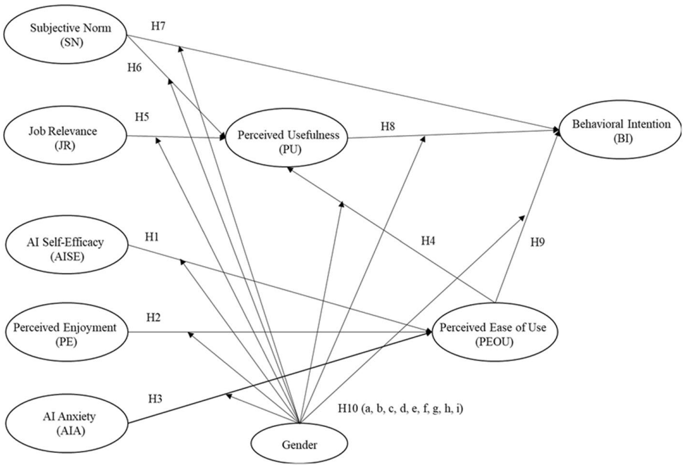
Over the past few years, there has been a significant increase in the utilization of artificial intelligence (AI)-based educational applications in education. As pre-service teachers’ attitudes towards educational technology that utilizes AI have a potential impact on the learning outcomes of their future students, it is essential to know more about pre-service teachers’ acceptance of AI. The aims of this study are (1) to discover what factors determine pre-service teachers’ intentions to utilize AI-based educational applications and (2) to determine whether gender differences exist within determinants that affect those behavioral intentions. A sample of 452 pre-service teachers (325 female) participated in a survey at one German university. Based on a prominent technology acceptance model, structural equation modeling, measurement invariance, and multigroup analysis were carried out. The results demonstrated that eight out of nine hypotheses were supported; perceived ease of use ( β = 0.297***) and perceived usefulness ( β = 0.501***) were identified as primary factors predicting pre-service teachers’ intention to use AI. Furthermore, the latent mean differences results indicated that two constructs, AI anxiety (z = − 3.217**) and perceived enjoyment (z = 2.556*), were significantly different by gender. In addition, it is noteworthy that the paths from AI anxiety to perceived ease of use ( p = 0.018*) and from perceived ease of use to perceived usefulness ( p = 0.002**) are moderated by gender. This study confirms the determinants influencing the behavioral intention based on the Technology Acceptance Model 3 of German pre-service teachers to use AI-based applications in education. Furthermore, the results demonstrate how essential it is to address gender-specific aspects in teacher education because there is a high percentage of female pre-service teachers, in general. This study contributes to state of the art in AI-powered education and teacher education.
Overview
The claims and statistics of this paper haven’t been checked yet.
Free: it reads the open-access text and checks the first 5 claims that cite a source we can check. Create a free account to check every claim.
Integrity signals
Registry
Cites
Statistics
Figures
Verification
Claims the paper makes
The claims and statistics of this paper haven’t been checked yet.
Free: it reads the open-access text and checks the first 5 claims that cite a source we can check. Create a free account to check every claim.
Claims other papers make about this one
Each is checked against this paper’s own text: does it say what the citing paper says it does?
The source backs part of the claim, not all of it — or backs it for a different population, condition or comparison.
In the citing paper
“Directly relevant to mentorship needs, AI applications, as demonstrated by researchers like Zhang et al. (2023) and Doroudi (2023), have proven effective in providing personalised feedback, facilitating reflective practice, and offering adaptive learning resources.”
From Mentorship in the Age of Generative AI: ChatGPT to Support Self-Regulated Learning of Pre-Service Teachers Before and During Placements (2025) · cites this paper as Zhang et al., 2023
Experimental — accuracy not yet measured
Self-check
Percentages, sums and reported differences re-computed from the paper’s own numbers.
The self-check needs the paper’s full text.
Citations
Cites
R: A Language and Environment for Statistical Computing
R Core Team (2025) · doi:10.32614/r.manuals · Cited by 352,181
Perceived usefulness, perceived ease of use, and user acceptance of information technology
Davis, F. D. (1989) · MIS Quarterly · doi:10.2307/249008 · Cited by 68,483 · cited 1×
“The TAM, built on the TRA, can be used to foresee the adoption of any specific technology (Davis, 1989).”
MethodUser Acceptance of Information Technology: Toward A Unified View1
Venkatesh, V., Morris, M. G., Davis, G. B., & Davis, F. D. (2003) · MIS Quarterly · doi:10.2307/30036540 · Cited by 45,035
lavaan : An R Package for Structural Equation Modeling
Rosseel, Y. (2012) · Journal of Statistical Software · doi:10.18637/jss.v048.i02 · Cited by 27,955
(1980) · Medical Entomology and Zoology · Cited by 25,810
A Theoretical Extension of the Technology Acceptance Model: Four Longitudinal Field Studies
Venkatesh, V., & Davis, F. D. (2000) · Management Science · doi:10.1287/mnsc.46.2.186.11926 · Cited by 23,066
Evaluating Goodness-of-Fit Indexes for Testing Measurement Invariance
Cheung, G. W., & Rensvold, R. B. (2002) · Structural Equation Modeling: A Multidisciplinary Journal · doi:10.1207/s15328007sem0902_5 · Cited by 16,280 · cited 1×
“A value of ΔCFI higher than 0.01 indicates a significant drop in fit between the two models (Cheung & Rensvold, 2002).”
BackgroundInfluentialConfirmatory factor analysis for applied research
(2007) · Choice Reviews Online · doi:10.5860/choice.44-2769 · Cited by 15,614 · cited 1×
“As Brown (2006) recommended, before performing the invariance measurement, the initial measurement model requires splitting into two datasets; in this study, one for male students and the other for female students.”
BackgroundTechnology Acceptance Model 3 and a Research Agenda on Interventions
Venkatesh, V., & Bala, H. (2008) · Decision Sciences · doi:10.1111/j.1540-5915.2008.00192.x · Cited by 8,159
Vandenberg, R. J., & Lance, C. E. (2000) · Organizational Research Methods · doi:10.1177/109442810031002 · Cited by 7,997
Research works printed but not linked: 3
- Ajzen, I. (1985). From intentions to actions: A theory of planned behavior. In Action control (pp. 11–39). Springer. https://doi.org/10.1007/978-3-642-69746-3_24 · doi:10.1007/978-3-642-69746-3_24
- 19. Fornell, C., Tellis, G. J., & Zinkhan, G. M. (1982). Validity assessment: A structural equations approach using partial least squares. In Proceedings of the American marketing association educators' conference (Vol. 48, pp. 405-409).
- 22. Hair, J. F., Black, W. C., Babin, B. J., & Anderson, R. E. (2019). Multivariate data analysis (8th). Cengage Learning.
Cited by
Items 101–200 of 615
Bond, M. (2024) · International Journal of Educational Technology in Higher Education · doi:10.1186/s41239-024-00492-z · Cited by 33
“…intelligence, with a range of studies published from students’ intention to use AI (e.g., Delcker et al., 2024) and their AI acceptance (e.g., Zhang et al., 2023), to gamified robots (e.g., Yang et al., 2023), intelligent tutoring systems (e.g., Zheng et al., 2024), and predictive learning…”
Exploring artificial intelligence literacy among basic school teachers in Ghana
Arkorful, V., Arthur, F., Boateng, E., Ofosu-Koranteng, M., Salifu, I., Attom, E. R., Tetteh, S. A., Quayson, E., Asare-Bediako, S., & Nortey, S. A. (2025) · Discover Education · doi:10.1007/s44217-025-00630-3 · Cited by 31
“This observation supports Zhang et al.'s [60] findings, which indicated that female pre-service teachers exhibited higher AI anxiety and lower perceived enjoyment of AI, potentially impacting their confidence in adopting AI-based teaching strategies.”
Zhang, C., & Villanueva, L. E. (2023) · International Journal of Education and Humanities · doi:10.54097/ijeh.v11i2.13753 · Cited by 29
Self-citationBarbieri, W., & Nguyen, N. N. (2025) · Australasian Journal of Educational Technology · doi:10.14742/ajet.10035 · Cited by 36
Morales-García, W. C., Sairitupa-Sanchez, L. Z., Morales-García, S. B., & Morales-García, M. (2024) · Behavioral Sciences · doi:10.3390/bs14060437 · Cited by 28
“For instance, a multiple-group analysis of prospective German teachers revealed gender-specific factors that influence the acceptance of AI-based applications, underscoring the importance of addressing these aspects in educational settings [37].”
BackgroundUsing ChatGPT in Teaching Arabic as a Foreign Language
Nasaruddin, N. (2024) · ARABIYATUNA Jurnal Bahasa Arab · doi:10.29240/jba.v8i1.9413 · Cited by 34
Jdaitawi, M. T. (2025) · International Journal of Information and Education Technology · doi:10.18178/ijiet.2025.15.4.2282 · Cited by 30
“[57] study with education undergraduate students revealed no difference between male and female students in perceived usefulness of AI technologies.”
Şat, M. (2025) · BMC Psychology · doi:10.1186/s40359-025-03647-3 · Cited by 30
“The Technology Acceptance Model (TAM) provides the theoretical foundation for this variable, and studies demonstrate its effectiveness in predicting factors that may positively or negatively influence behavioral intentions to use AI applications in education [29].”
InfluentialAltınay, Z., Altınay, F., Dağlı, G., Shadiev, R., & Othman, A. (2024) · MIER Journal of Educational Studies Trends & Practices · doi:10.52634/mier/2024/v14/i2/2714 · Cited by 31
“Research on AI-related content in teacher education programs recommends designing curricula that enhance pre-service teachers’ knowledge and skills in AI (Chen et al., 2020; Luan et al., 2020; Zhang et al., 2023).”
Konca, A. S., Simsar, A., Alhajji, R., & Almansoori, A. G. A. M. (2025) · Interactive Learning Environments · doi:10.1080/10494820.2025.2488143 · Cited by 29
“The integration of AI in teacher education marks a shift toward interactive, personalized, and effective learning (Zhang et al., 2023).”
Malakul, S. (2025) · Journal of Computer Assisted Learning · doi:10.1111/jcal.70083 · Cited by 25
Exploring AI in Education: Preservice Teacher Perspectives, Usage, and Considerations
Ko, U. H., Hartley, K., & Hayak, . (2025) · Journal of Information Technology Education Research · doi:10.28945/5592 · Cited by 31
Dayagbil, F. T., Boholano, H. B., & Sumalinog, G. G. (2025) · Frontiers in Education · doi:10.3389/feduc.2025.1665205 · Cited by 31
MERZİFONLUOĞLU, A., & Güneş, H. (2025) · European Journal of Education · doi:10.1111/ejed.70053 · Cited by 26
Evaluating Reflective Writing in Pre-Service Teachers: The Potential of a Mixed-Methods Approach
Zhang, C., Schießl, J., Plößl, L., Hofmann, F., & Gläser‐Zikuda, M. (2023) · Education Sciences · doi:10.3390/educsci13121213 · Cited by 25
Self-citationCharkova, D. A. (2024) · Discover Education · doi:10.1007/s44217-024-00225-4 · Cited by 30
“Several studies have highlighted the connection between teachers’ perceived usefulness of technology and their readiness to utilize it in their instructional practices [1, 3, 11, 30, 44].”
InfluentialAlreiahi, N. J., & Alrwaished, N. (2025) · Contemporary Educational Technology · doi:10.30935/cedtech/17549 · Cited by 25
A Systematic Review of EFL Teachers’ Perspectives on Artificial Intelligence Technologies
Özkan, E. K., Erdemir, N., & Coşkun, D. (2024) · Ihlara Eğitim Araştırmaları Dergisi · doi:10.47479/ihead.1535035 · Cited by 25
Mindset matters: Fostering teachers’ responsible AI use through professional development
Huynh, L., Le, T. H., Dang, B., An, B. T., Vu, C. T., & Nguyen, A. (2025) · Journal of New Approaches in Educational Research · doi:10.1007/s44322-025-00043-y · Cited by 22
“…development to some extent (e.g., in early stages of writing and revising) (Chen et al., 2025), others remain skeptical and reject it due to concerns about misinformation, uncertainty about its effectiveness, or fears of potential job displacement resulting from AI adoption (Zhang et al., 2023).”
Pre-Service English Teachers’ Lived Experience in Using AI in Teaching Preparation
Karina, B. D., & Kastuhandani, F. C. (2024) · Edunesia Jurnal Ilmiah Pendidikan · doi:10.51276/edu.v5i1.767 · Cited by 25
“A previous study also showed that AI helps pre-service teachers access educational resources and has a positive impact on their performances (Butakor, 2023; Tunjera & Chigona, 2023; Zhang et al., 2023).”
BackgroundKuzu, Ç. İ. (2025) · BMC Psychology · doi:10.1186/s40359-025-03836-0 · Cited by 26
“However, studies in this area remain limited, and comprehensive research examining the cognitive and affective factors that influence AI integra-tion—particularly within the context of mathematics education—remains insufficient [23, 24].”
Barbosa, A. D. S., Crispim, M. C., da Silva, L. B., da Silva, J. M. N., Barbosa, A. M., Correia, L. M. A. D. M., & Morioka, S. N. (2025) · Technological Forecasting and Social Change · doi:10.1016/j.techfore.2025.124091 · Cited by 24
Integrating ChatGPT into the Design of 5E-Based Earth Science Lessons
Choi, Y. (2025) · Education Sciences · doi:10.3390/educsci15070815 · Cited by 22
Rui, X., Celik, I., & Edwards, J. (2025) · Computers and Education Open · doi:10.1016/j.caeo.2025.100317 · Cited by 23
K-12 Teachers’ Adoption of Generative AI for Teaching: An Extended TAM Perspective
Tang, Y., & Zhong, L. (2026) · Education Sciences · doi:10.3390/educsci16010136 · Cited by 22
Serdenia, J. R. C., Dumagay, A. H., Balasa, K. A., Capacio, E. A., & Lauzon, L. D. S. (2025) · LatIA · doi:10.62486/latia2025313 · Cited by 25
Syed, A. Z., Memon, Z. H., Khan, K., Hameed, I., & Nadeem, M. (2025) · On the Horizon The International Journal of Learning Futures · doi:10.1108/oth-02-2025-0019 · Cited by 23
Arachchi, H. A. D. M., & Samarasinghe, G. (2025) · European Journal of Management Studies · doi:10.1108/ejms-05-2024-0047 · Cited by 24
Zhang, C., Hofmann, F., Plößl, L., & Gläser‐Zikuda, M. (2024) · Education and Information Technologies · doi:10.1007/s10639-024-12720-0 · Cited by 24
“For instance, the study by Zhang et al. (2023a) demonstrated that words about cognitive and emotional aspects predict reflection levels, showcasing the practical application and relevance of these categories in research.”
Self-citationThreading the GenAI needle: Unpacking the ups and downs of GenAI for higher education stakeholders
Neupane, A., Shahi, T. B., Cowling, M., & Tanna, D. (2024) · Journal of Applied Learning & Teaching · doi:10.37074/jalt.2024.7.2.4 · Cited by 22
The Use of Artificial Intelligence in Differentiated Instruction Classrooms
Ruslim, M. I., & Khalid, F. B. (2024) · International Journal of Academic Research in Business and Social Sciences · doi:10.6007/ijarbss/v14-i8/22435 · Cited by 29
Dias, S. B., Jelinek, H. F., & Hadjileontiadis, L. J. (2024) · PLoS ONE · doi:10.1371/journal.pone.0304932 · Cited by 19
Tantivejakul, N., Chantharasombat, J., & Kongpolphrom, W. (2024) · LEARN Journal : Language Education and Acquisition Research Network · doi:10.70730/pvtd8302 · Cited by 25
Ruth, P.-J., Nelly, M.-M., & Isabel, G.-V. (2024) · South American Research Journal · doi:10.5281/zenodo.14507788 · Cited by 20
Cevallos, M. B. M., Alonso-García, S., Menéndez, A. M., & Maldonado, J. J. V. (2025) · Social Sciences · doi:10.3390/socsci14060355 · Cited by 18
Predictors of Pre-Service EFL Teachers’ Predisposition Towards AI Adoption in Language Teaching
Harakchiyska, T. (2025) · Education Sciences · doi:10.3390/educsci15091112 · Cited by 21
Artificial intelligence in pre-service teacher education: Bibliometrics analysis
Kuzu, S. (2025) · Pedagogical Research · doi:10.29333/pr/17402 · Cited by 21
“While individual studies have examined technology acceptance (Sun et al., 2024; Zhang et al., 2023), attitude change (Lucas et al., 2025; Yang et al., 2024), and competence frameworks (UNESCO, 2024) comprehensive analyses remain limited.”
InfluentialYu, H. M., Lee, H., & Kim, S. H. (2025) · Journal of Research in Childhood Education · doi:10.1080/02568543.2025.2579668 · Cited by 20
“As Zhang et al. (2023) noted, teacher education programs must address this gap by providing structured opportunities for pre-service teachers to interact with and implement AI tools in practical teaching contexts and better equip pre-service teachers with the skills necessary to leverage AI in…”
InfluentialBaimukhambetova, K., Ыбыраимжанов, К., Moldabek, K., Borashkyzy, A. U., Zhetkizgenova, A., & Uaidullakyzy, E. (2025) · Education Sciences · doi:10.3390/educsci16010043 · Cited by 18
Optimizing Artificial Intelligence Usage among Academicians in Higher Education Institutions
Osman, Z., Alwi, N. H., Jodi, K. H. M., Khan, B. N. A., Ismail, M. N., & Yusoff, Y. (2024) · International Journal of Academic Research in Accounting Finance and Management Sciences · doi:10.6007/ijarafms/v14-i2/20935 · Cited by 27
“Furthermore, an academician's own technological proficiency and familiarity with AI play a critical role (Zhang et al., 2023).”
BackgroundSu, Y., Luo, M., & Zhong, C. (2025) · SAGE Open · doi:10.1177/21582440251321853 · Cited by 18
“Thus, it is necessary to promote AI-supported pre-service teacher education in many forms as they will be at the forefront of education in the future (C. Zhang et al., 2023).”
Ninsiima, R., Mshenga, P. M., & Okello, D. (2025) · Frontiers in Sustainable Food Systems · doi:10.3389/fsufs.2025.1552637 · Cited by 18
Acosta-Enriquez, B. G., Pérez, M. D. R., Jordan, O. H., Saucedo, L. C., Caballero, J. E. A. P., Fernández-Altamirano, A. E. F., Yovera, A. J. G., Hernández, R. N. B., & Alarcón-Bustíos, J. M. (2025) · Sustainability · doi:10.3390/su17072834 · Cited by 19
Zhang, C., Hu, M., Wu, W., Chen, Y., Kamran, F., & Wang, X. (2025) · Teaching and Teacher Education · doi:10.1016/j.tate.2025.105086 · Cited by 19
Self-citationErdoğan, O., Kaymak, M. N., Çoban, Ö., & Bora, H. T. (2025) · Educational Management Administration & Leadership · doi:10.1177/17411432251351830 · Cited by 19
A multidimensional study of AI adoption among University students in teacher education programs
Bećirović, S., Polz, E., & Tinkel, I. (2025) · Smart Learning Environments · doi:10.1186/s40561-025-00422-0 · Cited by 17
Nguyen (Ruby), N. N., & Barbieri, W. (2025) · Education Sciences · doi:10.3390/educsci15060642 · Cited by 15
Palacios-Núñez, M. L., Mendoza-García, E. M., Zarate, J. W. N., & Deroncele-Acosta, Á. (2025) · Edutec Revista Electrónica de Tecnología Educativa · doi:10.21556/edutec.2025.93.3995 · Cited by 20
Reyes-Rojas, J., Díaz, B., Ruz-Reveco, C., Castro, Á., & Reyes‐González, D. (2025) · Computers and Education Open · doi:10.1016/j.caeo.2025.100320 · Cited by 17
Ziying, L., Yongchun, H., & Qiaoping, Z. (2026) · Computers and Education Open · doi:10.1016/j.caeo.2026.100330 · Cited by 17
Güngören, Ö. C., Erdoğan, D. G., & Horzum, M. B. (2026) · BMC Psychology · doi:10.1186/s40359-026-03977-w · Cited by 18
“Zhang et al. [84] also identified PU as the main factor predicting pre-service teachers’ intention to use artificial intelligence.”
InfluentialYang, H. (2024) · Interactive Learning Environments · doi:10.1080/10494820.2024.2423175 · Cited by 19
“Wang et al. (2021) and Zhang et al. (2023) suggest that ease of use and intuitive interfaces are crucial factors for the successful adoption of AI in education.”
Yu, H. M., Kim, S. H., & Lee, H. (2025) · International Journal of Early Childhood · doi:10.1007/s13158-025-00434-4 · Cited by 15
“Zhang et al.’s (2023) study of 452 pre-service teachers found that perceived ease of use and perceived usefulness are primary predictors of intention to integrate AI into teaching practices.”
InfluentialGökçearslan, Ş., Eşiyok, E., & Küçükergin, K. G. (2025) · Journal of Computational Social Science · doi:10.1007/s42001-025-00387-7 · Cited by 17
“Although different studies have explored the acceptance of AI chatbots in higher education settings [45, 47, 97, 105, 106, 121], most have been conducted within the framework of the general technology acceptance model, focusing broadly on AI-supported educational tools [29].”
AI Acceptance Among Prospective Social Studies and Culture and Arts Education Students
Dumagay, A. H., Balasa, K. A., Kunting, A. F., & Cabangcala, R. B. (2025) · Lecture notes in networks and systems · doi:10.1007/978-3-031-92611-2_11 · Cited by 15
Tbaishat, D., Amoudi, G., & Elfadel, M. (2025) · Computers and Education: Artificial Intelligence · doi:10.1016/j.caeai.2025.100421 · Cited by 14
Harakchiyska, T., & Vassilev, T. I. (2024) · Strategies for Policy in Science and Education-Strategii na Obrazovatelnata i Nauchnata Politika · doi:10.53656/str2024-5s-22-pre · Cited by 17
Yu, X., Hu, Y., Hu, Y., & Li, K. (2025) · Education and Information Technologies · doi:10.1007/s10639-025-13530-8 · Cited by 15
“…that remove attitude variables to investigate the adoption of new technologies, such as pre-service teachers’ acceptance of artificial intelligence (Zhang et al., 2023), learning management systems (Khoa et al., 2020), informal learning communica - tion tools (Alwreikat et al., 2023), blended…”
Carrasco, S. A. N., Ramírez, J. C. C., López, M. L., & Parra, K. L. (2025) · Formación universitaria · doi:10.4067/s0718-50062025000200107 · Cited by 15
Zaheer, S., Ma, C., Zhu, Y., & Vasinda, S. (2025) · International Journal of Artificial Intelligence · doi:10.4018/ijaitl.373582 · Cited by 20
Acosta-Enriquez, B. G., Ballesteros, M. A. A., Valle, M. D. L. Á. G., Angaspilco, J. E. M., Blanco-García, L. E., Ventura, G. C., Requejo, J. D. C., & Torre, M. C. (2025) · Human Behavior and Emerging Technologies · doi:10.1155/hbe2/4834893 · Cited by 15
The Future Classroom: Integrating AI and Social Media for Adaptive Learning
Masih, M., Suleman, S., Khan, M. H., Sahito, Z. H., & Shahid, D. S. (2025) · Inverge Journal of Social Sciences · doi:10.63544/ijss.v4i3.150 · Cited by 14
Khrapatyi, S., Токарєва, К. С., Hlushchenko, O., Paramonova, O., & Lvova, I. O. (2024) · STEM Education · doi:10.3934/steme.2024004 · Cited by 14
"Artificial intelligence is a very broad term": How educators perceive Artificial Intelligence?
Kasinidou, M., Kleanthous, S., & Otterbacher, J. (2024) · Proceedings of the 2024 International Conference on Information Technology for Social Good · doi:10.1145/3677525.3678677 · Cited by 13
“When it comes to using AI tools in their teaching, their technological knowledge, understanding of AI’s pedagogical contributions [5], and their perception of usefulness and ease of use were influencing factors [54].”
Detecting Innovators in the Field: Teachers’ Perceptions and Adoption of Generative AI in Education
Dalyanci, A. A., Mast, L., Krushinskaia, K., & Raes, A. (2025) · The Open/Technology in Education Society and Scholarship Association Journal · doi:10.18357/otessaj.2025.5.1.89 · Cited by 14
“To date, heated debates continue about how to leverage its potential to enhance teaching and learning while also addressing its challenges (Jauhiainen & Guerra, 2023; Kaplan-Rakowski et al., 2023; Lim et al., 2023; Lozano & Fontao, 2023; Zhang et al., 2023).”
AI Tools for Language Learners: The Promotion of Learning Independence or Reliance
Tin, D. T. (2025) · Studies in computational intelligence · doi:10.1007/978-3-032-01348-4_11 · Cited by 16
Canbeldek, M., Erol, A., Erol, M., & Budak, K. S. (2026) · International Journal of Human-Computer Interaction · doi:10.1080/10447318.2026.2619035 · Cited by 16
Çakır, D., & Güner, P. (2026) · International Journal of Didactical Studies · doi:10.33902/ijods.202643911 · Cited by 18
Lamrabet, M. (2024) · International Journal of Information and Education Technology · doi:10.18178/ijiet.2024.14.11.2180 · Cited by 13
“To fully capitalize on these advantages, it is imperative that future teachers develop a thorough understanding of AI-based tools and acquire the requisite skills to meet contemporary educational demands [26, 42].”
Teachers’ perceptions towards using artificial intelligence in mathematics education
Alsharidah, M. A. M., & alkramiti, A. M. M. (2024) · Revista Amazonia Investiga · doi:10.34069/ai/2024.84.12.3 · Cited by 18
ÖRGE YAŞAR, F., Meydan, E., & ÖZDEN, M. (2025) · Pegem Journal of Education and Instruction · doi:10.47750/pegegog.15.03.13 · Cited by 20
Yurt, E. (2025) · Current Psychology · doi:10.1007/s12144-025-08175-2 · Cited by 16
“As previous work suggests, transitioning from pre-service to in-service teaching involves significant changes in pro - fessional identity, self-efficacy, and contextual demands that may alter personality-motivation relationships in AI adop - tion (Zhang et al., 2023 ).”
Pre-Service English as a Foreign Language Teachers’ Attitudes toward Artificial Intelligence
Derinalp, P., & Halife, M. (2025) · Kuramsal Eğitimbilim · doi:10.30831/akukeg.1644354 · Cited by 15
Zhu, Y., Jiang, H., & Chugh, R. (2025) · Teaching and Teacher Education · doi:10.1016/j.tate.2025.105204 · Cited by 15
Özkul, H. (2025) · Dumlupınar Üniversitesi Eğitim Bilimleri Enstitüsü Dergisi · doi:10.71272/debder.1806905 · Cited by 13
Ateş, H., & GÜNDÜZALP, C. (2025) · Education and Information Technologies · doi:10.1007/s10639-025-13480-1 · Cited by 12
“Research highlights that emotional reactions to new technologies negatively impact acceptance and usage, with teachers experiencing higher anxiety levels being less likely to adopt digital tools due to fears of inadequate mastery and failure (Hopcan et al., 2024; Zhang et al., 2023).”
Ибрагимов, Г. И., Kolomoets, E. N., Filippova, A. A., Khairullina, E. R., N.Yu., G., & Torkunova, J. V. (2025) · Online Journal of Communication and Media Technologies · doi:10.30935/ojcmt/16594 · Cited by 14
Ching, K. W., & Jamaludin, K. A. (2025) · International Journal of Academic Research in Progressive Education and Development · doi:10.6007/ijarped/v14-i3/25196 · Cited by 18
Devanadera, A. C. (2025) · LatIA · doi:10.62486/latia2025249 · Cited by 16
Yurt, E., & Kaşarcı, İ. (2025) · AERA Open · doi:10.1177/23328584251403990 · Cited by 14
“…2018; Ayanwale et al., 2022; Ma & Lei, 2024; Quadir et al., 2022; Sánchez-Prieto et al., 2021; Sanusi, Ayanwale & Chiu, 2024; Scherer, Howard et al., 2019; Siyam, 2019; Vongkulluksn et al., 2018; Zhang et al., 2023) that highlight the critical role of perceived usefulness in technology acceptance.”
Kul, Ü., Beşaltı, M., Çelik, S., & Korkmaz, S. (2026) · Discover Education · doi:10.1007/s44217-026-01111-x · Cited by 13
“…indicates that technology acceptance is influenced by multiple factors, including perceived usefulness, ease of use, and alignment with pedagogical beliefs [66, 69], yet the relationship between teachers’ TPACK competencies and their acceptance of GAI technologies remains underexplored [59].”
Nguyen, P., Watson, G. P., Barnes, D., Agrawal, S., Schuster, A. M., & Cotten, S. R. (2026) · Journal of Management & Organization · doi:10.1017/jmo.2026.10090 · Cited by 15
Ageing in the digital age: What drives virtual reality technology adoption among older adults?
Man, S. S., Wang, J., Chan, A. H. S., & Liu, L. (2026) · Ergonomics · doi:10.1080/00140139.2025.2473685 · Cited by 11
“…to employ VR technology when they fear causing damage and making errors during its use (tsai et al. 2020). thus, among older adults, ta is anticipated to impact PeOU negatively (Zhang et al. 2023) and PU (tsai et al. 2020). the following hypotheses are introduced: H8: ta negatively influences PeOU.”
Jackman, G.-A., Marshall, I. A., & Carrington, T. (2024) · Caribbean Journal of Education and Development · doi:10.46425/cjed1201029055 · Cited by 15
Percepciones de los educadores sobre el uso de Inteligencia Artificial en el ámbito educativo1
Stavroulakis, I., Díaz, V. M., & Marín-Rodríguez, M. (2025) · Educação e Pesquisa · doi:10.1590/s1678-4634202551293219 · Cited by 11
Addai, P. (2025) · International Journal of Public Leadership · doi:10.1108/ijpl-04-2025-0073 · Cited by 14
Milutinović, V. (2025) · Education and Information Technologies · doi:10.1007/s10639-025-13786-0 · Cited by 12
“…teachers’ acceptance of technology, which demonstrated a significant positive impact of TPACK on perceived usefulness (Joo et al., 2018; Milutinović & Mandić, 2022; Sun et al., 2024; Wang et al., 2024), and a positive impact of SN on PU as shown by Zhang et al. (2023) and Sing et al. ( 2022).”
InfluentialTitova, S. V., & Temuryan, C. T. (2025) · Вестник Тамбовского университета. Серия: Гуманитарные науки · doi:10.20310/1810-0201-2025-30-5-1038-1062 · Cited by 12
“Данный факт также подтверждается ря-дом исследований [2–4; 27–29].”
Exploring Perspectives of Teacher Students Toward Generative AI Technologies
Thararattanasuwan, K., & Prachagool, V. (2024) · International Education Studies · doi:10.5539/ies.v17n5p22 · Cited by 14
“Knowledge about artificial intelligence technology indicated that they had a view on artificial intelligence technology that is, to a certain extent, acceptable (Zhang et al., 2023).”
BackgroundBahari, G., Alenazi, L., & Alkathiri, A. M. (2025) · Nurse Education Today · doi:10.1016/j.nedt.2025.106816 · Cited by 10
Analysis of Student Interactions with a Large Language Model in an Introductory Physics Lab Setting
Kregear, T., Babayeva, M., & Widenhorn, R. (2025) · International Journal of Artificial Intelligence in Education · doi:10.1007/s40593-025-00489-3 · Cited by 16
“Several studies have investigated the perception of Artificial Intelligence (AI) among both physics students and teachers (Bitzenbauer, 2023; Dahlkemper et al., 2023; Zhang et al., 2023).”
Nguyen, H., Thanh, V. D. T., & Dinh, V. P. (2025) · International Journal of Educational Methodology · doi:10.12973/ijem.11.3.335 · Cited by 11
Zhang, W., Ning, Y., Yu, N., Yao, D., Wu, H., Wu, J., & Fang, B. (2025) · Education and Information Technologies · doi:10.1007/s10639-025-13670-x · Cited by 11
“…in educational research and practice, existing studies have predominantly focused on teachers’ adaptability to AI, such as their preparedness for AI (Wang et al., 2023), their acceptance of AI (Zhang et al., 2023a), and their attitudes toward AI (Galindo-Domínguez et al., 2024; Yue et al., 2024).”
Han, F., & Guo, J. (2025) · International Journal of Educational Technology in Higher Education · doi:10.1186/s41239-025-00543-z · Cited by 10
“Our results and results from previous technology adoption research all support this argument (Huang et al., 2021; Ni & Cheung, 2022; Zhang et al., 2023).”
InfluentialAL-Qadri, A. H., & Al-khresheh, M. H. (2025) · The Electronic Library · doi:10.1108/el-12-2024-0391 · Cited by 10
Hsu, C.-Y., Chai, C. S., & Liang, J. (2025) · Australasian Journal of Educational Technology · doi:10.14742/ajet.9831 · Cited by 11
Malacapay, M. C. (2025) · Edelweiss Applied Science and Technology · doi:10.55214/2576-8484.v9i9.10059 · Cited by 11
“Additionally, past studies on similar topics agree that when pre-service teachers see AI as useful for tasks like lesson planning, developing content, and managing classrooms, they are more likely to incorporate it into their teaching [50-52].”
Determinants of university students’ attitudes towards smart devices in the smart campus environment
Wei, B., Zhuo, Y., Zeng, H., Hong, H., & Liu, H. (2025) · Humanities and Social Sciences Communications · doi:10.1057/s41599-025-05853-1 · Cited by 11
“…exerts a stronger effect on ATT than PEU, which is consistent with TAM, as proposed by Davis (1989), as well as fi ndings from prior studies on emerging technologies in higher education (Lefrid et al., 2023; Sungur Gül and Ate ş , 2023; Watanabe et al., 2023; Zhang et al., 2023; Wang et al., 2024b).”
Exploring pre-service teachers’ perspectives on integrating artificial intelligence in education
Panagou, D., Stylos, G., & Kotsis, K. Τ. (2025) · Journal of Digital Educational Technology · doi:10.30935/jdet/17297 · Cited by 12
“Zhang et al.’s (2023) research at a German university indicated that most pre-service instructors can generally characterize AI as “ mimicking human intelligence .””
Metadata
- Authors
- Zhang, C., Schießl, J., Plößl, L., Hofmann, F., & Gläser-Zikuda, M.
- Affiliations
- Friedrich-Alexander-Universität Erlangen-Nürnberg (DE)
- Corresponding author
- Zhang, Chengming
- Venue
- International Journal of Educational Technology in Higher Education
- Published
- 2023-09-04
- Volume
- 20
- Issue
- 1
- ISSN
- 2365-9440 (ISSN-L)
- OpenAlex
- W4386405611
- Semantic Scholar
- b05cb5bf173385b1696e219697beb9057bc5c64f
- Cited by
- 413
- References
- 84
- Citations by year
- 2026: 146 · 2025: 173 · 2024: 88 · 2023: 6
- FWCI
- 96.92
- Type
- journal article
- Language
- en
- Open access
- diamond
- doi.org
- Licence
- cc-by
- creativecommons.org/licenses/by/4.0 (tdm)
- creativecommons.org/licenses/by/4.0 (vor)
- Locations
- International Journal of Educational Technology in Higher Education (publishedVersion, cc-by)
- DOAJ (DOAJ: Directory of Open Access Journals) (submittedVersion, cc-by-sa)
- Funders
- BMBF (16DHB4019)
- Topics
- Social Sciences › Education › Artificial Intelligence in Education
- Social Sciences › Decision Sciences › Information Systems and Management › Technology Adoption and User Behaviour
- Social Sciences › Gender Studies › Gender and Technology in Education
- Keywords
- artificial intelligence in education, pre-service teachers, technology acceptance, behavioral intention, perceived usefulness, perceived ease of use, AI anxiety, perceived enjoyment, gender differences, teacher professional development, technology acceptance model
About these checks
Registry, retraction, Cites and statistics results are computed, not judged, with one exception: a printed reference that no index lists is read once by a model before it counts as a citation error. Claims are extracted by a model and kept only when their quote appears verbatim in the text; each cited source is then checked, with a model’s help, for whether it says what the claim relies on. Those verdicts can be wrong — read the claim’s quote and the cited source before relying on one.
Statistics and arithmetic are recomputed, not judged.
Confidence bands are shown only for fields calibrated on our annotated test set. None is calibrated yet, so no band is shown.
What counts as a claim ›How we measure confidence ›How we check this ›
Are you an author, or do you see a problem with this page? Request a review
Data sources
Bibliographic data: Semantic Scholar, OpenAlex, Crossref.
Contains information from the Semantic Scholar Academic Graph Datasets, made available under the ODC Attribution License (ODC-BY 1.0).
Semantic Scholar’s data is described in: Kinney, R., et al. (2023). The Semantic Scholar Open Data Platform. arXiv:2301.10140.
