

Acceptance of artificial intelligence among pre-service teachers: a multigroup analysis
Open accessThe DOI matches its Crossref record; 83 of the 84 references it cites were found in a registry or an index.
Abstract
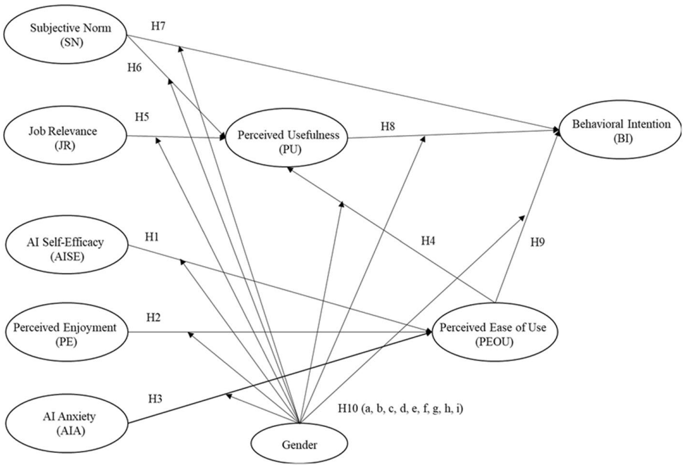
Over the past few years, there has been a significant increase in the utilization of artificial intelligence (AI)-based educational applications in education. As pre-service teachers’ attitudes towards educational technology that utilizes AI have a potential impact on the learning outcomes of their future students, it is essential to know more about pre-service teachers’ acceptance of AI. The aims of this study are (1) to discover what factors determine pre-service teachers’ intentions to utilize AI-based educational applications and (2) to determine whether gender differences exist within determinants that affect those behavioral intentions. A sample of 452 pre-service teachers (325 female) participated in a survey at one German university. Based on a prominent technology acceptance model, structural equation modeling, measurement invariance, and multigroup analysis were carried out. The results demonstrated that eight out of nine hypotheses were supported; perceived ease of use ( β = 0.297***) and perceived usefulness ( β = 0.501***) were identified as primary factors predicting pre-service teachers’ intention to use AI. Furthermore, the latent mean differences results indicated that two constructs, AI anxiety (z = − 3.217**) and perceived enjoyment (z = 2.556*), were significantly different by gender. In addition, it is noteworthy that the paths from AI anxiety to perceived ease of use ( p = 0.018*) and from perceived ease of use to perceived usefulness ( p = 0.002**) are moderated by gender. This study confirms the determinants influencing the behavioral intention based on the Technology Acceptance Model 3 of German pre-service teachers to use AI-based applications in education. Furthermore, the results demonstrate how essential it is to address gender-specific aspects in teacher education because there is a high percentage of female pre-service teachers, in general. This study contributes to state of the art in AI-powered education and teacher education.
Overview
The claims and statistics of this paper haven’t been checked yet.
Free: it reads the open-access text and checks the first 5 claims that cite a source we can check. Create a free account to check every claim.
Integrity signals
Registry
Cites
Statistics
Figures
Verification
Claims the paper makes
The claims and statistics of this paper haven’t been checked yet.
Free: it reads the open-access text and checks the first 5 claims that cite a source we can check. Create a free account to check every claim.
Claims other papers make about this one
Each is checked against this paper’s own text: does it say what the citing paper says it does?
The source backs part of the claim, not all of it — or backs it for a different population, condition or comparison.
In the citing paper
“Directly relevant to mentorship needs, AI applications, as demonstrated by researchers like Zhang et al. (2023) and Doroudi (2023), have proven effective in providing personalised feedback, facilitating reflective practice, and offering adaptive learning resources.”
From Mentorship in the Age of Generative AI: ChatGPT to Support Self-Regulated Learning of Pre-Service Teachers Before and During Placements (2025) · cites this paper as Zhang et al., 2023
Experimental — accuracy not yet measured
Self-check
Percentages, sums and reported differences re-computed from the paper’s own numbers.
The self-check needs the paper’s full text.
Citations
Cites
R: A Language and Environment for Statistical Computing
R Core Team (2025) · doi:10.32614/r.manuals · Cited by 352,181
Perceived usefulness, perceived ease of use, and user acceptance of information technology
Davis, F. D. (1989) · MIS Quarterly · doi:10.2307/249008 · Cited by 68,483 · cited 1×
“The TAM, built on the TRA, can be used to foresee the adoption of any specific technology (Davis, 1989).”
MethodUser Acceptance of Information Technology: Toward A Unified View1
Venkatesh, V., Morris, M. G., Davis, G. B., & Davis, F. D. (2003) · MIS Quarterly · doi:10.2307/30036540 · Cited by 45,035
lavaan : An R Package for Structural Equation Modeling
Rosseel, Y. (2012) · Journal of Statistical Software · doi:10.18637/jss.v048.i02 · Cited by 27,955
(1980) · Medical Entomology and Zoology · Cited by 25,810
A Theoretical Extension of the Technology Acceptance Model: Four Longitudinal Field Studies
Venkatesh, V., & Davis, F. D. (2000) · Management Science · doi:10.1287/mnsc.46.2.186.11926 · Cited by 23,066
Evaluating Goodness-of-Fit Indexes for Testing Measurement Invariance
Cheung, G. W., & Rensvold, R. B. (2002) · Structural Equation Modeling: A Multidisciplinary Journal · doi:10.1207/s15328007sem0902_5 · Cited by 16,280 · cited 1×
“A value of ΔCFI higher than 0.01 indicates a significant drop in fit between the two models (Cheung & Rensvold, 2002).”
BackgroundInfluentialConfirmatory factor analysis for applied research
(2007) · Choice Reviews Online · doi:10.5860/choice.44-2769 · Cited by 15,614 · cited 1×
“As Brown (2006) recommended, before performing the invariance measurement, the initial measurement model requires splitting into two datasets; in this study, one for male students and the other for female students.”
BackgroundTechnology Acceptance Model 3 and a Research Agenda on Interventions
Venkatesh, V., & Bala, H. (2008) · Decision Sciences · doi:10.1111/j.1540-5915.2008.00192.x · Cited by 8,159
Vandenberg, R. J., & Lance, C. E. (2000) · Organizational Research Methods · doi:10.1177/109442810031002 · Cited by 7,997
Research works printed but not linked: 3
- Ajzen, I. (1985). From intentions to actions: A theory of planned behavior. In Action control (pp. 11–39). Springer. https://doi.org/10.1007/978-3-642-69746-3_24 · doi:10.1007/978-3-642-69746-3_24
- 19. Fornell, C., Tellis, G. J., & Zinkhan, G. M. (1982). Validity assessment: A structural equations approach using partial least squares. In Proceedings of the American marketing association educators' conference (Vol. 48, pp. 405-409).
- 22. Hair, J. F., Black, W. C., Babin, B. J., & Anderson, R. E. (2019). Multivariate data analysis (8th). Cengage Learning.
Cited by
Items 201–300 of 615
Exploring students’ perceptions of generative AI-generated feedback in learning programming
Khor, E. T., Chan, L., Koh, E., & Seow, P. (2025) · Educational Psychology · doi:10.1080/01443410.2025.2564894 · Cited by 11
“This is surprising as the influence of subjective norms on perceived usefulness has been well proven (Algerafi et al., 2023; Zhang et al., 2023).”
Cui, Y., & Li, M. (2025) · Interactive Learning Environments · doi:10.1080/10494820.2025.2583194 · Cited by 11
“For instance, Zhang et al. (2023) applied SEM to survey data from German and found that PU had a stronger effect on pre-service teachers’ intention to adopt Gen AI than PEOU.”
Rosli, M. S., Saleh, N. S., Ali, A. M., & Bakar, S. A. (2026) · Journal for STEM Education Research · doi:10.1007/s41979-025-00171-2 · Cited by 14
Jiang, S., & Li, J. (2026) · Education Sciences · doi:10.3390/educsci16020315 · Cited by 10
GenAI in Indian higher education: faculty at the crossroads of adoption
Razi-ur-Rahim, M., Uddin, F., Chauhan, J., & Faisal, K. P. (2026) · Asian Education and Development Studies · doi:10.1108/aeds-04-2025-0194 · Cited by 9
Investigating Algerian EFL Teachers' Attitudes Towards AI Utilization in Language Education
BENAICHA, B., & Semmoud, A. (2024) · أطراس · doi:10.70091/atras/ai.8 · Cited by 15
“Teachers tend to use intuitive AI tools that require minimal effort (Zhang et al., 2023).”
BackgroundZhao, J., Yao, H., & Zhang, J. (2025) · Education and Information Technologies · doi:10.1007/s10639-025-13661-y · Cited by 11
“Thus, analyzing the factors influencing teachers’ acceptance intentions and attitudes toward the technologies has been an important research issue, yielding significant outcomes (Jeong & Kim, 2017; Scherer et al., 2019 ; Strzelecki et al., 2024; Zhang et al., 2023).”
Kılıç, E., & Çelik, H. E. (2025) · Computers and Education Artificial Intelligence · doi:10.1016/j.caeai.2025.100452 · Cited by 13
A detailed examination of faculty acceptance of artificial intelligence: Insights from key variables
Bilgin, S., & Güngören, Ö. C. (2025) · Journal of Pedagogical Sociology and Psychology · doi:10.33902/jpsp.202534245 · Cited by 12
Xiao, J., Pan, D., Gong, R., Xia, T., Zhang, X., & Yao, D. (2025) · Applied Sciences · doi:10.3390/app151910603 · Cited by 11
Netinant, P., Pukdesree, S., & Rukhiran, M. (2025) · IEEE Access · doi:10.1109/access.2025.3616630 · Cited by 10
Artificial Intelligence and Formative and Shared Assessment in Teacher Education
Fuentes-Nieto, T., Herguedas, J. L. A., & Pastor, V. M. L. (2025) · Applied Sciences · doi:10.3390/app152212067 · Cited by 12
Dang, T. H. A., & Nguyen, V. T. T. (2025) · Journal of Information Technology Education Research · doi:10.28945/5689 · Cited by 11
The Role of Supportive Environments in Shaping EFL Teachers’ Adoption of ChatGPT
Tram, N. H. M., & Tran–Thanh, V. (2024) · Studies in computational intelligence · doi:10.1007/978-3-031-63447-5_4 · Cited by 11
Examining Learning Anxiety in AI-Enhanced Educational Environments Among Urban Lecturers
Christian, M., Pardede, R., Gularso, K., Dewi, Y. K., Sunarno, S., & Amiro, T. (2024) · International Conference on Creative Communication and Innovative Technology (ICCIT) · doi:10.1109/iccit62134.2024.10701128 · Cited by 9
“Other factors that can impact learning anxiety in the field of AI include the individual’s level of expertise in AI and the impact of relevant subjective criteria [15].”
BackgroundIzquierdo-Álvarez, V., & Llorente, A. M. P. (2025) · Sustainability · doi:10.3390/su17052164 · Cited by 9
Thanh, V. D. T., Dinh, V. P., & Nguyen, H. (2025) · Eurasia Journal of Mathematics Science and Technology Education · doi:10.29333/ejmste/17158 · Cited by 9
“Zhang et al. (2023) confirms that traditional models may not fully account for the unique factors associated with AI adoption in education, indicating a need for expanded frameworks.”
Ke, Q., & Gong, Y. (2025) · Journal of Research on Technology in Education · doi:10.1080/15391523.2025.2568514 · Cited by 9
GenAI: Opportunities, Disruptions, and the New Learning Paradigm
Mir, S. A., Saini, N., Kumar, A. V. S., Ganaie, N. A., Rautrao, R. R., -, A. C., Sehgal, S., & Khandelwal, A. R. R. (2025) · IGI Global eBooks · doi:10.4018/979-8-3373-5157-5.ch012 · Cited by 8
Amin, M. A., Noh, M., Haque, A., Rupa, R., & Kim, Y. (2026) · Beijing International Review of Education · doi:10.1177/25902547261421646 · Cited by 9
“Many previous studies overlook the crucial in fl uence of moderating factors, such as trust, in shaping users ’ intentions to adopt AI technologies (Al Darayseh, 2023; Zhang et al., 2023).”
Ji, L., Mbowe, A. E., Aziku, M., & Tahri, D. (2026) · Education Sciences · doi:10.3390/educsci16040538 · Cited by 8
“…such as age, gender, and teaching experience have been reported to influence teachers’ beliefs and participation in professional development (Taheri et al., 2025; Thibaut et al., 2018), as well as sustained integration of AI in instructional practices (Horváth et al., 2025; C. Zhang et al., 2023).”
Sustainable AI Integration in Teacher Education: From Personalised Learning to Signature Pedagogies
Khurma, O. A., Ali, N., Almarashdi, H. S., Fidalgo, P., Alarabi, K., & Alkhalaileh, H. A. (2026) · Education Sciences · doi:10.3390/educsci16050786 · Cited by 9
Teachers in the Age of Artificial Intelligence: Preparation and Response to Challenges
Escalona-Márquez, L. N., Tapia, S. J. C., Camputaro, L. A., & Aparicio-Escalante, C. O. O. (2024) · Artificial intelligence · doi:10.5772/intechopen.1005172 · Cited by 11
The impact of the artificial intelligence (AI) Art Generator in pre-service art teacher training
Zhou, Y. L. (2024) · IEEE Conference on Artificial Intelligence (CAI) · doi:10.1109/cai59869.2024.00250 · Cited by 10
“Preparing teachers for AI-powered education is a major challenge in integrating AI into the classroom of the future [1].”
BackgroundA Critical Analysis of Artificial Intelligence Tools in Education: A Blessing or a Curse?
Mgala, M. (2024) · Multidisciplinary Journal of Technical University of Mombasa · doi:10.48039/mjtum.v3i2.78 · Cited by 11
Du, Y. (2026) · arXiv (Cornell University) · doi:10.48550/arxiv.2603.11455 · Cited by 8
“…with research on human–AI interaction and conversational agents, which indicates that perceived intelligence enhances users’ confidence in the system’s capabilities and strengthens their positive perception of the technology (Chou et al., 2025; Tusseyeva et al., 2024; Zhang et al., 2023).”
Using AI chatbots to facilitate mathematics preservice teachers’ noticing skills
Bastian, A., Buchholtz, N., & Kaiser, G. (2025) · Frontiers in Education · doi:10.3389/feduc.2025.1605921 · Cited by 7
Fahreni, R., Ali, H. S., & Daud, A. (2024) · Scope Journal of English Language Teaching · doi:10.30998/scope.v9i1.21785 · Cited by 11
Factors affecting Indonesian pre-service EFL teachers’ AI acceptance and use
Firdaus, R., Habibi, A., Hendra, R., Fauzee, M. S. O., Oktaria, S. D., Sofwan, M., & Alqahtani, T. M. (2025) · Texto Livre Linguagem e Tecnologia · doi:10.1590/1983-3652.2025.57135 · Cited by 7
Investigation of preservice secondary school mathematics teachers views on artificial intelligence
Açıkyıldız, G., & Şahin, A. (2025) · Journal of Pedagogical Sociology and Psychology · doi:10.33902/jpsp.202536762 · Cited by 10
Demir, U., & ÇELEBİ, C. (2025) · Necmettin Erbakan Universitesi Eregli Egitim Fakultesi Necmettin Erbakan University · doi:10.51119/ereegf.2025.141 · Cited by 8
Xu, J., Shen, R., Li, J., & Hu, D. (2025) · Australasian Journal of Educational Technology · doi:10.14742/ajet.10656 · Cited by 8
The Use of Artificial Intelligence in Accounting Classes: Behavioral Insights from Students
Fachrurrozie, F. (2025) · Journal of Applied Data Sciences · doi:10.47738/jads.v6i3.781 · Cited by 7
Qi, L., Xu, X., Wu, Y., Wang, F., & Wei, W. (2026) · Acta Psychologica · doi:10.1016/j.actpsy.2026.107053 · Cited by 10
Una revisión sistemática de estudios sobre IA: Aproximaciones desde la perspectiva del estudiantado
Chacón, M., Ramírez, J. C. C., Carrasco, S. A. N., & Encinas, K. L. P. (2025) · European Public & Social Innovation Review · doi:10.31637/epsir-2025-1704 · Cited by 7
Li, Y., Harris, M. J., Dawod, A. Y., & Lawanna, T. (2025) · IEEE Access · doi:10.1109/access.2025.3568834 · Cited by 8
“Empirical research regarding AI acceptance in teacher education has primarily concentrated on in-service instructors, with little studies addressing preservice teachers [5].”
Börekci, C., & Uyangör, N. (2025) · Balıkesir Üniversitesi Fen Bilimleri Enstitüsü Dergisi · doi:10.25092/baunfbed.1596547 · Cited by 8
Ali, M., Ma, M., Muneeb, M., & Wong, G. K. W. (2025) · Metrics · doi:10.3390/metrics2040023 · Cited by 6
Linden, T., Yuan, K., & Mendoza, A. (2025) · Information Systems Education Journal · doi:10.62273/ienp8578 · Cited by 6
Cheng, H.-H. (2025) · International Journal of Human-Computer Interaction · doi:10.1080/10447318.2025.2600532 · Cited by 7
“Zhang et al. (2023) reported that AI anxiety had a stronger negative effect on perceived construct among women, whereas Elshaer et al. (2024) found that stronger expectancy effects on AI adoption in men in Saudi Arabian.”
Looi, C., YANG, Y., Velander, J., Milrad, M., & Sun, D. (2026) · Research and Practice in Technology Enhanced Learning · doi:10.58459/rptel.2026.21041 · Cited by 7
“As teachers develop a nuanced understanding of AI’s capabilities and limitations, they are better equipped to navigate the complexities associated with incorporating AI into their teaching methods (Zhang, et al., 2023).”
Examining the use of artificial intelligence in pre-service teacher education
Ponomarenko, E. B., Sergeeva, O. V., ZHELTUKHINA, M. R., Baranova, K. M., Budkevich, R. L., & Melnik, M. V. (2026) · Contemporary Educational Technology · doi:10.30935/cedtech/18458 · Cited by 7
Mahmoudi-Dehaki, M., & Nasr-Esfahani, N. (2025) · Journal of Responsible Technology · doi:10.1016/j.jrt.2025.100141 · Cited by 6
Artificial intelligence application in education: A systematic study
Rishwinder, S. B., Radhika, & Rakesh, K. (2024) · i-manager’s Journal on Educational Psychology · doi:10.26634/jet.21.1.20532 · Cited by 9
Loke, D., Radloff, J., & Yeter, I. H. (2024) · ASEE Annual Conference & Exposition · doi:10.18260/1-2--46727 · Cited by 7
Manto, A. M., Señedo, G. E., Jauculan, F. G. E., Giangan, M. S. Q., & Alcantara, G. A. (2025) · International Journal of Learning Teaching and Educational Research · doi:10.26803/ijlter.24.7.37 · Cited by 6
Kılıç, E., Almasri, F., & Çelik, H. E. (2025) · Computers and Education Artificial Intelligence · doi:10.1016/j.caeai.2025.100486 · Cited by 7
Algerian Pre-service English Teachers’ Perceptions of AI-Assisted Lesson Planning
Tobbi, S. (2026) · Academicus International Scientific Journal · doi:10.7336/academicus.2026.33.05 · Cited by 5
Baier‐Mosch, F., Schulze-Vorberg, L., & Schneider, J. M. (2026) · Technology Knowledge and Learning · doi:10.1007/s10758-025-09943-6 · Cited by 6
“Among personal characteristics, socio-demographic variables have been discussed as important predictors, in particular age and gender (Petko, 2012; Zhang et al., 2023 ).”
InfluentialInvestigating pre-service teachers’ AI literacy for ELL instruction: A mixed-methods study
Kushki, A., Garcia, A., Lowell, V. L., & Wright, W. E. (2026) · Language Teaching Research · doi:10.1177/13621688261426620 · Cited by 6
Day, M. J. (2026) · Artificial Intelligence in Education · doi:10.1108/aiie-08-2025-0216 · Cited by 5
Heil, J., Delcker, J., Ifenthaler, D., Seufert, S., & Spirgi, L. (2024) · Informatik-Spektrum · doi:10.1007/s00287-024-01570-2 · Cited by 7
A Segue From Search to Dialogue
Dillig, M., Böhmer, A., Mason, J., Bolaji, S., Isso, I., Stănescu, M., Sahin, H., & Kuraner, A. (2024) · Advances in educational technologies and instructional design book series · doi:10.4018/979-8-3693-1351-0.ch002 · Cited by 5
Explaining astronomy teaching self-efficacy among pre-service teachers
Canlas, I. P., Picardal, M. T., & Picardal, J. P. (2024) · International Journal of Science Education · doi:10.1080/09500693.2024.2385760 · Cited by 5
“…(David & Aruta, 2022), as well as preservice teachers’ acceptance and adoption of AI technology for information-based teaching (Ma & Lei, 2024; Zhang et al., 2023), educational use of Internet of Things (Gökçearslan et al., 2022), and designing teaching and learning plans based on Maker…”
Quintana-Ordorika, A., Camino-Esturo, E., Garay-Ruiz, U., & Portillo-Berasaluce, J. (2025) · Journal of Education and e-Learning Research · doi:10.20448/jeelr.v12i2.6893 · Cited by 3
Ahmad, S., Ahmed, A., Bhutta, S. M., & Ansari, A. N. (2024) · The Evolution of Artificial Intelligence in Higher Education · doi:10.1108/978-1-83549-486-820241007 · Cited by 4
Yang, Y., & Yanqiu, D. (2025) · doi:10.1109/icaie64856.2025.11158592 · Cited by 4
“Zhang, C., Schießl, J., Plößl, L., Hofmann, F., & Gläser-Zikuda, M highlight that AI enhances the quality of teaching and learning processes, opening up new opportunities for both educators and students [ 10 ] .”
Exploring Pre-service EFL Teachers’ Readiness to Integrate AI: A UTAUT2 Model Analysis
Tootkaboni, A. A., & Maghsoudi, M. (2025) · Journal of Education · doi:10.1177/00220574251379029 · Cited by 5
Zahrani, A. A. (2025) · IEEE Access · doi:10.1109/access.2025.3647788 · Cited by 5
Çelik, S., Beşaltı, M., & Kul, Ü. (2026) · Frontiers in Psychology · doi:10.3389/fpsyg.2026.1714147 · Cited by 5
Alvero, J. C., & Saldua, M. (2026) · Journal of interdisciplinary perspectives · doi:10.69569/jip.2026.150 · Cited by 5
Fuchs, E., & Lenzgeiger, B. (2026) · Education Sciences · doi:10.3390/educsci16091407 · Cited by 6
Beyond Utility: The Impact of Religiosity and Calling on AI Adoption in Education
Turós, M., Pajtók-Tari, I., Szőke-Milinte, E., Rubovszky, R., Soltész-Várhelyi, K., Zsódi, V., & Szűts, Z. (2025) · Religions · doi:10.3390/rel16081069 · Cited by 6
Extending C-TAM-TPB: Dual-level Moderation of Perceived Web Security and Age in Digital Banking
Abdalla, R. A. (2025) · Emerging Science Journal · doi:10.28991/esj-2025-09-04-013 · Cited by 6
Arini, D. N., Almubarak, Im, J., Alderaan, H., Taqwiem, A., & Suparman, A. R. (2026) · Disciplinary and Interdisciplinary Science Education Research · doi:10.1186/s43031-025-00147-7 · Cited by 16
“Therefore, the findings presented here capture preservice teachers’ anticipated practices and orientations toward AI integration, rather than enacted use, providing insight into how teacher education programs can proactively address training needs (Zhang et al., 2023).”
Gold, L. A., Winn, V., & Arnold, J. M. (2026) · Journal of Teaching and Learning with Technology · doi:10.14434/jotlt.v14i1.41670 · Cited by 5
Pre-service Preschool and Primary School Teachers’ Position on Artificial Intelligence
Lamanauskas, V., & Makarskaitė-Petkevičienė, R. (2025) · EAI/Springer Innovations in Communication and Computing · doi:10.1007/978-3-031-81261-3_14 · Cited by 5
Exploring Android Creativity: Empowering Human-Machine Interaction Through GenAI Persona Dialogues
Böhmer, A., Dillig, M., Isso, I., Şahin, H., & Kuraner, A. (2024) · Ludwigsburger Beiträge zur Medienpädagogik · doi:10.21240/lbzm/24/06 · Cited by 6
Nursanti, Y. B., Sujadi, İ., Kurniawati, I., Andriatna, R., & Wulandari, A. N. (2025) · Journal of Educational Management and Instruction (JEMIN) · doi:10.22515/jemin.v5i2.11242 · Cited by 7
“While studies have explored the general acceptance of AI in education (e.g., Baytak, 2023; Hazaimeh & Al-Ansi, 2024; Zhang et al., 2023), few have focused on the specific context of mathematics education, and even fewer have investigated how students from non-Western, developing countries perceive…”
Factors shaping the adoption of artificial intelligence in education
Milutinović, V., Đorđević, S. M., & Obradović, I. (2025) · Metodicka praksa · doi:10.5937/metpra28-56242 · Cited by 3
Comparing Gen AI adoption in pre- and in-service mathematics teachers
Bui, P., Vinerean, M., & Liljekvist, Y. (2026) · LUMAT International Journal on Math Science and Technology Education · doi:10.31129/lumat.14.1.2983 · Cited by 3
“Current research rarely compares Gen AI adoption across career stages, often focusing on either in-service or pre-service teachers without distinction (Moorhouse, 2024; Ogunleye et al., 2024; Zhang et al., 2023).”
Reframing Avatar-Mediated Instruction in Higher Education: A Theory-Building Integrative Review
Hanson, J., Yu, C. H., & Truong, M. H. (2025) · International Journal of Learning and Development · doi:10.5296/ijld.v15i2.22988 · Cited by 4
Agormedah, E. K. (2025) · Future education and learning spaces · doi:10.1007/978-981-96-9251-4_10 · Cited by 3
Examining the Potential Benefits and Ethical Risks of GenAI in Lesson Planning: A TAM Approach
Estocapio, V., Bilog, R. M., Cacananta, J., Corpuz, J. M., Ibasan, B., Paneda, S., & Asuncion, R. J. R. (2025) · Journal of Teaching and Learning · doi:10.22329/jtl.v19i4.10056 · Cited by 3
Radvila, V., Bredelytė, A., & Lekutienė, K. (2025) · SOCIAL WELFARE INTERDISCIPLINARY APPROACH · doi:10.15388/sw.2025.15.9 · Cited by 5
Tsankov, N., & Damyanov, I. (2025) · TEM Journal · doi:10.18421/tem144-68 · Cited by 4
Amandoron, M., Yanson, C., Banzon, S., Salundaguit, J., Tejero, L. R., Mahilum, R. M., Tan, E., Graham-Wilberforce, L., Ramos, C., General, E., et al. (2025) · Journal of Technology and Science Education · doi:10.3926/jotse.3555 · Cited by 4
“Individuals with greater exposure to digital tools generally experience lower anxiety towards new technologies (Wen, Li, Zhou, An & Zou, 2024; Kaya & Bulut, 2022) and show higher confidence in learning and using AI (Wang, Wei, Lin, Wang & Wang, 2024; Zhang et al., 2023).”
InfluentialWhat Do Teachers Think About the Use of Artificial Intelligence in Educational Environments?
Cengiz, E., & Gümüş, M. (2025) · Sakarya University Journal of Education · doi:10.19126/suje.1473933 · Cited by 3
Modeling music student teachers’ behavioral intention of using artificial intelligence in China
Niu, Y. (2026) · Frontiers in Psychology · doi:10.3389/fpsyg.2026.1756135 · Cited by 4
Profiling Teachers' Technology Acceptance and Digital Competence Using Machine Learning Techniques
Alabed, T., & Servı, S. (2026) · Turkish Journal of Mathematics and Computer Science · doi:10.47000/tjmcs.1778991 · Cited by 3
Towards a Sustainable and Ethical Integration of AI Chatbots in Higher Education
Voicu, M.-C., Sîrghi, N., Mircea, G., & Toth, D. M.-M. (2026) · Sustainability · doi:10.3390/su18052534 · Cited by 3
Kurt, B., KARAMIK, G. A., & Özkaya, A. (2026) · PLoS ONE · doi:10.1371/journal.pone.0342853 · Cited by 4
Li, H., Xu, Y., Brown, C. L., O’Steen, B., & Luo, Z. (2026) · Sustainability · doi:10.3390/su18073291 · Cited by 5
Leveraging the Use of AI Tools in Practice Teaching: Insights from Science Pre-Service Teachers
Jackaria, P. M., Pon, M. M. R., Eldani, N.-A. S., Alvarado, H. A. L., & Iralan, S. A. (2026) · Advances in computational intelligence and robotics book series · doi:10.4018/979-8-3373-8027-8.ch005 · Cited by 3
Ergun, M., & Arslan, M. A. (2026) · Hacettepe University Journal of Education · doi:10.16986/hunefd.1770828 · Cited by 5
Ningsih, I. R., & Espinosa, K. P. M. (2026) · MATCHA Journal of Modern Approaches to Communication Humanities and Academia · doi:10.70152/matcha.v2i1.331 · Cited by 3
Calamlam, J. M. M. (2026) · Asian Journal for Mathematics Education · doi:10.1177/27527263261454602 · Cited by 3
“Studies suggest that PSTs are more likely to adopt AI when they perceive it as useful for improving ef fi ciency, creativity, instructional quality, and workload management during lesson planning (Powell & Courchesne, 2024; Zhang et al., 2023).”
Chen, P. S., Lee, H., Huang, Y., & Wu, T. (2026) · International Journal of STEM Education · doi:10.1186/s40594-026-00634-x · Cited by 3
“Recent research often uses multigroup analysis to examine group differences in pre-service teachers’ acceptance of generative AI, for example comparisons across gender or background variables (Zhang et al., 2023).”
Gürbüz, F., Sarıoğlan, A. B., & Akbay, B. (2026) · Journal of Pedagogical Sociology and Psychology · doi:10.33902/jpsp.202647606 · Cited by 4
Integrating Artificial Intelligence (AI) in Teaching and Learning
-, J. I. P. A., & Khalid, P. Z. M. (2024) · International Journal For Multidisciplinary Research · doi:10.36948/ijfmr.2024.v06i02.14064 · Cited by 3
Kim, R. (2025) · Modern English Education · doi:10.18095/meeso.2025.26.1.113 · Cited by 5
Teacher Leadership and AI Literacy: An Analysis of Teachers' AI Literacy Levels
Çoban, Ö., & Durnalı, M. (2025) · IGI Global eBooks · doi:10.4018/979-8-3373-0472-4.ch001 · Cited by 6
The Impact of Usability and Reliability on ChatGPT Satisfaction among Gen Z and Gen Y
Bach, M. P., Palić, M., & Šimičević, V. (2025) · Organizacija · doi:10.2478/orga-2025-0013 · Cited by 3
Arunima, S. N., & Akhter, M. (2025) · Review of Artificial Intelligence in Education · doi:10.37497/rev.artif.intell.educ.v6ii.53 · Cited by 4
Pengetahuan dan Kemahiran Teknologi Guru Pelatih abad ke 21
Azman, M. H., Zabit, M. N. M., Khalis, P. Z. M., Shahuddin, S. A., Ahmad, M. F., & Zachariah, T. Z. (2024) · Jurnal Pendidikan Bitara UPSI · doi:10.37134/bitara.vol17.sp2.11.2024 · Cited by 3
AI and Pre-service Teachers: Attitudes to and the Prospect of Applying AI-Based Tools in Education
Baťko, J., Frolík, D., Rohlíková, L., Vejvodová, J., Visvizi, A., Voltrová, M., & Vrbová, V. (2025) · Springer proceedings in complexity · doi:10.1007/978-3-031-78623-5_23 · Cited by 4
Expectancy-Value Beliefs as Predictors of Student Intentions in AI Learning and Application
Yin, S. X., & Goh, D. H. (2024) · Lecture notes in computer science · doi:10.1007/978-981-96-0865-2_12 · Cited by 2
“First, rather than emotional cost directly affecting behavioral intention in the context of our study, it might be mediated or moderated by other variables, such as perceived ease of use and perceived usefulness of AI technology [57].”
Awareness of AI and its Uses in Education Among General Education Schools Teachers in Kuwait
Safar, P. A. H. (2024) · Al-Mağallah Al-Dawliyyaẗ Lil Taʿlim Al-Iliktirūnī · doi:10.21608/ijel.2024.410548 · Cited by 2
Guohua, W., & Jing-fang, L. (2025) · International Journal of Instruction · doi:10.29333/iji.2026.19131a · Cited by 2
“However, existing empirical studies have predominantly focused on in-service teachers, with relatively insufficient attention paid to pre-service teachers (Zhang et al., 2023).”
Metadata
- Authors
- Zhang, C., Schießl, J., Plößl, L., Hofmann, F., & Gläser-Zikuda, M.
- Affiliations
- Friedrich-Alexander-Universität Erlangen-Nürnberg (DE)
- Corresponding author
- Zhang, Chengming
- Venue
- International Journal of Educational Technology in Higher Education
- Published
- 2023-09-04
- Volume
- 20
- Issue
- 1
- ISSN
- 2365-9440 (ISSN-L)
- OpenAlex
- W4386405611
- Semantic Scholar
- b05cb5bf173385b1696e219697beb9057bc5c64f
- Cited by
- 413
- References
- 84
- Citations by year
- 2026: 146 · 2025: 173 · 2024: 88 · 2023: 6
- FWCI
- 96.92
- Type
- journal article
- Language
- en
- Open access
- diamond
- doi.org
- Licence
- cc-by
- creativecommons.org/licenses/by/4.0 (tdm)
- creativecommons.org/licenses/by/4.0 (vor)
- Locations
- International Journal of Educational Technology in Higher Education (publishedVersion, cc-by)
- DOAJ (DOAJ: Directory of Open Access Journals) (submittedVersion, cc-by-sa)
- Funders
- BMBF (16DHB4019)
- Topics
- Social Sciences › Education › Artificial Intelligence in Education
- Social Sciences › Decision Sciences › Information Systems and Management › Technology Adoption and User Behaviour
- Social Sciences › Gender Studies › Gender and Technology in Education
- Keywords
- artificial intelligence in education, pre-service teachers, technology acceptance, behavioral intention, perceived usefulness, perceived ease of use, AI anxiety, perceived enjoyment, gender differences, teacher professional development, technology acceptance model
About these checks
Registry, retraction, Cites and statistics results are computed, not judged, with one exception: a printed reference that no index lists is read once by a model before it counts as a citation error. Claims are extracted by a model and kept only when their quote appears verbatim in the text; each cited source is then checked, with a model’s help, for whether it says what the claim relies on. Those verdicts can be wrong — read the claim’s quote and the cited source before relying on one.
Statistics and arithmetic are recomputed, not judged.
Confidence bands are shown only for fields calibrated on our annotated test set. None is calibrated yet, so no band is shown.
What counts as a claim ›How we measure confidence ›How we check this ›
Are you an author, or do you see a problem with this page? Request a review
Data sources
Bibliographic data: Semantic Scholar, OpenAlex, Crossref.
Contains information from the Semantic Scholar Academic Graph Datasets, made available under the ODC Attribution License (ODC-BY 1.0).
Semantic Scholar’s data is described in: Kinney, R., et al. (2023). The Semantic Scholar Open Data Platform. arXiv:2301.10140.
