

Acceptance of artificial intelligence among pre-service teachers: a multigroup analysis
Open accessThe DOI matches its Crossref record; 83 of the 84 references it cites were found in a registry or an index.
Abstract
Over the past few years, there has been a significant increase in the utilization of artificial intelligence (AI)-based educational applications in education. As pre-service teachers’ attitudes towards educational technology that utilizes AI have a potential impact on the learning outcomes of their future students, it is essential to know more about pre-service teachers’ acceptance of AI. The aims of this study are (1) to discover what factors determine pre-service teachers’ intentions to utilize AI-based educational applications and (2) to determine whether gender differences exist within determinants that affect those behavioral intentions. A sample of 452 pre-service teachers (325 female) participated in a survey at one German university. Based on a prominent technology acceptance model, structural equation modeling, measurement invariance, and multigroup analysis were carried out. The results demonstrated that eight out of nine hypotheses were supported; perceived ease of use ( β = 0.297***) and perceived usefulness ( β = 0.501***) were identified as primary factors predicting pre-service teachers’ intention to use AI. Furthermore, the latent mean differences results indicated that two constructs, AI anxiety (z = − 3.217**) and perceived enjoyment (z = 2.556*), were significantly different by gender. In addition, it is noteworthy that the paths from AI anxiety to perceived ease of use ( p = 0.018*) and from perceived ease of use to perceived usefulness ( p = 0.002**) are moderated by gender. This study confirms the determinants influencing the behavioral intention based on the Technology Acceptance Model 3 of German pre-service teachers to use AI-based applications in education. Furthermore, the results demonstrate how essential it is to address gender-specific aspects in teacher education because there is a high percentage of female pre-service teachers, in general. This study contributes to state of the art in AI-powered education and teacher education.
Overview
The claims and statistics of this paper haven’t been checked yet.
Free: it reads the open-access text and checks the first 5 claims that cite a source we can check. Create a free account to check every claim.
Integrity signals
Registry
Cites
Statistics
Figures
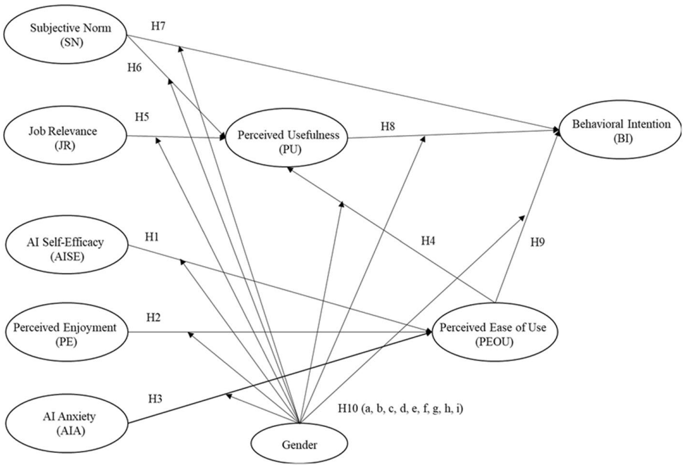
Verification
Claims the paper makes
The claims and statistics of this paper haven’t been checked yet.
Free: it reads the open-access text and checks the first 5 claims that cite a source we can check. Create a free account to check every claim.
Claims other papers make about this one
Each is checked against this paper’s own text: does it say what the citing paper says it does?
The source backs part of the claim, not all of it — or backs it for a different population, condition or comparison.
In the citing paper
“Directly relevant to mentorship needs, AI applications, as demonstrated by researchers like Zhang et al. (2023) and Doroudi (2023), have proven effective in providing personalised feedback, facilitating reflective practice, and offering adaptive learning resources.”
From Mentorship in the Age of Generative AI: ChatGPT to Support Self-Regulated Learning of Pre-Service Teachers Before and During Placements (2025) · cites this paper as Zhang et al., 2023
Experimental — accuracy not yet measured
Self-check
Percentages, sums and reported differences re-computed from the paper’s own numbers.
The self-check needs the paper’s full text.
Citations
Cites
R: A Language and Environment for Statistical Computing
R Core Team (2025) · doi:10.32614/r.manuals · Cited by 352,181
Perceived usefulness, perceived ease of use, and user acceptance of information technology
Davis, F. D. (1989) · MIS Quarterly · doi:10.2307/249008 · Cited by 68,483 · cited 1×
“The TAM, built on the TRA, can be used to foresee the adoption of any specific technology (Davis, 1989).”
MethodUser Acceptance of Information Technology: Toward A Unified View1
Venkatesh, V., Morris, M. G., Davis, G. B., & Davis, F. D. (2003) · MIS Quarterly · doi:10.2307/30036540 · Cited by 45,035
lavaan : An R Package for Structural Equation Modeling
Rosseel, Y. (2012) · Journal of Statistical Software · doi:10.18637/jss.v048.i02 · Cited by 27,955
(1980) · Medical Entomology and Zoology · Cited by 25,810
A Theoretical Extension of the Technology Acceptance Model: Four Longitudinal Field Studies
Venkatesh, V., & Davis, F. D. (2000) · Management Science · doi:10.1287/mnsc.46.2.186.11926 · Cited by 23,066
Evaluating Goodness-of-Fit Indexes for Testing Measurement Invariance
Cheung, G. W., & Rensvold, R. B. (2002) · Structural Equation Modeling: A Multidisciplinary Journal · doi:10.1207/s15328007sem0902_5 · Cited by 16,280 · cited 1×
“A value of ΔCFI higher than 0.01 indicates a significant drop in fit between the two models (Cheung & Rensvold, 2002).”
BackgroundInfluentialConfirmatory factor analysis for applied research
(2007) · Choice Reviews Online · doi:10.5860/choice.44-2769 · Cited by 15,614 · cited 1×
“As Brown (2006) recommended, before performing the invariance measurement, the initial measurement model requires splitting into two datasets; in this study, one for male students and the other for female students.”
BackgroundTechnology Acceptance Model 3 and a Research Agenda on Interventions
Venkatesh, V., & Bala, H. (2008) · Decision Sciences · doi:10.1111/j.1540-5915.2008.00192.x · Cited by 8,159
Vandenberg, R. J., & Lance, C. E. (2000) · Organizational Research Methods · doi:10.1177/109442810031002 · Cited by 7,997
Research works printed but not linked: 3
- Ajzen, I. (1985). From intentions to actions: A theory of planned behavior. In Action control (pp. 11–39). Springer. https://doi.org/10.1007/978-3-642-69746-3_24 · doi:10.1007/978-3-642-69746-3_24
- 19. Fornell, C., Tellis, G. J., & Zinkhan, G. M. (1982). Validity assessment: A structural equations approach using partial least squares. In Proceedings of the American marketing association educators' conference (Vol. 48, pp. 405-409).
- 22. Hair, J. F., Black, W. C., Babin, B. J., & Anderson, R. E. (2019). Multivariate data analysis (8th). Cengage Learning.
Cited by
Yusuf, A., Pervin, N., & Román-González, M. (2024) · International Journal of Educational Technology in Higher Education · doi:10.1186/s41239-024-00453-6 · Cited by 554
“Recent studies have reported the continual proliferation of Artificial Intelligence (AI) tools in HE (e.g., Chu et al., 2022; Crompton & Burke, 2023) owing to their potential benefits, including improved personalized learning (Bhutoria, 2022), automation of repetitive tasks (de la Torre-López et al., 2023), and provis…”
BackgroundSchiavo, G., Businaro, S., & Zancanaro, M. (2024) · Technology in Society · doi:10.1016/j.techsoc.2024.102537 · Cited by 284
Teachers and AI: Understanding the factors influencing AI integration in K-12 education
Filiz, O., Kaya, M. H., & Adıgüzel, T. (2025) · Education and Information Technologies · doi:10.1007/s10639-025-13463-2 · Cited by 277
“Teachers’ resistance often stems from negative attitudes towards innovations and a hesitancy to leave their comfort zones, thereby hindering their willingness to embrace AI in the classroom (Istenic et al., 2021; Zhang et al., 2023).”
Delcker, J., Heil, J., Ifenthaler, D., Seufert, S., & Spirgi, L. (2024) · International Journal of Educational Technology in Higher Education · doi:10.1186/s41239-024-00452-7 · Cited by 147
Dahri, N. A., Yahaya, N., Al-Rahmi, W. M., Aldraiweesh, A., Alturki, U., Almutairy, S., Shutaleva, A., & Soomro, R. B. (2024) · Heliyon · doi:10.1016/j.heliyon.2024.e29317 · Cited by 239
“TAM has been extensively employed to understand the determinants of technology acceptance in various regions including Germany [50], US [51], Saudi Arabia [52], Pakistan [53], Malaysia [54], Turkey [55], Greece [56], Indonesia [57], South Korea [58], and China [56,57], and across different…”
BackgroundExamining artificial intelligence literacy among pre-service teachers for future classrooms
Ayanwale, M. A., Adelana, O. P., Molefi, R. R., Adeeko, O., & Ishola, A. M. (2024) · Computers and Education Open · doi:10.1016/j.caeo.2024.100179 · Cited by 238
Hazzan-Bishara, A., Kol, O., & Levy, S. (2025) · Education and Information Technologies · doi:10.1007/s10639-025-13393-z · Cited by 270
“In the context of AI, a recent study has demonstrated that perceived usefulness and ease of use are important factors that influence intentions to use AI (C. Zhang et al., 2023).”
InfluentialGuan, L., Zhang, Y., & Gu, M. M. (2024) · Computers and Education Artificial Intelligence · doi:10.1016/j.caeai.2024.100341 · Cited by 278
Dahri, N. A., Yahaya, N., Al-Rahmi, W. M., Vighio, M. S., Alblehai, F., Soomro, R. B., & Shutaleva, A. (2024) · Education and Information Technologies · doi:10.1007/s10639-024-12599-x · Cited by 144
Mustofa, R. H., Kuncoro, T. G., Atmono, D., Hermawan, H. D., & Sukirman, S. (2025) · Computers and Education Artificial Intelligence · doi:10.1016/j.caeai.2025.100379 · Cited by 232
Exploring the relationship between teachers’ competencies in AI-TPACK and digital proficiency
Hava, K., & Babayiğit, Ö. (2025) · Education and Information Technologies · doi:10.1007/s10639-024-12939-x · Cited by 72
“When conducting a literature review, it becomes evident that there is a need for research to investigate the various factors that influence the AI-TPACK competen - cies of teachers (Chai et al., 2023; Lodge et al., 2023; Ma & Lei, 2024; Zhang et al., 2023).”
InfluentialAcceptance of artificial intelligence: key factors, challenges, and implementation strategies
Rane, N., Choudhary, S. P., & Rane, J. (2024) · Journal of Applied Artificial Intelligence · doi:10.48185/jaai.v5i2.1017 · Cited by 216
Acosta-Enriquez, B. G., Arbulú Ballesteros, M. A., Huamaní Jordan, O., López Roca, C., & Saavedra Tirado, K. (2024) · BMC Psychology · doi:10.1186/s40359-024-01764-z · Cited by 164
“The above hypotheses were also tested in studies with technology users in a variety of contexts [30, 31, 40, 42, 63–65].”
BackgroundMethodResultInfluentialAI in the Classroom: Insights from Educators on Usage, Challenges, and Mental Health
Delello, J. A., Sung, W., Mokhtari, K., Hebert, J., Bronson, A., & Giuseppe, T. D. (2025) · Education Sciences · doi:10.3390/educsci15020113 · Cited by 191
Mohebbi, A. (2025) · Cogent Education · doi:10.1080/2331186x.2024.2433814 · Cited by 161
“Over the past few decades, AI has evolved from a speculative concept into a powerful tool that reshapes instructional methods, pedagogical techniques, and learner engagement (S. Zhang et al., 2023).”
Katsantonis, A., & Katsantonis, I. G. (2024) · Education Sciences · doi:10.3390/educsci14090988 · Cited by 77
“For example, a study with education undergraduates found no differences between female and male students in perceived usefulness, ease of use, enjoyment, and job relevance of AI [33].”
Zhu, W., Huang, L., Zhou, X., Li, X., Shi, G., Ying, J., & Wang, C. (2025) · International Journal of Human–Computer Interaction · doi:10.1080/10447318.2024.2323277 · Cited by 143
“…intention, it is found that performance expectancy is the most critical determinant, which aligns with past research on the acceptance and use of AI products in some contexts (Andrews et al., 2021; Chatterjee et al., 2021; Foroughi et al., 2023; Gansser & Reich, 2021; C. Zhang et al., 2023).”
Yim, I. H. Y., & Wegerif, R. (2024) · Future in Educational Research · doi:10.1002/fer3.65 · Cited by 162
Sergeeva, O. V., Zheltukhina, M. R., Shoustikova, T., Tukhvatullina, L. R., Dobrokhotov, D. A., & Kondrashev, S. V. (2025) · Contemporary Educational Technology · doi:10.30935/cedtech/16039 · Cited by 131
Exploring Factors That Support Pre-service Teachers’ Engagement in Learning Artificial Intelligence
Ayanwale, M. A., Frimpong, E. K., Opesemowo, O. A. G., & Sanusi, I. T. (2024) · Journal for STEM Education Research · doi:10.1007/s41979-024-00121-4 · Cited by 151
“However, studies (Al Darayseh, 2023; Kelly et al., 2023; Zhang et al., 2023) have demonstrated that attitude is a critical factor that influences teachers’ acceptance or rejection of the use of AI.”
Molefi, R. R., Ayanwale, M. A., Kurata, L., & Chere-Masopha, J. (2024) · Computers and Education Open · doi:10.1016/j.caeo.2024.100191 · Cited by 76
Ali, I., Warraich, N. F., & Butt, K. (2024) · Information Development · doi:10.1177/02666669241257206 · Cited by 135
“…studies, the relationship between PU and BI was signi fi cant in different contexts such as learning AI among students (Sing et al., 2022) and AI acceptance in pre-service teachers (Zhang et al., 2023) Pillai et al. (2023) carried out research related to the adoption of AI-based teacher-bots.”
Zhang, C., Hu, M., Wu, W., Kamran, F., & Wang, X. (2024) · Education and Information Technologies · doi:10.1007/s10639-024-12905-7 · Cited by 123
“In the introductory section of the questionnaire we gave ., Davis, 1989; Zhang et al., 2023a, 2023b), PU (four items, α = 0.79) (e.g., Davis, 1989; Zhang et al., 2023a, 2023b), ATT (three items, α = 0.86) (e.g., Davis, 1989), BI (three items, α = 0.84) (e.g., Venkatesh & Davis, 2000; Zhang et al., 2023a, 2023b), PSR (…”
InfluentialSelf-citationDringó-Horváth, I., Rajki, Z., & Nagy, J. T. (2025) · Education Sciences · doi:10.3390/educsci15070868 · Cited by 114
Eltahir, M. E., & Mohd Elmagzoub Babiker, F. (2024) · Electronic Journal of e-Learning · doi:10.34190/ejel.22.9.3639 · Cited by 62
Abdalla, R. (2024) · Journal of Open Innovation Technology Market and Complexity · doi:10.1016/j.joitmc.2024.100327 · Cited by 108
Runge, I., Hebibi, F., & Lazarides, R. (2025) · Education Sciences · doi:10.3390/educsci15020167 · Cited by 85
Performance of the pre-trained large language model GPT-4 on automated short answer grading
Kortemeyer, G. (2024) · Discover Artificial Intelligence · doi:10.1007/s44163-024-00147-y · Cited by 100
“This limitation might be overcome by using Artificial Intelligence (AI) solutions [2]; it is therefore not surprising that when it comes to the use of AI in higher education, assessment and evaluation are the most prominent topics [3], and acceptance of this technology for education is increasing based on its perceive…”
The artificial intelligence literacy (AIL) scale for teachers: A tool for enhancing AI education
Younis, B. (2025) · Journal of Digital Learning in Teacher Education · doi:10.1080/21532974.2024.2441682 · Cited by 93
“For instance, there is evidence suggesting that female educators might express greater reluctance toward incorporating AI-based tools into their teaching and learning methods compared to their male counterparts (Zhang et al., 2023).”
Pokrivcakova, S. (2023) · Journal of language and cultural education · doi:10.2478/jolace-2023-0031 · Cited by 81
“…no (Ahmed, Bhinder, Tariq et al., 2022; Al Hadithy, Al Lawati, Al-Zadjali, & Al Sinawi, 2023; Al-Qerem, Eberhardt, Jarab et al., 2023; Truong, Vo et al., 2023) or only basic knowledge of AI and its functionalities (Al Saad, Shehadeh, Alanazi et al, 2022; Asmatahasin, Pratap et al., 2021; Baigi,…”
BackgroundInfluentialBalaskas, S., Tsiantos, V., Chatzifotiou, S., & Rigou, M. (2025) · Information · doi:10.3390/info16020082 · Cited by 81
“Among these, the Technology Acceptance Model emerged as one foundational framework to understand technology adoption [18–23].”
InfluentialYounis, B. (2024) · Journal of Digital Learning in Teacher Education · doi:10.1080/21532974.2024.2365663 · Cited by 92
“For example, female teachers may be more apprehensive about utilizing AI-based applications in their teaching and learning processes than male teachers (Zhang et al., 2023).”
Scrutinizing Indonesian pre-service teachers’ technological knowledge in utilizing AI-powered tools
Hastomo, T., Mandasari, B., & Widiati, U. (2024) · Journal of Education and Learning (EduLearn) · doi:10.11591/edulearn.v18i4.21644 · Cited by 83
“A previous study claims that participants in TPD programs have learning opportunities to develop new AI-related abilities and capabilities [32].”
BackgroundInfluentialTechnology Acceptance Model in Artificial Intelligence in Education: A Meta-Analysis
Xue, L., Mahat, J., & Ghazali, N. (2026) · SAGE Open · doi:10.1177/21582440251409441 · Cited by 95
Alejandro, I. M. V., Sanchez, J. M. P., Sumalinog, G. G., Mananay, J. A., Goles, C. E., & Fernandez, C. B. (2024) · STEM Education · doi:10.3934/steme.2024024 · Cited by 88
“Studies like Zhang et al. [28], Al Darayseh [31], and Ofosu-Ampong et al. [29] provide evidence of the substantial influence of perceived simplicity of use on the perceived usefulness of AI applications in education.”
InfluentialSaleh, Z. T., Rababa, M., Elshatarat, R. A., Alharbi, M., Alhumaidi, B. N., Al-Za'areer, M. S., Jarrad, R. A., niarat, T. F. A., Almagharbeh, W. T., Al‐Sayaghi, K. M., et al. (2025) · BMC Nursing · doi:10.1186/s12912-025-03082-0 · Cited by 83
“Research indicates that perceived benefits and limitations significantly influence an individual’s willingness to adopt new technologies, making faculty perceptions a key factor in shaping attitudes toward AI chatbot integration [23, 24].”
Development and validation of the Artificial Intelligence Literacy Scale for Teachers (AILST)
Ning, Y., Zhang, W., Yao, D., Fang, B., Xu, B., & Wijaya, T. T. (2025) · Education and Information Technologies · doi:10.1007/s10639-025-13347-5 · Cited by 80
“Whether teachers perceive AI as capable of improving classroom teaching efficiency, personalized teaching services, and student learning outcomes is a key indicator of its PU (Zhang et al., 2023).”
Heine, S., & König, J. (2025) · European Journal of Teacher Education · doi:10.1080/02619768.2025.2540791 · Cited by 78
“…as well as their related self-efficacy, influencing their attitudes towards digital innovations, supporting their capacity to critically reflect on digital resources, and helping them bridge the gap between their personal technology use and its pedagogical applications (S. Zhang et al. 2023).”
InfluentialLaru, J., Çelik, İ., Jokela, I., & Mäkitalo‐Siegl, K. (2025) · European Journal of Teacher Education · doi:10.1080/02619768.2025.2535623 · Cited by 78
“Educators who view AI as unpredictable or overly complex are less likely to accept its use in classrooms (Zhang et al. 2023).”
InfluentialFactors influencing educators' AI adoption: A grounded meta-analysis review
Taheri, R., Nazemi, N., Pennington, S. E., Clark, J. A., & Dadgostari, F. (2025) · Computers and Education Artificial Intelligence · doi:10.1016/j.caeai.2025.100464 · Cited by 89
Multimodal composing with generative AI: Examining preservice teachers’ processes and perspectives
Smith, B. E., Shimizu, A. Y., Burriss, S. K., Hundley, M. K., & Pendergrass, E. (2024) · Computers & composition/Computers and composition · doi:10.1016/j.compcom.2024.102896 · Cited by 76
Adopting AI in education: optimizing human resource management considering teacher perceptions
Gârdan, I. P., Manu, M. B., Gârdan, D. A., Negoiţă, L., Paștiu, C. A., Ghiță, E., & Zaharia, A. (2025) · Frontiers in Education · doi:10.3389/feduc.2025.1488147 · Cited by 68
“Zhang et al. (2023) found that schools with a positive culture towards technology adoption foster positive attitudes among teachers.”
InfluentialAn exploratory study of artificial intelligence adoption in higher education
Nagy, A. S., Tumiwa, J. R., Arie, F. V., & Erdey, L. (2024) · Cogent Education · doi:10.1080/2331186x.2024.2386892 · Cited by 70
“The primary motivation for investigating consumer acceptability, adoption, and use of developing technology is adoption behavior (Schießl et al., 2023).”
Falebita, O. S., & Kok, P. J. (2024) · Discover Education · doi:10.1007/s44217-024-00252-1 · Cited by 65
“A lack of familiarity with AI and its potential benefits can create resistance to adoption and integration within the academic community [90].”
Börekci, C., & Çelik, Ö. (2024) · Sakarya University Journal of Education · doi:10.19126/suje.1468866 · Cited by 63
A comparative analysis of pre-service teachers’ readiness for AI integration
Lucas, M., Bem‐Haja, P., Zhang, Y., Cejudo, M. D. C. L., & Palacios‐Rodríguez, A. (2025) · Computers and Education Artificial Intelligence · doi:10.1016/j.caeai.2025.100396 · Cited by 72
Alqurni, J. (2026) · Frontiers in Artificial Intelligence · doi:10.3389/frai.2026.1738774 · Cited by 58
Liu, Y., Wang, Q., & Lei, J. (2025) · Behavioral Sciences · doi:10.3390/bs15081040 · Cited by 64
“C. Zhang et al. (2023) conducted a large-scale TAM-based multigroup analysis in Germany, revealing gendered patterns in constructs like AI anxiety and perceived enjoyment.”
Salhab, R., & Aboushi, M. M. (2025) · Frontiers in Education · doi:10.3389/feduc.2025.1640212 · Cited by 37
Sánchez‐Prieto, J. C., Izquierdo-Álvarez, V., Moral-Marcos, M. T. D., & Abad, F. M. (2024) · RIED Revista Iberoamericana de Educación a Distancia · doi:10.5944/ried.28.1.41548 · Cited by 64
Fostering AI literacy in pre-service physics teachers: inputs from training and co-variables
Abdulayeva, A., Zhanatbekova, N., Andasbayev, Y., & Boribekova, F. (2025) · Frontiers in Education · doi:10.3389/feduc.2025.1505420 · Cited by 33
Kleine, A., Schaffernak, I., & Lermer, E. (2024) · Computers in Human Behavior Artificial Humans · doi:10.1016/j.chbah.2024.100113 · Cited by 57
AI In education: comparative perspectives from STEM and non-STEM instructors
Parviz, M. (2024) · Computers and Education Open · doi:10.1016/j.caeo.2024.100190 · Cited by 50
Wang, C., & Yin, H. (2025) · Computers & Education · doi:10.1016/j.compedu.2025.105250 · Cited by 56
Galimova, E. G., Oborsky, A. Y., Khvatova, M. A., Astakhov, D. V., Orlova, E. V., & Andryushchenko, I. S. (2024) · Frontiers in Education · doi:10.3389/feduc.2024.1436724 · Cited by 51
Solórzano, S. S. S., Romero, J. P., Díaz-Cueva, J. G., Montero, J. E. A., Campoverde, M. A. Z., Valarezo, M. M. L., Ninaquispe, J. C. M., Acosta-Enriquez, B. G., & Ballesteros, M. A. A. (2024) · Journal of Innovation and Entrepreneurship · doi:10.1186/s13731-024-00412-5 · Cited by 53
“Moreover, this challenge goes beyond mere technological adoption; it involves the understanding, acceptance, and application of AI by future professionals (Stevens & Stetson, 2023; Zhang et al., 2023a, 2023b).”
It Is Not the Huge Enemy: Preservice Teachers’ Evolving Perspectives on AI
Uwosomah, E. E., & Dooly, M. (2025) · Education Sciences · doi:10.3390/educsci15020152 · Cited by 53
Understanding Teachers’ Adoption of AI Technologies: An Empirical Study from Chinese Middle Schools
Zhao, J., Li, S., & Zhang, J. (2025) · Systems · doi:10.3390/systems13040302 · Cited by 50
Hsu, H.-P., Mak, J., Werner, J., White-Taylor, J., Geiselhofer, M. A., Gorman, A., & Capurro, C. T. (2024) · The Journal of Technology and Teacher Education · doi:10.70725/869859beoezu · Cited by 59
Understanding user stickiness in GAI-IDLE platforms: Insights from self-determination theory
Zhou, G., & Ma, Q. (2025) · Learning and Motivation · doi:10.1016/j.lmot.2025.102179 · Cited by 46
Du, Y., Tang, M., Jia, K., Wang, C., & Zou, B. (2025) · Journal of Computer Assisted Learning · doi:10.1002/jcal.70174 · Cited by 47
Shen, X., Mo, X., & Xia, T. (2024) · Interactive Learning Environments · doi:10.1080/10494820.2024.2365959 · Cited by 55
“Besides, in some previous studies (Racero et al., 2020; Zardari et al., 2021; Zhang et al., 2023) PEU significantly affected PU and BI, while in other studies (D. Y. Lee & Lehto, 2013; Liu & Ma, 2023; W.-T. Wang & Wang, 2009) PEU didn ’ t have a direct effect on BI.”
Cypriot teachers’ digital skills and attitudes towards AI
Kasinidou, M., Kleanthoys, S., & Otterbacher, J. (2025) · Discover Education · doi:10.1007/s44217-024-00390-6 · Cited by 54
“In terms of using AI tools in their teaching, factors such as their technological knowledge, understanding of AI’s pedagogical contributions [67], and their perception of usefulness and ease of use [68, 69] significantly influence their acceptance of these technologies.”
Tomczyk, Ł., & Majkut, A. (2025) · Human Behavior and Emerging Technologies · doi:10.1155/hbe2/5599169 · Cited by 50
Zheng, W., Ma, Z., Sun, J., Wu, Q., & Hu, Y. (2024) · International Journal of Human-Computer Interaction · doi:10.1080/10447318.2024.2433300 · Cited by 44
“(Esiyok et al., 2024; Jin & Youn, 2023; Zhang et al., 2023).”
Masry-Herzallah, A., & Makaldy, R. (2025) · Computers and Education Artificial Intelligence · doi:10.1016/j.caeai.2025.100377 · Cited by 53
Ning, Y., Zheng, H., Wu, H., Jin, Z. M., Chang, H., & Wijaya, T. T. (2025) · Education and Information Technologies · doi:10.1007/s10639-025-13477-w · Cited by 44
“Lastly, the positive effect of school support on acceptance of AI (H4: +) has been extensively discussed in the field of educational technology integration (Zhang et al., 2023).”
Uludağ, F., Kılıç, E., & Çelik, H. E. (2025) · Humanities and Social Sciences Communications · doi:10.1057/s41599-025-05641-x · Cited by 52
Wulyani, A. N., Widiati, U., Muniroh, S., Rachmadhany, C. D., Nurlaila, N., Hanifiyah, L., & Sharif, T. I. S. T. (2024) · LLT Journal A Journal on Language and Language Teaching · doi:10.24071/llt.v27i1.7966 · Cited by 50
“As also identified by Zhang et al. (2023), PEoU and PU can be used as primary considerations in projecting pre-service teachers’ intention to use AI.”
BackgroundSun, J., Wu, Q., Ma, Z., Zheng, W., & Hu, Y. (2025) · Educational Technology Research and Development · doi:10.1007/s11423-025-10495-w · Cited by 50
“Prior studies, Zhang et al. (2023) and Banzon et al. (2022) have examined the acceptance of traditional AI among pre-service teachers.”
InfluentialJi, Y., Zou, X., Li, T., & Zhan, Z. (2023) · Proceedings of the 2023 6th International Conference on Educational Technology Management · doi:10.1145/3637907.3637948 · Cited by 29
“It can help pre-service teachers identify interconnections between different subjects, generate inquiry-driven STEM topics, and structure course content [3].”
BackgroundStudents’ GAI Acceptance: Role of Demographics, Creative Mindsets, Anxiety, Attitudes
Avcı, Ü. (2024) · Journal of Computer Information Systems · doi:10.1080/08874417.2024.2386545 · Cited by 44
“Zhang et al. 70 found that anxiety about AI did not affect the behavioral intentions of candidate teachers toward AI.”
Cognitive aspects of interaction in the “Human — Artificial Intelligence” system
Fedorets, V. M., Клочко, О., Твердохліб, І. А., & Sharyhin, O. A. (2024) · Journal of Physics Conference Series · doi:10.1088/1742-6596/2871/1/012023 · Cited by 45
“The work of Zhang et al. [5] is devoted to the study of the indicated problems.”
InfluentialHuang, T., & Wu, C. (2025) · Computers and Education Open · doi:10.1016/j.caeo.2025.100275 · Cited by 50
AI-assisted automated short answer grading of handwritten university-level mathematics exam
Liu, T., Chatain, J., Keller, L. G. A., Kortemeyer, G., Willwacher, T., & Sachan, M. (2026) · Teaching Mathematics and its Applications An International Journal of the IMA · doi:10.1093/teamat/hrag010 · Cited by 40
Acosta-Enriquez, B. G., Valle, M. D. L. Á. G., Ballesteros, M. A. A., Castillo, J. C. A., Várgas, C. G. A. P., Torres, I. S., León, P. M. S., & Tirado, K. S. (2025) · BMC Psychology · doi:10.1186/s40359-024-02328-x · Cited by 44
Generative AI as a Cognitive Co-Pilot in English Language Learning in Higher Education
Zaim, M., Arsyad, S., Waluyo, B., Ardi, H., Hafizh, M. A., Zakiyah, M., Syafitri, W., Nusi, A., & Hardiah, M. (2025) · Education Sciences · doi:10.3390/educsci15060686 · Cited by 53
“For example, empirical studies on Iran (Fathi et al., 2024), China (An et al., 2023; Y. Wang & Zhang, 2023; Xu et al., 2024), Vietnam (Vo & Nguyen, 2024), Thailand (Waluyo & Kusumastuti, 2024), Indonesia (Habibi et al., 2023; Rosmayanti et al., 2022), South Korea (Jang, 2024), and Hong Kong (Chan &…”
Mnguni, L. E., Nuangchalerm, P., Islami, R. A. Z. E., Sibanda, D., Sari, I. J., & Ramulumo, M. (2024) · Computers and Education Artificial Intelligence · doi:10.1016/j.caeai.2024.100334 · Cited by 43
Matobobo, C. (2026) · Discover Education · doi:10.1007/s44217-026-01116-6 · Cited by 36
“Male students often view generative AI as a tool that enhances career prospects, while female students approach it with greater caution, particularly expressing concern over potential impacts on their critical and independent thinking [9, 39].”
Guo, S., Shi, L., & Zhai, X. (2025) · Education and Information Technologies · doi:10.1007/s10639-025-13338-6 · Cited by 35
“These three constructs are also empirically verified to be powerful for predicting and explaining user behaviors for new technologies in educational contexts (Davis et al., 1989; Sánchez-Prieto et al., 2017; Zhang et al., 2023).”
InfluentialPan, L., Luo, H., & Gu, Q. (2025) · IEEE Access · doi:10.1109/access.2025.3546572 · Cited by 41
Are Turkish pre-service teachers worried about AI? A study on AI anxiety and digital literacy
Ayduğ, D., & Altınpulluk, H. (2025) · AI & Society · doi:10.1007/s00146-025-02348-0 · Cited by 41
“In their study, Zhang et al. (2023) investigated the acceptance of artificial intelligence (AI) among pre-service teachers.”
Cai, H., Han, B., Sun, J., Li, X., & Wong, L. H. (2025) · The Internet and Higher Education · doi:10.1016/j.iheduc.2025.101022 · Cited by 42
Oh, S. (2025) · IEEE Access · doi:10.1109/access.2025.3586593 · Cited by 39
Eldakar, M. A. M., Shehata, A. M. K., & Ammar, A. S. A. (2025) · Information Development · doi:10.1177/02666669251314859 · Cited by 37
“Past studies also provide similar trends with regard to social in fl uence, ease of use, and perceived usefulness (Al-Emran et al., 2023; AlGera fi et al., 2023; Bouteraa et al., 2024; Menon and Shilpa, 2023; Zhang et al., 2023).”
Ishmuradova, I. I., Zhdanov, S. P., Kondrashev, S. V., Erokhova, N. S., Grishnova, E. E., & Volosova, N. Y. (2025) · Contemporary Educational Technology · doi:10.30935/cedtech/16207 · Cited by 38
Falebita, O. S. (2024) · Interdisciplinary Journal of Education Research · doi:10.38140/ijer-2024.vol6.20 · Cited by 36
“This study aligns with some studies (Ayanwale et al., 2024; Yıldız & Taşhan, 2023; Zhang et al., 2023) that stressed AI-Adoption as being influenced by the level of AI-Anxiety.”
BackgroundResultCollege Teachers’ Behavioral Intention to Adopt Artificial Intelligence-Assisted Teaching Systems
Zhang, W., & Hou, Z. (2024) · IEEE Access · doi:10.1109/access.2024.3445909 · Cited by 40
“…perspectives including ease of use perception, usefulness perception, AI anxiety, technological convictions, security, and subjective norms [20], [21], [22], [23], there are still at least the following shortcomings: 1) Current study samples on the behavioral intention of adopting AIATS are…”
BackgroundAI in the language classroom: Insights from pre-service English teachers
Yetkin, R., & Altınkaya, Z. Ö. (2024) · E-Learning and Digital Media · doi:10.1177/20427530241267011 · Cited by 33
“Despite the breadth of research on in-service teachers ’ perceptions of AI, the views of pre-service teachers have received comparatively less attention (Zhang et al., 2023).”
Artificial Intelligence Powered Pedagogy: Unveiling Higher Educators Acceptance with Extended TAM
Kavitha, K. V., & Joshith, V. P. (2025) · Journal of University Teaching and Learning Practice · doi:10.53761/s1pkk784 · Cited by 39
“Despite the spectrum of TAM versions, the key variables-perceived usefulness (PU) and perceived ease of use (PEOU) were found to be the prominent determinants affecting the uptake of technology (Davis et al., 1989; Zhang et al., 2023).”
BackgroundAbualrob, M. M. (2024) · Contemporary Educational Technology · doi:10.30935/cedtech/15686 · Cited by 36
“If AI proves to be highly beneficial and significantly impacts educational results, it is likely to be adopted, although it would require a lot of effort to learn how to use it (Zhang et al., 2023).”
Wu, Y., & Derakhshan, A. (2025) · Porta Linguarum Revista Interuniversitaria de Didáctica de las Lenguas Extranjeras · doi:10.30827/portalin.vixiii.33117 · Cited by 34
Acceptance of artificial intelligence in education: opportunities, concerns and need for action
Brandhofer, G., & Tengler, K. (2024) · Advances in Mobile Learning Educational Research · doi:10.25082/amler.2024.02.005 · Cited by 34
Alsudairy, N. A., & Eltantawy, M. M. (2024) · Journal of Intellectual Disability - Diagnosis and Treatment · doi:10.6000/2292-2598.2024.12.02.5 · Cited by 42
A systematic review of AI anxiety in education
Wu, X., & Li, H. (2025) · AI and Ethics · doi:10.1007/s43681-025-00783-9 · Cited by 35
“Pre-service teacher training programs, as examined by Sanusi et al. [ 50, 51] and Zhang et al. [66], demonstrated the significance of cultivating a positive attitude toward AI, especially by illustrating its applicability to teaching practices and societal advantages.”
Falebita, O. S. (2024) · Journal of Mathematics Instruction Social Research and Opinion · doi:10.58421/misro.v4i1.309 · Cited by 33
Integrating AI in teacher education: exploring the impact on preservice teacher competencies
Lee, H., & Bryan, L. M. (2025) · Professional Development in Education · doi:10.1080/19415257.2025.2490000 · Cited by 15
“Addressing these issues requires comprehensive training programmes that equip future educators with the necessary skills and confidence to use AI effectively (Zhang et al .”
Mandasari, B., Basthomi, Y., Hastomo, T., Afrianto, A., Hamzah, I. N. S., & Aminatun, D. (2025) · Voices of English Language Education Society · doi:10.29408/veles.v9i1.27965 · Cited by 29
“Research has also explored pre-service teachers' (PSTs) perspectives on using technology-based tools in language instruction (Nariyati & Pratiwi, 2020; Ridha & Fithriani, 2023; Zhang et al., 2023).”
van den Berg, G. (2025) · Discover Education · doi:10.1007/s44217-025-00596-2 · Cited by 32
“Anxiety may stem from insufficient exposure to AI, leading to low AI self-efficacy [51].”
InfluentialAktulun, Ö. U., Kasapoğlu, K., & Aydoğdu, B. (2024) · Journal of Baltic Science Education · doi:10.33225/jbse/24.23.950 · Cited by 31
“Zhang et al. (2023) have found out that the key factors influencing the intentions of student teachers to utilize AI technology are perceived utility and perceived usability, with perceived utility being more influential than perceived usability.”
Metadata
- Authors
- Zhang, C., Schießl, J., Plößl, L., Hofmann, F., & Gläser-Zikuda, M.
- Affiliations
- Friedrich-Alexander-Universität Erlangen-Nürnberg (DE)
- Corresponding author
- Zhang, Chengming
- Venue
- International Journal of Educational Technology in Higher Education
- Published
- 2023-09-04
- Volume
- 20
- Issue
- 1
- ISSN
- 2365-9440 (ISSN-L)
- OpenAlex
- W4386405611
- Semantic Scholar
- b05cb5bf173385b1696e219697beb9057bc5c64f
- Cited by
- 413
- References
- 84
- Citations by year
- 2026: 146 · 2025: 173 · 2024: 88 · 2023: 6
- FWCI
- 96.92
- Type
- journal article
- Language
- en
- Open access
- diamond
- doi.org
- Licence
- cc-by
- creativecommons.org/licenses/by/4.0 (tdm)
- creativecommons.org/licenses/by/4.0 (vor)
- Locations
- International Journal of Educational Technology in Higher Education (publishedVersion, cc-by)
- DOAJ (DOAJ: Directory of Open Access Journals) (submittedVersion, cc-by-sa)
- Funders
- BMBF (16DHB4019)
- Topics
- Social Sciences › Education › Artificial Intelligence in Education
- Social Sciences › Decision Sciences › Information Systems and Management › Technology Adoption and User Behaviour
- Social Sciences › Gender Studies › Gender and Technology in Education
- Keywords
- artificial intelligence in education, pre-service teachers, technology acceptance, behavioral intention, perceived usefulness, perceived ease of use, AI anxiety, perceived enjoyment, gender differences, teacher professional development, technology acceptance model
About these checks
Registry, retraction, Cites and statistics results are computed, not judged, with one exception: a printed reference that no index lists is read once by a model before it counts as a citation error. Claims are extracted by a model and kept only when their quote appears verbatim in the text; each cited source is then checked, with a model’s help, for whether it says what the claim relies on. Those verdicts can be wrong — read the claim’s quote and the cited source before relying on one.
Statistics and arithmetic are recomputed, not judged.
Confidence bands are shown only for fields calibrated on our annotated test set. None is calibrated yet, so no band is shown.
What counts as a claim ›How we measure confidence ›How we check this ›
Are you an author, or do you see a problem with this page? Request a review
Data sources
Bibliographic data: Semantic Scholar, OpenAlex, Crossref.
Contains information from the Semantic Scholar Academic Graph Datasets, made available under the ODC Attribution License (ODC-BY 1.0).
Semantic Scholar’s data is described in: Kinney, R., et al. (2023). The Semantic Scholar Open Data Platform. arXiv:2301.10140.
