

Acceptance of artificial intelligence among pre-service teachers: a multigroup analysis
Open accessThe DOI matches its Crossref record; 83 of the 84 references it cites were found in a registry or an index.
Abstract
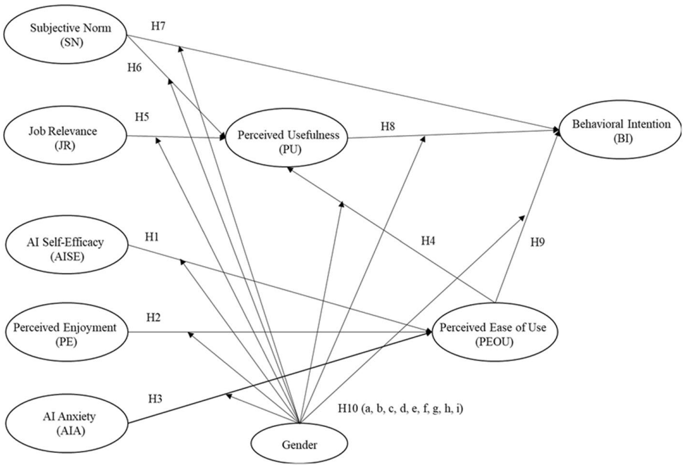
Over the past few years, there has been a significant increase in the utilization of artificial intelligence (AI)-based educational applications in education. As pre-service teachers’ attitudes towards educational technology that utilizes AI have a potential impact on the learning outcomes of their future students, it is essential to know more about pre-service teachers’ acceptance of AI. The aims of this study are (1) to discover what factors determine pre-service teachers’ intentions to utilize AI-based educational applications and (2) to determine whether gender differences exist within determinants that affect those behavioral intentions. A sample of 452 pre-service teachers (325 female) participated in a survey at one German university. Based on a prominent technology acceptance model, structural equation modeling, measurement invariance, and multigroup analysis were carried out. The results demonstrated that eight out of nine hypotheses were supported; perceived ease of use ( β = 0.297***) and perceived usefulness ( β = 0.501***) were identified as primary factors predicting pre-service teachers’ intention to use AI. Furthermore, the latent mean differences results indicated that two constructs, AI anxiety (z = − 3.217**) and perceived enjoyment (z = 2.556*), were significantly different by gender. In addition, it is noteworthy that the paths from AI anxiety to perceived ease of use ( p = 0.018*) and from perceived ease of use to perceived usefulness ( p = 0.002**) are moderated by gender. This study confirms the determinants influencing the behavioral intention based on the Technology Acceptance Model 3 of German pre-service teachers to use AI-based applications in education. Furthermore, the results demonstrate how essential it is to address gender-specific aspects in teacher education because there is a high percentage of female pre-service teachers, in general. This study contributes to state of the art in AI-powered education and teacher education.
Overview
The claims and statistics of this paper haven’t been checked yet.
Free: it reads the open-access text and checks the first 5 claims that cite a source we can check. Create a free account to check every claim.
Integrity signals
Registry
Cites
Statistics
Figures
Verification
Claims the paper makes
The claims and statistics of this paper haven’t been checked yet.
Free: it reads the open-access text and checks the first 5 claims that cite a source we can check. Create a free account to check every claim.
Claims other papers make about this one
Each is checked against this paper’s own text: does it say what the citing paper says it does?
The source backs part of the claim, not all of it — or backs it for a different population, condition or comparison.
In the citing paper
“Directly relevant to mentorship needs, AI applications, as demonstrated by researchers like Zhang et al. (2023) and Doroudi (2023), have proven effective in providing personalised feedback, facilitating reflective practice, and offering adaptive learning resources.”
From Mentorship in the Age of Generative AI: ChatGPT to Support Self-Regulated Learning of Pre-Service Teachers Before and During Placements (2025) · cites this paper as Zhang et al., 2023
Experimental — accuracy not yet measured
Self-check
Percentages, sums and reported differences re-computed from the paper’s own numbers.
The self-check needs the paper’s full text.
Citations
Cites
R: A Language and Environment for Statistical Computing
R Core Team (2025) · doi:10.32614/r.manuals · Cited by 352,181
Perceived usefulness, perceived ease of use, and user acceptance of information technology
Davis, F. D. (1989) · MIS Quarterly · doi:10.2307/249008 · Cited by 68,483 · cited 1×
“The TAM, built on the TRA, can be used to foresee the adoption of any specific technology (Davis, 1989).”
MethodUser Acceptance of Information Technology: Toward A Unified View1
Venkatesh, V., Morris, M. G., Davis, G. B., & Davis, F. D. (2003) · MIS Quarterly · doi:10.2307/30036540 · Cited by 45,035
lavaan : An R Package for Structural Equation Modeling
Rosseel, Y. (2012) · Journal of Statistical Software · doi:10.18637/jss.v048.i02 · Cited by 27,955
(1980) · Medical Entomology and Zoology · Cited by 25,810
A Theoretical Extension of the Technology Acceptance Model: Four Longitudinal Field Studies
Venkatesh, V., & Davis, F. D. (2000) · Management Science · doi:10.1287/mnsc.46.2.186.11926 · Cited by 23,066
Evaluating Goodness-of-Fit Indexes for Testing Measurement Invariance
Cheung, G. W., & Rensvold, R. B. (2002) · Structural Equation Modeling: A Multidisciplinary Journal · doi:10.1207/s15328007sem0902_5 · Cited by 16,280 · cited 1×
“A value of ΔCFI higher than 0.01 indicates a significant drop in fit between the two models (Cheung & Rensvold, 2002).”
BackgroundInfluentialConfirmatory factor analysis for applied research
(2007) · Choice Reviews Online · doi:10.5860/choice.44-2769 · Cited by 15,614 · cited 1×
“As Brown (2006) recommended, before performing the invariance measurement, the initial measurement model requires splitting into two datasets; in this study, one for male students and the other for female students.”
BackgroundTechnology Acceptance Model 3 and a Research Agenda on Interventions
Venkatesh, V., & Bala, H. (2008) · Decision Sciences · doi:10.1111/j.1540-5915.2008.00192.x · Cited by 8,159
Vandenberg, R. J., & Lance, C. E. (2000) · Organizational Research Methods · doi:10.1177/109442810031002 · Cited by 7,997
Research works printed but not linked: 3
- Ajzen, I. (1985). From intentions to actions: A theory of planned behavior. In Action control (pp. 11–39). Springer. https://doi.org/10.1007/978-3-642-69746-3_24 · doi:10.1007/978-3-642-69746-3_24
- 19. Fornell, C., Tellis, G. J., & Zinkhan, G. M. (1982). Validity assessment: A structural equations approach using partial least squares. In Proceedings of the American marketing association educators' conference (Vol. 48, pp. 405-409).
- 22. Hair, J. F., Black, W. C., Babin, B. J., & Anderson, R. E. (2019). Multivariate data analysis (8th). Cengage Learning.
Cited by
Items 501–600 of 615
Development of an artificial intelligence competency scale for early childhood educators (ACES)
Kaçmaz, C., & Çelik, O. T. (2026) · Humanities and Social Sciences Communications · doi:10.1057/s41599-026-07838-0
Butar-Butar, L. I., Afandi, Marlina, R., Enawaty, E., & Ripanti, E. F. (2026) · Journal of Advanced Sciences and Mathematics Education · doi:10.58524/jasme.v6i2.1280
“Previous studies have also explored AI adoption among pre-service teachers, science teachers, and higher education instructors, demonstrating that individual perceptions and technological readiness significantly influence AI acceptance (Al Darayseh, 2023; Zhang et al., 2023).”
Andayani, S., Rahmawati, D., & Anwar, R. B. (2026) · Journal of Advanced Sciences and Mathematics Education · doi:10.58524/jasme.v6i2.1286
Generating Culturally Responsive Visual Aids for Teaching and LearningPreprint
Nabang, M., Essel, H. B., Tachie-Menson, A., Setsoafia, P., Koduah, C. A., Appiah-Kubi, J., Acheampong, E. B., & Nyaaba, M. (2026) · Research Square · doi:10.21203/rs.3.rs-10284209/v1
Umar, M., & Ashraf, A. (2026) · Academic Journal of Social Sciences (AJSS ) · doi:10.54692/ajss.2024.101317 · Cited by 1
Shi, W., Ramzy, M. I., & Ali, S. K. S. (2026) · International Journal of Entrepreneurship and Management Practices · doi:10.35631/ijepc.1163020
Behera, A., Singh, A. K., Ranjan, R., & -, K. B. B. (2026) · Advances in computational intelligence and robotics book series · doi:10.4018/979-8-2600-3204-6.ch012
Assessing Final Year Economics Pre-service Teachers’ Artificial Intelligence Readiness
Ngulube, B. (2026) · Journal of Educational Studies · doi:10.59915/jes.2026.25.1.2
Kervan, S., Morına, S., & Kovaç, E. S. (2026) · Journal of Pedagogical Sociology and Psychology · doi:10.33902/jpsp.202647460
Ghosh, P., Shetty, A., G, B. B., Shashi Kumar, M., & Muneshwara, M. S. (2025) · IEEE International Conference on Innovate for Humanitarian: Tech Solutions for Global Challenge (ICIH) · doi:10.1109/icih67754.2025.11608817
Generative AI in Physical Education: A PLS-SEM Approach Among Preservice PETE Students in Taiwan
Chang, S.-H., & Chen, S. (2026) · Journal of Teaching in Physical Education · doi:10.1123/jtpe.2025-0398 · Cited by 1
Al-Alawi, A. M., & Jahwari, D. S. A. (2026) · Cogent Education · doi:10.1080/2331186x.2026.2705016
GenAI as a frenemy in teaching: Perceived autonomy and risks
Dai, H. M., Ni, K., Meng, H., Ju, B., Crawford, J., & Teo, T. P. (2026) · Australasian Journal of Educational Technology · doi:10.14742/ajet.11301
“The associations originally proposed in TAM (PU → BI, PEU → PU) were significant in this study (H1: β = .815, p < .001; H3: β = .501, p < .001), supporting previous empirical findings (An et al., 2023; Choi et al., 2023; Zhang et al., 2023).”
InfluentialFouzi, N. I. M., & Rahman, M. J. A. (2026) · Journal of Research Innovation and Strategies for Education (RISE) · doi:10.70148/rise.v3i5.8
“Hal ini menjelaskan mengapa kesediaan menggunakan AI perlu disertai kompetensi pedagogi dan literasi AI yang mencukupi (Maizatul & Muhammad Helmi, 2026; Zhang et al., 2023).”
Joseph, C. H., Osiesi, M. P., Madikizela-Madiya, N., Adaramoye, T. O., Akinola, O. T., & Abiodun, A. A. (2026) · SN Social Sciences · doi:10.1007/s43545-026-01604-4
Tan, S. F., Chan, J. I. L., Chew, C. M., & Eak, A. D. (2026) · Discover Education · doi:10.1007/s44217-026-01979-9
“Zhang et al. [17] Confidence Interval intervals at 2.5% for lower limit and 97.5% for upper limit found that German pre-service teachers were more inclined to use AI in their pedagogy when they saw its benefits, while Wang et al. [40] demonstrated that higher education instructors were more likely…”
InfluentialDijitalleşme, Yapay Zekâ ve Öğretmenlik
Özenç, Y. Y. (2026) · doi:10.29329/penbook.36.3
Chen, Y., & Wang, J. (2026) · Scientific Reports · doi:10.1038/s41598-026-66335-1
Kenanoğlu, R., & Kahyaoğlu, M. (2026) · journal of physical education · doi:10.4025/jphyseduc.v37i1.3708
Ağmaz, R. F., Ergüleç, F., & Küçükaydın, M. A. (2026) · Quality & Quantity · doi:10.1007/s11135-026-03050-z
Finding meaning in the AI era: How AI self-efficacy shapes doctoral persistence
Triangga, B., & Arsawan, I. W. E. (2026) · Journal of Applied Research in Higher Education · doi:10.1108/jarhe-02-2026-0211
Dine, N. A. A. E. (2026) · International Journal of Research and Innovation in Social Science · doi:10.47772/ijriss.2026.100700703
Pre-Service Teachers' Self-Esteem, Behavioral Intention, and AI Use in Academic Writing
Cubillas, T. E., Orozco, J. F., Intong, I. L. M., & Torralba, E. (2026) · International Conference on e-Education, e-Business, e-Management and e-Learning · doi:10.1109/ic4e69618.2026.11631532
“Prior studies also highlight that perceived usefulness and ease of use strongly influence behavioral intention to adopt AI for academic tasks [2], and that pre-service teachers with proactive attitudes are more likely to explore AI for improving teaching and learning [13].”
Phuong, G. N. T., Dong, T. T., Duy, N. B. P., Hung, L. H., & Hong, N. L. T. (2026) · Lecture notes in networks and systems · doi:10.1007/978-3-032-25387-3_11
Measuring AI readiness in education: validation of the German AI readiness scale for educators
Ullrich, A., Schallert-Vallaster, S., Baez, C., Winder, G., Rey, T., & Buchner, J. (2026) · Artificial Intelligence in Education · doi:10.1108/aiie-09-2025-0285 · Cited by 1
Artificial intelligence in public sector accounting: Understanding the drivers of adoption readiness
Alonso-Morales, N., & Sáez-Martín, A. (2026) · International Review of Economics & Finance · doi:10.1016/j.iref.2026.105770
Jang, Y.-T. J. (2026) · Education and Information Technologies · doi:10.1007/s10639-026-14138-2
“These include the integration of AI into STEM education (Sun et al., 2024 ), the acceptance of artificial intelligence tools — such as ChatGPT — in educational settings (Alshammari & Babu, 2025 ; Zhang et al., 2023 ), and the adoption of metaverse-based learning platforms (Al-Adwan et al., 2023 ).”
Mosia, M. S., Nannim, F. A., Thamae, M. T., Hamilton, J., & Egara, F. O. (2026) · Social Sciences & Humanities Open · doi:10.1016/j.ssaho.2026.103441
AI Literacy and Convergence Competencies Among Pre-Service Teachers in Non-STEM Disciplines
Lee, J. (2026) · IAFOR Journal of Education · doi:10.22492/ije.14.2.06
ATTITUDES TOWARD ARTIFICIAL INTELLIGENCE AND GENDER DIFFERENCES AMONG SPANISH EMERGING ADULTS
Gómez‐Baya, D., Rodríguez‐Sánchez, S., & Moro, F. J. G. (2026) · TEME · doi:10.22190/teme260131027g
Iralan, S. A., Alvarado, H. A. L., Nuluddin, A. J. A., & Jackaria, P. M. (2026) · Advances in computational intelligence and robotics book series · doi:10.4018/979-8-3373-8377-4.ch011
Alvarado, W. M., Villacrés-Roca, R., & Pérez-Cepeda, M. (2026) · Journal of Technology in Behavioral Science · doi:10.1007/s41347-026-00704-5
Rahmatika, L., Islam, M. M., Murshidi, G. H. A., Nawaz, S. S., & Riantina, E. M. (2026) · Online Learning · doi:10.24059/olj.v30i3.5273
Chen, J., & Deng, F. (2026) · Interactive Learning Environments · doi:10.1080/10494820.2026.2728026
Liu, X., Jantakoon, T., & Laoha, R. (2026) · Higher Education Studies · doi:10.5539/hes.v16n4p165
“The direction of this difference closely replicates Zhang et al. (2023), who reported a stronger perceived ease of use to perceived usefulness path for female (β = 0.530) than for male (β = 0.283) pre-service teachers, and it is consistent with earlier evidence that gender conditions the relative…”
InfluentialDuan, J. (2026) · Journal of Interdisciplinary Research · doi:10.14456/au-ejir.2026.30
Rachmadina, A. N., & Setyowibowo, F. (2026) · EDUTECH Jurnal Inovasi Pendidikan Berbantuan Teknologi · doi:10.51878/edutech.v6i4.13795
Cantos, K. F. S., Coello, M. B. B., León, L. P. C., & Castillo, L. A. C. (2026) · Código Científico Revista de Investigación · doi:10.55813/gaea/ccri/v7/n1/1626
“In a similar vein, Zhang et al. (2023) looked at aspects related to AI acceptability in their research of pre-service teachers and emphasized the importance of users' views in influencing their desire to use these technologies.”
AI's Evolving Role in the Education Sector
Malik, K., Malhan, D., Sehgal, S., Deswal, T., & Gothwal, R. (2026) · Advances in computational intelligence and robotics book series · doi:10.4018/979-8-3373-9893-8.ch002
Formación docente en la era de la IA: una revisión sistemática
Malagón, J. V., Espinoza, K. G., Rubio, L. E., & Meza-Cortés, A. F. (2026) · Profesorado Revista de Currículum y Formación del Profesorado · doi:10.30827/profesorado.v30i2.34056
Wang, J., Pan, L., & Juan, L. (2026) · European Journal of Education · doi:10.1111/ejed.70877
AI Usefulness vs. Student's Concern in Vietnam: The Central Role of EI in an Extended AIDUA Model
Tran, T. H. H., Luu, T. T. D., & Dao, D. L. (2026) · International Journal of Asian Business and Information Management · doi:10.4018/ijabim.422376
Osiesi, M. P., Mosito, C. P., Sathorar, H., & Moeng, M. (2026) · Journal of Education and Learning (EduLearn) · doi:10.11591/edulearn.v20i4.25817
“Since students (pre-service teachers in our case) will be the future of education, they must learn (and be specially trained) about AI and how best and ethically to use it [98].”
Nicchia, E., Benigno, V., Ravicchio, F., Pario, M., Parmigiani, D., & Radović, S. (2026) · Education Sciences · doi:10.3390/educsci16091554
Entrepreneurship Educators’ Acceptance and Use of Generative Artificial Intelligence
Bahaw, P., Sadiq, G., Sookhai, S., Stephens, A., Mack, A. J., & Pittaway, L. (2026) · Entrepreneurship Education and Pedagogy · doi:10.1177/25151274261484162
AI Literacy, Technology Acceptance, and Teaching Efficiency among Higher Education Teachers
Joseph, G. V., Thomas, A. M., Jose, D., Athira, P., & Romeo, N. (2026) · Journal of Learning for Development · doi:10.56059/kb9v4b74
Torion, J. G., Baguhin, C. L. N., Mamba, H. L., & Reyes, J. (2026) · Studies in big data · doi:10.1007/978-3-032-20412-7_47
Kabakçı, D. S. (2026) · Bilkent University Institutional Repository (Bilkent University)
Öğretmen Adaylarında Üretken Yapay Zekâ Tutumları, Bilişsel Esneklik ve Eleştirel Düşünme
Kaygas, Y., & Sağlık, Z. Y. (2026) · Yaşadıkça Eğitim · doi:10.33308/26674874.20264031169
Yu, H., Cho, M., Lim, S., Park, E., & Kang, S. (2026) · Computers in the Schools · doi:10.1080/07380569.2026.2740438
РАЗВИТИЕ ЦИФРОВОЙ КОМПЕТЕНТНОСТИ БУДУЩИХ УЧИТЕЛЕЙ ИНФОРМАТИКИ С ПОМОЩЬЮ ИСКУССТВЕННОГО ИНТЕЛЛЕКТА
Bokan, M., Мақпыр, С. А., & Tokanov, M. (2026) · Bulletin of Zhetysu University named after I Zhansugurov · doi:10.53355/zhu.2026.120.3.009
Factors Predicting Pre‐Service Teachers' Intentions to Use Artificial Intelligence Software
AÇIKGÜL, K., ÇELİK, B., & Şad, S. N. (2026) · European Journal of Education · doi:10.1111/ejed.70889
الكعبي, ع. ف., & Qutran, Y. A. (2026) · Discover Education · doi:10.1007/s44217-026-02204-3
Nguyen, T. T. T., Nguyen, K. T. H., Pham, B. A., Nguyen, V. M. T., & Vo, K. H. (2025) · International Conference on Digital Technology in Education (ICDTE) · doi:10.1145/3796159.3796171
“Empirical studies on AI acceptance also show the relationship between usability and its usefulness [7, 45].”
Luhwera, M. G. (2025) · JOURNAL OF PUBLIC SECTOR MANAGEMENT · Cited by 2
Nurlaila, E., & Ubaidah, U. (2026) · International Conference on ICT for Smart Society (ICISS) · doi:10.1109/iciss71466.2026.11715176
“This is consistent with TAM-based research showing that technology-related beliefs shape users' confidence in AI-supported learning [19].”
La inteligencia artificial como apoyo didáctico: oportunidades y resistencias en el profesorado
Ramírez, G. C., Maridueña, A. M. B., Salazar, G. G. C., & Sánchez, G. M. P. (2026) · Conexión Científica Revista Internacional · doi:10.71068/7ngv4524
Coutinho, R. A. D. F. V. (2026) · CiencIPCA
Acceptance Of Artificial Intelligence Technology By UIN North Sumatra Students
Hayati, N., & Sayekti, R. (2024) · Jurnal Info Sains Informatika dan Sains · Cited by 1
Waluyo, B., & Isma, A. (2025) · The New English Teacher · Cited by 2
Lozano, D. D. T., & Sánchez, B. A. N. (2025) · Revista Científica Interdisciplinaria Investigación y Saberes · doi:10.53887/642x1226
Apeanti, W. O., & Barnor, E. N. (2026) · International Journal on Engineering Science and Technology · doi:10.46328/ijonest.8045
Nabang, M., Essel, H. B., Tachie-Menson, A., Setsoafia, P., Koduah, C. A., Appiah-Kubi, J., Acheampong, E. B., Aboagye, G. A., & Nyaaba, M. (2026) · Discover Education · doi:10.1007/s44217-026-02241-y
“This interpretation is consistent with studies showing that pre-service teachers’ responses to GenAI are shaped by usability, perceived pedagogical value, confidence and opportunities to apply AI within teaching tasks [2, 3, 22, 23].”
InfluentialIntegrated Micro-Statistical Frameworks for Predictive Validity in Climate and Policy Econometrics
Nadeem, N., Waleed, N., & Muzafar, Z. (2026) · International Research Journal of Arts, Humanities and Social Sciences · doi:10.3456/d4r8fw35
Zhao, X., Netthip, W., & Yongsorn, C. (2026) · Multidisciplinary Reviews · doi:10.31893/multirev.2027149
“Zhang et al. (2023) and Hu et al. (2025) showed that perceived usefulness, ease of use, social influence, effort expectancy, and perceived risk shape preservice teachers’ i ntention to use AI in education.”
Adnyani, M. A. A., Ratminingsih, N. M., & Santosa, M. H. (2026) · Channing Journal of English Language Education and Literature · doi:10.30599/5wrn7q75
Beyond the Hype: A Scoping Review of Artificial Intelligence Integration in Learning
Koçak, T., & Saltan, F. (2026) · Journal of Computer Education
Rizka, C. (2025) · META: Journal of Science and Technological Education
YUSUF, F. Z., Jamilu, A., & SALIHU, A. A. (2026) · Federal University Gusau Faculty of Education Journal · doi:10.64348/zije.2026599
“Zhang et al. (2023), studying 452 preservice teachers in Germany using an extended TAM with measurement invariance and multigroup analysis, found that both PEOU and perceived usefulness significantly predicted intention to use AI-based educational applications, and that the pathway from AI anxiety…”
InfluentialSuleiman, E.-I.-C.-C. P. B., Lawal, A. E.-H. D. N. I., Shaibu, E. P. A., Atadoga, E. P. M. M., Tukur, E. P. A. K., Dikki, C., Abdullahi, P. E. D. Y. A., Ismail, E. D. A., Adedo, E. D. G., Yahaya, E. D. H., et al. (2026) · Federal University Gusau Faculty of Education Journal · doi:10.64348/zije.2026616
Kurniawati, A. D., & Pratiwi, M. M. A. (2026) · LINEAR Journal of Mathematics Education · doi:10.32332/linear.v7i1.65-81
“Many AI initiatives fail or remain superficial because users do not fully accept AI as part of their practice, even when tools are technically sound (Gustilo et al., 2024; Runge et al., 2025; Zhang et al., 2023).”
InfluentialDo-It-with-AI Framework for Invention: A Kundt’s Tube Case Study
Eadkhong, T., Attachaiya, P., Luanghiranpusit, S., Chimtab, J., Dam-O, P., Danworaphong, S., & Sirisathitkul, C. (2026) · Inventions · doi:10.3390/inventions11050108
Kulikova, T. A., PODDUBNAYA, N. A., Fedina, O. V., & Prakasha, G. S. (2026) · Lecture notes in networks and systems · doi:10.1007/978-3-032-27834-0_26
Rawat, S., Ashton-Bell, R. L. T., Prakasha, G. S., & Grigoriev, S. (2026) · Lecture notes in networks and systems · doi:10.1007/978-3-032-27834-0_51
The Perception of Teachers on the Integration of AI in English Language Teaching
Mardhiyya, Q. A., Saptaningtyas, A. R., Syifa, S. K. M., & Lestari, V. L. (2025) · IDEAS Journal on English Language Teaching and Learning Linguistics and Literature
The Implementation of Project-Based Learning to Foster 21st-Century Skills in Primary Education
Andriani, I., & Zelenović, M. (2026) · JOBE: Journal of Basic Education
Pre-service Teacher Strategies in Empowering Ethics in Using AI in Classroom
Arroyan, A. R. R., & Widhiatama, D. A. (2026) · IDEAS Journal on English Language Teaching and Learning Linguistics and Literature · doi:10.24256/ideas.v13i2.9493
Sidqi, M. F., Matra, S. D., & Ulya, I. (2025) · IDEAS Journal on English Language Teaching and Learning Linguistics and Literature
GÜL, I., & Özgür, H. (2026) · Trakya Eğitim Dergisi · doi:10.24315/tred.1902835
Zhao, C. (2026) · Sustainability · doi:10.3390/su182010310
“Prior research also identified perceived usefulness as a primary driver of AI adoption among teachers [54,61], indicating that teachers who believe AI benefits their instruction and administrative work are more likely to report using it.”
InfluentialEren, C. D., & Geçer, A. K. (2026) · Acta Infologica · doi:10.26650/acin.1893001
A Course-Specific AI Consultant at a Central Asian Technical University: A Two-Phase Empirical Study
Rasulova, N., Danaa, G., Anufriyeva, Y., Ziyodullaeva, G., & Marasulova, Z. (2026) · International Symposium on Computer Science and Educational Technology (ISCSET) · doi:10.1109/iscset70652.2026.11722929
“Meta-analytic evidence consistently shows that perceived usefulness (PU) is a stronger predictor of behavioral intention (BI) than perceived ease of use (PEOU) [9]; the same pattern holds among pre-service teachers [10] and in medical education [11].”
AI Use during Teaching Practice: Pre-service English as a Foreign Language Teachers’ Perspectives
Wulandari, B. A., Habibi, A., Budiyanto, C. W., Wijaya, H. A., Fauzee, M. S. O., Alharmali, T. M., Sumandya, I. W., & Abdullah, H. (2026) · International Journal of Information and Education Technology · doi:10.18178/ijiet.2026.16.10.2715
“For example, the Unified Technology Acceptance and Use of Technology (UTAUT) and TPB were modified to assess the variables influencing students’ intention to experience virtual reality [14].”
InfluentialInstitutionalizing AI Literacy in Teacher Preparation: A Competency-Based Microcredential Framework
Luma, M., Duncan, T. A., Browning, T., Isaacs, T., & Bradley, K. D. (2026) · Advances in computational intelligence and robotics book series · doi:10.4018/979-8-3373-8740-6.ch014
Romero, C. N., ZAKHAROVA, G., Guillén‐Gámez, F. D., & Cifuentes, S. C. (2026) · Education Sciences · doi:10.3390/educsci16101736 · Cited by 1
Duong, H. T. M., Pham, C. K., & Duong, H. T. (2026) · Lecture notes in networks and systems · doi:10.1007/978-3-032-41317-8_11
Behavioral Intention Towards Artificial Intelligence Integration and Teachers’ Self-Efficacy
Baricuatro, J. S., Pontillas, P. V., Corpuz, G. G., & Comon, J. D. (2026) · American Journal of Arts and Human Science · doi:10.54536/ajahs.v5i4.8741
PRE-SERVICE ENGLISH TEACHERS' ACCEPTANCE AND USE OF AI-ENABLED LANGUAGE LEARNING TOOLS
Дуйсенова, М., & Duisenova, M. M. (2026) · Bulletin of Multilingual education and philology of foreign languages
Sarango, I. K. S., Díaz, E. J. B., Pasochoa, A. D. R. C., Miranda, P. M. C., & Rodríguez, J. A. M. (2026) · doi:10.71112/415n9k28
Mathematics teachers’ AI-TMPK: exploring structural relationships and latent profiles
Xu, J., Tian, M., Huang, S., Li, K., Peng, F., & Hu, D. (2026) · Interactive Learning Environments · doi:10.1080/10494820.2026.2750864
Ünsal, F., Kayhan, O., Çakır, R., & Korkmaz, Ö. (2026) · European Journal of Education · doi:10.1111/ejed.70912
Exploring artificial intelligence in teacher education: A scoping review
Ahmed, A., Kwok, A., & Macfarlane, K. O. (2026) · Educational Research Review · doi:10.1016/j.edurev.2026.100860
What do Preservice Teachers Need to Know About Generative AI?
Nixon, J., Anderson, K., Cain, R., & Wheeler, G. M. (2026) · Emerald Group Publishing Limited eBooks · doi:10.1108/978-1-80791-234-520261002
Satmaz, İ., & Adıyaman, M. (2026) · Frontiers in Psychology · doi:10.3389/fpsyg.2026.1946898 · Cited by 1
Modeling the Antecedents of K–12 Teachers’ Adoption Decisions for AI-Augmented Instruction
Bantasan, M. (2026) · Journal of Artificial Intelligence in Education · doi:10.29303/jaie.v2i2.1615
Zhang, H., Yu, H., Deng, H., Wang, H., & Dong, Y. (2026) · European Journal of Education · doi:10.1111/ejed.70900
RECALIBRATING AI ACCEPTANCE AMONG MID-TO-LATE-CAREER EFL TEACHERS THROUGH GUIDED AI ENGAGEMENT
Nguyen, T. S., Renandya, W. A., & Floris, F. D. (2026) · LLT Journal A Journal on Language and Language Teaching · doi:10.24071/llt.v29i2.2040
Metadata
- Authors
- Zhang, C., Schießl, J., Plößl, L., Hofmann, F., & Gläser-Zikuda, M.
- Affiliations
- Friedrich-Alexander-Universität Erlangen-Nürnberg (DE)
- Corresponding author
- Zhang, Chengming
- Venue
- International Journal of Educational Technology in Higher Education
- Published
- 2023-09-04
- Volume
- 20
- Issue
- 1
- ISSN
- 2365-9440 (ISSN-L)
- OpenAlex
- W4386405611
- Semantic Scholar
- b05cb5bf173385b1696e219697beb9057bc5c64f
- Cited by
- 413
- References
- 84
- Citations by year
- 2026: 146 · 2025: 173 · 2024: 88 · 2023: 6
- FWCI
- 96.92
- Type
- journal article
- Language
- en
- Open access
- diamond
- doi.org
- Licence
- cc-by
- creativecommons.org/licenses/by/4.0 (tdm)
- creativecommons.org/licenses/by/4.0 (vor)
- Locations
- International Journal of Educational Technology in Higher Education (publishedVersion, cc-by)
- DOAJ (DOAJ: Directory of Open Access Journals) (submittedVersion, cc-by-sa)
- Funders
- BMBF (16DHB4019)
- Topics
- Social Sciences › Education › Artificial Intelligence in Education
- Social Sciences › Decision Sciences › Information Systems and Management › Technology Adoption and User Behaviour
- Social Sciences › Gender Studies › Gender and Technology in Education
- Keywords
- artificial intelligence in education, pre-service teachers, technology acceptance, behavioral intention, perceived usefulness, perceived ease of use, AI anxiety, perceived enjoyment, gender differences, teacher professional development, technology acceptance model
About these checks
Registry, retraction, Cites and statistics results are computed, not judged, with one exception: a printed reference that no index lists is read once by a model before it counts as a citation error. Claims are extracted by a model and kept only when their quote appears verbatim in the text; each cited source is then checked, with a model’s help, for whether it says what the claim relies on. Those verdicts can be wrong — read the claim’s quote and the cited source before relying on one.
Statistics and arithmetic are recomputed, not judged.
Confidence bands are shown only for fields calibrated on our annotated test set. None is calibrated yet, so no band is shown.
What counts as a claim ›How we measure confidence ›How we check this ›
Are you an author, or do you see a problem with this page? Request a review
Data sources
Bibliographic data: Semantic Scholar, OpenAlex, Crossref.
Contains information from the Semantic Scholar Academic Graph Datasets, made available under the ODC Attribution License (ODC-BY 1.0).
Semantic Scholar’s data is described in: Kinney, R., et al. (2023). The Semantic Scholar Open Data Platform. arXiv:2301.10140.
