

Acceptance of artificial intelligence among pre-service teachers: a multigroup analysis
Open accessThe DOI matches its Crossref record; 83 of the 84 references it cites were found in a registry or an index.
Abstract
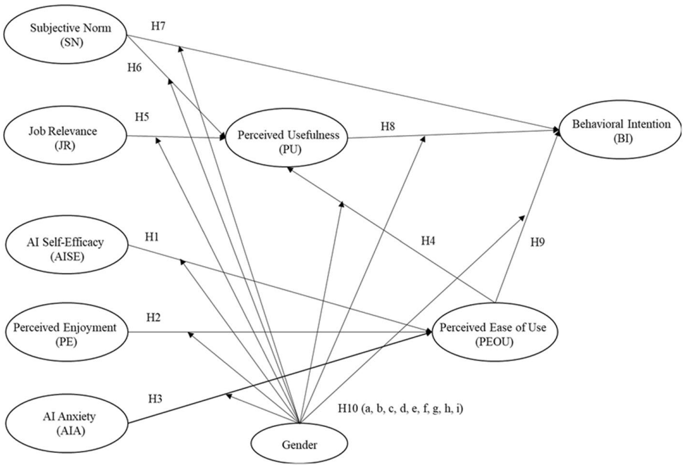
Over the past few years, there has been a significant increase in the utilization of artificial intelligence (AI)-based educational applications in education. As pre-service teachers’ attitudes towards educational technology that utilizes AI have a potential impact on the learning outcomes of their future students, it is essential to know more about pre-service teachers’ acceptance of AI. The aims of this study are (1) to discover what factors determine pre-service teachers’ intentions to utilize AI-based educational applications and (2) to determine whether gender differences exist within determinants that affect those behavioral intentions. A sample of 452 pre-service teachers (325 female) participated in a survey at one German university. Based on a prominent technology acceptance model, structural equation modeling, measurement invariance, and multigroup analysis were carried out. The results demonstrated that eight out of nine hypotheses were supported; perceived ease of use ( β = 0.297***) and perceived usefulness ( β = 0.501***) were identified as primary factors predicting pre-service teachers’ intention to use AI. Furthermore, the latent mean differences results indicated that two constructs, AI anxiety (z = − 3.217**) and perceived enjoyment (z = 2.556*), were significantly different by gender. In addition, it is noteworthy that the paths from AI anxiety to perceived ease of use ( p = 0.018*) and from perceived ease of use to perceived usefulness ( p = 0.002**) are moderated by gender. This study confirms the determinants influencing the behavioral intention based on the Technology Acceptance Model 3 of German pre-service teachers to use AI-based applications in education. Furthermore, the results demonstrate how essential it is to address gender-specific aspects in teacher education because there is a high percentage of female pre-service teachers, in general. This study contributes to state of the art in AI-powered education and teacher education.
Overview
The claims and statistics of this paper haven’t been checked yet.
Free: it reads the open-access text and checks the first 5 claims that cite a source we can check. Create a free account to check every claim.
Integrity signals
Registry
Cites
Statistics
Figures
Verification
Claims the paper makes
The claims and statistics of this paper haven’t been checked yet.
Free: it reads the open-access text and checks the first 5 claims that cite a source we can check. Create a free account to check every claim.
Claims other papers make about this one
Each is checked against this paper’s own text: does it say what the citing paper says it does?
The source backs part of the claim, not all of it — or backs it for a different population, condition or comparison.
In the citing paper
“Directly relevant to mentorship needs, AI applications, as demonstrated by researchers like Zhang et al. (2023) and Doroudi (2023), have proven effective in providing personalised feedback, facilitating reflective practice, and offering adaptive learning resources.”
From Mentorship in the Age of Generative AI: ChatGPT to Support Self-Regulated Learning of Pre-Service Teachers Before and During Placements (2025) · cites this paper as Zhang et al., 2023
Experimental — accuracy not yet measured
Self-check
Percentages, sums and reported differences re-computed from the paper’s own numbers.
The self-check needs the paper’s full text.
Citations
Cites
R: A Language and Environment for Statistical Computing
R Core Team (2025) · doi:10.32614/r.manuals · Cited by 352,181
Perceived usefulness, perceived ease of use, and user acceptance of information technology
Davis, F. D. (1989) · MIS Quarterly · doi:10.2307/249008 · Cited by 68,483 · cited 1×
“The TAM, built on the TRA, can be used to foresee the adoption of any specific technology (Davis, 1989).”
MethodUser Acceptance of Information Technology: Toward A Unified View1
Venkatesh, V., Morris, M. G., Davis, G. B., & Davis, F. D. (2003) · MIS Quarterly · doi:10.2307/30036540 · Cited by 45,035
lavaan : An R Package for Structural Equation Modeling
Rosseel, Y. (2012) · Journal of Statistical Software · doi:10.18637/jss.v048.i02 · Cited by 27,955
(1980) · Medical Entomology and Zoology · Cited by 25,810
A Theoretical Extension of the Technology Acceptance Model: Four Longitudinal Field Studies
Venkatesh, V., & Davis, F. D. (2000) · Management Science · doi:10.1287/mnsc.46.2.186.11926 · Cited by 23,066
Evaluating Goodness-of-Fit Indexes for Testing Measurement Invariance
Cheung, G. W., & Rensvold, R. B. (2002) · Structural Equation Modeling: A Multidisciplinary Journal · doi:10.1207/s15328007sem0902_5 · Cited by 16,280 · cited 1×
“A value of ΔCFI higher than 0.01 indicates a significant drop in fit between the two models (Cheung & Rensvold, 2002).”
BackgroundInfluentialConfirmatory factor analysis for applied research
(2007) · Choice Reviews Online · doi:10.5860/choice.44-2769 · Cited by 15,614 · cited 1×
“As Brown (2006) recommended, before performing the invariance measurement, the initial measurement model requires splitting into two datasets; in this study, one for male students and the other for female students.”
BackgroundTechnology Acceptance Model 3 and a Research Agenda on Interventions
Venkatesh, V., & Bala, H. (2008) · Decision Sciences · doi:10.1111/j.1540-5915.2008.00192.x · Cited by 8,159
Vandenberg, R. J., & Lance, C. E. (2000) · Organizational Research Methods · doi:10.1177/109442810031002 · Cited by 7,997
Zawacki-Richter, O., Marín, V. I., Bond, M., & Gouverneur, F. (2019) · International Journal of Educational Technology in Higher Education · doi:10.1186/s41239-019-0171-0 · Cited by 7,242 · cited 1×
“One such challenge is the weak link between theoretical and pedagogical perspectives and the practical application of AI in the classroom; additionally, ethical and educational approaches to AI are still in the exploratory stage (Zawacki-Richter et al., 2019).”
BackgroundStructural Equation Modeling With AMOS: Basic Concepts, Applications, and Programming, Third Edition
Byrne, B. M. (2016) · doi:10.4324/9781315757421 · Cited by 4,653
Technology acceptance model: a literature review from 1986 to 2013
Marangunić, N., & Granić, A. (2015) · Universal Access in the Information Society · doi:10.1007/s10209-014-0348-1 · Cited by 2,458
Social Cognitive Theory in Cultural Context
Bandura, A. (2002) · Applied Psychology · doi:10.1111/1464-0597.00092 · Cited by 2,092 · cited 1×
“This phenomenon can be explained by social cognitive theory (Bandura, 2002), which suggests that individuals’ perceptions of social influence can impact their self-efficacy, perceived expectations, and resistance to change.”
BackgroundEagly, A. H., & Wood, W. (2012) · Handbook of Theories of Social Psychology · doi:10.4135/9781446249222.n49 · Cited by 1,853 · cited 1×
“This is also supported by social role theory (Eagly & Wood, 2012).”
MethodSchepers, J., & Wetzels, M. (2007) · Information & Management · doi:10.1016/j.im.2006.10.007 · Cited by 1,656
(2016) · Open Research Online (The Open University) · Cited by 1,410
Social Measurement: Current Issues
Bohrnstedt, G. W., & Borgatta, E. F. (1981) · Medical Entomology and Zoology · Cited by 1,394
A Review of Artificial Intelligence (AI) in Education from 2010 to 2020
Zhai, X., Chu, X., Chai, C. S., Jong, M. S. Y., Istenic, A., Spector, M., Liu, J.-B., Yuan, J., & Li, Y. (2021) · Complexity · doi:10.1155/2021/8812542 · Cited by 1,364
Strong Evidence for Gender Differences in Risk Taking
Charness, G., & Gneezy, U. (2012) · Journal of Economic Behavior & Organization · doi:10.1016/j.jebo.2011.06.007 · Cited by 1,357
Technology acceptance model in educational context: A systematic literature review
Granić, A., & Marangunić, N. (2019) · British Journal of Educational Technology · doi:10.1111/bjet.12864 · Cited by 1,204
Acceptance of Internet-based learning medium: the role of extrinsic and intrinsic motivation
Lee, M. K. O., Cheung, C. M. K., & Chen, Z. (2005) · Information & Management · doi:10.1016/j.im.2003.10.007 · Cited by 1,184 · cited 1×
“PU is another key driver influencing the user’s performance (Lee et al., 2005).”
BackgroundApplication and theory gaps during the rise of artificial intelligence in education
Chen, X., Xie, H., Zou, D., & Hwang, G.-J. (2020) · Computers and Education: Artificial Intelligence · doi:10.1016/j.caeai.2020.100002 · Cited by 1,003
The role of moderating factors in user technology acceptance
Sun, H., & Zhang, P. (2006) · International Journal of Human-Computer Studies · doi:10.1016/j.ijhcs.2005.04.013 · Cited by 982
An Integrated Approach to Communication Theory and Research
(2014) · Routledge eBooks · doi:10.4324/9780203887011 · Cited by 981
AI technologies for education: Recent research & future directions
Zhang, K., & Aslan, A. B. (2021) · Computers and Education: Artificial Intelligence · doi:10.1016/j.caeai.2021.100025 · Cited by 923
Wang, Y.-Y., & Wang, Y.-S. (2022) · Interactive Learning Environments · doi:10.1080/10494820.2019.1674887 · Cited by 716
Toward a Framework for Levels of Robot Autonomy in Human-Robot Interaction
Beer, J. M., Fisk, A. D., & Rogers, W. A. (2014) · Journal of Human-Robot Interaction · doi:10.5898/jhri.3.2.beer · Cited by 629 · cited 1×
“(1) Unlike computers, AI can make autonomous decisions (Beer et al., 2014); (2) AI has a variety of virtual forms (Castelo et al.”
BackgroundHolden, H., & Rada, R. (2011) · Journal of Research on Technology in Education · doi:10.1080/15391523.2011.10782576 · Cited by 584
Teo, T., & Noyes, J. (2011) · Computers & Education · doi:10.1016/j.compedu.2011.03.002 · Cited by 531
Dimensions of artificial intelligence anxiety based on the integrated fear acquisition theory
Li, J., & Huang, J.-S. (2020) · Technology in Society · doi:10.1016/j.techsoc.2020.101410 · Cited by 453
Teachers’ readiness and intention to teach artificial intelligence in schools
Ayanwale, M. A., Sanusi, I. T., Adelana, O. P., Aruleba, K. D., & Oyelere, S. S. (2022) · Computers and Education: Artificial Intelligence · doi:10.1016/j.caeai.2022.100099 · Cited by 412
Teo, T., Lee, C. B., Chai, C. S., & Wong, S. L. (2009) · Computers & Education · doi:10.1016/j.compedu.2009.05.017 · Cited by 402 · cited 2×
“Previous studies on technology acceptance have also shown that perceived usefulness has a more significant effect (Koutromanos et al., 2015; Teo, 2012; Teo et al., 2009; Wong, 2015).”
BackgroundEaton, A. A., Saunders, J. F., Jacobson, R. K., & West, K. (2020) · Sex Roles · doi:10.1007/s11199-019-01052-w · Cited by 391
Mobile-based assessment: Investigating the factors that influence behavioral intention to use
Nikou, S. A., & Economides, A. A. (2017) · Computers & Education · doi:10.1016/j.compedu.2017.02.005 · Cited by 388
Factors influencing students’ acceptance of m-learning: An investigation in higher education
Abu-Al-Aish, A., & Love, S. (2013) · The International Review of Research in Open and Distributed Learning · doi:10.19173/irrodl.v14i5.1631 · Cited by 376
Learning cultures and learning styles: myth-understandings about adult (Hong Kong) Chinese learners
Kennedy, P. (2002) · International Journal of Lifelong Education · doi:10.1080/02601370210156745 · Cited by 369
Johnson, D. G., & Verdicchio, M. (2017) · Journal of the Association for Information Science and Technology · doi:10.1002/asi.23867 · Cited by 367
Promoting students' well-being by developing their readiness for the artificial intelligence age
Dai, Y., Chai, C.-S., Lin, P.-Y., Jong, M. S.-Y., Guo, Y., & Qin, J. (2020) · Sustainability · doi:10.3390/su12166597 · Cited by 330
Chen, H.-R., & Tseng, H.-F. (2012) · Evaluation and Program Planning · doi:10.1016/j.evalprogplan.2011.11.007 · Cited by 313
Unpacking teachers’ intentions to integrate technology: A meta-analysis
Scherer, R., & Teo, T. (2019) · Educational Research Review · doi:10.1016/j.edurev.2019.03.001 · Cited by 302
Choi, S., Jang, Y., & Kim, H. (2023) · International Journal of Human–Computer Interaction · doi:10.1080/10447318.2022.2049145 · Cited by 294
Girls in STEM: Is It a Female Role-Model Thing?
González-Pérez, S., Mateos de Cabo, R., & Sáinz, M. (2020) · Frontiers in Psychology · doi:10.3389/fpsyg.2020.02204 · Cited by 271 · cited 1×
“students may have less previous experience and exposure to STEM fields compared to males (González-Pérez et al., 2020).”
BackgroundTeo, T., & Noyes, J. (2014) · Interactive Learning Environments · doi:10.1080/10494820.2011.641674 · Cited by 234
Teo, T. (2012) · Interactive Learning Environments · doi:10.1080/10494821003714632 · Cited by 234
Why Some Teachers Resist Change and What Principals Can Do About It
Zimmerman, J. (2006) · NASSP Bulletin · doi:10.1177/0192636506291521 · Cited by 233 · cited 1×
“The reasons preventing their acceptance include teachers’ anxiety (Zimmerman, 2006) about interacting with new technology, their comfort zone, and their willingness to use the same materials and didactics (Tallvid, 2016).”
BackgroundTesting Factorial Invariance With Unbalanced Samples
Yoon, M., & Lai, M. H. C. (2018) · Structural Equation Modeling: A Multidisciplinary Journal · doi:10.1080/10705511.2017.1387859 · Cited by 230
The use of AI in education: Practicalities and ethical considerations
Reiss, M. J. (2021) · London Review of Education · doi:10.14324/lre.19.1.05 · Cited by 211 · cited 1×
“While some see the potential of AI in education and see it as a way to make it more fair and equitable for all students, others are skeptical and reject it because they fear it will replace teachers and increase unemployment (Reiss, 2021).”
BackgroundFactors Impacting Teachers’ Adoption of Mobile Learning
Mac Callum, K., Jeffrey, L., & NA, K. (2014) · Journal of Information Technology Education: Research · doi:10.28945/1970 · Cited by 208
Factors impacting special education teachers’ acceptance and actual use of technology
Siyam, N. (2019) · Education and Information Technologies · doi:10.1007/s10639-018-09859-y · Cited by 203 · cited 1×
“, 2015), self-efficacy (Wong, 2015), and job relevance (Siyam, 2019) positively influence perceived usefulness.”
BackgroundInvestigating a theoretical framework for e-learning technology acceptance
Al Kurdi, B., Alshurideh, M., & Salloum, S. A. (2020) · International Journal of Electrical and Computer Engineering (IJECE) · doi:10.11591/ijece.v10i6.pp6484-6496 · Cited by 202
STEM stereotypes predict students’ STEM career interest via self-efficacy and outcome expectations
Luo, T., So, W. W. M., Wan, Z. H., & Li, W. C. (2021) · International Journal of STEM Education · doi:10.1186/s40594-021-00295-y · Cited by 195
Understanding teachers’ reluctance to the pedagogical use of ICT in the 1:1 classroom
Tallvid, M. (2014) · Education and Information Technologies · doi:10.1007/s10639-014-9335-7 · Cited by 176
Gender-based differences in attitudes toward computers
Shashaani, L. (1993) · Computers & Education · doi:10.1016/0360-1315(93)90085-w · Cited by 173 · cited 2×
“, 2009), and with a focus on gender (Emin & Sami, 2016; Shashaani, 1993; Teo et al., 2015).”
BackgroundTechnology acceptance among pre-service teachers: Does gender matter?
Teo, T., Fan, X., & Du, J. (2015) · Australasian Journal of Educational Technology · doi:10.14742/ajet.1672 · Cited by 155 · cited 4×
“According to previous research, perceived ease of use (Teo et al., 2015), self-efficacy (Wong, 2015), and job relevance (Siyam, 2019) positively influence perceived usefulness.”
BackgroundMethodResultInfluentialPapadakis, S. (2018) · International Journal of Mobile Learning and Organisation · doi:10.1504/ijmlo.2018.095130 · Cited by 141
Ursavaş, Ö. F., Yalçın, Y., & Bakır-Yalçın, E. (2019) · British Journal of Educational Technology · doi:10.1111/bjet.12834 · Cited by 127
Does it matter being innovative: Teachers’ technology acceptance
Mazman, S. G. (2019) · Education and Information Technologies · doi:10.1007/s10639-019-09933-z · Cited by 126
Understanding technology acceptance in pre-service teachers of primary mathematics in Hong Kong
Wong, G. K. W. (2015) · Australasian Journal of Educational Technology · doi:10.14742/ajet.1890 · Cited by 120 · cited 4×
“Similarly, research conducted in Hong Kong with pre-service mathematics teachers revealed that PU was more influential than perceived ease of use in the TAM (Wong, 2015).”
BackgroundResultInfluentialMoè, A., Hausmann, M., & Hirnstein, M. (2020) · Psychological Research · doi:10.1007/s00426-019-01285-0 · Cited by 114
Gendered differences in academic emotions and their implications for student success in STEM
Pelch, M. (2018) · International Journal of STEM Education · doi:10.1186/s40594-018-0130-7 · Cited by 100
(2021) · DOAJ (DOAJ: Directory of Open Access Journals) · Cited by 91
Are pre‐service teachers disinclined to utilise embodied humanoid social robots in the classroom?
Starčič, A. I., Bratko, I., & Rosanda, V. (2021) · British Journal of Educational Technology · doi:10.1111/bjet.13144 · Cited by 85
Luan, W. S., & Teo, T. (2009) · The Asia-Pacific Education Researcher · doi:10.3860/taper.v18i2.1327 · Cited by 81
Human or Robot? Consumer Responses to Radical Cognitive Enhancement Products
Castelo, N., Schmitt, B., & Sarvary, M. (2019) · Journal of the Association for Consumer Research · doi:10.1086/703462 · Cited by 80
A model for preservice teachers’ intentions to use ICT in future lessons
Baydaş, Ö., & Göktaş, Y. (2016) · Interactive Learning Environments · doi:10.1080/10494820.2016.1232277 · Cited by 72
Zarafshani, K., Solaymani, A., D’Itri, M., Helms, M. M., & Sanjabi, S. (2020) · Social Sciences & Humanities Open · doi:10.1016/j.ssaho.2020.100041 · Cited by 72 · cited 1×
“The results of this study are consistent with those of the technology acceptance (Schepers & Wetzels, 2007; Mazman Akar et al., 2019; Zarafshani et al., 2020).”
ResultEffects and acceptance of precision education in an AI-supported smart learning environment
Hu, Y.-H. (2022) · Education and Information Technologies · doi:10.1007/s10639-021-10664-3 · Cited by 68
Digital Teaching Competence Evaluation of Pre-Service Teachers in Spain: A Review Study
Mínguez, R. T., Guerrero, C. S., & Sanz‐Cervera, P. (2021) · IEEE Revista Iberoamericana de Tecnologias del Aprendizaje · doi:10.1109/rita.2021.3052848 · Cited by 64 · cited 1×
“Current research on technology acceptance in the educational context is based on the Technology Acceptance Model (TAM) (Granić & Marangunić, 2019; Scherer & Teo, 2019; Tarraga-Minguez et al., 2021).”
MethodPre-service teachers’ acceptance of mobile-technology-supported learning activities
İslamoğlu, H., Yurdakul, I. K., & Ursavaş, Ö. F. (2021) · Educational Technology Research and Development · doi:10.1007/s11423-021-09973-8 · Cited by 60
Educational big data: extracting meaning from data for smart education
Chen, N.-S., Yin, C., Isaias, P., & Psotka, J. (2020) · Interactive Learning Environments · doi:10.1080/10494820.2019.1635395 · Cited by 58
The Future of Service Post-COVID-19 Pandemic, Volume 1: Rapid Adoption of Digital Service Technology
Lee, J., & Han, S. H. (2021) · The ICT and Evolution of Work · doi:10.1007/978-981-33-4126-5 · Cited by 54
Liaw, S.-S., & Huang, H. (2015) · The International Review of Research in Open and Distributed Learning · doi:10.19173/irrodl.v16i4.2355 · Cited by 52
The Role of Self-efficacy in Technology Acceptance
Alharbi, S., & Drew, S. (2018) · Advances in intelligent systems and computing · doi:10.1007/978-3-030-02686-8_85 · Cited by 46 · cited 1×
“Previous research shows self-efficacy (Alharbi & Drew, 2018) and perceived enjoyment (Teo & Noyes, 2011) have been positively associated with PEOU.”
BackgroundInvestigating Pre-Service Teachers’ Behavioral Intentions to Use Web 2.0 Gamification Tools
Turan, Z., Küçük, S., & Karabey, S. Ç. (2022) · Participatory Educational Research · doi:10.17275/per.22.85.9.4 · Cited by 43
Koutromanos, G., Styliaras, G., & Christodoulou, S. (2014) · Education and Information Technologies · doi:10.1007/s10639-013-9302-8 · Cited by 41
How to Measure Teachers' Acceptance of AI-driven Assessment in eLearning: A TAM-based Proposal
Sánchez-Prieto, J. C., Cruz-Benito, J., Therón, R., & García-Peñalvo, F. J. (2019) · Proceedings of the Seventh International Conference on Technological Ecosystems for Enhancing Multiculturality · doi:10.1145/3362789.3362918 · Cited by 29 · cited 1×
“because this theoretical model can adequately test how technology and AI are accepted in various settings (Sánchez-Prieto et al., 2019; Scherer & Teo, 2019).”
BackgroundNumeracy Gender Gap in STEM Higher Education: The Role of Neuroticism and Math Anxiety
Lunardon, M., Cerni, T., & Rumiati, R. I. (2022) · Frontiers in Psychology · doi:10.3389/fpsyg.2022.856405 · Cited by 23
İbili, E., & Sami, S. (2016) · Educational Research and Reviews · doi:10.5897/err2015.2119 · Cited by 21 · cited 1×
“…been widely applied to a broad range of different types of educational tools (Chen & Tseng, 2012; Koutromanos et al., 2015; Luan & Teo, 2009; Mac Callum et al., 2014); across cultural contexts (Teo et al., 2009), and with a focus on gender (Emin & Sami, 2016; Shashaani, 1993; Teo et al., 2015).”
BackgroundTeachers' Attitudes Towards the Use of Tablets in Six EFL Classrooms
Kaban, A. L., & Ergül, I. B. (2020) · Advances in educational technologies and instructional design book series · doi:10.4018/978-1-7998-2104-5.ch015 · Cited by 21
Teo, T. P. (2010) · Campus-Wide Information Systems · doi:10.1108/10650741011073770 · Cited by 18 · cited 2×
“acceptance of technology has found that gender was a moderator in some cases, but the results have been inconsistent (Papadakis, 2018; Teo, 2010; Teo et al., 2015).”
BackgroundResult(2019) · MINISTERIO DE EDUCACIÓN
(1994)
Research works printed but not linked: 3
- Ajzen, I. (1985). From intentions to actions: A theory of planned behavior. In Action control (pp. 11–39). Springer. https://doi.org/10.1007/978-3-642-69746-3_24 · doi:10.1007/978-3-642-69746-3_24
- 19. Fornell, C., Tellis, G. J., & Zinkhan, G. M. (1982). Validity assessment: A structural equations approach using partial least squares. In Proceedings of the American marketing association educators' conference (Vol. 48, pp. 405-409).
- 22. Hair, J. F., Black, W. C., Babin, B. J., & Anderson, R. E. (2019). Multivariate data analysis (8th). Cengage Learning.
Cited by
Yusuf, A., Pervin, N., & Román-González, M. (2024) · International Journal of Educational Technology in Higher Education · doi:10.1186/s41239-024-00453-6 · Cited by 554
“Recent studies have reported the continual proliferation of Artificial Intelligence (AI) tools in HE (e.g., Chu et al., 2022; Crompton & Burke, 2023) owing to their potential benefits, including improved personalized learning (Bhutoria, 2022), automation of repetitive tasks (de la Torre-López et al., 2023), and provis…”
BackgroundSchiavo, G., Businaro, S., & Zancanaro, M. (2024) · Technology in Society · doi:10.1016/j.techsoc.2024.102537 · Cited by 284
Teachers and AI: Understanding the factors influencing AI integration in K-12 education
Filiz, O., Kaya, M. H., & Adıgüzel, T. (2025) · Education and Information Technologies · doi:10.1007/s10639-025-13463-2 · Cited by 277
“Teachers’ resistance often stems from negative attitudes towards innovations and a hesitancy to leave their comfort zones, thereby hindering their willingness to embrace AI in the classroom (Istenic et al., 2021; Zhang et al., 2023).”
Delcker, J., Heil, J., Ifenthaler, D., Seufert, S., & Spirgi, L. (2024) · International Journal of Educational Technology in Higher Education · doi:10.1186/s41239-024-00452-7 · Cited by 147
Dahri, N. A., Yahaya, N., Al-Rahmi, W. M., Aldraiweesh, A., Alturki, U., Almutairy, S., Shutaleva, A., & Soomro, R. B. (2024) · Heliyon · doi:10.1016/j.heliyon.2024.e29317 · Cited by 239
“TAM has been extensively employed to understand the determinants of technology acceptance in various regions including Germany [50], US [51], Saudi Arabia [52], Pakistan [53], Malaysia [54], Turkey [55], Greece [56], Indonesia [57], South Korea [58], and China [56,57], and across different…”
Background
Metadata
- Authors
- Zhang, C., Schießl, J., Plößl, L., Hofmann, F., & Gläser-Zikuda, M.
- Affiliations
- Friedrich-Alexander-Universität Erlangen-Nürnberg (DE)
- Corresponding author
- Zhang, Chengming
- Venue
- International Journal of Educational Technology in Higher Education
- Published
- 2023-09-04
- Volume
- 20
- Issue
- 1
- ISSN
- 2365-9440 (ISSN-L)
- OpenAlex
- W4386405611
- Cited by
- 413
- References
- 84
- Citations by year
- 2026: 146 · 2025: 173 · 2024: 88 · 2023: 6
- FWCI
- 96.92
- Type
- journal article
- Language
- en
- Open access
- diamond
- doi.org
- Licence
- cc-by
- creativecommons.org/licenses/by/4.0 (tdm)
- creativecommons.org/licenses/by/4.0 (vor)
- Locations
- International Journal of Educational Technology in Higher Education (publishedVersion, cc-by)
- DOAJ (DOAJ: Directory of Open Access Journals) (submittedVersion, cc-by-sa)
- Funders
- BMBF (16DHB4019)
- Topics
- Social Sciences › Education › Artificial Intelligence in Education
- Social Sciences › Decision Sciences › Information Systems and Management › Technology Adoption and User Behaviour
- Social Sciences › Gender Studies › Gender and Technology in Education
- Keywords
- artificial intelligence in education, pre-service teachers, technology acceptance, behavioral intention, perceived usefulness, perceived ease of use, AI anxiety, perceived enjoyment, gender differences, teacher professional development, technology acceptance model
About these checks
Registry, retraction, Cites and statistics results are computed, not judged, with one exception: a printed reference that no index lists is read once by a model before it counts as a citation error. Claims are extracted by a model and kept only when their quote appears verbatim in the text; each cited source is then checked, with a model’s help, for whether it says what the claim relies on. Those verdicts can be wrong — read the claim’s quote and the cited source before relying on one.
Statistics and arithmetic are recomputed, not judged.
Confidence bands are shown only for fields calibrated on our annotated test set. None is calibrated yet, so no band is shown.
What counts as a claim ›How we measure confidence ›How we check this ›
Are you an author, or do you see a problem with this page? Request a review
Data sources
Bibliographic data: Semantic Scholar, OpenAlex, Crossref.
Contains information from the Semantic Scholar Academic Graph Datasets, made available under the ODC Attribution License (ODC-BY 1.0).
Semantic Scholar’s data is described in: Kinney, R., et al. (2023). The Semantic Scholar Open Data Platform. arXiv:2301.10140.
