

Acceptance of artificial intelligence among pre-service teachers: a multigroup analysis
Open accessThe DOI matches its Crossref record; 83 of the 84 references it cites were found in a registry or an index.
Abstract
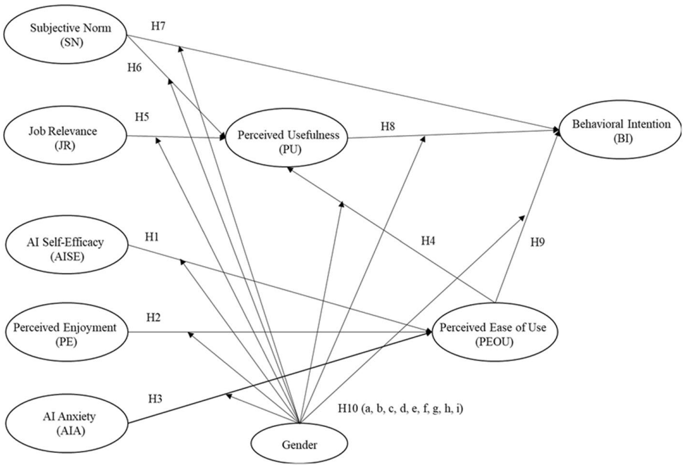
Over the past few years, there has been a significant increase in the utilization of artificial intelligence (AI)-based educational applications in education. As pre-service teachers’ attitudes towards educational technology that utilizes AI have a potential impact on the learning outcomes of their future students, it is essential to know more about pre-service teachers’ acceptance of AI. The aims of this study are (1) to discover what factors determine pre-service teachers’ intentions to utilize AI-based educational applications and (2) to determine whether gender differences exist within determinants that affect those behavioral intentions. A sample of 452 pre-service teachers (325 female) participated in a survey at one German university. Based on a prominent technology acceptance model, structural equation modeling, measurement invariance, and multigroup analysis were carried out. The results demonstrated that eight out of nine hypotheses were supported; perceived ease of use ( β = 0.297***) and perceived usefulness ( β = 0.501***) were identified as primary factors predicting pre-service teachers’ intention to use AI. Furthermore, the latent mean differences results indicated that two constructs, AI anxiety (z = − 3.217**) and perceived enjoyment (z = 2.556*), were significantly different by gender. In addition, it is noteworthy that the paths from AI anxiety to perceived ease of use ( p = 0.018*) and from perceived ease of use to perceived usefulness ( p = 0.002**) are moderated by gender. This study confirms the determinants influencing the behavioral intention based on the Technology Acceptance Model 3 of German pre-service teachers to use AI-based applications in education. Furthermore, the results demonstrate how essential it is to address gender-specific aspects in teacher education because there is a high percentage of female pre-service teachers, in general. This study contributes to state of the art in AI-powered education and teacher education.
Overview
The claims and statistics of this paper haven’t been checked yet.
Free: it reads the open-access text and checks the first 5 claims that cite a source we can check. Create a free account to check every claim.
Integrity signals
Registry
Cites
Statistics
Figures
Verification
Claims the paper makes
The claims and statistics of this paper haven’t been checked yet.
Free: it reads the open-access text and checks the first 5 claims that cite a source we can check. Create a free account to check every claim.
Claims other papers make about this one
Each is checked against this paper’s own text: does it say what the citing paper says it does?
The source backs part of the claim, not all of it — or backs it for a different population, condition or comparison.
In the citing paper
“Directly relevant to mentorship needs, AI applications, as demonstrated by researchers like Zhang et al. (2023) and Doroudi (2023), have proven effective in providing personalised feedback, facilitating reflective practice, and offering adaptive learning resources.”
From Mentorship in the Age of Generative AI: ChatGPT to Support Self-Regulated Learning of Pre-Service Teachers Before and During Placements (2025) · cites this paper as Zhang et al., 2023
Experimental — accuracy not yet measured
Self-check
Percentages, sums and reported differences re-computed from the paper’s own numbers.
The self-check needs the paper’s full text.
Citations
Cites
R: A Language and Environment for Statistical Computing
R Core Team (2025) · doi:10.32614/r.manuals · Cited by 352,181
Perceived usefulness, perceived ease of use, and user acceptance of information technology
Davis, F. D. (1989) · MIS Quarterly · doi:10.2307/249008 · Cited by 68,483 · cited 1×
“The TAM, built on the TRA, can be used to foresee the adoption of any specific technology (Davis, 1989).”
MethodUser Acceptance of Information Technology: Toward A Unified View1
Venkatesh, V., Morris, M. G., Davis, G. B., & Davis, F. D. (2003) · MIS Quarterly · doi:10.2307/30036540 · Cited by 45,035
lavaan : An R Package for Structural Equation Modeling
Rosseel, Y. (2012) · Journal of Statistical Software · doi:10.18637/jss.v048.i02 · Cited by 27,955
(1980) · Medical Entomology and Zoology · Cited by 25,810
A Theoretical Extension of the Technology Acceptance Model: Four Longitudinal Field Studies
Venkatesh, V., & Davis, F. D. (2000) · Management Science · doi:10.1287/mnsc.46.2.186.11926 · Cited by 23,066
Evaluating Goodness-of-Fit Indexes for Testing Measurement Invariance
Cheung, G. W., & Rensvold, R. B. (2002) · Structural Equation Modeling: A Multidisciplinary Journal · doi:10.1207/s15328007sem0902_5 · Cited by 16,280 · cited 1×
“A value of ΔCFI higher than 0.01 indicates a significant drop in fit between the two models (Cheung & Rensvold, 2002).”
BackgroundInfluentialConfirmatory factor analysis for applied research
(2007) · Choice Reviews Online · doi:10.5860/choice.44-2769 · Cited by 15,614 · cited 1×
“As Brown (2006) recommended, before performing the invariance measurement, the initial measurement model requires splitting into two datasets; in this study, one for male students and the other for female students.”
BackgroundTechnology Acceptance Model 3 and a Research Agenda on Interventions
Venkatesh, V., & Bala, H. (2008) · Decision Sciences · doi:10.1111/j.1540-5915.2008.00192.x · Cited by 8,159
Vandenberg, R. J., & Lance, C. E. (2000) · Organizational Research Methods · doi:10.1177/109442810031002 · Cited by 7,997
Research works printed but not linked: 3
- Ajzen, I. (1985). From intentions to actions: A theory of planned behavior. In Action control (pp. 11–39). Springer. https://doi.org/10.1007/978-3-642-69746-3_24 · doi:10.1007/978-3-642-69746-3_24
- 19. Fornell, C., Tellis, G. J., & Zinkhan, G. M. (1982). Validity assessment: A structural equations approach using partial least squares. In Proceedings of the American marketing association educators' conference (Vol. 48, pp. 405-409).
- 22. Hair, J. F., Black, W. C., Babin, B. J., & Anderson, R. E. (2019). Multivariate data analysis (8th). Cengage Learning.
Cited by
Items 301–400 of 615
Rohana, W. D., Nugraha, J., & Koblianska, I. (2025) · Jurnal Pendidikan Administrasi Perkantoran (JPAP) · doi:10.26740/jpap.v13n2.p498-512 · Cited by 2
“In the TAM model, the Enjoyment variable is a variable that can affect the perception of ease in using technology (Zhang et al., 2023).”
Bóbkina, J., & Romero, E. D. (2026) · Springer eBooks · doi:10.1007/978-981-95-4871-2_17 · Cited by 2
Zaim, M., Arsyad, S., Waluyo, B., Syafei, A. F. R., Ratmanida, & Zaim, R. A. (2026) · Education Sciences · doi:10.3390/educsci16020271 · Cited by 3
Turki, A. (2026) · Frontiers in Education · doi:10.3389/feduc.2026.1727497 · Cited by 2
Zhang, Y. (2026) · Open Praxis · doi:10.55982/openpraxis.18.1.1010 · Cited by 3
Hong, T. T. M., Tung, N. T. T., & Thinh, H. T. (2026) · Discover Education · doi:10.1007/s44217-026-01289-0 · Cited by 7
AI for adaptive science teaching: strengthening teacher self-efficacy and perceived usefulness
Brückner, M., Thyssen, C., & Huwer, J. (2026) · Frontiers in Education · doi:10.3389/feduc.2026.1759274 · Cited by 2
Li, M., Yang, C., & Wang, Q. (2026) · Interactive Learning Environments · doi:10.1080/10494820.2026.2638486 · Cited by 3
“Although previous studies have interpreted gender differences in technology-related innovation partly through lenses such as risk preferences (Charness & Gneezy, 2012) or gender stereotypes (Zhang et al., 2023), the gender patterns observed in this study should be interpreted with caution.”
Towards AI Literacy in L1 Education: Examining L1 Teachers’ Beliefs About Generative AI
Stevens, E., van Rijt, J., Bluijs, S., & Bax, S. (2026) · Digital studies in language and literature · doi:10.1515/dsll-2025-0003 · Cited by 2
“TAM has been used to assess AI acceptance for various groups of pre-and in-service teachers (Bergdahl and Sjöberg 2025; Dahri et al. 2024; Kong et al. 2024; Wang et al. 2025; Zhang et al. 2023).”
Karagiorgou, C.-E., Koukis, N., Koundourou, C., & Tzovla, E. (2026) · Contemporary Educational Technology · doi:10.30935/cedtech/18149 · Cited by 2
Vocational Teachers’ Insights on Artificial Intelligence and Computational Thinking Integration
Majid, N. W. A., Barri, M. A. F., Sari, A. P., Sodikin, R. A., Azman, M. N. A., & Prestoza, M. J. R. (2026) · Jurnal Penelitian dan Pengkajian Ilmu Pendidikan e-Saintika · doi:10.36312/e-saintika.v10i1.3660 · Cited by 2
Jeong, D.-K., & Kwon, Y.-J. (2026) · The American Biology Teacher · doi:10.1525/abt.2026.88.3.167 · Cited by 3
Duan, Z., Shan, Y., & Gong, Y. (2026) · Computers and Education Artificial Intelligence · doi:10.1016/j.caeai.2026.100589 · Cited by 4
Transformational Leadership as a Contextual Enabler of Teachers’ AI Use
Chassida, Y. (2026) · Education Sciences · doi:10.3390/educsci16040572 · Cited by 2
Nurkhin, A., Fachrurrozie, F., Mukhibad, H., Wolor, C. W., & Hoo, W. C. (2026) · European Journal of Educational Research · doi:10.12973/eu-jer.15.3.813 · Cited by 2
Çokçalışkan, A., & Şener, S. (2026) · Advances in computational intelligence and robotics book series · doi:10.4018/979-8-3373-6325-7.ch013 · Cited by 3
Karaaslan, F., & Erişken, Y. (2026) · BMC Medical Education · doi:10.1186/s12909-026-09161-3 · Cited by 2
“Parallel findings in dental studies [2, 13] are consistent with this pattern and suggest that gender may be associated with how students appraise AI-related risks and responsibilities.”
InfluentialTeachers’ acceptance of AI-powered applications in teaching and learning mathematics and sciences
Habimana, O., Iyamuremye, A., Fadillah, M. A., & Isabwe, G. M. N. (2026) · Discover Education · doi:10.1007/s44217-026-01586-8 · Cited by 2
“The perception that AI improves academic support and provides adaptive learning pathways has also been noted in higher-education contexts [29] suggesting that AI’s perceived value transcends educational levels while remaining dependent on teacher mediation.”
Mai, C. V. T. (2026) · PaperAsia · doi:10.59953/paperasia.v42i2b.1015 · Cited by 2
“For instance, Ngubelanga and Duffett (2021) report that enjoyment enhances perceived ease of use in mobile commerce applications, while Zhang et al. (2023) find similar effects in AI-supported educational systems.”
Adoption of ChatGPT Among Higher Education Students: A PLS-SEM Analysis Using the UTAUT-2 Framework
Himang, C. M., Villa, S. C., Nolon, N. F., Pajaron, G. P., Jr., Himang, E., Villa, B., Gabia, C. C., Gabia, D. A., & Lopez, A. A. (2026) · International Journal of Information and Communication Technology Education · doi:10.4018/ijicte.411220 · Cited by 3
Alonso-Morales, N., Sáez-Martín, A., Díaz, A. M. P., & López-Hernández, A. M. (2026) · Journal of financial reporting & accounting · doi:10.1108/jfra-09-2025-0719 · Cited by 3
Wang, C., Zhang, D., & Yin, H. (2026) · International Journal of Information Management · doi:10.1016/j.ijinfomgt.2026.103090 · Cited by 3
Mersin, N. (2026) · Journal of Educational Computing Research · doi:10.1177/07356331261456930 · Cited by 2
“…research has shown that PU and PEOU are powerful determinants of teachers’ attitudes or intentions towards technology use (Al Darayseh, 2023; Gado et al., 2022; Zhang et al., 2023) and that PU has the more powerful of the two effects (Baydas¸ & G ¨ oktas¸, 2017; Teo et al., 2009; Teo, 2012).”
InfluentialKazykhankyzy, L., Khalmatova, Z., Seıtova, M., Kılıç, E., & Çelik, H. E. (2026) · European Journal of Education · doi:10.1111/ejed.70746 · Cited by 2
Cao, S., & Zheng, Y. (2026) · Sustainability · doi:10.3390/su18147206 · Cited by 3
Hsu, L., & Wang, Y.-C. (2026) · Asian-Pacific Journal of Second and Foreign Language Education · doi:10.1186/s40862-026-00421-9 · Cited by 2
Boumadan, M., Matosas-López, L., Tamayo, C. F. M., & Campos, L. (2026) · Revista Interuniversitaria de Formación del Profesorado Continuación de la antigua Revista de Escuelas Normales · doi:10.6018/rifop.701251 · Cited by 4
Aldemir, T., Biçer, A., Kılınç, S., Moon, J., & Kwok, M. (2026) · Cogent Education · doi:10.1080/2331186x.2026.2721038 · Cited by 2
Govender, S., & Ramatea, M. A. (2025) · IGI Global eBooks · doi:10.4018/979-8-3693-8759-7.ch010 · Cited by 2
Relator, A. A. A., Arguelles, A. F. P., Quizada, K. D., Toscano, J. C. N., & Protacio, A. V. (2025) · International Journal of English Literature and Social Sciences · doi:10.22161/ijels.103.14 · Cited by 2
“Similarly, Zhang et al. (2023) stress that pre-service teachers' perceptions evolve with experience, suggesting that teacher training programs should include targeted interventions and hands-on exposure to AI tools.”
Examining Attitudes of Turkish Pre-Service Teachers Towards Artificial Intelligence
Ata, R., & Alpaslan, M. M. (2025) · Communications in computer and information science · doi:10.1007/978-3-031-98003-9_4 · Cited by 2
da Silva, A. S., & Samá, S. (2026) · Educitec - Revista de Estudos e Pesquisas sobre Ensino Tecnológico · doi:10.31417/educitec.v12.2804 · Cited by 6
Peran Guru dan Tenaga Kependidikan dalam Sistem Pembelajaran di SMP Negeri 34 Surabaya
Kirana, D. A. A., & Rosita, R. D. A. (2024) · Jurnal Teknologi Pendidikan · doi:10.47134/jtp.v1i4.346 · Cited by 2
Ասատրյան, Ս., & Safaryan, N. (2025) · Main Issues Of Pedagogy And Psychology · doi:10.24234/miopap.v12i1.85 · Cited by 1
Teachers' AI Adoption in Namibia: A Theory of Planned Behaviour Analysis
Stefanus, L., Nhinda, G. T., & Shaanika, I. N. (2025) · Higher Education Research · doi:10.11648/j.her.20251003.12 · Cited by 1
Wen, O. Y., & Nasri, N. M. (2025) · International Journal of Academic Research in Progressive Education and Development · doi:10.6007/ijarped/v14-i3/26113 · Cited by 1
Couraceiro, P., Paisana, M., & Vasconcelos, A. (2025) · Revista de Comunicación · doi:10.26441/rc24.2-2025-4049 · Cited by 1
“In this sense, our results appear to be in line with those of Zhang et al. (2023), who emphasise that while women enjoy AI tools more, they also tend to feel more anxious about AI and are therefore less comfortable with it.”
Younis, B. (2025) · Proceedings of the International Conference on New Trends in Teaching and Education · doi:10.33422/ntteconf.v2i1.1232 · Cited by 1
“For instance, a study by Zhang et al. (2023) highlights the need for educators to be equipped with the skills to effectively integrate AI tools like ChatGPT into their teaching practices, moving beyond basic exposure to more meaningful and practical applications.”
InfluentialWang, Y. (2025) · Advances in Curriculum Design&Education · doi:10.63808/acde.v1i2.185 · Cited by 1
“The attitudes of teachers and students will be crucial for the successful use of AI (Zhang et al., 2023).”
Realigning English Language Teaching and Assessment through Pedagogy, Technology, and Purpose
Mohammad, S. I. S., PronemaBagchi, Natarajan, R., & Vasudevan, A. (2025) · Architecture Image Studies · doi:10.62754/ais.v6i3.208 · Cited by 1
Calle-Arango, L., Tello, A. B., & Rojas, J. (2025) · Teaching Education · doi:10.1080/10476210.2025.2603281 · Cited by 1
RURALITE ACCEPTANCE ON ARTIFICIAL INTELLIGENCE TECHNOLOGY ON STUNTING PREVALENCE REDUCTION
Wargadinata, E. L. (2026) · Journal of Trends and Challenges in Artificial Intelligence · doi:10.61552/jai.2026.01.001 · Cited by 1
Kılıç, M. S., Yaz, Ö. V., & Doğru, M. S. (2026) · Advances in computational intelligence and robotics book series · doi:10.4018/979-8-3373-5403-3.ch009 · Cited by 1
Delanoy, N. (2026) · Journal of Digital Life and Learning · doi:10.51357/jdll.v6i1.362 · Cited by 1
Ma, W., Jiang, L., Zhuang, W., Cai, J., Xie, X., & Zhang, C. (2026) · Educational Research Advances · doi:10.46690/era.2026.01.01 · Cited by 3
Self-citationNg, H. K. Y., & Chan, L. C. M. (2025) · International Workshop on Artificial Intelligence and Education (WAIE) · doi:10.1109/waie67422.2025.11381244 · Cited by 1
“Since 2024, only two studies specifically involved pre-service teachers [8][9].”
Pedagogy with generative artificial intelligence: Opportunities and challenges in education
Adewale, O. A., Rane, J., Ogbonna, M. O., & Rane, N. L. (2026) · International Journal of Applied Resilience and Sustainability · doi:10.70593/deepsci.0202013 · Cited by 2
“It is obvious that the opportunity is there: with the help of generative AI, the assistance industry can become more democratic and give individual students a tutor or writing coach which, in turn, may enhance the learning results and allow one to do more ambitious projects [88-91].”
Investigate Determinants and Configuration of Human AI Use: Combining PLS-SEM and fsQCA Analysis
Zhang, X., Dong, Q., Ma, L., Zhang, G., & Hao, F. (2026) · International Journal of Human-Computer Interaction · doi:10.1080/10447318.2026.2631657 · Cited by 1
“In line with the findings of previous studies (Zhang, Schießl, et al., 2023), these results suggest that the data exhibit good reliability.”
Kuang, T. M., Meythi, M., & Martusa, R. (2026) · Accounting Education · doi:10.1080/09639284.2026.2652619 · Cited by 1
Chen, Q., Xue, Y., Lin, J., & Zhu, C. (2026) · Big Data and Cognitive Computing · doi:10.3390/bdcc10040108 · Cited by 2
“Studies suggest an asymmetrical effect: when usefulness is perceived as high, especially under time pressure, students tend to downplay risks [6].”
InfluentialInvestigation of AI Anxiety and Some Personal Variables’ Effects on Teachers' Attitudes Towards AI
Özyürek, A., Gümüş, H., & AYDIN, A. (2026) · Kuramsal Eğitimbilim · doi:10.30831/akukeg.1785613 · Cited by 1
Paiwithayasiritham, C., Mingsiritham, K., Sinthaworn, W., & Busabong, C. (2026) · International Journal of Evaluation and Research in Education (IJERE) · doi:10.11591/ijere.v15i2.38385 · Cited by 1
“In the meantime, educational institutes should integrate AI ethics education into teacher training programs one after another [11].”
InfluentialAdewale, O. A. (2026) · International Journal of Applied Resilience and Sustainability · doi:10.70593/deepsci.0202048 · Cited by 2
MUSAH, E. (2026) · International Journal of Applied Resilience and Sustainability · doi:10.70593/deepsci.0202054 · Cited by 2
“Automated essay grading, plagiarism-detection systems, intelligent grading systems and adaptive-testing platforms are now considered standard components of web-based learning in online education programs and institution of higher education [18,47-49].”
Bara’u, R. (2026) · International Journal of Applied Resilience and Sustainability · doi:10.70593/deepsci.0203006 · Cited by 1
“Adaptive Learning Technologies are based on machine learning, predictive analytics, and learner profiles to personalize education [28,84-86].”
Du, X., Ling, C., Yang, L., & Liusi, W. (2026) · Digital Health · doi:10.1177/20552076261450815 · Cited by 1
“39 These findings are consistent with the core propositions of the TAM.”
Liu, F., & Wang, S. (2026) · Artificial Intelligence in Education · doi:10.1108/aiie-08-2025-0204 · Cited by 1
Choudhury, S., Kar, A., Shukla, P., & Khatun, R. (2026) · Asian Journal of Interdisciplinary Research · doi:10.54392/ajir26211 · Cited by 1
“The validation of this three-dimensional structure is one of the most important contributions of the study because it offers a more holistic framework than many earlier tools that focused on only one of these constructs in isolation (Zhang et al., 2023; Ramazanoglu & Akın, 2024 ).”
InfluentialGenerative AI literacy among pre-service teachers: Focusing on physical education majors
Lee, Y., & Jeong, S.-H. (2026) · Journal of Education and e-Learning Research · doi:10.20448/jeelr.v13i2.8661 · Cited by 2
“…demonstrate openness to AI and a functional capacity to use AI tools, while more advanced competencies, particularly those related to critical evaluation may remain less consistently developed without structured pedagogical training (Karata ş & Yüce, 2024; Runge et al., 2025; Zhang et al., 2023).”
Althaqafi, A. S., & Alamri, A. (2026) · IJERI International Journal of Educational Research and Innovation · doi:10.46661/ijeri.12960 · Cited by 1
Vocational Teachers’ Adoption of and Resistance to AI Teaching Tools: A Dual-Path Framework
Wang, J., Li, J., & Yao, N. (2026) · Information · doi:10.3390/info17060544 · Cited by 1
Kuang, T. M., Karnalim, O., & Setiawan, S. (2026) · Journal of Accounting Education · doi:10.1016/j.jaccedu.2026.101031 · Cited by 1
Jugnauth, K. K. (2026) · Advances in Social Sciences Research Journal · doi:10.14738/assrj.1305.11312 · Cited by 1
Tınmaz, A. K., & Atmaca, M. (2026) · Ege Eğitim Dergisi · doi:10.12984/egeefd.1805994 · Cited by 1
Slijepčević, M., Šević, N. P., Šević, A., & Krstić, J. (2026) · International Journal of Technology in Education · doi:10.46328/ijte.5952 · Cited by 2
Zhang, Z., Nouri, K. M., Tan, L., & Wei, G. (2026) · npj Science of Learning · doi:10.1038/s41539-026-00431-9 · Cited by 1
“For example, technology acceptance research typically focuses on perceived usefulness, perceived ease of use, and related adoption beliefs 8,9,18,19 , while satisfaction-oriented studies emphasize broader evaluative responses to educational technology use 20 – 22 .”
Zhou, H., Chen, C., & Xie, Y. (2026) · Frontiers in Psychology · doi:10.3389/fpsyg.2026.1868148 · Cited by 2
“…integration involve a complex process shaped by technology-related cognition, competence beliefs, pedagogical knowledge bases, and contextual support (Beege et al., 2024; Sun et al., 2024; Ramnarain et al., 2024; Wang X. et al., 2023; Zhang et al., 2023; Hsu et al., 2025; Zhao et al., 2024).”
Zhang, J., Yuting, P. E. N. G., Deng, X., Zeng, Q., & Wang, K. (2026) · Behavioral Sciences · doi:10.3390/bs16071114 · Cited by 4
“…research under structured support conditions suggests that GenAI activities and AI literacy training may foster pre-service teachers’ AI readiness by improving their attitudes, awareness, and confidence in AI use (Bilbao-Eraña & Arroyo-Sagasta, 2025; Y. Liu et al., 2025; C. Zhang et al., 2023).”
Sağlık, Z. Y., SURAL, Ü. Ç., & Aktaş, N. (2026) · Technology Pedagogy and Education · doi:10.1080/1475939x.2026.2694588 · Cited by 1
“Zhang et al. (2023) stated that it is crucial to learn more about pre-service teachers’ acceptance of AI, as pre-service teachers’ attitudes towards educational technology using AI have a potential impact on their future students’ learning outcomes.”
InfluentialKim, J. (2026) · Mathematics Education Research and Practice · doi:10.63311/jksmed.2026.29.2.97 · Cited by 1
Chen, H.-Y., & Chi, Y. (2026) · Computers in Human Behavior Reports · doi:10.1016/j.chbr.2026.101205 · Cited by 1
Artificial instrumentalism? A critique of AI acceptance and AI anxiety research
Rasa, T. (2026) · AI and Ethics · doi:10.1007/s43681-026-01261-6 · Cited by 1
“Elsewhere, Zhang et al. [90] have examined the AI anxiety and AI acceptance of German preservice teachers, noting that these are not correlated because teachers “lack of awareness or sufficient background knowledge to under - stand AI technology’s complexity” (ibid. p. 15).”
Qomari, N., Sa'diyah, K. K. H., Makki, A., Habibullah, M. R., & Babiker, G. A. B. M. (2026) · Journal of Arabic Language Teaching · doi:10.35719/arkhas.v6i1.2461 · Cited by 1
“The instrument, adapted from validated scales, captures teachers’ evaluations of AI, their understanding of its pedagogical uses, their attitudes toward technology adoption, and their reported use of AI in classroom practice (Aghaziarati et al., 2023; Ferikoğlu & Akgün, 2022; C. Zhang et al., 2023).”
Chen, X., Qi, Z., & Ou, Y. (2026) · Frontiers in Psychology · doi:10.3389/fpsyg.2026.1803874 · Cited by 2
“In doing so, the study responds to recent calls to move beyond broad claims about educational technology adoption and examine the psychological conditions under which digital resources are interpreted as academically useful (Bhatt and Muduli, 2024; Zhang et al., 2023).”
Kauttonen, J., Aunimo, L., Alamäki, A. V., & Gálvez-Ruiz, D. (2026) · Behaviour and Information Technology · doi:10.1080/0144929x.2026.2711030 · Cited by 1
Nguyễn, H. V., Le, N. K. N., Nguyen, T. H. T., Tran, N. M., Phu, G. T., Nguyen, N. T., & Nguyen, K. M. (2026) · China Finance Review International · doi:10.1108/cfri-07-2025-0470 · Cited by 1
Mbona, S. V., & Msosa, S. K. (2026) · Frontiers in Education · doi:10.3389/feduc.2026.1917699 · Cited by 1
Al-khresheh, M. H., Yusuf, A., Orak, S. D., Almayez, M., & Alenezi, S. M. (2026) · TechTrends · doi:10.1007/s11528-026-01222-0 · Cited by 2
Tasić, N., Glušac, D., Jokić, S. V., Pardanjac, M., Makitan, V., Ljubojev, N., & Amižić, V. (2026) · Electronics · doi:10.3390/electronics15194465 · Cited by 1
Caribio, J., David, E., & Natividad, L. R. (2026) · Multidisciplinary Reviews · doi:10.31893/multirev.2027133 · Cited by 1
YUSUF, F. Z., Jamilu, A., & Danlami, K. B. (2026) · Federal University Gusau Faculty of Education Journal · doi:10.64348/zije.2026602 · Cited by 1
LA INTELIGENCIA ARTIFICIAL EN LA EDUCACIÓN: APORTE O COMPETENCIA
REYNAGA, H. F. C., Ttito, C. N. D., & Medina, W. A. A. (2023) · Editora Científica Digital eBooks · doi:10.37885/231215175 · Cited by 1
صفر, ع. ح. (2024) · المجلة التربوية لکلية التربية بسوهاج · doi:10.21608/edusohag.2024.294761.1489 · Cited by 1
Quan, J., Li, R., Wu, W., & Chen, H. (2024) · International Symposium on Educational Technology · doi:10.1109/iset61814.2024.00027 · Cited by 4
“Based on the mature questionnaire developed by Zhang et al. [9], this study employed a five-point Likert scale, which covered six dimensions with a total of 18 items: performance expectancy, perceived ease of use, perceived risk, external cognitive load, internal cognitive load and associated…”
MethodHan, F., Cook, H., & Ellis, R. A. (2024) · ASCILITE Publications · doi:10.14742/apubs.2024.1203 · Cited by 1
Studies on the use of Artificial Intelligence in teacher education
Hürsen, Ç., Erçağ, E., & Özdamlı, F. (2024) · Proceedings of the... International Conference on Virtual Learning · doi:10.58503/icvl-v19y202431 · Cited by 1
Funny, R. A., Oktiningrum, W., & Husenti, N. (2025) · Advances in engineering research/Advances in Engineering Research · doi:10.2991/978-94-6463-668-0_22 · Cited by 1
Kustini, S., Amelia, R., Mutammimah, H., Ningsih, R. P., & Amelia, R. (2025) · Proceeding International Seminar of Science and Technology · doi:10.33830/isst.v4i1.5224 · Cited by 1
“Research concerning teachers and students’ acceptance and attitude on the use of AI in educational setting has also been prevalent (e.g., [9, 4, 10, 11, 3, 12, 13, 14, 1].”
AI in Higher Education: Does AI Fear Hinder Learning Outcomes?
Phong, C. T., Huong, D. T., Thinh, D. Q., & Hoàng, N. T. (2024) · Artificial Intelligence Revolutions (AIR) · doi:10.1109/air63653.2024.00013 · Cited by 1
“Studies suggest that perceptions of Benefits, Challenges, and Familiarity have a detrimental effect on AI Fear, aligning with previous research [42] [16] [44] [26] [41].”
Lamanauskas, V. (2024) · Pro Edu International Journal of Educational Sciences · doi:10.26520/peijes.2024.11.6.47-60 · Cited by 1
AI Literacy among Pre- service Teachers: Inputs Towards a Relevant Teacher Education Curriculum
Lumanlan, J. S., Ayson, M. R., Bautista, M. J. V., Dizon, J. C., & Ylarde, C. M. (2025) · International Journal of Multidisciplinary Educational Research and Innovation · doi:10.17613/3bv4c-7kc53 · Cited by 8
Silva, R. S. R., Lotfi, A., Ihianle, I. K., Shahtahmassebi, G., & Bird, J. J. (2025) · Research Square · doi:10.21203/rs.3.rs-8248369/v1 · Cited by 4
AKPAN, S. M., & Valentine Joseph Owan, P. D. (2026) · SSRN Electronic Journal · doi:10.2139/ssrn.7052758 · Cited by 1
Ayanda, A. O. (2026) · International Journal of Applied Resilience and Sustainability · doi:10.70593/deepsci.0203003
Desafíos de la educación superior al 2030
(2023) · Editora Científica Digital eBooks · doi:10.37885/978-65-5360-499-5
Exploring Computer Anxiety among Prospective Teachers in Himachal Pradesh, India
Bala, R. (2024) · JOURNAL OF DIGITAL LEARNING AND DISTANCE EDUCATION · doi:10.56778/jdlde.v3i3.329
“…suggest that gender is not a significant determinant of computer anxiety among prospective teachers, which could indicate that other factors, such as prior exposure to technology or personal interest, might play a more pivotal role (Zhang et al., 2023); (Qu & Wu, 2024); (Radyuli et al., 2022).”
BackgroundArtificial Intelligence Experiences of Pre-Service Preschool Teachers
Aydin, F., Budak, K. S., Polat, E. B., Engin, K., & Ulutaş, İ. (2024) · Advances in educational technologies and instructional design book series · doi:10.4018/979-8-3693-3944-2.ch003
Pedagogical support for the use of artificial intelligence at university
Rakhimova, T. A., & Kaseka, I. P. (2024) · Professional education in the modern world · doi:10.20913/2618-7515-2024-3-12
“Изученные нами исследования продемонстрировали важность моти - вационных факторов в намерениях людей изучать ИИ [1; 5; 11; 9].”
Afecto y Cognición: Modelando la Conducta Estudiantil hacia la Inteligencia Artificial en Maestrías.
Brosig-Rodriguez, M. E., Ábrego-Almazán, D., & Niño-Rodríguez, C. I. (2024) · Vinculatégica EFAN · doi:10.29105/vtga10.6-1057
“(Zhang et al., 2023).”
Metadata
- Authors
- Zhang, C., Schießl, J., Plößl, L., Hofmann, F., & Gläser-Zikuda, M.
- Affiliations
- Friedrich-Alexander-Universität Erlangen-Nürnberg (DE)
- Corresponding author
- Zhang, Chengming
- Venue
- International Journal of Educational Technology in Higher Education
- Published
- 2023-09-04
- Volume
- 20
- Issue
- 1
- ISSN
- 2365-9440 (ISSN-L)
- OpenAlex
- W4386405611
- Cited by
- 413
- References
- 84
- Citations by year
- 2026: 146 · 2025: 173 · 2024: 88 · 2023: 6
- FWCI
- 96.92
- Type
- journal article
- Language
- en
- Open access
- diamond
- doi.org
- Licence
- cc-by
- creativecommons.org/licenses/by/4.0 (tdm)
- creativecommons.org/licenses/by/4.0 (vor)
- Locations
- International Journal of Educational Technology in Higher Education (publishedVersion, cc-by)
- DOAJ (DOAJ: Directory of Open Access Journals) (submittedVersion, cc-by-sa)
- Funders
- BMBF (16DHB4019)
- Topics
- Social Sciences › Education › Artificial Intelligence in Education
- Social Sciences › Decision Sciences › Information Systems and Management › Technology Adoption and User Behaviour
- Social Sciences › Gender Studies › Gender and Technology in Education
- Keywords
- artificial intelligence in education, pre-service teachers, technology acceptance, behavioral intention, perceived usefulness, perceived ease of use, AI anxiety, perceived enjoyment, gender differences, teacher professional development, technology acceptance model
About these checks
Registry, retraction, Cites and statistics results are computed, not judged, with one exception: a printed reference that no index lists is read once by a model before it counts as a citation error. Claims are extracted by a model and kept only when their quote appears verbatim in the text; each cited source is then checked, with a model’s help, for whether it says what the claim relies on. Those verdicts can be wrong — read the claim’s quote and the cited source before relying on one.
Statistics and arithmetic are recomputed, not judged.
Confidence bands are shown only for fields calibrated on our annotated test set. None is calibrated yet, so no band is shown.
What counts as a claim ›How we measure confidence ›How we check this ›
Are you an author, or do you see a problem with this page? Request a review
Data sources
Bibliographic data: Semantic Scholar, OpenAlex, Crossref.
Contains information from the Semantic Scholar Academic Graph Datasets, made available under the ODC Attribution License (ODC-BY 1.0).
Semantic Scholar’s data is described in: Kinney, R., et al. (2023). The Semantic Scholar Open Data Platform. arXiv:2301.10140.
