

Acceptance of artificial intelligence among pre-service teachers: a multigroup analysis
Open accessThe DOI matches its Crossref record; 83 of the 84 references it cites were found in a registry or an index.
Abstract
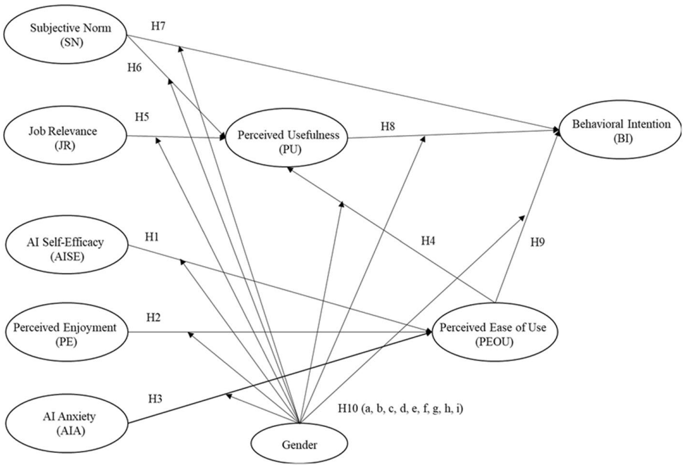
Over the past few years, there has been a significant increase in the utilization of artificial intelligence (AI)-based educational applications in education. As pre-service teachers’ attitudes towards educational technology that utilizes AI have a potential impact on the learning outcomes of their future students, it is essential to know more about pre-service teachers’ acceptance of AI. The aims of this study are (1) to discover what factors determine pre-service teachers’ intentions to utilize AI-based educational applications and (2) to determine whether gender differences exist within determinants that affect those behavioral intentions. A sample of 452 pre-service teachers (325 female) participated in a survey at one German university. Based on a prominent technology acceptance model, structural equation modeling, measurement invariance, and multigroup analysis were carried out. The results demonstrated that eight out of nine hypotheses were supported; perceived ease of use ( β = 0.297***) and perceived usefulness ( β = 0.501***) were identified as primary factors predicting pre-service teachers’ intention to use AI. Furthermore, the latent mean differences results indicated that two constructs, AI anxiety (z = − 3.217**) and perceived enjoyment (z = 2.556*), were significantly different by gender. In addition, it is noteworthy that the paths from AI anxiety to perceived ease of use ( p = 0.018*) and from perceived ease of use to perceived usefulness ( p = 0.002**) are moderated by gender. This study confirms the determinants influencing the behavioral intention based on the Technology Acceptance Model 3 of German pre-service teachers to use AI-based applications in education. Furthermore, the results demonstrate how essential it is to address gender-specific aspects in teacher education because there is a high percentage of female pre-service teachers, in general. This study contributes to state of the art in AI-powered education and teacher education.
Overview
The claims and statistics of this paper haven’t been checked yet.
Free: it reads the open-access text and checks the first 5 claims that cite a source we can check. Create a free account to check every claim.
Integrity signals
Registry
Cites
Statistics
Figures
Verification
Claims the paper makes
The claims and statistics of this paper haven’t been checked yet.
Free: it reads the open-access text and checks the first 5 claims that cite a source we can check. Create a free account to check every claim.
Claims other papers make about this one
Each is checked against this paper’s own text: does it say what the citing paper says it does?
The source backs part of the claim, not all of it — or backs it for a different population, condition or comparison.
In the citing paper
“Directly relevant to mentorship needs, AI applications, as demonstrated by researchers like Zhang et al. (2023) and Doroudi (2023), have proven effective in providing personalised feedback, facilitating reflective practice, and offering adaptive learning resources.”
From Mentorship in the Age of Generative AI: ChatGPT to Support Self-Regulated Learning of Pre-Service Teachers Before and During Placements (2025) · cites this paper as Zhang et al., 2023
Experimental — accuracy not yet measured
Self-check
Percentages, sums and reported differences re-computed from the paper’s own numbers.
The self-check needs the paper’s full text.
Citations
Cites
R: A Language and Environment for Statistical Computing
R Core Team (2025) · doi:10.32614/r.manuals · Cited by 352,181
Perceived usefulness, perceived ease of use, and user acceptance of information technology
Davis, F. D. (1989) · MIS Quarterly · doi:10.2307/249008 · Cited by 68,483 · cited 1×
“The TAM, built on the TRA, can be used to foresee the adoption of any specific technology (Davis, 1989).”
MethodUser Acceptance of Information Technology: Toward A Unified View1
Venkatesh, V., Morris, M. G., Davis, G. B., & Davis, F. D. (2003) · MIS Quarterly · doi:10.2307/30036540 · Cited by 45,035
lavaan : An R Package for Structural Equation Modeling
Rosseel, Y. (2012) · Journal of Statistical Software · doi:10.18637/jss.v048.i02 · Cited by 27,955
(1980) · Medical Entomology and Zoology · Cited by 25,810
A Theoretical Extension of the Technology Acceptance Model: Four Longitudinal Field Studies
Venkatesh, V., & Davis, F. D. (2000) · Management Science · doi:10.1287/mnsc.46.2.186.11926 · Cited by 23,066
Evaluating Goodness-of-Fit Indexes for Testing Measurement Invariance
Cheung, G. W., & Rensvold, R. B. (2002) · Structural Equation Modeling: A Multidisciplinary Journal · doi:10.1207/s15328007sem0902_5 · Cited by 16,280 · cited 1×
“A value of ΔCFI higher than 0.01 indicates a significant drop in fit between the two models (Cheung & Rensvold, 2002).”
BackgroundInfluentialConfirmatory factor analysis for applied research
(2007) · Choice Reviews Online · doi:10.5860/choice.44-2769 · Cited by 15,614 · cited 1×
“As Brown (2006) recommended, before performing the invariance measurement, the initial measurement model requires splitting into two datasets; in this study, one for male students and the other for female students.”
BackgroundTechnology Acceptance Model 3 and a Research Agenda on Interventions
Venkatesh, V., & Bala, H. (2008) · Decision Sciences · doi:10.1111/j.1540-5915.2008.00192.x · Cited by 8,159
Vandenberg, R. J., & Lance, C. E. (2000) · Organizational Research Methods · doi:10.1177/109442810031002 · Cited by 7,997
Research works printed but not linked: 3
- Ajzen, I. (1985). From intentions to actions: A theory of planned behavior. In Action control (pp. 11–39). Springer. https://doi.org/10.1007/978-3-642-69746-3_24 · doi:10.1007/978-3-642-69746-3_24
- 19. Fornell, C., Tellis, G. J., & Zinkhan, G. M. (1982). Validity assessment: A structural equations approach using partial least squares. In Proceedings of the American marketing association educators' conference (Vol. 48, pp. 405-409).
- 22. Hair, J. F., Black, W. C., Babin, B. J., & Anderson, R. E. (2019). Multivariate data analysis (8th). Cengage Learning.
Cited by
Items 401–500 of 615
In-service Teachers’ Views on the use of Artificial Intelligence for Teaching Practices
Degeng, P. D. D., Isnaini, M. H., & Dewi, D. N. (2025) · Advances in Social Science, Education and Humanities Research/Advances in social science, education and humanities research · doi:10.2991/978-2-38476-388-7_15
Determination of the Artificial Intelligence readiness levels of preservice teachers
Hürsen, Ç., & Batman, K. A. (2025) · Proceedings of the... International Conference on Virtual Learning · doi:10.58503/icvl-v20y202531
Voloskovich, O. (2025) · International Journal of Science and Research (IJSR) · doi:10.21275/sr25430213916
Al‐Mahdy, Y. F. H., & Elwakil, F. R. (2025) · International Conference for Artificial Intelligence, Applications, Innovation and Ethics (AI2E) · doi:10.1109/ai2e64943.2025.10983145
Villaceran, E. C., Himang, C. M., Garcia, J. M. S., & Densing, G. R. R. (2025) · SSRN Electronic Journal · doi:10.2139/ssrn.5265534
Pham, L. T. A. (2025) · Asian Conference on Education & International Development official conference proceedings · doi:10.22492/issn.2189-101x.2025.56
A Preliminary Study on Higher Education Students’ Usage, and Attitudes Towards AI
Klančar, A., & Janeš, A. (2025) · Communications in computer and information science · doi:10.1007/978-3-031-95627-0_18
Kaur, B. (2025) · Advances in computational intelligence and robotics book series · doi:10.4018/979-8-3373-5092-9.ch010
Huling, H. M., & Crawford, K. M. (2025) · Advances in computational intelligence and robotics book series · doi:10.4018/979-8-3373-1122-7.ch007 · Cited by 1
Artificial Intelligence Transforming Higher Education Volume 1
Adarkwah, M. A., Amponsah, S., Plessis, D., Gani, F., Holmner, M., Mudau, L., Tjano, R. N., Wyk, V., & van Wyk, M. M. (2025) · UJ Press eBooks · doi:10.64449/9780906785959
EDUCATIONAL REVOLUTION: THE IMPACT OF ARTIFICIAL INTELLIGENCE ON TEACHER TRAINING
Niebles, W., Guzmán, H., & Torres, J. (2025) · Lex localis - Journal of Local Self-Government · doi:10.52152/801949
Verma, A., & Bhandari, D. M. (2025) · Lex localis - Journal of Local Self-Government · doi:10.52152/q9rfga90
“As a result, there is a strong need for studies on embracing AI in teacher education and figuring out what elements influence its use (C. Zhang et al., 2023).”
InfluentialTeacher Professional Development: Training Strategies for Effective AI Tool Usage in Early Education
Ramacciotti, M. C. C. (2025) · Wiley eBooks · doi:10.1002/9781394352821.ch18
Qiang, F., Mohamad, H., Yee, C. M., & Chunyu, M. (2025) · International Journal of Academic Research in Progressive Education and Development · doi:10.6007/ijarped/v14-i4/26712 · Cited by 1
Chang, S.-H., Davis, S., & Chen, S. (2026) · The International Journal of Management Education · doi:10.2139/ssrn.5723730
Wang, Y., & Nasri, N. M. (2025) · International Journal of Academic Research in Progressive Education and Development · doi:10.6007/ijarped/v14-i4/26442
Kamalayan, pagtanggap, at hamon sa paggamit ng Artificial Intelligence sa pagtuturo ng Filipino
Dichoso, J. D., Lagata, M. C. J., & Marbella, F. D. (2025) · International Journal of Research Studies in Education · doi:10.5861/ijrse.2025.25326
Singh, P., Singh, H., Somasundram, P., & Anthonysamy, L. (2025) · Asian Journal of University Education · doi:10.24191/ajue.v21i3.47
Acosta-Enriquez, B. G., Arbulú Ballesteros, M. A., Huamaní Jordan, O., Roca, C. L., & Tirado, K. S. (2024) · Figshare · doi:10.6084/m9.figshare.26717835
Yusuf, A., Pervin, N., & Román-González, . (2024) · Figshare · doi:10.6084/m9.figshare.26691340
Zhang, C. (2024) · doi:10.25593/open-fau-860 · Cited by 5
Self-citationAcosta-Enriquez, B. G., Arbulú Ballesteros, M. A., Huamaní Jordan, O., Roca, C. L., & Tirado, K. S. (2024) · Figshare · doi:10.6084/m9.figshare.26717832
Delcker, J., Heil, J., Ifenthaler, D., Seufert, S., & Spirgi, L. (2024) · Figshare · doi:10.6084/m9.figshare.26690500
Die Messung und Förderung von AI Literacy in der Hochschulbildung
Hornberger, M., Nerdel, C., & München, T. U. (2025)
Jungner, A., & Olofsson, W. (2024) · DiVA (Digitala Vetenskapliga Arkivet) · Cited by 1
Pop, R., & Marc, A. (2025) · The Journal of Studies in Language, Culture and Society · Cited by 3
Matamoros Rodriguez, M. A. (2024) · DiVA - Jönköping University · Cited by 1
Alonso-García, S. (2025) · Institutional Repository of the University of Granada (University of Granada)
Palle, S. M. (2025) · DiVA - Jönköping University · Cited by 2
Niebles, W., Guzman, H., & Torres, J. (2025) · Lex localis - Journal of Local Self-Government · doi:10.52152/801005
Peran Guru dan Tenaga Kependidikan dalam Sistem Pembelajaran di SMP Negeri 34 Surabaya
Kirana, D. A. A., & Rosita, R. D. A. (2024) · Jurnal Teknologi Pendidikan · doi:10.47134/jtp.v2i1.346 · Cited by 1
Fakuade, O. V. (2025) · Journal of West European Social Sciences · doi:10.63632/jowess.v2i2.89 · Cited by 1
Modeling Motivation, Attitude, and Autonomy through AI User Behavior in Calculus Performance
Cabusao, B., Cogtas, J. C., Guiral, E. D., & Ballenas, E. B. (2025) · doi:10.1109/icet67257.2025.11290886
“Research suggests that perceived ease of use directly influences AI user behavior, academic performance, and perceived usefulness [7], [8], [9], [10].”
Oh, S. (2025) · The Mathematical Education · doi:10.63311/mathedu.25.6443
Dias, C., Santos, C., Rodrigues, E., & Cardoso, L. (2025) · Portuguese National Funding Agency for Science, Research and Technology (RCAAP Project by FCT)
YAPAY ZEKA KULLANIM KABULÜ ÖLÇEĞİNİN GELİŞTİRİLMESİ
Öztırak, M. (2025) · Akademik Hassasiyetler · doi:10.58884/akademik-hassasiyetler.1640741
Perceptions and Acceptance of AI-Driven Educational Robotics in Education
Krčadinac, O., Stanković, Ž., Đokić, V. V., & Đokić, D. B. (2025) · Journal of UUNT Informatics and Computer Sciences · doi:10.62907/juuntics250202001k
Velarde, J. M., & Vasodavan, V. (2025) · Advances in computational intelligence and robotics book series · doi:10.4018/979-8-3373-3755-5.ch008
Essays on the implication of artificial intelligence to distance education in Brazil
Durso, S. D. O. (2024) · LA Referencia (Red Federada de Repositorios Institucionales de Publicaciones Científicas)
Davidović-Rakić Jelena, I., Popović, E., & Pavićević, M. (2025) · Zbornik radova Filozofskog fakulteta u Pristini · doi:10.5937/zrffp55-60297
Model of Acceptance of Artificial Intelligence Devices in Higher Education
Salazar, L., & Rivera, L. (2026) · Computers · doi:10.3390/computers15010046 · Cited by 1
“However, Zhang et al. [91] found no negative relationship between anxiety towards AI and perceived ease of use.”
Shaping Tomorrow’s Classrooms: Integrating AI in Technology Teacher Training and VET in Germany
Vernholz, M., Schäfers, J., Jonas-Ahrend, G., & Temmen, K. (2026) · Lecture notes in networks and systems · doi:10.1007/978-3-032-07316-7_10
درجة وعي معلمي العلوم للصف الثامن بمفاهيم الذكاء الاصطناعي وتطبيقاته في التعليم في محافظة المفرق
الصبيحات, ن. ع. ع. ا. (2025) · Educational and Psychological Sciences Series · doi:10.59759/educational.v4i3.1447
Eibinger, V., Fromm, H., & Reitbauer, M. (2026) · ExELL · doi:10.51558/2303-4858.2025.13.2.159
“…capable of integrating generative AI in their teaching practices, it is indispensable that existing teacher training programs be modernized and adapted accordingly to familiarize teachers with the potential of AI in language education (Dimitriadou & La-nitis, 2023; Royce, 2025; Zhang et al., 2023).”
AI and the Reconfiguration of Professional Identity: Reskilling Teachers in Private Language Schools
Kızıl, V. (2026) · Advances in computational intelligence and robotics book series · doi:10.4018/979-8-3373-7416-1.ch002
Prácticas y epistemologías en estudios de lenguas
Roo, U. A. D. E. D. Q., Chulim, F. D., Romero, M. I. H., Roo, U. A. D. E. D. Q., Durán, A. J. C., Turnbull, A. C. Y. M., López, K. P. V., Aguilar, A. M. C. D., Valenzuela, L. C. M., Quintero, C. J. C., et al. (2025) · doi:10.22403/uqroomx/2025/l03
Escobar, J. N. P., Cabezas, A. V. V., Machado, M. E. Z., & Brito, G. F. E. (2026) · Perspectivas Sociales y Administrativas. · doi:10.61347/psa.v4i1.130
AI, Gender, and Attitudinal Analytics in Educational Technologies: A Systematic Review
Monroy-Tepepa, J., Sanz-Martín, L., Ordaz, R. G., & Parra-Domínguez, J. (2026) · Lecture notes in networks and systems · doi:10.1007/978-3-032-15743-0_17
İngilizce Öğretmen Adaylarının Yapay Zekaya Yönelik Tutumları
Derinalp, P., & Halife, M. (2025) · Kuramsal Eğitimbilim
Wang, K., Shen, L., Duan, B., Zhang, C., & Xue, Y. (2026) · Asia Pacific Journal of Education · doi:10.1080/02188791.2026.2625132 · Cited by 1
Self-citationPurwanto, D. (2025) · IJGIE (International Journal of Graduate of Islamic Education) · doi:10.37567/ijgie.v6i2.4630
Barzola, K. E. G., Revelo, M. Z. A., Herrera, K. L. M., & Altafulla, C. M. H. (2026) · LATAM Revista Latinoamericana de Ciencias Sociales y Humanidades · doi:10.56712/latam.v7i1.5304
Wu, B., & Chen, Y. (2025) · International Workshop on Artificial Intelligence and Education (WAIE) · doi:10.1109/waie67422.2025.11381034
Teachers' Perception and Trust in the Use of AI Chat: A Survey on Its Role in Education
Firstiany, G. M., & Sasmoko (2025) · International Conference on ICT for Smart Society (ICISS) · doi:10.1109/iciss66954.2025.11389510
Utari, A. L., & Sasmoko (2025) · International Conference on ICT for Smart Society (ICISS) · doi:10.1109/iciss66954.2025.11389517
Alshwiah, A. A., & Alaulamie, L. A. (2026) · Contemporary Educational Technology · doi:10.30935/cedtech/17982 · Cited by 1
Brindha Devi, S., & Ramnath, R. (2026) · Innovare Journal of Education · doi:10.22159/ijoe.2026v14i2.58384 · Cited by 1
The Impact of AI Courses on Pre-Service Teachers' Perception of AI Competency
Han, X., & Yang, Y. (2025) · International Conference on Educational Technology Management (ICETM) · doi:10.1109/icetm67477.2025.11413562
“Given the growing importance of AI competency, it is essential to assess pre-service teachers’ AI competency since they are the backbone of future education and their competency significantly shape both their own professional development and their future students’ learning outcomes [10].”
Lee, H.-I., & Li, J. (2025) · International Conference on Educational Technology Management (ICETM) · doi:10.1109/icetm67477.2025.11413506
“Zhang et al. (2023) examined factors influencing students’ acceptance of mobile learning tools, while Ma (2025) focused on chatbot and AI-assisted language learning, demonstrating TAM’s versatility across different settings.”
InfluentialArtificial Intelligence and Education
Holmes, W., Persson, J., Chounta, I., Wasson, B., & Димитрова, В. (2022) · Points de vue sur la jeunesse · doi:10.3917/e.europ.holm.2022.01 · Cited by 1
Konstantinidis, K., Apostolakis, I., Malamateniou, C., & Papagiannis, P. (2025) · European Journal of Engineering and Technology Research · doi:10.24018/ejeng.2025.1.cie.70024
Integrating AI Competencies into Teacher Education Programs
Eguchi, A., George, S., Fraga, L. M., Black, N. B., Blackwood, A., Dempsey, J. C., & Kasun, G. S. (2026) · Proceedings of the AAAI Conference on Artificial Intelligence · doi:10.1609/aaai.v40i47.41504
“This approach enabled researchers to examine how preservice teachers engage with AI for lesson planning, and their ability to critically evaluate AI-generated content across varied experience levels (Zhang et al. 2023).”
Sebopelo, P., & Chukwuma, N. N. (2026) · Review of Artificial Intelligence in Education · doi:10.37497/rev.artif.intell.educ.v7ii.78
Παπαδήμας, Χ., & Eteokleous, N. (2026) · Διεθνές Συνέδριο για την Ανοικτή & εξ Αποστάσεως Εκπαίδευση · doi:10.12681/icodl.8606
Wu, Q., Sun, J., & Hu, Y. (2026) · The Asia-Pacific Education Researcher · doi:10.1007/s40299-026-01103-3
“Previous research (Zhang et al., 2023) suggests that pre-service teachers, they likely focus more on understanding the complex workings of GAI systems, and the security of data in those systems, more so than just looking at its utility and user-friendliness.”
Farinango, J. M. P. (2026) · Universidad Politécnica Salesiana Repositorio Digital (Universidad Politécnica Salesiana)
González, C. L. (2026) · O2 - Repositori Institucional (Universitat Oberta de Catalunya)
Padhy, A. (2026) · International Journal of Applied Resilience and Sustainability · doi:10.70593/deepsci.0202038
TAŞÇILAR, M., Sağlık, Z. Y., & Dağdeviren, A. (2026) · Journal of Computer and Education Research · doi:10.18009/jcer.1757103
Liu, C., Yi, Y., Wang, X., Wang, H., & Wang, Y. (2026) · Research Square · doi:10.21203/rs.3.rs-8618094/v1
Exploring Gen Z's Adoption of AI-Based Learning Tools: Evidence from Can Tho, Vietnam
Nguyen, T. A. V. (2025) · International Conference on Modern Educational Technology (ICMET) · doi:10.1109/icmet67594.2025.11451953
“That is, students usually choose tools that they feel are of real value to them in their learning and assist them in accomplishing their academic goals [13].”
Gender perspectives: Artificial intelligence in academic practice
Slijepčević, M., Šević, N. P., & Šević, A. (2026) · Research in Pedagogy · doi:10.5937/istrped2601099s · Cited by 2
Quality of Academic Services: A Phenomenological Study at the Bureau of Academic and Student Affairs
Munari, M., Mufti, M. I., Hakim, A., Badollahi, M. Z., & Kondoj, T. H. I. (2025) · Journal La Edusci · doi:10.37899/journallaedusci.v6i6.2858
“This can be seen from the attitude shown by the officer must be sufficient time in following up on the services needed by students, such as providing an explanation for filling out the data input form (Head of Bureau et al., 2021; C. Zhang et al., 2023).”
Adoption of AI-Enabled Educational Tools in Schools: A Big Tech—Driven Transformation
Sharma, M., Sharma, S., Prakash, V., Senger, V., Dubey, M., & Gupta, V. (2026) · International Conference on Innovative Practices in Technology and Management (ICIPTM) · doi:10.1109/iciptm69057.2026.11465425
“Findings from existing literature suggest teachers who possess greater digital literacy and educational malleability are more receptive to AI-supported learning and instruction (Teo, 2011; Zhang et. al., 2023).”
InfluentialYang, Y., Wang, Z., Ma, R., & Schaub, F. (2026) · CHI Conference on Human Factors in Computing Systems · doi:10.1145/3772318.3790881
Maldonado, C. P. A., Rodriguez, C. P. B., & membreño, D. A. J. (2026) · LATAM Revista Latinoamericana de Ciencias Sociales y Humanidades · doi:10.56712/latam.v7i2.5707
Wang, X., Zhang, Z., Han, Z., & Wei, W. (2026) · Teaching and Teacher Education · doi:10.1016/j.tate.2026.105582
Mokhtar, K. A. E., Zerhane, R., Aidoun, A., & Janati‐Idrissi, R. (2026) · Multidisciplinary Science Journal · doi:10.31893/multiscience.2026624
“Indeed, AI has the potential to significantly impact the education sector by offering personalized learning experiences to students (Zhang et al., 2023), as it can provide immersive and differentiated learning experiences, which are particularly beneficial for scientific subjects.”
Pre-service Teachers’ Experiences in Instructional Design with Artificial Intelligence Tools
Ayaz, E., & Ekinci, V. (2026) · Springer eBooks · doi:10.1007/978-3-032-18030-8_8
Kristovič, S., & Serrano, P. (2025) · doi:10.33700/21t68m84
Song, R., Qin, W., & Xue, X. (2026) · Research Square · doi:10.21203/rs.3.rs-9263933/v1
Jiang, Y., Wang, Z., Wang, Y., Zhang, Y., Xu, Y., & Wu, C. (2026) · International Conference on Educational and Information Technology · doi:10.1109/iceit68991.2026.11521608
“Existing educational studies focus more on general AI acceptance or explainability in analytic systems than on how uncertainty cues shape pedagogical judgment during lesson planning [20], [21], [30].”
Psychological Mechanisms of Generative AI Discontinuance Intention Among Chinese K–12 Teachers
Du, Y., Chen, Q., & He, H. (2026) · Advances in Human-Computer Interaction · doi:10.1155/ahci/8302982
Unlocking knowledge power in an emerging market: a structural–configurational framework
Konalingam, K., Thangavadivel, K., Achchuthan, S., Kengatharan, N., & Umanakenan, R. (2026) · The Learning Organization · doi:10.1108/tlo-07-2025-0169
Burgos, G. J. E., & Constantinopla, S. J. P. (2026) · Journal for Research Scholars and Professionals of English Language Teaching · doi:10.54850/jrspelt.10.55.002
Amerol, S. H. S., Mustapha, M. M., Padate, S.-Z. S., Matugas, F. Y. M., & Aloyod, N. B. (2026) · International Journal of Research and Innovation in Applied Science · doi:10.51584/ijrias.2026.11050083
Impact of Artificial Intelligence on education: a systematic review of literature
Paredes-Ventura, A., de Gracia, S., & Cabanillas-Carbonell, M. (2026) · Scientific Repository of Open Access of Portugal (RCAAP) · doi:10.29352/mill0230.41727
Dibdib, N. (2026) · Pantao (International Journal of the Humanities and Social Sciences) · doi:10.69651/pijhss05021157
Nemt-allah, M. A., Hesham Ramadan Omar, A. B. D. O., Boraai, M. C., Nassar, A. M., Atta, E. E., & Ibrahim, A. (2026) · International Journal of Evaluation and Research in Education (IJERE) · doi:10.11591/ijere.v15i3.37815
“More critically, student teachers represent an underexplored population, as existing literature predominantly focuses on in-service teachers or general learner populations [53], [54].”
Sun, Y., Liu, J., Liu, T., Wei, Z., & Shen, H. (2026) · Frontiers in Psychology · doi:10.3389/fpsyg.2026.1855345 · Cited by 2
Rahim, N. H. S. M., Luqman, A., & Li, C. C. (2024) · International Journal of Accounting, Finance and Business
Mehdian, N., Lozjanin, A., Shienko, L., & Pukhovskaya, A. (2026) · Journal of Applied Learning & Teaching · doi:10.37074/jalt.2026.9.2.4
Understanding AI education perceptions and teaching efficacy among pre-service teachers in Korea
Lee, Y., & Jeong, S.-H. (2026) · Journal of Education and Learning (EduLearn) · doi:10.11591/edulearn.v20i3.25169
Dikmen, Ş., & Kirişçi, N. (2026) · Bayburt Eğitim Fakültesi Dergisi · doi:10.35675/befdergi.1785903
EFL Students’ Acceptance of AI Tools in English Writing: A Technology Acceptance Model Perspective
Paulijah, R., & Siswana, S. (2026) · EDUSOSHUM Journal of Islamic Education and Social Humanities · doi:10.52366/edusoshum.v6i3.490 · Cited by 1
“The result is also consistent with (Zhao et al., 2024) and (Zhang et al., 2023), who reported that ease of use is an important factor influencing users’ acceptance of AI technologies.”
Syamsiyah, N., Anridho, C., Savira, P. S., Prasetyo, R. A., Mawardi, R. A., & Camhol, A. N.-A. (2026) · Jurnal Sosiologi Dialektika · doi:10.20473/jsd.v21i1.2026.87-97
“Several studies have shown that teachers are more willing to use AI when the technology is perceived as useful and easy to use (Chounta et al. 2022, Zhang et al. 2023).”
Metadata
- Authors
- Zhang, C., Schießl, J., Plößl, L., Hofmann, F., & Gläser-Zikuda, M.
- Affiliations
- Friedrich-Alexander-Universität Erlangen-Nürnberg (DE)
- Corresponding author
- Zhang, Chengming
- Venue
- International Journal of Educational Technology in Higher Education
- Published
- 2023-09-04
- Volume
- 20
- Issue
- 1
- ISSN
- 2365-9440 (ISSN-L)
- OpenAlex
- W4386405611
- Semantic Scholar
- b05cb5bf173385b1696e219697beb9057bc5c64f
- Cited by
- 413
- References
- 84
- Citations by year
- 2026: 146 · 2025: 173 · 2024: 88 · 2023: 6
- FWCI
- 96.92
- Type
- journal article
- Language
- en
- Open access
- diamond
- doi.org
- Licence
- cc-by
- creativecommons.org/licenses/by/4.0 (tdm)
- creativecommons.org/licenses/by/4.0 (vor)
- Locations
- International Journal of Educational Technology in Higher Education (publishedVersion, cc-by)
- DOAJ (DOAJ: Directory of Open Access Journals) (submittedVersion, cc-by-sa)
- Funders
- BMBF (16DHB4019)
- Topics
- Social Sciences › Education › Artificial Intelligence in Education
- Social Sciences › Decision Sciences › Information Systems and Management › Technology Adoption and User Behaviour
- Social Sciences › Gender Studies › Gender and Technology in Education
- Keywords
- artificial intelligence in education, pre-service teachers, technology acceptance, behavioral intention, perceived usefulness, perceived ease of use, AI anxiety, perceived enjoyment, gender differences, teacher professional development, technology acceptance model
About these checks
Registry, retraction, Cites and statistics results are computed, not judged, with one exception: a printed reference that no index lists is read once by a model before it counts as a citation error. Claims are extracted by a model and kept only when their quote appears verbatim in the text; each cited source is then checked, with a model’s help, for whether it says what the claim relies on. Those verdicts can be wrong — read the claim’s quote and the cited source before relying on one.
Statistics and arithmetic are recomputed, not judged.
Confidence bands are shown only for fields calibrated on our annotated test set. None is calibrated yet, so no band is shown.
What counts as a claim ›How we measure confidence ›How we check this ›
Are you an author, or do you see a problem with this page? Request a review
Data sources
Bibliographic data: Semantic Scholar, OpenAlex, Crossref.
Contains information from the Semantic Scholar Academic Graph Datasets, made available under the ODC Attribution License (ODC-BY 1.0).
Semantic Scholar’s data is described in: Kinney, R., et al. (2023). The Semantic Scholar Open Data Platform. arXiv:2301.10140.
