

A meta systematic review of artificial intelligence in higher education: a call for increased ethics, collaboration, and rigour
Open accessThe DOI matches its Crossref record; 147 of the 148 references it cites were found in a registry or an index, and 1 are not checked yet; 46 of the 95 sources its claims cite were checked for support.
Abstract
Although the field of Artificial Intelligence in Education (AIEd) has a substantial history as a research domain, never before has the rapid evolution of AI applications in education sparked such prominent public discourse. Given the already rapidly growing AIEd literature base in higher education, now is the time to ensure that the field has a solid research and conceptual grounding. This review of reviews is the first comprehensive meta review to explore the scope and nature of AIEd in higher education (AIHEd) research, by synthesising secondary research (e.g., systematic reviews), indexed in the Web of Science, Scopus, ERIC, EBSCOHost, IEEE Xplore, ScienceDirect and ACM Digital Library, or captured through snowballing in OpenAlex, ResearchGate and Google Scholar. Reviews were included if they synthesised applications of AI solely in formal higher or continuing education, were published in English between 2018 and July 2023, were journal articles or full conference papers, and if they had a method section 66 publications were included for data extraction and synthesis in EPPI Reviewer, which were predominantly systematic reviews (66.7%), published by authors from North America (27.3%), conducted in teams (89.4%) in mostly domestic-only collaborations (71.2%). Findings show that these reviews mostly focused on AIHEd generally (47.0%) or Profiling and Prediction (28.8%) as thematic foci, however key findings indicated a predominance of the use of Adaptive Systems and Personalisation in higher education. Research gaps identified suggest a need for greater ethical, methodological, and contextual considerations within future research, alongside interdisciplinary approaches to AIHEd application. Suggestions are provided to guide future primary and secondary research.
Verified 2026-11-25 · 1 reference not checked yet
Overview
CoChat Summary
TL;DR
This tertiary review synthesises 66 secondary studies on artificial intelligence in higher education (AIHEd) published 2018–July 2023, mapping review types, authorship, quality, applications, benefits, challenges, and gaps. It finds adaptive systems and personalisation dominate key findings, while ethics, collaboration, and methodological rigour remain major gaps.
Key findings
- Of 66 included evidence syntheses, 66.7% were systematic literature reviews; 89.4% were team-authored, but 71.2% were domestic-only collaborations, and North America accounted for 27.3% of authorship.
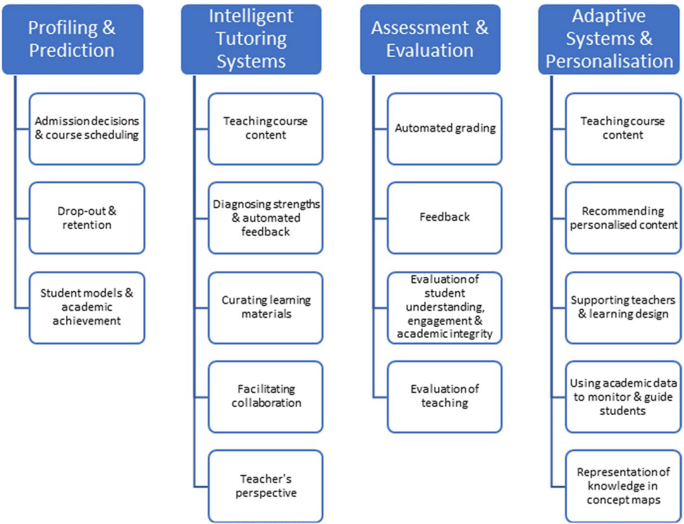
- Review focus was mostly General AIEd (47.0%) or Profiling and Prediction (28.8%); key findings most often discussed Adaptive Systems and Personalisation (54.5%), then Profiling and Prediction (48.5%), Assessment and Evaluation (39.4%), and Intelligent Tutoring Systems (21.2%).
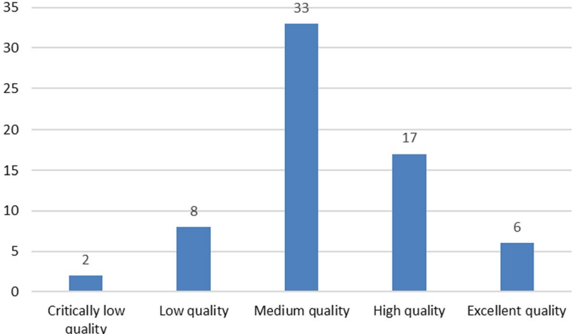
- Quality averaged 6.57/10; 45.5% did not undertake any quality assessment, 31.8% searched only one or two databases, 24.2% provided their exact data extraction coding scheme, and 34.8% did not reflect on review limitations; 65% were critically low to medium quality.
- Top research gaps were ethics (40.9%), methodological rigour (36.4%), wider stakeholders (21.2%), disciplines (16.7%), and countries (15.2%); the top challenge was lack of ethical consideration (29.0%).
Methods
- Tertiary review/review of reviews guided by PRISMA; searched Web of Science, Scopus, ERIC, EBSCOHost, IEEE Xplore, ScienceDirect, ACM Digital Library, OpenAlex, and Google Scholar (first 500 records), plus snowballing/manual additions; initial search 13 October 2022, updated to 18 July 2023.
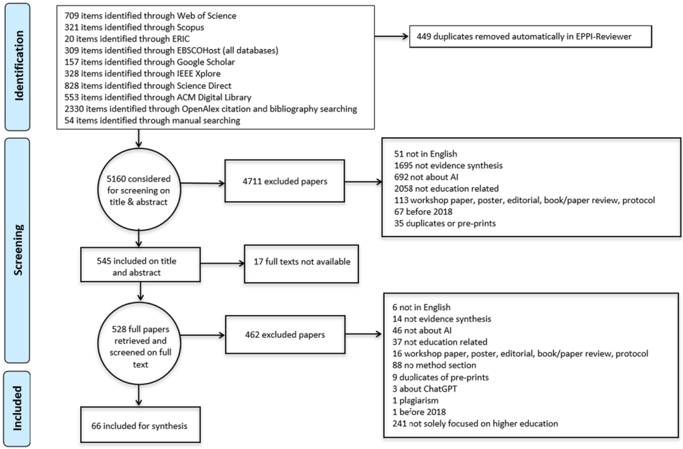
- Included secondary research with a method section on AI applications in formal higher or continuing education, published in English January 2018–18 July 2023 as journal articles or full conference papers; from 5,609 records and 5,160 title/abstract screened, 66 reviews solely focused on higher/continuing education were synthesised.
- Data extracted in EPPI Reviewer; quality assessed with 10 criteria adapted from DARE, AMSTAR 2, and Buntins et al.; narrative synthesis and interactive evidence/gap maps.
Limitations
- Stated: the protocol was not pre-registered in an official repository such as PROSPERO; only the first 500 Google Scholar records were considered versus the 1000 recommended; additional journals and non-English literature could have been searched to reduce language bias; the quality assessment tool is imperfect and yes/no/partly distances cannot be assumed equal.
- Stated/design: generative AI and ChatGPT reviews were excluded; 32 reviews that included higher education but combined it with other levels were excluded to keep results higher-education-specific.
- Evident from the text: English-language and 2018–July 2023 restrictions, plus reliance on available databases and snowballing, may limit coverage; the authors note future work will explore the full 307 AIEd evidence syntheses across educational levels.
Model-written summary. Check it against the paper before relying on it.
Integrity signals
Registry
Cites
Statistics
Figures
Verification
Claims the paper makes
36 Valid · 0 Not valid · 28 Not checked · 127 Own results and interpretations
Every source the paper cites for this claim was checked and supports it.
In the paper
“This can occur when researchers do not give enough consideration to work that has already been published, costing valuable time, effort, and money”
§ A meta systematic review of artificial intelligence in higher education: a call for increased ethics, collaboration, and rigour > Contribution of this review
What the sources say
- Supportedcites Robinson et al., 2021 matched to “Evidence-Based Research Series-Paper 1: What Evidence-Based Research is and why is it important?” (2021) source
The “Need for Evidence-Based Research” section says that failing to consider prior research has led to unnecessary trials over many years and limited funding for important research. The “Limitations” section also describes the opportunity cost of research waste. Together, these support the claim about wasted time, effort, and money. (LLM, conf=0.90)
plainstates a cause- Asserted: passes — The authors put it forward as true.
- Checkable: passes — It can be checked against evidence.
- Load-bearing: passes — The paper’s conclusions depend on it.
- Based: passes — The paper gives a reason why it holds.
- Supported
Every source the paper cites for this claim was checked and supports it.
In the paper
“However, issues of quality when undertaking evidence synthesis persist.”
§ A meta systematic review of artificial intelligence in higher education: a call for increased ethics, collaboration, and rigour > Evidence synthesis quality
What the sources say
- Supportedcites Chalmers et al., 2023 matched to “Topics, publication patterns, and reporting quality in systematic reviews in language education. Lessons from the international database of education systematic reviews (IDESR)” (2024) source
Section 4.5 (Quality over time) says reporting quality in language-education systematic reviews has remained fairly stable and relatively incomplete. This supports the claim that quality issues persist in the evidence syntheses studied. (LLM, conf=0.92)
- Supportedcites Gough et al., 2012 matched to “Clarifying differences between review designs and methods” (2012) source
In “Aggregative and configurative reviews” (page unavailable), the paper says there is less consensus about quality assessment in configurative reviews and describes differing approaches to it. The “Clarifying the nature of variation in reviews” section also identifies unresolved questions about quality assurance and critical appraisal, supporting the broad claim that quality issues persist in evidence synthesis. (LLM, conf=0.88)
plain- Asserted: passes — The authors put it forward as true.
- Checkable: passes — It can be checked against evidence.
- Load-bearing: passes — The paper’s conclusions depend on it.
- Based: passes — The paper gives a reason why it holds.
- Supported
The sources with a verdict support this claim; the rest weren’t checked yet, have no full text we could read, or their verdicts aren’t rated yet.
In the paper
“this tertiary review was conducted using explicit, predefined criteria and transparent methods of searching, analysis and reporting”
§ A meta systematic review of artificial intelligence in higher education: a call for increased ethics, collaboration, and rigour > Method
What the sources say
- Supportedcites Gough et al., 2012 matched to “Clarifying differences between review designs and methods” (2012) source
The Background section describes systematic reviews as using explicit, accountable methods, and the section on aggregative and configurative reviews describes predefined methods and inclusion criteria. The paper supports the methodological approach invoked here; whether the citing authors followed those methods in their own tertiary review is their claim, not a finding attributed to this source. (LLM, conf=0.85)
- Not checked — no full text of the sourcecites Zawacki-Richter et al., 2020 matched to “Systematic Reviews in Educational Research: Methodology, Perspectives and Application” (2020) source
plain- Asserted: passes — The authors put it forward as true.
- Checkable: passes — It can be checked against evidence.
- Load-bearing: passes — The paper’s conclusions depend on it.
- Based: passes — The paper gives a reason why it holds.
- Supported
The cited sources support only part of this claim — read each source’s verdict below.
In the paper
“Prior AIHEd tertiary syntheses have so far also taken place within secondary research (e.g., systematic reviews), rather than as standalone reviews of reviews such as this one.”
§ A meta systematic review of artificial intelligence in higher education: a call for increased ethics, collaboration, and rigour > Prior AIEd syntheses in higher education
What the sources say
- Not checked — no full text of the sourcecites Saghiri et al. (2022) matched to “Scoping review of artificial intelligence and immersive digital tools in dental education” (2022) source
- Not checked — no full text of the sourcecites de Oliveira et al. (2021) matched to “An Overview on the Use of Educational Data Mining for Constructing Recommendation Systems to Mitigate Retention in Higher Education” (2021) source
- Partly supportedcites Sapci and Sapci (2020) matched to “Artificial Intelligence Education and Tools for Medical and Health Informatics Students: Systematic Review” (2020) sourceExperimental — accuracy not yet measured
The Methods describe this paper as a systematic review of AI in medical and health informatics education and list review papers among the eligible publication types. That supports its use as an example of secondary research open to reviews, but the cited passages do not establish that it actually synthesized prior reviews—a tertiary synthesis—or that prior tertiary syntheses generally lacked standalone reviews of reviews. (LLM, conf=0.78)
plain- Asserted: passes — The authors put it forward as true.
- Checkable: passes — It can be checked against evidence.
- Load-bearing: passes — The paper’s conclusions depend on it.
- Based: passes — The paper gives a reason why it holds.
Every source the paper cites for this claim was checked and supports it.
In the paper
“Zawacki-Richter et al. (2019) found three studies (2.1%) that discussed this function, which relate to the presentation of personalised learning materials to students”
§ A meta systematic review of artificial intelligence in higher education: a call for increased ethics, collaboration, and rigour > Intelligent tutoring systems (ITS)
What the sources say
- Supportedcites Zawacki-Richter et al., 2019 matched to “Systematic review of research on artificial intelligence applications in higher education – where are the educators?” (2019) source
The “Intelligent tutoring systems” section identifies two studies focused on curating learning materials based on student needs and a third that mentions the function descriptively. It describes personalised recommendations for reading materials and exercises; the review includes 146 articles, making three approximately 2.1%. (LLM, conf=0.91)
plain- Asserted: passes — The authors put it forward as true.
- Checkable: passes — It can be checked against evidence.
- Load-bearing: unclear — It is unclear whether the paper’s conclusions depend on it.
- Based: passes — The paper gives a reason why it holds.
- Supported
100 more claims · 6 with their cited sources checked
Create a free account to see all 191 claims and to verify the 4 references still open.
- It may state two separate claims as one. 70
- Probably not a substantial claim. 25
Claims other papers make about this one
Each is checked against this paper’s own text: does it say what the citing paper says it does?
The source backs part of the claim, not all of it — or backs it for a different population, condition or comparison.
In the citing paper
“However, the existing body of research predominantly focuses on adult learners in higher education, leaving a significant gap in understanding AI's impact on younger learners in K-12 settings, particularly in the English as a Foreign Language (EFL) context.”
From AI-Integrated Scaffolding to Enhance Agency and Creativity in K-12 English Language Learners: A Systematic Review (2025) · cites this paper as [12]
Experimental — accuracy not yet measuredThe source backs part of the claim, not all of it — or backs it for a different population, condition or comparison.
In the citing paper
“En instituciones como la UNAM (México) y la Universidad de Chile, plataformas con IA han logrado automatizar hasta el 70% de las evaluaciones formativas [13], aunque persisten desafíos en la retroalimentación de competencias creativas [5, 9].”
From Avances, Retos Éticos y Perspectivas de la Inteligencia Artificial (IA) en la Educación de América Latina (2025) · cites this paper as [9]
Experimental — accuracy not yet measuredThe source backs part of the claim, not all of it — or backs it for a different population, condition or comparison.
In the citing paper
“Bond (2024) llevó a cabo una revisión de revisiones sobre IA en la educación superior, sintetizando hallazgos de 50 resúmenes sistemáticos y resaltando la necesidad de estudios empíricos que evalúen el impacto pedagógico de las tecnologías [9].”
From Avances, Retos Éticos y Perspectivas de la Inteligencia Artificial (IA) en la Educación de América Latina (2025) · cites this paper as [9]
Experimental — accuracy not yet measuredThe source backs part of the claim, not all of it — or backs it for a different population, condition or comparison.
In the citing paper
“Las revisiones sistemáticas globales disponibles arrojan una escasa producción de datos desde Latinoamérica (Bond et al., 2024)”
From Percepciones de estudiantes latinoamericanos sobre el uso de la inteligencia artificial en la educación superior (2024) · cites this paper as Bond et al., 2024
Experimental — accuracy not yet measuredThe cited source says what the claim attributes to it.
In the citing paper
“Although every attempt was made to conduct this systematic review as transparently and rigorously as possible, according to previously established quality criteria (Bond et al., 2024), there are some limitations that must be acknowledged.”
From Unpacking student engagement in higher education learning analytics: a systematic review (2024) · cites this paper as Bond et al., 2024
10 more claims about this paper
Create a free account to see every claim other papers make about this one.
Self-check
Percentages, sums and reported differences re-computed from the paper’s own numbers.
Each contradiction between two passages listed here was confirmed by an independent check.
Rated major: it would touch a result — a value a result rests on, reported and recomputed p-values on opposite sides of the significance level, two passages that conflict with no sign which is right, or a cited work retracted before this paper was published.
In the paper
§ A meta systematic review of artificial intelligence in higher education: a call for increased ethics, collaboration, and rigour > AIHEd evidence synthesis quality
“51.5% did not report anything about inter-rater reliability or how screening and coding decisions were decided between review teams”
§ A meta systematic review of artificial intelligence in higher education: a call for increased ethics, collaboration, and rigour > A call for increased collaboration
“less than half of the reviews in this corpus (43.9%, n = 29) did not report any inter-rater agreement processes”
Rated minor: it would not touch a result — a value no result rests on, a p-value that stays on the same side of the significance level, or a conflict that is clerical, resolved elsewhere in the paper, or outside its own findings.
In the paper
§ A meta systematic review of artificial intelligence in higher education: a call for increased ethics, collaboration, and rigour > General publication characteristics
“only 67.6% are available open access.”
§ A meta systematic review of artificial intelligence in higher education: a call for increased ethics, collaboration, and rigour > Discussion
“only 67.7% of evidence synthesis in this sample were published open access”
Rated minor: it would not touch a result — a value no result rests on, a p-value that stays on the same side of the significance level, or a conflict that is clerical, resolved elsewhere in the paper, or outside its own findings.
In the paper
§ A meta systematic review of artificial intelligence in higher education: a call for increased ethics, collaboration, and rigour > Discussion
“the top six most productive countries from six different continents”
§ A meta systematic review of artificial intelligence in higher education: a call for increased ethics, collaboration, and rigour > Conclusion
“| 1 | United States | 11 | 16.7 | | 2 | Canada | 9 | 13.6 |”
Rated minor: it would not touch a result — a value no result rests on, a p-value that stays on the same side of the significance level, or a conflict that is clerical, resolved elsewhere in the paper, or outside its own findings.
In the paper
§ A meta systematic review of artificial intelligence in higher education: a call for increased ethics, collaboration, and rigour > Data extraction
“An initial five studies were coded by all authors, to ensure agreement on the coding scheme”
§ A meta systematic review of artificial intelligence in higher education: a call for increased ethics, collaboration, and rigour > Contribution
“All authors except GS were involved in data extraction.”
Rated minor: it would not touch a result — a value no result rests on, a p-value that stays on the same side of the significance level, or a conflict that is clerical, resolved elsewhere in the paper, or outside its own findings.
In the paper
“After the two disagreements were reconciled, the remaining 5060 items were screened on title and abstract by the same authors, resulting in 4711 items excluded.To continue ensuring inter-rater reliability at the screening on full text stage of 545 studies”
§ A meta systematic review of artificial intelligence in higher education: a call for increased ethics, collaboration, and rigour > Inclusion/exclusion criteria and screening
Reported 545 · recomputed 449
Citations
Cites
The PRISMA 2020 statement: An updated guideline for reporting systematic reviews
Page, M. J., McKenzie, J. E., Bossuyt, P. M., Boutron, I., Hoffmann, T. C., Mulrow, C. D., Shamseer, L., Tetzlaff, J. M., Akl, E. A., Brennan, S. E., et al. (2021) · BMJ · doi:10.1136/bmj.n71 · Cited by 108,283
Preferred Reporting Items for Systematic Reviews and Meta-Analyses: the PRISMA statement
Moher, D., Liberati, A., Tetzlaff, J., Altman, D. G., & for the PRISMA Group (2009) · BMJ · doi:10.1136/bmj.b2535 · Cited by 83,823
PRISMA Extension for Scoping Reviews (PRISMA-ScR): Checklist and Explanation
Tricco, A. C., Lillie, E., Zarin, W., O'Brien, K. K., Colquhoun, H., Levac, D., Moher, D., Peters, M. D. J., Horsley, T., Weeks, L., et al. (2018) · Annals of Internal Medicine · doi:10.7326/m18-0850 · Cited by 43,565 · cited 4×
“Overcoming resistance to change and solving various challenges, including those of an ethical and administrative nature, was identified as pivotal for successful AIHEd integration (Sourani, 2019).”
BackgroundMethodInfluentialScoping studies: towards a methodological framework
Arksey, H., & O'Malley, L. (2005) · International Journal of Social Research Methodology · doi:10.1080/1364557032000119616 · Cited by 36,742
PRISMA-P Group, Moher, D., Shamseer, L., Clarke, M., Ghersi, D., Liberati, A., Petticrew, M., Shekelle, P., & Stewart, L. A. (2015) · Systematic Reviews · doi:10.1186/2046-4053-4-1 · Cited by 26,223 · cited 2×
“…in the field of Applied Linguistics against the Preferred Reporting Items for Systematic Review and Meta-Analysis Protocols (PRISMA-P) guidelines (Shamseer et al., 2015), and found that most of the information expected in any research report were present; background, rationale, objectives and a…”
MethodInfluentialInterrater reliability: The kappa statistic
McHugh, M. L. (2012) · Biochemia Medica · doi:10.11613/bm.2012.031 · Cited by 19,877 · cited 2×
“…reliability between members of the research team, following lengthy discussion and agreement on the inclusion and exclusion criteria by all authors, two members of the team (MB and PP) double screened the first 100 items, resulting in almost perfect agreement (Cohen’s k = 0.89) (McHugh, 2012).”
BackgroundInfluentialPreferred Reporting Items for Systematic Reviews and Meta-Analyses: The PRISMA Statement
Moher, D., Liberati, A., Tetzlaff, J., & Altman, D. G. (2009) · Journal of Clinical Epidemiology · doi:10.1016/j.jclinepi.2009.06.005 · Cited by 19,575
Liberati, A., Altman, D. G., Tetzlaff, J., Mulrow, C., Gotzsche, P. C., Ioannidis, J. P. A., Clarke, M., Devereaux, P. J., Kleijnen, J., & Moher, D. (2009) · BMJ · doi:10.1136/bmj.b2700 · Cited by 17,648
Shamseer, L., Moher, D., Clarke, M., Ghersi, D., Liberati, A., Petticrew, M., Shekelle, P., Stewart, L. A., & the PRISMA-P Group (2015) · BMJ · doi:10.1136/bmj.g7647 · Cited by 13,120 · cited 1×
“…in the field of Applied Linguistics against the Preferred Reporting Items for Systematic Review and Meta-Analysis Protocols (PRISMA-P) guidelines (Shamseer et al., 2015), and found that most of the information expected in any research report were present; background, rationale, objectives and a…”
MethodShea, B. J., Reeves, B. C., Wells, G., Thuku, M., Hamel, C., Moran, J., Moher, D., Tugwell, P., Welch, V., Kristjansson, E., et al. (2017) · BMJ · doi:10.1136/bmj.j4008 · Cited by 10,636 · cited 2×
“Although the authors acknowledge the AMSTAR 2 tool as an effective quality assessment tool for systematic reviews (Shea et al., 2017), the present review includes any kind of evidence synthesis, as long as it has a method section.”
Method
Research works printed but not linked: 6
- 2. Algabri, H. K., Kharade, K. G., & Kamat, R. K. (2021). Promise, threats, and personalization in higher education with artificial intelligence. Webology, 18(6), 2129-2139.
- 26. Chen, X., Zou, D., Xie, H., Cheng, G., & Liu, C. (2022). Two decades of artificial intelligence in education: Contributors, collaborations, research topics, challenges, and future directions. Educational Technology and Society, 25(1), 28-47. https:// doi. org/ 10. 2307/ 48647 028 · doi:10.2307/48647028
- 28. Chu, H.-C., Hwang, G.-H., Tu, Y.-F., & Yang, K.-H. (2022). Roles and research trends of artificial intelligence in higher educa- tion: A systematic review of the top 50 most-cited articles. Australasian Journal of Educational Technology, 38(3), 22-42. https:// doi. org/ 10. 14742/ ajet. 7526 · doi:10.14742/ajet.7526
- 83. Mahmood, A., Sarwar, Q., & Gordon, C. (2022). A Systematic Review on Artificial Intelligence in Education (AIE) with a focus on Ethics and Ethical Constraints. Pakistan Journal of Multidisciplinary Research, 3(1). https:// pjmr. org/ pjmr/ artic le/ view/ 245 *
- 103. Priem, J., Piwowar, H., & Orr, R. (2022). OpenAlex: A fully-open index of scholarly works, authors, venues, institutions, and concepts. ArXiv. https:// arxiv. org/ abs/ 2205. 01833
- 137. Zawacki-Richter, O. (2023). Umbrella Review in ODDE. Herbsttagung der Sektion Medienpädagogik (DGfE), 22 September 2023.
Cited by
Items 701–800 of 805
Sari, D. N., Karno, R., & Purnama, A. A. (2026) · Indonesian Journal of Innovation Multidisipliner Research · doi:10.69693/ijim.v4i3.2481
Shanshan, T. A. N. G., Lee, K. C. S., & Beh, W. F. (2026) · International Conference on Distance Education and Learning (ICDEL) · doi:10.1109/icdel70250.2026.11663656
A five-study design-based research approach to co-design an institutional AI digital assistant
Rienties, B., Bektik, D., Coughlan, E., Coughlan, T., Domingue, J., Edwards, C., Ekuban, A., Herodotou, C., Kwarteng, J., Sanders, C., et al. (2026) · Computers & Education · doi:10.1016/j.compedu.2026.105746 · Cited by 1
Zhang, Y., & Lu, F. (2026) · International Conference on Distance Education and Learning (ICDEL) · doi:10.1109/icdel70250.2026.11663706
Mendoza, O. A., Osores, B. V., Linares-Vizcarra, M. L. D. C., & Guaman, M. M. L. (2026) · Revista Simón Rodríguez · doi:10.62319/simonrodriguez.v.6i12.214
Mapping artificial intelligence research in primary education: a bibliometric study
Abroto, A., Maemonah, M., & Machali, I. (2026) · Discover Education · doi:10.1007/s44217-026-02012-9 · Cited by 2
Evaluation of ChatGPT Study Mode: Results from an Expert Rating Regarding Self-Regulated Learning
Steinberg, E., Perels, F., Aubreville, M., & Dörrenbächer‐Ulrich, L. (2026) · Open Education Studies · doi:10.1515/edu-2025-0169 · Cited by 1
Gómez-Rivero, J. O., Herrera, E. G. D., Escobar, N. E. L., & Riera, M. P. B. (2026) · Revista Multidisciplinar Ciencia y Descubrimiento · doi:10.63816/4xa5c409
Khaldy, M. A. A., Gheraibia, Y., & Shaheen, A. (2026) · Advances in computational intelligence and robotics book series · doi:10.4018/979-8-2600-4050-8.ch003
Viteri, G. A. M., Patricia, M. M. K., Maribel, S. F. G., & Dayana, R. G. M. (2026) · Revista Multidisciplinar Ciencia y Descubrimiento · doi:10.63816/av5afr11
AI-Enabled Digital Transformation in Higher Education: Workforce, Skills, and Global Perspectives
Aksu, M. (2026) · Advances in computational intelligence and robotics book series · doi:10.4018/979-8-2600-4050-8.ch005
Azram, M., Mei, H., Khan, A., Ahmad, B., & Ali, U. U. R. (2026) · Information Processing & Management · doi:10.1016/j.ipm.2026.105119 · Cited by 1
Shabut, A. M., Sangvikar, V., Lu, X., KARIMU, A. Y., & Nwoko, C. (2026) · Information · doi:10.3390/info17090853
Hao, X., Li, J., Huang, H., & Hao, B. (2026) · Sustainability · doi:10.3390/su18179084 · Cited by 1
Liu, Y., Lian, X., & Qi, X. (2026) · Education Sciences · doi:10.3390/educsci16091458
Shi, G., & Xia, Y. (2026) · Higher Education Research · doi:10.11648/j.her.20261105.11
Molina, O. A. M., Villegas, R. A. M., Luque, O. F., Garriga, A. M. P., & Fernández, N. I. U. (2026) · Ciencia Interdisciplinaria Internacional · doi:10.70577/cieninter.v4i3.110 · Cited by 1
Predictors of the ethical use of generative artificial intelligence in higher education
Cruz, Y. B. T., Sánchez, H. A. C., Pita, I. G. A., Rodríguez-Álava, L. A., Carreño-Mendoza, Á. L., Cedeño-Barreto, M., Castillo, G., Villavicencio, J. C., & Moreira-Chóez, J. S. (2026) · Frontiers in Education · doi:10.3389/feduc.2026.1942426 · Cited by 2
Jackson, D. A., Lambert, C., & Coetzee, S. (2026) · Education Sciences · doi:10.3390/educsci16091466
Rodríguez, A. M. M., & Rodríguez, F. M. M. (2026) · European Journal of Investigation in Health Psychology and Education · doi:10.3390/ejihpe16090135 · Cited by 1
Chen, J., Shen, J., Qiu, Y., & Qiao, J. (2026) · SAGE Open · doi:10.1177/21582440261488569
Aponte, M. L., Sánchez, A. D. V., Chiappe, A., & Martínez-Pérez, S. (2026) · Frontiers in Psychology · doi:10.3389/fpsyg.2026.1935683
Fu, L., Ouyang, Z., & Wu, Q. (2026) · Frontiers in Psychology · doi:10.3389/fpsyg.2026.1900061
Kajan, K., Shi, W. Y., & Wanatowski, D. (2026) · UK-China Teaching, Learning, and Educational Technology (TILE-TEC) · doi:10.1109/tile-tec70450.2026.11682164 · Cited by 1
Navigating the AI Frontier: Practical Insights from Faculty Perspectives in Higher Education
Muhammad, A. E. (2026) · TechTrends · doi:10.1007/s11528-026-01220-2
PICRAT-Guided Integration of GenAI into a Project-Based Learning Course
Straková, N., Válek, J., & Sládek, P. (2026) · International Journal of Interactive Mobile Technologies (iJIM) · doi:10.3991/ijim.v20i17.62377
Lee, Y., & Kim, M. (2026) · Management in Education · doi:10.1177/08920206261487370
Inteligencia artificial y tecnología en el aprendizaje basado en proyectos: revisión sistemática
Baltazar, J. R. G. (2026) · Revista Simón Rodríguez · doi:10.62319/simonrodriguez.v.6i12.217 · Cited by 1
Bru-Cordero, O., Quiceno, E., & Correa-Álvarez, C. D. (2026) · Trends in Higher Education · doi:10.3390/higheredu5030101
Rodríguez-Montoya, C., Garrido, L. E., & VanderLinde, G. (2026) · Discover Education · doi:10.1007/s44217-026-02175-5 · Cited by 2
Negricea, D. (2026) · Religions · doi:10.3390/rel17091090
de Melo, S. E., Ferigato, E., & de Souza, S. M. N. L. (2026) · Revista Gestão e Conhecimento · doi:10.55908/rgcv20n2-002
Digital transformation of education in Ukraine: A methodological framework for integrated assessment
Mazaraki, A., Vedmid, N., Tkachuk, T., Zhuchenko, V. G., & Balkin, Y. (2026) · Problems and Perspectives in Management · doi:10.21511/ppm.24(3).2026.45
López, J. J. S., Ormeño, A. M. G., & Granados, A. C. T. (2026) · Horizontes Revista de Investigación en Ciencias de la Educación · doi:10.33996/revistahorizontes.v10i43.1301
AI-Enabled Learning Analytics and Digital Pedagogy for Sustainable Higher Education Decision-Making
Dudin, B., Taqi, M., & Vemavarapu, K. R. (2026) · Advances in computational intelligence and robotics book series · doi:10.4018/979-8-3373-8352-1.ch003
The bright highlights and the dark shadows of artificial intelligence in higher education
Sejdiu, N. P., Rosner, M., & Sejdiu, S. (2026) · Open Research Europe · doi:10.12688/openreseurope.24951.1
Zagkos, C., Kyridis, A., Kamarianos, I., Tourtouras, C. D., Ladias, G., & Kyridi, A. (2026) · Journal of Digital Educational Technology · doi:10.29333/jdet/19285
Öksüz, H. İ., Afyoncu, T., Gök, S., Yıldırım, T., & Yıldırım, K. (2026) · Interactive Learning Environments · doi:10.1080/10494820.2026.2734314
Jiménez, R. R. L., Peña, E. M., & González, E. G. (2026) · International Journal of Combinatorial Optimization Problems and Informatics. · doi:10.61467/2007.1558.2027.v18i1.1505
Teferi, H. (2026) · Innovation Education · doi:10.11648/j.iedu.20260103.13
The Impact of Artificial Intelligence on Language Learning and Linguistic Research
Ivanović, Đ., Chukwuma-Nwankwo, I. F., & Francis, R. S. (2026) · Qubahan Political Journal · doi:10.48161/qpj.v5n3a49
Benchmarking Observable Platform Dynamics Beyond Persistence in Three Open Educational Datasets
Li, H., Liu, X., & Gao, M. (2026) · Education Sciences · doi:10.3390/educsci16091572
Karataş, F. (2026) · Interactive Learning Environments · doi:10.1080/10494820.2026.2734309
Nicchia, E., Benigno, V., Ravicchio, F., Pario, M., Parmigiani, D., & Radović, S. (2026) · Education Sciences · doi:10.3390/educsci16091554
Wu, Y. (2026) · Encyclopedia · doi:10.3390/encyclopedia6090206 · Cited by 1
González, L. J. B. (2026) · Educational Regent Multidisciplinary Journal · doi:10.63969/gfmnyn91
Li, Z., Conesa, J., Gabbouj, M., & Chen, X. (2026) · International Journal of Educational Technology in Higher Education · doi:10.1186/s41239-026-00624-7
Zheng, R., Wang, B., Wang, X., & Zhang, Y. (2026) · Acta Psychologica · doi:10.1016/j.actpsy.2026.107840
A survey study of Cambodian university lecturers’ experiences and perceptions of AI use
Heng, K., Sok, S., Sol, K., & Sor, R. (2026) · Discover Artificial Intelligence · doi:10.1007/s44163-026-02313-w
Yang, H., Guan, Q., & Gao, Z. (2026) · Sustainability · doi:10.3390/su18199836
Togra, D. S. D., & Quezada-Lozano, G. (2026) · Frontiers in Education · doi:10.3389/feduc.2026.1876239 · Cited by 1
Bykov, A., Zhakypbekov, S., Mustafina, A., & Yermakova, V. (2026) · Procedia Computer Science · doi:10.1016/j.procs.2026.09.002 · Cited by 1
Dahal, N., Hasan, M. K., & Islam, M. T. (2026) · Frontiers in Education · doi:10.3389/feduc.2026.1948064
Zammit, J., Grech, V., Francalanza, E., Maffei, A., Sala, R., Pirola, F., Pezzotta, G., Ljubić, S., Batistić, L., Podržaj, P., et al. (2026) · IFIP advances in information and communication technology · doi:10.1007/978-3-032-38618-2_16
Teachers as Custodians of Trust: Linking Learning Analytics and Learning Design in the AI Era
Svetec, B., Divjak, B., Rienties, B., & Muukkonen, H. (2026) · Communications in computer and information science · doi:10.1007/978-3-032-39106-3_10
Negotiating AI integration in higher education curricula: Coping behaviour or career opportunity?
Dey, S. K., Ramkissoon, H. R., Chatterjee, S., Srivastava, S., & Vaculčíková, Z. (2026) · Social Sciences & Humanities Open · doi:10.1016/j.ssaho.2026.103680
Xuan, R. P., & Krein, U. (2026) · Springer international handbooks of education · doi:10.1007/978-3-032-21359-4_203
Knowing more, doing less: AI literacy development and organisational barriers in healthcare training
Naffi, N., Beaulieu, N., Bahlouli, Y. E., Grégoire, J., Fortier, N., Whelan, K., Faraj, D. A., & Demers, M. (2026) · Journal of Workplace Learning · doi:10.1108/jwl-02-2026-0062
López, C. A. L., Quintana, O. V., Moreno, J. P. S., et al. (2026) · Reincisol · doi:10.65835/reincisol.v6(10)1871
Kusi, E., & Sarfo, S. D. (2026) · Frontiers in Education · doi:10.3389/feduc.2026.1938755
Shehzad, N., & Nomaan, S. (2026) · Frontiers in Education · doi:10.3389/feduc.2026.1919066
Wang, X., Yu, W., 周佳穎, Qiao, Y., & Chen, Z. (2026) · Sustainability · doi:10.3390/su18199979
Educación aumentada: Inteligencia artificial, neurociencia y nuevas fronteras del aprendizaje humano
Mena, G. M. D. C. G., Elizabeth, L. A. J. E. L. A. J., Elizabeth, M. R. Y. E. M. R. Y., & Andrés, M. V. J. A. M. V. J. (2026) · Revista Multidisciplinar Ciencia y Descubrimiento · doi:10.63816/hm0cw931
Lee, Y., Walkington, C., & Wu, J. (2026) · Computers & Education · doi:10.1016/j.compedu.2026.105757 · Cited by 1
Sun, Y., & Li, Y. (2026) · Frontiers in Psychology · doi:10.3389/fpsyg.2026.1963259
Jama, A. M., Tahlil, A. A., Ali, A. O., Hamud, M. O., Hassan, A. M., & Mohamed, A. S. (2026) · Discover Education · doi:10.1007/s44217-026-02213-2
Villanueva, G. (2026) · Assessment & Evaluation in Higher Education · doi:10.1080/02602938.2026.2740764
Galvão, A. M., Chumbo, I., & Pais, C. (2026) · Advances in computational intelligence and robotics book series · doi:10.4018/979-8-3373-8735-2.ch005
Noor, M. L. A.-H. M., Isa, M. A., Sahrir, M. S., & Ghalib, M. F. (2026) · International Journal of Learning Teaching and Educational Research · doi:10.26803/ijlter.25.9.20 · Cited by 1
Mubarok, I. (2026) · HAKIKI Jurnal Integrasi dan Studi Islam · doi:10.67319/hakiki.v1i1.22 · Cited by 1
Adha, N. P., & Ubaidah (2026) · International Conference on ICT for Smart Society (ICISS) · doi:10.1109/iciss71466.2026.11715478
Suprayogi, M. N., & Suwarno (2026) · International Conference on ICT for Smart Society (ICISS) · doi:10.1109/iciss71466.2026.11715154
Shen, N., Lee, L. S., & He, A. (2026) · Frontiers in Psychology · doi:10.3389/fpsyg.2026.1956939
徐, 雪., & Lin, X. (2026) · Acta Psychologica · doi:10.1016/j.actpsy.2026.107934
Mobile applications and pedagogical systems for fostering digital competence in higher education
Синіцька, Н., Грицай, Н. Б., Polishchuk, O., Shayner, H., & Остапчук, Н. (2026) · EDUWEB · doi:10.46502/issn.1856-7576/2026.20.03.24
A Reflexive Ethnography of Digital Pedagogy in the Virtual Classroom
Chen, X., & Li, Y. (2026) · Journal of Formative Design in Learning · doi:10.1007/s41686-026-00118-9
Rosario, I. M. C. (2026) · Estudios y Perspectivas Revista Científica y Académica · doi:10.61384/r.c.a..v6i3.2119
Guechairi, S., Smail, N., Махмудов, С., & Mohammed, K. S. (2026) · Social Sciences & Humanities Open · doi:10.1016/j.ssaho.2026.103771 · Cited by 1
Andinnari, S. R., Chaeruman, U. A., & Siregar, E. (2026) · Tadris Jurnal Keguruan dan Ilmu Tarbiyah · doi:10.24042/tadris.v11i3.32309
Tran, K. D., Nguyen, T. A. D., & Tran, K. P. (2026) · SSRN Electronic Journal · doi:10.2139/ssrn.7571959
Vincoli, M., Scholz, N., & Nagashima, T. (2026) · Lecture notes in computer science · doi:10.1007/978-3-032-37979-5_42
Alrashed, M. A. (2026) · Sustainability · doi:10.3390/su181910171
Choi, Y.-S. (2026) · Frontiers in Education · doi:10.3389/feduc.2026.1963429
Higher education transformation through artificial intelligence: an empirical study in Saudi Arabia
GHUNAIM, H., & Masoud, M. (2026) · Cogent Education · doi:10.1080/2331186x.2026.2722498
YEŞİLTAŞ, H. M. (2026) · Ordu Üniversitesi Bilim ve Teknoloji Dergisi · doi:10.54370/ordubtd.1960695
Lees, P., Davis-Crane, N., & Taylor, C. (2026) · Research in Post-Compulsory Education · doi:10.1080/13596748.2026.2739104
Polanía, L. R., Castillo, V. S., & Cano, C. A. G. (2026) · doi:10.62486/978-9915-9928-4-6.ch11
Jin, W., & Ge, Y. (2026) · Frontiers in Psychology · doi:10.3389/fpsyg.2026.1923587
Ranieri, M., & Biagini, G. (2026) · Computers & Education · doi:10.1016/j.compedu.2026.105761 · Cited by 1
Митрофанова, О. Н. (2026) · Vestnik MIRBIS. · doi:10.25634/mirbis.2026.3.29
Bohórquez-Ponce, S. D., Buelvas, E. D. J. H., López-López, E. M., Bru-Cordero, O., & Correa-Álvarez, C. D. (2026) · Journal of Intelligence · doi:10.3390/jintelligence14100250
Wu, S., & Sumettikoon, P. (2026) · Education Sciences · doi:10.3390/educsci16101680
Zou, X., & Yimsakul, P. (2026) · New Horizon of Education · doi:10.63944/yrms03.nhe
Acceptance and Use of Generative AI among University French Language Teachers in VietnamPreprint
Do, T. T. G., & Tran, T. H. G. (2026) · SSRN Electronic Journal · doi:10.2139/ssrn.7597624
Aydın, F., & Yurdugül, H. (2026) · Technology Knowledge and Learning · doi:10.1007/s10758-026-10039-y
Nurwahid, M., Fitrianawati, M., Nurmaningsih, Saumi, F., & Rosmaiyadi, R. (2026) · Learning Research and Practice · doi:10.1080/23735082.2026.2742938
Bucayu-Cuerdo, M. C. (2026) · QualiSearch Journal of Educational Research and Practice · doi:10.66437/qjerp.v2i10.026
Zellweger, F., Röhl, T., Binder, S., Egli, J., Condom, M. F. I., Gavin, D., Matti, T., Moser, L., Spieler, B., Waibel, S., et al. (2026) · Journal of Adult Learning Knowledge and Innovation · doi:10.1556/2059.2026.00164
Lipow, G., & Rowe, N. C. (2026) · Communications in computer and information science · doi:10.1007/978-3-032-28454-9_19
Metadata
- Authors
- Bond, M., Khosravi, H., De Laat, M., Bergdahl, N., Negrea, V., Oxley, E., Pham, P., Chong, S. W., & Siemens, G.
- Affiliations
- University College London (GB)
- The University of Queensland (AU)
- Stockholm University (SE)
- University of South Australia (AU)
- University of St Andrews (GB)
- Corresponding author
- Bond, Melissa
- ORCID
- Venue
- International Journal of Educational Technology in Higher Education
- Published
- 2024-01-19
- Volume
- 21
- Issue
- 1
- ISSN
- 2365-9440 (ISSN-L)
- OpenAlex
- W4391006361
- Semantic Scholar
- c8cc6ca886011e63c64bc9ac03b5a7798734fcec
- Cited by
- 852
- References
- 135
- Citations by year
- 2026: 474 · 2025: 279 · 2024: 99
- FWCI
- 48.93
- Type
- journal article
- Language
- en
- Open access
- diamond
- doi.org
- Licence
- cc-by
- creativecommons.org/licenses/by/4.0 (tdm)
- creativecommons.org/licenses/by/4.0 (vor)
- Locations
- International Journal of Educational Technology in Higher Education (publishedVersion, cc-by)
- Hogskolan Ihalmstad (Halmstad University) (submittedVersion, other-oa)
- ENLIGHTEN (Jurnal Bimbingan dan Konseling Islam) (submittedVersion, other-oa)
- UCL Discovery (University College London) (submittedVersion, cc-by)
- St Andrews Research Repository (St Andrews Research Repository) (submittedVersion, cc-by)
- UniSA Research Outputs Repository (University of South Australia) (submittedVersion, cc-by)
- Adelaide Research & Scholarship (AR&S) (University of Adelaide) (submittedVersion, cc-by)
- DOAJ (DOAJ: Directory of Open Access Journals) (submittedVersion, cc-by-sa)
- Funders
- University of South Australia
- Topics
- Social Sciences › Education › Artificial Intelligence in Education
- Physical Sciences › Computer Science › Artificial Intelligence › Intelligent Tutoring Systems and Adaptive Learning
- Physical Sciences › Computer Science › Computer Science Applications › Online Learning and Analytics
- Keywords
- artificial intelligence in higher education, AI in education research, research ethics, research collaboration, scientific rigor, adaptive learning systems, personalization, research gaps, interdisciplinary approach
About these checks
Registry, retraction, Cites and statistics results are computed, not judged, with one exception: a printed reference that no index lists is read once by a model before it counts as a citation error. Claims are extracted by a model and kept only when their quote appears verbatim in the text; each cited source is then checked, with a model’s help, for whether it says what the claim relies on. Those verdicts can be wrong — read the claim’s quote and the cited source before relying on one.
The claim verdicts this report counts are experimental: their accuracy is not yet measured.
A language model drew the claims from the paper on 2026-10-16, under version 3 of the claim definition (model deepseek-v4.1-flash, prompt extract-v3).
A second model labelled each claim on 2026-10-16 (model jev-1.13-20260917, definition revision gold-guideline-v0.2).
Cited sources are checked with a language model’s help (gpt-6-sol).
Statistics and arithmetic are recomputed, not judged.
Confidence bands are shown only for fields calibrated on our annotated test set. None is calibrated yet, so no band is shown.
What counts as a claim ›How we measure confidence ›How we check this ›
Are you an author, or do you see a problem with this page? Request a review
Data sources
Bibliographic data: Semantic Scholar, OpenAlex, Crossref.
Contains information from the Semantic Scholar Academic Graph Datasets, made available under the ODC Attribution License (ODC-BY 1.0).
Semantic Scholar’s data is described in: Kinney, R., et al. (2023). The Semantic Scholar Open Data Platform. arXiv:2301.10140.
