

A meta systematic review of artificial intelligence in higher education: a call for increased ethics, collaboration, and rigour
Open accessThe DOI matches its Crossref record; 147 of the 148 references it cites were found in a registry or an index, and 1 are not checked yet; 46 of the 95 sources its claims cite were checked for support.
Abstract
Although the field of Artificial Intelligence in Education (AIEd) has a substantial history as a research domain, never before has the rapid evolution of AI applications in education sparked such prominent public discourse. Given the already rapidly growing AIEd literature base in higher education, now is the time to ensure that the field has a solid research and conceptual grounding. This review of reviews is the first comprehensive meta review to explore the scope and nature of AIEd in higher education (AIHEd) research, by synthesising secondary research (e.g., systematic reviews), indexed in the Web of Science, Scopus, ERIC, EBSCOHost, IEEE Xplore, ScienceDirect and ACM Digital Library, or captured through snowballing in OpenAlex, ResearchGate and Google Scholar. Reviews were included if they synthesised applications of AI solely in formal higher or continuing education, were published in English between 2018 and July 2023, were journal articles or full conference papers, and if they had a method section 66 publications were included for data extraction and synthesis in EPPI Reviewer, which were predominantly systematic reviews (66.7%), published by authors from North America (27.3%), conducted in teams (89.4%) in mostly domestic-only collaborations (71.2%). Findings show that these reviews mostly focused on AIHEd generally (47.0%) or Profiling and Prediction (28.8%) as thematic foci, however key findings indicated a predominance of the use of Adaptive Systems and Personalisation in higher education. Research gaps identified suggest a need for greater ethical, methodological, and contextual considerations within future research, alongside interdisciplinary approaches to AIHEd application. Suggestions are provided to guide future primary and secondary research.
Verified 2026-11-25 · 1 reference not checked yet
Overview
CoChat Summary
TL;DR
This tertiary review synthesises 66 secondary studies on artificial intelligence in higher education (AIHEd) published 2018–July 2023, mapping review types, authorship, quality, applications, benefits, challenges, and gaps. It finds adaptive systems and personalisation dominate key findings, while ethics, collaboration, and methodological rigour remain major gaps.
Key findings
- Of 66 included evidence syntheses, 66.7% were systematic literature reviews; 89.4% were team-authored, but 71.2% were domestic-only collaborations, and North America accounted for 27.3% of authorship.
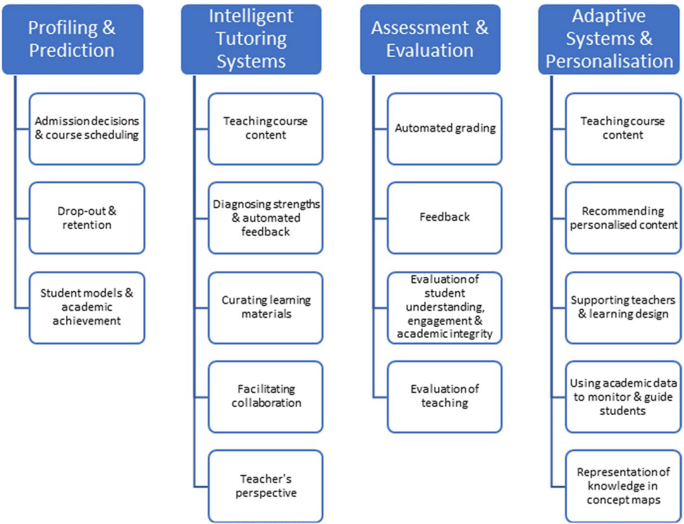
- Review focus was mostly General AIEd (47.0%) or Profiling and Prediction (28.8%); key findings most often discussed Adaptive Systems and Personalisation (54.5%), then Profiling and Prediction (48.5%), Assessment and Evaluation (39.4%), and Intelligent Tutoring Systems (21.2%).
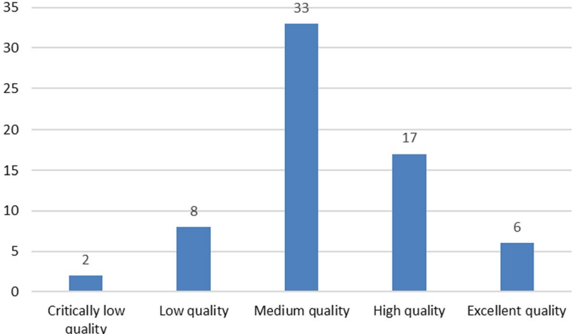
- Quality averaged 6.57/10; 45.5% did not undertake any quality assessment, 31.8% searched only one or two databases, 24.2% provided their exact data extraction coding scheme, and 34.8% did not reflect on review limitations; 65% were critically low to medium quality.
- Top research gaps were ethics (40.9%), methodological rigour (36.4%), wider stakeholders (21.2%), disciplines (16.7%), and countries (15.2%); the top challenge was lack of ethical consideration (29.0%).
Methods
- Tertiary review/review of reviews guided by PRISMA; searched Web of Science, Scopus, ERIC, EBSCOHost, IEEE Xplore, ScienceDirect, ACM Digital Library, OpenAlex, and Google Scholar (first 500 records), plus snowballing/manual additions; initial search 13 October 2022, updated to 18 July 2023.
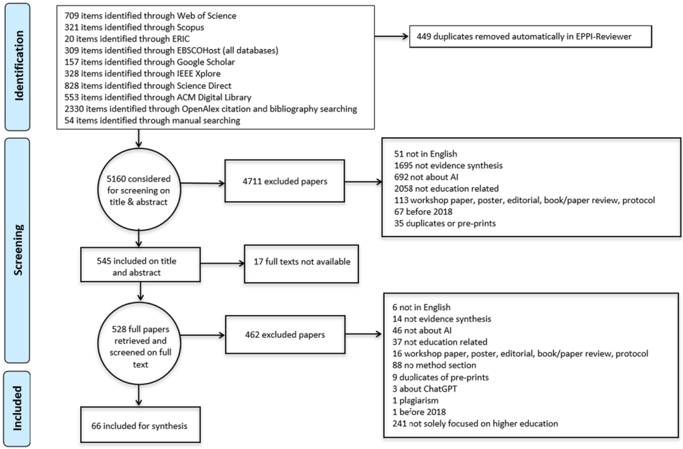
- Included secondary research with a method section on AI applications in formal higher or continuing education, published in English January 2018–18 July 2023 as journal articles or full conference papers; from 5,609 records and 5,160 title/abstract screened, 66 reviews solely focused on higher/continuing education were synthesised.
- Data extracted in EPPI Reviewer; quality assessed with 10 criteria adapted from DARE, AMSTAR 2, and Buntins et al.; narrative synthesis and interactive evidence/gap maps.
Limitations
- Stated: the protocol was not pre-registered in an official repository such as PROSPERO; only the first 500 Google Scholar records were considered versus the 1000 recommended; additional journals and non-English literature could have been searched to reduce language bias; the quality assessment tool is imperfect and yes/no/partly distances cannot be assumed equal.
- Stated/design: generative AI and ChatGPT reviews were excluded; 32 reviews that included higher education but combined it with other levels were excluded to keep results higher-education-specific.
- Evident from the text: English-language and 2018–July 2023 restrictions, plus reliance on available databases and snowballing, may limit coverage; the authors note future work will explore the full 307 AIEd evidence syntheses across educational levels.
Model-written summary. Check it against the paper before relying on it.
Integrity signals
Registry
Cites
Statistics
Figures
Verification
Claims the paper makes
36 Valid · 0 Not valid · 28 Not checked · 127 Own results and interpretations
Every source the paper cites for this claim was checked and supports it.
In the paper
“This can occur when researchers do not give enough consideration to work that has already been published, costing valuable time, effort, and money”
§ A meta systematic review of artificial intelligence in higher education: a call for increased ethics, collaboration, and rigour > Contribution of this review
What the sources say
- Supportedcites Robinson et al., 2021 matched to “Evidence-Based Research Series-Paper 1: What Evidence-Based Research is and why is it important?” (2021) source
The “Need for Evidence-Based Research” section says that failing to consider prior research has led to unnecessary trials over many years and limited funding for important research. The “Limitations” section also describes the opportunity cost of research waste. Together, these support the claim about wasted time, effort, and money. (LLM, conf=0.90)
plainstates a cause- Asserted: passes — The authors put it forward as true.
- Checkable: passes — It can be checked against evidence.
- Load-bearing: passes — The paper’s conclusions depend on it.
- Based: passes — The paper gives a reason why it holds.
- Supported
Every source the paper cites for this claim was checked and supports it.
In the paper
“However, issues of quality when undertaking evidence synthesis persist.”
§ A meta systematic review of artificial intelligence in higher education: a call for increased ethics, collaboration, and rigour > Evidence synthesis quality
What the sources say
- Supportedcites Chalmers et al., 2023 matched to “Topics, publication patterns, and reporting quality in systematic reviews in language education. Lessons from the international database of education systematic reviews (IDESR)” (2024) source
Section 4.5 (Quality over time) says reporting quality in language-education systematic reviews has remained fairly stable and relatively incomplete. This supports the claim that quality issues persist in the evidence syntheses studied. (LLM, conf=0.92)
- Supportedcites Gough et al., 2012 matched to “Clarifying differences between review designs and methods” (2012) source
In “Aggregative and configurative reviews” (page unavailable), the paper says there is less consensus about quality assessment in configurative reviews and describes differing approaches to it. The “Clarifying the nature of variation in reviews” section also identifies unresolved questions about quality assurance and critical appraisal, supporting the broad claim that quality issues persist in evidence synthesis. (LLM, conf=0.88)
plain- Asserted: passes — The authors put it forward as true.
- Checkable: passes — It can be checked against evidence.
- Load-bearing: passes — The paper’s conclusions depend on it.
- Based: passes — The paper gives a reason why it holds.
- Supported
The sources with a verdict support this claim; the rest weren’t checked yet, have no full text we could read, or their verdicts aren’t rated yet.
In the paper
“this tertiary review was conducted using explicit, predefined criteria and transparent methods of searching, analysis and reporting”
§ A meta systematic review of artificial intelligence in higher education: a call for increased ethics, collaboration, and rigour > Method
What the sources say
- Supportedcites Gough et al., 2012 matched to “Clarifying differences between review designs and methods” (2012) source
The Background section describes systematic reviews as using explicit, accountable methods, and the section on aggregative and configurative reviews describes predefined methods and inclusion criteria. The paper supports the methodological approach invoked here; whether the citing authors followed those methods in their own tertiary review is their claim, not a finding attributed to this source. (LLM, conf=0.85)
- Not checked — no full text of the sourcecites Zawacki-Richter et al., 2020 matched to “Systematic Reviews in Educational Research: Methodology, Perspectives and Application” (2020) source
plain- Asserted: passes — The authors put it forward as true.
- Checkable: passes — It can be checked against evidence.
- Load-bearing: passes — The paper’s conclusions depend on it.
- Based: passes — The paper gives a reason why it holds.
- Supported
The cited sources support only part of this claim — read each source’s verdict below.
In the paper
“Prior AIHEd tertiary syntheses have so far also taken place within secondary research (e.g., systematic reviews), rather than as standalone reviews of reviews such as this one.”
§ A meta systematic review of artificial intelligence in higher education: a call for increased ethics, collaboration, and rigour > Prior AIEd syntheses in higher education
What the sources say
- Not checked — no full text of the sourcecites Saghiri et al. (2022) matched to “Scoping review of artificial intelligence and immersive digital tools in dental education” (2022) source
- Not checked — no full text of the sourcecites de Oliveira et al. (2021) matched to “An Overview on the Use of Educational Data Mining for Constructing Recommendation Systems to Mitigate Retention in Higher Education” (2021) source
- Partly supportedcites Sapci and Sapci (2020) matched to “Artificial Intelligence Education and Tools for Medical and Health Informatics Students: Systematic Review” (2020) sourceExperimental — accuracy not yet measured
The Methods describe this paper as a systematic review of AI in medical and health informatics education and list review papers among the eligible publication types. That supports its use as an example of secondary research open to reviews, but the cited passages do not establish that it actually synthesized prior reviews—a tertiary synthesis—or that prior tertiary syntheses generally lacked standalone reviews of reviews. (LLM, conf=0.78)
plain- Asserted: passes — The authors put it forward as true.
- Checkable: passes — It can be checked against evidence.
- Load-bearing: passes — The paper’s conclusions depend on it.
- Based: passes — The paper gives a reason why it holds.
Every source the paper cites for this claim was checked and supports it.
In the paper
“Zawacki-Richter et al. (2019) found three studies (2.1%) that discussed this function, which relate to the presentation of personalised learning materials to students”
§ A meta systematic review of artificial intelligence in higher education: a call for increased ethics, collaboration, and rigour > Intelligent tutoring systems (ITS)
What the sources say
- Supportedcites Zawacki-Richter et al., 2019 matched to “Systematic review of research on artificial intelligence applications in higher education – where are the educators?” (2019) source
The “Intelligent tutoring systems” section identifies two studies focused on curating learning materials based on student needs and a third that mentions the function descriptively. It describes personalised recommendations for reading materials and exercises; the review includes 146 articles, making three approximately 2.1%. (LLM, conf=0.91)
plain- Asserted: passes — The authors put it forward as true.
- Checkable: passes — It can be checked against evidence.
- Load-bearing: unclear — It is unclear whether the paper’s conclusions depend on it.
- Based: passes — The paper gives a reason why it holds.
- Supported
100 more claims · 6 with their cited sources checked
Create a free account to see all 191 claims and to verify the 4 references still open.
- It may state two separate claims as one. 70
- Probably not a substantial claim. 25
Claims other papers make about this one
Each is checked against this paper’s own text: does it say what the citing paper says it does?
The source backs part of the claim, not all of it — or backs it for a different population, condition or comparison.
In the citing paper
“However, the existing body of research predominantly focuses on adult learners in higher education, leaving a significant gap in understanding AI's impact on younger learners in K-12 settings, particularly in the English as a Foreign Language (EFL) context.”
From AI-Integrated Scaffolding to Enhance Agency and Creativity in K-12 English Language Learners: A Systematic Review (2025) · cites this paper as [12]
Experimental — accuracy not yet measuredThe source backs part of the claim, not all of it — or backs it for a different population, condition or comparison.
In the citing paper
“En instituciones como la UNAM (México) y la Universidad de Chile, plataformas con IA han logrado automatizar hasta el 70% de las evaluaciones formativas [13], aunque persisten desafíos en la retroalimentación de competencias creativas [5, 9].”
From Avances, Retos Éticos y Perspectivas de la Inteligencia Artificial (IA) en la Educación de América Latina (2025) · cites this paper as [9]
Experimental — accuracy not yet measuredThe source backs part of the claim, not all of it — or backs it for a different population, condition or comparison.
In the citing paper
“Bond (2024) llevó a cabo una revisión de revisiones sobre IA en la educación superior, sintetizando hallazgos de 50 resúmenes sistemáticos y resaltando la necesidad de estudios empíricos que evalúen el impacto pedagógico de las tecnologías [9].”
From Avances, Retos Éticos y Perspectivas de la Inteligencia Artificial (IA) en la Educación de América Latina (2025) · cites this paper as [9]
Experimental — accuracy not yet measuredThe source backs part of the claim, not all of it — or backs it for a different population, condition or comparison.
In the citing paper
“Las revisiones sistemáticas globales disponibles arrojan una escasa producción de datos desde Latinoamérica (Bond et al., 2024)”
From Percepciones de estudiantes latinoamericanos sobre el uso de la inteligencia artificial en la educación superior (2024) · cites this paper as Bond et al., 2024
Experimental — accuracy not yet measuredThe cited source says what the claim attributes to it.
In the citing paper
“Although every attempt was made to conduct this systematic review as transparently and rigorously as possible, according to previously established quality criteria (Bond et al., 2024), there are some limitations that must be acknowledged.”
From Unpacking student engagement in higher education learning analytics: a systematic review (2024) · cites this paper as Bond et al., 2024
10 more claims about this paper
Create a free account to see every claim other papers make about this one.
Self-check
Percentages, sums and reported differences re-computed from the paper’s own numbers.
Each contradiction between two passages listed here was confirmed by an independent check.
Rated major: it would touch a result — a value a result rests on, reported and recomputed p-values on opposite sides of the significance level, two passages that conflict with no sign which is right, or a cited work retracted before this paper was published.
In the paper
§ A meta systematic review of artificial intelligence in higher education: a call for increased ethics, collaboration, and rigour > AIHEd evidence synthesis quality
“51.5% did not report anything about inter-rater reliability or how screening and coding decisions were decided between review teams”
§ A meta systematic review of artificial intelligence in higher education: a call for increased ethics, collaboration, and rigour > A call for increased collaboration
“less than half of the reviews in this corpus (43.9%, n = 29) did not report any inter-rater agreement processes”
Rated minor: it would not touch a result — a value no result rests on, a p-value that stays on the same side of the significance level, or a conflict that is clerical, resolved elsewhere in the paper, or outside its own findings.
In the paper
§ A meta systematic review of artificial intelligence in higher education: a call for increased ethics, collaboration, and rigour > General publication characteristics
“only 67.6% are available open access.”
§ A meta systematic review of artificial intelligence in higher education: a call for increased ethics, collaboration, and rigour > Discussion
“only 67.7% of evidence synthesis in this sample were published open access”
Rated minor: it would not touch a result — a value no result rests on, a p-value that stays on the same side of the significance level, or a conflict that is clerical, resolved elsewhere in the paper, or outside its own findings.
In the paper
§ A meta systematic review of artificial intelligence in higher education: a call for increased ethics, collaboration, and rigour > Discussion
“the top six most productive countries from six different continents”
§ A meta systematic review of artificial intelligence in higher education: a call for increased ethics, collaboration, and rigour > Conclusion
“| 1 | United States | 11 | 16.7 | | 2 | Canada | 9 | 13.6 |”
Rated minor: it would not touch a result — a value no result rests on, a p-value that stays on the same side of the significance level, or a conflict that is clerical, resolved elsewhere in the paper, or outside its own findings.
In the paper
§ A meta systematic review of artificial intelligence in higher education: a call for increased ethics, collaboration, and rigour > Data extraction
“An initial five studies were coded by all authors, to ensure agreement on the coding scheme”
§ A meta systematic review of artificial intelligence in higher education: a call for increased ethics, collaboration, and rigour > Contribution
“All authors except GS were involved in data extraction.”
Rated minor: it would not touch a result — a value no result rests on, a p-value that stays on the same side of the significance level, or a conflict that is clerical, resolved elsewhere in the paper, or outside its own findings.
In the paper
“After the two disagreements were reconciled, the remaining 5060 items were screened on title and abstract by the same authors, resulting in 4711 items excluded.To continue ensuring inter-rater reliability at the screening on full text stage of 545 studies”
§ A meta systematic review of artificial intelligence in higher education: a call for increased ethics, collaboration, and rigour > Inclusion/exclusion criteria and screening
Reported 545 · recomputed 449
Citations
Cites
The PRISMA 2020 statement: An updated guideline for reporting systematic reviews
Page, M. J., McKenzie, J. E., Bossuyt, P. M., Boutron, I., Hoffmann, T. C., Mulrow, C. D., Shamseer, L., Tetzlaff, J. M., Akl, E. A., Brennan, S. E., et al. (2021) · BMJ · doi:10.1136/bmj.n71 · Cited by 108,283
Preferred Reporting Items for Systematic Reviews and Meta-Analyses: the PRISMA statement
Moher, D., Liberati, A., Tetzlaff, J., Altman, D. G., & for the PRISMA Group (2009) · BMJ · doi:10.1136/bmj.b2535 · Cited by 83,823
PRISMA Extension for Scoping Reviews (PRISMA-ScR): Checklist and Explanation
Tricco, A. C., Lillie, E., Zarin, W., O'Brien, K. K., Colquhoun, H., Levac, D., Moher, D., Peters, M. D. J., Horsley, T., Weeks, L., et al. (2018) · Annals of Internal Medicine · doi:10.7326/m18-0850 · Cited by 43,565 · cited 4×
“Overcoming resistance to change and solving various challenges, including those of an ethical and administrative nature, was identified as pivotal for successful AIHEd integration (Sourani, 2019).”
BackgroundMethodInfluentialScoping studies: towards a methodological framework
Arksey, H., & O'Malley, L. (2005) · International Journal of Social Research Methodology · doi:10.1080/1364557032000119616 · Cited by 36,742
PRISMA-P Group, Moher, D., Shamseer, L., Clarke, M., Ghersi, D., Liberati, A., Petticrew, M., Shekelle, P., & Stewart, L. A. (2015) · Systematic Reviews · doi:10.1186/2046-4053-4-1 · Cited by 26,223 · cited 2×
“…in the field of Applied Linguistics against the Preferred Reporting Items for Systematic Review and Meta-Analysis Protocols (PRISMA-P) guidelines (Shamseer et al., 2015), and found that most of the information expected in any research report were present; background, rationale, objectives and a…”
MethodInfluentialInterrater reliability: The kappa statistic
McHugh, M. L. (2012) · Biochemia Medica · doi:10.11613/bm.2012.031 · Cited by 19,877 · cited 2×
“…reliability between members of the research team, following lengthy discussion and agreement on the inclusion and exclusion criteria by all authors, two members of the team (MB and PP) double screened the first 100 items, resulting in almost perfect agreement (Cohen’s k = 0.89) (McHugh, 2012).”
BackgroundInfluentialPreferred Reporting Items for Systematic Reviews and Meta-Analyses: The PRISMA Statement
Moher, D., Liberati, A., Tetzlaff, J., & Altman, D. G. (2009) · Journal of Clinical Epidemiology · doi:10.1016/j.jclinepi.2009.06.005 · Cited by 19,575
Liberati, A., Altman, D. G., Tetzlaff, J., Mulrow, C., Gotzsche, P. C., Ioannidis, J. P. A., Clarke, M., Devereaux, P. J., Kleijnen, J., & Moher, D. (2009) · BMJ · doi:10.1136/bmj.b2700 · Cited by 17,648
Shamseer, L., Moher, D., Clarke, M., Ghersi, D., Liberati, A., Petticrew, M., Shekelle, P., Stewart, L. A., & the PRISMA-P Group (2015) · BMJ · doi:10.1136/bmj.g7647 · Cited by 13,120 · cited 1×
“…in the field of Applied Linguistics against the Preferred Reporting Items for Systematic Review and Meta-Analysis Protocols (PRISMA-P) guidelines (Shamseer et al., 2015), and found that most of the information expected in any research report were present; background, rationale, objectives and a…”
MethodShea, B. J., Reeves, B. C., Wells, G., Thuku, M., Hamel, C., Moran, J., Moher, D., Tugwell, P., Welch, V., Kristjansson, E., et al. (2017) · BMJ · doi:10.1136/bmj.j4008 · Cited by 10,636 · cited 2×
“Although the authors acknowledge the AMSTAR 2 tool as an effective quality assessment tool for systematic reviews (Shea et al., 2017), the present review includes any kind of evidence synthesis, as long as it has a method section.”
MethodUpdated methodological guidance for the conduct of scoping reviews
Peters, M. D. J., Marnie, C., Tricco, A. C., Pollock, D., Munn, Z., Alexander, L., McInerney, P., Godfrey, C. M., & Khalil, H. (2020) · JBI Evidence Synthesis · doi:10.11124/jbies-20-00167 · Cited by 9,046
The PRISMA 2020 statement: an updated guideline for reporting systematic reviews
Page, M. J., McKenzie, J., Bossuyt, P., Boutron, I., Hoffmann, T., mulrow, C., Shamseer, L., Tetzlaff, J., Akl, E., Brennan, S. E., et al. (2020) · doi:10.31222/osf.io/v7gm2_v1 · Cited by 8,090
Zawacki-Richter, O., Marín, V. I., Bond, M., & Gouverneur, F. (2019) · International Journal of Educational Technology in Higher Education · doi:10.1186/s41239-019-0171-0 · Cited by 7,242 · cited 26×
“By using the framework of Zawacki-Richter et al. (2019), this tertiary review of 66 AIHEd evidence syntheses found that most reviews report findings on the use of adaptive systems and personalisation tools, followed by profiling and prediction tools.”
BackgroundMethodResultInfluentialSelf-citation(2004) · Cited by 5,198
The PRISMA 2020 statement: an updated guideline for reporting systematic reviews
Page, M. J., McKenzie, J., Bossuyt, P., Boutron, I., Hoffmann, T., mulrow, C., Shamseer, L., Tetzlaff, J., Akl, E., Brennan, S. E., et al. (2020) · doi:10.31222/osf.io/v7gm2 · Cited by 5,177
Systematic Literature Reviews in Software Engineering—A Systematic Literature Review
Kitchenham, B., Pearl Brereton, O., Budgen, D., Turner, M., Bailey, J., & Linkman, S. (2009) · Information and Software Technology · doi:10.1016/j.infsof.2008.09.009 · Cited by 4,537 · cited 10×
“In order to help avoid research waste, and to map the state of the AIEd field in higher education (AIHEd), this review is the first to undertake a tertiary review approach (Kitchenham et al., 2009).”
BackgroundMethodInfluentialRethlefsen, M. L., Kirtley, S., Waffenschmidt, S., Ayala, A. P., Moher, D., Page, M. J., Koffel, J. B., PRISMA-S Group, Blunt, H., Brigham, T., et al. (2021) · Systematic Reviews · doi:10.1186/s13643-020-01542-z · Cited by 3,714 · cited 2×
“Guidance for synthesis methods have been available for more than a decade (e.g., Moher et al., 2009; Rader et al., 2014) and are constantly being updated as the methodology advances (e.g., Rethlefsen et al., 2021; Tricco et al., 2018).”
BackgroundMethodRethlefsen, M. L., Kirtley, S., Waffenschmidt, S., Ayala, A. P., Moher, D., Page, M. J., & Koffel, J. (2019) · doi:10.31219/osf.io/sfc38 · Cited by 3,696
Systematic Reviews in the Social Sciences: A Practical Guide
Petticrew, M., & Roberts, H. (2006) · doi:10.1002/9780470754887 · Cited by 3,586 · cited 1×
“A narrative synthesis of the data was undertaken (Petticrew & Roberts, 2006), including a tabulation of the included studies (see Additional file 1: Appendix A), in order to provide an overview of the AIHEd field.”
MethodThe role of google scholar in evidence reviews and its applicability to grey literature searching
Haddaway, N. R., Collins, A. M., Coughlin, D., & Kirk, S. (2015) · PLOS ONE · doi:10.1371/journal.pone.0138237 · Cited by 2,387 · cited 1×
“Only the first 500 records in Google Scholar were considered, as opposed to the 1000 records recommended by Haddaway et al. (2015), although OpenAlex was also used to supplement this.”
MethodGusenbauer, M., & Haddaway, N. R. (2020) · Research Synthesis Methods · doi:10.1002/jrsm.1378 · Cited by 2,379 · cited 1×
“The platforms and databases searched were the Web of Science, Scopus, ERIC, EBSCOHost (all databases), IEEE Xplore, Science Direct and ACM Digital Library, as these have been found particularly useful for evidence synthesis (e.g., Gusenbauer & Haddaway, 2020).”
MethodWhat Is the Impact of ChatGPT on Education? A Rapid Review of the Literature
Lo, C. K. (2023) · Education Sciences · doi:10.3390/educsci13040410 · Cited by 2,024 · cited 1×
“Although reviews have already started being published on the topic of generative AI, and Chat-GPT in particular (e.g., İpek et al., 2023; Lo, 2023), the decision was made to exclude these from this sample, as these AI developments arguably represent the next stage of AI evolution in teaching and…”
BackgroundArtificial intelligence in higher education: the state of the field
Crompton, H., & Burke, D. (2023) · International Journal of Educational Technology in Higher Education · doi:10.1186/s41239-023-00392-8 · Cited by 2,010 · cited 14×
“…(Chu et al., 2022), engagement (Rabelo et al., 2023; Sghir et al., 2022), plagiarism (Albluwi, 2019), reflections and higher order thinking (Crompton & Burke, 2023), often through LMS data (Manhiça et al., 2022), with a view to identifying students at risk and to enable earlier…”
BackgroundMethodInfluentialConducting systematic literature reviews and bibliometric analyses
Linnenluecke, M. K., Marrone, M., & Singh, A. K. (2020) · Australian Journal of Management · doi:10.1177/0312896219877678 · Cited by 1,649 · cited 1×
“Whilst some tertiary reviews focus on one form of secondary research (e.g., meta-analyses; Higgins et al., 2012), it was decided to include any form of evidence synthesis as the goal of this review was to map the field, irrespective of the secondary research approach used.”
BackgroundA Brief Overview of ChatGPT: The History, Status Quo and Potential Future Development
Wu, T., He, S., Liu, J., Sun, S., Liu, K., Han, Q.-L., & Tang, Y. (2023) · IEEE/CAA Journal of Automatica Sinica · doi:10.1109/jas.2023.123618 · Cited by 1,452 · cited 2×
“Six evidence syntheses had a specific geographical focus, with three centred on research conducted within individual countries: India (Algabri et al., 2021; Bhat-tacharjee, 2019) and Saudi Arabia (Alotaibi & Alshehri, 2023).”
BackgroundEthics of AI in Education: Towards a Community-Wide Framework
Holmes, W., Porayska-Pomsta, K., Holstein, K., Sutherland, E., Baker, T., Shum, S. B., Santos, O. C., Rodrigo, M. T., Cukurova, M., Bittencourt, I. I., et al. (2022) · International Journal of Artificial Intelligence in Education · doi:10.1007/s40593-021-00239-1 · Cited by 1,437 · cited 1×
“Yet, amid the technological strides, researchers also continued to grapple with persistent challenges and new dilemmas such as ensuring ethical use (Holmes et al., 2021), enhancing system transparency and explainability (Khosravi et al., 2022), and navigating the pedagogical implications of…”
BackgroundBuilding Intelligent Interactive Tutors : student-centered strategies for revolutionizing e-learning
Woolf, B. P. (2009) · HAL · Cited by 1,429
An Introduction to Systematic Reviews
Gough, D., Oliver, S., & Thomas, J. (2017) · doi:10.4135/9781036234942 · Cited by 1,239
Systematic literature reviews in software engineering – A tertiary study
Kitchenham, B., Pretorius, R., Budgen, D., Pearl Brereton, O., Turner, M., Niazi, M., & Linkman, S. (2010) · Information and Software Technology · doi:10.1016/j.infsof.2010.03.006 · Cited by 1,230 · cited 2×
“Overcoming resistance to change and solving various challenges, including those of an ethical and administrative nature, was identified as pivotal for successful AIHEd integration (Sourani, 2019).”
BackgroundMethodClarifying differences between review designs and methods
Gough, D., Thomas, J., & Oliver, S. (2012) · Systematic Reviews · doi:10.1186/2046-4053-1-28 · Cited by 1,063
Tamim, R. M., Bernard, R. M., Borokhovski, E., Abrami, P. C., & Schmid, R. F. (2011) · Review of Educational Research · doi:10.3102/0034654310393361 · Cited by 1,029 · cited 1×
“There has been a proliferation of evidence synthesis conducted in the field of EdTech, particularly within the past five years (Zawacki-Richter, 2023), with the rising number of secondary research resulting in the need for tertiary reviews (e.g., Lai & Bower, 2020; Tamim et al., 2011).”
BackgroundHistorical threads, missing links, and future directions in AI in education
Williamson, B., & Eynon, R. (2020) · Learning, Media and Technology · doi:10.1080/17439884.2020.1798995 · Cited by 981
Scoping reviews: reinforcing and advancing the methodology and application
Peters, M. D. J., Marnie, C., Colquhoun, H., Garritty, C. M., Hempel, S., Horsley, T., Langlois, E. V., Lillie, E., O’Brien, K. K., Tunçalp, Ӧ., et al. (2021) · Systematic Reviews · doi:10.1186/s13643-021-01821-3 · Cited by 887
Explainable Artificial Intelligence in education
Khosravi, H., Shum, S. B., Chen, G., Conati, C., Tsai, Y.-S., Kay, J., Knight, S., Martinez-Maldonado, R., Sadiq, S., & Gašević, D. (2022) · Computers and Education: Artificial Intelligence · doi:10.1016/j.caeai.2022.100074 · Cited by 863 · cited 2×
“…with persistent challenges and new dilemmas such as ensuring ethical use (Holmes et al., 2021), enhancing system transparency and explainability (Khosravi et al., 2022), and navigating the pedagogical implications of increasingly autonomous AI systems in educational settings (Han et al., 2023).”
BackgroundMethodSelf-citationOuyang, F., Zheng, L., & Jiao, P. (2022) · Education and Information Technologies · doi:10.1007/s10639-022-10925-9 · Cited by 831 · cited 1×
“Bib-liometric analyses have also emerged as a popular form of evidence synthesis (e.g., Lin-nenluecke et al., 2020; Zheng et al., 2022), which analyse bibliographic data to explore research trends and impact.”
BackgroundUtilising learning analytics to support study success in higher education: a systematic review
Ifenthaler, D., & Yau, J. Y.-K. (2020) · Educational Technology Research and Development · doi:10.1007/s11423-020-09788-z · Cited by 659
Predicting academic success in higher education: literature review and best practices
Alyahyan, E., & Düştegör, D. (2020) · International Journal of Educational Technology in Higher Education · doi:10.1186/s41239-020-0177-7 · Cited by 615
Meeting the review family: exploring review types and associated information retrieval requirements
Sutton, A., Clowes, M., Preston, L., & Booth, A. (2019) · Health Information & Libraries Journal · doi:10.1111/hir.12276 · Cited by 570 · cited 7×
“Whilst not included in the Sutton et al. (2019) framework, their ability to provide insight into a field arguably necessitates their inclusion as a valuable form of evidence synthesis.”
BackgroundMethodInfluentialDiscourses of artificial intelligence in higher education: a critical literature review
Bearman, M., Ryan, J., & Ajjawi, R. (2023) · Higher Education · doi:10.1007/s10734-022-00937-2 · Cited by 545
Emergency remote teaching in higher education: mapping the first global online semester
Bond, M., Bedenlier, S., Marín, V. I., & Händel, M. (2021) · International Journal of Educational Technology in Higher Education · doi:10.1186/s41239-021-00282-x · Cited by 527 · cited 1×
“Related to the issue of global reach, only 67.7% of evidence synthesis in this sample were published open access, as opposed to 88.3% of higher education EdTech research published during the pandemic (Bond et al., 2021).”
ResultInfluentialSelf-citationSystematic Reviews in Educational Research: Methodology, Perspectives and Application
(2020) · doi:10.1007/978-3-658-27602-7 · Cited by 467
Self-citationA review of recent advances in learner and skill modeling in intelligent learning environments
Desmarais, M. C., & Baker, R. S. J. D. (2012) · User Modeling and User-Adapted Interaction · doi:10.1007/s11257-011-9106-8 · Cited by 449 · cited 1×
“…the 1990s and into the 2000s, research began to diversify and deepen, exploring varied facets of AIEd such as intelligent tutoring systems (Woolf, 2010), adaptive learning environments (Desmarais & Baker, 2012) as well as supporting collaborative learning environments (Dillenbourg & Jermann, 2007).”
BackgroundRethlefsen, M. L., Kirtley, S., Waffenschmidt, S., Ayala, A. P., Moher, D., Page, M. J., Koffel, J. B., & Group, P.-S. (2021) · Journal of the Medical Library Association · doi:10.5195/jmla.2021.962 · Cited by 409
Hinojo-Lucena, F.-J., Aznar-Díaz, I., Cáceres-Reche, M.-P., & Romero-Rodríguez, J.-M. (2019) · Education Sciences · doi:10.3390/educsci9010051 · Cited by 400 · cited 1×
“…(Crompton & Burke, 2023; Rangel-de Lázaro & Duart, 2023), four did not mention any benefits, and six reviews did not mention any challenges, which for four reviews were due to their bibliometric nature (Gudyanga, 2023; Hinojo-Lucena et al. 2019; Maphosa & Maphosa, 2021; Ullrich et al., 2022).”
BackgroundSapci, A. H., & Sapci, H. A. (2020) · JMIR Medical Education · doi:10.2196/19285 · Cited by 377
Hew, K. F., Hu, X., Qiao, C., & Tang, Y. (2020) · Computers & Education · doi:10.1016/j.compedu.2019.103724 · Cited by 366 · cited 1×
“Ouyang et al. (2020) highlighted a paper in their review (Hew et al., 2020), which analysed the course features of 249 randomly sampled MOOCs, and 6,393 students’ perceptions were examined to understand what factors predicted student satisfaction.”
BackgroundPredicting academic performance: a systematic literature review
Hellas, A., Ihantola, P., Petersen, A., Ajanovski, V. V., Gutica, M., Hynninen, T., Knutas, A., Leinonen, J., Messom, C., & Liao, S. N. (2018) · Proceedings Companion of the 23rd Annual ACM Conference on Innovation and Technology in Computer Science Education · doi:10.1145/3293881.3295783 · Cited by 355 · cited 4×
“Future research should ensure that a detailed description is provided on what is being predicted, how and why (Hellas et al., 2018), could be deepened by more diverse study design, such as longitudinal and large-scale studies (Ifenthaler & Yau, 2020) with multiple data collection techniques (Abu…”
BackgroundMethodInfluentialBozkurt, A., Xiao, J., Lambert, S., Pazurek, A., Crompton, H., Koseoglu, S., Farrow, R., Bond, M., Nerantzi, C., Honeychurch, S., et al. (2023) · Zenodo · doi:10.5281/zenodo.7636568 · Cited by 350
Self-citationBozkurt, A., Xiao, J., Lambert, S., Pazurek, A., Crompton, H., Koseoglu, S., Farrow, R., Bond, M., Nerantzi, C., Honeychurch, S., et al. (2023) · Dublin City University Open Access Institutional Repository (Dublin City University) · doi:10.5281/zenodo.7636567 · Cited by 341
Self-citationHow is the use of technology in education evaluated? A systematic review
Lai, J. W. M., & Bower, M. (2019) · Computers & Education · doi:10.1016/j.compedu.2019.01.010 · Cited by 334 · cited 1×
“However, owing to the heavy predominance of primary AIHEd research in STEM and Health & Welfare courses, as in other EdTech research (e.g., Lai & Bower, 2019), AI applications and presence within the curriculum appear to be at a more mature stage in those rather than in other disciplines.”
BackgroundArtificial intelligence applications in Latin American higher education: a systematic review
Salas-Pilco, S. Z., & Yang, Y. (2022) · International Journal of Educational Technology in Higher Education · doi:10.1186/s41239-022-00326-w · Cited by 330 · cited 12×
“%) reported on findings of ITS diagnosing strengths and gaps, suggesting learning paths and providing automated feedback (Salas-Pilco & Yang, 2022), which can help reduce educator workload (Alam & Mohanty, 2022) and ensure that students receive timely information about their learning (Crompton &…”
BackgroundMethodInfluentialPredicted Influences of Artificial Intelligence on Nursing Education: Scoping Review
Buchanan, C., Howitt, M. L., Wilson, R., Booth, R. G., Risling, T., & Bamford, M. (2021) · JMIR Nursing · doi:10.2196/23933 · Cited by 326 · cited 12×
“Educating students about their own ethical behaviour and the ethical use of AI also emerged as an important topic (Albluwi, 2019; Buchanan et al., 2021; Charow et al., 2021; Lee et al., 2021; Salas-Pilco & Yang, 2022), with the need for more evaluation and reporting of current curriculum impact,…”
BackgroundMethodInfluentialArtificial intelligence and learning analytics in teacher education: A systematic review
Salas-Pilco, S., Xiao, K., & Hu, X. (2022) · Education Sciences · doi:10.3390/educsci12080569 · Cited by 326 · cited 7×
“…(Alam & Mohanty, 2022; Fichten et al., 2021; Li et al., 2021; Manhiça et al., 2022; Otoo-Arthur & van Zyl, 2020; Salas-Pilco & Yang, 2022; Salas-Pilco et al., 2022; Zawacki-Richter et al., 2019), and that this necessitates the need for the creation or improvement of ethical frameworks…”
BackgroundMethodInfluentialArtificial Intelligence in Undergraduate Medical Education: A Scoping Review
Lee, J., Wu, A. S., Li, D., & Kulasegaram, K. (. (2021) · Academic Medicine · doi:10.1097/acm.0000000000004291 · Cited by 324 · cited 8×
“…and suggest the need for more unified, standardised frameworks that incorporate ethical principles and advocate for the development of multidisciplinary teams (Charow et al., Lee et al., 2021), with a stronger focus on more robust and ethically aware AI curricula (e.g., Grunhut et al., 2021).”
BackgroundInfluentialDillenbourg, P., & Jermann, P. (2007) · Scripting Computer-Supported Collaborative Learning · doi:10.1007/978-0-387-36949-5_16 · Cited by 317 · cited 2×
“…the 1990s and into the 2000s, research began to diversify and deepen, exploring varied facets of AIEd such as intelligent tutoring systems (Woolf, 2010), adaptive learning environments (Desmarais & Baker, 2012) as well as supporting collaborative learning environments (Dillenbourg & Jermann, 2007).”
BackgroundAI and the Future of Skills, Volume 1: Capabilities and Assessments
OECD (2021) · Educational research and innovation · doi:10.1787/5ee71f34-en · Cited by 316
Priem, J. R., Piwowar, H., Barrett, J., Demes, K., McCafferty, N., Meyer, C., Orr, R., & Portenoy, J. (2022) · arXiv (Cornell University) · doi:10.48550/arxiv.2205.01833 · Cited by 297 · cited 1×
“The OpenAlex platform (Priem et al., 2022) was also searched, which indexes approximately 209 million publications, and was accessed through evidence synthesis software EPPI Reviewer version 6 (Thomas et al., 2023).”
MethodArtificial intelligence education programs for health care professionals: Scoping review
Charow, R., Jeyakumar, T., Younus, S., Dolatabadi, E., Salhia, M., Al-Mouaswas, D., Anderson, M., Balakumar, S., Clare, M., Dhalla, A., et al. (2021) · JMIR Medical Education · doi:10.2196/31043 · Cited by 291
Zhai, C., & Wibowo, S. (2023) · Computers and Education: Artificial Intelligence · doi:10.1016/j.caeai.2023.100134 · Cited by 261 · cited 3×
“…et al., 2021), with a review of English as a foreign language literature (Klímová & Ibna Seraj, 2023) finding chatbots having a particularly positive influence on developing speaking skills (intonation, stress, and fluency), possibly in part due to feelings of reduced anxiety (Zhai & Wibowo, 2023).”
BackgroundBanihashem, S. K., Noroozi, O., van Ginkel, S., Macfadyen, L. P., & Biemans, H. J. A. (2022) · Educational Research Review · doi:10.1016/j.edurev.2022.100489 · Cited by 246
Bond, M., Zawacki‐Richter, O., & Nichols, M. (2019) · British Journal of Educational Technology · doi:10.1111/bjet.12730 · Cited by 243 · cited 1×
“In line with previous EdTech research (e.g., Bond et al., 2019), there was far less representation from South and Central America (4.5%).”
ResultInfluentialSelf-citationRecent advances in Predictive Learning Analytics: A decade systematic review (2012–2022)
Sghir, N., Adadi, A., & Lahmer, M. (2023) · Education and Information Technologies · doi:10.1007/s10639-022-11536-0 · Cited by 232
Abu Saa, A., Al-Emran, M., & Shaalan, K. (2019) · Technology, Knowledge and Learning · doi:10.1007/s10758-019-09408-7 · Cited by 229 · cited 7×
“This was followed by reviews focusing on profiling and prediction (e.g., Abu Saa et al., 2019) and adaptive systems and personalisation (e.g., Fontaine et al., 2019).”
BackgroundMethodResultInfluentialHo, I. M. K., Cheong, K. Y., & Weldon, A. (2021) · PLOS ONE · doi:10.1371/journal.pone.0249423 · Cited by 208 · cited 1×
“…accuracy of their ML model, allowing them to predict student satisfaction with online education with nearly perfect accuracy, and the second (Ho et al., 2021) investigated the most important predictors in determining the satisfaction of undergraduate students during the COVID-19 pandemic…”
BackgroundEducational Applications of the ChatGPT AI System: A Systematic Review Research
İpek, Z. H., Gözüm, A. İ. C., Papadakis, S., & Kallogiannakis, M. (2023) · Educational Process International Journal · doi:10.22521/edupij.2023.123.2 · Cited by 201 · cited 1×
“Although reviews have already started being published on the topic of generative AI, and Chat-GPT in particular (e.g., İpek et al., 2023; Lo, 2023), the decision was made to exclude these from this sample, as these AI developments arguably represent the next stage of AI evolution in teaching and…”
BackgroundFontaine, G., Cossette, S., Maheu-Cadotte, M.-A., Mailhot, T., Deschênes, M.-F., Mathieu-Dupuis, G., Côté, J., Gagnon, M.-P., & Dubé, V. (2019) · BMJ Open · doi:10.1136/bmjopen-2018-025252 · Cited by 193 · cited 7×
“…Chu et al., 2022; Hwang et al., 2022; Zawacki-Richter et al., 2019); • More evaluation of the effectiveness of tools on learning, cognition, affect, skills etc. rather than focusing on technical aspects like accuracy (Albluwi, 2019; Chaka, 2023; Crow et al., 2018; Frangoudes et al., 2021;…”
BackgroundMethodInfluentialRecommendation Systems for Education: Systematic Review
Urdaneta-Ponte, M. C., Mendez-Zorrilla, A., & Oleagordia-Ruiz, I. (2021) · Electronics · doi:10.3390/electronics10141611 · Cited by 186 · cited 2×
“Urdaneta-Ponte et al. (2021) suggest that further investigation is needed of algorithms that are based on a semantic approach, as well as further development of hybrid systems.”
BackgroundMethodInfluentialAlotaibi, N. S., & Alshehri, A. H. (2023) · Sustainability · doi:10.3390/su151310723 · Cited by 181
Intelligent tutoring systems for programming education: a systematic review
Crow, T., Luxton-Reilly, A., & Wuensche, B. (2018) · Proceedings of the 20th Australasian Computing Education Conference · doi:10.1145/3160489.3160492 · Cited by 166
Grunhut, J., Wyatt, A. T., & Marques, O. (2021) · Journal of Medical Education and Curricular Development · doi:10.1177/23821205211036836 · Cited by 161
Bibliometric mapping techniques in educational technology research: A systematic literature review
Jing, Y., Wang, C., Chen, Y., Wang, H., Yu, T., & Shadiev, R. (2023) · Education and Information Technologies · doi:10.1007/s10639-023-12178-6 · Cited by 149 · cited 1×
“…guidelines (Moher et al., 2009; Page et al., 2021)—underscore an urgent necessity for contemporary, stringent, and universally adopted review guidelines within AIEd, but also within the wider field of EdTech (e.g., Jing et al., 2023) and educational research at large (e.g., Chong et al., 2023).”
BackgroundAI in Medical Education: Global situation, effects and challenges
Zhang, W., Cai, M., Lee, H. J., Evans, R., Zhu, C., & Ming, C. (2024) · Education and Information Technologies · doi:10.1007/s10639-023-12009-8 · Cited by 148
Evidence-Based Research Series-Paper 1: What Evidence-Based Research is and why is it important?
Robinson, K. A., Brunnhuber, K., Ciliska, D., Juhl, C. B., Christensen, R., & Lund, H. (2021) · Journal of Clinical Epidemiology · doi:10.1016/j.jclinepi.2020.07.020 · Cited by 146 · cited 1×
“This can occur when researchers do not give enough consideration to work that has already been published, costing valuable time, effort, and money (Robinson et al., 2021).”
BackgroundDesperately Seeking Dissonance: Identifying the Disconfirming Case in Qualitative Evidence Synthesis
Booth, A., Carroll, C., Ilott, I., Low, L. L., & Cooper, K. (2013) · Qualitative Health Research · doi:10.1177/1049732312466295 · Cited by 145
A systematic literature review on personalised learning in the higher education context
Fariani, R. I., Junus, K., & Santoso, H. B. (2023) · Technology, Knowledge and Learning · doi:10.1007/s10758-022-09628-4 · Cited by 141
Chaka, C. (2022) · Research and Practice in Technology Enhanced Learning · doi:10.58459/rptel.2023.18002 · Cited by 132
Overviews in Education Research: A Systematic Review and Analysis
Polanin, J. R., Maynard, B. R., & Dell, N. A. (2017) · Review of Educational Research · doi:10.3102/0034654316631117 · Cited by 131 · cited 1×
“…process, identifying and analysing types of evidence and key characteristics, exploring how research has been conducted, and identifying gaps in the Page 3 of 41 Bond et al. Int J Educ Technol High Educ (2024) 21:4 literature to better guide future field development (Polanin et al., 2017).”
Background(2012) · Durham Research Online (Durham University) · Cited by 130
The intertwined histories of artificial intelligence and education
Doroudi, S. (2023) · International Journal of Artificial Intelligence in Education · doi:10.1007/s40593-022-00313-2 · Cited by 129 · cited 2×
“Artificial intelligence in education (AIEd) The evolution of AIEd can be traced back several decades, exhibiting a rich history of intertwining educational theory and emergent technology (Doroudi, 2022).”
BackgroundData Mining and Machine Learning Retention Models in Higher Education
Cardona, T. A., Cudney, E. A., Hoerl, R. W., & Snyder, J. L. (2020) · Journal of College Student Retention Research Theory & Practice · doi:10.1177/1521025120964920 · Cited by 128
Tsou, A. Y., Treadwell, J. R., Erinoff, E., & Schoelles, K. (2020) · Systematic Reviews · doi:10.1186/s13643-020-01324-7 · Cited by 122 · cited 1×
“Given the affordances in efficiency that machine learning can bring to evidence synthesis (e.g., Stansfield et al., 2022; Tsou et al., 2020), as well as the enhanced transparency through visualisation tools such as EPPI Visualiser, it is surprising that the AIHEd community has not made more use of…”
MethodQuality assessment tools used in systematic reviews of in vitro studies: A systematic review
Tran, L., Tam, D. N. H., Elshafay, A., Dang, T., Hirayama, K., & Huy, N. T. (2021) · BMC Medical Research Methodology · doi:10.1186/s12874-021-01295-w · Cited by 118 · cited 3×
“The questions were scored as per the adapted method used by Kitchenham et al., (2009, p. 9) and Tran et al., (2021, Figure S1).”
MethodHarmon, J., Pitt, V., Summons, P., & Inder, K. J. (2021) · Nurse Education Today · doi:10.1016/j.nedt.2020.104700 · Cited by 111
Fahd, K., Venkatraman, S., Miah, S. J., & Ahmed, K. (2022) · Education and Information Technologies · doi:10.1007/s10639-021-10741-7 · Cited by 110 · cited 1×
“%) and learning environments (5%), with 49% using machine learning algorithms and 51% measuring the impact of personalisation on learning.”
MethodHow pedagogical agents communicate with students: A two-phase systematic review
Sikström, P., Valentini, C., Sivunen, A., & Kärkkäinen, T. (2022) · Computers & Education · doi:10.1016/j.compedu.2022.104564 · Cited by 103
Educational data mining and learning analytics: a review of educational management in e-learning
Rabelo, A. M., Rodrigues, M. W., Nobre, C. N., Isotani, S., & Zárate, L. E. (2023) · Information Discovery and Delivery · doi:10.1108/idd-10-2022-0099 · Cited by 102
Language bias in systematic reviews: you only get out what you put in
Stern, C., & Kleijnen, J. (2020) · JBI Evidence Synthesis · doi:10.11124/jbies-20-00361 · Cited by 101 · cited 2×
“Reviews focused specifically on assessment and evaluation (e.g., Banihashem et al., 2022) and intelligent tutoring systems (e.g., Crow et al., 2018) were rare.”
BackgroundMethodArtificial Intelligence and Surgical Education: A Systematic Scoping Review of Interventions
Kirubarajan, A., Young, D., Khan, S., Crasto, N., Sobel, M., & Sussman, D. (2022) · Journal of Surgical Education · doi:10.1016/j.jsurg.2021.09.012 · Cited by 101
Yu, L., & Yu, Z. (2023) · Frontiers in Psychology · doi:10.3389/fpsyg.2023.1061778 · Cited by 101 · cited 1×
“Whilst this realisation is not lost on the AIEd field, with at least four evidence syntheses published specifically on the topic in the last two years (Guan et al., 2023; Mahmood et al., 2022; Rios-Campos et al., 2023; Yu & Yu, 2023), 29 this meta review indicates that the issue remains pressing.”
BackgroundZhong, L. (2022) · Interactive Learning Environments · doi:10.1080/10494820.2022.2061006 · Cited by 100 · cited 4×
“Zhong’s (2022) review of 41 studies found that 54% used learning traits to structure learning content, with macro the most popular sequencing approach (24%).”
BackgroundMethodInfluentialResearch trends in instructional design and technology journals
Bodily, R., Leary, H., & West, R. E. (2019) · British Journal of Educational Technology · doi:10.1111/bjet.12712 · Cited by 99 · cited 1×
“In contrast to previous reviews in the field of EdTech (e.g., Bodily et al., 2019), and previous EdTech tertiary reviews (Buntins et al., 2023; Zawacki-Richter, 2023), authors conducting AIHEd evidence synthesis represent a wide range of countries, with the top six most productive countries from…”
ResultRangel-de Lázaro, G., & Duart, J. M. (2023) · Sustainability · doi:10.3390/su15043507 · Cited by 95 · cited 17×
“The surge in data from learning management systems (LMS) and self-serve course registration has boosted research in these sectors, and algorithms targeting course selection, program admission, and pathway advising can have significant and sometimes restrictive effects on students (McConvey et al., 2023).”
BackgroundMethodResultInfluentialLai, J. W. M., & Bower, M. (2020) · Journal of Computer Assisted Learning · doi:10.1111/jcal.12412 · Cited by 92 · cited 6×
“…and with a view to suggest future primary and secondary research (Sutton et al., 2019), a tertiary review was conducted (Kitchenham et al., 2009; Lai & Bower, 2020), with the reporting here guided by the Preferred Reporting Items for Systematic Review and Meta-Analyses (PRISMA, Page et al.,…”
BackgroundMethodInfluentialScoping review of artificial intelligence and immersive digital tools in dental education
Saghiri, M. A., Vakhnovetsky, J., & Nadershahi, N. (2022) · Journal of Dental Education · doi:10.1002/jdd.12856 · Cited by 91
Cobos, C., Rodriguez, O., Rivera, J. J., Betancourt, J., Mendoza, M., León, E., & Herrera‐Viedma, E. (2013) · Information Processing & Management · doi:10.1016/j.ipm.2012.12.002 · Cited by 89 · cited 1×
“…had guided students and recommended course material, and Zawacki-Richter et al. (2019) found three studies, including one suggesting pedagogical strategies for educators (Cobos et al., 2013), Urdaneta-Ponte et al.’s (2021) systematic review focused solely on RSs in HE and included 98 studies.”
BackgroundAbdelkader, H. E., Gad, A. G., Abohany, A. A., & Sorour, S. E. (2022) · IEEE Access · doi:10.1109/access.2022.3143035 · Cited by 89
Hwang, G.-J., Tang, K.-Y., & Tu, Y.-F. (2024) · Interactive Learning Environments · doi:10.1080/10494820.2022.2086579 · Cited by 87 · cited 8×
“…learning capabilities and facilitating smoother transitions into professional roles, especially in nursing and medicine (Buchanan et al., 2021; Hwang et al., 2022; Sapci & Sapci, 2020), alongside stimulating student engagement (Chaka, 2023) and honing specific skills such as writing…”
BackgroundResultInfluentialBozkurt, A., & Sharma, R. C. (2023) · Zenodo (CERN European Organization for Nuclear Research) · doi:10.5281/zenodo.7755272 · Cited by 77
Daoudi, I. (2022) · Education and Information Technologies · doi:10.1007/s10639-022-11087-4 · Cited by 74
Replication, Duplication, and Waste in a Quarter Million Systematic Reviews and Meta-Analyses
Siontis, K. C., & Ioannidis, J. P. A. (2018) · Circulation: Cardiovascular Quality and Outcomes · doi:10.1161/circoutcomes.118.005212 · Cited by 73 · cited 2×
“…synthesis is a welcome approach to gaining insight into effective applications of AI in education, there is a risk of ‘research waste’ in every field of research due to a duplication of efforts, by conducting reviews on the same or similar topics (Grainger et al., 2020; Siontis & Ioannidis, 2018).”
BackgroundRetention Factors in STEM Education Identified Using Learning Analytics: A Systematic Review
Li, C., Herbert, N., Yeom, S., & Montgomery, J. (2022) · Education Sciences · doi:10.3390/educsci12110781 · Cited by 71 · cited 2×
“Future primary research must ensure that lengthy consideration is given to participant consent, data collection procedures, and data storage (Otoo-Arthur & van Zyl, 2020).”
BackgroundThe use of chatbots in university EFL settings: Research trends and pedagogical implications
Klímová, B., & Ibna Seraj, P. M. (2023) · Frontiers in Psychology · doi:10.3389/fpsyg.2023.1131506 · Cited by 69
Systematic Literature Review of Predictive Analysis Tools in Higher Education
Liz-Domínguez, M., Caeiro-Rodríguez, M., Llamas-Nistal, M., & Mikic-Fonte, F. A. (2019) · Applied Sciences · doi:10.3390/app9245569 · Cited by 68 · cited 1×
“Liz-Domínguez et al. (2019) acknowledge the trend of using AI to identify at-risk students, while Maphosa and Maphosa (2021) note AI’s high accuracy in predicting student outcomes.”
BackgroundOpen and Distance Learning Today
Cauthers, J. (1997) · Canadian Journal of University Continuing Education · doi:10.21225/d5930x · Cited by 66
A Human-Centered Review of Algorithms in Decision-Making in Higher Education
McConvey, K., Guha, S., & Kuzminykh, A. (2023) · CHI Conference on Human Factors in Computing Systems · doi:10.1145/3544548.3580658 · Cited by 66
An Overview of the Use of Chatbots in Medical and Healthcare Education
Frangoudes, F., Hadjiaros, M., Schiza, E. C., Matsangidou, M., Tsivitanidou, O., & Neokleous, K. (2021) · Lecture notes in computer science · doi:10.1007/978-3-030-77943-6_11 · Cited by 65 · cited 10×
“Only two reviews considered AIHEd affordances (Crompton & Burke, 2023; Rangel-de Lázaro & Duart, 2023), four did not mention any benefits, and six reviews did not mention any challenges, which for four reviews were due to their bibliometric nature (Gudyanga, 2023; Hinojo-Lucena et al. 2019; Maphosa & Maphosa, 2021; Ul…”
BackgroundInfluentialAlam, A., & Mohanty, A. (2022) · Communications in Computer and Information Science · doi:10.1007/978-3-031-23233-6_2 · Cited by 62
Evidence synthesis for tackling research waste
Grainger, M. J., Bolam, F. C., Stewart, G. B., & Nilsen, E. B. (2020) · Nature Ecology & Evolution · doi:10.1038/s41559-020-1141-6 · Cited by 59 · cited 2×
“…synthesis is a welcome approach to gaining insight into effective applications of AI in education, there is a risk of ‘research waste’ in every field of research due to a duplication of efforts, by conducting reviews on the same or similar topics (Grainger et al., 2020; Siontis & Ioannidis, 2018).”
BackgroundEthical and Pedagogical Impacts of AI in Education
Han, B., Nawaz, S., Buchanan, G. R., & McKay, D. (2023) · Lecture notes in computer science · doi:10.1007/978-3-031-36272-9_54 · Cited by 59 · cited 2×
“…for example, included an analysis of four systematic reviews in their scoping review of AI applications in dental education, de Oliveira et al. (2021) included eight reviews in their systematic review of educational data mining for recommender systems, and Sapci and Sapci (2020) included five…”
The dilemma and countermeasures of educational data ethics in the age of intelligence
Guan, X., Feng, X., & Islam, A. Y. M. A. (2023) · Humanities and Social Sciences Communications · doi:10.1057/s41599-023-01633-x · Cited by 55 · cited 1×
“Whilst this realisation is not lost on the AIEd field, with at least four evidence syntheses published specifically on the topic in the last two years (Guan et al., 2023; Mahmood et al., 2022; Rios-Campos et al., 2023; Yu & Yu, 2023), 29 this meta review indicates that the issue remains pressing.”
BackgroundApplying Big Data Analytics in Higher Education: A Systematic Mapping Study
Alkhalil, A., Abdallah, M. A. E., Alogali, A. F. M., & Aljaloud, A. S. (2021) · International Journal of Information and Communication Technology Education · doi:10.4018/ijicte.20210701.oa3 · Cited by 54
Automatic evaluation of open-ended questions for online learning. A systematic mapping
del Gobbo, E., Guarino, A., Cafarelli, B., Grilli, L., & Limone, P. (2023) · Studies in Educational Evaluation · doi:10.1016/j.stueduc.2023.101258 · Cited by 54
Past, present and future of living systematic review: a bibliometrics analysis
Zheng, Q., Xu, J., Gao, Y., Liu, M., Cheng, L., Xiong, L., Cheng, J., Yuan, M., OuYang, G., Huang, H., et al. (2022) · BMJ Global Health · doi:10.1136/bmjgh-2022-009378 · Cited by 51 · cited 2×
“Bib-liometric analyses have also emerged as a popular form of evidence synthesis (e.g., Lin-nenluecke et al., 2020; Zheng et al., 2022), which analyse bibliographic data to explore research trends and impact.”
BackgroundHow Machine Learning (ML) is Transforming Higher Education: A Systematic Literature Review
Pinto, A. S., Abreu, A., Costa, E., & Paiva, J. (2023) · Journal of Information Systems Engineering and Management · doi:10.55267/iadt.07.13227 · Cited by 49
Ullrich, A., Vladova, G., Eigelshoven, F., & Renz, A. (2022) · Discover Artificial Intelligence · doi:10.1007/s44163-022-00031-7 · Cited by 41 · cited 13×
“However, there remain many concerns about how institutions are storing and using teaching and learning data (see section below, Research Gaps ), and therefore further data regulations and a greater emphasis on ethical considerations are needed (Bear-man et al., 2023; Ullrich et al., 2022).”
BackgroundInfluentialMethods for documenting systematic review searches: a discussion of common issues
Rader, T., Mann, M., Stansfield, C., Cooper, C., & Sampson, M. (2014) · Research Synthesis Methods · doi:10.1002/jrsm.1097 · Cited by 37 · cited 1×
“Guidance for synthesis methods have been available for more than a decade (e.g., Moher et al., 2009; Rader et al., 2014) and are constantly being updated as the methodology advances (e.g., Rethlefsen et al., 2021; Tricco et al., 2018).”
MethodNeurophysiological Measurements in Higher Education: A Systematic Literature Review
Darvishi, A., Khosravi, H., Sadiq, S., & Weber, B. (2022) · International Journal of Artificial Intelligence in Education · doi:10.1007/s40593-021-00256-0 · Cited by 37 · cited 1×
“…with persistent challenges and new dilemmas such as ensuring ethical use (Holmes et al., 2021), enhancing system transparency and explainability (Khosravi et al., 2022), and navigating the pedagogical implications of increasingly autonomous AI systems in educational settings (Han et al., 2023).”
BackgroundSelf-citationPennington, R. C., Saadatzi, M. N., Welch, K. C., & Scott, R. (2014) · Journal of Special Education Technology · doi:10.1177/016264341402900404 · Cited by 36 · cited 1×
“…( n = 10) of studies focused on how robots could be used to enhance the teaching and learning of undergraduate students, with one study exploring the use of a robot-assisted instructional package to help teach students with intellectual disabilities how to write messages (Pennington et al., 2014).”
BackgroundApplying machine classifiers to update searches: Analysis from two case studies
Stansfield, C., Stokes, G., & Thomas, J. (2021) · Research Synthesis Methods · doi:10.1002/jrsm.1537 · Cited by 34 · cited 1×
“Given the affordances in efficiency that machine learning can bring to evidence synthesis (e.g., Stansfield et al., 2022; Tsou et al., 2020), as well as the enhanced transparency through visualisation tools such as EPPI Visualiser, it is surprising that the AIHEd community has not made more use of…”
MethodChong, S. W., Bond, M., & Chalmers, H. (2023) · Applied Linguistics Review · doi:10.1515/applirev-2022-0193 · Cited by 30 · cited 1×
“…guidelines (Moher et al., 2009; Page et al., 2021)—underscore an urgent necessity for contemporary, stringent, and universally adopted review guidelines within AIEd, but also within the wider field of EdTech (e.g., Jing et al., 2023) and educational research at large (e.g., Chong et al., 2023).”
BackgroundSelf-citationChoosing the Right Tool for the Job: Screening Tools for Systematic Reviews in Education
Zhang, Q., & Neitzel, A. (2024) · Journal of Research on Educational Effectiveness · doi:10.1080/19345747.2023.2209079 · Cited by 28 · cited 12×
“Zhang et al. (2023) found that machine learning could reveal objective skills indicators and Kirubarajan et al. (2022) found that AI-based assessments demonstrated high levels of accuracy.”
BackgroundMethodInfluentialStuA: An Intelligent Student Assistant
Lodhi, P., Mishra, O., Jain, S., & Bajaj, V. (2018) · International Journal of Interactive Multimedia and Artificial Intelligence · doi:10.9781/ijimai.2018.02.008 · Cited by 27 · cited 1×
“…academic advising, where students are provided with individualised guidance and educational planning, and Zawacki-Richter et al. (2019) reported examples of AI to support university career services, including an interactive intelligent tutor to assist new students (see Lodhi et al., 2018).”
BackgroundMaphosa, V., & Maphosa, M. (2021) · International Conference on Artificial Intelligence, Big Data, Computing and Data Communication Systems (icABCD) · doi:10.1109/icabcd51485.2021.9519368 · Cited by 26 · cited 7×
“Maphosa and Maphosa (2021) called for further primary research on the development and application of intelligent robots, although Chaka (2023) pointed out that barriers to further HE implementation will need to be overcome, includ-Page ing challenges with infrastructure and technology, educator…”
BackgroundInfluentialManhica, R., Santos, A., & Cravino, J. (2022) · 2022 17th Iberian Conference on Information Systems and Technologies (CISTI) · doi:10.23919/cisti54924.2022.9820205 · Cited by 26 · cited 6×
“Manhiça et al. (2022) also found two studies exploring automated feedback, but unfortunately did not provide any further information about them, which gives further weight to the potential of more research need in this area.”
BackgroundInfluentialChalmers, H., Brown, J., & Koryakina, A. (2024) · Applied Linguistics Review · doi:10.1515/applirev-2022-0190 · Cited by 26 · cited 3×
“Chalmers et al. (2023), for example, analysed the quality of 307 reviews in the field of Applied Linguistics against the Preferred Reporting Items for Systematic Review and Meta-Analysis Protocols (PRISMA-P) guidelines (Shamseer et al., 2015), and found that most of the information expected in any…”
BackgroundMethodInfluentialThe New Teacher Assistant: A Review of Chatbots’ Use in Higher Education
Hamam, D. (2021) · Communications in computer and information science · doi:10.1007/978-3-030-78645-8_8 · Cited by 25
Invisible borders in educational technology research? A comparative analysis
Marín, V. I., Buntins, K., Bedenlier, S., & Bond, M. (2023) · Educational Technology Research and Development · doi:10.1007/s11423-023-10195-3 · Cited by 25 · cited 4×
“Owing to time and the project scope, studies were only included if they had been published in the English language and were either a peer-reviewed journal article or conference paper.”
BackgroundInfluentialSelf-citationEmergency remote teaching in higher education: Mapping the first global online semester (Pre-print)Preprint
Bond, M., Bedenlier, S., Marín, V. I., & Händel, M. (2021) · OSF Preprints (OSF Preprints) · doi:10.31219/osf.io/gsdu7 · Cited by 21
Self-citationBond, M. (2018) · Australasian Journal of Educational Technology · doi:10.14742/ajet.4363 · Cited by 20 · cited 7×
“However, authors from an Education disciplinary background were slightly more likely to use PRISMA than those from Computer Science, who preferred to follow the guidance of Kitchenham and colleagues (Kitchenham, 2004; Kitch-enham & Charters, 2007; Kitchenham et al., 2009, 2010).”
MethodInfluentialSelf-citationProgress, Challenges and Countermeasures of Adaptive Learning: A Systematic Review
Li, F., Yifeng, H., & Xue, Q. (2021) · DOAJ (DOAJ: Directory of Open Access Journals) · Cited by 20
Ethics of artificial intelligence
Rios-Campos, C., Tejada-Castro, M. I., Viteri, J. D. C. L., Zambrano, E. O. G., Núñez, J. B., & Vara, F. E. O. (2023) · South Florida Journal of Development · doi:10.46932/sfjdv4n4-022 · Cited by 19
A Systematic Review on Big Data Analytics Frameworks for Higher Education - Tools and Algorithms
Otoo-Arthur, D., & van Zyl, T. L. (2019) · International Conference on E-Business, Information Management and Computer Science (EBIMCS) · doi:10.1145/3377817.3377836 · Cited by 18
Trends and Topics in Educational Technology, 2023 Edition
Allman, B., Kimmons, R. M., Rosenberg, J. M., et al. (2023) · TechTrends · doi:10.1007/s11528-023-00840-2 · Cited by 18
A Meta-analysis of Educational Data Mining for Predicting Students Performance in Programming
Moonsamy, D., Naicker, N., Timothy, T., & Ropo, E. (2021) · International Journal of Advanced Computer Science and Applications · doi:10.14569/ijacsa.2021.0120213 · Cited by 17 · cited 1×
“…AI to predict academic performance in HE (Abu Saa et al., 2019; Fahd et al., 2022; Ifenthaler & Yau, 2020; Zulkifli et al., 2019), with some reviews specialising in specific disciplines (STEM; Hellas et al., 2018; Moonsamy et al., 2021) and study levels (undergraduates; Alyahyan & Düştegör, 2020).”
BackgroundSystematic Research on Predictive Models on Students’ Academic Performance in Higher Education
(2019) · International Journal of Recent Technology and Engineering (IJRTE) · doi:10.35940/ijrte.b1061.0782s319 · Cited by 17 · cited 1×
“Seven reviews purely focused on the use of AI to predict academic performance in HE (Abu Saa et al., 2019; Fahd et al., 2022; Ifenthaler & Yau, 2020; Zulkifli et al., 2019), with some reviews specialising in specific disciplines (STEM; Hellas et al., 2018; Moonsamy et al., 2021) and study levels…”
BackgroundArtificial Intelligence in Medical Education: A citation-based systematic literature review
Burney, I. A., & Ahmad, N. (2022) · Journal of Shifa Tameer-e-Millat University · doi:10.32593/jstmu/vol5.iss1.183 · Cited by 16
Methodische Ansätze zu Evidenzsynthesen in der Bildungstechnologie: Eine tertiäre Übersichtsarbeit
Buntins, K., Bedenlier, S., Marín, V., Händel, M., & Bond, M. (2023) · MedienPädagogik: Zeitschrift für Theorie und Praxis der Medienbildung · doi:10.21240/mpaed/54/2023.12.20.x · Cited by 13
Self-citationArtificial Intelligence :, A Prospective Or Real Option For Education
Sourani, M. (2018) · الجنان · doi:10.33986/0522-000-011-018 · Cited by 13
Educational data mining in higher education in sub-saharan africa
Maphosa, M., & Maphosa, V. (2020) · International Conference on Intelligent and Innovative Computing Applications · doi:10.1145/3415088.3415096 · Cited by 11 · cited 2×
“…of contexts, especially developing countries (e.g., Pinto et al., 2023), such as India (Bhattacharjee, 2019) and African nations (Gudyanga, 2023; Maphosa & Maphosa, 2020), in order to better understand how AI can be used to enhance learning in under-resourced communities (Crompton & Burke,…”
BackgroundBhattacharjee, K. K. (2019) · 2019 IEEE International Conference on Industrial Engineering and Engineering Management (IEEM) · doi:10.1109/ieem44572.2019.8978798 · Cited by 9
Fichten, C., Pickup, D., Asunsion, J., Jorgensen, M., Vo, C., Legault, A., & Libman, E. (2022) · Exceptionality Education International · doi:10.5206/eei.v31i1.14089 · Cited by 9
De Oliveira, T. N., Bernardini, F., & Viterbo, J. (2021) · 2021 IEEE Frontiers in Education Conference (FIE) · doi:10.1109/fie49875.2021.9637207 · Cited by 8 · cited 4×
“The initial search was conducted on 13 October 2022, with subsequent searches conducted until 18 July 2023 to ensure the inclusion of extant literature (see OSF for search details 14 ).”
BackgroundInfluentialMapping education 4.0 research trends: a bibliometrics analysis on African publications
Gudyanga, R. (2023) · International Journal of Research in Business and Social Science (2147- 4478) · doi:10.20525/ijrbs.v12i4.2585 · Cited by 4
AI destroys principles of authorship. A scary case from educational technology publishing.
Kalz, M. (2023) · doi:10.59350/7ps3d-bzf63 · Cited by 2
Trends and Topics in Educational Technology, 2024 Edition
Allman, B., Kimmons, R., Wang, W., et al. (2024) · TechTrends · doi:10.1007/s11528-024-00950-5
Artificial Intelligence Education Programs for Health Care Professionals: Scoping Review (Preprint)
Charow, R., Jeyakumar, T., Younus, S., et al. (2021) · doi:10.2196/preprints.31043
Evidence synthesis for tackling research waste
Grainger, M., Bolam, F. C., stewart, G., & Nilsen, E. B. (2019) · doi:10.32942/osf.io/42fkh
Research works printed but not linked: 6
- 2. Algabri, H. K., Kharade, K. G., & Kamat, R. K. (2021). Promise, threats, and personalization in higher education with artificial intelligence. Webology, 18(6), 2129-2139.
- 26. Chen, X., Zou, D., Xie, H., Cheng, G., & Liu, C. (2022). Two decades of artificial intelligence in education: Contributors, collaborations, research topics, challenges, and future directions. Educational Technology and Society, 25(1), 28-47. https:// doi. org/ 10. 2307/ 48647 028 · doi:10.2307/48647028
- 28. Chu, H.-C., Hwang, G.-H., Tu, Y.-F., & Yang, K.-H. (2022). Roles and research trends of artificial intelligence in higher educa- tion: A systematic review of the top 50 most-cited articles. Australasian Journal of Educational Technology, 38(3), 22-42. https:// doi. org/ 10. 14742/ ajet. 7526 · doi:10.14742/ajet.7526
- 83. Mahmood, A., Sarwar, Q., & Gordon, C. (2022). A Systematic Review on Artificial Intelligence in Education (AIE) with a focus on Ethics and Ethical Constraints. Pakistan Journal of Multidisciplinary Research, 3(1). https:// pjmr. org/ pjmr/ artic le/ view/ 245 *
- 103. Priem, J., Piwowar, H., & Orr, R. (2022). OpenAlex: A fully-open index of scholarly works, authors, venues, institutions, and concepts. ArXiv. https:// arxiv. org/ abs/ 2205. 01833
- 137. Zawacki-Richter, O. (2023). Umbrella Review in ODDE. Herbsttagung der Sektion Medienpädagogik (DGfE), 22 September 2023.
Cited by
The promise and challenges of generative AI in education
Giannakos, M., Azevedo, R., Brusilovsky, P., Cukurova, M., Dimitriadis, Y., Hernandez-Leo, D., Järvelä, S., Mavrikis, M., & Rienties, B. (2025) · Behaviour & Information Technology · doi:10.1080/0144929x.2024.2394886 · Cited by 543
“In recent years, AI has significantly impacted the way humans learn and the way the respective institutions operate (Bond et al. 2024).”
In search of artificial intelligence (AI) literacy in teacher education: A scoping review
Sperling, K., Stenberg, C.-J., McGrath, C., Åkerfeldt, A., Heintz, F., & Stenliden, L. (2024) · Computers and Education Open · doi:10.1016/j.caeo.2024.100169 · Cited by 498
Wang, C., Wang, H., Li, Y., Dai, J., Gu, X., & Yu, T. (2025) · International Journal of Human–Computer Interaction · doi:10.1080/10447318.2024.2383033 · Cited by 353
“…et al., 2023), programming (Jing et al., 2024; Yilmaz & Yilmaz, 2023b), online learning (Hwang et al., 2021), intelligent learning (Chen et al., 2021), medical education (Winkler-Schwartz et al., 2019; Zhang et al., 2024), higher education (Bond et al., 2024), and e-learning (Tang et al., 2023).”
Feedback sources in essay writing: peer-generated or AI-generated feedback?
Banihashem, S. K., Kerman, N. T., Noroozi, O., Moon, J., & Drachsler, H. (2024) · International Journal of Educational Technology in Higher Education · doi:10.1186/s41239-024-00455-4 · Cited by 282
“This tool’s introduction has initiated discussions on the considerable ways AI can support educational endeavors (Bond et al., 2024; Darvishi et al., 2024).”
BackgroundGenerative AI for Customizable Learning Experiences
Pesovski, I., Santos, R., Henriques, R., & Trajkovik, V. (2024) · Sustainability · doi:10.3390/su16073034 · Cited by 274
“Furthermore, Bond et al. [29], in the recent systematic review of artificial intelligence in higher education, stated that available literature on how AI is used at the postgraduate level remains limited, besides the fast development of AI models, tools, and solutions.”
Background
Metadata
- Authors
- Bond, M., Khosravi, H., De Laat, M., Bergdahl, N., Negrea, V., Oxley, E., Pham, P., Chong, S. W., & Siemens, G.
- Affiliations
- University College London (GB)
- The University of Queensland (AU)
- Stockholm University (SE)
- University of South Australia (AU)
- University of St Andrews (GB)
- Corresponding author
- Bond, Melissa
- ORCID
- Venue
- International Journal of Educational Technology in Higher Education
- Published
- 2024-01-19
- Volume
- 21
- Issue
- 1
- ISSN
- 2365-9440 (ISSN-L)
- OpenAlex
- W4391006361
- Semantic Scholar
- c8cc6ca886011e63c64bc9ac03b5a7798734fcec
- Cited by
- 852
- References
- 135
- Citations by year
- 2026: 474 · 2025: 279 · 2024: 99
- FWCI
- 48.93
- Type
- journal article
- Language
- en
- Open access
- diamond
- doi.org
- Licence
- cc-by
- creativecommons.org/licenses/by/4.0 (tdm)
- creativecommons.org/licenses/by/4.0 (vor)
- Locations
- International Journal of Educational Technology in Higher Education (publishedVersion, cc-by)
- Hogskolan Ihalmstad (Halmstad University) (submittedVersion, other-oa)
- ENLIGHTEN (Jurnal Bimbingan dan Konseling Islam) (submittedVersion, other-oa)
- UCL Discovery (University College London) (submittedVersion, cc-by)
- St Andrews Research Repository (St Andrews Research Repository) (submittedVersion, cc-by)
- UniSA Research Outputs Repository (University of South Australia) (submittedVersion, cc-by)
- Adelaide Research & Scholarship (AR&S) (University of Adelaide) (submittedVersion, cc-by)
- DOAJ (DOAJ: Directory of Open Access Journals) (submittedVersion, cc-by-sa)
- Funders
- University of South Australia
- Topics
- Social Sciences › Education › Artificial Intelligence in Education
- Physical Sciences › Computer Science › Artificial Intelligence › Intelligent Tutoring Systems and Adaptive Learning
- Physical Sciences › Computer Science › Computer Science Applications › Online Learning and Analytics
- Keywords
- artificial intelligence in higher education, AI in education research, research ethics, research collaboration, scientific rigor, adaptive learning systems, personalization, research gaps, interdisciplinary approach
About these checks
Registry, retraction, Cites and statistics results are computed, not judged, with one exception: a printed reference that no index lists is read once by a model before it counts as a citation error. Claims are extracted by a model and kept only when their quote appears verbatim in the text; each cited source is then checked, with a model’s help, for whether it says what the claim relies on. Those verdicts can be wrong — read the claim’s quote and the cited source before relying on one.
The claim verdicts this report counts are experimental: their accuracy is not yet measured.
A language model drew the claims from the paper on 2026-10-16, under version 3 of the claim definition (model deepseek-v4.1-flash, prompt extract-v3).
A second model labelled each claim on 2026-10-16 (model jev-1.13-20260917, definition revision gold-guideline-v0.2).
Cited sources are checked with a language model’s help (gpt-6-sol).
Statistics and arithmetic are recomputed, not judged.
Confidence bands are shown only for fields calibrated on our annotated test set. None is calibrated yet, so no band is shown.
What counts as a claim ›How we measure confidence ›How we check this ›
Are you an author, or do you see a problem with this page? Request a review
Data sources
Bibliographic data: Semantic Scholar, OpenAlex, Crossref.
Contains information from the Semantic Scholar Academic Graph Datasets, made available under the ODC Attribution License (ODC-BY 1.0).
Semantic Scholar’s data is described in: Kinney, R., et al. (2023). The Semantic Scholar Open Data Platform. arXiv:2301.10140.
