

The DOI matches its Crossref record; 53 of the 54 references it cites were found in a registry or an index.
Exercise Training Modulates Gut Microbiota Profile and Improves Endotoxemia
Open accessAbstract
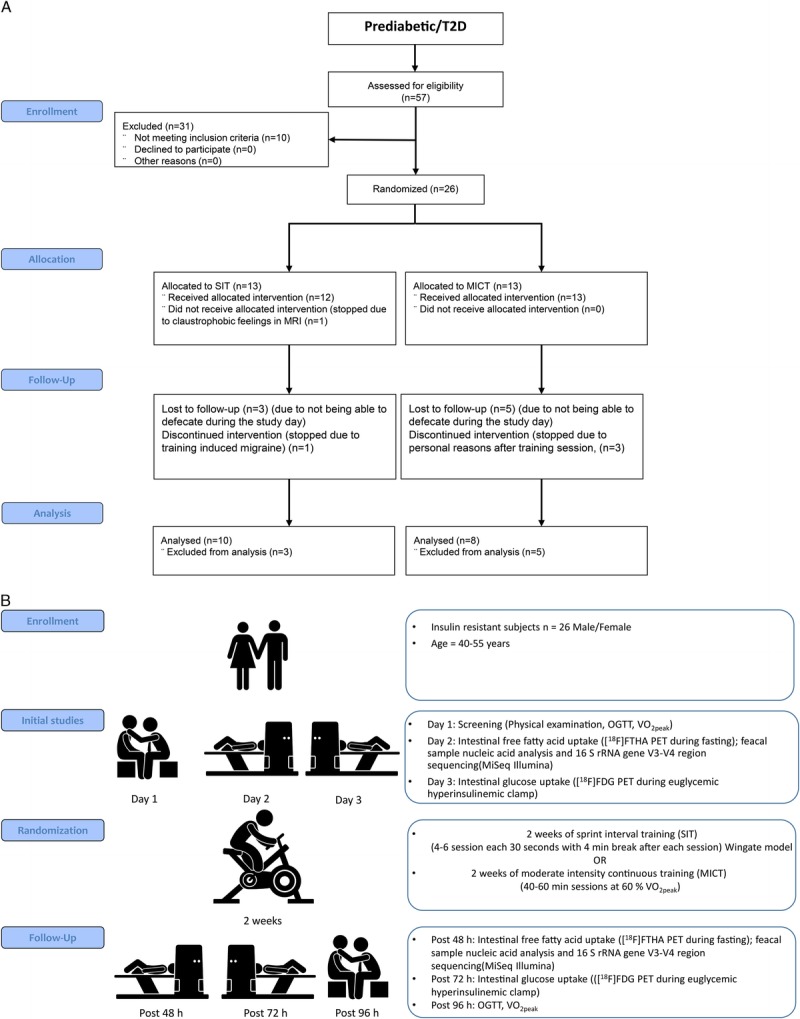
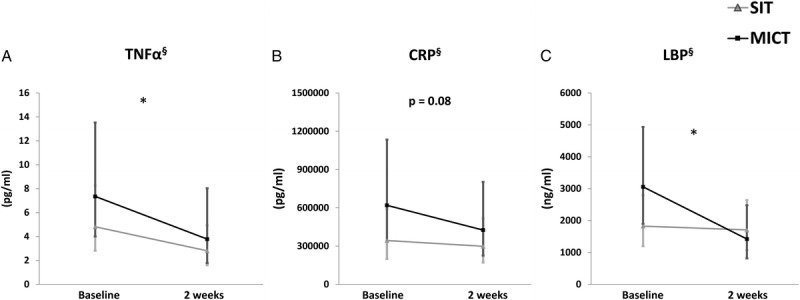
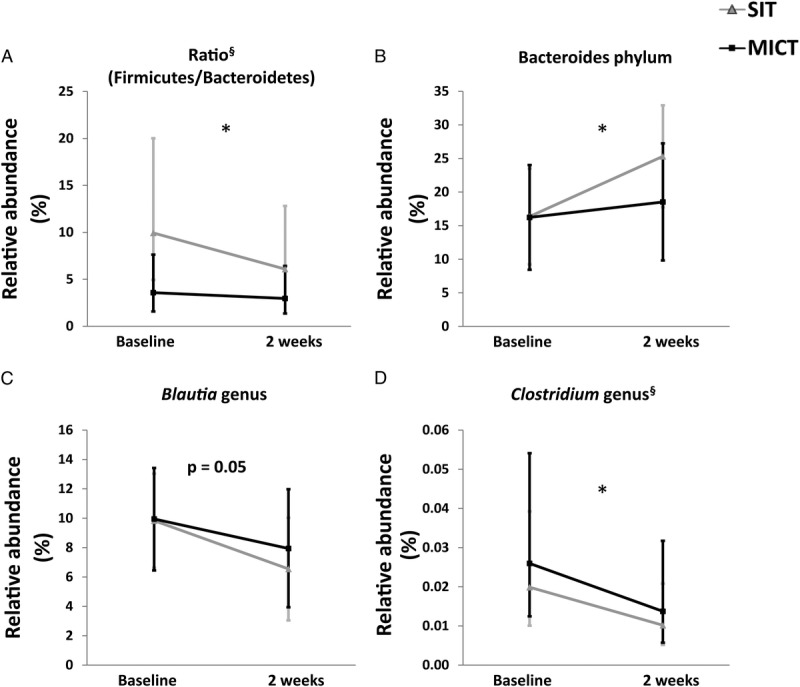
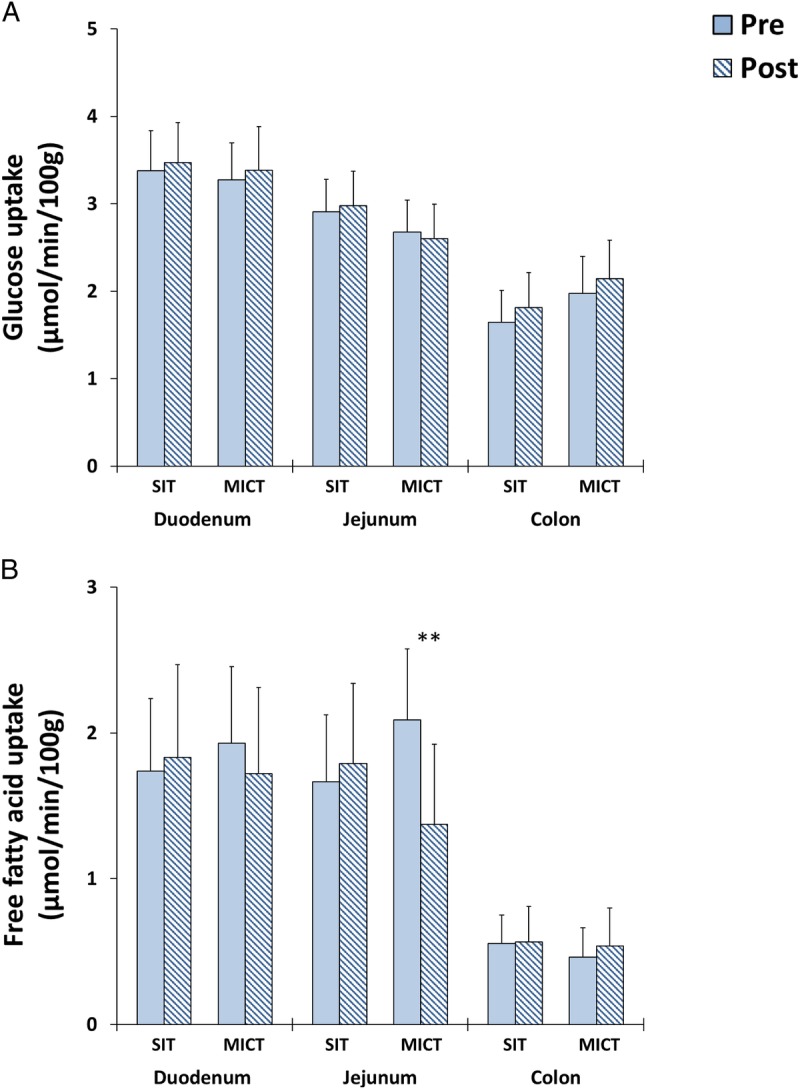
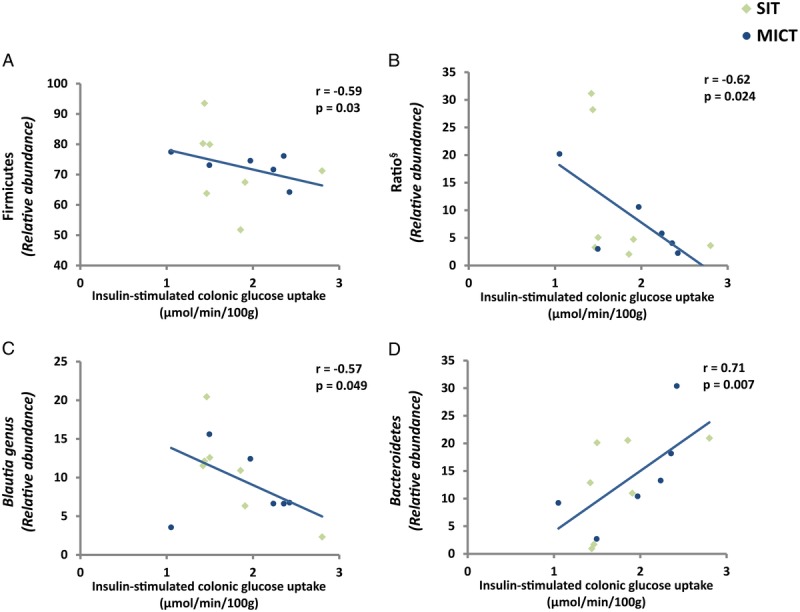
Introduction: Intestinal metabolism and microbiota profiles are impaired in obesity and insulin resistance. Moreover, dysbiotic gut microbiota has been suggested to promote systemic low-grade inflammation and insulin resistance through the release of endotoxins particularly lipopolysaccharides. We have previously shown that exercise training improves intestinal metabolism in healthy men. To understand whether changes in intestinal metabolism interact with gut microbiota and its release of inflammatory markers, we studied the effects of sprint interval (SIT) and moderate-intensity continuous training (MICT) on intestinal metabolism and microbiota in subjects with insulin resistance. Methods: Twenty-six, sedentary subjects (prediabetic, n = 9; type 2 diabetes, n = 17; age, 49 [SD, 4] yr; body mass index, 30.5 [SD, 3]) were randomized into SIT or MICT. Intestinal insulin-stimulated glucose uptake (GU) and fatty acid uptake (FAU) from circulation were measured using positron emission tomography. Gut microbiota composition was analyzed by 16S rRNA gene sequencing and serum inflammatory markers with multiplex assays and enzyme-linked immunoassay kit. Results: V˙O 2peak improved only after SIT ( P = 0.01). Both training modes reduced systematic and intestinal inflammatory markers (tumor necrosis factor-α, lipopolysaccharide binding protein) (time P < 0.05). Training modified microbiota profile by increasing Bacteroidetes phylum (time P = 0.03) and decreasing Firmicutes/Bacteroidetes ratio (time P = 0.04). Moreover, there was a decrease in Clostridium genus (time P = 0.04) and Blautia (time P = 0.051). Only MICT decreased jejunal FAU ( P = 0.02). Training had no significant effect on intestinal GU. Colonic GU associated positively with Bacteroidetes and inversely with Firmicutes phylum, ratio Firmicutes/Bacteroidetes and Blautia genus. Conclusions: Intestinal substrate uptake associates with gut microbiota composition and whole-body insulin sensitivity. Exercise training improves gut microbiota profiles and reduces endotoxemia.
Overview
The claims and statistics of this paper haven’t been checked yet.
Run the check — free, no account needed. It reads the open-access text and checks the sources it cites.
Integrity signals
Registry
Cites
Statistics
Figures
Verification
Claims the paper makes
The claims and statistics of this paper haven’t been checked yet.
Run the check — free, no account needed. It reads the open-access text and checks the sources it cites.
Claims other papers make about this one
Each is checked against this paper’s own text: does it say what the citing paper says it does?
In the citing paper
“lower abundance of Blautia genus was associated with better whole-body insulin sensitivity.”
From The athletic gut microbiota (2020) · cites this paper as [109]
In the citing paper
“Bacteroidetes increased and the Firmicutes/Bacteroidetes ratio decreased.”
From The athletic gut microbiota (2020) · cites this paper as [109]
In the citing paper
“both high intensity interval and moderate continuous training affected the gut microbiota in insulin resistant, sedentary individuals following a 2-week exercise intervention [109].”
From The athletic gut microbiota (2020) · cites this paper as [109]
In the citing paper
“There was also a decrease in Clostridium and Blautia genera.”
From The athletic gut microbiota (2020) · cites this paper as [109]
In the citing paper
“These results highlight the importance of intestinal substrate uptake on the whole-body and changes, especially in glucose uptake, might have a positive effect on the gut microbiota.”
From The athletic gut microbiota (2020) · cites this paper as [109]
In the citing paper
“colonic glucose concentrations associated positively with Bacteroidetes and inversely with Firmicutes phylum, the Firmicutes/Bacteroidetes ratio, and Blautia genus.”
From The athletic gut microbiota (2020) · cites this paper as [109]
Self-check
Percentages, sums and reported differences re-computed from the paper’s own numbers.
The self-check needs the paper’s full text.
Citations
Cites
QIIME allows analysis of high-throughput community sequencing data
Caporaso, J. G., Kuczynski, J., Stombaugh, J., Bittinger, K., Bushman, F. D., Costello, E. K., Fierer, N., Peña, A. G., Goodrich, J. K., Gordon, J. I., et al. (2010) · Nature Methods · doi:10.1038/nmeth.f.303 · Cited by 34,887
An obesity-associated gut microbiome with increased capacity for energy harvest
Turnbaugh, P. J., Ley, R. E., Mahowald, M. A., Magrini, V., Mardis, E. R., & Gordon, J. I. (2006) · Nature · doi:10.1038/nature05414 · Cited by 12,444
Human gut microbes associated with obesity
Ley, R. E., Turnbaugh, P. J., Klein, S., & Gordon, J. I. (2006) · Nature · doi:10.1038/4441022a · Cited by 8,785
Glucose clamp technique: a method for quantifying insulin secretion and resistance.
DeFronzo, R. A., Tobin, J. D., & Andres, R. (1979) · American Journal of Physiology-Endocrinology and Metabolism · doi:10.1152/ajpendo.1979.237.3.e214 · Cited by 7,425
Obesity alters gut microbial ecology
Ley, R. E., Bäckhed, F., Turnbaugh, P., Lozupone, C. A., Knight, R. D., & Gordon, J. I. (2005) · Proceedings of the National Academy of Sciences · doi:10.1073/pnas.0504978102 · Cited by 6,176
Cani, P. D., Bibiloni, R., Knauf, C., Waget, A., Neyrinck, A. M., Delzenne, N. M., & Burcelin, R. (2008) · Diabetes · doi:10.2337/db07-1403 · Cited by 4,819
Graphical Evaluation of Blood-to-Brain Transfer Constants from Multiple-Time Uptake Data
Patlak, C. S., Blasberg, R. G., & Fenstermacher, J. D. (1983) · Journal of Cerebral Blood Flow & Metabolism · doi:10.1038/jcbfm.1983.1 · Cited by 3,565
Turnbaugh, P. J., Bäckhed, F., Fulton, L., & Gordon, J. I. (2008) · Cell Host & Microbe · doi:10.1016/j.chom.2008.02.015 · Cited by 2,915
Classification and Diagnosis of Diabetes
Fajans, S. S. (1990) · Medical Entomology and Zoology · Cited by 2,356
A microbial symbiosis factor prevents intestinal inflammatory disease
Mazmanian, S. K., Round, J. L., & Kasper, D. L. (2008) · Nature · doi:10.1038/nature07008 · Cited by 2,340
Cited by
Sorted by citations
Items 301–333 of 333
Aune, S. K., Byrkjeland, R., Solheim, S., Arnesen, H., Trøseid, M., Awoyemi, A., Seljeflot, I., & Helseth, R. (2021) · Figshare · doi:10.6084/m9.figshare.14361701
Aune, S. K., Byrkjeland, R., Solheim, S., Arnesen, H., Trøseid, M., Awoyemi, A., Seljeflot, I., & Helseth, R. (2021) · Figshare · doi:10.6084/m9.figshare.14361698
Knoll, R. L., Jarquín‐Díaz, V. H., Klopp, J., Kemper, A., Hilbert, K., Hillen, B., Pfirrmann, D., Simon, P., Bähner, V., Nitsche, O., et al. (2024) · Figshare · doi:10.6084/m9.figshare.26570074
Gómez‐Bruton, A., Irún, P., Matute-Llorente, Á., Lozano‐Berges, G., Moradell, A., Ara-Gimeno, S., Subías-Perié, J., Sánchez‐Luengo, M., Hijos, G., García-Mateo, S., et al. (2024) · Figshare · doi:10.6084/m9.figshare.26739561
Gut Microbiota and Exercise: Implications for Health Promotion and Athletic Performance
Shi, L., Landberg, R., Qu, Y., Lv, J., Zhou, L., Liu, T., Cao, Y., & Wang, D. (2025) · Epigenetics and human health · doi:10.1007/978-3-032-08045-5_11
Wang, J., Feng, S., Cao, X., & Li, X. (2026) · Food Science & Nutrition · doi:10.1002/fsn3.71503
Thomson, A. M., Drost, D. C., Johannsen, N. M., Silvestri, C., & Sénéchal, M. (2026) · PLoS ONE · doi:10.1371/journal.pone.0343294
Caruso, M. G., Dohm-Hansen, S., Williams, Z. A. P., English, J. A., Lavelle, A., Nicolas, S., O’Leary, O. F., & Nolan, Y. M. (2026) · Brain medicine : · doi:10.61373/bm026r.0009
Singh, N. P., Singh, S., Jain, R. K., Yadav, M., & Kumar, A. (2025) · De Gruyter eBooks · doi:10.1515/9783112205150-002
Relationship between intestinal microbiota and psoriasis pathogenesis
Arsenyeva, A. A., Kaiumov, K. A., Lyamin, A. V., & Migacheva, N. B. (2026) · Russian Journal of Clinical Dermatology and Venereology · doi:10.17116/klinderma20262501115
Chen, J., Fan, Z., Li, Y., Duan, R., & Gao, B. (2026) · iScience · doi:10.1016/j.isci.2026.115490
Zeng, L., Chen, L., Wei, L., Li, J., Liang, S., Jiang, H., & Gao, F. (2026) · The Journals of Gerontology Series A · doi:10.1093/gerona/glag084
Ou, Y., Huang, Y., Cui, Z., Ji, S., Yang, X., Mei, R., Yu, Z., So, K., Chen, J., Tang, S., et al. (2026) · Neural Regeneration Research · doi:10.4103/nrr.nrr-d-25-00683
Zhaoxie, Y. U., Yao, R., Li, Y., Li, H., Shen, F., Wang, Y., & Wang, Y. (2026) · Frontiers in Aging Neuroscience · doi:10.3389/fnagi.2026.1765016
Salama, M. S. M. M., Elmasry, D. M., El-Moatasem, A. M., Zeyada, R., Abouelhassan, M. A. M., & Elnahas, N. G. M. (2026) · Advances in Rehabilitation · doi:10.2478/advrehab-2026-0005
Song, Y., Lan, J., Ke, Y., & Tang, L. (2026) · Healthcare · doi:10.3390/healthcare14111529
Rui, L. I., Li-Yun, S. H. A., You-Guan, H. E. N. G., & Shen, W.-Q. (2026) · Shengming kexue · doi:10.3724/cbls.2026077
MENEGOTTE, P. C. S., Sá, C. A. D., Mânica, A., Ozelame, B. C., Farias, K. C., Bones, U. A., Cardoso, A. M., Laux, R. C., & Corralo, V. D. S. (2026) · Experimental Gerontology · doi:10.1016/j.exger.2026.113224
Crespo-Garcia, C., Borsati, A., Taaffe, D. R., Peddle‐McIntyre, C. J., Campbell, J. P., Avancini, A., Jeffery, E., Galvao, D. A., & Newton, R. U. (2026) · Sports Medicine · doi:10.1007/s40279-026-02481-w
The dual role of the microbiome in sepsis: A complex interplay between pathogenicity and protection
Zhang, Y., Zhang, H., Song, L., Xing, F., Jing, M.-Z., Wang, C., Deng, X., Liao, Y., Xing, N., & Zhang, W. (2026) · Physics of Life Reviews · doi:10.1016/j.plrev.2026.07.001 · Cited by 1
Keirns, B. H., Keller, A., Quirk, A. R., Lawson, D., Smith, H., & Emerson, S. R. (2026) · American Journal of Physiology-Gastrointestinal and Liver Physiology · doi:10.1152/ajpgi.00124.2026
Zhang, S., Han, F., Wang, B., Chen, Z., Lyu, J., & Fan, F. (2026) · International Journal of Endocrinology · doi:10.1155/ije/9999960
Ortega‐Santos, C. P., Kerchner, D., Rahnavard, A., & Crandall, K. A. (2026) · medRxiv · doi:10.64898/2026.07.10.26357758
Merino-País, M., López‐Ortiz, S., Emanuele, E., Imbimbo, C., Imbimbo, B. P., Lista, S., & Santos‐Lozano, A. (2026) · Journal of Functional Morphology and Kinesiology · doi:10.3390/jfmk11030287
Zhou, L., Leng, H., Wang, Z., & Liu, W. (2026) · Frontiers in Cellular and Infection Microbiology · doi:10.3389/fcimb.2026.1868705
Lu, C., Huang, J., Tan, H., HUANG, Q., Chen, M., & Yang, X. H. (2026) · Science & Sports · doi:10.1016/j.scispo.2026.06.005
Makiel, K., & Suder, A. (2026) · Journal of Clinical Medicine · doi:10.3390/jcm15176671
Pang, T., Zhou, X., & Ge, Z. (2026) · Metabolites · doi:10.3390/metabo16090638
Merelim, A. S., dos Santos, A. P. S., Zacca, R., Moreira‐Gonçalves, D., Costa, P., & Baptista, L. C. P. (2026) · Sport Sciences for Health · doi:10.1007/s11332-026-01947-8
Microbial-derived exerkines as a model of drug discovery
Burke, B. I., Valentino, T. R., Ismaeel, A., Wen, Y., & McCarthy, J. J. (2026) · American Journal of Physiology-Cell Physiology · doi:10.1152/ajpcell.90006.2026
Liu, X., Jing, D., Liu, X., Hu, S., & Wang, X. (2026) · Metabolites · doi:10.3390/metabo16100766
Bao, Z., Jiao, M., Zhao, M., Huang, F.-Y., Liu, Y. H., & Wang, S. (2026) · Nutrition Reviews · doi:10.1093/nutrit/nuag156
Metadata
- Authors
- MOTIANI, K. K., COLLADO, M. C., ESKELINEN, J.-J., VIRTANEN, K. A., LÖYTTYNIEMI, E., SALMINEN, S., NUUTILA, P., KALLIOKOSKI, K. K., & HANNUKAINEN, J. C.
- Affiliations
- University of Turku (FI)
- Consejo Superior de Investigaciones Científicas (ES)
- Turku University Hospital (FI)
- ORCID
- Venue
- Medicine & Science in Sports & Exercise
- Published
- 2019-08-19
- Volume
- 52
- Issue
- 1
- Pages
- 94-104
- ISSN
- 0195-9131 (ISSN-L)
- 1530-0315
- PMC
- PMC7028471
- OpenAlex
- W2969245839
- Cited by
- 333
- References
- 54
- Citations by year
- 2026: 39 · 2025: 68 · 2024: 64 · 2023: 58 · 2022: 48 · 2021: 40 · 2020: 13 · 2019: 2
- FWCI
- 8.52
- Type
- journal article
- Language
- en
- Open access
- hybrid
- doi.org
- Licence
- Locations
- Medicine & Science in Sports & Exercise (publishedVersion, cc-by-nc-nd)
- Europe PMC (PubMed Central) (publishedVersion, cc-by-nc-nd)
- PubMed Central (publishedVersion, cc-by-nc-nd)
- PubMed (publishedVersion)
- DIGITAL.CSIC (Spanish National Research Council (CSIC)) (submittedVersion, cc-by-nc-nd)
- Topics
- Life Sciences › Biochemistry, Genetics and Molecular Biology › Molecular Biology › Gut microbiota and health
- Health Sciences › Medicine › Endocrinology, Diabetes and Metabolism › Adipokines, Inflammation, and Metabolic Diseases
- Health Sciences › Dentistry › Periodontics › Oral microbiology and periodontitis research
- Keywords
- exercise training, gut microbiota, endotoxemia, lipopolysaccharide, insulin resistance, type 2 diabetes, prediabetes, sprint interval training, moderate-intensity continuous training, intestinal glucose absorption, fatty acid uptake, Bacteroidetes, Firmicutes/Bacteroidetes ratio, Blautia, Clostridium, low-grade inflammation, intestinal metabolism
- MeSH terms
- Gastrointestinal Microbiome, Lipopolysaccharide-Binding Protein, Acute-Phase Proteins, Carrier Proteins, Diabetes Mellitus, Type 2, Female, Humans, Inflammation, Insulin Resistance, Intestinal Mucosa, Male, Membrane Glycoproteins, Middle Aged, Obesity, Oxygen Consumption, Prediabetic State, Tumor Necrosis Factor-alpha, Biomarkers, Body Mass Index, Endotoxemia, Physical Conditioning, Human
About these checks
Registry, retraction, Cites and statistics results are computed, not judged, with one exception: a printed reference that no index lists is read once by a model before it counts as a citation error. Claims are extracted by a model and kept only when their quote appears verbatim in the text; each cited source is then checked, with a model’s help, for whether it says what the claim relies on. Those verdicts can be wrong — read the claim’s quote and the cited source before relying on one.
Statistics and arithmetic are recomputed, not judged.
Confidence bands are shown only for fields calibrated on our annotated test set. None is calibrated yet, so no band is shown.
What counts as a claim ›How we measure confidence ›How we check this ›
Are you an author, or do you see a problem with this page? Request a review
