

Descriptive Epidemiology of Cardiorespiratory Fitness in UK Adults: The Fenland Study
Open accessPublished version of a preprint
The DOI matches its Crossref record; 53 of the 54 references it cites were found in a registry or an index.
Abstract
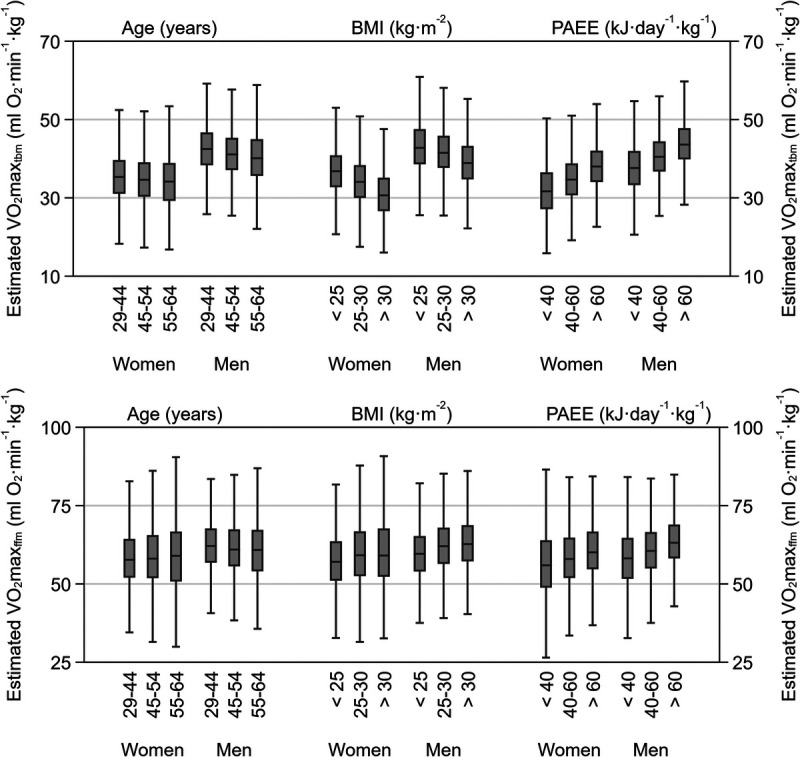
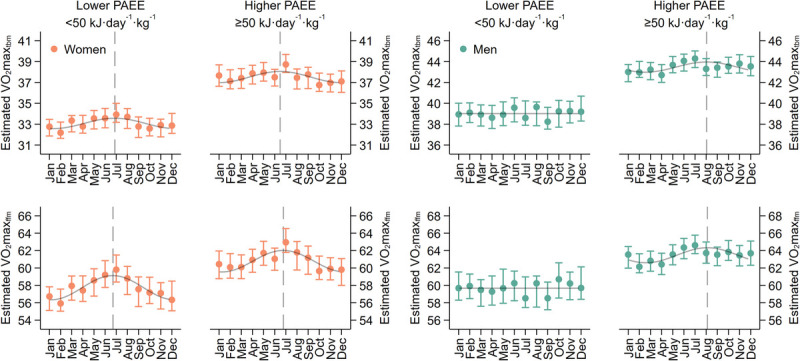
Introduction: Cardiorespiratory fitness (CRF) is rarely measured in population studies. Most studies of CRF do not examine differences by population subgroups or seasonal trends. We examined how estimated CRF levels vary by anthropometric, sociodemographic, and behavioral characteristics in a population-based cohort of UK adults (the Fenland Study). Methods: We used a validated submaximal exercise test to obtain CRF estimates (CRF estimated ) in 5976 women and 5316 men, residing in the East of England. CRF estimated was defined as estimated maximal oxygen consumption per kilogram total body mass (V̇O 2 max tbm ) and fat-free mass (V̇O 2 max ffm ). Descriptive statistics were computed across anthropometric and sociodemographic characteristics, and across the year. Progressive multivariable analyses were performed to examine associations with physical activity energy expenditure (PAEE) and body mass index (BMI). Results: Mean ± SD V̇O 2 max tbm was lower in women (35.2 ± 7.5 mL·min −1 ·kg −1 ) than men (41.7 ± 7.3 mL·min −1 ·kg −1 ) but V̇O 2 max ffm was similar (women: 59.2 ± 11.6 mL·min −1 ·kg −1 ; men: 62.0 ± 10.3 mL·min −1 ·kg −1 ). CRF estimated was inversely associated with age but not after adjustment for PAEE. People in more physically demanding jobs were fitter compared with those in sedentary jobs, but this association was attenuated in women and reversed in men after adjustment for total PAEE. Physical activity energy expenditure and BMI were positively associated with CRF estimated at all levels of adjustment when expressed relative to fat-free mass. CRF estimated was 4% higher in summer than in winter among women, but did not differ by season among men. Conclusions: CRF estimated was inversely associated with age but less steeply than anticipated, suggesting older generations are comparatively fitter than younger generations. Physical activity energy expenditure and BMI were stronger determinants of the variance in CRF estimated than other characteristic including age. This emphasizes the importance of modifiable physical activity behaviors in public health interventions.
Overview
The claims and statistics of this paper haven’t been checked yet.
Free: it reads the open-access text and checks the first 5 claims that cite a source we can check. Create a free account to check every claim.
Integrity signals
Registry
Cites
Statistics
Figures
Verification
Claims the paper makes
The claims and statistics of this paper haven’t been checked yet.
Free: it reads the open-access text and checks the first 5 claims that cite a source we can check. Create a free account to check every claim.
Claims other papers make about this one
Each is checked against this paper’s own text: does it say what the citing paper says it does?
The source backs part of the claim, not all of it — or backs it for a different population, condition or comparison.
In the citing paper
“This VO2max estimation procedure has been validated against directly measured VO2max in a subsample of Fenland Study participants (43 women; 42 men), demonstrating low bias and high correlation with directly measured VO2max (r = 0.70) [18,19].”
From Resting heart rate is a population-level biomarker of cardiorespiratory fitness: The Fenland Study (2023) · cites this paper as [19]
Experimental — accuracy not yet measured
Self-check
Percentages, sums and reported differences re-computed from the paper’s own numbers.
The self-check needs the paper’s full text.
Citations
Cites
Age-predicted maximal heart rate revisited
Tanaka, H., Monahan, K. D., & Seals, D. R. (2001) · Journal of the American College of Cardiology · doi:10.1016/s0735-1097(00)01054-8 · Cited by 3,775 · cited 2×
“To estimate V̇O2max per kg total-body mass (V̇O2maxtbm) from exercise test performance, we extrapolated the linear relationship between heart rate and work rate (17) to age-predicted maximal heart rate (16), whichwas reduced by 7 bpm in smokers (18,19), added an estimate of resting energy expenditure (20), and then co…”
BackgroundMethodKodama, S. (2009) · JAMA · doi:10.1001/jama.2009.681 · Cited by 3,035
A wilcoxon‐type test for trend
Cuzick, J. (1985) · Statistics in Medicine · doi:10.1002/sim.4780040112 · Cited by 1,900
Blair, S. N. (1996) · JAMA: The Journal of the American Medical Association · doi:10.1001/jama.1996.03540030039029 · Cited by 1,819
Basal metabolic rate studies in humans: measurement and development of new equations
Henry, C. (2005) · Public Health Nutrition · doi:10.1079/phn2005801 · Cited by 1,033 · cited 1×
“To estimate V̇O2max per kg total-body mass (V̇O2maxtbm) from exercise test performance, we extrapolated the linear relationship between heart rate and work rate (17) to age-predicted maximal heart rate (16), whichwas reduced by 7 bpm in smokers (18,19), added an estimate of resting energy expenditure (20), and then co…”
MethodAccelerated longitudinal decline of aerobic capacity in healthy older adults
Fleg, J. L., Morrell, C. H., Bos, A. G., Brant, L. J., Talbot, L. A., Wright, J. G., & Lakatta, E. G. (2005) · Circulation · doi:10.1161/circulationaha.105.545459 · Cited by 970
Reliability and validity of the combined heart rate and movement sensor Actiheart
Brage, S., Brage, N., Franks, P. W., Ekelund, U., & Wareham, N. J. (2005) · European Journal of Clinical Nutrition · doi:10.1038/sj.ejcn.1602118 · Cited by 667
Self-citationShort, K. R., Vittone, J. L., Bigelow, M. L., Proctor, D. N., Rizza, R. A., Coenen-Schimke, J. M., & Nair, K. S. (2003) · Diabetes · doi:10.2337/diabetes.52.8.1888 · Cited by 631
Reference Standards for Cardiorespiratory Fitness Measured With Cardiopulmonary Exercise Testing
Kaminsky, L. A., Arena, R., & Myers, J. (2015) · Mayo Clinic Proceedings · doi:10.1016/j.mayocp.2015.07.026 · Cited by 461
Cardiovascular responses to exercise. Effects of aging and exercise training in healthy men
Stratton, J. R., Levy, W. C., Cerqueira, M. D., Schwartz, R. S., & Abrass, I. B. (1994) · Circulation · doi:10.1161/01.cir.89.4.1648 · Cited by 449 · cited 1×
“CARDIORESPIRATORY FITNESS: THE FENLAND STUDY majority of the variance in CRF among adults (32–34), but age-related decline in CRF is not wholly due to physical inactivity (35,36).”
BackgroundEnergetics of muscular exercise
Di Prampero, P. E. (1981) · Reviews of Physiology, Biochemistry and Pharmacology · doi:10.1007/bfb0035266 · Cited by 379
Total body fat does not influence maximal aerobic capacity
Goran, M., Fields, D., Hunter, G., Herd, S., & Weinsier, R. (2000) · International Journal of Obesity · doi:10.1038/sj.ijo.0801241 · Cited by 376
Brage, S., Ekelund, U., Brage, N., Hennings, M. A., Froberg, K., Franks, P. W., & Wareham, N. J. (2007) · Journal of Applied Physiology · doi:10.1152/japplphysiol.00092.2006 · Cited by 303
Self-citationO'Donovan, G., Owen, A., Bird, S. R., Kearney, E. M., Nevill, A. M., Jones, D. W., & Woolf-May, K. (2005) · Journal of Applied Physiology · doi:10.1152/japplphysiol.01310.2004 · Cited by 276
Correa-de-Araujo, R., Harris-Love, M. O., Miljkovic, I., Fragala, M. S., Anthony, B. W., & Manini, T. M. (2017) · Frontiers in Physiology · doi:10.3389/fphys.2017.00087 · Cited by 268
Cardiorespiratory fitness and cardiovascular disease - The past, present, and future
Kaminsky, L. A., Arena, R., Ellingsen, Ø., Harber, M. P., Myers, J., Ozemek, C., & Ross, R. (2019) · Progress in Cardiovascular Diseases · doi:10.1016/j.pcad.2019.01.002 · Cited by 254
Miljkovic, I., & Zmuda, J. M. (2010) · Current Opinion in Clinical Nutrition and Metabolic Care · doi:10.1097/mco.0b013e328337d826 · Cited by 234 · cited 1×
“Indeed, ectopic fat infiltration of skeletal muscle may be more related to impaired muscle oxidative capacity and reduced force production than overall adiposity (48,49).”
BackgroundMeasurement of fat mass using DEXA: a validation study in elderly adults
Salamone, L. M., Fuerst, T., Visser, M., Kern, M., Lang, T., Dockrell, M., Cauley, J. A., Nevitt, M., Tylavsky, F., & Lohman, T. G. (2000) · Journal of Applied Physiology · doi:10.1152/jappl.2000.89.1.345 · Cited by 233
Reference values for cardiopulmonary exercise testing in healthy volunteers: the SHIP study
Koch, B., Schäper, C., Ittermann, T., Spielhagen, T., Dörr, M., Völzke, H., Opitz, C. F., Ewert, R., & Gläser, S. (2009) · European Respiratory Journal · doi:10.1183/09031936.00074208 · Cited by 215
Kaminsky, L. A., Arena, R., Myers, J., Peterman, J. E., Bonikowske, A. R., Harber, M. P., Medina Inojosa, J. R., Lavie, C. J., & Squires, R. W. (2022) · Mayo Clinic Proceedings · doi:10.1016/j.mayocp.2021.08.020 · Cited by 199
A PRACTICAL METHOD OF ESTIMATING AN INDIVIDUAL'S MAXIMAL OXYGEN INTAKE
MARITZ, J. S., MORRISON, J. F., PETER, J., STRYDOM, N. B., & WYNDHAM, C. H. (1961) · Ergonomics · doi:10.1080/00140136108930512 · Cited by 180
Determinants of V O2 maxdecline with aging: an integrated perspective
Betik, A. C., & Hepple, R. T. (2008) · Applied Physiology, Nutrition, and Metabolism · doi:10.1139/h07-174 · Cited by 175
Lee, D.-C., Sui, X., Church, T. S., Lee, I.-M., & Blair, S. N. (2009) · Diabetes Care · doi:10.2337/dc08-1377 · Cited by 169
Skeletal muscle mass and the reduction ofV˙ o 2 max in trained older subjects
Proctor, D. N., & Joyner, M. J. (1997) · Journal of Applied Physiology · doi:10.1152/jappl.1997.82.5.1411 · Cited by 155
Genomic predictors of trainability
Bouchard, C. (2012) · Experimental Physiology · doi:10.1113/expphysiol.2011.058735 · Cited by 151 · cited 1×
“Although CRF and CRF trainability are known to have a strong genetic component (24), our findings reinforce the importance of maintaining an active lifestyle in adulthood to counteract declines in CRF with age.”
BackgroundBrage, S., Westgate, K., Franks, P. W., Stegle, O., Wright, A., Ekelund, U., & Wareham, N. J. (2015) · PLOS ONE · doi:10.1371/journal.pone.0137206 · Cited by 151
Self-citationSKINNER, J. S., WILMORE, K. M., KRASNOFF, J. B., JASKÓLSKI, A., JASKÓLSKA, A., GAGNON, J., PROVINCE, M. A., LEON, A. S., RAO, D. C., WILMORE, J. H., et al. (2000) · Medicine & Science in Sports & Exercise · doi:10.1097/00005768-200001000-00023 · Cited by 127
Gilchrist, S. C., Barlow, C. E., Farrell, S. W., Berry, J. D., Morrow, J. R., & Haskell, W. L. (2011) · The American Journal of Cardiology · doi:10.1016/j.amjcard.2011.02.338 · Cited by 118
Hormone seasonality in medical records suggests circannual endocrine circuits
Tendler, A., Bar, A., Cohen, N. M., Karin, O., Kohanim, Y. K., Maimon, L., Milo, T., Raz, M., Mayo, A., Tanay, A., et al. (2021) · Proceedings of the National Academy of Sciences · doi:10.1073/pnas.2003926118 · Cited by 117
Rapp, D., Scharhag, J., Wagenpfeil, S., & Scholl, J. (2018) · BMJ Open · doi:10.1136/bmjopen-2017-018697 · Cited by 116 · cited 2×
“Similarly, the age-gradient in the Prevention First Registry (28) was 1.5 mL O2·kg·min −1 but 1 mL O2·kg −1·min−1 in the SHIP study http://www.acsm-msse.org TA BL E 2.”
BackgroundInfluentialSandvik, L., Erikssen, J., Ellestad, M., Erikssen, G., Thaulow, E., Mundal, R., & Rodahl, K. (1995) · Coronary Artery Disease · doi:10.1097/00019501-199508000-00012 · Cited by 115 · cited 1×
“To estimate V̇O2max per kg total-body mass (V̇O2maxtbm) from exercise test performance, we extrapolated the linear relationship between heart rate and work rate (17) to age-predicted maximal heart rate (16), whichwas reduced by 7 bpm in smokers (18,19), added an estimate of resting energy expenditure (20), and then co…”
MethodPapathanasiou, G., Georgakopoulos, D., Papageorgiou, E. G., Zerva, E., Michalis, L., Kalfakakou, V., & Evangelou, A. M. (2013) · PubMed · Cited by 101
Descriptive epidemiology of physical activity energy expenditure in UK adults (The Fenland study)
Lindsay, T., Westgate, K., Wijndaele, K., Hollidge, S., Kerrison, N., Forouhi, N., Griffin, S., Wareham, N., & Brage, S. (2019) · International Journal of Behavioral Nutrition and Physical Activity · doi:10.1186/s12966-019-0882-6 · Cited by 83
Self-citationSavinainen, M., Nygård, C.-H., & Ilmarinen, J. (2004) · Ergonomics · doi:10.1080/00140130410001686357 · Cited by 68 · cited 1×
“Other studies report that manual workers may have greater muscle strength but lower CRF than the general population (41,42).”
BackgroundEriksen, L., Grønbæk, M., Helge, J. W., & Tolstrup, J. S. (2016) · Scandinavian Journal of Medicine & Science in Sports · doi:10.1111/sms.12608 · Cited by 66
Gonzales, T. I., Westgate, K., Strain, T., Hollidge, S., Jeon, J., Christensen, D. L., Jensen, J., Wareham, N. J., & Brage, S. (2021) · Scientific Reports · doi:10.1038/s41598-021-94768-3 · Cited by 59
Self-citationIncreased occupational physical activity does not improve physical fitness: Table 1
Ružić, L., Heimer, S., Mišigoj‐Duraković, M., & Matković, B. (2003) · Occupational and Environmental Medicine · doi:10.1136/oem.60.12.983 · Cited by 59
Cardiovascular Responses to Exercise
Xiang, L., & Hester, R. L. (2011) · Colloquium Series on Integrated Systems Physiology From Molecule to Function · doi:10.4199/c00040ed1v01y201109isp027 · Cited by 50
Neto, J. M. R., Tebexreni, A. S., Alves, A. N. F., Smanio, P. E. P., de Abreu, F. B., Thomazi, M. C., Nishio, P. A., & Antelmi, I. (2019) · PLoS ONE · doi:10.1371/journal.pone.0209897 · Cited by 47
O'Donovan, G., Hillsdon, M., Ukoumunne, O. C., Stamatakis, E., & Hamer, M. (2013) · Preventive Medicine · doi:10.1016/j.ypmed.2013.05.022 · Cited by 42
Predicting VO2peak from Submaximal- and Peak Exercise Models: The HUNT 3 Fitness Study, Norway
Loe, H., Nes, B. M., & Wisløff, U. (2016) · PLoS ONE · doi:10.1371/journal.pone.0144873 · Cited by 41
Health, fitness, physical activity, and morbidity of middle aged male factory workers. I.
Tuxworth, W., Nevill, A. M., White, C., & Jenkins, C. (1986) · Occupational and Environmental Medicine · doi:10.1136/oem.43.11.733 · Cited by 41
Accuracy of Exercise-based Equations for Estimating Cardiorespiratory Fitness
Peterman, J. E., Harber, M. P., Imboden, M. T., WHALEY, M. H., Fleenor, B. S., MYERS, J. N., Arena, R. A., & Kaminsky, L. A. (2020) · Medicine & Science in Sports & Exercise · doi:10.1249/mss.0000000000002435 · Cited by 40 · cited 1×
“This could impact the classification of participants into CRF categories in clinical settings (51).”
BackgroundHealth effects and acceptance of a physical activity program for older long-term unemployed workers
Kreuzfeld, S., Preuss, M., Weippert, M., & Stoll, R. (2012) · International Archives of Occupational and Environmental Health · doi:10.1007/s00420-012-0749-5 · Cited by 30
Schnurr, T. M., Gjesing, A. P., Sandholt, C. H., Jonsson, A. E., Mahendran, Y., Have, C. T., Ekstrøm, C. T., Bjerregaard, A., Brage, S., Witte, D. R., et al. (2016) · PLoS ONE · doi:10.1371/journal.pone.0166738 · Cited by 28
Self-citationBrage, S., Lindsay, T., Venables, M., Wijndaele, K., Westgate, K., Collins, D., Roberts, C., Bluck, L., Wareham, N., & Page, P. (2020) · International Journal of Epidemiology · doi:10.1093/ije/dyaa005 · Cited by 25 · cited 1×
“These differences were small, however, and observed physical activity levels—the strongest determinant of CRF—were similar to those observed in the general UK population (11,52), suggesting findings may generalize more widely.”
ResultSelf-citationSimmons, R. K., van Sluijs, E. M. F., Hardeman, W., Sutton, S. R., Griffin, S. J., & the ProActive project team (2010) · BMC Public Health · doi:10.1186/1471-2458-10-226 · Cited by 25
Self-citationReference Values for Cardiorespiratory Fitness in Healthy Koreans
Jang, W. Y., Kim, W., Kang, D. O., Park, Y., Lee, J., Choi, J. Y., Roh, S., Na, J. O., Choi, C. U., Rha, S., et al. (2019) · Journal of Clinical Medicine · doi:10.3390/jcm8122191 · Cited by 21
MacAuley, D., Crum, E. M., STOTT, G., Evans, A., Gamble, R., Roberts, B., Boreham, C. A., Trinick, T. R., & Sweeney, K. (1998) · International Journal of Sports Medicine · doi:10.1055/s-2007-971952 · Cited by 17
Harris‐Love, M. O., Gonzales, T. I., Wei, Q., Ismail, C., Zabal, J., Woletz, P. S., DiPietro, L., & Blackman, M. R. (2018) · Journal of Ultrasound in Medicine · doi:10.1002/jum.14864 · Cited by 17
Self-citationPhysical performances show conflicting associations in aged manual workers
Norheim, K. L., Samani, A., Bønløkke, J. H., Omland, Ø., & Madeleine, P. (2020) · Scientific Reports · doi:10.1038/s41598-020-59050-y · Cited by 11
Brage, S., Lindsay, T., Venables, M., Wijndaele, K., Westgate, K. L., Collins, D., Roberts, C., Bluck, L., Wareham, N. J., & Page, P. (2019) · Apollo (University of Cambridge) · doi:10.17863/cam.47222 · Cited by 10
Self-citationCooke, C. B., Smith, G. D., Hoinville, G., Catford, J., & Tuxworth, W. (1992) · Cambridge University Press eBooks · doi:10.1017/cbo9780511983924.006 · Cited by 2
Research works printed but not linked: 1
- 23. Cattaneo MD, Crump RK, Farrell MH, Feng Y. Binscatter regressions. arXiv. 2021;190209615.
Cited by
Causal associations between cardiorespiratory fitness and type 2 diabetes
Cai, L., Gonzales, T. I., Wheeler, E., Kerrison, N. D., Day, F. R., Langenberg, C., Perry, J. R. B., Brage, S., & Wareham, N. J. (2023) · Nature Communications · doi:10.1038/s41467-023-38234-w · Cited by 61
Self-citationResting heart rate is a population-level biomarker of cardiorespiratory fitness: The Fenland Study
Gonzales, T. I., Jeon, J. Y., Lindsay, T., Westgate, K., Perez-Pozuelo, I., Hollidge, S., Wijndaele, K., Rennie, K., Forouhi, N., Griffin, S., et al. (2023) · PLOS ONE · doi:10.1371/journal.pone.0285272 · Cited by 44
Self-citationPerry, A., Farber‐Eger, E. H., Gonzales, T. I., Tanaka, T., Robbins, J., Murthy, V. L., Stolze, L. K., Zhao, S., Huang, S., Colangelo, L. A., et al. (2024) · Nature Medicine · doi:10.1038/s41591-024-03039-x · Cited by 47
“We validated our findings in three external cohorts: Fenland 14 ; BLSA 15 ; and HERITAGE 10 .”
BackgroundResultSelf-citationLongitudinal cardio-respiratory fitness prediction through wearables in free-living environments
Spathis, D., Perez-Pozuelo, I., Gonzales, T. I., Wu, Y., Brage, S., Wareham, N., & Mascolo, C. (2022) · npj Digital Medicine · doi:10.1038/s41746-022-00719-1 · Cited by 30
Self-citationA Self-Paced Walk Test for Individual Calibration of Heart Rate to Energy Expenditure
Westgate, K. L., Gonzales, T. I., Hollidge, S. E., Lindsay, T., Wareham, N. J., & Brage, S. (2024) · Journal for the Measurement of Physical Behaviour · doi:10.1123/jmpb.2023-0042 · Cited by 6
Self-citation
Metadata
- Authors
- GONZALES, T. I., WESTGATE, K., HOLLIDGE, S., LINDSAY, T., WIJNDAELE, K., FOROUHI, N. G., GRIFFIN, S., WAREHAM, N., & BRAGE, S.
- Affiliations
- American College of Sports Medicine (US)
- Venue
- Medicine & Science in Sports & Exercise
- Published
- 2022-10-21
- Volume
- 55
- Issue
- 3
- Pages
- 507-516
- ISSN
- 0195-9131 (ISSN-L)
- 1530-0315
- PMC
- PMC9924962
- OpenAlex
- W4318965993
- Semantic Scholar
- 2e734aea176501c53e26be731c05195c299501d0
- Cited by
- 6
- References
- 54
- Citations by year
- 2026: 1 · 2024: 2 · 2023: 2 · 2022: 1
- FWCI
- 0.77
- Type
- journal article
- Language
- en
- Open access
- hybrid
- doi.org
- Locations
- Medicine & Science in Sports & Exercise (publishedVersion, cc-by)
- medRxiv (acceptedVersion, cc-by-nd)
- PubMed Central (publishedVersion, cc-by)
- PubMed (publishedVersion)
- Apollo (University of Cambridge) (submittedVersion, cc-by-nc)
- Apollo
- Funders
- Wellcome Trust
- National Institute for Health and Care Research ([IS-BRC-1215-20014, NIHR202397)
- Cambridge University Hospitals (146281)
- Medical Research Council (MC_UU_12015/1, MC_UU_12015/5, MC_UU_12015/4, MC_UU_12015, MC_UU_12015/3)
- Topics
- Health Sciences › Medicine › Public Health, Environmental and Occupational Health › Physical Activity and Health
- Health Sciences › Medicine › Physiology (medical) › Cardiovascular and exercise physiology
- Health Sciences › Medicine › Public Health, Environmental and Occupational Health › Obesity, Physical Activity, Diet
- Keywords
- cardiorespiratory fitness, VO2max, submaximal exercise testing, physical activity energy expenditure, body mass index, sex differences, seasonal variation, occupational physical demands, fat-free mass, age differences, sociodemographic factors
- MeSH terms
- Cardiorespiratory Fitness, Adult, Exercise Test, Female, United Kingdom, Humans, Male, Motor Activity, Physical Fitness, Exercise, Body Mass Index
About these checks
Registry, retraction, Cites and statistics results are computed, not judged, with one exception: a printed reference that no index lists is read once by a model before it counts as a citation error. Claims are extracted by a model and kept only when their quote appears verbatim in the text; each cited source is then checked, with a model’s help, for whether it says what the claim relies on. Those verdicts can be wrong — read the claim’s quote and the cited source before relying on one.
Statistics and arithmetic are recomputed, not judged.
Confidence bands are shown only for fields calibrated on our annotated test set. None is calibrated yet, so no band is shown.
What counts as a claim ›How we measure confidence ›How we check this ›
Are you an author, or do you see a problem with this page? Request a review
Data sources
Bibliographic data: Semantic Scholar, OpenAlex, Crossref.
Contains information from the Semantic Scholar Academic Graph Datasets, made available under the ODC Attribution License (ODC-BY 1.0).
Semantic Scholar’s data is described in: Kinney, R., et al. (2023). The Semantic Scholar Open Data Platform. arXiv:2301.10140.
