

The DOI matches its Crossref record; 59 of the 59 references it cites were found in a registry or an index.
PCB-95 Promotes Dendritic Growth via Ryanodine Receptor–Dependent Mechanisms
Open accessAbstract
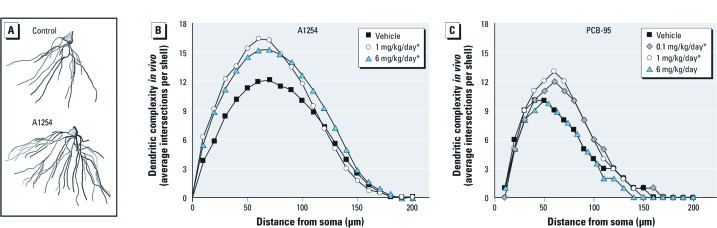
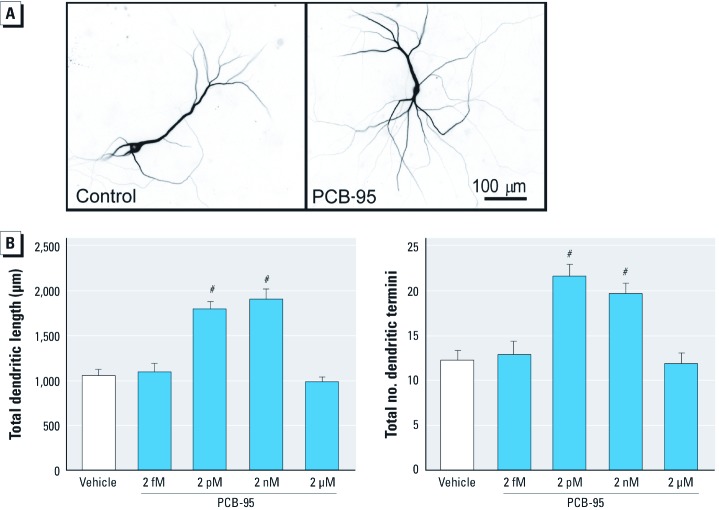
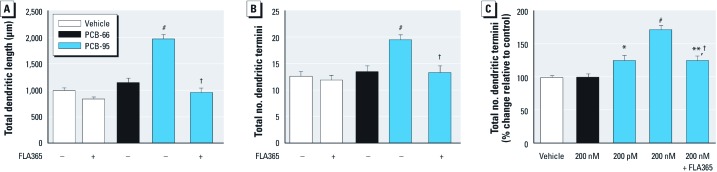
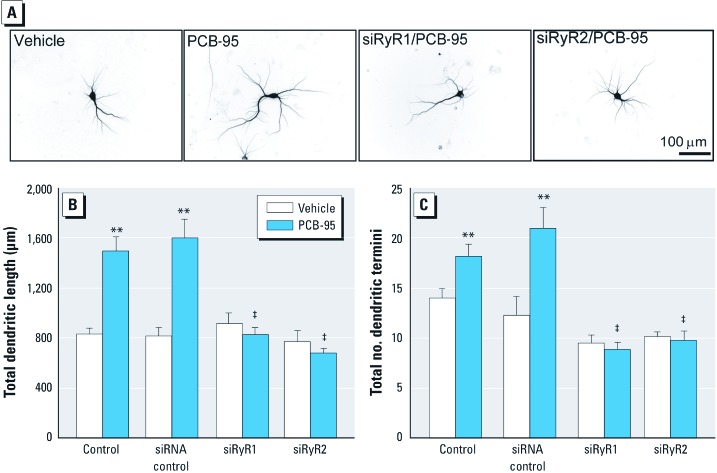
Background: Aroclor 1254 (A1254) interferes with normal dendritic growth and plasticity in the developing rodent brain, but the mechanism(s) mediating this effect have yet to be established. Non-dioxin-like (NDL) polychlorinated biphenyls (PCBs) enhance the activity of ryanodine receptor (RyR) calcium ion (Ca2+) channels, which play a central role in regulating the spatiotemporal dynamics of intracellular Ca2+ signaling. Ca2+ signaling is a predominant factor in shaping dendritic arbors, but whether PCB potentiation of RyR activity influences dendritic growth is not known. Objective: We determined whether RyR activity is required for PCB effects on dendritic growth. Methods and Results: Golgi analysis of hippocampi from weanling rats confirmed that developmental exposure via the maternal diet to NDL PCB-95 (2,2´,3,5´6-pentachlorobiphenyl), a potent RyR potentiator, phenocopies the dendrite-promoting effects of A1254. Dendritic growth in dissociated cultures of primary hippocampal neurons and in hippocampal slice cultures is similarly enhanced by PCB-95 but not by PCB-66 (2,3,4´,4-tetrachlorobiphenyl), a congener with negligible effects on RyR activity. The dendrite-promoting effects of PCB-95 are evident at concentrations as low as 2 pM and are inhibited by either pharmacologic blockade or siRNA knockdown of RyRs. Conclusions: Our findings demonstrate that environmentally relevant levels of NDL PCBs modulate neuronal connectivity via RyR-dependent effects on dendritic arborization. In addition, these findings identify RyR channel dysregulation as a novel mechanism contributing to dysmorphic dendritogenesis associated with heritable and environmentally triggered neurodevelopmental disorders.
Overview
The claims and statistics of this paper haven’t been checked yet.
Run the check — free, no account needed. It reads the open-access text and checks the sources it cites.
Integrity signals
Registry
Cites
Statistics
Figures
Verification
Claims the paper makes
The claims and statistics of this paper haven’t been checked yet.
Run the check — free, no account needed. It reads the open-access text and checks the sources it cites.
Claims other papers make about this one
Each is checked against this paper’s own text: does it say what the citing paper says it does?
In the citing paper
“Second, NDL PCB congeners modulate dendritic arborization and spine formation [ 107 , 108 ], and similar changes in neuronal connectivity have been observed in the autistic brain [ 109 , 110 ].”
From DNA methylation: a mechanism linking environmental chemical exposures to risk of autism spectrum disorders? (2016) · cites this paper as [107]
In the citing paper
“Interestingly, a nonmonotonic dose–response relationship has also been reported for NDL PCB effects on dendritic arborization of cultured rat hippocampal neurons [ 107 ] and learning and memory deficits in rats exposed throughout gestation and lactation to NDL PCBs in the maternal diet [ 117 ].”
From DNA methylation: a mechanism linking environmental chemical exposures to risk of autism spectrum disorders? (2016) · cites this paper as [107]
Self-check
Percentages, sums and reported differences re-computed from the paper’s own numbers.
The self-check needs the paper’s full text.
Citations
Cites
Basic and Clinical Biostatistics,
(2002) · Survey of Ophthalmology · doi:10.1016/s0039-6257(02)00360-0 · Cited by 1,818
Design and validation of a tool for neurite tracing and analysis in fluorescence microscopy images
Meijering, E. H. W., Jacob, M., Sarria, J. ‐. F., Steiner, P., Hirling, H., & Unser, M. A. (2004) · Cytometry Part A · doi:10.1002/cyto.a.20022 · Cited by 1,637
Dendritic spine pathology in neuropsychiatric disorders
Penzes, P., Cahill, M. E., Jones, K. A., VanLeeuwen, J.-E., & Woolfrey, K. M. (2011) · Nature Neuroscience · doi:10.1038/nn.2741 · Cited by 1,523
Bourgeron, T. (2009) · Current Opinion in Neurobiology · doi:10.1016/j.conb.2009.06.003 · Cited by 637 · cited 4×
“Structural aberrations in the dendritic arbors of central neurons are thought to con tribute to clinical manifestations of diverse heritable and environmentally induced neuro developmental disorders in humans (Bourgeron 2009; Fukuda et al. 2005; Garey 2010; Penzes et al. 2011; Svitkina et al. 2010).”
BackgroundInfluentialCalmodulin-kinases: modulators of neuronal development and plasticity.
Wayman, G. A., Lee, Y.-S., Tokumitsu, H., Silva, A., & Soderling, T. R. (2008) · Neuron · doi:10.1016/j.neuron.2008.08.021 · Cited by 567
Self-citationCalcium microdomains: Organization and function
Berridge, M. J. (2006) · Cell Calcium · doi:10.1016/j.ceca.2006.09.002 · Cited by 525
Effects of PCB exposure on neuropsychological function in children.
Schantz, S. L., Widholm, J. J., & Rice, D. C. (2003) · Environmental Health Perspectives · doi:10.1289/ehp.5461 · Cited by 503
Dendritic arbor development and synaptogenesis
Cline, H. T. (2001) · Current Opinion in Neurobiology · doi:10.1016/s0959-4388(00)00182-3 · Cited by 499
Polychlorinated Biphenyls (PCBs): Routes of Exposure and Effects on Human Health
Carpenter, D. O. (2006) · Reviews on Environmental Health · doi:10.1515/reveh.2006.21.1.1 · Cited by 494
Wayman, G. A., Impey, S., Marks, D., Saneyoshi, T., Grant, W. F., Derkach, V., & Soderling, T. R. (2006) · Neuron · doi:10.1016/j.neuron.2006.05.008 · Cited by 466 · cited 4×
“Dendritic arbors of individual neurons in highdensity neuron glia cocultures were visualized by expressing a MAP2BEGFP construct under the control of the CAG promoter, which exhibits neuron specific expression (Wayman et al. 2006).”
BackgroundMethodInfluentialSelf-citationCalcium Regulation of Dendritic Growth via CaM Kinase IV and CREB-Mediated Transcription
Redmond, L., Kashani, A. H., & Ghosh, A. (2002) · Neuron · doi:10.1016/s0896-6273(02)00737-7 · Cited by 462
Schratt, G. M., Nigh, E. A., Chen, W., Hu, L. S., & Greenberg, M. E. (2004) · Journal of Neuroscience · doi:10.1523/jneurosci.1739-04.2004 · Cited by 403
INTRACELLULAR CALCIUM RELEASE AND CARDIAC DISEASE
Wehrens, X. H. T., Lehnart, S. E., & Marks, A. R. (2004) · Annual Review of Physiology · doi:10.1146/annurev.physiol.67.040403.114521 · Cited by 353
How do dendrites take their shape?
Scott, E. K., & Luo, L. (2001) · Nature Neuroscience · doi:10.1038/86006 · Cited by 296
An activity-induced microRNA controls dendritic spine formation by regulating Rac1-PAK signaling
Impey, S., Davare, M., Lasiek, A., Fortin, D., Ando, H., Varlamova, O., Obrietan, K., Soderling, T. R., Goodman, R. H., & Wayman, G. A. (2010) · Molecular and Cellular Neuroscience · doi:10.1016/j.mcn.2009.10.005 · Cited by 270
Self-citationTsokas, P. (2005) · Journal of Neuroscience · doi:10.1523/jneurosci.0599-05.2005 · Cited by 251
Minding the calcium store: Ryanodine receptor activation as a convergent mechanism of PCB toxicity
Pessah, I. N., Cherednichenko, G., & Lein, P. J. (2010) · Pharmacology & Therapeutics · doi:10.1016/j.pharmthera.2009.10.009 · Cited by 231
Self-citationFukuda, T., Itoh, M., Ichikawa, T., Washiyama, K., & Goto, Y.-I. (2005) · Journal of Neuropathology & Experimental Neurology · doi:10.1093/jnen/64.6.537 · Cited by 221
Regulation of mammalian ryanodine receptors
Meissner, G. (2002) · Frontiers in bioscience · doi:10.2741/a899 · Cited by 204
Dendritic spine formation and pruning: common cellular mechanisms?
Segal, M., Korkotian, E., & Murphy, D. D. (2000) · Trends in Neurosciences · doi:10.1016/s0166-2236(99)01499-x · Cited by 196
Airey, J. A., Beck, C. F., Murakami, K., Tanksley, S. J., Deerinck, T. J., Ellisman, M. H., & Sutko, J. L. (1990) · Journal of Biological Chemistry · doi:10.1016/s0021-9258(18)77285-2 · Cited by 181
Coordinated Movement of Cytoplasmic and Transmembrane Domains of RyR1 upon Gating
Samsó, M., Feng, W., Pessah, I. N., & Allen, P. D. (2009) · PLoS Biology · doi:10.1371/journal.pbio.1000085 · Cited by 180
Self-citationYang, D., Kim, K. H., Phimister, A., Bachstetter, A. D., Ward, T. R., Stackman, R. W., Mervis, R. F., Wisniewski, A. B., Klein, S. L., Kodavanti, P. R. S., et al. (2009) · Environmental Health Perspectives · doi:10.1289/ehp.11771 · Cited by 166
Self-citationWhen cortical development goes wrong: schizophrenia as a neurodevelopmental disease of microcircuits
Garey, L. J. (2010) · Journal of Anatomy · doi:10.1111/j.1469-7580.2010.01231.x · Cited by 158
Chen, Y., Tassone, F., Berman, R. F., Hagerman, P. J., Hagerman, R. J., Willemsen, R., & Pessah, I. N. (2009) · Human Molecular Genetics · doi:10.1093/hmg/ddp479 · Cited by 151
Self-citationPessah, I. N., Hansen, L. G., Albertson, T. E., Garner, C. E., Ta, T. A., Do, Z., Kim, K. H., & Wong, P. W. (2005) · Chemical Research in Toxicology · doi:10.1021/tx050196m · Cited by 146
Self-citationTransmembrane Redox Sensor of Ryanodine Receptor Complex
Feng, W., Liu, G., Allen, P. D., & Pessah, I. N. (2000) · Journal of Biological Chemistry · doi:10.1074/jbc.c000523200 · Cited by 142
Self-citationRegulation of dendritic growth and plasticity by local and global calcium dynamics
Löhmann, C., & Wong, R. (2005) · Cell Calcium · doi:10.1016/j.ceca.2005.01.008 · Cited by 138
Wayman, G. A., Bose, D. D., Yang, D., Lesiak, A. J., Bruun, D. A., Impey, S., Ledoux, V. A., Pessah, I. N., & Lein, P. J. (2012) · Environmental Health Perspectives · doi:10.1289/ehp.1104833 · Cited by 136
Self-citationAdasme, T., Haeger, P. A., Paula-Lima, A. C., Espinoza, I., Casas-Alarcón, M. M., Carrasco, M. A., & Hidalgo, C. (2011) · Proceedings of the National Academy of Sciences · doi:10.1073/pnas.1013580108 · Cited by 135
Regulation of spine and synapse formation by activity-dependent intracellular signaling pathways
Saneyoshi, T., Fortin, D. A., & Soderling, T. R. (2010) · Current Opinion in Neurobiology · doi:10.1016/j.conb.2009.09.013 · Cited by 133
Wong, P. W., Brackney, W. R., & Pessah, I. N. (1997) · Journal of Biological Chemistry · doi:10.1074/jbc.272.24.15145 · Cited by 124
Self-citationVickers, C. A., Dickson, K. S., & Wyllie, D. J. A. (2005) · The Journal of Physiology · doi:10.1113/jphysiol.2005.092924 · Cited by 116
WONG, P. W. K., & Pessah, I. N. (1996) · Molecular Pharmacology · doi:10.1016/s0026-895x(25)08790-5 · Cited by 116
Self-citationPolychlorinated biphenyls, organochlorine pesticides and neurodevelopment
Korrick, S. A., & Sagiv, S. K. (2008) · Current Opinion in Pediatrics · doi:10.1097/mop.0b013e3282f6a4e9 · Cited by 115
Schantz, S. L., Seo, B. W., Wong, P. W., & Pessah, I. N. (1997) · PubMed · Cited by 114
Self-citationHoward, A. (2003) · Toxicology and Applied Pharmacology · doi:10.1016/s0041-008x(03)00156-x · Cited by 112
Fonnum, F., Mariussen, E., & Reistad, T. (2005) · Journal of Toxicology and Environmental Health · doi:10.1080/15287390500259020 · Cited by 109
Liu, G., Abramson, J. J., Zable, A. C., & Pessah, I. N. (1994) · Molecular Pharmacology · doi:10.1016/s0026-895x(25)09914-6 · Cited by 103
Self-citationKodavanti, P. R. S., Kannan, N., Yamashita, N., Derr-Yellin, E. C., Ward, T. R., Burgin, D. E., Tilson, H. A., & Birnbaum, L. S. (2001) · Environmental Health Perspectives · doi:10.1289/ehp.011091153 · Cited by 97
Gauger, K. J., Giera, S., Sharlin, D. S., Bansal, R., Iannacone, E. A., & Zoeller, R. T. (2007) · Environmental Health Perspectives · doi:10.1289/ehp.10328 · Cited by 95
Expression of a cardiac Ca2+-release channel isoform in mammalian brain
Lai, F. A., Dent, M. A. R., Wickenden, C., Xu, L., Kumari, G., Misra, M., Lee, H. B., Sar, M., & Meissner, G. (1992) · Biochemical Journal · doi:10.1042/bj2880553 · Cited by 93
Kim, S., Yun, H., Baik, J., Chung, K. C., Nah, S.-Y., & Rhim, H. (2007) · Journal of Biological Chemistry · doi:10.1074/jbc.m701418200 · Cited by 90
Giera, S., Bansal, R., Ortiz-Toro, T., Taub, D. G., & Zoeller, R. T. (2011) · Endocrinology · doi:10.1210/en.2010-1490 · Cited by 89
Kostyniak, P. J., Hansen, L. G., Widholm, J. J., Fitzpatrick, R. D., Olson, J. R., Helferich, J. L., Kim, K. H., Sable, H. J. K., Seegal, R. F., Pessah, I. N., et al. (2005) · Toxicological Sciences · doi:10.1093/toxsci/kfi338 · Cited by 88
Self-citationLein, P. J., Yang, D., Bachstetter, A. D., Tilson, H. A., Harry, G. J., Mervis, R. F., & Kodavanti, P. R. S. (2007) · Environmental Health Perspectives · doi:10.1289/ehp.9773 · Cited by 81
Self-citationAcute Hippocampal Slice Preparation and Hippocampal Slice Cultures
Lein, P. J., Barnhart, C. D., & Pessah, I. N. (2011) · Methods in molecular biology · doi:10.1007/978-1-61779-170-3_8 · Cited by 80
Self-citationYuen, B., Boncompagni, S., Feng, W., Yang, T., Lopez, J. R., MATTHAEI, K. I., Goth, S. R., Protasi, F., Franzini‐Armstrong, C., Allen, P. D., et al. (2011) · The FASEB Journal · doi:10.1096/fj.11-197582 · Cited by 80
Self-citationProperties of Ryr3 Ryanodine Receptor Isoform in Mammalian Brain
Murayama, T., & Ogawa, Y. (1996) · Journal of Biological Chemistry · doi:10.1074/jbc.271.9.5079 · Cited by 73
Redox sensing properties of the Ryanodine receptor complex
Pessah, I. N. (2002) · Frontiers in bioscience · doi:10.2741/a741 · Cited by 72
Self-citationRegulation of the Postsynaptic Cytoskeleton: Roles in Development, Plasticity, and Disorders
Svitkina, T., Lin, W., Webb, D. J., Yasuda, R., Wayman, G. A., Aelst, L. V., & Soderling, S. H. (2010) · Journal of Neuroscience · doi:10.1523/jneurosci.4276-10.2010 · Cited by 69
Self-citationNeuronal structural remodeling: is it all about access?
Chen, J. L., & Nedivi, E. (2010) · Current Opinion in Neurobiology · doi:10.1016/j.conb.2010.06.002 · Cited by 68
Mechanisms of Dendritic Maturation
Libersat, F., & Duch, C. (2004) · Molecular Neurobiology · doi:10.1385/mn:29:3:303 · Cited by 57
Complex Pharmacology of Malignant Hyperthermia
Pessah, I. N., Lynch, C. I., & Gronert, G. A. (1996) · Anesthesiology · doi:10.1097/00000542-199606000-00001 · Cited by 46
Self-citationLaitinen, P. H., Swan, H., Piippo, K., Viitasalo, M. T., Toivonen, L. K., & KONTULA, K. K. (2004) · Annals of Medicine · doi:10.1080/17431380410032599 · Cited by 42
Mack, W., Zimanyi, I. A., & Pessah, I. N. (1992) · Journal of Pharmacology and Experimental Therapeutics · doi:10.1016/s0022-3565(25)10895-1 · Cited by 40
Self-citationBarrientos, G. C., Feng, W., Truong, K. M., MATTHAEI, K. I., Yang, T., Allen, P. D., Lopez, J. R., & Pessah, I. N. (2011) · Journal of Biological Chemistry · doi:10.1074/jbc.m111.307926 · Cited by 34
Self-citationChiesi, M., Schwaller, R., & Calviello, G. (1988) · Biochemical and Biophysical Research Communications · doi:10.1016/0006-291x(88)90641-9 · Cited by 27
Ta, T. A., & Pessah, I. N. (2006) · NeuroToxicology · doi:10.1016/j.neuro.2006.08.007 · Cited by 23
Self-citation
Cited by
Sorted by citations
Neurotoxicity of polychlorinated biphenyls and related organohalogens
Pessah, I. N., Lein, P. J., Seegal, R. F., & Sagiv, S. K. (2019) · Acta Neuropathologica · doi:10.1007/s00401-019-01978-1 · Cited by 236
Self-citationMitchell, M. M., Woods, R., Chi, L., Schmidt, R. J., Pessah, I. N., Kostyniak, P. J., & LaSalle, J. M. (2012) · Environmental and Molecular Mutagenesis · doi:10.1002/em.21722 · Cited by 164
Self-citationKeil, K. P., & Lein, P. J. (2016) · Environmental Epigenetics · doi:10.1093/eep/dvv012 · Cited by 167
Self-citationWayman, G. A., Bose, D. D., Yang, D., Lesiak, A. J., Bruun, D. A., Impey, S., Ledoux, V. A., Pessah, I. N., & Lein, P. J. (2012) · Environmental Health Perspectives · doi:10.1289/ehp.1104833 · Cited by 136
Self-citationKlocke, C. R., & Lein, P. J. (2020) · International Journal of Molecular Sciences · doi:10.3390/ijms21031013 · Cited by 140
Self-citation
Metadata
- Authors
- Wayman, G. A., Yang, D., Bose, D. D., Lesiak, A., Ledoux, V., Bruun, D., Pessah, I. N., & Lein, P. J.
- Affiliations
- Washington State University (US)
- University of California, Davis (US)
- Program in Neuroscience, Department of Veterinary and Comparative Anatomy, Pharmacology and Physiology, Washington State University, Pullman, Washington, USA
- Oregon Health & Science University (US)
- Corresponding author
- Lein, Pamela J.
- Venue
- Environmental Health Perspectives
- Publisher
- American Chemical Society (ACS)
- Published
- 2012-04-25
- Volume
- 120
- Issue
- 7
- Pages
- 997-1002
- ISSN
- 0091-6765 (ISSN-L)
- 1552-9924
- PMC
- PMC3404670
- OpenAlex
- W2057153652
- Cited by
- 136
- References
- 59
- Citations by year
- 2026: 7 · 2025: 2 · 2024: 6 · 2023: 10 · 2022: 11 · 2021: 6 · 2020: 12 · 2019: 14 · 2018: 12 · 2017: 12 · 2016: 8 · 2015: 3 · 2014: 12 · 2013: 15 · 2012: 5
- FWCI
- 7.77
- Type
- journal article
- Language
- en
- Open access
- gold
- doi.org
- Licence
- public-domain
- creativecommons.org/licenses/by/4.0/ (vor, 2074 d)
- Locations
- Environmental Health Perspectives (publishedVersion, public-domain)
- PubMed Central (publishedVersion, public-domain)
- PubMed (publishedVersion)
- eScholarship (California Digital Library) (submittedVersion)
- Funders
- U.S. Environmental Protection Agency (R-829388, R-833292, R01 ES014901, ES011269)
- Hope for Depression Research Foundation
- National Institutes of Health (ES04699, ES014901, ES011269)
- National Institute of Mental Health (R01MH086032)
- National Institute of Environmental Health Sciences (P42-ES-04699, P42ES004699, R01ES017425, P01ES011269, R01ES014901, T32ES007060)
- Topics
- Physical Sciences › Environmental Science › Health, Toxicology and Mutagenesis › Toxic Organic Pollutants Impact
- Life Sciences › Neuroscience › Cellular and Molecular Neuroscience › Neuroscience and Neuropharmacology Research
- Physical Sciences › Environmental Science › Health, Toxicology and Mutagenesis › Effects and risks of endocrine disrupting chemicals
- Keywords
- PCB 95, non-dioxin-like polychlorinated biphenyls, ryanodine receptor, dendritic growth, dendritic branching, calcium signaling, Aroclor 1254, hippocampal neurons, neurodevelopmental disorders, developmental neurotoxicity, PCB congeners, maternal dietary exposure
- MeSH terms
- Animals, Cells, Cultured, Dendrites, Hippocampus, Neurons, Polychlorinated Biphenyls, Ryanodine Receptor Calcium Release Channel, Rats
About these checks
Registry, retraction, Cites and statistics results are computed, not judged, with one exception: a printed reference that no index lists is read once by a model before it counts as a citation error. Claims are extracted by a model and kept only when their quote appears verbatim in the text; each cited source is then checked, with a model’s help, for whether it says what the claim relies on. Those verdicts can be wrong — read the claim’s quote and the cited source before relying on one.
Statistics and arithmetic are recomputed, not judged.
Confidence bands are shown only for fields calibrated on our annotated test set. None is calibrated yet, so no band is shown.
What counts as a claim ›How we measure confidence ›How we check this ›
Are you an author, or do you see a problem with this page? Request a review
