

Seborrheic Dermatitis and Dandruff: A Comprehensive Review
Open accessThe DOI matches its Crossref record; 134 of the 138 references it cites were found in a registry or an index; 38 of the 218 sources its claims cite were checked for support.
Abstract
EU-Russian relations have been a defining parameter of European security during the post- Cold War era. The axis of cooperation has been defined not only by EU-Russian common goals but also the ability of the US to derail this emerging partnership. The recent crisis in Georgia has illustrated Russia's
Overview
CoChat Summary
TL;DR
This comprehensive review argues that seborrheic dermatitis (SD) and dandruff represent a continuous spectrum of the same disease, differing mainly by location and severity, with multifactorial pathogenesis involving Malassezia, sebaceous activity, barrier/immune factors, and genetics. It summarizes epidemiology, burden, clinical diagnosis, treatment, and pathophysiologic mechanisms, noting that etiology remains incompletely understood.
Key findings
- SD and dandruff combined are estimated to affect half of the adult population; dandruff affects approximately 50% of adults worldwide and is more prevalent in males. SD incidence is 1–3% of the general adult population, up to 42% in infants ≤3 months, and 30–83% among HIV patients.
- Dandruff prevalence varies by ethnicity: 81–95% in African Americans, 66–82% in Caucasians, and 30–42% in Chinese.
- Burden estimates include at least 50 million Americans with dandruff spending $300 million annually on over-the-counter products; SD direct costs were estimated at $179 million plus $51 million indirect costs, with willingness to pay $1.2 billion for symptom relief.
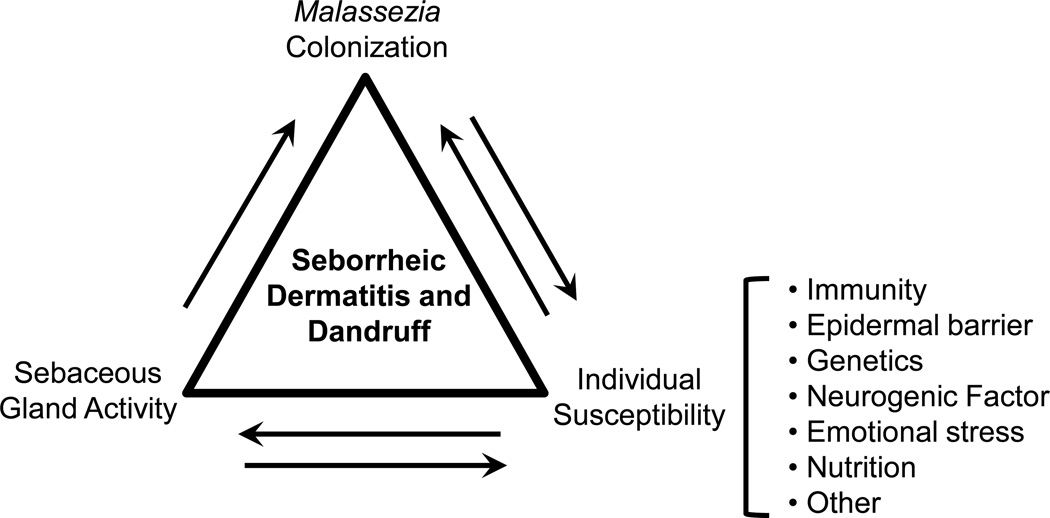
- Pathogenesis involves Malassezia (higher numbers of M. globosa and M. restricta correlate with SD appearance/severity), sebaceous gland activity, epidermal barrier disruption, immune response, genetic factors (e.g., MPZL3, ZNF750), and neurogenic/emotional stress; treatment mainly uses topical antifungal and anti-inflammatory agents.
Methods
- Narrative review of current knowledge on SD and dandruff; no primary data collection, sample, or systematic search/analysis is described.
- Covers epidemiology, burden of disease, clinical presentations and diagnosis, treatment, genetic studies in humans and animal models, and predisposing factors.
Limitations
- Stated: pathogenesis of SD and dandruff is not well understood; the specific role of lymphocyte activity remains controversial; efficacy of immune modulators such as topical calcineurin inhibitors and metronidazole remains controversial; the mutation underlying inherited seborrheic dermatitis (seb) mice remains unidentified.
- Evident: as a narrative review, it does not report a systematic search strategy, inclusion criteria, or quality appraisal.
- Evident: Tables 1–4 and Figure 1 are referenced for clinical presentations, differential diagnosis, treatment, and pathogenesis but are not included in the supplied text, so those details cannot be verified here.
Model-written summary. Check it against the paper before relying on it.
Integrity signals
Registry
Cites
Statistics
Figures
Verification
Claims the paper makes
30 Valid · 4 Not valid · 67 Not checked · 6 Own results and interpretations
At least one cited source doesn’t support this claim or points to a different paper, and none confirmed it — see the verdicts below.
In the paper
“Its incidence peaks during three age periods - in the first three months of life, during puberty, and in adulthood with an apex at 40 to 60 years of age [1–4].”
§ Seborrheic Dermatitis and Dandruff: A Comprehensive Review > Epidemiology
What the sources say
- Not checked — no full text of the sourcecites [1] Gupta AK Madzia SE Batra R Etiology and management of Seborrheic dermatitis Dermatology 2004 208 89 93 15056994 source
- Not checked — no full text of the sourcecites [2] Del Rosso JQ Adult seborrheic dermatitis: a status report on practical topical management J Clin Aesthet Dermatol 2011 4 32 38 21607192 PMC3100109
- Disputedcites [3] Sampaio AL Mameri AC Vargas TJ Ramos-e-Silva M Nunes AP Seborrheic dermatitis An Bras Dermatol 2011 86 1061 1071 22281892 sourceExperimental — accuracy not yet measured
The paper’s Abstract (page unavailable) states that seborrheic dermatitis has two incidence peaks, not three: one in the first three months of life and a second beginning at puberty that reaches its apex at ages 40–60. It does not describe puberty and adulthood as separate peaks. (LLM, conf=0.90)
Checked by a reasoning model — may be wrong.
- Not checked — no full text of the sourcecites [4] Schwartz RA Janusz CA Janniger CK Seborrheic dermatitis: an overview Am Fam Physician 2006 74 125 130 16848386
plainstates an association- Asserted: passes — The authors put it forward as true.
- Checkable: passes — It can be checked against evidence.
- Load-bearing: unclear — It is unclear whether the paper’s conclusions depend on it.
- Based: passes — The paper gives a reason why it holds.
The sources with a verdict support this claim; the rest weren’t checked yet, have no full text we could read, or their verdicts aren’t rated yet.
In the paper
“These observations suggest that immunological defects may play a role in SD.”
§ Seborrheic Dermatitis and Dandruff: A Comprehensive Review > Epidemiology
What the sources say
- Supportedcites [3] Sampaio AL Mameri AC Vargas TJ Ramos-e-Silva M Nunes AP Seborrheic dermatitis An Bras Dermatol 2011 86 1061 1071 22281892 source
The IMUNOGENÉTICA section (page not supplied) reports altered cellular immunity in people with seborrheic dermatitis. The paper also identifies an individual's immunological profile as a contributing factor, supporting the cautious claim that immunological defects may play a role. (LLM, conf=0.92)
- Not checked — no full text of the sourcecites [14] Nnoruka EN Chukwuka JC Anisuiba B Correlation of mucocutaneous manifestations of HIV/AIDS infection with CD4 counts and disease progression Int J Dermatol 2007 46 Suppl 2 14 18 17958624 source
- Not checked — no full text of the sourcecites [15] Ramos-E-Silva M Sampaio AL Carneiro S Red face revisited: Endogenous dermatitis in the form of atopic dermatitis and seborrheic dermatitis Clin Dermatol 2014 32 109 115 24314384 source
hedgedstates a possible cause- Asserted: passes — The authors put it forward as true.
- Checkable: passes — It can be checked against evidence.
- Load-bearing: unclear — It is unclear whether the paper’s conclusions depend on it.
- Based: passes — The paper gives a reason why it holds.
- Supported
The cited sources that could be checked couldn’t confirm or dispute this claim.
In the paper
“Men are affected more frequently than women (3.0% vs. 2.6%) in all age groups, suggesting that SD may be associated with sex hormones such as androgens [1,3,8].”
§ Seborrheic Dermatitis and Dandruff: A Comprehensive Review > Epidemiology
What the sources say
- Not checked — no full text of the sourcecites [1] Gupta AK Madzia SE Batra R Etiology and management of Seborrheic dermatitis Dermatology 2004 208 89 93 15056994 source
- Could not verifycites [3] Sampaio AL Mameri AC Vargas TJ Ramos-e-Silva M Nunes AP Seborrheic dermatitis An Bras Dermatol 2011 86 1061 1071 22281892 sourceExperimental — accuracy not yet measured
The Abstract (page unavailable) gives an overall prevalence of 1–3% and describes age-related incidence, but does not compare men with women. Searches of the indexed full text for sex-specific prevalence, 3.0%, and 2.6% did not locate the claimed comparison across all age groups. (LLM, conf=0.69)
- Not checked — no full text of the sourcecites [8] Naldi L Rebora A Clinical practice. Seborrheic dermatitis N Engl J Med 2009 360 387 396 19164189 source
plainstates an association- Asserted: passes — The authors put it forward as true.
- Checkable: passes — It can be checked against evidence.
- Load-bearing: unclear — It is unclear whether the paper’s conclusions depend on it.
- Based: passes — The paper gives a reason why it holds.
The cited sources support only part of this claim — read each source’s verdict below.
In the paper
“Men are affected more frequently than women (3.0% vs. 2.6%) in all age groups, suggesting that SD may be associated with sex hormones such as androgens [1,3,8].”
§ Seborrheic Dermatitis and Dandruff: A Comprehensive Review > Epidemiology
What the sources say
- Not checked — no full text of the sourcecites [1] Gupta AK Madzia SE Batra R Etiology and management of Seborrheic dermatitis Dermatology 2004 208 89 93 15056994 source
- Partly supportedcites [3] Sampaio AL Mameri AC Vargas TJ Ramos-e-Silva M Nunes AP Seborrheic dermatitis An Bras Dermatol 2011 86 1061 1071 22281892 sourceExperimental — accuracy not yet measured
In the paper’s continuing-education questions (section labeled “Medicações tópicas,” page unavailable), an item links seborrheic dermatitis with sex hormones, citing its occurrence in newborns and return in adolescence. The copy does not specifically identify androgens as the hormones involved; its treatment discussion mentions antiandrogenic effects of antifungals only as a debated possibility. (LLM, conf=0.82)
- Not checked — no full text of the sourcecites [8] Naldi L Rebora A Clinical practice. Seborrheic dermatitis N Engl J Med 2009 360 387 396 19164189 source
hedgedstates an association- Asserted: passes — The authors put it forward as true.
- Checkable: passes — It can be checked against evidence.
- Load-bearing: unclear — It is unclear whether the paper’s conclusions depend on it.
- Based: passes — The paper gives a reason why it holds.
The cited sources support only part of this claim — read each source’s verdict below.
In the paper
“SD is more prevalent in immune-compromised patients such as HIV/AIDS patients [7,10], organ transplant recipients [11,12], and patients with lymphoma [13].”
§ Seborrheic Dermatitis and Dandruff: A Comprehensive Review > Epidemiology
What the sources say
- Not checked — no full text of the sourcecites [7] Clark GW Pope SM Jaboori KA Diagnosis and treatment of seborrheic dermatitis Am Fam Physician 2015 91 185 190 25822272
- Supportedcites [10] Dunic I Vesic S Jevtovic DJ Oral candidiasis and seborrheic dermatitis in HIV-infected patients on highly active antiretroviral therapy HIV Med 2004 5 50 54 14731170 source
The Introduction describes seborrheic dermatitis as a common condition among HIV-infected people, with a reported prevalence of 7–50%, and links it to reduced immune function. The transplant and lymphoma portions of the citing sentence have separate citations and are not attributed to this source. (LLM, conf=0.88)
- Not checked — no full text of the sourcecites [11] Lally A Casabonne D Newton R Wojnarowska F Seborrheic dermatitis among Oxford renal transplant recipients J Eur Acad Dermatol Venereol 2010 24 561 564 19888944 source
- Not checked — no full text of the sourcecites [12] Ozcan D Seckin D Ada S Haberal M Mucocutaneous disorders in renal transplant recipients receiving sirolimus-based immunosuppressive therapy: a prospective, case-control study Clin Transplant 2013 27 742 748 23991694 source
- Partly supportedcites [13] Okada K Endo Y Fujisawa A Tanioka M Kabashima K Refractory seborrheic dermatitis of the head in a patient with malignant lymphoma Case Rep Dermatol 2014 6 279 282 25566053 PMC4280471 sourceExperimental — accuracy not yet measured
The Case Report describes an SD-like eruption in a patient diagnosed with lymphoma, and the Discussion notes a few published cases involving lymphoma. These passages support an association in individual cases, but do not establish that SD is more prevalent among patients with lymphoma. This citation is attached only to the lymphoma portion of the sentence, not the HIV/AIDS or transplant portions. (LLM, conf=0.87)
plainstates an association- Asserted: passes — The authors put it forward as true.
- Checkable: passes — It can be checked against evidence.
- Load-bearing: unclear — It is unclear whether the paper’s conclusions depend on it.
- Based: passes — The paper gives a reason why it holds.
48 more claims · 13 with their cited sources checked
Create a free account to see all 107 claims and to verify the 14 references still open.
- Probably not a substantial claim. 10
- It may state two separate claims as one. 45
Citations
Cites
Schweiger, D., Baufeld, C., Drescher, P., Oltrogge, B., Höpfner, S., Mess, A., Lüttke, J., Rippke, F., Filbry, A., & Max, H. (2013) · Skin Pharmacology and Physiology · doi:10.1159/000348473 · Cited by 1,346
Lisnevskaia, L., Murphy, G., & Isenberg, D. (2014) · The Lancet · doi:10.1016/s0140-6736(14)60128-8 · Cited by 752
Bickers (2006) · doi:10.1016/j.jaad.2006.05.048 · Cited by 741
The Malassezia Genus in Skin and Systemic Diseases
Gaitanis, G., Magiatis, P., Hantschke, M., Bassukas, I. D., & Velegraki, A. (2012) · Clinical Microbiology Reviews · doi:10.1128/cmr.00021-11 · Cited by 642 · cited 1×
“Several lines of evidence suggest a pathogenic role for yeasts of the genus Malassezia in SD and dandruff [42-46].”
The stratum corneum: structure and function in health and disease
Harding, C. R. (2004) · Dermatologic Therapy · doi:10.1111/j.1396-0296.2004.04s1001.x · Cited by 362
THE AETIOLOGY OF DANDRUFF AND THE MODE OF ACTION OF THERAPEUTIC AGENTS
SHUSTER, S. (1984) · British Journal of Dermatology · doi:10.1111/j.1365-2133.1984.tb04050.x · Cited by 308 · cited 1×
“Several lines of evidence suggest a pathogenic role for yeasts of the genus Malassezia in SD and dandruff [42-46].”
DeAngelis, Y. M., Gemmer, C. M., Kaczvinsky, J. R., Kenneally, D. C., Schwartz, J. R., & Dawson, T. L. (2005) · Journal of Investigative Dermatology Symposium Proceedings · doi:10.1111/j.1087-0024.2005.10119.x · Cited by 289 · cited 5×
“These observations are suggestive of intrinsic epidermal barrier defects in the pathogenesis of SD and dandruff [48].”
InfluentialRo, B. I., & Dawson, T. L. (2005) · Journal of Investigative Dermatology Symposium Proceedings · doi:10.1111/j.1087-0024.2005.10104.x · Cited by 286
Seborrheic dermatitis: Etiology, risk factors, and treatments:
Dessinioti, C., & Katsambas, A. (2013) · Clinics in Dermatology · doi:10.1016/j.clindermatol.2013.01.001 · Cited by 285 · cited 8×
“SD is also more commonly seen in depressive disorders and emotional stress [5,16].”
InfluentialA review of applications of tea tree oil in dermatology
Pazyar, N., Yaghoobi, R., Bagherani, N., & Kazerouni, A. (2013) · International Journal of Dermatology · doi:10.1111/j.1365-4632.2012.05654.x · Cited by 252 · cited 1×
“Alternative therapies have been reported as well, such as tea tree oil [40,41].”
Research works printed but not linked: 2
- [38]Reider N Fritsch PO Bolognia JL Jorizzo JL Schaffer JV Other eczematous eruptions Dermatology 2012 UK Elsevier Health Sciences 219 221
- [62]Strauss JS Downing DT Ebling FJ Goldsmith LA Sebaceous glands Biochemistry and physiology of skin 1983 New York Oxford University Press 569 595
Cited by
Items 201–300 of 397
Park, M. H., Jung, Y. R., Choi, E. B., Park, B., Hwang, J., & Park, M. (2025) · Biomolecules & Therapeutics · doi:10.4062/biomolther.2025.072 · Cited by 3
Primawati, I., Utari, M., & Nurwiyeni, N. (2021) · Ibnu Sina Jurnal Kedokteran dan Kesehatan-Fakultas Kedokteran Universitas Islam Sumatera Utara · doi:10.30743/ibnusina.v20i2.112 · Cited by 11
Lai, P.-Y., Shih, T., Chang, Y.-H., Chou, Y., Wu, T.-H., Su, Y.-Y., Chang, C., & Kuo, W. (2021) · JID Innovations · doi:10.1016/j.xjidi.2021.100010 · Cited by 4
Eldy, & Darmawan, H. (2023) · Folia Medica Indonesiana · doi:10.20473/fmi.v59i2.41208 · Cited by 7
Current Understanding of Seborrheic Dermatitis: Presentation, Diagnosis, and Special Populations
Turchin, I., Albrecht, L. E., Hanna, S., Kyritsis, D., Loo, W. J., Lynde, C. W., Prajapati, V. H., Purdy, K. S., Rochette, L., Wiseman, M., et al. (2025) · Journal of Cutaneous Medicine and Surgery · doi:10.1177/12034754251368828 · Cited by 10
Effect of Neem Leaf Paste Application on Dandruff
(2025) · doi:10.7759/cureus.80685 · Cited by 3
Liu, Y., Liu, J., Xu, R., Yuan, Y., Sun, Q., Ding, S., Wang, F., & Qu, L. (2025) · Journal of Ethnopharmacology · doi:10.1016/j.jep.2025.120416 · Cited by 4
Asz‐Sigall, D., & Tosti, A. (2019) · Springer eBooks · doi:10.1007/978-3-030-21555-2_12 · Cited by 2
Natural Topical Treatment Contributes to a Reduction of Dry Scalp Symptoms in Children
Fithian, E., Thivalapill, N., Kosner, J., Necheles, J., & Bilaver, L. (2023) · Clinical Cosmetic and Investigational Dermatology · doi:10.2147/ccid.s424077 · Cited by 3
Historical corona name in dermatology
(2020) · doi:10.1111/dth.13449 · Cited by 2
HIMANIARWATI, Arba, M., Susilawati, Y., & Mustarichie, R. (2022) · International Journal of Applied Pharmaceutics · doi:10.22159/ijap.2022.v14s5.33 · Cited by 2
Alexis, A. F., Bukhalo, M., Cook-Bolden, F. E., Rosso, J. Q. D., Draelos, Z. D., DuBois, J. C., Ferris, L. K., Forman, S. B., Kempers, S. E., Kircik, L., et al. (2025) · American Journal of Clinical Dermatology · doi:10.1007/s40257-025-00984-2 · Cited by 5
Pityriasis in dermatology: an updated review
(2020) · doi:10.1111/ijd.15097 · Cited by 2
Steinberg, F. T. T., Matos, P. A. W., Rokohl, A. C., & Heindl, L. M. (2025) · Klinische Monatsblätter für Augenheilkunde · doi:10.1055/a-2689-6204 · Cited by 2
Chovatiya, R., Chang, C. H., Aldredge, L. M., Heath, C. R., Acevedo, M., Chu, D. H., Hanna, D. T., Seal, M. S., & Zirwas, M. (2025) · Journal of Dermatological Treatment · doi:10.1080/09546634.2025.2476576 · Cited by 2
Molodykh, K. Y., Araviiskaia, E., & Sokolovskiy, E. V. (2021) · Russian Journal of Skin and Venereal Diseases · doi:10.17816/dv77251 · Cited by 3
Gebrezihier, B. G., Abdulkadir, M., Sbhatu, D. B., Tsegay, E., & Berhe, G. G. (2024) · BMC Research Notes · doi:10.1186/s13104-024-06998-z · Cited by 7
Review on Seborrheic Dermatitis Diagnosis and Treatment in Primary Health Care Center
Juman, A. A. A., Halabi, R. H. T., Fatini, F. M., Almuhana, G., Alrashidi, A. R., Alshehri, A. S., Alasafra, Z. O. A., & Aljubran, Z. N. A. (2021) · Archives of Pharmacy Practice · doi:10.51847/x3nekcwjts · Cited by 2
Formulation and evaluation of propolis extracts based shampoo on dandruff causing bacteria
Wasu, M., Ramarau, N. K., Yahya, M. H., Mahmood, S., Halim, N. A. A., & Kutty, R. V. (2020) · Malaysian Journal of Microbiology · doi:10.21161/mjm.190368 · Cited by 2
Arun, P. P. S., Vineetha, Y., Waheed, M., & Ravikanth, K. (2019) · International Journal of Scientific Research in Biological Sciences · doi:10.26438/ijsrbs/v6i2.144147 · Cited by 3
Multidimensional Research on Hair Loss in Young Chinese Females With Oily Scalps
Shao, S., Li, B., Yang, J., Qi, F., Liu, Q., & Zhao, F. (2025) · Journal of Cosmetic Dermatology · doi:10.1111/jocd.70426 · Cited by 3
Varma, S., Varma, S., Waragade, S., Cordeiro, R., & Yadav, A. (2025) · Letters in Drug Design & Discovery · doi:10.1016/j.lddd.2025.100001 · Cited by 2
Punyani, S., Shukla, R., Gudulkar, S., Sachdev, M., Kumar, R., Sachdev, A., & Shome, A. (2024) · International Journal of Research in Dermatology · doi:10.18203/issn.2455-4529.intjresdermatol20242358 · Cited by 2
A novel enzymatic approach for a targeted fungal growth inhibition
Ivanova, A., & Buzova, V. (2025) · BMC Microbiology · doi:10.1186/s12866-025-04453-y · Cited by 2
Cutaneous Pathology of the Head and Neck
Yap, T., Kern, J. S., Wood, B. A., & Scardamaglia, L. (2019) · Springer eBooks · doi:10.1007/978-3-319-72303-7_24 · Cited by 2
Singh, S. P., Kumar, B., Misra, A., Rawat, P., Tripathi, D., & Srivastava, S. K. (2025) · Frontiers in Microbiology · doi:10.3389/fmicb.2025.1654658 · Cited by 4
Local and Systemic Associations
Imbrogno, V. M. (2021) · Essentials in ophthalmology/Essentials ophthalmology · doi:10.1007/978-3-030-65040-7_3 · Cited by 2
Zschiesche, A., Hummel, T. R., Guerra, N. P., Haehner, A., Falkenburger, B. H., Koch, S., Broesamle, J., & Schulz, K. (2025) · Microchemical Journal · doi:10.1016/j.microc.2025.114369 · Cited by 2
Emerson, A. N., & Brodell, R. T. (2020) · Elsevier eBooks · doi:10.1016/b978-0-323-61211-1.00051-6 · Cited by 4
Shinde, M. B., Kadam, A. P., Yadav, D. D., Sayed, Z. N., & More, P. R. (2025) · Research Journal of Pharmacy and Technology · doi:10.52711/0974-360x.2025.00457 · Cited by 1
Evaluation of the role of ACT1 gene polymorphism in seborrheic dermatitis: a case–control study
Fayad, A., Bazid, H. A. S., Hammam, M., & Gayed, E. M. A. E. (2022) · Menoufia Medical Journal · doi:10.4103/mmj.mmj_190_21 · Cited by 1
Features of management of patients with seborrheic dermatitis
Markelova, E. M. M. (2021) · Medical alphabet · doi:10.33667/2078-5631-2021-9-29-32 · Cited by 1
Experts’ view on the management of scalp seborrheic dermatitis in Italy
Piraccini, B. M., Micali, G., Fulgione, E., Guida, S., & Caldarola, G. (2026) · Journal of Dermatological Treatment · doi:10.1080/09546634.2026.2644012 · Cited by 1
A cutaneous clue to HIV infection
Chan, S., & Aronowitz, P. B. (2021) · Cleveland Clinic Journal of Medicine · doi:10.3949/ccjm.88a.20042 · Cited by 2
Seborrheic dermatitis associated with HIV infection: new concepts and hypotheses
Khryanin, А. А., Russkikh, M. V., Bocharova, V. K., & Надеев, А. П. (2021) · HIV Infection and Immunosuppressive Disorders · doi:10.22328/2077-9828-2020-12-4-98-107 · Cited by 2
Melaleuca essential oil in the control of the seborrheic dermatitis: a mini-review
dos Santos, G. D., & da Silva, I. C. V. (2024) · Brazilian Journal of Hair Health · doi:10.62742/2965-7911.2024.1.bjhh7 · Cited by 1
Hakobyan, G., Комиссарова, И. А., Evsyukova, Z., Ribakova, E., & Haruthyunyan, A. (2020) · Biomedical Research and Clinical Reviews · doi:10.31579/2692-9406/031 · Cited by 1
The study of pharmacological activity of shampoo for seborea treatment
Zaika, S. V., Ostapets, M. O., Yeromenko, R. F., & Баранова, І. І. (2020) · Management economy and quality assurance in pharmacy · doi:10.24959/uekj.20.12 · Cited by 1
Cradle Cap in a Child with Cerebral Palsy
Karna, N. L. P. R. V., Sudarsa, P. S. S., & Sadeli, M. S. (2022) · Clinical Cases in Dermatology · doi:10.1007/978-3-030-93426-2_44 · Cited by 1
Dermatitis seborreica facial y de la piel cabelluda: su relación con el género Malassezia
Silva, M. R.-Y., & Padilla‐Desgarennes, M. D. C. (2023) · Revista del Centro Dermatológico Pascua · doi:10.35366/115492 · Cited by 2
Strategic Developments for Pre-clinical Safety/Efficacy Studies of Hair Care Products
Srivastava, A., Srivastava, A. K., & Pant, A. B. (2024) · Springer eBooks · doi:10.1007/978-981-97-6740-3_14 · Cited by 2
Filatov, V. A., Kulyak, O. Y., & Каленикова, Е. И. (2024) · Drug development & registration · doi:10.33380/2305-2066-2024-13-2-1772 · Cited by 2
McGinley, T. C., Cornejo, K. M., & Lambert, P. (2019) · Springer eBooks · doi:10.1007/978-3-030-18065-2_10 · Cited by 3
Overview of Dandruff and its Remedies with Allopathy and Ayurvedic Therapy
Shyamali, B. (2020) · International Journal for Research in Applied Science and Engineering Technology · doi:10.22214/ijraset.2020.31968 · Cited by 1
Seborrheic dermatitis in HIV-infected patients
Evdokimov, E. Y. E., Sundukov, A. V. S., & Svechnikova, E. V. S. (2019) · Russian Journal of Clinical Dermatology and Venereology · doi:10.17116/klinderma201918061728 · Cited by 1
Kim, A., Seo, J. Y., Jeong, K. M., Baek, Y. S., & Jeon, J. (2025) · Archives of Dermatological Research · doi:10.1007/s00403-025-04413-6 · Cited by 1
Awareness about seborrheic dermatitis among chennai population: a survey
Subramanian, V. S. (2017) · International Journal of Current Advanced Research · doi:10.24327/ijcar.2017.3019.0166
(2021) · doi:10.4103/ejdv.ejdv_31_21 · Cited by 1
Seborrheic dermatitis with massive facial hyperkeratosis resembling acquired ichthyosis
Austin, B. A., Vu, A., Boothe, W. D., & Stetson, C. L. (2020) · Baylor University Medical Center Proceedings · doi:10.1080/08998280.2020.1779573 · Cited by 1
Krishna, H. (2020) · Springer eBooks · doi:10.1007/978-3-319-47829-6_1284-1 · Cited by 1
Mahally, G. M., Alipour, A., Oraki, M., & Zarghami, M. (2019) · Journal of Nursing and Midwifery Sciences · doi:10.4103/jnms.jnms_36_19 · Cited by 1
Xian, Q., Zhou, J., Li, X., Xu, Y., & Sun, Y. (2025) · Archives of Dermatological Research · doi:10.1007/s00403-025-04028-x · Cited by 3
Sushma, I., Simon, N., Pravin, A. J. S., Padmaprasad, M. K., Vijayabharathi, M., & Varghese, M. G. (2021) · International Journal of Research in Dermatology · doi:10.18203/issn.2455-4529.intjresdermatol20211701 · Cited by 1
Management of patients with seborrheic dermatitis
Markelova, E. M. M. (2021) · Medical alphabet · doi:10.33667/2078-5631-2021-27-56-60 · Cited by 2
Barry, P., Teo, J. N., Guo, J., Engels, P., Droste, K., Michaelis, A. K., & Voss, W. (2025) · International Journal of Cosmetic Science · doi:10.1111/ics.70011 · Cited by 3
Fatirahma, S. R., Mathar, N. R. S., & Yamani, M. (2023) · Medika Alkhairaat Jurnal Penelitian Kedokteran dan Kesehatan · doi:10.31970/ma.v5i3.154 · Cited by 2
Manifestaciones cutáneas secundarias a la pandemia de COVID-19
Hink, H. M., Gómez, A. M., Carbajosa, J., Gómez, M. I., Mosqueda, R. A., Miranda, G. A., & de Acevedo, B. G. (2021) · Acta Médica Grupo Ángeles · doi:10.35366/101025 · Cited by 6
Antidandruff property of Psidium guajava leaf extracts
Bhajan, C., Soulange, J. G., & Sanmukhiya, V. R. (2022) · Natural Resources for Human Health · doi:10.53365/nrfhh/150396 · Cited by 1
Ayu, B., Indrastiti, R., & Ratnaningrum, K. (2018) · MAGNA MEDICA Berkala Ilmiah Kedokteran dan Kesehatan · doi:10.26714/magnamed.2.4.2018.76-84 · Cited by 5
(2024) · International Journal of Clinical & Experimental Dermatology · doi:10.33140/ijced.09.01.01 · Cited by 2
Huang, Z., Lin, J., Ding, Q., Li, X., Lin, L., & Lu, T. (2025) · Archives of Dermatological Research · doi:10.1007/s00403-025-03870-3 · Cited by 2
Siddique, A. A., Shaheen, K. H., Raza, I., Ashraf, M. A., Maree, G. K., Mirza, A. A., & Alvi, T. (2021) · Life and Science · doi:10.37185/lns.1.1.203 · Cited by 1
A 67-Year-Old Woman with an Acute Scalp Erythema
(2022) · doi:10.1007/978-3-030-93426-2_22 · Cited by 1
Aspek Klinis Dermatitis Seboroik
(2022) · doi:10.55175/cdk.v49i6.241 · Cited by 1
Seborrheic Dermatitis in Immunocompetent and HIV-Infected Persons
Барабанов, А. Л., & Барабанова, Е. М. (2023) · Дерматовенерология Косметология · doi:10.34883/pi.2023.9.3.010
Krishna, H., & Sesham, K. (2021) · Springer eBooks · doi:10.1007/978-3-319-47829-6_1284-2
Seborrheic Dermatitis in the Geriatric Population
Laudadio, R., Arango, S., Gofman, J., & Lens, A. (2024) · Springer eBooks · doi:10.1007/978-3-031-53888-9_24-1
Chu, H., Park, C. O., & Lee, K. H. (2021) · Springer eBooks · doi:10.1007/978-981-15-8159-5_3
Cutaneous Pathology of the Head and Neck
Yap, T., Kern, J. S., Wood, B. A., & Scardamaglia, L. (2018) · Springer eBooks · doi:10.1007/978-3-319-28100-1_24-2
TAMPOO AS A NOVEL ANTIDANDRUFF FORMULATION
Naik, V., omnache, S. N., Teli, R. B. S., Godbole, A. M., Gajare, P. S., & Pednekar, A. S. (2023) · INDIAN DRUGS · doi:10.53879/id.60.04.12872
UJI KLINIS SAMPO FORMULASI KHUSUS PADA PASIEN KETOMBE DAN DERMATITIS SEBOROIK RINGAN PADA SKALP
Agustin, T., Rahmayunita, G., Astriningrum, R., Miranda, E., Pusponegoro, E. H. D., Setiawati, A., & Widaty, S. (2019) · Media Dermato Venereologica Indonesiana · doi:10.33820/mdvi.v46i3.66
A Review on Nonviral, Nonbacterial Infectious Agents Toxicity Involved in Neurodegenerative Diseases
Taheri, M., Bahrami, A., Asadi, K. K., Mohammadi, M., Molaei, P., Hashemi, M., & Nouri, F. (2023) · Neurodegenerative Disease Management · doi:10.2217/nmt-2023-0004
Bhat, B. V., & Nagaraja, J. M. (2020) · JOURNAL OF CONVENTIONAL KNOWLEDGE AND HOLISTIC HEALTH · doi:10.53517/jckhh.2581-3331.422020208
Sabino, A. L., Sabino, A. L., Lemos, A. C. E., & de Abreu, M. A. M. M. (2024) · Brazilian Journal of Health Review · doi:10.34119/bjhrv7n4-221 · Cited by 1
Myoung, K.-S., Shin, S., Kim, S., Baek, H. S., Kim, H.-J., & Hwang, J. S. (2025) · Research Square · doi:10.21203/rs.3.rs-6132321/v1
Healing hair naturally: A focus on herbal treatment for hair disorders
Shinde, P., Patil, S., Bhawal, A., Maskare, P., Potale, H., & Joshi, A. (2025) · International Journal of Pharmacognosy and Life Science · doi:10.33545/27072827.2025.v6.i1a.142
Metadata
- Authors
- Borda, L. J., & Wikramanayake, T. C.
- Affiliations
- University of Miami (US)
- Venue
- Journal of Clinical and Investigative Dermatology
- Publisher
- Avens Publishing Group
- Published
- 2015
- Volume
- 3
- Issue
- 2
- ISSN
- 2373-1044 (ISSN-L)
- PMC
- PMC4852869
- OpenAlex
- W2345819870
- Cited by
- 398
- References
- 138
- Citations by year
- 2026: 21 · 2025: 52 · 2024: 55 · 2023: 44 · 2022: 51 · 2021: 55 · 2020: 42 · 2019: 41 · 2018: 13 · 2017: 17 · 2016: 3 · 2015: 1
- FWCI
- 8.89
- Type
- journal article
- Language
- en
- Open access
- diamond
- doi.org
- Licence
- cc-by
- Locations
- Journal of Clinical and Investigative Dermatology (publishedVersion, cc-by)
- PubMed (publishedVersion)
- PubMed Central (acceptedVersion, cc-by)
- Funders
- National Institutes of Health
- National Institute of Arthritis and Musculoskeletal and Skin Diseases (R03AR059907)
- Topics
- Health Sciences › Medicine › Dermatology › Nail Diseases and Treatments
- Health Sciences › Medicine › Dermatology › Dermatology and Skin Diseases
- Health Sciences › Medicine › Dermatology › Hair Growth and Disorders
- Keywords
- seborrheic dermatitis, dandruff, sebaceous secretion, Malassezia, fungal colonization, pruritus, pathogenesis, genetic susceptibility, animal models, disease burden, diagnosis, treatment
About these checks
Registry, retraction, Cites and statistics results are computed, not judged, with one exception: a printed reference that no index lists is read once by a model before it counts as a citation error. Claims are extracted by a model and kept only when their quote appears verbatim in the text; each cited source is then checked, with a model’s help, for whether it says what the claim relies on. Those verdicts can be wrong — read the claim’s quote and the cited source before relying on one.
The claim verdicts this report counts are experimental: their accuracy is not yet measured.
A language model drew the claims from the paper on 2026-10-10, under version 3 of the claim definition (model deepseek-v4.1-flash, prompt extract-v3).
A second model labelled each claim on 2026-10-10 (model jev-1.13-20260917, definition revision gold-guideline-v0.2).
Cited sources are checked with a language model’s help (gpt-6-sol).
Statistics and arithmetic are recomputed, not judged.
Confidence bands are shown only for fields calibrated on our annotated test set. None is calibrated yet, so no band is shown.
What counts as a claim ›How we measure confidence ›How we check this ›
Are you an author, or do you see a problem with this page? Request a review
Data sources
Bibliographic data: Semantic Scholar, OpenAlex, Crossref.
Contains information from the Semantic Scholar Academic Graph Datasets, made available under the ODC Attribution License (ODC-BY 1.0).
Semantic Scholar’s data is described in: Kinney, R., et al. (2023). The Semantic Scholar Open Data Platform. arXiv:2301.10140.
