

Seborrheic Dermatitis and Dandruff: A Comprehensive Review
Open accessThe DOI matches its Crossref record; 134 of the 138 references it cites were found in a registry or an index; 38 of the 218 sources its claims cite were checked for support.
Abstract
EU-Russian relations have been a defining parameter of European security during the post- Cold War era. The axis of cooperation has been defined not only by EU-Russian common goals but also the ability of the US to derail this emerging partnership. The recent crisis in Georgia has illustrated Russia's
Overview
CoChat Summary
TL;DR
This comprehensive review argues that seborrheic dermatitis (SD) and dandruff represent a continuous spectrum of the same disease, differing mainly by location and severity, with multifactorial pathogenesis involving Malassezia, sebaceous activity, barrier/immune factors, and genetics. It summarizes epidemiology, burden, clinical diagnosis, treatment, and pathophysiologic mechanisms, noting that etiology remains incompletely understood.
Key findings
- SD and dandruff combined are estimated to affect half of the adult population; dandruff affects approximately 50% of adults worldwide and is more prevalent in males. SD incidence is 1–3% of the general adult population, up to 42% in infants ≤3 months, and 30–83% among HIV patients.
- Dandruff prevalence varies by ethnicity: 81–95% in African Americans, 66–82% in Caucasians, and 30–42% in Chinese.
- Burden estimates include at least 50 million Americans with dandruff spending $300 million annually on over-the-counter products; SD direct costs were estimated at $179 million plus $51 million indirect costs, with willingness to pay $1.2 billion for symptom relief.
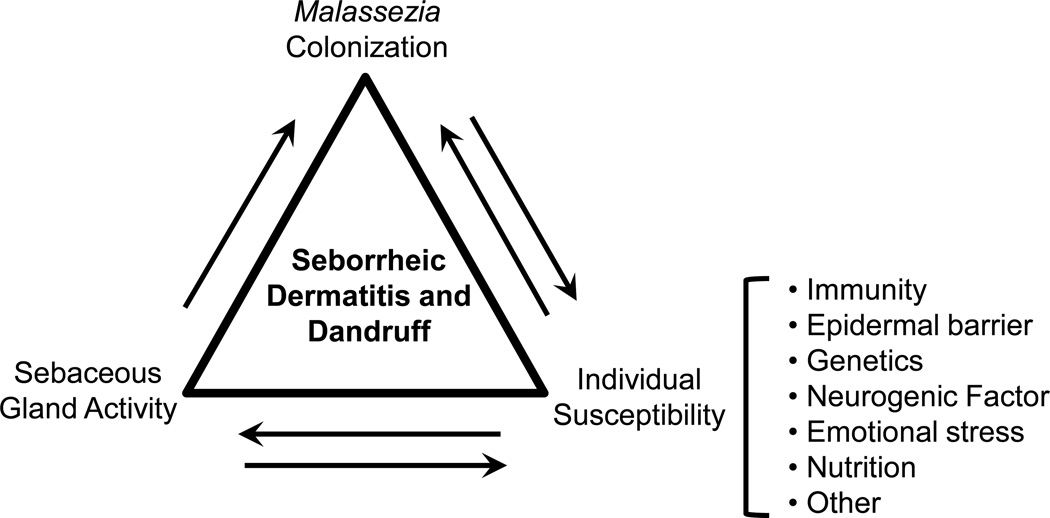
- Pathogenesis involves Malassezia (higher numbers of M. globosa and M. restricta correlate with SD appearance/severity), sebaceous gland activity, epidermal barrier disruption, immune response, genetic factors (e.g., MPZL3, ZNF750), and neurogenic/emotional stress; treatment mainly uses topical antifungal and anti-inflammatory agents.
Methods
- Narrative review of current knowledge on SD and dandruff; no primary data collection, sample, or systematic search/analysis is described.
- Covers epidemiology, burden of disease, clinical presentations and diagnosis, treatment, genetic studies in humans and animal models, and predisposing factors.
Limitations
- Stated: pathogenesis of SD and dandruff is not well understood; the specific role of lymphocyte activity remains controversial; efficacy of immune modulators such as topical calcineurin inhibitors and metronidazole remains controversial; the mutation underlying inherited seborrheic dermatitis (seb) mice remains unidentified.
- Evident: as a narrative review, it does not report a systematic search strategy, inclusion criteria, or quality appraisal.
- Evident: Tables 1–4 and Figure 1 are referenced for clinical presentations, differential diagnosis, treatment, and pathogenesis but are not included in the supplied text, so those details cannot be verified here.
Model-written summary. Check it against the paper before relying on it.
Integrity signals
Registry
Cites
Statistics
Figures
Verification
Claims the paper makes
30 Valid · 4 Not valid · 67 Not checked · 6 Own results and interpretations
At least one cited source doesn’t support this claim or points to a different paper, and none confirmed it — see the verdicts below.
In the paper
“Its incidence peaks during three age periods - in the first three months of life, during puberty, and in adulthood with an apex at 40 to 60 years of age [1–4].”
§ Seborrheic Dermatitis and Dandruff: A Comprehensive Review > Epidemiology
What the sources say
- Not checked — no full text of the sourcecites [1] Gupta AK Madzia SE Batra R Etiology and management of Seborrheic dermatitis Dermatology 2004 208 89 93 15056994 source
- Not checked — no full text of the sourcecites [2] Del Rosso JQ Adult seborrheic dermatitis: a status report on practical topical management J Clin Aesthet Dermatol 2011 4 32 38 21607192 PMC3100109
- Disputedcites [3] Sampaio AL Mameri AC Vargas TJ Ramos-e-Silva M Nunes AP Seborrheic dermatitis An Bras Dermatol 2011 86 1061 1071 22281892 sourceExperimental — accuracy not yet measured
The paper’s Abstract (page unavailable) states that seborrheic dermatitis has two incidence peaks, not three: one in the first three months of life and a second beginning at puberty that reaches its apex at ages 40–60. It does not describe puberty and adulthood as separate peaks. (LLM, conf=0.90)
Checked by a reasoning model — may be wrong.
- Not checked — no full text of the sourcecites [4] Schwartz RA Janusz CA Janniger CK Seborrheic dermatitis: an overview Am Fam Physician 2006 74 125 130 16848386
plainstates an association- Asserted: passes — The authors put it forward as true.
- Checkable: passes — It can be checked against evidence.
- Load-bearing: unclear — It is unclear whether the paper’s conclusions depend on it.
- Based: passes — The paper gives a reason why it holds.
The sources with a verdict support this claim; the rest weren’t checked yet, have no full text we could read, or their verdicts aren’t rated yet.
In the paper
“These observations suggest that immunological defects may play a role in SD.”
§ Seborrheic Dermatitis and Dandruff: A Comprehensive Review > Epidemiology
What the sources say
- Supportedcites [3] Sampaio AL Mameri AC Vargas TJ Ramos-e-Silva M Nunes AP Seborrheic dermatitis An Bras Dermatol 2011 86 1061 1071 22281892 source
The IMUNOGENÉTICA section (page not supplied) reports altered cellular immunity in people with seborrheic dermatitis. The paper also identifies an individual's immunological profile as a contributing factor, supporting the cautious claim that immunological defects may play a role. (LLM, conf=0.92)
- Not checked — no full text of the sourcecites [14] Nnoruka EN Chukwuka JC Anisuiba B Correlation of mucocutaneous manifestations of HIV/AIDS infection with CD4 counts and disease progression Int J Dermatol 2007 46 Suppl 2 14 18 17958624 source
- Not checked — no full text of the sourcecites [15] Ramos-E-Silva M Sampaio AL Carneiro S Red face revisited: Endogenous dermatitis in the form of atopic dermatitis and seborrheic dermatitis Clin Dermatol 2014 32 109 115 24314384 source
hedgedstates a possible cause- Asserted: passes — The authors put it forward as true.
- Checkable: passes — It can be checked against evidence.
- Load-bearing: unclear — It is unclear whether the paper’s conclusions depend on it.
- Based: passes — The paper gives a reason why it holds.
- Supported
The cited sources that could be checked couldn’t confirm or dispute this claim.
In the paper
“Men are affected more frequently than women (3.0% vs. 2.6%) in all age groups, suggesting that SD may be associated with sex hormones such as androgens [1,3,8].”
§ Seborrheic Dermatitis and Dandruff: A Comprehensive Review > Epidemiology
What the sources say
- Not checked — no full text of the sourcecites [1] Gupta AK Madzia SE Batra R Etiology and management of Seborrheic dermatitis Dermatology 2004 208 89 93 15056994 source
- Could not verifycites [3] Sampaio AL Mameri AC Vargas TJ Ramos-e-Silva M Nunes AP Seborrheic dermatitis An Bras Dermatol 2011 86 1061 1071 22281892 sourceExperimental — accuracy not yet measured
The Abstract (page unavailable) gives an overall prevalence of 1–3% and describes age-related incidence, but does not compare men with women. Searches of the indexed full text for sex-specific prevalence, 3.0%, and 2.6% did not locate the claimed comparison across all age groups. (LLM, conf=0.69)
- Not checked — no full text of the sourcecites [8] Naldi L Rebora A Clinical practice. Seborrheic dermatitis N Engl J Med 2009 360 387 396 19164189 source
plainstates an association- Asserted: passes — The authors put it forward as true.
- Checkable: passes — It can be checked against evidence.
- Load-bearing: unclear — It is unclear whether the paper’s conclusions depend on it.
- Based: passes — The paper gives a reason why it holds.
The cited sources support only part of this claim — read each source’s verdict below.
In the paper
“Men are affected more frequently than women (3.0% vs. 2.6%) in all age groups, suggesting that SD may be associated with sex hormones such as androgens [1,3,8].”
§ Seborrheic Dermatitis and Dandruff: A Comprehensive Review > Epidemiology
What the sources say
- Not checked — no full text of the sourcecites [1] Gupta AK Madzia SE Batra R Etiology and management of Seborrheic dermatitis Dermatology 2004 208 89 93 15056994 source
- Partly supportedcites [3] Sampaio AL Mameri AC Vargas TJ Ramos-e-Silva M Nunes AP Seborrheic dermatitis An Bras Dermatol 2011 86 1061 1071 22281892 sourceExperimental — accuracy not yet measured
In the paper’s continuing-education questions (section labeled “Medicações tópicas,” page unavailable), an item links seborrheic dermatitis with sex hormones, citing its occurrence in newborns and return in adolescence. The copy does not specifically identify androgens as the hormones involved; its treatment discussion mentions antiandrogenic effects of antifungals only as a debated possibility. (LLM, conf=0.82)
- Not checked — no full text of the sourcecites [8] Naldi L Rebora A Clinical practice. Seborrheic dermatitis N Engl J Med 2009 360 387 396 19164189 source
hedgedstates an association- Asserted: passes — The authors put it forward as true.
- Checkable: passes — It can be checked against evidence.
- Load-bearing: unclear — It is unclear whether the paper’s conclusions depend on it.
- Based: passes — The paper gives a reason why it holds.
The cited sources support only part of this claim — read each source’s verdict below.
In the paper
“SD is more prevalent in immune-compromised patients such as HIV/AIDS patients [7,10], organ transplant recipients [11,12], and patients with lymphoma [13].”
§ Seborrheic Dermatitis and Dandruff: A Comprehensive Review > Epidemiology
What the sources say
- Not checked — no full text of the sourcecites [7] Clark GW Pope SM Jaboori KA Diagnosis and treatment of seborrheic dermatitis Am Fam Physician 2015 91 185 190 25822272
- Supportedcites [10] Dunic I Vesic S Jevtovic DJ Oral candidiasis and seborrheic dermatitis in HIV-infected patients on highly active antiretroviral therapy HIV Med 2004 5 50 54 14731170 source
The Introduction describes seborrheic dermatitis as a common condition among HIV-infected people, with a reported prevalence of 7–50%, and links it to reduced immune function. The transplant and lymphoma portions of the citing sentence have separate citations and are not attributed to this source. (LLM, conf=0.88)
- Not checked — no full text of the sourcecites [11] Lally A Casabonne D Newton R Wojnarowska F Seborrheic dermatitis among Oxford renal transplant recipients J Eur Acad Dermatol Venereol 2010 24 561 564 19888944 source
- Not checked — no full text of the sourcecites [12] Ozcan D Seckin D Ada S Haberal M Mucocutaneous disorders in renal transplant recipients receiving sirolimus-based immunosuppressive therapy: a prospective, case-control study Clin Transplant 2013 27 742 748 23991694 source
- Partly supportedcites [13] Okada K Endo Y Fujisawa A Tanioka M Kabashima K Refractory seborrheic dermatitis of the head in a patient with malignant lymphoma Case Rep Dermatol 2014 6 279 282 25566053 PMC4280471 sourceExperimental — accuracy not yet measured
The Case Report describes an SD-like eruption in a patient diagnosed with lymphoma, and the Discussion notes a few published cases involving lymphoma. These passages support an association in individual cases, but do not establish that SD is more prevalent among patients with lymphoma. This citation is attached only to the lymphoma portion of the sentence, not the HIV/AIDS or transplant portions. (LLM, conf=0.87)
plainstates an association- Asserted: passes — The authors put it forward as true.
- Checkable: passes — It can be checked against evidence.
- Load-bearing: unclear — It is unclear whether the paper’s conclusions depend on it.
- Based: passes — The paper gives a reason why it holds.
48 more claims · 13 with their cited sources checked
Create a free account to see all 107 claims and to verify the 14 references still open.
- Probably not a substantial claim. 10
- It may state two separate claims as one. 45
Citations
Cites
Schweiger, D., Baufeld, C., Drescher, P., Oltrogge, B., Höpfner, S., Mess, A., Lüttke, J., Rippke, F., Filbry, A., & Max, H. (2013) · Skin Pharmacology and Physiology · doi:10.1159/000348473 · Cited by 1,346
Lisnevskaia, L., Murphy, G., & Isenberg, D. (2014) · The Lancet · doi:10.1016/s0140-6736(14)60128-8 · Cited by 752
Bickers (2006) · doi:10.1016/j.jaad.2006.05.048 · Cited by 741
The Malassezia Genus in Skin and Systemic Diseases
Gaitanis, G., Magiatis, P., Hantschke, M., Bassukas, I. D., & Velegraki, A. (2012) · Clinical Microbiology Reviews · doi:10.1128/cmr.00021-11 · Cited by 642 · cited 1×
“Several lines of evidence suggest a pathogenic role for yeasts of the genus Malassezia in SD and dandruff [42-46].”
The stratum corneum: structure and function in health and disease
Harding, C. R. (2004) · Dermatologic Therapy · doi:10.1111/j.1396-0296.2004.04s1001.x · Cited by 362
THE AETIOLOGY OF DANDRUFF AND THE MODE OF ACTION OF THERAPEUTIC AGENTS
SHUSTER, S. (1984) · British Journal of Dermatology · doi:10.1111/j.1365-2133.1984.tb04050.x · Cited by 308 · cited 1×
“Several lines of evidence suggest a pathogenic role for yeasts of the genus Malassezia in SD and dandruff [42-46].”
DeAngelis, Y. M., Gemmer, C. M., Kaczvinsky, J. R., Kenneally, D. C., Schwartz, J. R., & Dawson, T. L. (2005) · Journal of Investigative Dermatology Symposium Proceedings · doi:10.1111/j.1087-0024.2005.10119.x · Cited by 289 · cited 5×
“These observations are suggestive of intrinsic epidermal barrier defects in the pathogenesis of SD and dandruff [48].”
InfluentialRo, B. I., & Dawson, T. L. (2005) · Journal of Investigative Dermatology Symposium Proceedings · doi:10.1111/j.1087-0024.2005.10104.x · Cited by 286
Seborrheic dermatitis: Etiology, risk factors, and treatments:
Dessinioti, C., & Katsambas, A. (2013) · Clinics in Dermatology · doi:10.1016/j.clindermatol.2013.01.001 · Cited by 285 · cited 8×
“SD is also more commonly seen in depressive disorders and emotional stress [5,16].”
InfluentialA review of applications of tea tree oil in dermatology
Pazyar, N., Yaghoobi, R., Bagherani, N., & Kazerouni, A. (2013) · International Journal of Dermatology · doi:10.1111/j.1365-4632.2012.05654.x · Cited by 252 · cited 1×
“Alternative therapies have been reported as well, such as tea tree oil [40,41].”
Research works printed but not linked: 2
- [38]Reider N Fritsch PO Bolognia JL Jorizzo JL Schaffer JV Other eczematous eruptions Dermatology 2012 UK Elsevier Health Sciences 219 221
- [62]Strauss JS Downing DT Ebling FJ Goldsmith LA Sebaceous glands Biochemistry and physiology of skin 1983 New York Oxford University Press 569 595
Cited by
Items 301–397 of 397
Study on rice water composition and preparation of antidandruff shampoo against Malassezia species
Balakrishnaraja, R., Ranjith, G., Aniskumar, M., Vijayanand, P. S., & Vasan, P. T. (2023) · IOP Conference Series Earth and Environmental Science · doi:10.1088/1755-1315/1258/1/012008 · Cited by 1
Setiawan, M. A. D. (2024) · Jurnal Kesehatan Komunitas Indonesia · doi:10.58545/jkki.v4i2.354 · Cited by 2
Bagherni, N., Hasić-Mujanović, M., Smoller, B. R., Barron, C. R., Bergler-Czop, B. S., Miziołek, B., Kasumagić-Halilović, E., Sinclair, R. D., Poa, J. E., Ankad, B. S., et al. (2021) · Springer eBooks · doi:10.1007/978-3-319-45134-3_53-1
Yunita, A. D., Nurainiwati, S. A., & Putri, A. V. (2026) · KnE Medicine · doi:10.18502/kme.v4i1.20803
A case series of intertriginous rashes in cancer patients
Weygand, A., Patra, P., & Greene, J. N. (2024) · International Journal of Case Reports and Images · doi:10.5348/101472z01aw2024cs
Óleo essencial de Melaleuca alternifolia: uma proposta para tratamento de disfunções capilares
Carvalho, T. D. R., Queiroz, B. R., Costa, B. S., Rocha, C. C., Oliveira, D. C. L., dos Santos, L. V., Bastos, L. B., Ferreira, L. A. N. D. C., de Miranda, J. A., Filho, J. M. T. D. A., et al. (2022) · Seven Editora eBooks · doi:10.56238/sevcipcsv1-012
Cutaneous Pathology of the Head and Neck
Yap, T., Kern, J. S., Wood, B. A., & Scardamaglia, L. (2017) · Springer eBooks · doi:10.1007/978-3-319-28100-1_24-1
Seborrheic Dermatitis: From Adolescence to Adulthood
Hill, J., Brokamp, G., & Mosser‐Goldfarb, J. (2025) · Pediatric Annals · doi:10.3928/19382359-20250321-02 · Cited by 6
Padilla, R., & Catalina, D. (2018)
Damaharyuningtyas, M., Kintoko, K., & Darmawan, E. (2022) · Pharmaciana · doi:10.12928/pharmaciana.v12i3.21836
Wybrane zagadnienia z zakresu produkcji surowców, żywności i kosmetyków. T. 2
(2022) · Jagiellonian Digital Library (Jagiellonian University)
Tuor, M., Stappers, M. H. T., Ruchti, F., Desgardin, A., Sparber, F., Orr, S. J., Gow, N. A. R., & LeibundGut‐Landmann, S. (2024) · bioRxiv (Cold Spring Harbor Laboratory) · doi:10.1101/2024.07.12.603211
Elisia, E., & Pemayun, T. D. (2019) · Intisari Sains Medis · doi:10.15562/ism.v10i2.414 · Cited by 5
Sasane, M., Dargode, P., Barve, S., Malhotra, D., Mukherjee, R., Sawant, P. N., & Sangle, P. (2026) · International Journal of Research in Dermatology · doi:10.18203/issn.2455-4529.intjresdermatol20260370
(2023) · doi:10.2196/preprints.49965 · Cited by 7
Seborrheic dermatitis. Current issues of etiopathogenesis and current therapeutic options
Sanikidze, E. A., & Olkhovskaya, K. B. (2026) · Medical alphabet · doi:10.33667/2078-5631-2026-3-42-50
Dermatolojik Hastalıklara Algoritmik Yaklaşım ve Tanısal İpuçları
Yavuz, C., Durdu, M., Yorulmaz, A., Günaydın, S. D., Çınar, S. L., Kızıltaç, K., Kocatürk, E., Hacınecipoğlu, F., Gönül, M., Çakmak, S. K., et al. (2022) · Akademisyen Kitabevi eBooks · doi:10.37609/akya.1231
Microbially-competent skin organotypics reveal dysregulated AhR signalling in microbial dysbiosisPreprint
McPolin-Hall, E., Stephen, A. S., Pardieu, C., Georgeu, G., Allaker, R. P., Bhogal, R. K., Pople, J., Philpott, M. P., & Hannen, R. F. (2025) · bioRxiv (Cold Spring Harbor Laboratory) · doi:10.1101/2025.07.01.662505
Seborrheic dermatitis and pityriasis sicca: A review
Singh, R., Madke, B., & Bose, S. (2022) · Cosmoderma · doi:10.25259/csdm_38_2022 · Cited by 5
The Effect of Sambung Nyawa (Gynura procumbens) Leaves Extract to Reduction of Dandruff on The Scalp
Ambarwati, N. S. S., Susesty, R., & Sulastiowati, D. (2021) · JURNAL ILMU KEFARMASIAN INDONESIA · doi:10.35814/jifi.v19i1.942
The pathogenesis of seborrheic dermatitis: a modern outlook
Sergeeva, M., Sorokina, E., & Arzumanian, V. G. (2023) · Immunopathology Allergology Infectology · doi:10.14427/jipai.2023.3.25
Kılınç, F., Akbaş, A., DUMAN, Z. T. Ö., Güney, C. A., Hayran, Y., & Aktaş, A. (2023) · Turkiye Klinikleri Journal of Dermatology · doi:10.5336/dermato.2023-95656 · Cited by 1
Khalil, M. I., Rahman, M. L., Ibrahim, M., & Rashid, M. M. U. (2025) · International Journal of Research in Dermatology · doi:10.18203/issn.2455-4529.intjresdermatol20252070
SnapshotDx Quiz: December 2018
Galimberti, F., Kamath, P., & Miteva, M. I. (2018) · Journal of Investigative Dermatology · doi:10.1016/j.jid.2018.10.002
Zondi, S. M. (2017) · DUT Open Scholar (Durban University of Technology) · doi:10.51415/10321/2899 · Cited by 2
Reznichenko, N. Y., Reznichenko, Y. G., & Veretelnyk, O. V. (2021) · Ukrainian Journal of Dermatology Venerology Cosmetology · doi:10.30978/ujdvk2021-3-39 · Cited by 1
Infeksi Jamur Rekuren dan Bakteri Persisten pada Dermatitis Atopik Dewasa: Sebuah Laporan Kasus
Pawitri, A., & Novianto, E. (2022) · Jurnal Kedokteran Meditek · doi:10.36452/jkdoktmeditek.v28i3.2349 · Cited by 1
Most Common Patient Hair Questions and Answers
Burroway, B., Griggs, J. W., & Tosti, A. (2019) · Springer eBooks · doi:10.1007/978-3-030-21555-2_21
Jiang, W., Zhang, R., Wang, L., Xu, Y., & Tan, Y. (2026) · Frontiers in Medicine · doi:10.3389/fmed.2026.1866777
A 30-Year-Old Man with Recurrent Scaling and Itching of the Scalp
Kaczorowska, A., & Waśkiel‐Burnat, A. (2022) · Clinical Cases in Dermatology · doi:10.1007/978-3-030-93426-2_6
Holyoak, K. (2023) · Physician Assistant Clinics · doi:10.1016/j.cpha.2023.05.007
Combination of seborrheic dermatitis and HIV infection: a literature review with a clinical case
Khryanin, А. А., Надеев, А. П., Russkikh, M. V., & Bocharova, V. K. (2021) · Russian Journal of Clinical Dermatology and Venereology · doi:10.17116/klinderma202120032125
An Overview of Herbal Ingredients with Anti-dandruff Activity in Shampoo Formulations
Pagaran, A. M., Janelle Marie Erika, L., Dematingcal, Serafin, D. G. E., Torre, A. M. A. D., Timario, R. M. M., & Querequincia, J. M. B. (2023) · International Journal of Research Publication and Reviews · doi:10.55248/gengpi.2023.4125 · Cited by 4
Borda, L. J., & Wikramanayake, T. C. (2015)
Self-citationAslam, A., Rehman, K. S., Siddique, M. I., Ali, H. W., Alzahrani, S. A., Althobaiti, A. W., Rehman, Z. U., & Imran, M. (2025) · Journal of Pure and Applied Microbiology · doi:10.22207/jpam.19.2.36
Bhattacharya, S., Roth, T., Costa, S., Santoro, A., Mazza, W., Coyte, K. Z., Clavaud, C., Foster, K. R., & Kim, W. (2023) · bioRxiv (Cold Spring Harbor Laboratory) · doi:10.1101/2023.09.07.556667
Evaluation of an in-house pan-Malassezia quantitative PCR in human clinical samples
Euzen, V., Ghelfenstein-Ferreira, T., Benhadid-Brahmi, Y., Teboul, A., Dellière, S., Benderdouche, M., Charlier, V., Desnos‐Ollivier, M., Hamane, S., & Alanio, A. (2024) · Medical Mycology · doi:10.1093/mmy/myae095
Yellumahanthi, D. K. (2024) · Springer eBooks · doi:10.1007/978-3-031-68406-7_5
Agbai, O. N., & Raffi, J. (2021) · Updates in clinical dermatology · doi:10.1007/978-3-030-64830-5_11
Krishna, H., & Sesham, K. (2022) · Springer eBooks · doi:10.1007/978-3-319-55065-7_1284
Effect of Durvadi Taila in the Management of Darunaka: A Case Report
Patil, P., Bulla, P., & Avula, S. (2026) · Journal of Ayurveda and Integrated Medical Sciences · doi:10.21760/jaims.11.5.74
Charoenchaipiyakul, K., Rujirawan, P., Noppakun, N., Chongpison, Y., & Kumtornrut, C. (2025) · Dermatologic Therapy · doi:10.1155/dth/8887280 · Cited by 1
Perkembangan Pengobatan Topikal Untuk Dermatitis Seboroik Wajah
Zulkifli, A., Gustia, R., & Ashal, T. (2021) · Jurnal Ilmu Kesehatan Indonesia · doi:10.25077/jikesi.v2i1.505 · Cited by 1
Comercialización de aceite y nuevas estrategias cooperativistas
Navarro, A. L. (1999) · Vida rural
Юрьевич, Д. И., Olisova, O. Y., & Koriakin, D. A. (2026) · Russian Journal of Skin and Venereal Diseases · doi:10.17816/dv699955
Kandhari, S., Hawelia, D., Sen, M., & Banodkar, P. (2025) · International Journal of Research in Dermatology · doi:10.18203/issn.2455-4529.intjresdermatol20252078
Seborrheic Dermatitis, Scalp Psoriasis, and Allergic Contact Dermatitis
Walker, C. J., Flanagan, K. E., Pathoulas, J. T., Wiss, I. P., & Senna, M. M. (2026) · Updates in clinical dermatology · doi:10.1007/978-3-032-24862-6_4
Seborrheic dermatitis: comparative effectiveness of standard and intermittent external therapy
Vasiliev-Stupalsky, E. A. (2020) · Vestnik dermatologii i venerologii · doi:10.25208/vdv1194
Blume‐Peytavi, U., Albrecht-Nebe, H., Hillmann, K., & Sterry, W. (2018) · Wiley eBooks · doi:10.1002/9783527689668.biblio
Diseases Deriving from Alterations of the Ecological Niche—Part II: Regarding the Holobiont
Libertini, G., Corbi, G., Shubernetskaya, O. S., Komici, K., & Ferrara, N. (2024) · Advances in studies of aging and health · doi:10.1007/978-3-031-84877-3_4
Lausarina, R., Yenny, S. W., & Asri, E. (2019) · Jurnal Kesehatan Andalas · doi:10.25077/jka.v8i1.970 · Cited by 10
Filatov, V., Sekerina, V., & Каленикова, Е. И. (2026) · Frontiers in Cellular and Infection Microbiology · doi:10.3389/fcimb.2026.1813026
Kim, M., Kim, B. R., Park, J. Y., Shin, J. M., Shin, J. W., Na, J., & Huh, C. (2026) · Dermatologic Therapy · doi:10.1155/dth/4887762
Dharmarajan, T. S., & Vyas, D. (2026) · Springer eBooks · doi:10.1007/978-3-031-53888-9_19-2
dược, P. Y. (2022) · Pham Ngoc Thach Journal of Medicine and Pharmacy · doi:10.59715/pntjmp.1.2.0
Tinea Versicolor and Tinea Capitis
Patterson, S., & Akintilo, L. O. (2017) · Springer eBooks · doi:10.1007/978-3-319-53961-4_11
Prevalence, risk factors and management approaches for seborrheic dermatitis
Islam, M. S., Islam, N., Khan, M., Hasan, A., Saha, K. R., Moon, R. H., Begum, M., & Rubana, S. (2024) · International Journal of Research in Medical Sciences · doi:10.18203/2320-6012.ijrms20244100 · Cited by 3
Bagherani, N., Hasić-Mujanović, M., Smoller, B. R., Barron, C. R., Bergler-Czop, B. S., Miziołek, B., Kasumagić-Halilović, E., Sinclair, R. D., Poa, J. E., Ankad, B. S., et al. (2021) · Springer eBooks · doi:10.1007/978-3-319-53808-2_53 · Cited by 3
Dermatoloji ve Kozmetolojide D Vitamini
Cenk, H., Rüstemoğlu, A., Akbulut, S., Uzdoğan, A., Yücel, Ç., Çifci, A., Yakut, H. İ., Oğuz, I. D., Türkmen, D., Demirbaş, A., et al. (2022) · Akademisyen Kitabevi eBooks · doi:10.37609/akya.1313 · Cited by 1
Alshammari, S. M., Alsaif, B. E., & Hamid, A. A. (2024) · International Conference on Developments in eSystems Engineering (DeSE) · doi:10.1109/dese63988.2024.10911891
Clinical efficacy of a gentle anti-dandruff regimen
Madhavi, M. S. L., Kulkarni, S., Shete, P., Mathur, S., & Punyani, S. (2026) · International Journal of Research in Dermatology · doi:10.18203/issn.2455-4529.intjresdermatol20261098
Khasawneh, A. R. (2019) · Reports of Vinnytsia National Medical University · doi:10.31393/reports-vnmedical-2019-23(4)-31 · Cited by 1
Haircare Practice and Dandruff Problems Among Indonesian Medical Students
Wikanto, J., Wijaya, L., Astiarani, Y., & Regina, R. (2022) · Journal of General-Procedural Dermatology & Venereology Indonesia · doi:10.7454/jdvi.v6i2.1000 · Cited by 7
Dharmarajan, T. S., & Vyas, D. (2025) · Springer eBooks · doi:10.1007/978-3-031-53888-9_19-1
A 14-Year-Old Boy with Hair Loss and Scaling on the Scalp
Enechukwu, N. A., Umeadi, E. N., Ezejiofor, O. I., & Ogunbiyi, A. O. (2022) · Clinical Cases in Dermatology · doi:10.1007/978-3-030-93423-1_2
Sonawane, S. K., Sharma, Y. P., Sonawane, G., Mahajan, S., & Sonawane, D. (2026) · Prospects in Pharmaceutical Sciences · doi:10.56782/pps.902
Bioactive materials for dandruff control: Insights and challenges
Sen, A., & Qanungo, K. (2025) · AIP conference proceedings · doi:10.1063/5.0247474 · Cited by 1
Deng, L., Ling, X., Li, L., He, Y., & Guo, M. (2026) · Molecules · doi:10.3390/molecules31122093 · Cited by 1
The role of the malassezia yeasts in the etiology of seborrheic dermatitis of the capillitium
Bakardzhiev, I., Argirov, A., & Pehlivanov, G. (2016) · Varna Medical Forum · doi:10.14748/vmf.v5i0.2877
Systemic isotretinoin in treatment of severe seborrheic dermatitis
Markelova, E. M. M. (2022) · Medical alphabet · doi:10.33667/2078-5631-2022-8-68-70
Elsawah, M. M. M. A., AlSabbagh, F., Bukhari, A. E., Juma, H. A. A. M. H., Almudimeegh, A. M., Alshehhi, B. A. R. B., Sinno, N., Mohamed, H. A., Almukhadeb, E. A., Hantirah, S. A. T., et al. (2026) · Dermatologic Therapy · doi:10.1155/dth/4755440
Hladyshev, V. V., Романина, Д. М., Kharaponova, O. B., Kolycheva, N. L., Hnitko, I. V., Пухальська, І. О., & Лисянська, Г. П. (2022) · Current issues in pharmacy and medicine science and practice · doi:10.14739/2409-2932.2022.2.258934
Osman, W. A. A., Altaiyb, H. A., Mahjaf, G. M., Abubaker, L. J., Altaher, T. A. A., & Hamad, M. N. M. (2023) · Middle East Research Journal Microbiology and Biotechnology · doi:10.36348/merjmb.2023.v03i02.003
Metadata
- Authors
- Borda, L. J., & Wikramanayake, T. C.
- Affiliations
- University of Miami (US)
- Venue
- Journal of Clinical and Investigative Dermatology
- Publisher
- Avens Publishing Group
- Published
- 2015
- Volume
- 3
- Issue
- 2
- ISSN
- 2373-1044 (ISSN-L)
- PMC
- PMC4852869
- OpenAlex
- W2345819870
- Cited by
- 398
- References
- 138
- Citations by year
- 2026: 21 · 2025: 52 · 2024: 55 · 2023: 44 · 2022: 51 · 2021: 55 · 2020: 42 · 2019: 41 · 2018: 13 · 2017: 17 · 2016: 3 · 2015: 1
- FWCI
- 8.89
- Type
- journal article
- Language
- en
- Open access
- diamond
- doi.org
- Licence
- cc-by
- Locations
- Journal of Clinical and Investigative Dermatology (publishedVersion, cc-by)
- PubMed (publishedVersion)
- PubMed Central (acceptedVersion, cc-by)
- Funders
- National Institutes of Health
- National Institute of Arthritis and Musculoskeletal and Skin Diseases (R03AR059907)
- Topics
- Health Sciences › Medicine › Dermatology › Nail Diseases and Treatments
- Health Sciences › Medicine › Dermatology › Dermatology and Skin Diseases
- Health Sciences › Medicine › Dermatology › Hair Growth and Disorders
- Keywords
- seborrheic dermatitis, dandruff, sebaceous secretion, Malassezia, fungal colonization, pruritus, pathogenesis, genetic susceptibility, animal models, disease burden, diagnosis, treatment
About these checks
Registry, retraction, Cites and statistics results are computed, not judged, with one exception: a printed reference that no index lists is read once by a model before it counts as a citation error. Claims are extracted by a model and kept only when their quote appears verbatim in the text; each cited source is then checked, with a model’s help, for whether it says what the claim relies on. Those verdicts can be wrong — read the claim’s quote and the cited source before relying on one.
The claim verdicts this report counts are experimental: their accuracy is not yet measured.
A language model drew the claims from the paper on 2026-10-10, under version 3 of the claim definition (model deepseek-v4.1-flash, prompt extract-v3).
A second model labelled each claim on 2026-10-10 (model jev-1.13-20260917, definition revision gold-guideline-v0.2).
Cited sources are checked with a language model’s help (gpt-6-sol).
Statistics and arithmetic are recomputed, not judged.
Confidence bands are shown only for fields calibrated on our annotated test set. None is calibrated yet, so no band is shown.
What counts as a claim ›How we measure confidence ›How we check this ›
Are you an author, or do you see a problem with this page? Request a review
Data sources
Bibliographic data: Semantic Scholar, OpenAlex, Crossref.
Contains information from the Semantic Scholar Academic Graph Datasets, made available under the ODC Attribution License (ODC-BY 1.0).
Semantic Scholar’s data is described in: Kinney, R., et al. (2023). The Semantic Scholar Open Data Platform. arXiv:2301.10140.
