

Reasoning, Learning, and Creativity: Frontal Lobe Function and Human Decision-Making
Open accessThe DOI matches its Crossref record; 71 of the 71 references it cites were found in a registry or an index.
Abstract
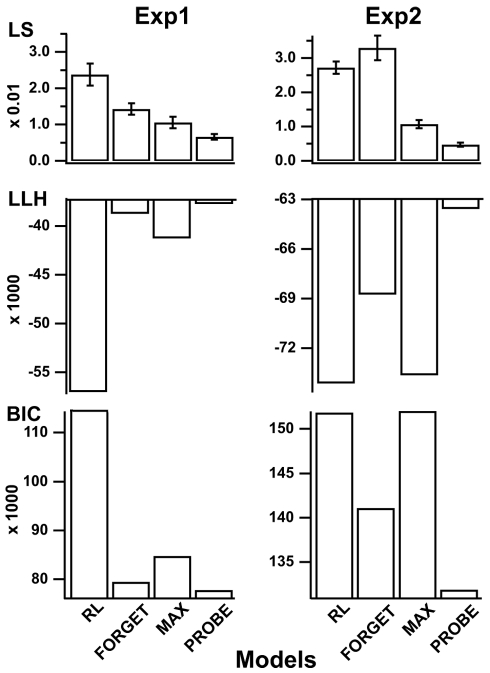
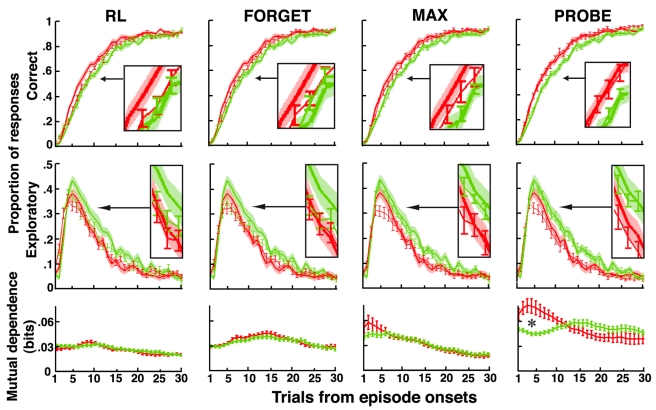
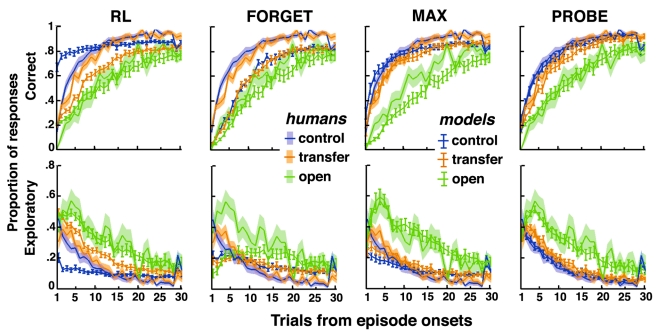
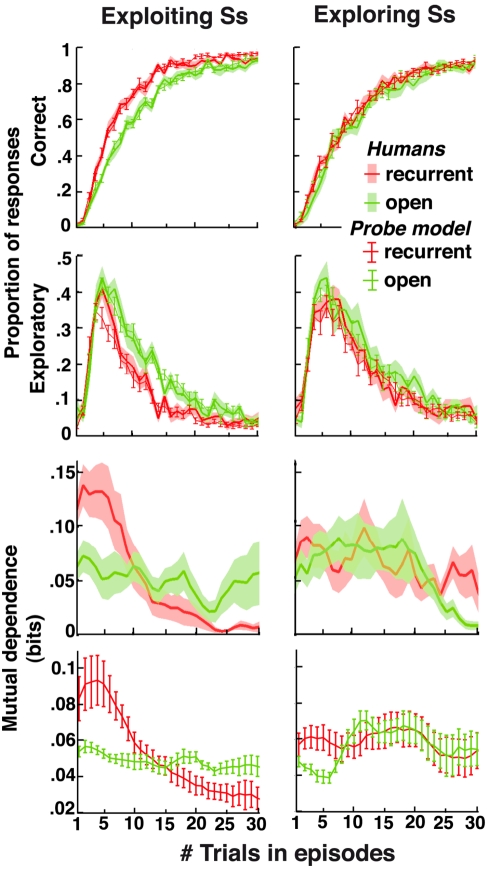
The frontal lobes subserve decision-making and executive control--that is, the selection and coordination of goal-directed behaviors. Current models of frontal executive function, however, do not explain human decision-making in everyday environments featuring uncertain, changing, and especially open-ended situations. Here, we propose a computational model of human executive function that clarifies this issue. Using behavioral experiments, we show that unlike others, the proposed model predicts human decisions and their variations across individuals in naturalistic situations. The model reveals that for driving action, the human frontal function monitors up to three/four concurrent behavioral strategies and infers online their ability to predict action outcomes: whenever one appears more reliable than unreliable, this strategy is chosen to guide the selection and learning of actions that maximize rewards. Otherwise, a new behavioral strategy is tentatively formed, partly from those stored in long-term memory, then probed, and if competitive confirmed to subsequently drive action. Thus, the human executive function has a monitoring capacity limited to three or four behavioral strategies. This limitation is compensated by the binary structure of executive control that in ambiguous and unknown situations promotes the exploration and creation of new behavioral strategies. The results support a model of human frontal function that integrates reasoning, learning, and creative abilities in the service of decision-making and adaptive behavior.
Overview
The claims and statistics of this paper haven’t been checked yet.
Free: it reads the open-access text and checks the first 5 claims that cite a source we can check. Create a free account to check every claim.
Integrity signals
Registry
Cites
Statistics
Figures



Verification
Claims the paper makes
The claims and statistics of this paper haven’t been checked yet.
Free: it reads the open-access text and checks the first 5 claims that cite a source we can check. Create a free account to check every claim.
Claims other papers make about this one
Each is checked against this paper’s own text: does it say what the citing paper says it does?
The source backs part of the claim, not all of it — or backs it for a different population, condition or comparison.
In the citing paper
“Other functions, higher-order EF, such as planning, reasoning, and problem solving, develop from these core processes [16].”
From Comparing Executive Functions in Children and Adolescents with Autism and ADHD—A Systematic Review and Meta-Analysis (2024) · cites this paper as [16]
Experimental — accuracy not yet measuredIn the citing paper
“The frontal lobe performs executive functions, such as planning and organizing, and undergoes massive changes from puberty until mid-twenties [74].”
In the citing paper
“accurately inferring one’s confidence in a task is an important indicator of whether a previous decision should be revised 17, 57, whether a subsequent step in a chain of decisions should be initiated (58), or more generally when it is advantageous to deliberate (59) or engage cognitive control (18).”
From Psychiatric Symptom Dimensions Are Associated With Dissociable Shifts in Metacognition but Not Task Performance (2018) · cites this paper as [17]
Self-check
Percentages, sums and reported differences re-computed from the paper’s own numbers.
The self-check needs the paper’s full text.
Citations
Cites
Hitch, G. (1984) · Science · doi:10.1017/s0033291700003548 · Cited by 16,233
Information theory and statistical mechanics
Jaynes, E. T. (1957) · Physical Review · doi:10.1103/physrev.106.620 · Cited by 12,931 · cited 2×
“Prior reliability lprior of the probe actor is chosen as minimizing prior information over task set reliability because no information is available to estimate it [32].”
BackgroundAn Integrative Theory of Prefrontal Cortex Function
Miller, E. K., & Cohen, J. D. (2001) · Annual Review of Neuroscience · doi:10.1146/annurev.neuro.24.1.167 · Cited by 12,803 · cited 1×
“Neuroimaging studies suggest that these internal mappings are implemented in distinct frontal regions: (1) selective mappings in lateral premotor regions, because these regions are involved in learning and processing stimulus-response associations [10,46]; (2) predictive mappings in ventromedial prefrontal regions, be…”
BackgroundRescorla, R. A. (1972) · Medical Entomology and Zoology · Cited by 9,462
Kahneman, D., & Tversky, A. (1984) · American Psychologist · doi:10.1037/0003-066x.39.4.341 · Cited by 6,544 · cited 1×
“associating stimuli, actions, and expected outcomes [1–4]).”
Models of Bounded Rationality: Empirically Grounded Economic Reason
Simon, H. A. (1997) · The MIT Press eBooks · doi:10.7551/mitpress/4711.001.0001 · Cited by 4,205 · cited 1×
“Indeed, actor selection is based on a ‘‘satisficing’’ criterion based on task set reliability [1]: either a task set appears to be reliable, in which case it becomes the actor, because no other task sets meet this criterion, or no task set appears reliable, in which case a new task set is created and serves as an acto…”
BackgroundCosts of a predictible switch between simple cognitive tasks.
Rogers, R. D., & Monsell, S. (1995) · Journal of Experimental Psychology: General · doi:10.1037/0096-3445.124.2.207 · Cited by 3,170 · cited 1×
“. Thus, we assumed that in agreement with previous studies (e.g.,”
Result(2000) · doi:10.1017/cbo9780511803475 · Cited by 2,987
Barto, A. G. (1998) · IFAC Proceedings Volumes · doi:10.1016/s1474-6670(17)38315-5 · Cited by 2,976 · cited 6×
“After observing action outcome ot, the actor selective mapping is updated based on outcome values r[o] according to standard reinforcement learning mechanisms [11] (e.”
BackgroundMethodInfluentialBoden, M. A. (2004) · doi:10.4324/9780203508527 · Cited by 2,775
Daw, N. D., Niv, Y., & Dayan, P. (2005) · Nature Neuroscience · doi:10.1038/nn1560 · Cited by 2,533 · cited 2×
“As previously proposed [42,43], this internal recalibration is achieved through model-based reinforcement learning before experiencing actual action outcomes; using predictive mappings embedded in behavioral strategies for anticipating action outcomes, associated selective mappings are altered according to current out…”
BackgroundCortical substrates for exploratory decisions in humans
Daw, N. D., O'Doherty, J. P., Dayan, P., Seymour, B., & Dolan, R. J. (2006) · Nature · doi:10.1038/nature04766 · Cited by 2,224 · cited 4×
“The results therefore reveal two fundamentally distinct human exploration processes: first, uncontrolled exploration stochastically selecting actions within actor task sets according to a softmax policy for learning behavioral strategies that maximize action utility [3,28,41], and second, controlled exploration occurr…”
BackgroundMethodResultInfluentialEffects of Different Brain Lesions on Card Sorting: The Role of the Frontal Lobes
MILNER, B. (1963) · Archives of Neurology · doi:10.1001/archneur.1963.00460070100010 · Cited by 2,217
Hierarchical Dirichlet Processes
Teh, Y. W., Jordan, M. I., Beal, M. J., & Blei, D. M. (2006) · Journal of the American Statistical Association · doi:10.1198/016214506000000302 · Cited by 2,120 · cited 1×
“computational problem that statistical learning models based on Dirichlet process mixtures address [18–20].”
BackgroundDissociable Roles of Ventral and Dorsal Striatum in Instrumental Conditioning
O'Doherty, J., Dayan, P., Schultz, J., Deichmann, R., Friston, K., & Dolan, R. J. (2004) · Science · doi:10.1126/science.1094285 · Cited by 2,088
Learning the value of information in an uncertain world
Behrens, T. E. J., Woolrich, M. W., Walton, M. E., & Rushworth, M. F. S. (2007) · Nature Neuroscience · doi:10.1038/nn1954 · Cited by 2,053 · cited 6×
“Neuroimaging studies further show that dorsomedial prefrontal regions evaluate the discrepancies between actual and predicted action outcomes [17,52] and estimate the volatility of external contingencies [14].”
BackgroundMethodResultInfluentialThe formation of learning sets.
Harlow, H. F. (1949) · Psychological Review · doi:10.1037/h0062474 · Cited by 1,959 · cited 1×
“—that is, active representations of behavioral strategies stored in long-term memory—for driving action”
Background(2020) · Machine Learning and Visual Perception · doi:10.1515/9783110595567-011 · Cited by 1,930
The Architecture of Cognitive Control in the Human Prefrontal Cortex
Koechlin, E., Ody, C., & Kouneiher, F. (2003) · Science · doi:10.1126/science.1088545 · Cited by 1,838 · cited 2×
“Neuroimaging studies suggest that these internal mappings are implemented in distinct frontal regions: (1) selective mappings in lateral premotor regions, because these regions are involved in learning and processing stimulus-response associations [10,46]; (2) predictive mappings in ventromedial prefrontal regions, be…”
BackgroundSelf-citationUncertainty, Neuromodulation, and Attention
Yu, A. J., & Dayan, P. (2005) · Neuron · doi:10.1016/j.neuron.2005.04.026 · Cited by 1,774 · cited 5×
“The actor predictive mapping simply regularizes action outcome likelihood given stimulus [13].”
BackgroundMethodInfluentialThe Creative Mind: Myths and Mechanisms.
Gullickson, T. (1995) · doi:10.1037/004007 · Cited by 1,593
Goal-directed instrumental action: contingency and incentive learning and their cortical substrates
Balleine, B. W., & Dickinson, A. (1998) · Neuropharmacology · doi:10.1016/s0028-3908(98)00033-1 · Cited by 1,541 · cited 1×
“As previously proposed [42,43], this internal recalibration is achieved through model-based reinforcement learning before experiencing actual action outcomes; using predictive mappings embedded in behavioral strategies for anticipating action outcomes, associated selective mappings are altered according to current out…”
BackgroundChapter 20 What are the differences between long-term, short-term, and working memory?
Cowan, N. (2008) · Progress in Brain Research · doi:10.1016/s0079-6123(07)00020-9 · Cited by 1,394 · cited 1×
“Concomitantly, the strategies associated with unused task sets decay into the random strategy (decay rate Q, 0,Q,1) [33,34], so that unused task sets may be recycled as ‘‘new’’ task sets.”
BackgroundFrontal lobes and human memory: Insights from functional neuroimaging
Fletcher, P. C. (2001) · Brain · doi:10.1093/brain/124.5.849 · Cited by 1,349 · cited 1×
“Furthermore, consistent with the notion of controlled exploration, frontopolar regions are engaged in exploratory behavior [28], long-term memory cued retrieval [55], and in the early phase of learning new behaviors [50,56].”
BackgroundAn information theoretical approach to prefrontal executive function
Koechlin, E., & Summerfield, C. (2007) · Trends in Cognitive Sciences · doi:10.1016/j.tics.2007.04.005 · Cited by 1,183 · cited 1×
“long-term memory—for driving action [5–10].”
Cohen, J. D., McClure, S. M., & Yu, A. J. (2007) · Philosophical Transactions of the Royal Society B Biological Sciences · doi:10.1098/rstb.2007.2098 · Cited by 1,121 · cited 1×
“The results therefore reveal two fundamentally distinct human exploration processes: first, uncontrolled exploration stochastically selecting actions within actor task sets according to a softmax policy for learning behavioral strategies that maximize action utility [3,28,41], and second, controlled exploration occurr…”
BackgroundThe role of the anterior prefrontal cortex in human cognition
Koechlin, E., Basso, G., Pietrini, P., Panzer, S., & Grafman, J. (1999) · Nature · doi:10.1038/20178 · Cited by 1,054
Self-citationNeuroeconomics: decision making and the brain
(2014) · Choice Reviews Online · doi:10.5860/choice.51-5702 · Cited by 1,009
Glimcher, P. (2008) · Scholarpedia · doi:10.4249/scholarpedia.1759 · Cited by 877 · cited 1×
“associating stimuli, actions, and expected outcomes [1–4]).”
Choice, uncertainty and value in prefrontal and cingulate cortex
Rushworth, M. F. S., & Behrens, T. E. J. (2008) · Nature Neuroscience · doi:10.1038/nn2066 · Cited by 866
The cognitive neuroscience of creativity
Dietrich, A. (2004) · Psychonomic Bulletin & Review · doi:10.3758/bf03196731 · Cited by 844 · cited 1×
“The ability to break conventional or obvious patterns of thinking, adopt new and/or higher order rules and think conceptually and abstractly is at the heart of any theory of creativity’’ ([59]; see also [60]).”
BackgroundModels of Bounded Rationality: Empirically Grounded Economic Reason
Simon, H. A. (1997) · Cited by 827
The creative mind: Myths and mechanisms
Lustig, R. (1995) · Artificial Intelligence · doi:10.1016/0004-3702(95)90025-x · Cited by 823
Anterior Prefrontal Function and the Limits of Human Decision-Making
Koechlin, E., & Hyafil, A. (2007) · Science · doi:10.1126/science.1142995 · Cited by 747 · cited 1×
“This putative system matches the function attributed to frontopolar regions, usually referred to as cognitive branching [53,54]: enabling the unexpected execution of a task, while holding on and monitoring an alternative task for possible future execution.”
BackgroundSelf-citationMetalearning and neuromodulation
Doya, K. (2002) · Neural Networks · doi:10.1016/s0893-6080(02)00044-8 · Cited by 704 · cited 1×
“The actor selective mapping then determines the response to stimulus using a softmax policy (inverse temperature b and noise e) [11,15,28].”
MethodBoorman, E. D., Behrens, T. E. J., Woolrich, M. W., & Rushworth, M. F. S. (2009) · Neuron · doi:10.1016/j.neuron.2009.05.014 · Cited by 665 · cited 1×
“The PROBE model thus predicts that frontopolar regions monitor at least the reliability of the best alternative to the actor, a prediction supported by recent neuroimaging evidence [47,57].”
Neuroeconomics: Decision Making and the Brain
Rushworth, M. F. S., & Walton, M. E. (2009) · Neuron · doi:10.1016/j.neuron.2009.07.005 · Cited by 658
A Bayesian foundation for individual learning under uncertainty
Mathys, C. (2011) · Frontiers in Human Neuroscience · doi:10.3389/fnhum.2011.00039 · Cited by 655
The learning curve: Implications of a quantitative analysis
Gallistel, C. R., Fairhurst, S., & Balsam, P. (2004) · Proceedings of the National Academy of Sciences · doi:10.1073/pnas.0404965101 · Cited by 613 · cited 1×
“Knowing that adaptive behaviors are highly variable and may even qualitatively differ across individuals [37–39], we examined inter-individual variability by analyzing separately three groups of participants identified from post-tests.”
BackgroundNassar, M. R., Wilson, R. C., Heasly, B., & Gold, J. I. (2010) · The Journal of Neuroscience · doi:10.1523/jneurosci.0822-10.2010 · Cited by 560 · cited 1×
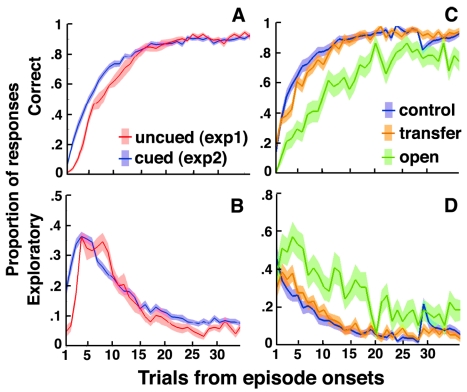
“Indeed, learning rates are presumed to increase with uncertainty [35,36] and should instead be faster in open episodes that feature increased uncertainty.”
Hierarchical models of behavior and prefrontal function
Botvinick, M. M. (2008) · Trends in Cognitive Sciences · doi:10.1016/j.tics.2008.02.009 · Cited by 532 · cited 1×
“long-term memory—for driving action [5–10].”
Multiple model-based reinforcement learning
Doya, K., Samejima, K., Katagiri, K.-I., & Kawato, M. (2002) · Neural Computation · doi:10.1162/089976602753712972 · Cited by 476 · cited 4×
“adjusting and choosing the most reliable actor [15–17].”
BackgroundMethodInfluentialFrank, M. J., Doll, B. B., Oas-Terpstra, J., & Moreno, F. (2009) · Nature Neuroscience · doi:10.1038/nn.2342 · Cited by 471 · cited 1×
“The results therefore reveal two fundamentally distinct human exploration processes: first, uncontrolled exploration stochastically selecting actions within actor task sets according to a softmax policy for learning behavioral strategies that maximize action utility [3,28,41], and second, controlled exploration occurr…”
BackgroundTransition of Brain Activation from Frontal to Parietal Areas in Visuomotor Sequence Learning
Sakai, K., Hikosaka, O., Miyauchi, S., Takino, R., Sasaki, Y., & Pütz, B. (1998) · The Journal of Neuroscience · doi:10.1523/jneurosci.18-05-01827.1998 · Cited by 468 · cited 1×
“Furthermore, consistent with the notion of controlled exploration, frontopolar regions are engaged in exploratory behavior [28], long-term memory cued retrieval [55], and in the early phase of learning new behaviors [50,56].”
BackgroundThe role of prelimbic cortex in instrumental conditioning
Corbit, L. H., & Balleine, B. W. (2003) · Behavioural Brain Research · doi:10.1016/j.bbr.2003.09.023 · Cited by 423 · cited 1×
“, [42,44]).”
Transient activation of inferior prefrontal cortex during cognitive set shifting
Konishi, S., Nakajima, K., Uchida, I., Kameyama, M., Nakahara, K., Sekihara, K., & Miyashita, Y. (1998) · Nature Neuroscience · doi:10.1038/283 · Cited by 401 · cited 2×
“We tested the model predictions in behavioral experiments inspired from the standard neuropsychological test of frontal executive function, namely the Wisconsin Card Sorting Test [26,27].”
MethodRelations between Pavlovian-instrumental transfer and reinforcer devaluation
Holland, P. C. (2004) · Journal of Experimental Psychology: Animal Behavior Processes · doi:10.1037/0097-7403.30.2.104 · Cited by 388 · cited 1×
“Moreover, as adjustments to external contingencies may be faster for predictive than selective mappings (Bayesian updating versus reinforcement learning, respectively), this hypothesis may also account for contrasted devaluation effects occurring after moderate versus extensive training [45].”
BackgroundTask Set and Prefrontal Cortex
Sakai, K. (2008) · Annual Review of Neuroscience · doi:10.1146/annurev.neuro.31.060407.125642 · Cited by 387 · cited 1×
“long-term memory—for driving action [5–10].”
Context, learning, and extinction
Gershman, S. J., Blei, D. M., & Niv, Y. (2010) · Psychological Review · doi:10.1037/a0017808 · Cited by 386 · cited 1×
“new task sets for driving action. This issue raises a computational problem that statistical learning models based on Dirichlet process mixtures address”
BackgroundFrontal Cortex and the Discovery of Abstract Action Rules
Badre, D., Kayser, A. S., & D'Esposito, M. (2010) · Neuron · doi:10.1016/j.neuron.2010.03.025 · Cited by 329
Creativity as flexible cognitive control
Zabelina, D. L., & Robinson, M. D. (2010) · Psychology of Aesthetics, Creativity, and the Arts · doi:10.1037/a0017379 · Cited by 294 · cited 1×
“The ability to break conventional or obvious patterns of thinking, adopt new and/or higher order rules and think conceptually and abstractly is at the heart of any theory of creativity’’ ([59]; see also [60]).”
BackgroundA preliminary framework for description, analysis and comparison of creative systems
Wiggins, G. A. (2006) · Knowledge-Based Systems · doi:10.1016/j.knosys.2006.04.009 · Cited by 291
Distributed neural system for general intelligence revealed by lesion mapping
Gläscher, J., Rudrauf, D., Colom, R., Paul, L. K., Tranel, D., Damasio, H., & Adolphs, R. (2010) · Proceedings of the National Academy of Sciences · doi:10.1073/pnas.0910397107 · Cited by 269 · cited 1×
“Consistently, the frontopolar function has been associated with individual variations in fluid intelligence [58], suggesting that fluid intelligence is associated with the ability to probe new strategies.”
BackgroundCounterfactual Choice and Learning in a Neural Network Centered on Human Lateral Frontopolar Cortex
Boorman, E. D., Behrens, T. E., & Rushworth, M. F. (2011) · PLoS Biology · doi:10.1371/journal.pbio.1001093 · Cited by 218
O'DOHERTY, J. P. (2007) · Annals of the New York Academy of Sciences · doi:10.1196/annals.1401.036 · Cited by 201
Computational Models of Performance Monitoring and Cognitive Control
Alexander, W. H., & Brown, J. W. (2010) · Topics in Cognitive Science · doi:10.1111/j.1756-8765.2010.01085.x · Cited by 193
Fractionating the neural substrate of cognitive control processes
Dreher, J.-C., & Berman, K. F. (2002) · Proceedings of the National Academy of Sciences · doi:10.1073/pnas.222193299 · Cited by 179 · cited 1×
“, [6,29,30]), selection happens at the level of task sets first, then at the level of actions within task sets.”
BackgroundTwo Mechanisms for Task Switching in the Prefrontal Cortex
Hyafil, A., Summerfield, C., & Koechlin, E. (2009) · The Journal of Neuroscience · doi:10.1523/jneurosci.2828-08.2009 · Cited by 172
Self-citationDivided Representation of Concurrent Goals in the Human Frontal Lobes
Charron, S., & Koechlin, E. (2010) · Science · doi:10.1126/science.1183614 · Cited by 170 · cited 1×
“This prediction is consistent with previous studies showing that humans are impaired in switching back and forth across three compared to two task sets, irrespective of working memory load [40].”
ResultSelf-citationComputational models of working memory: putting long-term memory into context
Burgess, N., & Hitch, G. (2005) · Trends in Cognitive Sciences · doi:10.1016/j.tics.2005.09.011 · Cited by 159 · cited 3×
“Consistent with the capacity limit of human working memory [22–24], the model assumes that the frontal executive function forms and monitors in parallel only a limited number of concurrent task sets: the executive function monitors only a small part of behavioral strategies stored in longterm memory [22,23,25].”
BackgroundNeural and cognitive plasticity: From maps to minds.
Mercado, E. (2008) · Psychological Bulletin · doi:10.1037/0033-2909.134.1.109 · Cited by 141 · cited 1×
“Knowing that adaptive behaviors are highly variable and may even qualitatively differ across individuals [37–39], we examined inter-individual variability by analyzing separately three groups of participants identified from post-tests.”
BackgroundMultiple Representations of Belief States and Action Values in Corticobasal Ganglia Loops
Samejima, K., & Doya, K. (2007) · Annals of the New York Academy of Sciences · doi:10.1196/annals.1390.024 · Cited by 137 · cited 1×
“Neuroimaging studies further show that dorsomedial prefrontal regions evaluate the discrepancies between actual and predicted action outcomes [17,52] and estimate the volatility of external contingencies [14].”
BackgroundVive les differences! Individual variation in neural mechanisms of executive control
Braver, T. S., Cole, M. W., & Yarkoni, T. (2010) · Current Opinion in Neurobiology · doi:10.1016/j.conb.2010.03.002 · Cited by 130
Koechlin, É., Danek, A., Burnod, Y., & Grafman, J. H. (2002) · Neuron · doi:10.1016/s0896-6273(02)00742-0 · Cited by 101 · cited 1×
“Furthermore, consistent with the notion of controlled exploration, frontopolar regions are engaged in exploratory behavior [28], long-term memory cued retrieval [55], and in the early phase of learning new behaviors [50,56].”
BackgroundSelf-citationThe Infinite Partially Observable Markov Decision Process
Doshi‐Velez, F. (2009) · Cited by 88
Daw, N. D., & Courville, A. C. (2007) · neural information processing systems · Cited by 77
Declarative and Procedural Working Memory: Common Principles, Common Capacity Limits?
Oberauer, K. (2010) · Psychologica Belgica · doi:10.5334/pb-50-3-4-277 · Cited by 71 · cited 1×
“Altogether, the results provide evidence that, on average, the monitoring capacity of human executive function (also referred to as procedural working-memory [23,24]) is limited to three concurrent behavioral strategies (four with probe actors).”
BackgroundWorking-Memory Capacity Limits in a Theoretical Context
Izawa, C., & Ohta, N. (2014) · Psychology Press eBooks · doi:10.4324/9781410612717-12 · Cited by 65 · cited 4×
“Consistent with the capacity limit of human working memory [22–24], the model assumes that the frontal executive function forms and monitors in parallel only a limited number of concurrent task sets: the executive function monitors only a small part of behavioral strategies stored in longterm memory [22,23,25].”
BackgroundInfluentialRicker, T. J., AuBuchon, A. M., & Cowan, N. (2010) · Wiley Interdisciplinary Reviews Cognitive Science · doi:10.1002/wcs.50 · Cited by 59
Selection of objects and tasks in working memory
Risse, S., & Oberauer, K. (2009) · Quarterly Journal of Experimental Psychology · doi:10.1080/17470210903147486 · Cited by 27 · cited 4×
“Altogether, the results provide evidence that, on average, the monitoring capacity of human executive function (also referred to as procedural working-memory [23,24]) is limited to three concurrent behavioral strategies (four with probe actors).”
BackgroundInfluentialEven-Dar, E. (2016) · Springer eBooks · doi:10.1007/978-1-4939-2864-4_341 · Cited by 22
Cited by
Diamond, A. (2013) · Annual Review of Psychology · doi:10.1146/annurev-psych-113011-143750 · Cited by 13,268
“From these, higherorder EFs are built such as reasoning, problem solving, and planning (Collins & Koechlin 2012, Lunt et al. 2012).”
Neuroscience-Inspired Artificial Intelligence
Hassabis, D., Kumaran, D., Summerfield, C., & Botvinick, M. (2017) · Neuron · doi:10.1016/j.neuron.2017.06.011 · Cited by 1,557
“Intriguingly, the proposed architecture bears some resemblance to a successful computational model of sequential task learning in humans (Collins and Koechlin, 2012; Donoso et al., 2014).”
BackgroundDiamond, A., & Ling, D. S. (2016) · Developmental Cognitive Neuroscience · doi:10.1016/j.dcn.2015.11.005 · Cited by 1,177
“From those, igher-order EFs are built such as reasoning, problem-solving, and lanning (Collins and Koechlin, 2012; Lunt et al., 2012).”
BackgroundActivities and Programs That Improve Children’s Executive Functions
Diamond, A. (2012) · Current Directions in Psychological Science · doi:10.1177/0963721412453722 · Cited by 750
“These form the foundation for higher-order EFs, such as reasoning, problem solving, and planning (Christoff, Ream, Geddes, & Gabrieli, 2003; Collins & Koechlin, 2012; Lunt et al., 2012).”
BackgroundTen simple rules for the computational modeling of behavioral data
Wilson, R. C., & Collins, A. G. (2019) · eLife · doi:10.7554/elife.49547 · Cited by 710
Self-citation
Metadata
- Authors
- Collins, A., & Koechlin, E.
- Affiliations
- Brown University (US)
- Corresponding author
- Collins, Anne
- ORCID
- Collins, Anne
- Venue
- PLoS Biology
- Publisher
- Public Library of Science (PLoS)
- Published
- 2012-03-27
- Volume
- 10
- Issue
- 3
- Pages
- e1001293
- ISSN
- 1544-9173 (ISSN-L)
- 1545-7885
- PMC
- PMC3313946
- OpenAlex
- W2093397813
- Cited by
- 558
- References
- 64
- Citations by year
- 2026: 24 · 2025: 45 · 2024: 47 · 2023: 47 · 2022: 66 · 2021: 69 · 2020: 58 · 2019: 47 · 2018: 39 · 2017: 29 · 2016: 24 · 2015: 25 · 2014: 19 · 2013: 14 · 2012: 5
- FWCI
- 10.33
- Type
- journal article
- Language
- en
- Open access
- gold
- doi.org
- Locations
- PLoS Biology (publishedVersion, cc-by)
- Europe PMC (PubMed Central) (publishedVersion, cc-by)
- PubMed Central (publishedVersion, cc-by)
- PubMed (publishedVersion)
- HAL (submittedVersion, other-oa)
- DOAJ (DOAJ: Directory of Open Access Journals) (submittedVersion, cc-by-sa)
- Figshare (submittedVersion, cc-by)
- Funders
- FP7 Ideas: European Research Council (250106)
- Topics
- Life Sciences › Neuroscience › Cognitive Neuroscience › Neural and Behavioral Psychology Studies
- Social Sciences › Decision Sciences › General Decision Sciences › Decision-Making and Behavioral Economics
- Social Sciences › Psychology › Experimental and Cognitive Psychology › Cognitive Functions and Memory
- Keywords
- frontal lobe function, executive function, decision-making, behavioral strategies, strategy monitoring, exploration, creativity, reasoning, learning, reward maximization, individual differences, naturalistic decision making, adaptive behavior
- MeSH terms
- Adaptation, Psychological, Behavior, Cognition, Creativity, Cues, Decision Making, Frontal Lobe, Humans, Individuality, Learning, Models, Neurological, Computational Biology, Executive Function
About these checks
Registry, retraction, Cites and statistics results are computed, not judged, with one exception: a printed reference that no index lists is read once by a model before it counts as a citation error. Claims are extracted by a model and kept only when their quote appears verbatim in the text; each cited source is then checked, with a model’s help, for whether it says what the claim relies on. Those verdicts can be wrong — read the claim’s quote and the cited source before relying on one.
Statistics and arithmetic are recomputed, not judged.
Confidence bands are shown only for fields calibrated on our annotated test set. None is calibrated yet, so no band is shown.
What counts as a claim ›How we measure confidence ›How we check this ›
Are you an author, or do you see a problem with this page? Request a review
Data sources
Bibliographic data: Semantic Scholar, OpenAlex, Crossref.
Contains information from the Semantic Scholar Academic Graph Datasets, made available under the ODC Attribution License (ODC-BY 1.0).
Semantic Scholar’s data is described in: Kinney, R., et al. (2023). The Semantic Scholar Open Data Platform. arXiv:2301.10140.
