

Hierarchical Models in the Brain
Open accessThe DOI matches its Crossref record; 95 of the 102 references it cites were found in a registry or an index; 10 of the 81 sources its claims cite were checked for support.
Abstract
This paper describes a general model that subsumes many parametric models for continuous data. The model comprises hidden layers of state-space or dynamic causal models, arranged so that the output of one provides input to another. The ensuing hierarchy furnishes a model for many types of data, of arbitrary complexity. Special cases range from the general linear model for static data to generalised convolution models, with system noise, for nonlinear time-series analysis. Crucially, all of these models can be inverted using exactly the same scheme, namely, dynamic expectation maximization. This means that a single model and optimisation scheme can be used to invert a wide range of models. We present the model and a brief review of its inversion to disclose the relationships among, apparently, diverse generative models of empirical data. We then show that this inversion can be formulated as a simple neural network and may provide a useful metaphor for inference and learning in the brain.
Overview
CoChat Summary
## TL;DR
This paper presents hierarchical dynamic models (HDMs) as a very general framework that contains many familiar static and dynamic statistical models as special cases, all invertible with the same dynamic expectation maximization (DEM) scheme. It argues that the same inversion can be written as a simple neural network and may serve as a metaphor for inference and learning in the brain.
## Key findings
- HDMs “subsum[e] many parametric models for continuous data,” ranging from the general linear model for static data to generalized convolution models with system noise for nonlinear time-series analysis.
- The paper claims that these diverse models can all be inverted using the same scheme, dynamic expectation maximization (DEM), under a Laplace/mean-field variational approximation.
- In the results, the author shows that HDMs encompass standard tools including the general linear model, expectation maximization (EM), restricted maximum likelihood (ReML), covariance component estimation, Gaussian process models, PCA, factor analysis, ICA, sparse coding, deconvolution, and state-space filtering.
- A worked example is described in which DEM converged in “about sixteen iterations” using embedding order “n = 6” and roughness hyperparameter “γ = 4,” with the text stating that the recovered states, parameters, and hyperparameters closely matched the true values and that the true values lay largely within the 90% confidence intervals.
## Methods
- The paper develops a hierarchical dynamic model in generalized coordinates of motion, with hidden states and causes organized across levels; the model includes Gaussian priors and Gaussian assumptions about fluctuations, and uses prediction errors at each level.
- Inversion is based on variational Bayes under mean-field and Laplace approximations, optimizing free energy / variational action with a dynamic expectation maximization scheme that separates D-step (states), E-step (parameters), and M-step (hyperparameters).
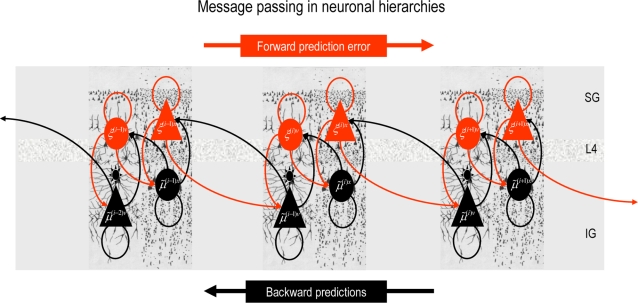
- The paper then maps this inversion scheme onto a neural-network-like message-passing architecture and illustrates the framework with analytic special cases and a simulation example.
## Limitations
- The paper states that the Laplace/Gaussian approximation “restrict[s] recognition to unimodal probabilistic representations,” though it frames this as a practical simplification.
- The text makes evident that many claims are theoretical and illustrative rather than empirically validated in this paper; it says the neuronal implementation “calls for an enormous amount of empirical verification and hypothesis testing” (evident in the text).
- The paper also makes evident that the examples and special-case derivations cover only a “partial list” of possible models, so the treatment is not exhaustive (evident in the text).
Model-written summary. Check it against the paper before relying on it.
Integrity signals
Registry
Cites
Statistics
Figures



Verification
Claims the paper makes
9 Valid · 2 Not valid · 48 Not checked · 185 Own results and interpretations
The cited sources support only part of this claim — read each source’s verdict below.
In the paper
“There is a key functional asymmetry between forward and backward connections that renders backward connections more modulatory or nonlinear in their effects on neuronal responses (e.g., [44]; see also Hupe et al. [47]).”
§ Hierarchical Models in the Brain > Results > Neuronal Implementation
What the sources say
- Partly supportedcites [44] SM Sherman, 1998, On the actions that one nerve cell can have on another: distinguishing “drivers” from “modulators”., Proc Natl Acad Sci U S A sourceExperimental — accuracy not yet measured
In the paper’s discussion of lateral geniculate inputs (indexed as Abstract; page unavailable), retinal inputs are treated as drivers, while inputs from cortex are described as modulators. That supports a forward-versus-backward distinction for this thalamic relay, but the Conclusions say that classifying corticocortical pathways remains largely untested; the paper does not establish the claimed general asymmetry or characterize backward effects as nonlinear. (LLM, conf=0.84)
- Not checked — no full text of the sourcecites Hupe et al. [47] JM Hupe, 1998, Cortical feedback improves discrimination between figure and background by V1, V2 and V3 neurons., Nature source
plainstates a cause- Asserted: passes — The authors put it forward as true.
- Checkable: passes — It can be checked against evidence.
- Load-bearing: passes — The paper’s conclusions depend on it.
- Based: passes — The paper gives a reason why it holds.
- Partly supported
The sources with a verdict support this claim; the rest weren’t checked yet, have no full text we could read, or their verdicts aren’t rated yet.
In the paper
“This selective modulation of afferents mirrors the gain-control mechanisms invoked for attention; e.g., [58],[59].”
§ Hierarchical Models in the Brain > Results > Neuronal Implementation
What the sources say
- Not checked — no full text of the sourcecites [58] S Treue, 1996, Attentional modulation of visual motion processing in cortical areas MT and MST., Nature source
- Supportedcites [59] JC Martinez-Trujillo, 2004, Feature-based attention increases the selectivity of population responses in primate visual cortex., Curr Biol source
The Conclusions (page unavailable) state that feature-based attention multiplicatively modulates neuronal responses in line with a feature-similarity gain model. This supports the cited comparison to attentional gain control; the sentence does not attribute the modulation of afferents themselves to this paper. (LLM, conf=0.88)
plainstates an association- Asserted: passes — The authors put it forward as true.
- Checkable: passes — It can be checked against evidence.
- Load-bearing: passes — The paper’s conclusions depend on it.
- Based: passes — The paper gives a reason why it holds.
The cited sources support only part of this claim — read each source’s verdict below.
In the paper
“Functional asymmetries in forwards (linear) and backwards (nonlinear) connections may reflect their distinct roles in recognition (c.f., [44]).”
§ Hierarchical Models in the Brain > Results > Neuronal Implementation
What the sources say
- Partly supportedcites [44] SM Sherman, 1998, On the actions that one nerve cell can have on another: distinguishing “drivers” from “modulators”., Proc Natl Acad Sci U S A sourceExperimental — accuracy not yet measured
The paper distinguishes driver inputs, which transmit receptive-field properties, from modulator inputs, which alter transmission (Abstract; page unavailable). It also discusses different possible roles for thalamocortical and corticothalamic pathways. It does not characterize forward connections as linear or backward connections as nonlinear, or link those properties to recognition; the Conclusions say corticocortical pathway classifications remain largely untested. (LLM, conf=0.76)
hedgedstates a possible cause- Asserted: passes — The authors put it forward as true.
- Checkable: passes — It can be checked against evidence.
- Load-bearing: unclear — It is unclear whether the paper’s conclusions depend on it.
- Based: passes — The paper gives a reason why it holds.
- Partly supported
Every source the paper cites for this claim was checked and supports it.
In the paper
“Arguments like this suggest that free-form approximations and their attending sampling schemes are not really viable in a neuronal context (although they have been considered; see [86] and above)”
§ Hierarchical Models in the Brain > Discussion
What the sources say
- Supportedcites [86] TS Lee, 2003, Hierarchical Bayesian inference in the visual cortex., J Opt Soc Am A source
The citation is attached to the parenthetical point that sampling-based approximations have been considered in a neuronal context, not to the citing authors’ conclusion that they are unviable. In “Particle Filtering and Bayesian Belief Propagation,” Lee and Mumford discuss weighted samples as an approximation to perceptual probability distributions; the Introduction proposes particle filtering as a possible cortical algorithm. The source does not endorse the unviability conclusion. (LLM, conf=0.92)
hedgedstates a cause- Asserted: passes — The authors put it forward as true.
- Checkable: passes — It can be checked against evidence.
- Load-bearing: passes — The paper’s conclusions depend on it.
- Based: passes — The paper gives a reason why it holds.
- Supported
The cited sources that could be checked couldn’t confirm or dispute this claim.
In the paper
“Lateral interactions may encode the relative precision of prediction errors and change in a way that is consistent with classical neuromodulation (c.f., [63],[71]).”
§ Hierarchical Models in the Brain > Results > Neuronal Implementation
What the sources say
- Not checked — no full text of the sourcecites [63] AJ Yu, 2005, Uncertainty, neuromodulation and attention., Neuron source
- Could not verifycites [71] Y Niv, 2005, Dopamine, uncertainty and TD learning., Behav Brain Funct sourceExperimental — accuracy not yet measured
The Discussion (page unavailable) addresses asymmetric dopamine coding of prediction errors and mentions a possible opponent neurotransmitter. Searches for lateral interactions, relative precision, and neuromodulation found no passage saying that lateral interactions encode precision or change in the claimed way. (LLM, conf=0.76)
hedgedstates a possible cause- Asserted: passes — The authors put it forward as true.
- Checkable: passes — It can be checked against evidence.
- Load-bearing: passes — The paper’s conclusions depend on it.
- Based: passes — The paper gives a reason why it holds.
122 more claims · 1 with their cited sources checked
Create a free account to see all 244 claims and to verify the 3 references still open.
- Probably not a substantial claim. 65
- It may state two separate claims as one. 65
- The quote only partly states this claim. 1
Claims other papers make about this one
Each is checked against this paper’s own text: does it say what the citing paper says it does?
The source backs part of the claim, not all of it — or backs it for a different population, condition or comparison.
In the citing paper
“This equation says that the contribution of any (angular) frequency ω in the prediction errors (encoded by superficial pyramidal cells) to the expectations (encoded by the deep pyramidal cells) is suppressed in proportion to that frequency (Friston 2008). In other words, high frequencies should be attenuated when passing from superficial to deep pyramidal cells.”
From Canonical Microcircuits for Predictive Coding (2012) · cites this paper as Friston 2008
Experimental — accuracy not yet measuredThe source backs part of the claim, not all of it — or backs it for a different population, condition or comparison.
In the citing paper
“and lies in the integrity of neuromodulatory function (2).”
From A more precise look at context in autism (2015) · cites this paper as [2]
Experimental — accuracy not yet measuredThe source backs part of the claim, not all of it — or backs it for a different population, condition or comparison.
In the citing paper
“its solutions grandfather nearly every known statistical estimation scheme, under parametric assumptions about additive or multiplicative noise (Friston, 2008)”
From The Computational Anatomy of Psychosis (2013) · cites this paper as Friston, 2008
Experimental — accuracy not yet measuredThe source backs part of the claim, not all of it — or backs it for a different population, condition or comparison.
In the citing paper
“Predictive coding is a process theory with a biologically plausible back story and a considerable amount of empirical support [21,22].”
From Active interoceptive inference and the emotional brain (2016) · cites this paper as [21]
Experimental — accuracy not yet measuredThe source backs part of the claim, not all of it — or backs it for a different population, condition or comparison.
In the citing paper
“Cortical bias or gain control is mediated by intrinsic inhibitory connections within cortical sources, which rescale prediction errors, in proportion to their precision, so that as precision increases intrinsic recurrent inhibition decreases (Abbott et al., 1997, Friston, 2008).”
From The functional anatomy of schizophrenia: A dynamic causal modeling study of predictive coding (2014) · cites this paper as Friston, 2008
Experimental — accuracy not yet measured
18 more claims about this paper
Create a free account to see every claim other papers make about this one.
Citations
Cites
Maximum Likelihood from Incomplete Data Via the EM Algorithm
Dempster, A. P., Laird, N. M., & Rubin, D. B. (1977) · Journal of the Royal Statistical Society Series B: Statistical Methodology · doi:10.1111/j.2517-6161.1977.tb01600.x · Cited by 50,444 · cited 1×
“We have discussed static cases of this fixed-form scheme previously and how it reduces to expectation maximisation ( EM ; [17]) and restricted maximum likelihood ( ReML ; [18]) for linear models [15].”
BackgroundA New Approach to Linear Filtering and Prediction Problems
Kalman, R. E. (1960) · Journal of Basic Engineering · doi:10.1115/1.3662552 · Cited by 31,751 · cited 1×
“The conventional approach to online Bayesian tracking of nonlinear or non-Gaussian systems employs extended Kalman filtering [30] or sequential Monte Carlo methods such as particle filtering.”
MethodLearning Internal Representations by Error Propagation
Rumelhart, D. E., Hinton, G. E., & Williams, R. J. (1985) · doi:10.21236/ada164453 · Cited by 16,172
An Information-Maximization Approach to Blind Separation and Blind Deconvolution
Bell, A. J., & Sejnowski, T. J. (1995) · Neural Computation · doi:10.1162/neco.1995.7.6.1129 · Cited by 8,986 · cited 1×
“) decomposes the observed response into a linear mixture of non-Gaussian causes”
Neural Mechanisms of Selective Visual Attention
Desimone, R., & Duncan, J. (1995) · Annual Review of Neuroscience · doi:10.1146/annurev.ne.18.030195.001205 · Cited by 8,388
Distributed hierarchical processing in the primate cerebral cortex
Felleman, D. J., & Van Essen, D. C. (1991) · Cerebral Cortex · doi:10.1093/cercor/1.1.1 · Cited by 7,783 · cited 2×
“This means we would expect to see connections reciprocated in the brain, which is generally the case [39,40].”
BackgroundStochastic Processes and Filtering Theory
(1970) · Mathematics in Science and Engineering · doi:10.1016/s0076-5392(09)x6022-4 · Cited by 7,302
Emergence of simple-cell receptive field properties by learning a sparse code for natural images
Olshausen, B. A., & Field, D. J. (1996) · Nature · doi:10.1038/381607a0 · Cited by 5,694 · cited 1×
“In the same way that factor analysis is a generalisation of PCA to non-Gaussian causes, ICA can be extended to form sparse-coding models of the sort proposed by Olshausen and Fields [37] by allowing observation error.”
MethodRao, R. P. N., & Ballard, D. H. (1999) · Nature Neuroscience · doi:10.1038/4580 · Cited by 5,483 · cited 2×
“The mean-field approximation q ( W )= q ( u ( t )) q ( h ) q ( l ) enables inference about perceptual states, causal regularities and context, without representing the joint distribution explicitly; c.f., [64].”
BackgroundA theory of cortical responses.
Friston, K. (2005) · Philosophical Transactions of the Royal Society B: Biological Sciences · doi:10.1098/rstb.2005.1622 · Cited by 4,578 · cited 2×
“We have laid out the neurobiological and psycho-physical motivation for the neuronal implementation of DEM in [3] and [4].”
MethodSelf-citation
Research works printed but not linked: 4
- DJC MacKay, 1995, Free-energy minimisation algorithm for decoding and cryptoanalysis., Electron Lett, 31, 445
- T Ozaki, 1992, A bridge between nonlinear time-series models and nonlinear stochastic dynamical systems: A local linearization approach., Stat Sin, 2, 113
- ME Tipping, 2001, Sparse Bayesian learning and the Relevance Vector Machine., J Mach Learn Res, 1, 211
- CE Rasmussen, 1996, Evaluation of Gaussian Processes and Other Methods for Nonlinear Regression [PhD thesis]. Toronto, Canada: Department of Computer Science, University of Toronto.
Cited by
Items 901–975 of 975
Illusory finger stretching and somatosensory responses in participants with chronic hand-based painPreprint
Hansford, K. J., Baker, D. H., McKenzie, K. J., et al. (2024) · doi:10.31234/osf.io/ambwv
Ciaunica, A., & Safron, A. (2024) · Oxford University Press eBooks · doi:10.1093/oso/9780192898371.003.0004 · Cited by 13
Wasserman, T. H., & Wasserman, L. D. (2024) · Springer eBooks · doi:10.1007/978-3-031-78732-4_10
Wasserman, T. H., & Wasserman, L. D. (2024) · Springer eBooks · doi:10.1007/978-3-031-78732-4_2
Investigating the intrinsic top-down dynamics of deep generative models
Tausani, L., Testolin, A., & Zorzi, M. (2025) · Scientific Reports · doi:10.1038/s41598-024-85055-y · Cited by 2
Illusory finger stretching and somatosensory responses in participants with chronic hand-based pain
Hansford, K. J., Baker, D. H., McKenzie, K. J., & Preston, C. (2025) · PLoS ONE · doi:10.1371/journal.pone.0317693
Optimizing Deep Learning for Biomedical Imaging
Chaturvedi, A., Cao, G., & Feng, W.-C. (2025) · Lecture notes in computer science · doi:10.1007/978-3-031-82768-6_4 · Cited by 1
“Although both the human brain and a DL model consist of millions of interconnected neurons that serve as fundamental processing units, the human brain, unlike traditional DL models, exhibits a sparse structure [7, 12], i.e., not all the neurons in the brain are always interconnected.”
MethodFast DPCNs for Feature Extraction without Labels
Xue, W., Ding, C., & Príncipe, J. C. (2025) · IEEE International Conference on Acoustics Speech and Signal Processing · doi:10.1109/icassp49660.2025.10889164
“In contrast, the DPCNs [16]–[23], a hierarchical generative model inspired by the brain architecture [24], allow estimation of both state and input, interpretable representation, and a bi-directional information passing on feedforward (bottom-up), feedback (top-down), and recurrent pathways [20],…”
Ling, C., Zhong, J., Li, W., Dong, R., & Dai, M. (2025) · Big Data and Cognitive Computing · doi:10.3390/bdcc9040079
Can working memory be explained by predictive coding?Preprint
Feng, M., & Nunez, M. D. (2025) · PsyArXiv (OSF Preprints) · doi:10.31234/osf.io/5zbc6_v1
Can working memory be explained by predictive coding?Preprint
Feng, M., & Nunez, M. D. (2025) · PsyArXiv (OSF Preprints) · doi:10.31234/osf.io/5zbc6_v2
Pc-Transformer: Probabilistic Flight Trajectory Prediction with Multi-Stage Predictive CodingPreprint
Ge, C., Zhang, J., & Du, J. (2025) · SSRN Electronic Journal · doi:10.2139/ssrn.5343063
ANALYSIS OF FUNCTIONAL BRAIN NETWORKS RECOVERED\ FROM FUNCTIONAL MAGNETIC RESONANCE IMAGING DATA
Mayorova, L. A., Kurkin, S., Khorev, V. S., Kuzovlev, A. N., Yakovlev, A. A., Grechko, A. V., & Hramov, A. E. (2025) · Radiophysics and Quantum Electronics · doi:10.1007/s11141-026-10468-w
Exaggerated perception of change with greater sensory imprecision
Herbert, G., Ho, C., Goddard, J., Garthwaite, H. J., Komes, J., Petkov, C. I., & Sedley, W. (2025) · Scientific Reports · doi:10.1038/s41598-025-14791-6 · Cited by 1
“In the brain, estimated precision is encoded largely by postsynaptic gain 8,9 .”
TANIYAMA, K., Shibue, H., & YANAGISAWA, H. (2025) · International Journal of Affective Engineering · doi:10.5057/ijae.ijae-d-25-00011 · Cited by 1
Parr, T., Pezzulo, G., Moran, R., Ramstead, M. J. D., Constant, A., & Bhat, A. (2025) · Entropy · doi:10.3390/e27090944 · Cited by 2
“Such systems are handled by accounting for anticipated covariance between position and acceleration, velocity and jerk, and other pairs of generalised coordinates of motion [37].”
Theory of Mind and Discourse Production in Schizotypy: An fMRI StudyPreprint
Newman, S. D., Rein, M., Gann, E. C., & Xiong, Y. (2025) · bioRxiv (Cold Spring Harbor Laboratory) · doi:10.1101/2025.09.19.677472
“These frameworks propose that schizophrenia-spectrum pathology involves disrupted excitatory/inhibitory (E/I) balance, leading to reverberations between top-down priors and bottom-up sensory evidence (Bishop, 2007; Friston, 2008; Markov et al., 2013; Leptourgos et al., 2017).”
Abduction: Its Point and Reach
Mınnameıer, G. (2025) · Synthese Library/Synthese library · doi:10.1007/978-3-031-96684-2_8
Müller-Schrader, M., Petzschner, F. H., Heinzle, J., Kasper, L., Wellstein, K. V., Bayer, J., Engel, M., Bianchi, S., Weber, L. A. E., Pruessmann, K. P., et al. (2025) · bioRxiv (Cold Spring Harbor Laboratory) · doi:10.1101/2025.10.08.679044 · Cited by 2
“These signals are then projected to deeper layers, particularly layer V, where predictions are thought to originate (Friston, 2008; Shipp et al., 2013; Barrett and Simmons, 2015).”
McGovern, H. T., Aqil, M., Atasoy, S., & Carhart-Harris, R. L. (2025) · Neuroscience of Consciousness · doi:10.1093/nc/niaf039 · Cited by 7
“Conversely, ascendant signals from sensory levels propagate e nsuing prediction error (Friston 2008, Friston 2010, Clark 2013).”
Individuation by Prediction and Debunking Realism
Schwaninger, A. C. (2025) · Synthese Library/Synthese library · doi:10.1007/978-3-032-05420-3_13
Sustained dynamics and modality-specific network reconfigurations define crossmodal prediction errorPreprint
Niedernhuber, M., Raimondo, F., Sitt, J. D., & Bekinschtein, T. A. (2025) · bioRxiv (Cold Spring Harbor Laboratory) · doi:10.1101/2025.10.29.685284
Phase Transition Hypothesis of Perception and Cognition in the Visually Impaired
Zhang, X., Liu, H., Luo, J., Jiang, Z., Zhang, J., Zheng, F., Zhai, G., & Hu, M. (2025) · IEEE Signal Processing Letters · doi:10.1109/lsp.2025.3636984
“…suppress drift from channel compression and neural noise, the brain minimizes prediction error recursively within a hierarchical inference framework[22]: where ˙ μp ( l ) represents the rate of change of the perceptual state at layer l , driven by the internal prediction term Dμp ( l ) , the…”
An intelligent framework for dynamic modeling of therapeutic response using clinical compliance data
Wang, X.-Y., & Xie, H. (2025) · Frontiers in Pharmacology · doi:10.3389/fphar.2025.1631599
“Hierarchical inference structures enable the representation of multiscale latent states corresponding to global patient traits, therapeutic dynamics, and local perturbations (Friston, 2008).”
Feature selective inhibitory mechanisms enable expectation suppression in cortical microcircuits
Huang, Y. (2025) · Scientific Reports · doi:10.1038/s41598-025-28227-8 · Cited by 1
“These feedback projections are thought to convey top-down information about expectations, beliefs, or predictions 36,37 .”
Pupil dilation offers a time-window on prediction errorPreprint
Colizoli, O., van Leeuwen, T. M., Rutar, D., & Bekkering, H. (2025) · eLife · doi:10.7554/elife.105287.2 · Cited by 2
Brown, H. R. (2014) · UCL Discovery (University College London)
Planning as Inference in a Hierarchical Predictive Memory
Choi, H., & Kim, D. (2013) · Lecture notes in computer science · doi:10.1007/978-3-642-42054-2_3
“Hierarchical predictive processing suggests the inference machinery in brains[4–7].”
MethodSaddle hierarchy in dense associative memory
Thériault, R., & Tantari, D. (2025) · Machine Learning Science and Technology · doi:10.1088/2632-2153/ae3051 · Cited by 3
“The sparsity of the brain suggests that it is also beneficial for biological NNs [45].”
Reduced belief updating impairs adaptive step initiation in older adultsPreprint
Jacob, A. B., Kotz, S. A., Ryszard, A., et al. (2025) · bioRxiv (Cold Spring Harbor Laboratory) · doi:10.64898/2025.12.19.695189
“…probabilities, we therefore used a reduced two-level HGF. Multiple change-point switches could be incorporated to better assess volatility’s impact on perceptual learning rates 50 in gait initiation, enabling examination of belief updating driven by volatility estimates in a three-level HGF 29 .”
InfluentialWhen Velocity Becomes Position: Proprioceptive Contributions to State EstimationPreprint
Mortensen, E. S., & Christensen, M. S. (2026) · bioRxiv (Cold Spring Harbor Laboratory) · doi:10.64898/2026.01.09.698577
“…over time through learned laws of motion or generative models; e.g., the arm may be expected to move smoothly through space, with congruent changes in position, velocity, and acceleration, rather than disappear in one spot and reappear at another (K. Friston, 2008; K. J. Friston et al., 2010).”
Diaconescu, A. O., Wang, Z., & Griffiths, J. D. (2026) · bioRxiv (Cold Spring Harbor Laboratory) · doi:10.64898/2026.01.28.702100
“At larger scales, these local perturbations propagate through anatomical connectivity, producing abnormal oscillatory coupling and reduced signal-to-noise ratio across networks Uhlhaas et al. (2009); Friston (2008).”
Perception Under Constraint: A Dual-Constraint Model Reconciling Positivism and Constructivism
Orbán, L. L. (2026) · Acta Analytica · doi:10.1007/s12136-026-00677-3
“It is helpful to compare the proposed external invariance constraint with the notion of hyperpriors in predictive-processing models (Clark, 2013; Friston, 2008; Friston et al., 2013; Swanson, 2016).”
Closed-form feedback-free learning with forward projection
O'Shea, R., & Rajendran, B. (2026) · Nature Communications · doi:10.1038/s41467-026-69161-1 · Cited by 2
“To approximate backpropagation in a more biologicallyplausibleway,approachessuchasPredictiveCoding 5,8 and Difference Target Propagation 1 seek to align forward neural activity with a backward network that mirrors the forward architecture, effectively implementing an inverse model.”
Training sparse convolutional deep predictive coding networks with attention
Li, H., Ding, C., & Principe, J. C. (2026) · Neural Networks · doi:10.1016/j.neunet.2026.108836
Friedrich, J., & Fischer, M. H. (2026) · Minds and Machines · doi:10.1007/s11023-026-09773-0 · Cited by 2
“These lower layers compare the predictions against sensory input, sending any resulting prediction-errors upward, to increasingly general, summarizing, and abstract layers above (Friston, 2003, 2008).”
Navarro, V. M., Brugger, S. P., Wolpe, N., Harding, J. N., Fletcher, P. C., & Teufel, C. (2026) · bioRxiv (Cold Spring Harbor Laboratory) · doi:10.64898/2026.03.23.713603
A triadic external window to cognitive evaluation
Özdilek, Ü. (2026) · Social Sciences & Humanities Open · doi:10.1016/j.ssaho.2026.102707
Functionnal organization of complex behavioral processes
Perdikis, D. (2011) · theses.fr (ABES) · doi:10.70675/485f1ad2za3d3z49a6z994dz45174fdb5432 · Cited by 1
Limitations of Variational Laplace-Based Dynamic Causal Modelling for Multistable Cortical Circuits
Asadpour, A., Azimi, A., & Wong‐Lin, K. (2026) · Neuroinformatics · doi:10.1007/s12021-025-09759-w · Cited by 1
“We represented the stimulus input to both columns using a Gaussian bump function (Friston 2008): ∆% " (1) Here, 𝑎 represents the amplitude at zero bias ( 𝛥 ), with 𝑡 ( =0 s as the stimulus onset time and t=2 s as the stimulus offset time.”
A neural mechanism for online discovery of latent contextsPreprint
Hummos, A., Wang, M. B., Lu, Q., Norman, K. A., & Jazayeri, M. (2026) · bioRxiv (Cold Spring Harbor Laboratory) · doi:10.64898/2026.03.31.715618 · Cited by 1
Pure awareness, entropy, and the foundation of perception
Mago, J., Chandaria, S., Miller, M., & Laukkonen, R. (2026) · Neurocomputing · doi:10.1016/j.neucom.2026.133443 · Cited by 1
Leptourgos, P. (2018) · theses.fr (ABES) · doi:10.70675/dafacdb1z9072z4ec2z8cebz0ca09b93b7ce · Cited by 4
Computational learning noise in human decision-making
Findling, C. (2018) · theses.fr (ABES) · doi:10.70675/32e62279zea97z45b1z9326z06a449dae472
Sparse deep predictive coding : a bio-inspired model of visual perception
Boutin, V. (2020) · theses.fr (ABES) · doi:10.70675/436831b6zf06az43f6zbe61z3eaf37251da3
Beyond introspective illusions, a brain computer interface approach to decision awareness
Rebouillat, B. (2020) · theses.fr (ABES) · doi:10.70675/b8f16473zb6e9z434bz80c5zdaaff6ec46b2
Deep learning and neuroscience : a match made in heaven?
Choksi, B. (2022) · theses.fr (ABES) · doi:10.70675/42802d90z0c77z4de8z829dz508145498217
Stulz, S. B. (2023) · theses.fr (ABES) · doi:10.70675/470b2d4bz0886z4876z846dzfefc3192a0fa
A review and integration of models on delusion maintenance
Lincoln, T. M., Romberg, H., Torrents‐Rodas, D., & Bott, A. (2026) · Psychological Medicine · doi:10.1017/s0033291726103705 · Cited by 1
“Within this hierarchy, top-down prior beliefs are fed forward and integrated with bottom-up prediction errors signaled from the next lower cortical level (Friston, 2008).”
Wright, J. J. (2026) · Studies in systems, decision and control · doi:10.1007/978-3-032-00242-6_17
Braithwaite, J. J., Ruffini, G., Farrelly, H., Salvador, R., Dewe, H., Joshi, S. D., Watson, D. G., & Thivierge, J. (2026) · Neuropsychologia · doi:10.1016/j.neuropsychologia.2026.109519
“Two influential and related systems-level frameworks are: (i) predictive coding and (ii) cortical gain theories, with the former focusing on hierarchical inference and the latter on signal regulation in the brain (Ferguson & Cardin, 2020; Friston, 2005; 2008; Rao & Ballard, 1999).”
Theoretical and Methodological Basis of the Concept of Perceptual-Cognitive Interfaces
Sergeev, S. F., Sergeev, A., & Smirnova, E. (2026) · Ergodesign · doi:10.30987/2658-4026-2026-2-198-206
Control-Mastery Theory of Psychotherapy
Li, E. T., Gazzillo, F., Kealy, D., & Silberschatz, G. (2026) · Elsevier eBooks · doi:10.1016/b978-0-443-29009-1.00053-6
Parvizi-Wayne, D., Pedersen, R., & Rankin, J. (2026) · Review of Philosophy and Psychology · doi:10.1007/s13164-026-00828-w
“…its different layers in the service of prediction error mini - misation, this hierarchical model attempts to achieve a recapitulation of the matrix of hidden causes which underlies the sensory data transduced by that agent’s receptors (Badcock et al. 2019; Friston 2008 ; Lee and Mumford 2003 ).”
Chen, Q., Zhang, Y., Liu, C., Fu, Y., Gan, Q., & Chen, Z. (2026) · Brain Research Bulletin · doi:10.1016/j.brainresbull.2026.112021 · Cited by 1
Hierarchical Predictive Processing during Natural ReadingPreprint
Chan, L., Dimigen, O., Gagl, B., & Maurer, U. (2026) · bioRxiv (Cold Spring Harbor Laboratory) · doi:10.64898/2026.06.24.734402
“The Hierarchical Predictive Processing hypothesis (HPP, 3–5) is a highly influential idea for understanding neural mechanisms, including those underlying language comprehension ( 6–8 ).”
Differentiation of cortical areas: effects of free energy minimization with broken symmetry
Wright, J. J., & Bourke, P. D. (2026) · Cerebral Cortex · doi:10.1093/cercor/bhag068
“The line of collision acts as a Markov blanket ( Friston 2002, 2008, 2010, 2022; Friston and Ao 2012; Friston and Buzsaki 2016; Friston et al. 2017, 2020, 2021; Palacios et al. 2020; Parr et al. 2022; Ramstead et al. 2022)—that is, any boundary, or manifold, over which exchanges between two systems…”
Cross-modal invariants as the foundational basis of emerging brain circuitry representations
Ramasamy, A., & Jörntell, H. (2026) · Physics of Life Reviews · doi:10.1016/j.plrev.2026.06.010 · Cited by 3
Hou, Y., Pizzuti, A., Knoblauch, K., Vezoli, J., Goebel, R., Vinck, M. A., & Kennedy, H. (2026) · PLoS Biology · doi:10.1371/journal.pbio.3003906
“Furthermore, a gradient in time scales and oscillation frequencies could be an emergent phenomenon in a hierarchical system performing predictive processing [220].”
Digital rent: From natural advantages to data-driven surpluses in the platform economy
Özdilek, Ü. (2026) · Journal of Digital Economy · doi:10.1016/j.jdec.2026.06.005
Silva, A. M., Truelove, R., Millán, A. C., & Limongi, R. (2026) · Brain Sciences · doi:10.3390/brainsci16080771 · Cited by 1
“Bayesian approaches to brain function, commonly referred to as the Bayesian-brain hypothesis [34,39–45], propose that the brain does not passively register the world but infers the hidden causes of sensory input.”
Bewegungstherapeutische Konsequenzen
Bochdansky, T. (2026) · Springer eBooks · doi:10.1007/978-3-662-71737-0_4
Bochdansky, T. (2026) · Springer eBooks · doi:10.1007/978-3-662-71737-0_1
Emergent multiscale organisation of neural dynamics fragments in anaesthesia
Milinkovic, B., Seth, A. C., Barnett, L., Carter, O. L., & Andrillon, T. (2026) · Imaging Neuroscience · doi:10.1162/imag.a.1364 · Cited by 5
“…(un)consciousness have often been associated with changes in structure and organisation of the dynamical interactions in neural activity across multiple spatial and temporal scales ( Deco et al., 2021; Friston, 2008; Kringelbach et al., 2023; Li et al., 2023; Luppi et al., 2023; Raut et al., 2020).”
Disambiguating Adaptivity in AI Research and RegulationPreprint
Radomski, B. M. (2026) · doi:10.14293/pr2199.004442.v1
Multimodal neuroimaging in schizophrenia: a systematic review of EEG and fMRI integration
Carbone, F., Donati, F. L., Bondi, E., Bosco, A. K., Brambilla, P., Maggioni, E., & D’Agostino, A. (2026) · Psychiatry Research Neuroimaging · doi:10.1016/j.pscychresns.2026.112328
Belief Functions Meet Quantum Logic: A Mathematical Framework for Coherence-Based Decision Theories
Fioretti, G. (2026) · Complexities · doi:10.3390/complexities2030022
Djebbara, Z., & Bogotá, J. D. (2026) · Neuroscience of Consciousness · doi:10.1093/nc/niaf050
“With temporal depth, more complex neurobiological and cognitive processes can be modelled ( Friston 2008, Pezzulo et al. 2018).”
Jia, Y., Wang, L., Tao, Y., Zhu, Z., Zhang, Y., & Zhang, H. (2026) · Lecture notes in computer science · doi:10.1007/978-3-032-38091-3_3
The phantastic organ: predictive processing in the brain
Friston, K. J., & Parr, T. (2026) · Frontiers in Psychology · doi:10.3389/fpsyg.2026.1901293
Self-citationLyndon, S., & Nedeljković, S. S. (2026) · Pain · doi:10.1097/j.pain.0000000000004123 · Cited by 1
Berndt, L. C. S., & Shaw, A. D. (2026) · Frontiers in Human Neuroscience · doi:10.3389/fnhum.2026.1917153
The generalized Hierarchical Gaussian Filter
Weber, L. A., Waade, P. T., Legrand, N., Møller, A. H., Stephan, K. E., & Mathys, C. (2026) · eLife · doi:10.7554/elife.110174
pyhgf: A neural network library for predictive coding
Legrand, N., Weber, L., Waade, P. T., Daugaard, A. H. M., Khodadadi, M., Mikuš, N., & Mathys, C. (2024) · arXiv · doi:10.48550/arxiv.2410.09206
Metadata
- Authors
- Friston, K.
- Affiliations
- Wellcome Centre for Human Neuroimaging (GB)
- Corresponding author
- Friston, Karl
- ORCID
- Friston, Karl
- Venue
- PLoS Computational Biology
- Publisher
- Public Library of Science (PLoS)
- Published
- 2008-11-07
- Volume
- 4
- Issue
- 11
- Pages
- e1000211
- ISSN
- 1553-734X (ISSN-L)
- 1553-7358
- PMC
- PMC2570625
- OpenAlex
- W1977628053
- Cited by
- 952
- References
- 102
- Citations by year
- 2026: 53 · 2025: 71 · 2024: 58 · 2023: 79 · 2022: 66 · 2021: 84 · 2020: 106 · 2019: 60 · 2018: 57 · 2017: 55 · 2016: 52 · 2015: 46 · 2014: 38 · 2013: 35 · 2012: 32
- FWCI
- 31.65
- Type
- journal article
- Language
- en
- Open access
- gold
- doi.org
- Licence
- cc-by
- Locations
- PLoS Computational Biology (publishedVersion, cc-by)
- PubMed Central (publishedVersion, cc-by)
- PubMed (publishedVersion)
- RePEc: Research Papers in Economics (submittedVersion)
- DOAJ (DOAJ: Directory of Open Access Journals) (submittedVersion, cc-by-sa)
- UCL Discovery (University College London) (submittedVersion)
- Funders
- Wellcome Trust (088130)
- Topics
- Physical Sciences › Computer Science › Artificial Intelligence › Bayesian Modeling and Causal Inference
- Physical Sciences › Computer Science › Artificial Intelligence › Gaussian Processes and Bayesian Inference
- Physical Sciences › Computer Science › Artificial Intelligence › Neural Networks and Applications
- Keywords
- hierarchical models, state-space model, dynamic causal modeling, model inversion, nonlinear time series analysis, general linear model, neural network inversion, brain learning
- MeSH terms
- Algorithms, Animals, Brain, Humans, Mental Processes, Models, Neurological, Nerve Net, Probability, Linear Models, Neural Networks, Computer, Nonlinear Dynamics
About these checks
Registry, retraction, Cites and statistics results are computed, not judged, with one exception: a printed reference that no index lists is read once by a model before it counts as a citation error. Claims are extracted by a model and kept only when their quote appears verbatim in the text; each cited source is then checked, with a model’s help, for whether it says what the claim relies on. Those verdicts can be wrong — read the claim’s quote and the cited source before relying on one.
The claim verdicts this report counts are experimental: their accuracy is not yet measured.
A language model drew the claims from the paper on 2026-10-10, under version 3 of the claim definition (model deepseek-v4.1-flash, prompt extract-v3).
A second model labelled each claim on 2026-10-10 (model jev-1.13-20260917, definition revision gold-guideline-v0.2).
Cited sources are checked with a language model’s help (gpt-6-sol).
Statistics and arithmetic are recomputed, not judged.
Confidence bands are shown only for fields calibrated on our annotated test set. None is calibrated yet, so no band is shown.
What counts as a claim ›How we measure confidence ›How we check this ›
Are you an author, or do you see a problem with this page? Request a review
Data sources
Bibliographic data: Semantic Scholar, OpenAlex, Crossref.
Contains information from the Semantic Scholar Academic Graph Datasets, made available under the ODC Attribution License (ODC-BY 1.0).
Semantic Scholar’s data is described in: Kinney, R., et al. (2023). The Semantic Scholar Open Data Platform. arXiv:2301.10140.
