

The DOI matches its Crossref record; 94 of the 102 references it cites were found in a registry or an index; 10 of the 81 sources its claims cite were checked for support.
Hierarchical Models in the Brain
Open accessAbstract
This paper describes a general model that subsumes many parametric models for continuous data. The model comprises hidden layers of state-space or dynamic causal models, arranged so that the output of one provides input to another. The ensuing hierarchy furnishes a model for many types of data, of arbitrary complexity. Special cases range from the general linear model for static data to generalised convolution models, with system noise, for nonlinear time-series analysis. Crucially, all of these models can be inverted using exactly the same scheme, namely, dynamic expectation maximization. This means that a single model and optimisation scheme can be used to invert a wide range of models. We present the model and a brief review of its inversion to disclose the relationships among, apparently, diverse generative models of empirical data. We then show that this inversion can be formulated as a simple neural network and may provide a useful metaphor for inference and learning in the brain.
Overview
CoChat Summary
## TL;DR
This paper presents hierarchical dynamic models (HDMs) as a very general framework that contains many familiar static and dynamic statistical models as special cases, all invertible with the same dynamic expectation maximization (DEM) scheme. It argues that the same inversion can be written as a simple neural network and may serve as a metaphor for inference and learning in the brain.
## Key findings
- HDMs “subsum[e] many parametric models for continuous data,” ranging from the general linear model for static data to generalized convolution models with system noise for nonlinear time-series analysis.
- The paper claims that these diverse models can all be inverted using the same scheme, dynamic expectation maximization (DEM), under a Laplace/mean-field variational approximation.
- In the results, the author shows that HDMs encompass standard tools including the general linear model, expectation maximization (EM), restricted maximum likelihood (ReML), covariance component estimation, Gaussian process models, PCA, factor analysis, ICA, sparse coding, deconvolution, and state-space filtering.
- A worked example is described in which DEM converged in “about sixteen iterations” using embedding order “n = 6” and roughness hyperparameter “γ = 4,” with the text stating that the recovered states, parameters, and hyperparameters closely matched the true values and that the true values lay largely within the 90% confidence intervals.
## Methods
- The paper develops a hierarchical dynamic model in generalized coordinates of motion, with hidden states and causes organized across levels; the model includes Gaussian priors and Gaussian assumptions about fluctuations, and uses prediction errors at each level.
- Inversion is based on variational Bayes under mean-field and Laplace approximations, optimizing free energy / variational action with a dynamic expectation maximization scheme that separates D-step (states), E-step (parameters), and M-step (hyperparameters).
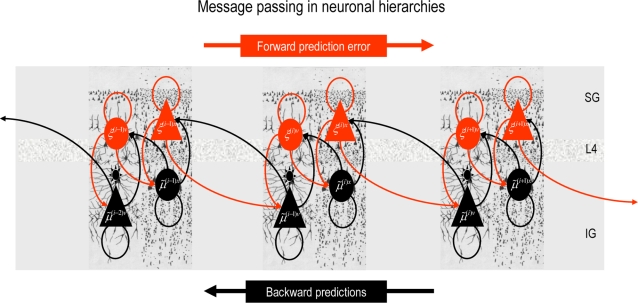
- The paper then maps this inversion scheme onto a neural-network-like message-passing architecture and illustrates the framework with analytic special cases and a simulation example.
## Limitations
- The paper states that the Laplace/Gaussian approximation “restrict[s] recognition to unimodal probabilistic representations,” though it frames this as a practical simplification.
- The text makes evident that many claims are theoretical and illustrative rather than empirically validated in this paper; it says the neuronal implementation “calls for an enormous amount of empirical verification and hypothesis testing” (evident in the text).
- The paper also makes evident that the examples and special-case derivations cover only a “partial list” of possible models, so the treatment is not exhaustive (evident in the text).
Model-written summary. Check it against the paper before relying on it.
Integrity signals
Registry
Cites
Statistics
Figures



Verification
Claims the paper makes
9 Valid · 2 Not valid · 48 Not checked · 185 Own results and interpretations
The cited sources support only part of this claim — read each source’s verdict below.
In the paper
“There is a key functional asymmetry between forward and backward connections that renders backward connections more modulatory or nonlinear in their effects on neuronal responses (e.g., [44]; see also Hupe et al. [47]).”
§ Hierarchical Models in the Brain > Results > Neuronal Implementation
What the sources say
- Partly supportedcites [44] SM Sherman, 1998, On the actions that one nerve cell can have on another: distinguishing “drivers” from “modulators”., Proc Natl Acad Sci U S A sourceExperimental — accuracy not yet measured
In the paper’s discussion of lateral geniculate inputs (indexed as Abstract; page unavailable), retinal inputs are treated as drivers, while inputs from cortex are described as modulators. That supports a forward-versus-backward distinction for this thalamic relay, but the Conclusions say that classifying corticocortical pathways remains largely untested; the paper does not establish the claimed general asymmetry or characterize backward effects as nonlinear. (LLM, conf=0.84)
- Not checked — no full text of the sourcecites Hupe et al. [47] JM Hupe, 1998, Cortical feedback improves discrimination between figure and background by V1, V2 and V3 neurons., Nature source
plainstates a cause- Asserted: passes — The authors put it forward as true.
- Checkable: passes — It can be checked against evidence.
- Load-bearing: passes — The paper’s conclusions depend on it.
- Based: passes — The paper gives a reason why it holds.
- Partly supported
The sources with a verdict support this claim; the rest weren’t checked yet, have no full text we could read, or their verdicts aren’t rated yet.
In the paper
“This selective modulation of afferents mirrors the gain-control mechanisms invoked for attention; e.g., [58],[59].”
§ Hierarchical Models in the Brain > Results > Neuronal Implementation
What the sources say
- Not checked — no full text of the sourcecites [58] S Treue, 1996, Attentional modulation of visual motion processing in cortical areas MT and MST., Nature source
- Supportedcites [59] JC Martinez-Trujillo, 2004, Feature-based attention increases the selectivity of population responses in primate visual cortex., Curr Biol source
The Conclusions (page unavailable) state that feature-based attention multiplicatively modulates neuronal responses in line with a feature-similarity gain model. This supports the cited comparison to attentional gain control; the sentence does not attribute the modulation of afferents themselves to this paper. (LLM, conf=0.88)
plainstates an association- Asserted: passes — The authors put it forward as true.
- Checkable: passes — It can be checked against evidence.
- Load-bearing: passes — The paper’s conclusions depend on it.
- Based: passes — The paper gives a reason why it holds.
The cited sources support only part of this claim — read each source’s verdict below.
In the paper
“Functional asymmetries in forwards (linear) and backwards (nonlinear) connections may reflect their distinct roles in recognition (c.f., [44]).”
§ Hierarchical Models in the Brain > Results > Neuronal Implementation
What the sources say
- Partly supportedcites [44] SM Sherman, 1998, On the actions that one nerve cell can have on another: distinguishing “drivers” from “modulators”., Proc Natl Acad Sci U S A sourceExperimental — accuracy not yet measured
The paper distinguishes driver inputs, which transmit receptive-field properties, from modulator inputs, which alter transmission (Abstract; page unavailable). It also discusses different possible roles for thalamocortical and corticothalamic pathways. It does not characterize forward connections as linear or backward connections as nonlinear, or link those properties to recognition; the Conclusions say corticocortical pathway classifications remain largely untested. (LLM, conf=0.76)
hedgedstates a possible cause- Asserted: passes — The authors put it forward as true.
- Checkable: passes — It can be checked against evidence.
- Load-bearing: unclear — It is unclear whether the paper’s conclusions depend on it.
- Based: passes — The paper gives a reason why it holds.
- Partly supported
Every source the paper cites for this claim was checked and supports it.
In the paper
“Arguments like this suggest that free-form approximations and their attending sampling schemes are not really viable in a neuronal context (although they have been considered; see [86] and above)”
§ Hierarchical Models in the Brain > Discussion
What the sources say
- Supportedcites [86] TS Lee, 2003, Hierarchical Bayesian inference in the visual cortex., J Opt Soc Am A source
The citation is attached to the parenthetical point that sampling-based approximations have been considered in a neuronal context, not to the citing authors’ conclusion that they are unviable. In “Particle Filtering and Bayesian Belief Propagation,” Lee and Mumford discuss weighted samples as an approximation to perceptual probability distributions; the Introduction proposes particle filtering as a possible cortical algorithm. The source does not endorse the unviability conclusion. (LLM, conf=0.92)
hedgedstates a cause- Asserted: passes — The authors put it forward as true.
- Checkable: passes — It can be checked against evidence.
- Load-bearing: passes — The paper’s conclusions depend on it.
- Based: passes — The paper gives a reason why it holds.
- Supported
The cited sources that could be checked couldn’t confirm or dispute this claim.
In the paper
“Lateral interactions may encode the relative precision of prediction errors and change in a way that is consistent with classical neuromodulation (c.f., [63],[71]).”
§ Hierarchical Models in the Brain > Results > Neuronal Implementation
What the sources say
- Not checked — no full text of the sourcecites [63] AJ Yu, 2005, Uncertainty, neuromodulation and attention., Neuron source
- Could not verifycites [71] Y Niv, 2005, Dopamine, uncertainty and TD learning., Behav Brain Funct sourceExperimental — accuracy not yet measured
The Discussion (page unavailable) addresses asymmetric dopamine coding of prediction errors and mentions a possible opponent neurotransmitter. Searches for lateral interactions, relative precision, and neuromodulation found no passage saying that lateral interactions encode precision or change in the claimed way. (LLM, conf=0.76)
hedgedstates a possible cause- Asserted: passes — The authors put it forward as true.
- Checkable: passes — It can be checked against evidence.
- Load-bearing: passes — The paper’s conclusions depend on it.
- Based: passes — The paper gives a reason why it holds.
122 more claims · 1 with their cited sources checked
Create a free account to see all 244 claims and to verify the 3 references still open.
- Probably not a substantial claim. 65
- It may state two separate claims as one. 65
- The quote only partly states this claim. 1
Claims other papers make about this one
Each is checked against this paper’s own text: does it say what the citing paper says it does?
The source backs part of the claim, not all of it — or backs it for a different population, condition or comparison.
In the citing paper
“This equation says that the contribution of any (angular) frequency ω in the prediction errors (encoded by superficial pyramidal cells) to the expectations (encoded by the deep pyramidal cells) is suppressed in proportion to that frequency (Friston 2008). In other words, high frequencies should be attenuated when passing from superficial to deep pyramidal cells.”
From Canonical Microcircuits for Predictive Coding (2012) · cites this paper as Friston 2008
Experimental — accuracy not yet measuredThe source backs part of the claim, not all of it — or backs it for a different population, condition or comparison.
In the citing paper
“and lies in the integrity of neuromodulatory function (2).”
From A more precise look at context in autism (2015) · cites this paper as [2]
Experimental — accuracy not yet measuredThe source backs part of the claim, not all of it — or backs it for a different population, condition or comparison.
In the citing paper
“its solutions grandfather nearly every known statistical estimation scheme, under parametric assumptions about additive or multiplicative noise (Friston, 2008)”
From The Computational Anatomy of Psychosis (2013) · cites this paper as Friston, 2008
Experimental — accuracy not yet measuredThe source backs part of the claim, not all of it — or backs it for a different population, condition or comparison.
In the citing paper
“Predictive coding is a process theory with a biologically plausible back story and a considerable amount of empirical support [21,22].”
From Active interoceptive inference and the emotional brain (2016) · cites this paper as [21]
Experimental — accuracy not yet measuredThe source backs part of the claim, not all of it — or backs it for a different population, condition or comparison.
In the citing paper
“Cortical bias or gain control is mediated by intrinsic inhibitory connections within cortical sources, which rescale prediction errors, in proportion to their precision, so that as precision increases intrinsic recurrent inhibition decreases (Abbott et al., 1997, Friston, 2008).”
From The functional anatomy of schizophrenia: A dynamic causal modeling study of predictive coding (2014) · cites this paper as Friston, 2008
Experimental — accuracy not yet measured
18 more claims about this paper
Create a free account to see every claim other papers make about this one.
Citations
Cites
Maximum Likelihood from Incomplete Data Via the EM Algorithm
Dempster, A. P., Laird, N. M., & Rubin, D. B. (1977) · Journal of the Royal Statistical Society Series B: Statistical Methodology · doi:10.1111/j.2517-6161.1977.tb01600.x · Cited by 50,444 · cited 1×
“We have discussed static cases of this fixed-form scheme previously and how it reduces to expectation maximisation ( EM ; [17]) and restricted maximum likelihood ( ReML ; [18]) for linear models [15].”
BackgroundA New Approach to Linear Filtering and Prediction Problems
Kalman, R. E. (1960) · Journal of Basic Engineering · doi:10.1115/1.3662552 · Cited by 31,751 · cited 1×
“The conventional approach to online Bayesian tracking of nonlinear or non-Gaussian systems employs extended Kalman filtering [30] or sequential Monte Carlo methods such as particle filtering.”
MethodLearning Internal Representations by Error Propagation
Rumelhart, D. E., Hinton, G. E., & Williams, R. J. (1985) · doi:10.21236/ada164453 · Cited by 16,172
An Information-Maximization Approach to Blind Separation and Blind Deconvolution
Bell, A. J., & Sejnowski, T. J. (1995) · Neural Computation · doi:10.1162/neco.1995.7.6.1129 · Cited by 8,986 · cited 1×
“) decomposes the observed response into a linear mixture of non-Gaussian causes”
Neural Mechanisms of Selective Visual Attention
Desimone, R., & Duncan, J. (1995) · Annual Review of Neuroscience · doi:10.1146/annurev.ne.18.030195.001205 · Cited by 8,388
Distributed hierarchical processing in the primate cerebral cortex
Felleman, D. J., & Van Essen, D. C. (1991) · Cerebral Cortex · doi:10.1093/cercor/1.1.1 · Cited by 7,783 · cited 2×
“This means we would expect to see connections reciprocated in the brain, which is generally the case [39,40].”
BackgroundStochastic Processes and Filtering Theory
(1970) · Mathematics in Science and Engineering · doi:10.1016/s0076-5392(09)x6022-4 · Cited by 7,302
Emergence of simple-cell receptive field properties by learning a sparse code for natural images
Olshausen, B. A., & Field, D. J. (1996) · Nature · doi:10.1038/381607a0 · Cited by 5,694 · cited 1×
“In the same way that factor analysis is a generalisation of PCA to non-Gaussian causes, ICA can be extended to form sparse-coding models of the sort proposed by Olshausen and Fields [37] by allowing observation error.”
MethodRao, R. P. N., & Ballard, D. H. (1999) · Nature Neuroscience · doi:10.1038/4580 · Cited by 5,483 · cited 2×
“The mean-field approximation q ( W )= q ( u ( t )) q ( h ) q ( l ) enables inference about perceptual states, causal regularities and context, without representing the joint distribution explicitly; c.f., [64].”
BackgroundA theory of cortical responses.
Friston, K. (2005) · Philosophical Transactions of the Royal Society B: Biological Sciences · doi:10.1098/rstb.2005.1622 · Cited by 4,578 · cited 2×
“We have laid out the neurobiological and psycho-physical motivation for the neuronal implementation of DEM in [3] and [4].”
MethodSelf-citation
Research works printed but not linked: 4
- DJC MacKay, 1995, Free-energy minimisation algorithm for decoding and cryptoanalysis., Electron Lett, 31, 445
- T Ozaki, 1992, A bridge between nonlinear time-series models and nonlinear stochastic dynamical systems: A local linearization approach., Stat Sin, 2, 113
- ME Tipping, 2001, Sparse Bayesian learning and the Relevance Vector Machine., J Mach Learn Res, 1, 211
- CE Rasmussen, 1996, Evaluation of Gaussian Processes and Other Methods for Nonlinear Regression [PhD thesis]. Toronto, Canada: Department of Computer Science, University of Toronto.
Cited by
Items 701–800 of 974
Robust and sparse estimator for EEG source localization
Mannepalli, T., & Routray, A. (2025) · Biomedical Engineering Advances · doi:10.1016/j.bea.2025.100177 · Cited by 2
Defining statistical perceptions with an empirical Bayesian approach
Tajima, S. (2013) · Physical Review E · doi:10.1103/physreve.87.042707 · Cited by 2
“Although there have been a number of previous attempts to relate cortical hierarchy to the hierarchical Bayesian method [19, 20, 17, 21, 22], few studies have discussed the perceptions of natural statistics in terms of empirical Bayesian inference.”
BackgroundMethodRazi, A., & Friston, K. J. (2016) · Cited by 2
Self-citationContext as Inter-domain Effects: The Hand-Action-Network Dynamic Language Embodiment Model
Ibáñez, A. M., & García, A. M. (2018) · SpringerBriefs in psychology · doi:10.1007/978-3-319-77285-1_3 · Cited by 3
Neuronal phase consistency tracks dynamic changes in acoustic spectral regularity
Gifford, A. M., Sperling, M. R., Sharan, A. D., Gorniak, R., Williams, R. B., Davis, K. A., Kahana, M. J., & Cohen, Y. E. (2018) · European Journal of Neuroscience · doi:10.1111/ejn.14263 · Cited by 3
“…like perception in other modalities, can be conceptualized as a “predictive” process in which we compare current incoming sensory information with previously learned models of our environment (Arnal & Giraud, 2012; Friston, 2008; Friston & Kiebel, 2009; Sedley et al., 2016; Wacongne et al., 2011).”
ResultMogu li kognicija i emocije utjecati na vid?
Marić, M., & Domijan, D. (2018) · Psihologijske teme · doi:10.31820/pt.27.2.9 · Cited by 2
Capturing Context Is Not Enough: The Embodied Impact of Story and Emotion in Ethnographic Film
Lemelson, R., & Tucker, A. (2020) · Cambridge University Press eBooks · doi:10.1017/9781108695374.023 · Cited by 2
Stendel, M. S., Ramstead, M. J. D., & Veissière, S. P. L. (2020) · Cambridge University Press eBooks · doi:10.1017/9781108695374.026 · Cited by 2
Pyramidal Predictive Network: A Model for Visual-Frame Prediction Based on Predictive Coding Theory
Ling, C., Zhong, J., & Li, W. (2022) · Electronics · doi:10.3390/electronics11182969 · Cited by 4
Collective behavior from surprise minimization
Heins, C., Millidge, B., Costa, L. D., et al. (2023) · White Rose Research Online (University of Leeds, The University of Sheffield, University of York) · doi:10.48550/arxiv.2307.14804 · Cited by 2
Self-citationKang, J., Eo, J., Lee, D. M., & Park, H. (2021) · NeuroImage · doi:10.1016/j.neuroimage.2021.117805 · Cited by 3
Iwashita, M., & Ishikawa, M. (2021) · IEEE Transactions on Cognitive and Developmental Systems · doi:10.1109/tcds.2021.3102993 · Cited by 3
“In the variational approach, it is common to approximate the recognition density q (χ) as a Gaussian distribution N (χ | μ, (cid:5)) , which is called the Laplace approximation and it peaks at its mean value μ with variance [22], [23].”
BackgroundApproximate Inference for State-Space Models
Higgs, M. (2011) · UCL Discovery (University College London) · Cited by 3
Ecological realism, prediction, and a new understanding of perception
Patton, P. E. (2014) · ProQuest Demo Repository · Cited by 2
On the achievability of blind source separation for high-dimensional nonlinear source mixturesPreprint
Isomura, T., & Toyoizumi, T. (2018) · arXiv (Cornell University) · doi:10.48550/arxiv.1808.00668 · Cited by 2
“Approaches using a nonlinear multilayer neural network satisfy requirement 1 when the number of neurons in each layer is sufficient (universality: Cybenko, 1989; Hornik, Stinchcombe, & White, 1989; Barron, 1993); moreover, learning algorithms that satisfy requirements 3 and 4 are also known (Dayan, Hinton, Neal, & Zem…”
MethodCommentary on Sanborn and Chater: Posterior Modes Are Attractor Basins
Alday, P. M., Schlesewsky, M., & Bornkessel‐Schlesewsky, I. (2017) · Trends in Cognitive Sciences · doi:10.1016/j.tics.2017.04.003 · Cited by 2
A Meta-Bayesian Model of Intentional Visual SearchPreprint
Cullen, M., Monney, J., Mirza, M. B., & Moran, R. (2020) · arXiv (Cornell University) · doi:10.48550/arxiv.2006.03531 · Cited by 4
“By assuming a Gaussian form for the recognition density p(x, v, a|y,m), we assume a local quadratic form for the variational free energy [30] under the generative model:”
BackgroundA Computational Theory of Mindfulness Based Cognitive Therapy from the “Bayesian Brain” PerspectivePreprint
Manjaly, Z., & Iglesias, S. (2019) · PsyArXiv (OSF Preprints) · doi:10.31234/osf.io/qu5gb · Cited by 2
The Computational Neuroanatomy of Predictive Dynamics of Pain PerceptionPreprint
Ishikawa, R., & Izawa, J. (2022) · bioRxiv (Cold Spring Harbor Laboratory) · doi:10.1101/2022.04.13.488260 · Cited by 2
“Meanwhile, the predictive coding framework [38–40] has proposed a hierarchical structure between neural populations to encode the world, i.e., top-100 down predictive pathways and bottom-up corrective pathways.”
BackgroundThe dark room problem in predictive processing and active inference, a legacy of cognitivism?Preprint
Baltieri, M., & Buckley, C. (2019) · PsyArXiv (OSF Preprints) · doi:10.31234/osf.io/p4z8f · Cited by 3
Ciaunica, A., Petreca, B. B., Fotopoulou, A., & Roepstorff, A. (2021) · PsyArXiv (OSF Preprints) · doi:10.31234/osf.io/rmp6g · Cited by 3
Brain-correlates of processing local dependencies within a statistical learning paradigmPreprint
Tsogli, V., Skouras, S., & Koelsch, S. (2022) · Research Square · doi:10.21203/rs.3.rs-1958561/v1 · Cited by 2
Brændholt, M., Kluger, D. S., Varga, S., et al. (2022) · doi:10.31234/osf.io/gp9rj · Cited by 2
Human hippocampal ripples tune cortical responses in uncertain visual contextsPreprint
Frank, D., Moratti, S., Sarnthein, J., Li, N., Horn, A., Imbach, L., Stieglitz, L. H., Gil‐Nagel, A., Toledano, R., Friston, K. J., et al. (2023) · bioRxiv (Cold Spring Harbor Laboratory) · doi:10.1101/2023.08.30.555474 · Cited by 4
Self-citationAcetylcholine Modulates the Precision of Prediction Error in the Auditory CortexPreprint
Pérez‐González, D., Lao-Rodríguez, A. B., Aedo, C., & Malmierca, M. S. (2023) · eLife · doi:10.7554/elife.91475.2 · Cited by 2
Nothingness in Meditation: Making Sense of Emptiness and CessationPreprint
Agrawal, V., & Laukkonen, R. (2024) · PsyArXiv (OSF Preprints) · doi:10.31234/osf.io/tygdf · Cited by 5
Mapping effective connectivity
Reyes, R. G., & Valdes-Sosa, P. A. (2024) · Elsevier eBooks · doi:10.1016/b978-0-12-820480-1.00184-4 · Cited by 2
Sparsity Limit to Prune Large Language Models for on-Device AI Assistants: Llama-2 as an ExamplePreprint
Liu, B., & Xu, Y. (2024) · Preprints.org · doi:10.20944/preprints202407.1568.v2 · Cited by 2
Maris, E. (2024) · SSRN Electronic Journal · doi:10.1101/2024.11.18.624125 · Cited by 2
Sharafeldin, A., & Choi, H. (2025) · bioRxiv (Cold Spring Harbor Laboratory) · doi:10.1101/2025.05.13.653877 · Cited by 2
“…et al., 2014; Wood et al., 2017; Batista-Brito et al., 2018), but they also make sense computationally since top-predictions must have a net inhibitory effect to allow the calculation of prediction errors at lower layers (Friston, 2005, 2008; Bastos et al., 2012; Keller and Mrsic-Flogel, 2018).”
Learning of Lateral Connections for Representational Invariant Recognition
Keck, C., & Lücke, J. (2010) · Lecture notes in computer science · doi:10.1007/978-3-642-15825-4_3 · Cited by 1
“Although much can be achieved by pure feed-forward processing (e.g., perceptron-like approaches [1,2]), systems that recurrently integrate information (laterally and across hierarchical stages) have recently come into focus (e.g., [3, 4 ]).”
BackgroundThe Neural Mechanisms Underlying Social Norms: Norm Detection, Punishment, and Compliance
Mu, Y., & Gelfand, M. J. (2020) · Cambridge University Press eBooks · doi:10.1017/9781108695374.015 · Cited by 2
HCNM: Hierarchical cognitive neural model for small-sample image classification
Jin, D., Li, R., Xiang, N., Zhao, D., Xiang, X., & Ying, S. (2025) · Expert Systems with Applications · doi:10.1016/j.eswa.2025.126904 · Cited by 1
Thinking (Im)Possibilities: Cognitive Acts of Imagination and Autofictional Books
Effe, A. (2025) · Literature · doi:10.3390/literature5020012 · Cited by 1
“See (Friston 2008, 2012) and (Frith 2007) for accounts in neuroscience.”
Beni, M. H. H., Hosseinpour, K., Seyednejad, M. R., & Aghajan, H. K. (2025) · Scientific Reports · doi:10.1038/s41598-025-00826-5 · Cited by 3
Donnarumma, F., Frosolone, M., & Pezzulo, G. (2025) · Physics of Life Reviews · doi:10.1016/j.plrev.2025.08.008 · Cited by 8
DHGFormer: Dynamic Hierarchical Graph Transformer for Disorder Brain Disease Diagnosis
Xue, R., Hu, H., Zhang, Z., Han, X., Wang, J., Gao, Y., & Du, S. (2025) · Lecture notes in computer science · doi:10.1007/978-3-032-05162-2_26 · Cited by 10
Using noise to distinguish between system and observer effects in multimodal neuroimaging
Fagerholm, E. D., Tanaka, H., Scott, G., Leech, R., Turkheimer, F., Zeidman, P., Friston, K. J., & Brázdil, M. (2025) · Frontiers in Computational Neuroscience · doi:10.3389/fncom.2025.1693279 · Cited by 2
“This strategy aligns with a broader movement in systems neuroscience toward integrative, cross-scale inference (Breakspear, 2017), and theoretical proposals that advocate hierarchical generative models for capturing multiscale neural dynamics (Friston, 2008; Marreiros et al., 2009).”
Self-citationNeural Oscillation as a Selective Modulatory Mechanism on Decision Confidence, Speed, and Accuracy
Azimi, A., & Wong‐Lin, K. (2025) · Journal of Neuroscience · doi:10.1523/jneurosci.0880-25.2025 · Cited by 2
Chen, S., Cheng, S., Geyer, T., Müller, H. J., & Shi, Z. (2025) · NeuroImage · doi:10.1016/j.neuroimage.2025.121582 · Cited by 1
Minimization of prediction errors during cerebral embryogenesis and the emergence of agency
Wright, J. J., & Bourke, P. D. (2025) · Frontiers in Systems Neuroscience · doi:10.3389/fnsys.2025.1683448 · Cited by 1
“It generalizes formal parallels between laws of nature, including least action, thermodynamics, and Bayesian inference (e.g., Friston, 2002, 2005, 2008, 2010a,b; Hohwy, 2016; Ramstead et al., 2022), and depends upon the idea that all systems separated by a boundary from a wider environment evolve…”
Pupil dilation offers a time-window on prediction error
Colizoli, O., van Leeuwen, T. M., Rutar, D., & Bekkering, H. (2025) · eLife · doi:10.7554/elife.105287.3 · Cited by 6
Parente, F. (2026) · Entropy · doi:10.3390/e28010083 · Cited by 1
“The resulting error is then used to update the prediction of incoming sensory information [62].”
Gann, E. C., Sandlin, G., Xiong, Y., Bui, C., & Newman, S. D. (2026) · Frontiers in Psychiatry · doi:10.3389/fpsyt.2025.1660324 · Cited by 1
Excitatory-inhibitory resonance in cognition stabilizes synaptic traces in memory
Tucker, D. M., & Luu, P. (2026) · Cerebral Cortex · doi:10.1093/cercor/bhag044 · Cited by 2
Conceptual spaces as predictive models
Scholz, S. (2026) · Synthese · doi:10.1007/s11229-026-05549-2 · Cited by 1
“While much work applies the paradigm to specific cognitive capacities, leading figures present it as a “grand unified theory” of the brain and cognition (Clark, 2013, 2015; Friston, 2002, 2005, 2008, 2010, 2012; Howhy, 2013, 2016 ).”
Prediction in action: Toward an empirical science of active inference
Lageman, J., Fahrenfort, J. J., & Slagter, H. A. (2026) · Neuroscience & Biobehavioral Reviews · doi:10.1016/j.neubiorev.2026.106817 · Cited by 2
Human hippocampal ripples tune cortical responses based on predicted uncertainty
Frank, D., Moratti, S., Hellerstedt, R., Sarnthein, J., Li, N., Horn, A., Imbach, L., Stieglitz, L. H., Gil‐Nagel, A., Toledano, R., et al. (2026) · Nature Neuroscience · doi:10.1038/s41593-026-02345-6 · Cited by 9
“This is interesting because acetylcholine has been implicated in the encoding of precision in predictive processing in several computational studies 9,58,64 .”
Self-citationHierarchies and networks: Toward heterarchical predictive coding
Nowakowski, P. R., & Piekarski, M. (2026) · Studies in History and Philosophy of Science Part A · doi:10.1016/j.shpsa.2026.102188 · Cited by 1
Temporal context in object recognition
Chalasani, R., & Príncipe, J. C. (2012) · Machine learning for signal processing ... · doi:10.1109/mlsp.2012.6349758 · Cited by 1
“One popular way to encode the temporal data is to use predictive coding [12, 13].”
BackgroundMethodElements for a Neural Theory of the Processing of Dynamic Faces
Serre, T., & Giese, M. A. (2010) · The MIT Press eBooks · doi:10.7551/mitpress/9780262014533.003.0014 · Cited by 1
“Predictive coding has been discussed extensively as an important principle for visual processing and especially for object and action recognition (e.g., Friston, 2008; Rao & Ballard, 1997).”
BackgroundComponents of the Language-Ready Brain
Boeckx, C. A., & Benítez‐Burraco, A. (2016) · Frontiers research topics · doi:10.3389/978-2-88919-893-1 · Cited by 1
Autonomous learning and chaining of motor primitives using the Free Energy Principle
Annabi, L., Pitti, A., & Quoy, M. (2020) · International Joint Conference on Neural Networks (IJCNN) · doi:10.1109/ijcnn48605.2020.9206699 · Cited by 8
“On the one hand, FEP applied to perception [3] translates the inference on the causes of sensory observations into a gradient descent on free energy, and aligns nicely with the predictive coding [4] and Bayesian brain hypotheses [5].”
MethodCoscienza ed Epigenetica Sub-quantistica
Manzalini, A. (2023) · doi:10.48274/ibi24 · Cited by 1
Hierarchical functional differences between gyri and sulci at different scales
Zhao, L., Dai, H., Wu, Z., Jiang, X., Zhu, D., Zhang, T., & Liu, T. (2024) · Cerebral Cortex · doi:10.1093/cercor/bhae057 · Cited by 1
Metric structural human connectomes: Localization and multifractality of eigenmodes
Bobyleva, A., Gorsky, A., Nechaev, S., Valba, O. V., & Pospelov, N. (2025) · Network Neuroscience · doi:10.1162/netn_a_00439 · Cited by 7
“The flow of information along the structural backbone of the connectome can be linked to functional brain dynamics via the so-called “ mass model, ” which balances activation and inhibition — see Deco, Jirsa, Robinson, Breakspear, and Friston (2008) and Sporns (2013) for a review.”
Predictive Coding Networks and Inference Learning: Tutorial and Survey
van Zwol, B. H., Jefferson, R., & van den Broek, E. L. (2026) · ACM Computing Surveys · doi:10.1145/3797870 · Cited by 13
“Underlying these is the mathematical structure of PCNs, as originally outlined in [12, 30, 31].”
Feasibility of a Personal Neuromorphic Emulation
Tucker, D. M., & Luu, P. (2024) · Entropy · doi:10.3390/e26090759 · Cited by 1
“Understanding the hierarchical organization of control systems for active inference in the brain [14,57] may be facilitated by considering the Bayesian mechanics that are intrinsic to the rhombencephalic, mesencephalic, and diencephalic foundations that determine the dynamic and ongoing mechanics…”
BackgroundDeep Hybrid Models: Infer and Plan in a Dynamic World
Priorelli, M., & Stoianov, I. P. (2025) · Entropy · doi:10.3390/e27060570 · Cited by 5
“…feature of active inference is its ability to model the environment as a hierarchy of causes and dynamic states evolving at different timescales [19], which is fundamental for biological phenomena such as linguistic communication [20], and for advanced movements such as that of a baseball…”
Exploring the Architectural Biases of the Cortical Microcircuit
Balwani, A., Cho, S., & Choi, H. (2025) · Neural Computation · doi:10.1162/neco.a.23 · Cited by 1
Placing Placebo in Normal Brain Function with Neuroimaging
Ingvar, M., Petrović, P., & Jensen, K. B. (2013) · Elsevier eBooks · doi:10.1016/b978-0-12-397928-5.00009-x · Cited by 1
An active inference implementation of phototaxis
Baltieri, M., & Buckley, C. L. (2017) · European Conference on Artificial Life · doi:10.7551/ecal_a_011 · Cited by 51
“Optimising free energy for arbitrary recognition densities can be complex, so a common assumption is to restrict the form of Q ( x ) to a tightly peaked Gaussian distribution, i.e. the Laplace approximation (Fris-ton et al., 2006, 2008; Bogacz, 2015; Buckley et al., 2017).”
BackgroundMethodLes décisions hâtives dans la schizophrénie sont fondées sur l’inférence circulaire
Jardri, R., & Denève, S. (2017) · médecine/sciences · doi:10.1051/medsci/20173311006 · Cited by 1
Active Inference for Integrated State-Estimation, Control, and Learning
Baioumy, M., Duckworth, P., Lacerda, B., & Hawes, N. (2021) · Proceedings - IEEE International Conference on Robotics and Automation/Proceedings · doi:10.1109/icra48506.2021.9562009 · Cited by 35
“Generalised motions (GM) [31] are used to represent the (belief) states of a dynamical system, using increasingly higher order derivatives of the system state.”
Sensing Happiness in Senseless Information
Özdilek, Ü. (2020) · Applied Research in Quality of Life · doi:10.1007/s11482-020-09854-x · Cited by 1
“…two functionally distinct subpopulations of neurons that hierarchically compare and evaluate the information processing in two opposite directions (Friston 2008; Egner et al. 2010): the higher level neurons firing down predictions (using existing information and integrated models) while…”
BackgroundInfluentialStout, D. (2020) · Cambridge University Press eBooks · doi:10.1017/9781108695374.005 · Cited by 1
Choudhury, S., & Berson, J. (2020) · Cambridge University Press eBooks · doi:10.1017/9781108695374.020 · Cited by 1
Bootstrap Hell: Perceptual Racial Biases in a Predictive Processing Framework.
Neemeh, Z. A. (2020) · eScholarship (California Digital Library) · Cited by 3
Intelligenza Biologica Quantistica
Manzalini, A. (2022) · doi:10.48274/ibi13 · Cited by 1
Kukkonen, K. (2019) · Oxford University Press eBooks · doi:10.1093/oso/9780190050955.003.0003 · Cited by 1
Friston, K. J. (2022) · Physics of Life Reviews · doi:10.1016/j.plrev.2022.07.007 · Cited by 1
“I thought the empirical evidence for predictive processing and active inference was overwhelming, ranging from hierarchical connectomes in the brain [9-11] through to the synaptopathies that underwrite psychopathology; e.g., [12, 13].”
Self-citationFunctional Architectures and Hierarchies of Time Scales
Perdikis, D., Woodman, M., & Jirsa, V. (2010) · Lecture notes in computer science · doi:10.1007/978-3-642-15822-3_43 · Cited by 2
“In summary, the ensemble of subsystems (fi(u), wi, I) operating on distinct time scales (TI«Tu«Tw), constitutes the proposed functional architecture (see [31,32] for other time hierarchies in brain and cognitive function).”
BackgroundVariational Bayesian parameter estimation techniques for the general linear modelPreprint
Starke, L., & Ostwald, D. (2016) · bioRxiv (Cold Spring Harbor Laboratory) · doi:10.1101/077461 · Cited by 1
On the Difference between Physics and Biology: Logical Branching and BiomoleculesPreprint
Ellis, G., & Kopel, J. J. (2017) · arXiv (Cornell University) · doi:10.48550/arxiv.1709.00950 · Cited by 4
“dients @F @˚ , one needs to evaluate the expected precisions, i.e. the variances p, u. It is plausible [107]1 that they correspond to aect, because of the way they change sensitivities and responses [42] as in (41) - which is what aect does. Overall, what this shows is the following:19 The Bayesian Brain predictive pr…”
BackgroundRichard Avenarius’ “Kritik Der Reinen Erfahrung” (Critique of Pure Experience): An English SummaryPreprint
Tozzi, A. (2018) · Preprints.org · doi:10.20944/preprints201809.0403.v1 · Cited by 1
“…autopoiesis, dynamical systems theory (Churchland 2007; Richardson et al., 2014; Tognoli and Kelso, 2014), embedded/embodied mind (Gibson 1986; Friston 2008), topology of the brain function (Lewin 1936; Tozzi e t al., 2017) – but also in countless neuroscientific theories and approaches –…”
BackgroundFatigue in perinatal stroke is associated with resting-state functional connectivityPreprint
Wrightson, J. G., Carlson, H. L., Condliffe, E. G., & Kirton, A. (2020) · Research Square · doi:10.1101/2020.04.14.20065326 · Cited by 1
“Predictive coding theoretical frameworks suggest that the brain contains a generative model of the body-state (Friston, 2008).”
BackgroundHein, T. P., & Ruiz, M. H. (2021) · bioRxiv (Cold Spring Harbor Laboratory) · doi:10.1101/2021.03.08.434415 · Cited by 1
“Estimates of uncertainty (or its inverse, precision) regulate how influential PEs are on updating our generative model of the environment (Friston, 2008; Yu and Dayan, 2005), scaling precision-weighted PEs (pwPEs).”
The Less Intelligent the Elements, the More Intelligent the Whole. Or, Possibly Not?Preprint
Fioretti, G., & Policarpi, A. (2020) · SSRN Electronic Journal · doi:10.2139/ssrn.3699365 · Cited by 2
“However, progress in neurosciences has highlighted that neurons in the brain are actually organized in dynamic hierarchies whose layers process increasingly abstract information while exerting influence upon one another [26] [63] [19].”
A Mathematical Walkthrough and Discussion of the Free Energy PrinciplePreprint
Millidge, B., Seth, A. K., & Buckley, C. L. (2021) · arXiv (Cornell University) · doi:10.48550/arxiv.2108.13343 · Cited by 12
“Given this, it is claimed, that under certain conditions, one can draw a relationship between the flow dynamics and the process of variational Bayesian inference through the minimization of the variational free energy – specifically, that the dynamics that result from this specific kind of flow under a Markov blanket…”
BackgroundInfluentialA Brain Inspired Learning Algorithm for the Perception of a Quadrotor in WindPreprint
Meera, A. A., & Wisse, M. (2021) · arXiv (Cornell University) · doi:10.48550/arxiv.2109.11971 · Cited by 9
“Numerous methods have been developed around these ideas to explain brain functions including predictive coding [2], hierarchical brain models [3], active inference [4], DEM [5] etc.”
BackgroundMethodReduced precision underwrites ego dissolution and therapeutic outcomes under psychedelicsPreprint
Stoliker, D., Egan, G. F., & Razi, A. (2021) · doi:10.31234/osf.io/dzswq · Cited by 1
Not so Primitive: Context Sensitive Meta-Learning About Unattended Sound Sequences
Todd, J., Provost, A. L., Whitson, L., & Heathcote, A. (2012) · PsycEXTRA Dataset · doi:10.1037/e502412013-171 · Cited by 1
Voluntary Control of Auditory Hallucinations: Phenomenology to Therapeutic ImplicationsPreprint
Swyer, A., & Powers, A. R. (2019) · doi:10.31234/osf.io/zg2jc · Cited by 1
Predicting First-Person and Counterfactual Experiences of Selfhood: Insights from AnosognosiaPreprint
Fotopoulou, A., & Besharati, S. N. (2022) · doi:10.31234/osf.io/2hq3p · Cited by 1
Orchard, E. R., Voigt, K., Chopra, S., et al. (2022) · bioRxiv (Cold Spring Harbor Laboratory) · doi:10.1101/2022.09.26.509524 · Cited by 1
Predicting and Reflecting: A Dual Framework for Dual Process TheoryPreprint
Bellini-Leite, S. C. (2023) · PsyArXiv (OSF Preprints) · doi:10.31234/osf.io/ewnp5 · Cited by 1
Acetylcholine Modulates the Precision of Prediction Error in the Auditory CortexPreprint
Pérez‐González, D., Lao-Rodríguez, A. B., Aedo, C., & Malmierca, M. S. (2023) · eLife · doi:10.7554/elife.91475.1 · Cited by 1
Invariant Representations in Abstract Concept Grounding - The Physical World in Grounded CognitionPreprint
Friedrich, J. C., Fischer, M. H., & Raab, M. (2024) · doi:10.31234/osf.io/x3jve · Cited by 1
Exploring the Architectural Biases of the Canonical Cortical MicrocircuitPreprint
Balwani, A., Cho, S., & Choi, H. (2024) · bioRxiv (Cold Spring Harbor Laboratory) · doi:10.1101/2024.05.23.595629 · Cited by 1
“…layers receiving feedback (i.e., 2/3 and 5/6) from higher areas counter the driving feedforward signals originating from superficial layers (2/3), and are therefore the location at which the error/difference computations that are crucial for the predictive coding hypothesis to hold, occur (17; 18).”
BackgroundPredictive encoding of auditory sequences in the human prefrontal cortexPreprint
Asko, O., Volehaugen, V., Llorens, A., Funderud, I., Leske, S. L., Ivanović, J., Meling, T. R., Etholm, L., Larsson, P. G., Knight, R. T., et al. (2025) · bioRxiv (Cold Spring Harbor Laboratory) · doi:10.1101/2025.08.22.671264 · Cited by 1
Platt, A. L. M. (2025) · bioRxiv (Cold Spring Harbor Laboratory) · doi:10.1101/2025.10.27.684752 · Cited by 1
Versatilité et infaisabilité : vers la fin des théories computationnelles du comportement moteur
Fultot, M. F. (2019) · theses.fr (ABES) · doi:10.70675/34cb178bzce6fz445bz9d2az40c5e2aa7d56 · Cited by 1
Attention reshapes the information dynamics of thalamic and cortical prediction-error learningPreprint
Äijälä, J., Jensen, M. A., Miller, K. J., Hermes, D., Blenkmann, A. O., Ince, R. A. A., Bekinschtein, T. A., Vinck, M. A., Garagnani, M., & Canales‐Johnson, A. (2026) · bioRxiv (Cold Spring Harbor Laboratory) · doi:10.64898/2026.07.10.737794 · Cited by 2
“This interpretation is consistent with predictive-processing accounts in which prediction errors update sensory expectations over time 1–4 , and with evidence that repeated standards strengthen auditory memory traces and shape subsequent mismatch responses 36–38 .”
InfluentialComplying with norms. a neurocomputational exploration
Colombo, M. (2012) · ERA
Clusters driven implementation of a brain inspired model for multi-view pattern identifications
Boo, Y. L., & Alahakoon, D. (2011) · International Conference on Intelligent Systems Design and Applications (ISDA) · doi:10.1109/isda.2011.6121713
“Based on the study of biological properties of human brain [1], [2], [3], [5], [7] and the related research works [10], [11], [12], a brain inspired framework is proposed, namely the Hierarchy and Granularity based Multimodal (HGM) Conceptual Model.”
BackgroundApplication of a brain inspired model for profiling multi-view crime patterns
Boo, Y. L., & Alahakoon, D. (2010) · International Conference on Information and Automation for Sustainability (ICIAfS) · doi:10.1109/iciafs.2010.5715712
“Based on the study of biological properties of human brain [5], [6], [7], [8], [9] and the related research works [10], [11],”
BackgroundKo, K.-E., & Sim, K.-B. (2014) · Journal of Institute of Control Robotics and Systems · doi:10.5302/j.icros.2014.14.9033
“Friston의 predictive coding strategy [15,16] 와 neuro-dynamic model [17,18]이 있다.”
Identifying multi-view patterns with hierarchy and granularity based multimodal (HGM) cogntive model
Boo, Y. L., & Alahakoon, D. (2011) · IEEE International Conference on Granular Computing (GrC) · doi:10.1109/grc.2011.6122570
“Based on the study of human intelligence [9], [10], [2], [8] and the related research works [11], [12], the Hierarchy and Granularity based Multimodal (HGM) Cognitive Model is developed.”
BackgroundFoundations towards an integrated theory of intelligence
Tarifi, M. (2012) · University of Florida Digital Collections (University of Florida)
Woolrich, M. W., & Chappell, M. A. (2015) · Elsevier eBooks · doi:10.1016/b978-0-12-397025-1.00325-0
Metadata
- Authors
- Friston, K.
- Affiliations
- Wellcome Centre for Human Neuroimaging (GB)
- Corresponding author
- Friston, Karl
- ORCID
- Friston, Karl
- Venue
- PLoS Computational Biology
- Publisher
- Public Library of Science (PLoS)
- Published
- 2008-11-07
- Volume
- 4
- Issue
- 11
- Pages
- e1000211
- ISSN
- 1553-734X (ISSN-L)
- 1553-7358
- PMC
- PMC2570625
- OpenAlex
- W1977628053
- Cited by
- 952
- References
- 102
- Citations by year
- 2026: 53 · 2025: 71 · 2024: 58 · 2023: 79 · 2022: 66 · 2021: 84 · 2020: 106 · 2019: 60 · 2018: 57 · 2017: 55 · 2016: 52 · 2015: 46 · 2014: 38 · 2013: 35 · 2012: 32
- FWCI
- 31.65
- Type
- journal article
- Language
- en
- Open access
- gold
- doi.org
- Licence
- cc-by
- Locations
- PLoS Computational Biology (publishedVersion, cc-by)
- PubMed Central (publishedVersion, cc-by)
- PubMed (publishedVersion)
- RePEc: Research Papers in Economics (submittedVersion)
- DOAJ (DOAJ: Directory of Open Access Journals) (submittedVersion, cc-by-sa)
- UCL Discovery (University College London) (submittedVersion)
- Funders
- Wellcome Trust (088130)
- Topics
- Physical Sciences › Computer Science › Artificial Intelligence › Bayesian Modeling and Causal Inference
- Physical Sciences › Computer Science › Artificial Intelligence › Gaussian Processes and Bayesian Inference
- Physical Sciences › Computer Science › Artificial Intelligence › Neural Networks and Applications
- Keywords
- hierarchical models, state-space model, dynamic causal modeling, model inversion, nonlinear time series analysis, general linear model, neural network inversion, brain learning
- MeSH terms
- Algorithms, Animals, Brain, Humans, Mental Processes, Models, Neurological, Nerve Net, Probability, Linear Models, Neural Networks, Computer, Nonlinear Dynamics
About these checks
Registry, retraction, Cites and statistics results are computed, not judged, with one exception: a printed reference that no index lists is read once by a model before it counts as a citation error. Claims are extracted by a model and kept only when their quote appears verbatim in the text; each cited source is then checked, with a model’s help, for whether it says what the claim relies on. Those verdicts can be wrong — read the claim’s quote and the cited source before relying on one.
The claim verdicts this report counts are experimental: their accuracy is not yet measured.
A language model drew the claims from the paper on 2026-10-10, under version 3 of the claim definition (model deepseek-v4.1-flash, prompt extract-v3).
A second model labelled each claim on 2026-10-10 (model jev-1.13-20260917, definition revision gold-guideline-v0.2).
Cited sources are checked with a language model’s help (gpt-6-sol).
Statistics and arithmetic are recomputed, not judged.
Confidence bands are shown only for fields calibrated on our annotated test set. None is calibrated yet, so no band is shown.
What counts as a claim ›How we measure confidence ›How we check this ›
Are you an author, or do you see a problem with this page? Request a review
Data sources
Bibliographic data: Semantic Scholar, OpenAlex, Crossref.
Contains information from the Semantic Scholar Academic Graph Datasets, made available under the ODC Attribution License (ODC-BY 1.0).
Semantic Scholar’s data is described in: Kinney, R., et al. (2023). The Semantic Scholar Open Data Platform. arXiv:2301.10140.
