

Hierarchical Models in the Brain
Open accessThe DOI matches its Crossref record; 95 of the 102 references it cites were found in a registry or an index; 10 of the 81 sources its claims cite were checked for support.
Abstract
This paper describes a general model that subsumes many parametric models for continuous data. The model comprises hidden layers of state-space or dynamic causal models, arranged so that the output of one provides input to another. The ensuing hierarchy furnishes a model for many types of data, of arbitrary complexity. Special cases range from the general linear model for static data to generalised convolution models, with system noise, for nonlinear time-series analysis. Crucially, all of these models can be inverted using exactly the same scheme, namely, dynamic expectation maximization. This means that a single model and optimisation scheme can be used to invert a wide range of models. We present the model and a brief review of its inversion to disclose the relationships among, apparently, diverse generative models of empirical data. We then show that this inversion can be formulated as a simple neural network and may provide a useful metaphor for inference and learning in the brain.
Overview
CoChat Summary
## TL;DR
This paper presents hierarchical dynamic models (HDMs) as a very general framework that contains many familiar static and dynamic statistical models as special cases, all invertible with the same dynamic expectation maximization (DEM) scheme. It argues that the same inversion can be written as a simple neural network and may serve as a metaphor for inference and learning in the brain.
## Key findings
- HDMs “subsum[e] many parametric models for continuous data,” ranging from the general linear model for static data to generalized convolution models with system noise for nonlinear time-series analysis.
- The paper claims that these diverse models can all be inverted using the same scheme, dynamic expectation maximization (DEM), under a Laplace/mean-field variational approximation.
- In the results, the author shows that HDMs encompass standard tools including the general linear model, expectation maximization (EM), restricted maximum likelihood (ReML), covariance component estimation, Gaussian process models, PCA, factor analysis, ICA, sparse coding, deconvolution, and state-space filtering.
- A worked example is described in which DEM converged in “about sixteen iterations” using embedding order “n = 6” and roughness hyperparameter “γ = 4,” with the text stating that the recovered states, parameters, and hyperparameters closely matched the true values and that the true values lay largely within the 90% confidence intervals.
## Methods
- The paper develops a hierarchical dynamic model in generalized coordinates of motion, with hidden states and causes organized across levels; the model includes Gaussian priors and Gaussian assumptions about fluctuations, and uses prediction errors at each level.
- Inversion is based on variational Bayes under mean-field and Laplace approximations, optimizing free energy / variational action with a dynamic expectation maximization scheme that separates D-step (states), E-step (parameters), and M-step (hyperparameters).
- The paper then maps this inversion scheme onto a neural-network-like message-passing architecture and illustrates the framework with analytic special cases and a simulation example.
## Limitations
- The paper states that the Laplace/Gaussian approximation “restrict[s] recognition to unimodal probabilistic representations,” though it frames this as a practical simplification.
- The text makes evident that many claims are theoretical and illustrative rather than empirically validated in this paper; it says the neuronal implementation “calls for an enormous amount of empirical verification and hypothesis testing” (evident in the text).
- The paper also makes evident that the examples and special-case derivations cover only a “partial list” of possible models, so the treatment is not exhaustive (evident in the text).
Model-written summary. Check it against the paper before relying on it.
Integrity signals
Registry
Cites
Statistics
Figures



Verification
Claims the paper makes
9 Valid · 2 Not valid · 48 Not checked · 185 Own results and interpretations
The cited sources support only part of this claim — read each source’s verdict below.
In the paper
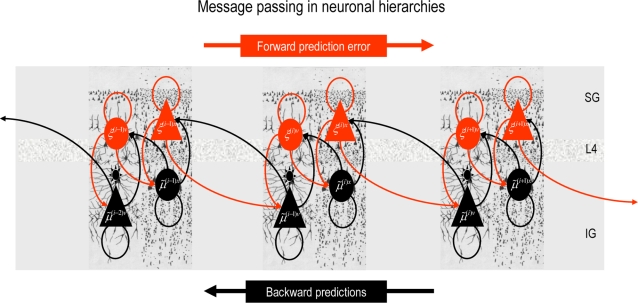
“There is a key functional asymmetry between forward and backward connections that renders backward connections more modulatory or nonlinear in their effects on neuronal responses (e.g., [44]; see also Hupe et al. [47]).”
§ Hierarchical Models in the Brain > Results > Neuronal Implementation
What the sources say
- Partly supportedcites [44] SM Sherman, 1998, On the actions that one nerve cell can have on another: distinguishing “drivers” from “modulators”., Proc Natl Acad Sci U S A sourceExperimental — accuracy not yet measured
In the paper’s discussion of lateral geniculate inputs (indexed as Abstract; page unavailable), retinal inputs are treated as drivers, while inputs from cortex are described as modulators. That supports a forward-versus-backward distinction for this thalamic relay, but the Conclusions say that classifying corticocortical pathways remains largely untested; the paper does not establish the claimed general asymmetry or characterize backward effects as nonlinear. (LLM, conf=0.84)
- Not checked — no full text of the sourcecites Hupe et al. [47] JM Hupe, 1998, Cortical feedback improves discrimination between figure and background by V1, V2 and V3 neurons., Nature source
plainstates a cause- Asserted: passes — The authors put it forward as true.
- Checkable: passes — It can be checked against evidence.
- Load-bearing: passes — The paper’s conclusions depend on it.
- Based: passes — The paper gives a reason why it holds.
- Partly supported
The sources with a verdict support this claim; the rest weren’t checked yet, have no full text we could read, or their verdicts aren’t rated yet.
In the paper
“This selective modulation of afferents mirrors the gain-control mechanisms invoked for attention; e.g., [58],[59].”
§ Hierarchical Models in the Brain > Results > Neuronal Implementation
What the sources say
- Not checked — no full text of the sourcecites [58] S Treue, 1996, Attentional modulation of visual motion processing in cortical areas MT and MST., Nature source
- Supportedcites [59] JC Martinez-Trujillo, 2004, Feature-based attention increases the selectivity of population responses in primate visual cortex., Curr Biol source
The Conclusions (page unavailable) state that feature-based attention multiplicatively modulates neuronal responses in line with a feature-similarity gain model. This supports the cited comparison to attentional gain control; the sentence does not attribute the modulation of afferents themselves to this paper. (LLM, conf=0.88)
plainstates an association- Asserted: passes — The authors put it forward as true.
- Checkable: passes — It can be checked against evidence.
- Load-bearing: passes — The paper’s conclusions depend on it.
- Based: passes — The paper gives a reason why it holds.
The cited sources support only part of this claim — read each source’s verdict below.
In the paper
“Functional asymmetries in forwards (linear) and backwards (nonlinear) connections may reflect their distinct roles in recognition (c.f., [44]).”
§ Hierarchical Models in the Brain > Results > Neuronal Implementation
What the sources say
- Partly supportedcites [44] SM Sherman, 1998, On the actions that one nerve cell can have on another: distinguishing “drivers” from “modulators”., Proc Natl Acad Sci U S A sourceExperimental — accuracy not yet measured
The paper distinguishes driver inputs, which transmit receptive-field properties, from modulator inputs, which alter transmission (Abstract; page unavailable). It also discusses different possible roles for thalamocortical and corticothalamic pathways. It does not characterize forward connections as linear or backward connections as nonlinear, or link those properties to recognition; the Conclusions say corticocortical pathway classifications remain largely untested. (LLM, conf=0.76)
hedgedstates a possible cause- Asserted: passes — The authors put it forward as true.
- Checkable: passes — It can be checked against evidence.
- Load-bearing: unclear — It is unclear whether the paper’s conclusions depend on it.
- Based: passes — The paper gives a reason why it holds.
- Partly supported
Every source the paper cites for this claim was checked and supports it.
In the paper
“Arguments like this suggest that free-form approximations and their attending sampling schemes are not really viable in a neuronal context (although they have been considered; see [86] and above)”
§ Hierarchical Models in the Brain > Discussion
What the sources say
- Supportedcites [86] TS Lee, 2003, Hierarchical Bayesian inference in the visual cortex., J Opt Soc Am A source
The citation is attached to the parenthetical point that sampling-based approximations have been considered in a neuronal context, not to the citing authors’ conclusion that they are unviable. In “Particle Filtering and Bayesian Belief Propagation,” Lee and Mumford discuss weighted samples as an approximation to perceptual probability distributions; the Introduction proposes particle filtering as a possible cortical algorithm. The source does not endorse the unviability conclusion. (LLM, conf=0.92)
hedgedstates a cause- Asserted: passes — The authors put it forward as true.
- Checkable: passes — It can be checked against evidence.
- Load-bearing: passes — The paper’s conclusions depend on it.
- Based: passes — The paper gives a reason why it holds.
- Supported
The cited sources that could be checked couldn’t confirm or dispute this claim.
In the paper
“Lateral interactions may encode the relative precision of prediction errors and change in a way that is consistent with classical neuromodulation (c.f., [63],[71]).”
§ Hierarchical Models in the Brain > Results > Neuronal Implementation
What the sources say
- Not checked — no full text of the sourcecites [63] AJ Yu, 2005, Uncertainty, neuromodulation and attention., Neuron source
- Could not verifycites [71] Y Niv, 2005, Dopamine, uncertainty and TD learning., Behav Brain Funct sourceExperimental — accuracy not yet measured
The Discussion (page unavailable) addresses asymmetric dopamine coding of prediction errors and mentions a possible opponent neurotransmitter. Searches for lateral interactions, relative precision, and neuromodulation found no passage saying that lateral interactions encode precision or change in the claimed way. (LLM, conf=0.76)
hedgedstates a possible cause- Asserted: passes — The authors put it forward as true.
- Checkable: passes — It can be checked against evidence.
- Load-bearing: passes — The paper’s conclusions depend on it.
- Based: passes — The paper gives a reason why it holds.
122 more claims · 1 with their cited sources checked
Create a free account to see all 244 claims and to verify the 3 references still open.
- Probably not a substantial claim. 65
- It may state two separate claims as one. 65
- The quote only partly states this claim. 1
Claims other papers make about this one
Each is checked against this paper’s own text: does it say what the citing paper says it does?
The source backs part of the claim, not all of it — or backs it for a different population, condition or comparison.
In the citing paper
“This equation says that the contribution of any (angular) frequency ω in the prediction errors (encoded by superficial pyramidal cells) to the expectations (encoded by the deep pyramidal cells) is suppressed in proportion to that frequency (Friston 2008). In other words, high frequencies should be attenuated when passing from superficial to deep pyramidal cells.”
From Canonical Microcircuits for Predictive Coding (2012) · cites this paper as Friston 2008
Experimental — accuracy not yet measuredThe source backs part of the claim, not all of it — or backs it for a different population, condition or comparison.
In the citing paper
“and lies in the integrity of neuromodulatory function (2).”
From A more precise look at context in autism (2015) · cites this paper as [2]
Experimental — accuracy not yet measuredThe source backs part of the claim, not all of it — or backs it for a different population, condition or comparison.
In the citing paper
“its solutions grandfather nearly every known statistical estimation scheme, under parametric assumptions about additive or multiplicative noise (Friston, 2008)”
From The Computational Anatomy of Psychosis (2013) · cites this paper as Friston, 2008
Experimental — accuracy not yet measuredThe source backs part of the claim, not all of it — or backs it for a different population, condition or comparison.
In the citing paper
“Predictive coding is a process theory with a biologically plausible back story and a considerable amount of empirical support [21,22].”
From Active interoceptive inference and the emotional brain (2016) · cites this paper as [21]
Experimental — accuracy not yet measuredThe source backs part of the claim, not all of it — or backs it for a different population, condition or comparison.
In the citing paper
“Cortical bias or gain control is mediated by intrinsic inhibitory connections within cortical sources, which rescale prediction errors, in proportion to their precision, so that as precision increases intrinsic recurrent inhibition decreases (Abbott et al., 1997, Friston, 2008).”
From The functional anatomy of schizophrenia: A dynamic causal modeling study of predictive coding (2014) · cites this paper as Friston, 2008
Experimental — accuracy not yet measured
18 more claims about this paper
Create a free account to see every claim other papers make about this one.
Citations
Cites
Maximum Likelihood from Incomplete Data Via the EM Algorithm
Dempster, A. P., Laird, N. M., & Rubin, D. B. (1977) · Journal of the Royal Statistical Society Series B: Statistical Methodology · doi:10.1111/j.2517-6161.1977.tb01600.x · Cited by 50,444 · cited 1×
“We have discussed static cases of this fixed-form scheme previously and how it reduces to expectation maximisation ( EM ; [17]) and restricted maximum likelihood ( ReML ; [18]) for linear models [15].”
BackgroundA New Approach to Linear Filtering and Prediction Problems
Kalman, R. E. (1960) · Journal of Basic Engineering · doi:10.1115/1.3662552 · Cited by 31,751 · cited 1×
“The conventional approach to online Bayesian tracking of nonlinear or non-Gaussian systems employs extended Kalman filtering [30] or sequential Monte Carlo methods such as particle filtering.”
MethodLearning Internal Representations by Error Propagation
Rumelhart, D. E., Hinton, G. E., & Williams, R. J. (1985) · doi:10.21236/ada164453 · Cited by 16,172
An Information-Maximization Approach to Blind Separation and Blind Deconvolution
Bell, A. J., & Sejnowski, T. J. (1995) · Neural Computation · doi:10.1162/neco.1995.7.6.1129 · Cited by 8,986 · cited 1×
“) decomposes the observed response into a linear mixture of non-Gaussian causes”
Neural Mechanisms of Selective Visual Attention
Desimone, R., & Duncan, J. (1995) · Annual Review of Neuroscience · doi:10.1146/annurev.ne.18.030195.001205 · Cited by 8,388
Distributed hierarchical processing in the primate cerebral cortex
Felleman, D. J., & Van Essen, D. C. (1991) · Cerebral Cortex · doi:10.1093/cercor/1.1.1 · Cited by 7,783 · cited 2×
“This means we would expect to see connections reciprocated in the brain, which is generally the case [39,40].”
BackgroundStochastic Processes and Filtering Theory
(1970) · Mathematics in Science and Engineering · doi:10.1016/s0076-5392(09)x6022-4 · Cited by 7,302
Emergence of simple-cell receptive field properties by learning a sparse code for natural images
Olshausen, B. A., & Field, D. J. (1996) · Nature · doi:10.1038/381607a0 · Cited by 5,694 · cited 1×
“In the same way that factor analysis is a generalisation of PCA to non-Gaussian causes, ICA can be extended to form sparse-coding models of the sort proposed by Olshausen and Fields [37] by allowing observation error.”
MethodRao, R. P. N., & Ballard, D. H. (1999) · Nature Neuroscience · doi:10.1038/4580 · Cited by 5,483 · cited 2×
“The mean-field approximation q ( W )= q ( u ( t )) q ( h ) q ( l ) enables inference about perceptual states, causal regularities and context, without representing the joint distribution explicitly; c.f., [64].”
BackgroundA theory of cortical responses.
Friston, K. (2005) · Philosophical Transactions of the Royal Society B: Biological Sciences · doi:10.1098/rstb.2005.1622 · Cited by 4,578 · cited 2×
“We have laid out the neurobiological and psycho-physical motivation for the neuronal implementation of DEM in [3] and [4].”
MethodSelf-citation
Research works printed but not linked: 4
- DJC MacKay, 1995, Free-energy minimisation algorithm for decoding and cryptoanalysis., Electron Lett, 31, 445
- T Ozaki, 1992, A bridge between nonlinear time-series models and nonlinear stochastic dynamical systems: A local linearization approach., Stat Sin, 2, 113
- ME Tipping, 2001, Sparse Bayesian learning and the Relevance Vector Machine., J Mach Learn Res, 1, 211
- CE Rasmussen, 1996, Evaluation of Gaussian Processes and Other Methods for Nonlinear Regression [PhD thesis]. Toronto, Canada: Department of Computer Science, University of Toronto.
Cited by
Items 801–900 of 975
Woolrich, M. W., & Chappell, M. A. (2015) · Elsevier eBooks · doi:10.1016/b978-0-12-397025-1.00325-0
Goupil, L. (2015) · theses.fr (ABES) · doi:10.70675/428bec58z5847z41acz905fzc51410a051e2 · Cited by 2
“Broadly, the idea is that the brain predicts changes in its own activity by minimizing “prediction errors”, which are evoked when sensory inputs differ from prior representations (Friston, 2008; Hohwy, 2013).”
BackgroundMethodInfluentialEllis, G. (2016) · The frontiers collection · doi:10.1007/978-3-662-49809-5_7
A Topological Theory of Knowledge in the Human BrainPreprint
Tozzi, A., & Peters, J. F. (2016) · viXra
Biomarkers of brain function in psychosis and their genetic basis
Ranlund, S. M. (2016) · UCL Discovery (University College London)
Commentary on Sanborn and Chater: Posterior Modes are Attractor BasinsPreprint
Alday, P. M., Schlesewsky, M., & Bornkessel‐Schlesewsky, I. (2017) · bioRxiv (Cold Spring Harbor Laboratory) · doi:10.1101/109355
“Sanborn and Chater briefly touch upon the connection of their work to Friston’s hierarchical model proposal, but only link it somewhat generally to the broad computational approach he has proposed for the representation and computation of these models in neural wetware [7].”
BackgroundCharacterizing predictive auditory processing with EEG
Reiche, M. (2016) · Qucosa (Saxon State and University Library Dresden)
Hybrid Active InferencePreprint
Ofner, A., & Stober, S. (2018) · arXiv (Cornell University) · doi:10.48550/arxiv.1810.02647 · Cited by 1
“Friston argues that hierarchical predictive coding, which is line with many observations about neural processing in the brain, can be used to implement active inference [35].”
BackgroundPuviani, L., & Rama, S. (2018) · Behavioural Brain Research · doi:10.1016/j.bbr.2018.10.019
“called predictive coding theory [30], which shows how automatic inference about the causes of sensory inputs are performed in a hierarchical structure within the brain.”
The Principles of Adaptation in Recognition and Behavior
Shimazaki, H. (2018) · The Brain & Neural Networks · doi:10.3902/jnns.25.86 · Cited by 2
Nonmodular Architectures of Cognitive Systems based on Active Inference
Baltieri, M., & Buckley, C. L. (2019) · International Joint Conference on Neural Networks (IJCNN) · doi:10.1109/ijcnn.2019.8852048 · Cited by 13
“We start by defining a generative model for an agent capturing the dynamics of the system to control and how these relate to observations and represented in a generalised state-space form [24], [31]:”
BackgroundMethodInfluentialGiersch, A., Poncelet, P. E., Duval, C. Z., & Lalanne, L. (2018) · BRILL eBooks · doi:10.1163/9789004280205_015
“It has been proposed that ‘predictive coding’ might apply generally to brain functioning (Friston, 2008).”
BackgroundPuviani, L., & Rama, S. (2016) · arXiv (Cornell University) · doi:10.48550/arxiv.1602.00258
“We argue such a model could be represented by the so called predictive coding model (and its version applied to action learning; active inference) [42, 43, 44, 45].”
BackgroundMethodInfluentialWalsh, B. C., Woods, S. W., & Powers, A. R. (2019) · Springer eBooks · doi:10.1007/978-3-030-17336-4_21
Kukkonen, K. (2019) · Oxford University Press eBooks · doi:10.1093/oso/9780190050955.003.0010
Kukkonen, K. (2019) · Oxford University Press eBooks · doi:10.1093/oso/9780190050955.003.0011
Kukkonen, K. (2019) · Oxford University Press eBooks · doi:10.1093/oso/9780190050955.003.0015
Kukkonen, K. (2019) · Oxford University Press eBooks · doi:10.1093/oso/9780190050955.003.0006
Artificial, in the Best Sense of the Word
Kukkonen, K. (2019) · Oxford University Press eBooks · doi:10.1093/oso/9780190050955.003.0012
Pleasures and Precision Shifts
Kukkonen, K. (2019) · Oxford University Press eBooks · doi:10.1093/oso/9780190050955.003.0007
Plots and Probability Transformations
Kukkonen, K. (2019) · Oxford University Press eBooks · doi:10.1093/oso/9780190050955.003.0002
Literature as a Designer Environment
Kukkonen, K. (2019) · Oxford University Press eBooks · doi:10.1093/oso/9780190050955.003.0014
Intertextual Precision Expectations
Kukkonen, K. (2019) · Oxford University Press eBooks · doi:10.1093/oso/9780190050955.003.0009
Introduction: Literature and Predictive Processing
Kukkonen, K. (2019) · Oxford University Press eBooks · doi:10.1093/oso/9780190050955.003.0001
Kukkonen, K. (2019) · Oxford University Press eBooks · doi:10.1093/oso/9780190050955.003.0013
Kukkonen, K. (2019) · Oxford University Press eBooks · doi:10.1093/oso/9780190050955.003.0004
Toward a naturalistically explicable folk psychology
Hougaard, D. S. (2019) · SUNScholar (Stellenbosch University)
Magnetoencephalographical Research in Schizophrenia: Current Status and Perspectives
Hua, L., Grent-‘t-Jong, T., & Uhlhaas, P. J. (2020) · Springer eBooks · doi:10.1007/978-3-030-35206-6_12 · Cited by 1
“Impossible to stop just now. Why, if I could only prove one simple little lemma”
Elpidorou, A. (2020) · Oxford University Press eBooks · doi:10.1093/oso/9780190912963.003.0007
“Immobile paradises promise us nothing”
Elpidorou, A. (2020) · Oxford University Press eBooks · doi:10.1093/oso/9780190912963.003.0010
“Confined in an invisible bubble that prevents contact with the world”
Elpidorou, A. (2020) · Oxford University Press eBooks · doi:10.1093/oso/9780190912963.003.0004
“An energizer, but not a guide; an engine, but not a steering gear”
Elpidorou, A. (2020) · Oxford University Press eBooks · doi:10.1093/oso/9780190912963.003.0006
“Like water after days in the desert”
Elpidorou, A. (2020) · Oxford University Press eBooks · doi:10.1093/oso/9780190912963.003.0005
“What do you think it’s like being dead?”
Elpidorou, A. (2020) · Oxford University Press eBooks · doi:10.1093/oso/9780190912963.003.0003
“I hear you clearly, yet your voice sounds far away—distant and unreal”
Elpidorou, A. (2020) · Oxford University Press eBooks · doi:10.1093/oso/9780190912963.003.0002
“And you, what do you think of optimism?”
Elpidorou, A. (2020) · Oxford University Press eBooks · doi:10.1093/oso/9780190912963.003.0009
“The secret to happiness may be unhappiness”
Elpidorou, A. (2020) · Oxford University Press eBooks · doi:10.1093/oso/9780190912963.003.0001
“Our possible existence is always greater than our destiny”
Elpidorou, A. (2020) · Oxford University Press eBooks · doi:10.1093/oso/9780190912963.003.0008
Social Neuroscience in Global Mental Health: Case Study on Stigma Reduction in Nepal
Kohrt, B. A. (2020) · Cambridge University Press eBooks · doi:10.1017/9781108695374.024 · Cited by 3
Literary Analysis and Weak Theories
Moses, O. (2020) · Cambridge University Press eBooks · doi:10.1017/9781108695374.022
Cities, Psychosis, and Social Defeat
Sayanvala, F., Bornstein, L., Choudhury, S., Shah, J. L., Weinstock, D., & Gold, I. (2020) · Cambridge University Press eBooks · doi:10.1017/9781108695374.025 · Cited by 1
Experience-Dependent Plasticity in the Hippocampus
West, G. L., & Bohbot, V. D. (2020) · Cambridge University Press eBooks · doi:10.1017/9781108695374.019
Improving Sequential Latent Variable Models with Autoregressive FlowsPreprint
Marino, J., Chen, L., He, J., & Mandt, S. (2020) · arXiv (Cornell University) · doi:10.48550/arxiv.2010.03172
“Modeling finite differences (or generalized coordinates (Friston 2008)) is a well-established technique, (see, e.g. ( Chua et al. 2018; Kumar et al. 2020)), which is generalized by affine autoregressive flows.”
MethodDifferent computations over the same inputs produce selective behavior in algorithmic brain networksPreprint
Jaworska, K., van Rijsbergen, N. J., Ince, R. A. A., & Schyns, P. G. (2021) · bioRxiv (Cold Spring Harbor Laboratory) · doi:10.1101/2021.02.04.429372
van Vucht, V. (2021) · Research Repository (Delft University of Technology)
Aedo-Sánchez, C. A. (2020) · Gredos (University of Salamanca) · doi:10.14201/gredos.145489
A brain basis of dynamical intelligence for AI and computational neurosciencePreprint
Monaco, J. D., Rajan, K., & Hwang, G. M. (2021) · arXiv (Cornell University) · doi:10.48550/arxiv.2105.07284 · Cited by 10
“This oscillatory division-of-labor is consistent with a “spectral connectome” for internal generative models 9,52,154–156 and a recent striking discovery of a beta-band hippocampal mode that emits reversed sequences 157 .”
ResultLearning Uncertainty: The Free Energy Principle in Anxiety FormationPreprint
McGovern, H. T., Foe, A. D., Leptourgos, P., Corlett, P. R., Bandara, K. H., Biddell, H., & Hutchinson, B. T. (2021) · doi:10.31234/osf.io/8zsv3
Applications of the Free Energy Principle to Machine Learning and NeurosciencePreprint
Millidge, B. (2021) · arXiv (Cornell University) · doi:10.7488/era/1501 · Cited by 18
“Both of these processes can be operationalized via the minimization of prediction error, first through the optimization of neuronal firing rates on a fast timescale, and then the optimization of synaptic weights on a slow timescale (Friston, 2008a).”
BackgroundMethodInfluentialAggarwal, A., Brennan, C. M., Luo, J., Chung, H., Contreras, D., Kelz, M. B., & Proekt, A. (2021) · bioRxiv (Cold Spring Harbor Laboratory) · doi:10.1101/2021.08.09.455716
Wiese, W., & Metzinger, T. K. (2021) · Cuadernos Filosóficos / Segunda Época · doi:10.35305/cf2.vi17.118
“En este caso, la energía libre es una cantidad teórica de la información, cuya minimización es posible desde la perspectiva del animal (para más detalles, Friston, 2008; Friston, 2009; Friston, 2010).”
Temporal Structure of Now from a Close-Up View
Lubashevsky, I., & Plavinska, N. (2021) · Understanding complex systems · doi:10.1007/978-3-030-82612-3_2
How theory can go wrong: The case of simplicity and likelihood in perceptionPreprint
Kubovy, M. (2021) · OSF Preprints (OSF Preprints) · doi:10.31219/osf.io/dcvzj
Neural underpinning of Japanese particle processing in non-native speakersPreprint
Kasai, C., Sumiya, M., Koike, T., Yoshimoto, T., Maki, H., & Sadato, N. (2021) · PsyArXiv (OSF Preprints) · doi:10.31234/osf.io/y89hg
Neural Underpinning of Japanese Particle Processing in Non-native SpeakersPreprint
Kasai, C., Sumiya, M., Koike, T., Yoshimoto, T., Maki, H., & Sadato, N. (2021) · Research Square · doi:10.21203/rs.3.rs-1159817/v1
(2018) · BRILL eBooks · doi:10.1163/9789004280205_001
How Social Coordination and Cooperation are Achieved
Kirmayer, L. J., Worthman, C. M., Kitayama, S., Lemelson, R., & Cummings, C. A. (2020) · Cambridge University Press eBooks · doi:10.1017/9781108695374.013
Kirmayer, L. J., Worthman, C. M., Kitayama, S., Lemelson, R., & Cummings, C. A. (2020) · Cambridge University Press eBooks · doi:10.1017/9781108695374.001
The Co-emergence of Culture, Mind, and Brain
Kirmayer, L. J., Worthman, C. M., Kitayama, S., Lemelson, R., & Cummings, C. A. (2020) · Cambridge University Press eBooks · doi:10.1017/9781108695374.004
Kirmayer, L. J., Worthman, C. M., Kitayama, S., Lemelson, R., & Cummings, C. A. (2020) · Cambridge University Press eBooks · doi:10.1017/9781108695374.008
(2020) · Cambridge University Press eBooks · doi:10.1017/9781108695374.017
Contextual expectancy, prior belief, and prediction error in early stage visual processing
Overell, A. M. (2022) · Queensland University of Technology · doi:10.5204/thesis.eprints.229732
Davenport, D. (2016) · Synthese Library/Synthese library · doi:10.1007/978-3-319-26485-1_20
Kukkonen, K. (2019) · Oxford University Press eBooks · doi:10.1093/oso/9780190050955.003.0005
Kirmayer, L. J., Worthman, C. M., Kitayama, S., Lemelson, R., & Cummings, C. A. (2020) · Cambridge University Press eBooks · doi:10.1017/9781108695374.029
Computational Psychiatry and the Bayesian Brain
Friston, K. J., & Dolan, R. J. (2017) · Oxford University Press eBooks · doi:10.1093/med/9780190681425.003.0072
Self-citationKukkonen, K. (2019) · Oxford University Press eBooks · doi:10.1093/oso/9780190050955.003.0008
Decision letter for "Grazer behaviour can regulate large‐scale patterning of community states"
(2021) · Publons reviews and discussion · doi:10.1111/ele.13828/v3/decision1
“In fact, ∆xt is a finite differences approximation of the generalized velocity (Friston, 2008) of x, a classic modeling technique in dynamical models and control (Kalman et al., 1960), redefining the state-space to be first-order Markov.”
InfluentialPupil dilation indexes automatic and dynamic inference about the precision of stimulus distributionsPreprint
Silvestrin, F., Penny, W. D., & FitzGerald, T. H. B. (2019) · doi:10.31234/osf.io/3evuy
Variational Bayesian Method: Ritz Method in Stochastic System
Isshiki, H. (2022) · Asian Journal of Probability and Statistics · doi:10.9734/ajpas/2022/v18i130437
Examining how attention and prediction modulate visual perception: A predictive coding view
Baker, K. S. (2022) · Queensland University of Technology · doi:10.5204/thesis.eprints.235895
A dynamical model of visual motion processing for arbitrary stimuli including type II plaids
Korai, Y., & Miura, K. (2023) · Neural Networks · doi:10.1016/j.neunet.2023.02.039
Adaptive Control of Uncertain Systems with Input Delay Based on Active Inference
Ji, M., Lyu, Y., Pan, Q., Wei, G., & Wei, D. (2023) · Lecture notes in electrical engineering · doi:10.1007/978-981-99-0479-2_260 · Cited by 1
Temporal Stability of Bayesian Belief Updating in Perceptual Decision MakingPreprint
Goodwin, I., Hester, R., & Garrido, M. I. (2023) · doi:10.31234/osf.io/wj8xh
de Vasconcelos, M. L. I. (2023) · Digital Library of Theses and Dissertations (Universidade de São Paulo) · doi:10.11606/d.8.2023.tde-17052023-114613 · Cited by 1
Aedo, C. (2023) · Revista de otorrinolaringología y cirugía de cabeza y cuello · doi:10.4067/s0718-48162023000200185 · Cited by 2
Acetylcholine Modulates the Precision of Prediction Error in the Auditory CortexPreprint
Pérez‐González, D., Lao-Rodríguez, A. B., Aedo, C., & Malmierca, M. S. (2023) · bioRxiv (Cold Spring Harbor Laboratory) · doi:10.1101/2023.08.17.553683
“According to the predictive coding model, there are, therefore, two mechanisms underlying the MMN/nMM ( Auksztulewicz and Friston, 2016 ; Carbajal and Malmierca, 2018 ; Friston and Sporns, 2008 ; Harms et al., 2021 ; Parras et al., 2017 ).”
MethodInfluentialCan working memory be explained by predictive coding?Preprint
Feng, M. (2023) · Thesis Commons (OSF Preprints) · doi:10.31237/osf.io/sqfr9
(2023) · The MIT Press eBooks · doi:10.7551/mitpress/10400.003.0029
A New Theory of Data Processing: Applying Artificial Intelligence to Cognition and Humanity
Liu, J. (2023) · INTERNATIONAL CONFERENCE ON MULTIMODAL INTERACTION · doi:10.1145/3577190.3616123
“It’s contended that the cortical responses in our brain observe a hierarchical model with forward and backward connections, where the forward driving connections convey prediction errors from a lower area to a higher area, and nonlinear backward connections construct predictions [9, 10, 14].”
BackgroundAtypical sensory perception in autism from the perspective of Bayesian framework
Cui, K., Luo, F., & Wang, J. (2023) · Chinese Science Bulletin (Chinese Version) · doi:10.1360/tb-2023-0939
Active Inference in Hebbian Learning Networks
Safa, A., Verbelen, T., Keuninckx, L., Ocket, I., Bourdoux, A., Catthoor, F., Gielen, G. E., & Cauwenberghs, G. (2023) · Communications in computer and information science · doi:10.1007/978-3-031-47958-8_15 · Cited by 2
Emotion processes and perceptual control of action choice
Scherer, K. R. (2023) · Cognition & Emotion · doi:10.1080/02699931.2023.2269828 · Cited by 1
“It will be of interest to compare Eder ’ s PCT to other emotion and action control (PC) theories, in particular the Predictive Coding tradition (Friston, 2008, 2012; Rao & Ballard, 1999).”
Delay Feedback Active Inference based on Predicted States for Uncertain Systems with Input Delay
Ji, M., Lyu, Y., Pan, K., Zhang, X., Pan, Q., Li, Y., Zhao, C., & Hu, J. (2023) · IEEE Conference on Decision and Control (CDC) · doi:10.1109/cdc49753.2023.10383848
The Environmental Model of MindfulnessPreprint
Meaden, J. (2024) · doi:10.31234/osf.io/3a78g
The Way Forward for Grounded Cognition - Invariant Representations in Abstract Concept GroundingPreprint
Friedrich, J. C., Fischer, M. H., & Raab, M. (2024) · doi:10.31234/osf.io/tsrcf
Sadato, N. (2024) · Rinsho Shinkeigaku · doi:10.5692/clinicalneurol.cn-001944
TANIYAMA, K., Shibue, H., & YANAGISAWA, H. (2024) · SSRN Electronic Journal · doi:10.2139/ssrn.4819891
Kukkonen, K. (2020) · Oxford University Press eBooks · doi:10.1093/oso/9780190050955.002.0005
Kukkonen, K. (2020) · Oxford University Press eBooks · doi:10.1093/oso/9780190050955.002.0008
Kukkonen, K. (2020) · Oxford University Press eBooks · doi:10.1093/oso/9780190050955.002.0003
Elpidorou, A. (2020) · Oxford University Press eBooks · doi:10.1093/oso/9780190912963.002.0005
Elpidorou, A. (2020) · Oxford University Press eBooks · doi:10.1093/oso/9780190912963.002.0007
Elpidorou, A. (2020) · Oxford University Press eBooks · doi:10.1093/oso/9780190912963.002.0008
Elpidorou, A. (2020) · Oxford University Press eBooks · doi:10.1093/oso/9780190912963.002.0003
Elpidorou, A. (2020) · Oxford University Press eBooks · doi:10.1093/oso/9780190912963.002.0004
Bridging Perspectives - A Review and Synthesis of 52 Theoretical Models of Delusions (Preprint)Preprint
Denecke, S., Schönig, S. N., Bott, A., Faße, J. L., & Lincoln, T. M. (2024) · doi:10.31234/osf.io/bc6a8
Active Inference in Hebbian Learning Networks
Safa, A., Keuninckx, L., Gielen, G. E., & Catthoor, F. (2024) · Springer eBooks · doi:10.1007/978-3-031-63565-6_7 · Cited by 1
Sparsity Limit to Prune Large Language Models for on-Device AI Assistants: Llama-2 as an ExamplePreprint
Liu, B., & Xu, Y. (2024) · Preprints.org · doi:10.20944/preprints202407.1568.v1
Pregled teorija i istraživanja o ulozi silaznih putova u vidnoj percepciji
Marić, M. (2024) · Psihologijske teme · doi:10.31820/pt.33.2.5
Metadata
- Authors
- Friston, K.
- Affiliations
- Wellcome Centre for Human Neuroimaging (GB)
- Corresponding author
- Friston, Karl
- ORCID
- Friston, Karl
- Venue
- PLoS Computational Biology
- Publisher
- Public Library of Science (PLoS)
- Published
- 2008-11-07
- Volume
- 4
- Issue
- 11
- Pages
- e1000211
- ISSN
- 1553-734X (ISSN-L)
- 1553-7358
- PMC
- PMC2570625
- OpenAlex
- W1977628053
- Cited by
- 952
- References
- 102
- Citations by year
- 2026: 53 · 2025: 71 · 2024: 58 · 2023: 79 · 2022: 66 · 2021: 84 · 2020: 106 · 2019: 60 · 2018: 57 · 2017: 55 · 2016: 52 · 2015: 46 · 2014: 38 · 2013: 35 · 2012: 32
- FWCI
- 31.65
- Type
- journal article
- Language
- en
- Open access
- gold
- doi.org
- Licence
- cc-by
- Locations
- PLoS Computational Biology (publishedVersion, cc-by)
- PubMed Central (publishedVersion, cc-by)
- PubMed (publishedVersion)
- RePEc: Research Papers in Economics (submittedVersion)
- DOAJ (DOAJ: Directory of Open Access Journals) (submittedVersion, cc-by-sa)
- UCL Discovery (University College London) (submittedVersion)
- Funders
- Wellcome Trust (088130)
- Topics
- Physical Sciences › Computer Science › Artificial Intelligence › Bayesian Modeling and Causal Inference
- Physical Sciences › Computer Science › Artificial Intelligence › Gaussian Processes and Bayesian Inference
- Physical Sciences › Computer Science › Artificial Intelligence › Neural Networks and Applications
- Keywords
- hierarchical models, state-space model, dynamic causal modeling, model inversion, nonlinear time series analysis, general linear model, neural network inversion, brain learning
- MeSH terms
- Algorithms, Animals, Brain, Humans, Mental Processes, Models, Neurological, Nerve Net, Probability, Linear Models, Neural Networks, Computer, Nonlinear Dynamics
About these checks
Registry, retraction, Cites and statistics results are computed, not judged, with one exception: a printed reference that no index lists is read once by a model before it counts as a citation error. Claims are extracted by a model and kept only when their quote appears verbatim in the text; each cited source is then checked, with a model’s help, for whether it says what the claim relies on. Those verdicts can be wrong — read the claim’s quote and the cited source before relying on one.
The claim verdicts this report counts are experimental: their accuracy is not yet measured.
A language model drew the claims from the paper on 2026-10-10, under version 3 of the claim definition (model deepseek-v4.1-flash, prompt extract-v3).
A second model labelled each claim on 2026-10-10 (model jev-1.13-20260917, definition revision gold-guideline-v0.2).
Cited sources are checked with a language model’s help (gpt-6-sol).
Statistics and arithmetic are recomputed, not judged.
Confidence bands are shown only for fields calibrated on our annotated test set. None is calibrated yet, so no band is shown.
What counts as a claim ›How we measure confidence ›How we check this ›
Are you an author, or do you see a problem with this page? Request a review
Data sources
Bibliographic data: Semantic Scholar, OpenAlex, Crossref.
Contains information from the Semantic Scholar Academic Graph Datasets, made available under the ODC Attribution License (ODC-BY 1.0).
Semantic Scholar’s data is described in: Kinney, R., et al. (2023). The Semantic Scholar Open Data Platform. arXiv:2301.10140.
