

Hierarchical Models in the Brain
Open accessThe DOI matches its Crossref record; 95 of the 102 references it cites were found in a registry or an index; 10 of the 81 sources its claims cite were checked for support.
Abstract
This paper describes a general model that subsumes many parametric models for continuous data. The model comprises hidden layers of state-space or dynamic causal models, arranged so that the output of one provides input to another. The ensuing hierarchy furnishes a model for many types of data, of arbitrary complexity. Special cases range from the general linear model for static data to generalised convolution models, with system noise, for nonlinear time-series analysis. Crucially, all of these models can be inverted using exactly the same scheme, namely, dynamic expectation maximization. This means that a single model and optimisation scheme can be used to invert a wide range of models. We present the model and a brief review of its inversion to disclose the relationships among, apparently, diverse generative models of empirical data. We then show that this inversion can be formulated as a simple neural network and may provide a useful metaphor for inference and learning in the brain.
Overview
CoChat Summary
## TL;DR
This paper presents hierarchical dynamic models (HDMs) as a very general framework that contains many familiar static and dynamic statistical models as special cases, all invertible with the same dynamic expectation maximization (DEM) scheme. It argues that the same inversion can be written as a simple neural network and may serve as a metaphor for inference and learning in the brain.
## Key findings
- HDMs “subsum[e] many parametric models for continuous data,” ranging from the general linear model for static data to generalized convolution models with system noise for nonlinear time-series analysis.
- The paper claims that these diverse models can all be inverted using the same scheme, dynamic expectation maximization (DEM), under a Laplace/mean-field variational approximation.
- In the results, the author shows that HDMs encompass standard tools including the general linear model, expectation maximization (EM), restricted maximum likelihood (ReML), covariance component estimation, Gaussian process models, PCA, factor analysis, ICA, sparse coding, deconvolution, and state-space filtering.
- A worked example is described in which DEM converged in “about sixteen iterations” using embedding order “n = 6” and roughness hyperparameter “γ = 4,” with the text stating that the recovered states, parameters, and hyperparameters closely matched the true values and that the true values lay largely within the 90% confidence intervals.
## Methods
- The paper develops a hierarchical dynamic model in generalized coordinates of motion, with hidden states and causes organized across levels; the model includes Gaussian priors and Gaussian assumptions about fluctuations, and uses prediction errors at each level.
- Inversion is based on variational Bayes under mean-field and Laplace approximations, optimizing free energy / variational action with a dynamic expectation maximization scheme that separates D-step (states), E-step (parameters), and M-step (hyperparameters).
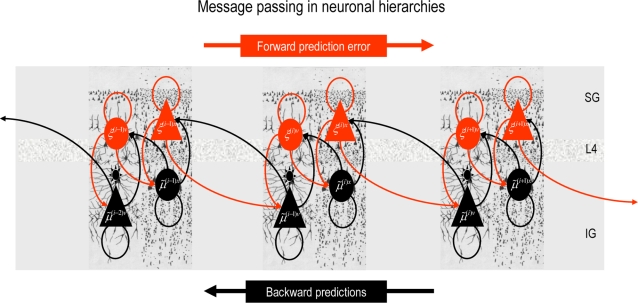
- The paper then maps this inversion scheme onto a neural-network-like message-passing architecture and illustrates the framework with analytic special cases and a simulation example.
## Limitations
- The paper states that the Laplace/Gaussian approximation “restrict[s] recognition to unimodal probabilistic representations,” though it frames this as a practical simplification.
- The text makes evident that many claims are theoretical and illustrative rather than empirically validated in this paper; it says the neuronal implementation “calls for an enormous amount of empirical verification and hypothesis testing” (evident in the text).
- The paper also makes evident that the examples and special-case derivations cover only a “partial list” of possible models, so the treatment is not exhaustive (evident in the text).
Model-written summary. Check it against the paper before relying on it.
Integrity signals
Registry
Cites
Statistics
Figures



Verification
Claims the paper makes
9 Valid · 2 Not valid · 48 Not checked · 185 Own results and interpretations
The cited sources support only part of this claim — read each source’s verdict below.
In the paper
“There is a key functional asymmetry between forward and backward connections that renders backward connections more modulatory or nonlinear in their effects on neuronal responses (e.g., [44]; see also Hupe et al. [47]).”
§ Hierarchical Models in the Brain > Results > Neuronal Implementation
What the sources say
- Partly supportedcites [44] SM Sherman, 1998, On the actions that one nerve cell can have on another: distinguishing “drivers” from “modulators”., Proc Natl Acad Sci U S A sourceExperimental — accuracy not yet measured
In the paper’s discussion of lateral geniculate inputs (indexed as Abstract; page unavailable), retinal inputs are treated as drivers, while inputs from cortex are described as modulators. That supports a forward-versus-backward distinction for this thalamic relay, but the Conclusions say that classifying corticocortical pathways remains largely untested; the paper does not establish the claimed general asymmetry or characterize backward effects as nonlinear. (LLM, conf=0.84)
- Not checked — no full text of the sourcecites Hupe et al. [47] JM Hupe, 1998, Cortical feedback improves discrimination between figure and background by V1, V2 and V3 neurons., Nature source
plainstates a cause- Asserted: passes — The authors put it forward as true.
- Checkable: passes — It can be checked against evidence.
- Load-bearing: passes — The paper’s conclusions depend on it.
- Based: passes — The paper gives a reason why it holds.
- Partly supported
The sources with a verdict support this claim; the rest weren’t checked yet, have no full text we could read, or their verdicts aren’t rated yet.
In the paper
“This selective modulation of afferents mirrors the gain-control mechanisms invoked for attention; e.g., [58],[59].”
§ Hierarchical Models in the Brain > Results > Neuronal Implementation
What the sources say
- Not checked — no full text of the sourcecites [58] S Treue, 1996, Attentional modulation of visual motion processing in cortical areas MT and MST., Nature source
- Supportedcites [59] JC Martinez-Trujillo, 2004, Feature-based attention increases the selectivity of population responses in primate visual cortex., Curr Biol source
The Conclusions (page unavailable) state that feature-based attention multiplicatively modulates neuronal responses in line with a feature-similarity gain model. This supports the cited comparison to attentional gain control; the sentence does not attribute the modulation of afferents themselves to this paper. (LLM, conf=0.88)
plainstates an association- Asserted: passes — The authors put it forward as true.
- Checkable: passes — It can be checked against evidence.
- Load-bearing: passes — The paper’s conclusions depend on it.
- Based: passes — The paper gives a reason why it holds.
The cited sources support only part of this claim — read each source’s verdict below.
In the paper
“Functional asymmetries in forwards (linear) and backwards (nonlinear) connections may reflect their distinct roles in recognition (c.f., [44]).”
§ Hierarchical Models in the Brain > Results > Neuronal Implementation
What the sources say
- Partly supportedcites [44] SM Sherman, 1998, On the actions that one nerve cell can have on another: distinguishing “drivers” from “modulators”., Proc Natl Acad Sci U S A sourceExperimental — accuracy not yet measured
The paper distinguishes driver inputs, which transmit receptive-field properties, from modulator inputs, which alter transmission (Abstract; page unavailable). It also discusses different possible roles for thalamocortical and corticothalamic pathways. It does not characterize forward connections as linear or backward connections as nonlinear, or link those properties to recognition; the Conclusions say corticocortical pathway classifications remain largely untested. (LLM, conf=0.76)
hedgedstates a possible cause- Asserted: passes — The authors put it forward as true.
- Checkable: passes — It can be checked against evidence.
- Load-bearing: unclear — It is unclear whether the paper’s conclusions depend on it.
- Based: passes — The paper gives a reason why it holds.
- Partly supported
Every source the paper cites for this claim was checked and supports it.
In the paper
“Arguments like this suggest that free-form approximations and their attending sampling schemes are not really viable in a neuronal context (although they have been considered; see [86] and above)”
§ Hierarchical Models in the Brain > Discussion
What the sources say
- Supportedcites [86] TS Lee, 2003, Hierarchical Bayesian inference in the visual cortex., J Opt Soc Am A source
The citation is attached to the parenthetical point that sampling-based approximations have been considered in a neuronal context, not to the citing authors’ conclusion that they are unviable. In “Particle Filtering and Bayesian Belief Propagation,” Lee and Mumford discuss weighted samples as an approximation to perceptual probability distributions; the Introduction proposes particle filtering as a possible cortical algorithm. The source does not endorse the unviability conclusion. (LLM, conf=0.92)
hedgedstates a cause- Asserted: passes — The authors put it forward as true.
- Checkable: passes — It can be checked against evidence.
- Load-bearing: passes — The paper’s conclusions depend on it.
- Based: passes — The paper gives a reason why it holds.
- Supported
The cited sources that could be checked couldn’t confirm or dispute this claim.
In the paper
“Lateral interactions may encode the relative precision of prediction errors and change in a way that is consistent with classical neuromodulation (c.f., [63],[71]).”
§ Hierarchical Models in the Brain > Results > Neuronal Implementation
What the sources say
- Not checked — no full text of the sourcecites [63] AJ Yu, 2005, Uncertainty, neuromodulation and attention., Neuron source
- Could not verifycites [71] Y Niv, 2005, Dopamine, uncertainty and TD learning., Behav Brain Funct sourceExperimental — accuracy not yet measured
The Discussion (page unavailable) addresses asymmetric dopamine coding of prediction errors and mentions a possible opponent neurotransmitter. Searches for lateral interactions, relative precision, and neuromodulation found no passage saying that lateral interactions encode precision or change in the claimed way. (LLM, conf=0.76)
hedgedstates a possible cause- Asserted: passes — The authors put it forward as true.
- Checkable: passes — It can be checked against evidence.
- Load-bearing: passes — The paper’s conclusions depend on it.
- Based: passes — The paper gives a reason why it holds.
122 more claims · 1 with their cited sources checked
Create a free account to see all 244 claims and to verify the 3 references still open.
- Probably not a substantial claim. 65
- It may state two separate claims as one. 65
- The quote only partly states this claim. 1
Claims other papers make about this one
Each is checked against this paper’s own text: does it say what the citing paper says it does?
The source backs part of the claim, not all of it — or backs it for a different population, condition or comparison.
In the citing paper
“This equation says that the contribution of any (angular) frequency ω in the prediction errors (encoded by superficial pyramidal cells) to the expectations (encoded by the deep pyramidal cells) is suppressed in proportion to that frequency (Friston 2008). In other words, high frequencies should be attenuated when passing from superficial to deep pyramidal cells.”
From Canonical Microcircuits for Predictive Coding (2012) · cites this paper as Friston 2008
Experimental — accuracy not yet measuredThe source backs part of the claim, not all of it — or backs it for a different population, condition or comparison.
In the citing paper
“and lies in the integrity of neuromodulatory function (2).”
From A more precise look at context in autism (2015) · cites this paper as [2]
Experimental — accuracy not yet measuredThe source backs part of the claim, not all of it — or backs it for a different population, condition or comparison.
In the citing paper
“its solutions grandfather nearly every known statistical estimation scheme, under parametric assumptions about additive or multiplicative noise (Friston, 2008)”
From The Computational Anatomy of Psychosis (2013) · cites this paper as Friston, 2008
Experimental — accuracy not yet measuredThe source backs part of the claim, not all of it — or backs it for a different population, condition or comparison.
In the citing paper
“Predictive coding is a process theory with a biologically plausible back story and a considerable amount of empirical support [21,22].”
From Active interoceptive inference and the emotional brain (2016) · cites this paper as [21]
Experimental — accuracy not yet measuredThe source backs part of the claim, not all of it — or backs it for a different population, condition or comparison.
In the citing paper
“Cortical bias or gain control is mediated by intrinsic inhibitory connections within cortical sources, which rescale prediction errors, in proportion to their precision, so that as precision increases intrinsic recurrent inhibition decreases (Abbott et al., 1997, Friston, 2008).”
From The functional anatomy of schizophrenia: A dynamic causal modeling study of predictive coding (2014) · cites this paper as Friston, 2008
Experimental — accuracy not yet measured
18 more claims about this paper
Create a free account to see every claim other papers make about this one.
Citations
Cites
Maximum Likelihood from Incomplete Data Via the EM Algorithm
Dempster, A. P., Laird, N. M., & Rubin, D. B. (1977) · Journal of the Royal Statistical Society Series B: Statistical Methodology · doi:10.1111/j.2517-6161.1977.tb01600.x · Cited by 50,444 · cited 1×
“We have discussed static cases of this fixed-form scheme previously and how it reduces to expectation maximisation ( EM ; [17]) and restricted maximum likelihood ( ReML ; [18]) for linear models [15].”
BackgroundA New Approach to Linear Filtering and Prediction Problems
Kalman, R. E. (1960) · Journal of Basic Engineering · doi:10.1115/1.3662552 · Cited by 31,751 · cited 1×
“The conventional approach to online Bayesian tracking of nonlinear or non-Gaussian systems employs extended Kalman filtering [30] or sequential Monte Carlo methods such as particle filtering.”
MethodLearning Internal Representations by Error Propagation
Rumelhart, D. E., Hinton, G. E., & Williams, R. J. (1985) · doi:10.21236/ada164453 · Cited by 16,172
An Information-Maximization Approach to Blind Separation and Blind Deconvolution
Bell, A. J., & Sejnowski, T. J. (1995) · Neural Computation · doi:10.1162/neco.1995.7.6.1129 · Cited by 8,986 · cited 1×
“) decomposes the observed response into a linear mixture of non-Gaussian causes”
Neural Mechanisms of Selective Visual Attention
Desimone, R., & Duncan, J. (1995) · Annual Review of Neuroscience · doi:10.1146/annurev.ne.18.030195.001205 · Cited by 8,388
Distributed hierarchical processing in the primate cerebral cortex
Felleman, D. J., & Van Essen, D. C. (1991) · Cerebral Cortex · doi:10.1093/cercor/1.1.1 · Cited by 7,783 · cited 2×
“This means we would expect to see connections reciprocated in the brain, which is generally the case [39,40].”
BackgroundStochastic Processes and Filtering Theory
(1970) · Mathematics in Science and Engineering · doi:10.1016/s0076-5392(09)x6022-4 · Cited by 7,302
Emergence of simple-cell receptive field properties by learning a sparse code for natural images
Olshausen, B. A., & Field, D. J. (1996) · Nature · doi:10.1038/381607a0 · Cited by 5,694 · cited 1×
“In the same way that factor analysis is a generalisation of PCA to non-Gaussian causes, ICA can be extended to form sparse-coding models of the sort proposed by Olshausen and Fields [37] by allowing observation error.”
MethodRao, R. P. N., & Ballard, D. H. (1999) · Nature Neuroscience · doi:10.1038/4580 · Cited by 5,483 · cited 2×
“The mean-field approximation q ( W )= q ( u ( t )) q ( h ) q ( l ) enables inference about perceptual states, causal regularities and context, without representing the joint distribution explicitly; c.f., [64].”
BackgroundA theory of cortical responses.
Friston, K. (2005) · Philosophical Transactions of the Royal Society B: Biological Sciences · doi:10.1098/rstb.2005.1622 · Cited by 4,578 · cited 2×
“We have laid out the neurobiological and psycho-physical motivation for the neuronal implementation of DEM in [3] and [4].”
MethodSelf-citation
Research works printed but not linked: 4
- DJC MacKay, 1995, Free-energy minimisation algorithm for decoding and cryptoanalysis., Electron Lett, 31, 445
- T Ozaki, 1992, A bridge between nonlinear time-series models and nonlinear stochastic dynamical systems: A local linearization approach., Stat Sin, 2, 113
- ME Tipping, 2001, Sparse Bayesian learning and the Relevance Vector Machine., J Mach Learn Res, 1, 211
- CE Rasmussen, 1996, Evaluation of Gaussian Processes and Other Methods for Nonlinear Regression [PhD thesis]. Toronto, Canada: Department of Computer Science, University of Toronto.
Cited by
Items 601–700 of 975
Cerebellar state estimation enables resilient coupling across behavioural domains
Palacios, E. R., Chadderton, P. T., Friston, K. J., & Houghton, C. J. (2024) · Scientific Reports · doi:10.1038/s41598-024-56811-x · Cited by 5
Self-citationUnderstanding and Improving Optimization in Predictive Coding Networks
Alonso, N., Krichmar, J. L., & Neftci, E. (2024) · Proceedings of the AAAI Conference on Artificial Intelligence · doi:10.1609/aaai.v38i10.28954 · Cited by 19
Scruff: A Deep Probabilistic Cognitive Architecture for Predictive Processing
Pfeffer, A., & Lynn, S. K. (2018) · Advances in intelligent systems and computing · doi:10.1007/978-3-319-99316-4_33 · Cited by 5
Improving sequential latent variable models with autoregressive flows
Marino, J., Chen, L., He, J., & Mandt, S. (2021) · Machine Learning · doi:10.1007/s10994-021-06092-6 · Cited by 7
“Modeling finite differences (or generalized coordinates (Friston 2008)) is a well-established technique, (see, e.g. ( Chua et al. 2018; Kumar et al. 2020)), which is generalized by affine autoregressive flows.”
MethodPredictive coding: Neuroscience and art
Wolf, J. (2020) · Progress in brain research · doi:10.1016/bs.pbr.2020.06.018 · Cited by 6
Variational free energy, individual fitness, and population dynamics under acute stress
Ueltzhöffer, K. J., Costa, L. D., & Friston, K. J. (2021) · Physics of Life Reviews · doi:10.1016/j.plrev.2021.04.005 · Cited by 8
Self-citationWhat a difference a syllable makes—Rhythmic reading of poetry
Beck, J., & Konieczny, L. (2023) · Frontiers in Psychology · doi:10.3389/fpsyg.2023.1043651 · Cited by 5
“The principles of the predictive coding theory (PCT), (compare Rao and Ballard, 1999; Friston, 2008, 2010; Clark, 2013) have recently been applied to the processing and production of acoustic signals and transferred to the field of music (Koelsch et al., 2019; Vuust et al., 2022).”
BackgroundTowards a Quantum Field Theory for Optical Artificial Intelligence
Manzalini, A. (2019) · Annals of Emerging Technologies in Computing · doi:10.33166/aetic.2019.03.001 · Cited by 5
Xiaobin, D. I. N. G., Liu, J., Yapeng, W. A. N. G., Tiejun, K. A. N. G., & Dang, C. (2019) · Advances in Psychological Science · doi:10.3724/sp.j.1042.2020.00085 · Cited by 5
The Cultural Brain as Historical Artifact
Boddice, R. (2020) · Cambridge University Press eBooks · doi:10.1017/9781108695374.018 · Cited by 9
A Predictive Coding Framework for Learning to Predict Changes in Streaming Data
Banerjee, B., & Dutta, J. K. (2013) · IEEE ... International Conference on Data Mining workshops · doi:10.1109/icdmw.2013.134 · Cited by 5
“Spratling’s PC/BC model [38] is a nonlinear model of predictive coding where the prediction error is computed by division, instead of subtraction, leading to interesting properties.”
MethodSynchrony upon repetition: One or multiple neural mechanisms?
Weiner, K. S., & Grill-Spector, K. (2012) · Cognitive Neuroscience · doi:10.1080/17588928.2012.689973 · Cited by 5
A Minimal Active Inference AgentPreprint
McGregor, S., Baltieri, M., & Buckley, C. L. (2015) · arXiv (Cornell University) · doi:10.48550/arxiv.1503.04187 · Cited by 15
“These conditions, along with additional approximations, allow IFE minimisation to form a tractable computational approach to active inference [15, 16] and are argued [13] to provide an elegant model of neural function.”
BackgroundJitsev, E. (2010) · Publication Server of Goethe University Frankfurt am Main (Goethe University Frankfurt) · Cited by 6
Puviani, L., Rama, S., & Vitetta, G. M. (2016) · arXiv (Cornell University) · doi:10.48550/arxiv.1601.07766 · Cited by 6
“In the Bayesian jargon neuronal activity encodes beliefs or probability distributions over states in the world that causes sensations [42].”
BackgroundInfluentialEEG and fMRI studies of the effects of stimulus properties on the control of attention
Vassallo, M., & Andrés, C. (2015) · Discovery Research Portal (University of Dundee) · Cited by 5
How brains are built: Principles of computational neurosciencePreprint
Granger, R. (2017) · arXiv (Cornell University) · doi:10.48550/arxiv.1704.03855 · Cited by 7
On Kalman-Bucy filters, linear quadratic control and active inferencePreprint
Baltieri, M., & Buckley, C. L. (2020) · arXiv (Cornell University) · doi:10.48550/arxiv.2005.06269 · Cited by 17
“The system’s dynamics are also then expressed as a prior [34]”
BackgroundMethodInfluentialDeep Boltzmann Machines as Hierarchical Generative Models of Perceptual Inference in the Cortex
Reichert, D. (2012) · ERA · Cited by 5
An active inference model of hierarchical action understanding, learning and imitationPreprint
Proietti, R., Pezzulo, G., & Tessari, A. (2021) · doi:10.31234/osf.io/ms95f · Cited by 5
Rutledge, R. B., & Adams, R. A. (2017) · Wiley eBooks · doi:10.1002/9781119159193.ch3 · Cited by 7
Huys, Q. J. M. (2022) · Springer eBooks · doi:10.1007/978-1-0716-1006-0_501 · Cited by 6
Kopčanová, M., Ince, R. A. A., & Benwell, C. (2023) · bioRxiv (Cold Spring Harbor Laboratory) · doi:10.1101/2023.04.21.537831 · Cited by 6
“The large number of task trials per participant allowed us to test for systematic EEG-behaviour relationships in a hierarchical twostage estimation model (Friston, 2008), thus incorporating subject-level variation into the grouplevel statistics.”
BackgroundHyperlearning Hypothesis: Network disruption and maladaptive learning in schizophrenia
Yuichi, T., Sunaga, M., Fujihara, K., Ohki, T., Kato, Y., & Jinde, S. (2025) · Progress in Neuro-Psychopharmacology and Biological Psychiatry · doi:10.1016/j.pnpbp.2025.111599 · Cited by 4
Forced Friends: Why the Free Energy Principle Is Not the New Hamilton’s Principle
Radomski, B. M., & Dołęga, K. (2024) · Entropy · doi:10.3390/e26090797 · Cited by 4
“In order to justify a biological application, Friston [19] (p. 2) presents a general scheme for data modeling that may be used to subsume many different models of data of arbitrary complexity under a single hierarchical model.”
BackgroundMethodInfluentialRelationships and representations of brain structures, connectivity, dynamics and functions
Schmitt, O. (2025) · Progress in Neuro-Psychopharmacology and Biological Psychiatry · doi:10.1016/j.pnpbp.2025.111332 · Cited by 6
Fan, T., Zhang, L., Liu, J., Niu, Y., Hong, T., Zhang, W., Shu, H., & Zhao, J. (2023) · Neuropsychologia · doi:10.1016/j.neuropsychologia.2023.108624 · Cited by 5
Brain-Inspired Reservoir Computing Models
Katori, Y. (2023) · Springer eBooks · doi:10.1007/978-981-99-5072-0_13 · Cited by 5
Visualizing threat and trustworthiness prior beliefs in face perception in high versus low paranoia
Bott, A., Steer, H. C., Faße, J. L., & Lincoln, T. M. (2024) · Schizophrenia · doi:10.1038/s41537-024-00459-z · Cited by 5
Sense of Time Continuity: Possible Mechanisms of Disruption in Schizophrenia
Giersch, A., Lalanne, L., van Assche, M., Poncelet, P. E., & Elliott, M. A. (2015) · BRILL eBooks · doi:10.1163/9789004230699_006 · Cited by 4
Sketch for a Theory of Evolution Based on Coding
Beule, J. D. (2014) · Biosemiotics · doi:10.1007/s12304-014-9210-3 · Cited by 4
“The brain, in other words, is a modelling system (Sebeok and Danesi 2000; Friston 2008; Barbieri 2011; Clark 2013).”
BackgroundThe Reward of Musical Emotions and Expectations
Gold, B. P., & Zatorre, R. J. (2020) · Cambridge University Press eBooks · doi:10.1017/9781108695374.021 · Cited by 6
Trial-Specific Feature Performance on Single-Channel Auditory Mismatch Negativity Detection
Masoumi, P. M., & Sadjedi, H. (2020) · IEEE Journal of Biomedical and Health Informatics · doi:10.1109/jbhi.2020.3034295 · Cited by 4
“A unifying framework named Predictive Coding [8] accommodates both hypotheses supported by connectivity modelling approach [9] to the MMN.”
MethodMalaia, E., Borneman, S., Borneman, J. D., Krebs, J., & Wilbur, R. Β. (2023) · Frontiers in Neuroscience · doi:10.3389/fnins.2023.1218510 · Cited by 7
“…shift, whereby the traditional concept of the brain as a passive, bottom-up receiver of external information has been replaced by the notion of the brain as an active predictor of the environment based on perceptual inference (Rao and Ballard, 1999; Friston, 2008; Auksztulewicz and Friston, 2015).”
BackgroundCortico-Cortical Communication through the Thalamus: Trans-Thalamic Pathways
Javadzadeh, M., & Hofer, S. B. (2023) · Oxford University Press eBooks · doi:10.1093/med/9780197676158.003.0042 · Cited by 3
Rapid calibration to dynamic temporal contexts
Rhodes, D., Bridgewater, T., Ayache, J., & Riemer, M. (2023) · Quarterly Journal of Experimental Psychology · doi:10.1177/17470218231219507 · Cited by 6
“Such a way of thinking and modelling phenomena is consistent with the free-energy principle (Friston, 2005, 2008; Friston et al., 2006; Friston & Stephan, 2007), where the brain seeks to reduce uncertainty to optimise behaviour through perception (Friston et al., 2017; Friston & Kiebel, 2009).”
BackgroundMethodFinkbeiner, J., Gmeinder, T., Pupilli, M., Titterton, A., & Neftci, E. (2024) · Proceedings of the AAAI Conference on Artificial Intelligence · doi:10.1609/aaai.v38i11.29087 · Cited by 7
Functional Modulation of Primary Motor Cortex During Action Selection
Bestmann, S. (2012) · Springer eBooks · doi:10.1007/978-3-642-32767-4_10 · Cited by 11
Perspectives on Natural Philosophy
Salthe, S. N. (2018) · Philosophies · doi:10.3390/philosophies3030023 · Cited by 4
Park, H., & Kang, J. (2021) · Frontiers in Computational Neuroscience · doi:10.3389/fncom.2021.590019 · Cited by 5
“For a neural circuit of the brain, the circuit’s environment can involve lower-level and higher-level neural populations, affecting the neural circuit by sensation from the lower-level neural populations and regulation from the higher-level neural populations (Friston, 2008).”
BackgroundBeyond Evolutionary Psychology: How and Why Neuropsychological Modules Arise
Ellis, G., & Solms, M. (2018) · Cited by 4
Deep Learning For Sequential Pattern Recognition
Safari, P. (2013) · LA Referencia (Red Federada de Repositorios Institucionales de Publicaciones Científicas) · Cited by 4
A probabilistic interpretation of PID controllers using active inferencePreprint
Baltieri, M., & Buckley, C. L. (2018) · bioRxiv (Cold Spring Harbor Laboratory) · doi:10.1101/284562 · Cited by 4
“The first equation includes an extra term D ˜ µ x that represents the “mean of the motion” in the minimisation of variables in generalised coordinates of motion [17, 9], with D as a differential operator with respect to time, i.e.”
BackgroundMethodInfluentialVessel, E. A., Pasqualette, L. B. B. B., Uran, C., Koldehoff, S., & Vinck, M. A. (2021) · doi:10.31234/osf.io/pnu3r · Cited by 3
Do Psychedelics Change Beliefs?Preprint
McGovern, H., Leptourgos, P., Hutchinson, B. T., et al. (2021) · doi:10.31234/osf.io/3dc2h · Cited by 4
Updating Beliefs Beyond the Here-and-Now: The Counter-factual Self in Anosognosia for HemiplegiaPreprint
Kirsch, L. P., Mathys, C. D., Papadaki, C., et al. (2020) · doi:10.31234/osf.io/5c4u9 · Cited by 4
Self-citationNartallo-Kaluarachchi, R., Bonetti, L., Fernández‐Rubio, G., Vuust, P., Deco, G., Kringelbach, M. L., Lambiotte, R., & Goriely, A. (2024) · bioRxiv (Cold Spring Harbor Laboratory) · doi:10.1101/2024.05.02.592195 · Cited by 4
“That is, the line connecting ( t i , X i ) and ( t j , X j ) does not cross any intermediate data-points as shown in Panel ( B ) of Fig.”
Increasing Meditation Efficiency with Virtual Reality
Škola, F., & Liarokapis, F. (2024) · CHI Conference Extended Abstracts on Human Factors in Computing Systems (CHI EA) · doi:10.1145/3613905.3651003 · Cited by 4
“The counterfactual layers correspond to the hierarchical nature of the brain [31, 34], where higher-level structures accommodate the higher-level concepts.”
BackgroundPredictive coding in the primate brain: From visual to fronto-limbic systems
Ito, R., Amemori, S., & Amemori, K. (2025) · Neuroscience Research · doi:10.1016/j.neures.2025.104972 · Cited by 5
The predictive processing embodied in brain conditions: the role of precision
Lao-Rodríguez, A. B., Cacciato‐Salcedo, S., & Malmierca, M. S. (2026) · Frontiers in Psychology · doi:10.3389/fpsyg.2026.1887747 · Cited by 3
“Under the free-energy framework, neuromodulatory systems have been proposed to encode the precision, or certainty, of prediction errors within cortical hierarchies (Friston, 2008; Atiani et al., 2014; Valdés-Baizabal et al., 2020; Pérez-González et al., 2024; Schultz, 2024).”
An economic model of the drives from Friston’s free energy perspective
Sikora, G. (2022) · Frontiers in Human Neuroscience · doi:10.3389/fnhum.2022.955903 · Cited by 6
“In recent years, the “Bayesian model of the brain” (Friston, 2008) which describes the brain as predictive agent and the “free energy principle” (Friston, 2010) have become very popular in theorizing on the interface between the brain and different aspects of the mind.”
BackgroundPreventing Deterioration of Classification Accuracy in Predictive Coding Networks
Kinghorn, P., Millidge, B., & Buckley, C. L. (2023) · Communications in computer and information science · doi:10.1007/978-3-031-28719-0_1 · Cited by 8
A computational approach to selective attention in embodied approaches to cognitive archaeology
Constant, A., Paolo, L. D. D., GUÉNIN--CARLUT, A., Martínez, L. M., Criado-Boado, F., Müeller, J., & Clark, A. (2024) · Journal of The Royal Society Interface · doi:10.1098/rsif.2024.0508 · Cited by 3
“The behaviour of the brain and cognition can be modelled as an optimization process of such a generative model [52,53].”
A Systematic Review and Meta-analysis of Empirical Evidence for the Simple Bayesian Model of Autism
Cui, K., Lin, X., Gao, R., Jing, S., Luo, F., & Wang, J. (2025) · Neuropsychology Review · doi:10.1007/s11065-025-09672-8 · Cited by 5
“More recent theories integrate the Bayesian framework with the classic predictive coding account (Friston, 2003; Rao & Ballard, 1999; Srini-vasan et al., 1982), which offers a neurobiologically plausible implementation of this inferential process (Bar, 2007; Friston, 2008, 2018).”
Multiscale modes of functional brain connectivity
Farahibozorg, S.-R., Harrison, S. J., Bijsterbosch, J. D., Woolrich, M. W., & Smith, S. M. (2025) · Imaging Neuroscience · doi:10.1162/imag.a.1031 · Cited by 5
“…the notion of hierarchal information processing in the brain; that brain function is organised in a hierarchical manner, with each level of the hierarchy underlying increasingly complex and abstract processing ( Cordes et al., 2002; Deco and Kringelbach, 2017; Friston, 2008; Vidaurre et al., 2017).”
The paradoxical brain – so what?
Kapur, N., Manly, T., Cole, J. D., & Pascual‐Leone, Á. (2011) · Cambridge University Press eBooks · doi:10.1017/cbo9780511978098.026 · Cited by 3
Ko, K.-E., & Sim, K.-B. (2013) · Journal of Korean institute of intelligent systems · doi:10.5391/jkiis.2013.23.6.565 · Cited by 3
“대표적으 로 Friston의 predictive coding scheme을 이용한 계층적 뇌 모델에 대하여 연구[5]와 이를 기반으로 뉴로 로보틱스 환경에서의 거울 뉴런의 동적 특성을 구현한 연구[6]를 찾 아볼 수 있다.”
An Open-Ended Approach to Piagetian Development of Adaptive Behavior
Harvey, K. (2018) · OALib · doi:10.4236/oalib.1104434 · Cited by 3
“Utilizing this framework for describing emotion becomes extremely useful as it can be combined with the exteroceptive and proprioceptive HGMs in a multimodal network which starts to resemble something very “human” in nature.”
BackgroundInfluentialBeing There: Foundations, Theory, Method
Worthman, C. M. (2020) · Cambridge University Press eBooks · doi:10.1017/9781108695374.007 · Cited by 3
Representation learning with reward prediction errors
Alexander, W. H., & Gershman, S. J. (2022) · Neurons Behavior Data analysis and Theory · doi:10.51628/001c.37270 · Cited by 11
“Friston and colleagues showed how predictive coding could be derivedwithin the framework of free energy minimization [22, 26, 27], how it could bemapped onto the structure of biologically realistic microcircuits [28], and how it could be applied tomotor control [29] and action selectionmore generally (a topic we visit…”
BackgroundA Quantum Predictive Brain: Complementarity Between Top-Down Predictions and Bottom-Up Evidence
Mastrogiorgio, A. (2022) · Frontiers in Psychology · doi:10.3389/fpsyg.2022.869894 · Cited by 5
“After the seminal article of Rao and Ballard (1999), such formalization passed through the recognition that predictive coding could be approximated by Bayesian inference based upon Gaussian generative models (e.g., Friston, 2003, 2008).”
BackgroundPredictive Coding: Forward and Backward Connectivity
Shipp, S. D., & Friston, K. J. (2023) · Oxford University Press eBooks · doi:10.1093/med/9780197676158.003.0041 · Cited by 7
Self-citationKunze, T., Haueisen, J., & Knösche, T. R. (2019) · Biological Cybernetics · doi:10.1007/s00422-019-00792-y · Cited by 4
“Structure building refers to the underlying mechanisms of their establishment (Fries 2005; Rolls and Deco 2015; Friston 2008; Spiegler et al. 2016) and is a central element of cell assembly theory (Hebb 1949; Braitenberg 1978; Pulvermüller et al. 2014; Palm et al. 2014).”
BackgroundOn the Convergence of DEM’s Linear Parameter Estimator
Meera, A. A., & Wisse, M. (2021) · Communications in computer and information science · doi:10.1007/978-3-030-93736-2_49 · Cited by 4
The Architecture of Mind as a Network of Networks of Natural Computational Processes
Dodig-Crnković, G. (2015) · Philosophies · doi:10.3390/philosophies1010111 · Cited by 3
“(The concept of dynamical depth can be connected to Friston’s hierarchical dynamic models (HDMs) of the brain, where hierarchical dynamical mechanisms are used to explain how brain neural networks could be configured to find sensory causes from given sensory inputs [48].”
BackgroundPuviani, L., Rama, S., & Vitetta, G. M. (2016) · Frontiers in Psychiatry · doi:10.3389/fpsyt.2016.00190 · Cited by 5
“…the degree to which neural signals are amplified or suppressed, according to environmental and internal demands; it is also termed precision (13, 31), since it represents the degree of confidence by which the neural signals are weighted before being assimilated at a high neural hierarchical…”
BackgroundThe role of noise modeling in the estimation of resting-state brain effective connectivity
Prando, G., Zorzi, M., Bertoldo, A., & Chiuso, A. (2018) · IFAC-PapersOnLine · doi:10.1016/j.ifacol.2018.09.206 · Cited by 3
“Other contributions by the same authors (Friston, 2008; Friston et al., 2008) suggest the use of non-Markovian noise processes when modeling biophysical fluctuations, such as those taking place in the brain.”
The Free-energy Principle: A Unified Theory of Brain Functions
Inui, T. (2018) · The Brain & Neural Networks · doi:10.3902/jnns.25.123 · Cited by 4
A Bayesian perspective on classical control
Baltieri, M. (2020) · International Joint Conference on Neural Networks (IJCNN) · doi:10.1109/ijcnn48605.2020.9206617 · Cited by 4
“, hyperpriors ηπz̃ 3 (or more complicated functions h(ηπz̃ )), see [24] for a formal treatment.”
BackgroundMethodInfluentialNonhuman rationality: a predictive coding perspective
Hung, T.-W. (2021) · Cognitive Processing · doi:10.1007/s10339-020-01009-y · Cited by 3
The Switching Hierarchical Gaussian Filter
Şenöz, İ., Podusenko, A., Akbayrak, S., Mathys, C. D., & de Vries, B. (2021) · IEEE International Symposium on Information Theory (ISIT) · doi:10.1109/isit45174.2021.9518229 · Cited by 7
Neural underpinning of Japanese particle processing in non-native speakers
Kasai, C., Sumiya, M., Koike, T., Yoshimoto, T., Maki, H., & Sadato, N. (2022) · Scientific Reports · doi:10.1038/s41598-022-23382-8 · Cited by 4
Böttcher, L., & Kernell, G. (2022) · Collective Intelligence · doi:10.1177/26339137221133401 · Cited by 5
“At the individual level, information processing in the brain (Friston, 2008) is known to be affected by the hierarchical organization of cortical areas (Zeki and Shipp, 1988).”
BackgroundIntroduction: Multiscale Analysis – Modeling, Data, Networks, and Nonlinear Dynamics
Pesenson, M. Z. (2013) · Wiley eBooks · doi:10.1002/9783527671632.ch01 · Cited by 4
Critical Slowing and Perception
Friston, K. J., Breakspear, M. J., & Deco, G. (2014) · Wiley eBooks · doi:10.1002/9783527651009.ch9 · Cited by 3
Self-citationSocial intelligence model with multiple internal modelsPreprint
Isomura, T., Parr, T., & Friston, K. J. (2018) · bioRxiv (Cold Spring Harbor Laboratory) · doi:10.1101/285353 · Cited by 3
“In the setting of continuous state-space models, hierarchical Bayesian filtering can be used to perform inference under a hierarchical generative model [14,28].”
BackgroundMethodSelf-citationWang, L., Schoot, L., Brothers, T. A., Alexander, E., Warnke, L., Kim, M., Khan, S., Hämäläinen, M., & Kuperberg, G. R. (2021) · Research Square · doi:10.21203/rs.3.rs-224534/v1 · Cited by 3
Kalman filters as the steady-state solution of gradient descent on variational free energyPreprint
Baltieri, M., & Isomura, T. (2021) · arXiv (Cornell University) · doi:10.48550/arxiv.2111.10530 · Cited by 12
“Finally, this clarifies a series of claims about the relation between Kalman filters and active inference [45, 31, 44, 6, 64, 58, 11, 33, 29, 35, 28, 43, 36, 37, 2, 3, 39, 71, 15, 1, 60, 80, 30, 42, 81, 40, 23, 41, 63, 78, 52, 34, 79, 77, 67, 19, 10, 75, 62, 8, 51, 69, 68, 5, 90, 20, 14, 4],…”
BackgroundOversampled and undersolved: Depressive rumination from an active inference perspectivePreprint
Berg, M., Feldmann, M., Kirchner, L., et al. (2021) · doi:10.31234/osf.io/va9c3 · Cited by 3
Ciaunica, A., Petreca, B. B., Fotopoulou, A., & Roepstorff, A. (2021) · PsyArXiv (OSF Preprints) · doi:10.31234/osf.io/u8ky6 · Cited by 4
Huys, Q. J. M. (2014) · Springer eBooks · doi:10.1007/978-1-4614-7320-6_501-2 · Cited by 5
“2007), speaking to a generalized notion of PEs that is less directly related to phasic dopaminergic prediction errors (Rao and Ballard 1999) but rather to the consequences of dopamine in modulating synaptic plasticity (Friston and Frith 1995; Stephan et al. 2006; Friston 2008; Stephan et al. 2009).”
BackgroundBlocking D2/D3 dopamine receptors increases volatility of beliefs when we learn to trust othersPreprint
Mikuš, N., Eisenegger, C., Mathys, C. D., Clark, L., Müller, U., Robbins, T. W., Lamm, C., & Naef, M. (2022) · bioRxiv (Cold Spring Harbor Laboratory) · doi:10.1101/2022.06.21.496956 · Cited by 3
“Dopamine receptors within the corticostriatal circuitry are ideally positioned to regulate the PE-related signal propagation and encode precision (Friston, 2008; Yao, Spealman, & Zhang, 2008).”
BackgroundMeasurable fields-to-spike causality and its dependence on cortical layer and areaPreprint
Akella, S., Bastos, A. M., Miller, E. K., & Príncipe, J. C. (2023) · bioRxiv (Cold Spring Harbor Laboratory) · doi:10.1101/2023.01.17.524451 · Cited by 4
Parvizi-Wayne, D. (2024) · doi:10.31234/osf.io/u3j28 · Cited by 3
Da Costa, L., Seth, A. K., Friston, K., Ramstead, M. J. D., & Sandved-Smith, L. (2026) · Neuroscience of Consciousness · doi:10.1093/nc/niag026 · Cited by 3
Self-citationLearning State-Variable Relationships in POMCP: A Framework for Mobile Robots
Zuccotto, M., Piccinelli, M., Castellini, A., Marchesini, E., & Farinelli, A. (2022) · Frontiers in Robotics and AI · doi:10.3389/frobt.2022.819107 · Cited by 2
“In order to deal with large environments in practical problems, hierarchical models (Friston, 2008) have been used to extend the POMDP framework (Pineau et al., 2001; Theocharous et al., 2001; Theocharous et al., 2004; Sridharan et al., 2008; Doshi-Velez, 2009).”
MethodThe Adaptive Function of Insight
Laukkonen, R. (2024) · Cambridge University Press eBooks · doi:10.1017/9781009244244.009 · Cited by 3
Costa, C., Scarpazza, C., & Filippini, N. (2024) · Journal of Neuroscience · doi:10.1523/jneurosci.0872-24.2024 · Cited by 3
Solving the relevance problem with predictive processing
Darling, T., Corcoran, A. W., & Hohwy, J. (2025) · Philosophical Psychology · doi:10.1080/09515089.2025.2460502 · Cited by 6
“…empirical priors unfolding over different time scales (i.e., priors that are informed by empirical data) into different levels and (hyper-) parameters of the model, allowing an agent to context-sensitively learn the regularities of their environment (Friston, 2003, 2008; Parr & Friston, 2018).”
A survey on neuro-mimetic deep learning via predictive coding
Salvatori, T., Mali, A., Buckley, C. L., Lukasiewicz, T., Rao, R. P. N., Friston, K., & Ororbia, A. (2026) · Neural Networks · doi:10.1016/j.neunet.2025.108161 · Cited by 2
Self-citationBeyond the Adult Mind: A Developmental Framework for Predictive Processing in Infancy
Ward, E. K., Rutar, D., Zaadnoordijk, L., Poli, F., & Hunnius, S. (2025) · Topics in Cognitive Science · doi:10.1111/tops.70028 · Cited by 8
Possible Principles for Aligned Structure Learning Agents
Costa, L. D., Gavenčiak, T., Hyland, D., Samiei, M., Dragos-Manta, C., Pattisapu, C., Razi, A., & Friston, K. J. (2025) · Neural Computation · doi:10.1162/neco.a.39 · Cited by 8
Self-citationExploiting isomorphisms: Model-based moral education in an era of ubiquitous AI
White, J. B. (2026) · Journal of Moral Education · doi:10.1080/03057240.2026.2661052 · Cited by 2
Temporally aligned sensory history restores Markov-blanket function in delayed sensorimotor systems
Yamaki, N., & Churiki, T. (2026) · Biosystems · doi:10.1016/j.biosystems.2026.105939 · Cited by 5
How Can the Blind Men See the Elephant
Banerjee, B. (2013) · National Conference on Artificial Intelligence · Cited by 2
Implizites Wissen: Berufs- und wirtschaftspädagogische Annäherungen
Hermkes, R., Neuweg, G. H., Bonowski, T., & Verlag, W. B. (2020) · doi:10.3278/6004682w · Cited by 8
Photonic Neural Networks with Spatiotemporal Dynamics: Paradigms of Computing and Implementation
Suzuki, H., Tanida, J., & Hashimoto, M. (2023) · Springer eBooks · doi:10.1007/978-981-99-5072-0 · Cited by 4
Chen, F., Hnazaee, M. F., Vanneste, S., & Mohan, A. (2024) · Brain Connectivity · doi:10.1089/brain.2024.0013 · Cited by 2
“As per the predictive coding framework, the brain is constantly minimizing PEs to optimize the internal model for better prediction of its environment (Friston, 2008).”
A Broken Duet: Multistable Dynamics in Dyadic Interactions
Medrano, J., & Sajid, N. (2024) · Entropy · doi:10.3390/e26090731 · Cited by 2
“This synchronisation process is grounded in hierarchical predictive coding [39], which posits that perceptual inference occurs through a cascade of predictions and prediction errors across multiple levels of processing.”
BackgroundDevelopmental Predictive Coding Model for Early Infancy Mono and Bilingual Vocal Continual Learning
Chen, X., Pitti, A., Quoy, M., & Chen, N. F. (2024) · Lecture notes in computer science · doi:10.1007/978-3-031-72350-6_2 · Cited by 3
“There are feedback loops where prediction errors are propagated through the system to refine predictions [7].”
Metadata
- Authors
- Friston, K.
- Affiliations
- Wellcome Centre for Human Neuroimaging (GB)
- Corresponding author
- Friston, Karl
- ORCID
- Friston, Karl
- Venue
- PLoS Computational Biology
- Publisher
- Public Library of Science (PLoS)
- Published
- 2008-11-07
- Volume
- 4
- Issue
- 11
- Pages
- e1000211
- ISSN
- 1553-734X (ISSN-L)
- 1553-7358
- PMC
- PMC2570625
- OpenAlex
- W1977628053
- Cited by
- 952
- References
- 102
- Citations by year
- 2026: 53 · 2025: 71 · 2024: 58 · 2023: 79 · 2022: 66 · 2021: 84 · 2020: 106 · 2019: 60 · 2018: 57 · 2017: 55 · 2016: 52 · 2015: 46 · 2014: 38 · 2013: 35 · 2012: 32
- FWCI
- 31.65
- Type
- journal article
- Language
- en
- Open access
- gold
- doi.org
- Licence
- cc-by
- Locations
- PLoS Computational Biology (publishedVersion, cc-by)
- PubMed Central (publishedVersion, cc-by)
- PubMed (publishedVersion)
- RePEc: Research Papers in Economics (submittedVersion)
- DOAJ (DOAJ: Directory of Open Access Journals) (submittedVersion, cc-by-sa)
- UCL Discovery (University College London) (submittedVersion)
- Funders
- Wellcome Trust (088130)
- Topics
- Physical Sciences › Computer Science › Artificial Intelligence › Bayesian Modeling and Causal Inference
- Physical Sciences › Computer Science › Artificial Intelligence › Gaussian Processes and Bayesian Inference
- Physical Sciences › Computer Science › Artificial Intelligence › Neural Networks and Applications
- Keywords
- hierarchical models, state-space model, dynamic causal modeling, model inversion, nonlinear time series analysis, general linear model, neural network inversion, brain learning
- MeSH terms
- Algorithms, Animals, Brain, Humans, Mental Processes, Models, Neurological, Nerve Net, Probability, Linear Models, Neural Networks, Computer, Nonlinear Dynamics
About these checks
Registry, retraction, Cites and statistics results are computed, not judged, with one exception: a printed reference that no index lists is read once by a model before it counts as a citation error. Claims are extracted by a model and kept only when their quote appears verbatim in the text; each cited source is then checked, with a model’s help, for whether it says what the claim relies on. Those verdicts can be wrong — read the claim’s quote and the cited source before relying on one.
The claim verdicts this report counts are experimental: their accuracy is not yet measured.
A language model drew the claims from the paper on 2026-10-10, under version 3 of the claim definition (model deepseek-v4.1-flash, prompt extract-v3).
A second model labelled each claim on 2026-10-10 (model jev-1.13-20260917, definition revision gold-guideline-v0.2).
Cited sources are checked with a language model’s help (gpt-6-sol).
Statistics and arithmetic are recomputed, not judged.
Confidence bands are shown only for fields calibrated on our annotated test set. None is calibrated yet, so no band is shown.
What counts as a claim ›How we measure confidence ›How we check this ›
Are you an author, or do you see a problem with this page? Request a review
Data sources
Bibliographic data: Semantic Scholar, OpenAlex, Crossref.
Contains information from the Semantic Scholar Academic Graph Datasets, made available under the ODC Attribution License (ODC-BY 1.0).
Semantic Scholar’s data is described in: Kinney, R., et al. (2023). The Semantic Scholar Open Data Platform. arXiv:2301.10140.
