

Hierarchical Models in the Brain
Open accessThe DOI matches its Crossref record; 94 of the 102 references it cites were found in a registry or an index; 10 of the 81 sources its claims cite were checked for support.
Abstract
This paper describes a general model that subsumes many parametric models for continuous data. The model comprises hidden layers of state-space or dynamic causal models, arranged so that the output of one provides input to another. The ensuing hierarchy furnishes a model for many types of data, of arbitrary complexity. Special cases range from the general linear model for static data to generalised convolution models, with system noise, for nonlinear time-series analysis. Crucially, all of these models can be inverted using exactly the same scheme, namely, dynamic expectation maximization. This means that a single model and optimisation scheme can be used to invert a wide range of models. We present the model and a brief review of its inversion to disclose the relationships among, apparently, diverse generative models of empirical data. We then show that this inversion can be formulated as a simple neural network and may provide a useful metaphor for inference and learning in the brain.
Overview
CoChat Summary
## TL;DR
This paper presents hierarchical dynamic models (HDMs) as a very general framework that contains many familiar static and dynamic statistical models as special cases, all invertible with the same dynamic expectation maximization (DEM) scheme. It argues that the same inversion can be written as a simple neural network and may serve as a metaphor for inference and learning in the brain.
## Key findings
- HDMs “subsum[e] many parametric models for continuous data,” ranging from the general linear model for static data to generalized convolution models with system noise for nonlinear time-series analysis.
- The paper claims that these diverse models can all be inverted using the same scheme, dynamic expectation maximization (DEM), under a Laplace/mean-field variational approximation.
- In the results, the author shows that HDMs encompass standard tools including the general linear model, expectation maximization (EM), restricted maximum likelihood (ReML), covariance component estimation, Gaussian process models, PCA, factor analysis, ICA, sparse coding, deconvolution, and state-space filtering.
- A worked example is described in which DEM converged in “about sixteen iterations” using embedding order “n = 6” and roughness hyperparameter “γ = 4,” with the text stating that the recovered states, parameters, and hyperparameters closely matched the true values and that the true values lay largely within the 90% confidence intervals.
## Methods
- The paper develops a hierarchical dynamic model in generalized coordinates of motion, with hidden states and causes organized across levels; the model includes Gaussian priors and Gaussian assumptions about fluctuations, and uses prediction errors at each level.
- Inversion is based on variational Bayes under mean-field and Laplace approximations, optimizing free energy / variational action with a dynamic expectation maximization scheme that separates D-step (states), E-step (parameters), and M-step (hyperparameters).
- The paper then maps this inversion scheme onto a neural-network-like message-passing architecture and illustrates the framework with analytic special cases and a simulation example.
## Limitations
- The paper states that the Laplace/Gaussian approximation “restrict[s] recognition to unimodal probabilistic representations,” though it frames this as a practical simplification.
- The text makes evident that many claims are theoretical and illustrative rather than empirically validated in this paper; it says the neuronal implementation “calls for an enormous amount of empirical verification and hypothesis testing” (evident in the text).
- The paper also makes evident that the examples and special-case derivations cover only a “partial list” of possible models, so the treatment is not exhaustive (evident in the text).
Model-written summary. Check it against the paper before relying on it.
Integrity signals
Registry
Cites
Statistics
Figures


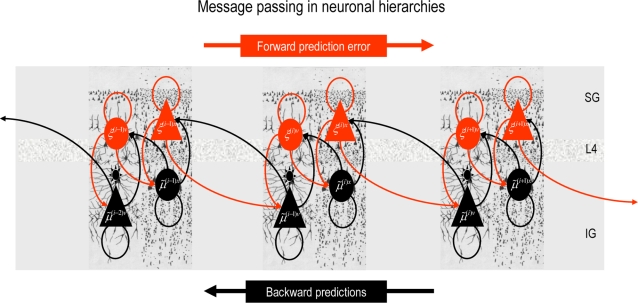

Verification
Claims the paper makes
9 Valid · 2 Not valid · 48 Not checked · 185 Own results and interpretations
The cited sources support only part of this claim — read each source’s verdict below.
In the paper
“There is a key functional asymmetry between forward and backward connections that renders backward connections more modulatory or nonlinear in their effects on neuronal responses (e.g., [44]; see also Hupe et al. [47]).”
§ Hierarchical Models in the Brain > Results > Neuronal Implementation
What the sources say
- Partly supportedcites [44] SM Sherman, 1998, On the actions that one nerve cell can have on another: distinguishing “drivers” from “modulators”., Proc Natl Acad Sci U S A sourceExperimental — accuracy not yet measured
In the paper’s discussion of lateral geniculate inputs (indexed as Abstract; page unavailable), retinal inputs are treated as drivers, while inputs from cortex are described as modulators. That supports a forward-versus-backward distinction for this thalamic relay, but the Conclusions say that classifying corticocortical pathways remains largely untested; the paper does not establish the claimed general asymmetry or characterize backward effects as nonlinear. (LLM, conf=0.84)
- Not checked — no full text of the sourcecites Hupe et al. [47] JM Hupe, 1998, Cortical feedback improves discrimination between figure and background by V1, V2 and V3 neurons., Nature source
plainstates a cause- Asserted: passes — The authors put it forward as true.
- Checkable: passes — It can be checked against evidence.
- Load-bearing: passes — The paper’s conclusions depend on it.
- Based: passes — The paper gives a reason why it holds.
- Partly supported
The sources with a verdict support this claim; the rest weren’t checked yet, have no full text we could read, or their verdicts aren’t rated yet.
In the paper
“This selective modulation of afferents mirrors the gain-control mechanisms invoked for attention; e.g., [58],[59].”
§ Hierarchical Models in the Brain > Results > Neuronal Implementation
What the sources say
- Not checked — no full text of the sourcecites [58] S Treue, 1996, Attentional modulation of visual motion processing in cortical areas MT and MST., Nature source
- Supportedcites [59] JC Martinez-Trujillo, 2004, Feature-based attention increases the selectivity of population responses in primate visual cortex., Curr Biol source
The Conclusions (page unavailable) state that feature-based attention multiplicatively modulates neuronal responses in line with a feature-similarity gain model. This supports the cited comparison to attentional gain control; the sentence does not attribute the modulation of afferents themselves to this paper. (LLM, conf=0.88)
plainstates an association- Asserted: passes — The authors put it forward as true.
- Checkable: passes — It can be checked against evidence.
- Load-bearing: passes — The paper’s conclusions depend on it.
- Based: passes — The paper gives a reason why it holds.
The cited sources support only part of this claim — read each source’s verdict below.
In the paper
“Functional asymmetries in forwards (linear) and backwards (nonlinear) connections may reflect their distinct roles in recognition (c.f., [44]).”
§ Hierarchical Models in the Brain > Results > Neuronal Implementation
What the sources say
- Partly supportedcites [44] SM Sherman, 1998, On the actions that one nerve cell can have on another: distinguishing “drivers” from “modulators”., Proc Natl Acad Sci U S A sourceExperimental — accuracy not yet measured
The paper distinguishes driver inputs, which transmit receptive-field properties, from modulator inputs, which alter transmission (Abstract; page unavailable). It also discusses different possible roles for thalamocortical and corticothalamic pathways. It does not characterize forward connections as linear or backward connections as nonlinear, or link those properties to recognition; the Conclusions say corticocortical pathway classifications remain largely untested. (LLM, conf=0.76)
hedgedstates a possible cause- Asserted: passes — The authors put it forward as true.
- Checkable: passes — It can be checked against evidence.
- Load-bearing: unclear — It is unclear whether the paper’s conclusions depend on it.
- Based: passes — The paper gives a reason why it holds.
- Partly supported
Every source the paper cites for this claim was checked and supports it.
In the paper
“Arguments like this suggest that free-form approximations and their attending sampling schemes are not really viable in a neuronal context (although they have been considered; see [86] and above)”
§ Hierarchical Models in the Brain > Discussion
What the sources say
- Supportedcites [86] TS Lee, 2003, Hierarchical Bayesian inference in the visual cortex., J Opt Soc Am A source
The citation is attached to the parenthetical point that sampling-based approximations have been considered in a neuronal context, not to the citing authors’ conclusion that they are unviable. In “Particle Filtering and Bayesian Belief Propagation,” Lee and Mumford discuss weighted samples as an approximation to perceptual probability distributions; the Introduction proposes particle filtering as a possible cortical algorithm. The source does not endorse the unviability conclusion. (LLM, conf=0.92)
hedgedstates a cause- Asserted: passes — The authors put it forward as true.
- Checkable: passes — It can be checked against evidence.
- Load-bearing: passes — The paper’s conclusions depend on it.
- Based: passes — The paper gives a reason why it holds.
- Supported
The cited sources that could be checked couldn’t confirm or dispute this claim.
In the paper
“Lateral interactions may encode the relative precision of prediction errors and change in a way that is consistent with classical neuromodulation (c.f., [63],[71]).”
§ Hierarchical Models in the Brain > Results > Neuronal Implementation
What the sources say
- Not checked — no full text of the sourcecites [63] AJ Yu, 2005, Uncertainty, neuromodulation and attention., Neuron source
- Could not verifycites [71] Y Niv, 2005, Dopamine, uncertainty and TD learning., Behav Brain Funct sourceExperimental — accuracy not yet measured
The Discussion (page unavailable) addresses asymmetric dopamine coding of prediction errors and mentions a possible opponent neurotransmitter. Searches for lateral interactions, relative precision, and neuromodulation found no passage saying that lateral interactions encode precision or change in the claimed way. (LLM, conf=0.76)
hedgedstates a possible cause- Asserted: passes — The authors put it forward as true.
- Checkable: passes — It can be checked against evidence.
- Load-bearing: passes — The paper’s conclusions depend on it.
- Based: passes — The paper gives a reason why it holds.
122 more claims · 1 with their cited sources checked
Create a free account to see all 244 claims and to verify the 3 references still open.
- Probably not a substantial claim. 65
- It may state two separate claims as one. 65
- The quote only partly states this claim. 1
Claims other papers make about this one
Each is checked against this paper’s own text: does it say what the citing paper says it does?
The source backs part of the claim, not all of it — or backs it for a different population, condition or comparison.
In the citing paper
“This equation says that the contribution of any (angular) frequency ω in the prediction errors (encoded by superficial pyramidal cells) to the expectations (encoded by the deep pyramidal cells) is suppressed in proportion to that frequency (Friston 2008). In other words, high frequencies should be attenuated when passing from superficial to deep pyramidal cells.”
From Canonical Microcircuits for Predictive Coding (2012) · cites this paper as Friston 2008
Experimental — accuracy not yet measuredThe source backs part of the claim, not all of it — or backs it for a different population, condition or comparison.
In the citing paper
“and lies in the integrity of neuromodulatory function (2).”
From A more precise look at context in autism (2015) · cites this paper as [2]
Experimental — accuracy not yet measuredThe source backs part of the claim, not all of it — or backs it for a different population, condition or comparison.
In the citing paper
“its solutions grandfather nearly every known statistical estimation scheme, under parametric assumptions about additive or multiplicative noise (Friston, 2008)”
From The Computational Anatomy of Psychosis (2013) · cites this paper as Friston, 2008
Experimental — accuracy not yet measuredThe source backs part of the claim, not all of it — or backs it for a different population, condition or comparison.
In the citing paper
“Predictive coding is a process theory with a biologically plausible back story and a considerable amount of empirical support [21,22].”
From Active interoceptive inference and the emotional brain (2016) · cites this paper as [21]
Experimental — accuracy not yet measuredThe source backs part of the claim, not all of it — or backs it for a different population, condition or comparison.
In the citing paper
“Cortical bias or gain control is mediated by intrinsic inhibitory connections within cortical sources, which rescale prediction errors, in proportion to their precision, so that as precision increases intrinsic recurrent inhibition decreases (Abbott et al., 1997, Friston, 2008).”
From The functional anatomy of schizophrenia: A dynamic causal modeling study of predictive coding (2014) · cites this paper as Friston, 2008
Experimental — accuracy not yet measured
18 more claims about this paper
Create a free account to see every claim other papers make about this one.
Citations
Cites
Maximum Likelihood from Incomplete Data Via the EM Algorithm
Dempster, A. P., Laird, N. M., & Rubin, D. B. (1977) · Journal of the Royal Statistical Society Series B: Statistical Methodology · doi:10.1111/j.2517-6161.1977.tb01600.x · Cited by 50,444 · cited 1×
“We have discussed static cases of this fixed-form scheme previously and how it reduces to expectation maximisation ( EM ; [17]) and restricted maximum likelihood ( ReML ; [18]) for linear models [15].”
BackgroundA New Approach to Linear Filtering and Prediction Problems
Kalman, R. E. (1960) · Journal of Basic Engineering · doi:10.1115/1.3662552 · Cited by 31,751 · cited 1×
“The conventional approach to online Bayesian tracking of nonlinear or non-Gaussian systems employs extended Kalman filtering [30] or sequential Monte Carlo methods such as particle filtering.”
MethodLearning Internal Representations by Error Propagation
Rumelhart, D. E., Hinton, G. E., & Williams, R. J. (1985) · doi:10.21236/ada164453 · Cited by 16,172
An Information-Maximization Approach to Blind Separation and Blind Deconvolution
Bell, A. J., & Sejnowski, T. J. (1995) · Neural Computation · doi:10.1162/neco.1995.7.6.1129 · Cited by 8,986 · cited 1×
“) decomposes the observed response into a linear mixture of non-Gaussian causes”
Neural Mechanisms of Selective Visual Attention
Desimone, R., & Duncan, J. (1995) · Annual Review of Neuroscience · doi:10.1146/annurev.ne.18.030195.001205 · Cited by 8,388
Distributed hierarchical processing in the primate cerebral cortex
Felleman, D. J., & Van Essen, D. C. (1991) · Cerebral Cortex · doi:10.1093/cercor/1.1.1 · Cited by 7,783 · cited 2×
“This means we would expect to see connections reciprocated in the brain, which is generally the case [39,40].”
BackgroundStochastic Processes and Filtering Theory
(1970) · Mathematics in Science and Engineering · doi:10.1016/s0076-5392(09)x6022-4 · Cited by 7,302
Emergence of simple-cell receptive field properties by learning a sparse code for natural images
Olshausen, B. A., & Field, D. J. (1996) · Nature · doi:10.1038/381607a0 · Cited by 5,694 · cited 1×
“In the same way that factor analysis is a generalisation of PCA to non-Gaussian causes, ICA can be extended to form sparse-coding models of the sort proposed by Olshausen and Fields [37] by allowing observation error.”
MethodRao, R. P. N., & Ballard, D. H. (1999) · Nature Neuroscience · doi:10.1038/4580 · Cited by 5,483 · cited 2×
“The mean-field approximation q ( W )= q ( u ( t )) q ( h ) q ( l ) enables inference about perceptual states, causal regularities and context, without representing the joint distribution explicitly; c.f., [64].”
BackgroundA theory of cortical responses.
Friston, K. (2005) · Philosophical Transactions of the Royal Society B: Biological Sciences · doi:10.1098/rstb.2005.1622 · Cited by 4,578 · cited 2×
“We have laid out the neurobiological and psycho-physical motivation for the neuronal implementation of DEM in [3] and [4].”
MethodSelf-citation
Research works printed but not linked: 4
- DJC MacKay, 1995, Free-energy minimisation algorithm for decoding and cryptoanalysis., Electron Lett, 31, 445
- T Ozaki, 1992, A bridge between nonlinear time-series models and nonlinear stochastic dynamical systems: A local linearization approach., Stat Sin, 2, 113
- ME Tipping, 2001, Sparse Bayesian learning and the Relevance Vector Machine., J Mach Learn Res, 1, 211
- CE Rasmussen, 1996, Evaluation of Gaussian Processes and Other Methods for Nonlinear Regression [PhD thesis]. Toronto, Canada: Department of Computer Science, University of Toronto.
Cited by
Items 401–500 of 975
Planar, spiral, and concentric traveling waves distinguish behavioral states in human memory
Das, A., Zabeh, E., Ermentrout, B., & Jacobs, J. (2026) · Nature Communications · doi:10.1038/s41467-026-71386-z · Cited by 28
Presence and general principles of brain function
Sjölie, D. (2012) · Interacting with Computers · doi:10.1016/j.intcom.2012.04.004 · Cited by 22
Neural correlates of local contextual processing across stimulus modalities and patient populations
Fogelson, N. (2015) · Neuroscience & Biobehavioral Reviews · doi:10.1016/j.neubiorev.2015.02.016 · Cited by 23
Decomposing experience-driven attention: Opposite attentional effects of previously predictive cues
Lin, Z., Lu, Z., & He, S. (2016) · Attention Perception & Psychophysics · doi:10.3758/s13414-016-1101-z · Cited by 21
“It has been increasingly recognized that associative learning contributes to the formation of predictive models of the world (Makino & Komiyama, 2015), and crucially top-down predictions are context sensitive (Bastos et al., 2012; Friston, 2008).”
Embedded ensemble encoding hypothesis: The role of the “Prepared” cell
Antic, S. D., Hines, M. L., & Lytton, W. W. (2018) · Journal of Neuroscience Research · doi:10.1002/jnr.24240 · Cited by 23
“In Bayesian theory, information streams are theorized to interact and provide information integration via projections between hierarchically-lower and hierarchically-higher cortical areas (as well as from amygdala, thalamus and other areas, Friston, 2008).”
BackgroundDaikoku, T., Wiggins, G. A., & Nagai, Y. (2021) · Frontiers in Neuroscience · doi:10.3389/fnins.2021.640412 · Cited by 23
“In this framework, the reliability of the prior prediction is also controlled by the precision (confidence) of prediction at higher levels of a hierarchical model (Friston, 2008).”
BackgroundPredictive processing and anti-representationalism
Facchin, M. (2021) · Synthese · doi:10.1007/s11229-021-03304-3 · Cited by 25
“19 Notice that albeit here all nets are homogeneously connected (and so there is no hierarchy) PP allows for horizontal (i.e. within level) message passing of error, see (Friston, 2008: p. 16).”
BackgroundGrossberg, S., & Kishnan, D. (2018) · Frontiers in Psychology · doi:10.3389/fpsyg.2018.00269 · Cited by 20
“For example, children with Fragile X can exhibit behavioral problems of severe inattention (Fryns et al., 1984; Baumgardner et al., 1995) and ADHD symptoms (Cornish et al., 2004) because their hippocampal adaptively timed circuits cannot maintain motivated attention long enough to successfully…”
BackgroundEmbodied Precision: Intranasal Oxytocin Modulates Multisensory Integration
Crucianelli, L., Paloyelis, Y., Ricciardi, L., Jenkinson, P. M., & Fotopoulou, A. (2018) · Journal of Cognitive Neuroscience · doi:10.1162/jocn_a_01366 · Cited by 21
Edey, R., Brewer, R., Bird, G., & Press, C. (2018) · Journal of Autism and Developmental Disorders · doi:10.1007/s10803-018-3725-4 · Cited by 22
“1 3 relative precision (Friston 2008).”
BackgroundPuviani, L., Rama, S., & Vitetta, G. M. (2018) · IEEE Transactions on Affective Computing · doi:10.1109/taffc.2018.2887385 · Cited by 20
The Neural Responses of Visual Complexity in the Oddball Paradigm: An ERP Study
Hu, R., Zhang, L., Meng, P., Meng, X., & Weng, M. (2022) · Brain Sciences · doi:10.3390/brainsci12040447 · Cited by 22
Reduced Precision Underwrites Ego Dissolution and Therapeutic Outcomes Under Psychedelics
Stoliker, D., Egan, G. F., & Razi, A. (2022) · Frontiers in Neuroscience · doi:10.3389/fnins.2022.827400 · Cited by 24
“Predictive processing describes the interplay between ascending neuronal signals—in the form of ascending prediction errors— and descending predictions of the cortical hierarchy that embody internal world models (Rao and Ballard, 1999; Friston, 2008).”
BackgroundLearning induces coordinated neuronal plasticity of metabolic demands and functional brain networks
Klug, S., Godbersen, G. M., Rischka, L., Wadsak, W., Pichler, V., Klöbl, M., Hacker, M., Lanzenberger, R. R., & Hahn, A. (2022) · Communications Biology · doi:10.1038/s42003-022-03362-4 · Cited by 24
“The attentional optimization is implemented by recurrent loops between different hierarchical levels of cortical systems (Friston & Kiebel, 2009; Mumford, 1992), based on synaptic gain or responsiveness of post-synaptic neurons that encode prediction errors (Friston, 2005, 2008).”
Networks, noise and models: Reconceptualizing the brain as a complex, distributed system
Breakspear, M. J., & McIntosh, A. R. (2011) · NeuroImage · doi:10.1016/j.neuroimage.2011.03.056 · Cited by 21
“…neuronal systems, from a functional (McIntosh et al., 2008), biophysical (Faisal et al., 2008), dynamic (Freyer and al., in press) and mathematical (Friston, 2008) perspective, (3) to develop and validate measures of effective connectivity that can be reliably inferred from neuroimaging data, and…”
BackgroundKwok, S. C., & Macaluso, E. (2015) · Scientific Reports · doi:10.1038/srep11248 · Cited by 19
Mugruza-Vassallo, C. A., & Potter, D. D. (2019) · Frontiers in Human Neuroscience · doi:10.3389/fnhum.2019.00039 · Cited by 24
“A simulation of an MMN experiment using predictive coding (Friston, 2005) and a hierarchical model of the brain based on relative changes on the task (Friston, 2008) showed the reduction of MMN in tone repetition in an auditory task (Moran et al., 2013).”
MethodOjha, V., & Nicosia, G. (2022) · Neural Networks · doi:10.1016/j.neunet.2022.02.003 · Cited by 28
“Indeed, it is similar to the sparsity of the biological brain that a sparse network generalizes better or as good as a dense network (Friston, 2008; Herculano-Houzel et al., 2010; Hoefler et al., 2021).”
BackgroundThe kinematic signature of voluntary actions
Becchio, C., Zanatto, D., Straulino, E., Cavallo, A., Sartori, G., & Castiello, U. (2014) · Neuropsychologia · doi:10.1016/j.neuropsychologia.2014.09.033 · Cited by 19
“In this perspective, motor structures may have a role in decision formation, contributing to the evaluation of different alternative options (Cisek, 2006, 2007, 2012; Friston, 2008; Shalden et al., 2008; Cisek and Kalaska, 2010).”
The Many Faces of Attention: Why Precision Optimization Is Not Attention
Ransom, M., & Fazelpour, S. (2020) · Bloomsbury Publishing Plc eBooks · doi:10.5040/9781350099784.ch-007 · Cited by 22
“Predictive coding as it has been developed by Karl Friston (2008, 2009, 2010), and adopted by philosophers such as Andy Clark (2013a, 2015) and Jakob Hohwy (2012, 2013), is claimed to be a grand unifying theory of all cognitive functioning, though it has been most thoroughly developed as a theory of perception.”
BackgroundMethodComputational model of visual hallucination in dementia with Lewy bodies
Tsukada, H., Fujii, H., Aihara, K., & Tsuda, I. (2015) · Neural Networks · doi:10.1016/j.neunet.2014.09.001 · Cited by 17
“As other theoretical frameworks that look similar to top-down facilitation, one may consider the following two theories: Convergence Divergence Zone (CDZ) theory (Damasio, 1989; Meyer & Damasio, 2009), and Hierarchical Dynamical Models (HDMs) theory (Friston, 2008; Friston & Kiebel, 2009).”
BackgroundAn Overview of the Free Energy Principle and Related Research
Zhang, Z., & Xu, F. (2024) · Neural Computation · doi:10.1162/neco_a_01642 · Cited by 25
Increased functional activity, bottom-up and intrinsic effective connectivity in autism
Randeniya, R., Vilares, I., Mattingley, J. B., & Garrido, M. I. (2022) · NeuroImage Clinical · doi:10.1016/j.nicl.2022.103293 · Cited by 20
“When considering the underlying neural processes that give rise to disruptions in sensory learning, such hierarchical models of the brain can provide critical insights (Friston, 2008).”
Dysconnection and cognition in schizophrenia: A spectral dynamic causal modeling study
Zarghami, T. S., Zeidman, P., Razi, A., Bahrami, F., & Hossein‐Zadeh, G. (2023) · Human Brain Mapping · doi:10.1002/hbm.26251 · Cited by 19
“It has been proposed that these predictions serve to explain our sensations by minimizing the prediction errors—in a theoretical framework known as predictive coding (Bastos et al., 2012; Clark, 2013; Friston, 2008; Rao and Ballard, 1999; Srinivasan et al., 1982).”
BackgroundMikuš, N., Eisenegger, C., Mathys, C. D., Clark, L., Müller, U., Robbins, T. W., Lamm, C., & Naef, M. (2023) · Nature Communications · doi:10.1038/s41467-023-39823-5 · Cited by 19
Modeling Motor Control in Continuous Time Active Inference: A Survey
Priorelli, M., Maggiore, F., Maselli, A., Donnarumma, F., Maisto, D., Mannella, F., Stoianov, I. P., & Pezzulo, G. (2023) · IEEE Transactions on Cognitive and Developmental Systems · doi:10.1109/tcds.2023.3338491 · Cited by 21
“In general, these coordinates have been introduced to deal with non-Markovian processes [40], [44], adopting a Stratonovich interpretation with continuous stochastic variables having finite, nonzero autocorrelation functions.”
BackgroundMethodInfluentialCiaramidaro, A., Toppi, J., Vogel, P., Freitag, C. M., Siniatchkin, M., & Astolfi, L. (2024) · NeuroImage · doi:10.1016/j.neuroimage.2024.120783 · Cited by 22
“The authors of this article have no conflicts of interest, financial or otherwise, to disclose.”
BackgroundDeep Construction of an Affective Latent Space via Multimodal Enactment
Boccignone, G., Conte, D., Cuculo, V., D’Amelio, A., Grossi, G., & Lanzarotti, R. (2018) · IEEE Transactions on Cognitive and Developmental Systems · doi:10.1109/tcds.2017.2788820 · Cited by 18
“ical systems involves the optimization of the prediction error on states and parameters, and this also holds when such systems are layered in a hierarchical structure [58].”
BackgroundA Probabilistic Interpretation of PID Controllers Using Active Inference
Baltieri, M., & Buckley, C. L. (2018) · Lecture notes in computer science · doi:10.1007/978-3-319-97628-0_2 · Cited by 24
Zhang, R. V., Featherstone, R. E., Melynchenko, O., Gifford, R. L., Weger, R., Liang, Y., & Siegel, S. J. (2019) · Experimental Brain Research · doi:10.1007/s00221-019-05558-3 · Cited by 19
“It is thought that there is preference for more precise prediction errors, which are thought to be represented by larger synaptic gain from ascending neurons (Friston 2008).”
BackgroundPrediction in speech and language processing
Tavano, A., & Scharinger, M. (2015) · Cortex · doi:10.1016/j.cortex.2015.05.001 · Cited by 18
“Predictive coding aims at explaining perception, behavior as well as the generation and update of beliefs andmovement patterns (Dayan, Hinton, Neal, & Zemel, 1995; Friston, 2008; Friston, Kilner, & Harrison, 2006; Lee & Mumford, 2003).”
BackgroundCognitive Architectures for Sensory Processing
Príncipe, J. C., & Chalasani, R. (2014) · Proceedings of the IEEE · doi:10.1109/jproc.2014.2307023 · Cited by 18
“The hidden states xt mediate the influence of the cause on the output and endow the system with short-term memory [10].”
BackgroundMethodInfluentialExcitatory versus inhibitory feedback in Bayesian formulations of scene construction
Abadi, A. K., Yahya, K., Amini, M., Friston, K. J., & Heinke, D. G. (2019) · Journal of The Royal Society Interface · doi:10.1098/rsif.2018.0344 · Cited by 17
“Moreover, a gradient descent on the free-energy functional implements the inference by optimizing the posterior distribution (e.g. [16]).”
BackgroundSelf-citationAtypical processing of uncertainty in individuals at risk for psychosisPreprint
Cole, D. M., Diaconescu, A. O., Pfeiffer, U. J., et al. (2019) · bioRxiv (Cold Spring Harbor Laboratory) · doi:10.1101/796300 · Cited by 17
Implementing Predictive Processing and Active Inference: Preliminary Steps and ResultsPreprint
Millidge, B. (2019) · PsyArXiv (OSF Preprints) · doi:10.31234/osf.io/4hb58 · Cited by 21
Meditation and complexity: a review and synthesis of evidence
Atad, D. A., Mediano, P. A. M., Rosas, F. E., & Berkovich‐Ohana, A. (2025) · Neuroscience of Consciousness · doi:10.1093/nc/niaf013 · Cited by 41
“…and concrete on the lower (sensory) levels of the hierarchy and more abstract and temporally “thick” (making inferences about the past and predictions about the future and generalizing the present moment) in higher levels (Friston and Sporns 2008; Corcoran et al. 2020, Laukkonen and Slagter 2021).”
Mindfulness, cognition, and long-term meditators: Toward a science of advanced meditation
Ehmann, S., Sezer, I., Treves, I. N., Gabrieli, J. D. E., & Sacchet, M. D. (2025) · Imaging Neuroscience · doi:10.1162/imag.a.82 · Cited by 33
“This so-called trait mindfulness is typically measured through self-report questionnaires and reflects a person’s dispositional mindful aptitude ( Baer et al., 2004, 2006, 2008; MacKillop & Anderson, 2007; Walach et al., 2006).”
Yonemura, Y., & Katori, Y. (2021) · Nonlinear Theory and Its Applications IEICE · doi:10.1587/nolta.12.143 · Cited by 17
“The hierarchical network can be modeled with the framework of predictive coding [4–6], which processes the sensory signal with the top-down and bottom-up process.”
BackgroundTesting Bayesian models of belief updating in the context of depressive symptomatology
Feldmann, M., Κube, T., Rief, W., & Brakemeier, E. (2022) · International Journal of Methods in Psychiatric Research · doi:10.1002/mpr.1946 · Cited by 17
“Generalised beliefs may shape situation‐specific predictions from top‐down, whereas prediction errors arising from specific predictions may change more generalised beliefs from bottom‐up (Friston, 2008; Pezzulo et al., 2015; Williams, 2020).”
BackgroundState Space Modeling of Neural Spike Train and Behavioral Data
Chen, Z. S., Barbieri, R., & Brown, E. N. (2010) · Elsevier eBooks · doi:10.1016/b978-0-12-375027-3.00006-5 · Cited by 21
Sequential Bayesian updating as a model for human perception
Glasauer, S. (2019) · Progress in brain research · doi:10.1016/bs.pbr.2019.04.025 · Cited by 21
Towards a cross-level understanding of Bayesian inference in the brain
Lin, C., & Garrido, M. I. (2022) · Neuroscience & Biobehavioral Reviews · doi:10.1016/j.neubiorev.2022.104649 · Cited by 23
Hübner, A. M., Trempler, I., & Schubotz, R. I. (2022) · NeuroImage · doi:10.1016/j.neuroimage.2022.119524 · Cited by 23
“The relative weight accorded to predictions and rediction errors at multiple levels of the predictive hierarchy is decribed in terms of precision , i.e. the reliability of (exteroceptive or inteoceptive) signals ( Friston, 2008 , 2010 ).”
BackgroundActive Inference, Predictive Coding and Cortical Architecture
Adams, R. A., Friston, K. J., & Bastos, A. M. (2015) · Springer eBooks · doi:10.1007/978-94-017-9900-3_7 · Cited by 23
Self-citationPosteromedial cortical networks encode visuomotor prediction errors.Preprint
Takeuchi, R. F., Sato, A., Ito, K. N., Yokoyama, H., Miyata, R., Ueda, R., Kitajima, K., Kamaguchi, R., Suzuki, T., Isobe, K., et al. (2022) · bioRxiv (Cold Spring Harbor Laboratory) · doi:10.1101/2022.08.16.504075 · Cited by 16
A systematic approach to brain dynamics: cognitive evolution theory of consciousness
Yurchenko, S. B. (2022) · Cognitive Neurodynamics · doi:10.1007/s11571-022-09863-6 · Cited by 20
“CET starts from the claim that brains should have primarily evolved as volitional (quantum in origin) subsystems of organisms, not as deterministic prediction machines (Knill and Pouget 2004; Friston 2008; Clark 2013).”
BackgroundInfluentialNeurophysiological mechanisms of implicit and explicit memory in the process of consciousness
Tucker, D. M., Luu, P., & Johnson, M. (2022) · Journal of Neurophysiology · doi:10.1152/jn.00328.2022 · Cited by 28
Structural coding versus free-energy predictive coding
van der Helm, P. A. (2015) · Psychonomic Bulletin & Review · doi:10.3758/s13423-015-0938-9 · Cited by 17
“Second, FE predictive coding seems to give action priority over perception, or as Friston (2009) put it: “perception”
BackgroundMethodInfluentialNeural Design Principles for Subjective Experience: Implications for Insects
Key, B., Zalucki, O. H., & Brown, D. J. (2021) · Frontiers in Behavioral Neuroscience · doi:10.3389/fnbeh.2021.658037 · Cited by 20
“Processing can be simplified, and performance enhanced by hierarchical tiering of models (Wolpert and Kawato, 1998; Otake et al., 2007; Friston, 2008).”
BackgroundMethodCulture, Mind, and Brain: Emerging Concepts, Models, and Applications
Kirmayer, L. J., Worthman, C. M., Kitayama, S., Lemelson, R., & Cummings, C. A. (2020) · Cited by 47
Saarinen, T., Jalava, A., Kujala, J., Stevenson, C. M., & Salmelin, R. H. (2015) · Human Brain Mapping · doi:10.1002/hbm.22784 · Cited by 16
“Neurocognitive networks are widely considered an important concept in understanding brain function [Friston, 2008; Mesulam, 2008].”
BackgroundBarca, L., Benedetti, F., & Pezzulo, G. (2015) · Journal of Cognitive Psychology · doi:10.1080/20445911.2015.1101117 · Cited by 14
“…of the covert speech of cue-word and stimulus (or in terms of predictive codingmodels of speech processing, low prediction error between the two, see Friston, 2008; Pezzulo, Rigoli, & Friston, 2015) is helpful, in keeping with the idea that it is considered as positive evidence for the decision.”
BackgroundSafron, A., Klimaj, V., & Hipólito, I. (2021) · doi:10.31234/osf.io/x734w · Cited by 13
Kopčanová, M., Thut, G., Benwell, C., & Keitel, C. (2025) · Imaging Neuroscience · doi:10.1162/imag_a_00566 · Cited by 19
Physical Exercise to Redynamize Interoception in Substance use Disorders
Brevers, D., Billieux, J., de Timary, P., Desmedt, O., Maurage, P., Perales, J. C., Suárez‐Suárez, S., & Bechara, A. (2023) · Current Neuropharmacology · doi:10.2174/1570159x21666230314143803 · Cited by 14
Ritterband‐Rosenbaum, A., Justiniano, M. D., Nielsen, J. B., & Christensen, M. S. (2019) · Infant Behavior and Development · doi:10.1016/j.infbeh.2019.02.001 · Cited by 16
On self-feedback connectivity in neural mass models applied to event-related potentials
Youssofzadeh, V., Prasad, G., & Wong‐Lin, K. (2015) · NeuroImage · doi:10.1016/j.neuroimage.2014.12.067 · Cited by 15
“To fit the model to the ERP data, we first defined a stimulus-related input using a Gaussian bump function u(t) = a ∗ exp(−(t − t0)(2))/Δt(2) parameterised by magnitude a and onset t0 values (Friston, 2008).”
You cannot speak and listen at the same time: a probabilistic model of turn-taking
Donnarumma, F., Dindo, H., Iodice, P., & Pezzulo, G. (2017) · Biological Cybernetics · doi:10.1007/s00422-017-0714-1 · Cited by 21
Recognition Dynamics in the Brain under the Free Energy Principle
Kim, C. S. (2018) · Neural Computation · doi:10.1162/neco_a_01115 · Cited by 18
“Fourth, the FEP introduces the hydrodynamics-like concepts of the path of a mode (motion of expectation) and the mode of a path (expected motion) by distinguishing the dynamic update from the temporal update of a time-dependent state (Friston, 2008b).”
BackgroundFriston, K. J. (2011) · Springer eBooks · doi:10.1007/978-1-4614-0751-5_9 · Cited by 20
Self-citationPrediction error signaling explains neuronal mismatch responses in the medial prefrontal cortexPreprint
Casado-Román, L., Carbajal, G. V., Pérez‐González, D., & Malmierca, M. S. (2019) · bioRxiv (Cold Spring Harbor Laboratory) · doi:10.1101/778928 · Cited by 12
An active inference approach to second-person neurosciencePreprint
Lehmann, K., Bolis, D., Ramstead, M. J. D., Friston, K. J., & Kanske, P. (2022) · doi:10.31234/osf.io/6y5ve · Cited by 13
Self-citationInvariant representations in abstract concept grounding – the physical world in grounded cognition
Friedrich, J., Fischer, M. H., & Raab, M. (2024) · Psychonomic Bulletin & Review · doi:10.3758/s13423-024-02522-3 · Cited by 17
“Importantly, the existence of invariant representations is assumed under predictive processing (Friston, 2008).”
Phenomenal transparency, cognitive extension, and predictive processing
Facchin, M. (2022) · Phenomenology and the Cognitive Sciences · doi:10.1007/s11097-022-09831-9 · Cited by 18
“(PT) 7 seems to capture phenomenal transparency as is at stake in the debate (cf. Clark, 2003; 2008: 37–39; Wheeler 2019a).”
Typical viewpoints of objects are better detected than atypical ones
Gephart, A. M., Yang, P.-L., & Beck, D. M. (2022) · Journal of Vision · doi:10.1167/jov.22.12.1 · Cited by 14
“The concept of a real-world statistical regularity is critical to predictive coding frameworks (Rao & Ballard, 1999; Friston, 2005; Friston, 2008; Spratling, 2008) in which such representations serve as predictions with which to compare against the current input, allowing the brain to make sense of…”
BackgroundInfluentialCosta, C., Pezzetta, R., Masina, F., Lago, S., Gastaldon, S., Frangi, C., Genon, S., Arcara, G., & Scarpazza, C. (2024) · Human Brain Mapping · doi:10.1002/hbm.26817 · Cited by 19
“…near the bottom and areas near the top can exist without intermediaries, creating a structure well-suited to support PP architecture (Clark, 2013; Friston, 2008, 2010; Keller & Mrsic-Flogel, 2018; Lee et al., 2021; Pessoa, 2019; Walsh et al., 2020), and suggesting a parallel organization of…”
Extending the Explanandum for Predictive Processing
Madary, M. (2015) · Scholarly Commons (University of the Pacific) · doi:10.15502/9783958570313 · Cited by 16
Understanding Predictive Processing. A Review
Piekarski, M. (2021) · Avant · doi:10.26913/avant.2021.01.04 · Cited by 18
“53 Minimizing free energy entails minimizing prediction errors under the Laplace assumption (Friston, 2008; cf. Wiese & Metzinger, 2017, p. 12). dictions and errors, which is based on the interaction of two types of pyramidal cells (cf. Clark, 2013; Park & Friston, 2013)), modifying their precision…”
MethodBahmer, A., & Gupta, D. S. (2018) · Frontiers in Neuroscience · doi:10.3389/fnins.2018.00793 · Cited by 11
“Furthermore, according to a leading modern theory of perception, predictive coding, there is an interaction between feedforward and feedback information (Friston, 2008).”
BackgroundConnolly, P. M., & van Deventer, V. (2017) · Frontiers in Psychology · doi:10.3389/fpsyg.2017.01695 · Cited by 20
“While the bulk of the research that Friston and colleagues have done with the FEP have focused on describing neurophysiological processes, the principle is understood as having applications well beyond neurophysiology, and applicable to a broader biological science, including being applicable to organisms without nerv…”
BackgroundMethodInfluentialThe direction and timing of theta and alpha traveling waves modulate human memory processingPreprint
Mohan, U. R., Zhang, H., & Jacobs, J. (2022) · bioRxiv (Cold Spring Harbor Laboratory) · doi:10.1101/2022.02.07.479466 · Cited by 13
Pupil dilation indexes automatic and dynamic inference about the precision of stimulus distributions
Silvestrin, F., Penny, W. D., & FitzGerald, T. H. B. (2021) · Journal of Mathematical Psychology · doi:10.1016/j.jmp.2021.102503 · Cited by 17
Towards Topological Mechanisms Underlying Experience Acquisition and Transmission in the Human Brain
Tozzi, A., & Peters, J. F. (2017) · Integrative Psychological and Behavioral Science · doi:10.1007/s12124-017-9380-z · Cited by 12
“bidirectionally connected (Friston, 2008; Barrett and Simmons, 2015), this means that interactions rarely should be quantified in terms of cause-and-effect.”
BackgroundOn memories, neural ensembles and mental flexibility
Pinotsis, D. A., Brincat, S. L., & Miller, E. K. (2017) · NeuroImage · doi:10.1016/j.neuroimage.2017.05.068 · Cited by 11
“under a Laplace assumption, where Q is the approximate posterior and after substituting z Ν I q Q z Z s Δ ∼ (0, ), ∼ ( , ) Q s(2) −1 and Y Ν GG s I ∼ (0, + ) T s P 2 , see also (Friston, 2008).”
Science-Driven Societal Transformation, Part I: Worldview
(2020) · doi:10.3390/su12176881 · Cited by 13
The brain tracks auditory rhythm predictability independent of selective attention
Foldal, M. D., Blenkmann, A. O., Llorens, A., Knight, R. T., Solbakk, A., & Endestad, T. (2020) · Scientific Reports · doi:10.1038/s41598-020-64758-y · Cited by 14
Lights from the Dark: Neural Responses from a Blind Visual Hemifield
Bollini, A., Sánchez-López, J., Savazzi, S., & Marzi, C. A. (2017) · Frontiers in Neuroscience · doi:10.3389/fnins.2017.00290 · Cited by 14
“Successively, the inverse solution was computed on the entire ERP period after stimulus onset (i.e., from 0 to 800 ms) by using coherent smooth prior method (COH) (Friston, 2008) smoothness prior similar to LORETA (Pascual-Marqui et al., 2002).”
MethodBayesian Inference, Predictive Coding, and Computational Models of Psychosis
Adams, R. A. (2017) · Elsevier eBooks · doi:10.1016/b978-0-12-809825-7.00007-9 · Cited by 22
Network Configurations in the Human Brain Reflect Choice Bias during Rapid Face Processing
Tu, T., Schneck, N., Muraskin, J., & Sajda, P. (2017) · Journal of Neuroscience · doi:10.1523/jneurosci.1677-17.2017 · Cited by 12
“The predictive coding theory suggests a top– down perceptual process in which frontal inputs maintain representations of expected stimuli and inform activity in perceptual regions (Dayan et al., 1995; Rao and Ballard, 1999; Friston, 2003, 2008).”
BackgroundCertainty-Based Reduced Sparse Solution for Dense Array EEG Source Localization
Mannepalli, T., & Routray, A. (2018) · IEEE Transactions on Neural Systems and Rehabilitation Engineering · doi:10.1109/tnsre.2018.2889719 · Cited by 13
“In [27] a hierarchal modeling in the brain is employed.”
MethodComplex Deep Learning with Quantum Optics
Manzalini, A. (2019) · Quantum Reports · doi:10.3390/quantum1010011 · Cited by 12
“This is well elaborated, for example, in [21] and [22], where the free energy principle has been proved valid for describing several aspects of functional brain architectures.”
BackgroundFree Energy Principle for State and Input Estimation of a Quadcopter Flying in Wind
Bos, F., Meera, A. A., Benders, D., & Wisse, M. (2022) · Proceedings - IEEE International Conference on Robotics and Automation/Proceedings · doi:10.1109/icra46639.2022.9812415 · Cited by 19
“DEM uses this mathematical framework, in conjunction with the use of generalized coordinates to provide a hierarchical brain model [22].”
MethodBodily Self, Affect, Consciousness, and the Cortex
Gallese, V. (2013) · Neuropsychoanalysis · doi:10.1080/15294145.2013.10773717 · Cited by 12
An Integrated theory of false insights and beliefs under psychedelicsPreprint
McGovern, H., Grimmer, H. J., Doss, M. K., et al. (2023) · doi:10.31234/osf.io/97gjw · Cited by 12
Computational components of visual predictive coding circuitry
Shipp, S. D. (2024) · Frontiers in Neural Circuits · doi:10.3389/fncir.2023.1254009 · Cited by 22
“…a decrement in frequency from forward to backward transmission is inherent in the gPC algorithm, which dictates that expectation/prediction units must show low-pass dynamics as a consequence of frequency attenuation in assimilating cumulative prediction error (Friston, 2008; Bastos et al., 2015a).”
BackgroundBridging perspectives - A review and synthesis of 53 theoretical models of delusions
Denecke, S., Schönig, S. N., Bott, A., Faße, J. L., & Lincoln, T. M. (2024) · Clinical Psychology Review · doi:10.1016/j.cpr.2024.102510 · Cited by 15
Timing in Predictive Coding: The Roles of Task Relevance and Global Probability
Sherwell, C. S., Garrido, M. I., & Cunnington, R. (2016) · Journal of Cognitive Neuroscience · doi:10.1162/jocn_a_01085 · Cited by 15
“Internal predictive models are thought to generate inferences of forthcoming sensory events (predictions) that are compared with incoming sensory signals from lower levels in a cortical hierarchy (Friston, 2008).”
BackgroundIs information the other face of causation in biological systems?
Yurchenko, S. B. (2023) · Biosystems · doi:10.1016/j.biosystems.2023.104925 · Cited by 12
Disturbed interoception in body dysmorphic disorder: A framework for future research
Jenkinson, P. M., & Rossell, S. L. (2023) · Australian & New Zealand Journal of Psychiatry · doi:10.1177/00048674231215030 · Cited by 11
“If prediction error is small, there is no need to revise the model, but if the prediction error is large, then the model fails to accurately represent the causes of sensory experience and should be updated (Friston, 2008, 2009).”
BackgroundSELP: A general-purpose framework for learning the norms from saliencies in spatiotemporal data
Banerjee, B., & Dutta, J. K. (2014) · Neurocomputing · doi:10.1016/j.neucom.2013.02.044 · Cited by 12
Context Dependent Encoding Using Convolutional Dynamic Networks
Chalasani, R., & Príncipe, J. C. (2014) · IEEE Transactions on Neural Networks and Learning Systems · doi:10.1109/tnnls.2014.2360060 · Cited by 11
“Hence, a combined model that encodes a sequence of observations can be written as a generalized state space model of the form [5] y t = F (x t , u t ) + n t x t = G(x t −1 , u t ) + v t .”
BackgroundMethodInfluentialWieser, E., & Cheng, G. (2020) · Biological Cybernetics · doi:10.1007/s00422-020-00828-8 · Cited by 12
“In neuroscience, the theory of predictive coding (Friston 2008, 2010) attempts to model hierarchical message passing in the human cortex.”
BackgroundOn the Natural Hierarchical Composition of Cliques in Cell Assemblies
Wennekers, T. (2009) · Cognitive Computation · doi:10.1007/s12559-008-9004-5 · Cited by 11
“Similarly, many scientists considered feedback processes, often interpreted as top-down attention [26, 47, 49] or more recently the action of some generative models that aim to reconstruct or predict the input [12, 46].”
BackgroundCortexNet: a Generic Network Family for Robust Visual Temporal RepresentationsPreprint
Canziani, A., & Culurciello, E. (2017) · arXiv (Cornell University) · doi:10.48550/arxiv.1706.02735 · Cited by 18
“Finally — inspired by the neuroscientific predictive coding theory introduced by Rao and Ballard [18] and expanded by Friston [8] — Chalasani and Principe [6] and Lotter et al.”
MethodHuys, Q. J. M. (2013) · Springer eBooks · doi:10.1007/978-1-4614-7320-6_501-1 · Cited by 11
Meditation and Complexity: a Systematic ReviewPreprint
Atad, D. A., Mediano, P. A. M., Rosas, F. E., & Berkovich‐Ohana, A. (2023) · doi:10.31234/osf.io/np97r · Cited by 11
Imagination vs. routines: festive time, weekly time, and the predictive brain
Bortolotti, A., Conti, A., Romagnoli, A., & Sacco, P. L. (2024) · Frontiers in Human Neuroscience · doi:10.3389/fnhum.2024.1357354 · Cited by 13
“The functional organization of sensory pathways also aligns with the hierarchical message-passing structure proposed by predictive coding, where backward connections convey predictions and forward connections transmit prediction errors up the cortical hierarchy (Friston, 2008; Shipp, 2016).”
BackgroundNartallo-Kaluarachchi, R., Bonetti, L., Fernández‐Rubio, G., Vuust, P., Deco, G., Kringelbach, M. L., Lambiotte, R., & Goriely, A. (2025) · Proceedings of the National Academy of Sciences · doi:10.1073/pnas.2408791122 · Cited by 25
A Measure of Information Available for Inference
Isomura, T. (2018) · Entropy · doi:10.3390/e20070512 · Cited by 10
Bayesian mechanics of perceptual inference and motor control in the brain
Kim, C. S. (2021) · Biological Cybernetics · doi:10.1007/s00422-021-00859-9 · Cited by 12
“The FEP facilitates dynamic causal models in the brain’s generalized-state space (Friston 2008b; Friston et al. 2010b), which pose a mixed discrete-continuous Bayesian filtering (Jazwinski 1970; Balaji and Friston 2011).”
BackgroundMethodInfluential
Metadata
- Authors
- Friston, K.
- Affiliations
- Wellcome Centre for Human Neuroimaging (GB)
- Corresponding author
- Friston, Karl
- ORCID
- Friston, Karl
- Venue
- PLoS Computational Biology
- Publisher
- Public Library of Science (PLoS)
- Published
- 2008-11-07
- Volume
- 4
- Issue
- 11
- Pages
- e1000211
- ISSN
- 1553-734X (ISSN-L)
- 1553-7358
- PMC
- PMC2570625
- OpenAlex
- W1977628053
- Cited by
- 952
- References
- 102
- Citations by year
- 2026: 53 · 2025: 71 · 2024: 58 · 2023: 79 · 2022: 66 · 2021: 84 · 2020: 106 · 2019: 60 · 2018: 57 · 2017: 55 · 2016: 52 · 2015: 46 · 2014: 38 · 2013: 35 · 2012: 32
- FWCI
- 31.65
- Type
- journal article
- Language
- en
- Open access
- gold
- doi.org
- Licence
- cc-by
- Locations
- PLoS Computational Biology (publishedVersion, cc-by)
- PubMed Central (publishedVersion, cc-by)
- PubMed (publishedVersion)
- RePEc: Research Papers in Economics (submittedVersion)
- DOAJ (DOAJ: Directory of Open Access Journals) (submittedVersion, cc-by-sa)
- UCL Discovery (University College London) (submittedVersion)
- Funders
- Wellcome Trust (088130)
- Topics
- Physical Sciences › Computer Science › Artificial Intelligence › Bayesian Modeling and Causal Inference
- Physical Sciences › Computer Science › Artificial Intelligence › Gaussian Processes and Bayesian Inference
- Physical Sciences › Computer Science › Artificial Intelligence › Neural Networks and Applications
- Keywords
- hierarchical models, state-space model, dynamic causal modeling, model inversion, nonlinear time series analysis, general linear model, neural network inversion, brain learning
- MeSH terms
- Algorithms, Animals, Brain, Humans, Mental Processes, Models, Neurological, Nerve Net, Probability, Linear Models, Neural Networks, Computer, Nonlinear Dynamics
About these checks
Registry, retraction, Cites and statistics results are computed, not judged, with one exception: a printed reference that no index lists is read once by a model before it counts as a citation error. Claims are extracted by a model and kept only when their quote appears verbatim in the text; each cited source is then checked, with a model’s help, for whether it says what the claim relies on. Those verdicts can be wrong — read the claim’s quote and the cited source before relying on one.
The claim verdicts this report counts are experimental: their accuracy is not yet measured.
A language model drew the claims from the paper on 2026-10-10, under version 3 of the claim definition (model deepseek-v4.1-flash, prompt extract-v3).
A second model labelled each claim on 2026-10-10 (model jev-1.13-20260917, definition revision gold-guideline-v0.2).
Cited sources are checked with a language model’s help (gpt-6-sol).
Statistics and arithmetic are recomputed, not judged.
Confidence bands are shown only for fields calibrated on our annotated test set. None is calibrated yet, so no band is shown.
What counts as a claim ›How we measure confidence ›How we check this ›
Are you an author, or do you see a problem with this page? Request a review
Data sources
Bibliographic data: Semantic Scholar, OpenAlex, Crossref.
Contains information from the Semantic Scholar Academic Graph Datasets, made available under the ODC Attribution License (ODC-BY 1.0).
Semantic Scholar’s data is described in: Kinney, R., et al. (2023). The Semantic Scholar Open Data Platform. arXiv:2301.10140.
