

Hierarchical Models in the Brain
Open accessThe DOI matches its Crossref record; 95 of the 102 references it cites were found in a registry or an index; 10 of the 81 sources its claims cite were checked for support.
Abstract
This paper describes a general model that subsumes many parametric models for continuous data. The model comprises hidden layers of state-space or dynamic causal models, arranged so that the output of one provides input to another. The ensuing hierarchy furnishes a model for many types of data, of arbitrary complexity. Special cases range from the general linear model for static data to generalised convolution models, with system noise, for nonlinear time-series analysis. Crucially, all of these models can be inverted using exactly the same scheme, namely, dynamic expectation maximization. This means that a single model and optimisation scheme can be used to invert a wide range of models. We present the model and a brief review of its inversion to disclose the relationships among, apparently, diverse generative models of empirical data. We then show that this inversion can be formulated as a simple neural network and may provide a useful metaphor for inference and learning in the brain.
Overview
CoChat Summary
## TL;DR
This paper presents hierarchical dynamic models (HDMs) as a very general framework that contains many familiar static and dynamic statistical models as special cases, all invertible with the same dynamic expectation maximization (DEM) scheme. It argues that the same inversion can be written as a simple neural network and may serve as a metaphor for inference and learning in the brain.
## Key findings
- HDMs “subsum[e] many parametric models for continuous data,” ranging from the general linear model for static data to generalized convolution models with system noise for nonlinear time-series analysis.
- The paper claims that these diverse models can all be inverted using the same scheme, dynamic expectation maximization (DEM), under a Laplace/mean-field variational approximation.
- In the results, the author shows that HDMs encompass standard tools including the general linear model, expectation maximization (EM), restricted maximum likelihood (ReML), covariance component estimation, Gaussian process models, PCA, factor analysis, ICA, sparse coding, deconvolution, and state-space filtering.
- A worked example is described in which DEM converged in “about sixteen iterations” using embedding order “n = 6” and roughness hyperparameter “γ = 4,” with the text stating that the recovered states, parameters, and hyperparameters closely matched the true values and that the true values lay largely within the 90% confidence intervals.
## Methods
- The paper develops a hierarchical dynamic model in generalized coordinates of motion, with hidden states and causes organized across levels; the model includes Gaussian priors and Gaussian assumptions about fluctuations, and uses prediction errors at each level.
- Inversion is based on variational Bayes under mean-field and Laplace approximations, optimizing free energy / variational action with a dynamic expectation maximization scheme that separates D-step (states), E-step (parameters), and M-step (hyperparameters).
- The paper then maps this inversion scheme onto a neural-network-like message-passing architecture and illustrates the framework with analytic special cases and a simulation example.
## Limitations
- The paper states that the Laplace/Gaussian approximation “restrict[s] recognition to unimodal probabilistic representations,” though it frames this as a practical simplification.
- The text makes evident that many claims are theoretical and illustrative rather than empirically validated in this paper; it says the neuronal implementation “calls for an enormous amount of empirical verification and hypothesis testing” (evident in the text).
- The paper also makes evident that the examples and special-case derivations cover only a “partial list” of possible models, so the treatment is not exhaustive (evident in the text).
Model-written summary. Check it against the paper before relying on it.
Integrity signals
Registry
Cites
Statistics
Figures



Verification
Claims the paper makes
9 Valid · 2 Not valid · 48 Not checked · 185 Own results and interpretations
The cited sources support only part of this claim — read each source’s verdict below.
In the paper
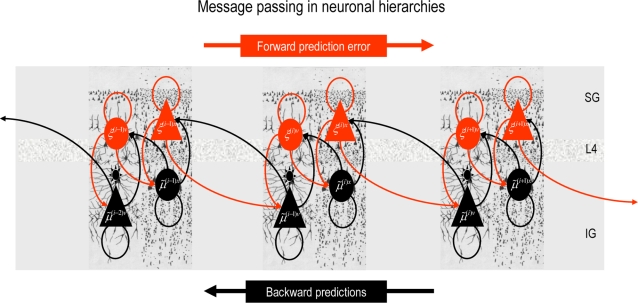
“There is a key functional asymmetry between forward and backward connections that renders backward connections more modulatory or nonlinear in their effects on neuronal responses (e.g., [44]; see also Hupe et al. [47]).”
§ Hierarchical Models in the Brain > Results > Neuronal Implementation
What the sources say
- Partly supportedcites [44] SM Sherman, 1998, On the actions that one nerve cell can have on another: distinguishing “drivers” from “modulators”., Proc Natl Acad Sci U S A sourceExperimental — accuracy not yet measured
In the paper’s discussion of lateral geniculate inputs (indexed as Abstract; page unavailable), retinal inputs are treated as drivers, while inputs from cortex are described as modulators. That supports a forward-versus-backward distinction for this thalamic relay, but the Conclusions say that classifying corticocortical pathways remains largely untested; the paper does not establish the claimed general asymmetry or characterize backward effects as nonlinear. (LLM, conf=0.84)
- Not checked — no full text of the sourcecites Hupe et al. [47] JM Hupe, 1998, Cortical feedback improves discrimination between figure and background by V1, V2 and V3 neurons., Nature source
plainstates a cause- Asserted: passes — The authors put it forward as true.
- Checkable: passes — It can be checked against evidence.
- Load-bearing: passes — The paper’s conclusions depend on it.
- Based: passes — The paper gives a reason why it holds.
- Partly supported
The sources with a verdict support this claim; the rest weren’t checked yet, have no full text we could read, or their verdicts aren’t rated yet.
In the paper
“This selective modulation of afferents mirrors the gain-control mechanisms invoked for attention; e.g., [58],[59].”
§ Hierarchical Models in the Brain > Results > Neuronal Implementation
What the sources say
- Not checked — no full text of the sourcecites [58] S Treue, 1996, Attentional modulation of visual motion processing in cortical areas MT and MST., Nature source
- Supportedcites [59] JC Martinez-Trujillo, 2004, Feature-based attention increases the selectivity of population responses in primate visual cortex., Curr Biol source
The Conclusions (page unavailable) state that feature-based attention multiplicatively modulates neuronal responses in line with a feature-similarity gain model. This supports the cited comparison to attentional gain control; the sentence does not attribute the modulation of afferents themselves to this paper. (LLM, conf=0.88)
plainstates an association- Asserted: passes — The authors put it forward as true.
- Checkable: passes — It can be checked against evidence.
- Load-bearing: passes — The paper’s conclusions depend on it.
- Based: passes — The paper gives a reason why it holds.
The cited sources support only part of this claim — read each source’s verdict below.
In the paper
“Functional asymmetries in forwards (linear) and backwards (nonlinear) connections may reflect their distinct roles in recognition (c.f., [44]).”
§ Hierarchical Models in the Brain > Results > Neuronal Implementation
What the sources say
- Partly supportedcites [44] SM Sherman, 1998, On the actions that one nerve cell can have on another: distinguishing “drivers” from “modulators”., Proc Natl Acad Sci U S A sourceExperimental — accuracy not yet measured
The paper distinguishes driver inputs, which transmit receptive-field properties, from modulator inputs, which alter transmission (Abstract; page unavailable). It also discusses different possible roles for thalamocortical and corticothalamic pathways. It does not characterize forward connections as linear or backward connections as nonlinear, or link those properties to recognition; the Conclusions say corticocortical pathway classifications remain largely untested. (LLM, conf=0.76)
hedgedstates a possible cause- Asserted: passes — The authors put it forward as true.
- Checkable: passes — It can be checked against evidence.
- Load-bearing: unclear — It is unclear whether the paper’s conclusions depend on it.
- Based: passes — The paper gives a reason why it holds.
- Partly supported
Every source the paper cites for this claim was checked and supports it.
In the paper
“Arguments like this suggest that free-form approximations and their attending sampling schemes are not really viable in a neuronal context (although they have been considered; see [86] and above)”
§ Hierarchical Models in the Brain > Discussion
What the sources say
- Supportedcites [86] TS Lee, 2003, Hierarchical Bayesian inference in the visual cortex., J Opt Soc Am A source
The citation is attached to the parenthetical point that sampling-based approximations have been considered in a neuronal context, not to the citing authors’ conclusion that they are unviable. In “Particle Filtering and Bayesian Belief Propagation,” Lee and Mumford discuss weighted samples as an approximation to perceptual probability distributions; the Introduction proposes particle filtering as a possible cortical algorithm. The source does not endorse the unviability conclusion. (LLM, conf=0.92)
hedgedstates a cause- Asserted: passes — The authors put it forward as true.
- Checkable: passes — It can be checked against evidence.
- Load-bearing: passes — The paper’s conclusions depend on it.
- Based: passes — The paper gives a reason why it holds.
- Supported
The cited sources that could be checked couldn’t confirm or dispute this claim.
In the paper
“Lateral interactions may encode the relative precision of prediction errors and change in a way that is consistent with classical neuromodulation (c.f., [63],[71]).”
§ Hierarchical Models in the Brain > Results > Neuronal Implementation
What the sources say
- Not checked — no full text of the sourcecites [63] AJ Yu, 2005, Uncertainty, neuromodulation and attention., Neuron source
- Could not verifycites [71] Y Niv, 2005, Dopamine, uncertainty and TD learning., Behav Brain Funct sourceExperimental — accuracy not yet measured
The Discussion (page unavailable) addresses asymmetric dopamine coding of prediction errors and mentions a possible opponent neurotransmitter. Searches for lateral interactions, relative precision, and neuromodulation found no passage saying that lateral interactions encode precision or change in the claimed way. (LLM, conf=0.76)
hedgedstates a possible cause- Asserted: passes — The authors put it forward as true.
- Checkable: passes — It can be checked against evidence.
- Load-bearing: passes — The paper’s conclusions depend on it.
- Based: passes — The paper gives a reason why it holds.
122 more claims · 1 with their cited sources checked
Create a free account to see all 244 claims and to verify the 3 references still open.
- Probably not a substantial claim. 65
- It may state two separate claims as one. 65
- The quote only partly states this claim. 1
Claims other papers make about this one
Each is checked against this paper’s own text: does it say what the citing paper says it does?
The source backs part of the claim, not all of it — or backs it for a different population, condition or comparison.
In the citing paper
“This equation says that the contribution of any (angular) frequency ω in the prediction errors (encoded by superficial pyramidal cells) to the expectations (encoded by the deep pyramidal cells) is suppressed in proportion to that frequency (Friston 2008). In other words, high frequencies should be attenuated when passing from superficial to deep pyramidal cells.”
From Canonical Microcircuits for Predictive Coding (2012) · cites this paper as Friston 2008
Experimental — accuracy not yet measuredThe source backs part of the claim, not all of it — or backs it for a different population, condition or comparison.
In the citing paper
“and lies in the integrity of neuromodulatory function (2).”
From A more precise look at context in autism (2015) · cites this paper as [2]
Experimental — accuracy not yet measuredThe source backs part of the claim, not all of it — or backs it for a different population, condition or comparison.
In the citing paper
“its solutions grandfather nearly every known statistical estimation scheme, under parametric assumptions about additive or multiplicative noise (Friston, 2008)”
From The Computational Anatomy of Psychosis (2013) · cites this paper as Friston, 2008
Experimental — accuracy not yet measuredThe source backs part of the claim, not all of it — or backs it for a different population, condition or comparison.
In the citing paper
“Predictive coding is a process theory with a biologically plausible back story and a considerable amount of empirical support [21,22].”
From Active interoceptive inference and the emotional brain (2016) · cites this paper as [21]
Experimental — accuracy not yet measuredThe source backs part of the claim, not all of it — or backs it for a different population, condition or comparison.
In the citing paper
“Cortical bias or gain control is mediated by intrinsic inhibitory connections within cortical sources, which rescale prediction errors, in proportion to their precision, so that as precision increases intrinsic recurrent inhibition decreases (Abbott et al., 1997, Friston, 2008).”
From The functional anatomy of schizophrenia: A dynamic causal modeling study of predictive coding (2014) · cites this paper as Friston, 2008
Experimental — accuracy not yet measured
18 more claims about this paper
Create a free account to see every claim other papers make about this one.
Citations
Cites
Maximum Likelihood from Incomplete Data Via the EM Algorithm
Dempster, A. P., Laird, N. M., & Rubin, D. B. (1977) · Journal of the Royal Statistical Society Series B: Statistical Methodology · doi:10.1111/j.2517-6161.1977.tb01600.x · Cited by 50,444 · cited 1×
“We have discussed static cases of this fixed-form scheme previously and how it reduces to expectation maximisation ( EM ; [17]) and restricted maximum likelihood ( ReML ; [18]) for linear models [15].”
BackgroundA New Approach to Linear Filtering and Prediction Problems
Kalman, R. E. (1960) · Journal of Basic Engineering · doi:10.1115/1.3662552 · Cited by 31,751 · cited 1×
“The conventional approach to online Bayesian tracking of nonlinear or non-Gaussian systems employs extended Kalman filtering [30] or sequential Monte Carlo methods such as particle filtering.”
MethodLearning Internal Representations by Error Propagation
Rumelhart, D. E., Hinton, G. E., & Williams, R. J. (1985) · doi:10.21236/ada164453 · Cited by 16,172
An Information-Maximization Approach to Blind Separation and Blind Deconvolution
Bell, A. J., & Sejnowski, T. J. (1995) · Neural Computation · doi:10.1162/neco.1995.7.6.1129 · Cited by 8,986 · cited 1×
“) decomposes the observed response into a linear mixture of non-Gaussian causes”
Neural Mechanisms of Selective Visual Attention
Desimone, R., & Duncan, J. (1995) · Annual Review of Neuroscience · doi:10.1146/annurev.ne.18.030195.001205 · Cited by 8,388
Distributed hierarchical processing in the primate cerebral cortex
Felleman, D. J., & Van Essen, D. C. (1991) · Cerebral Cortex · doi:10.1093/cercor/1.1.1 · Cited by 7,783 · cited 2×
“This means we would expect to see connections reciprocated in the brain, which is generally the case [39,40].”
BackgroundStochastic Processes and Filtering Theory
(1970) · Mathematics in Science and Engineering · doi:10.1016/s0076-5392(09)x6022-4 · Cited by 7,302
Emergence of simple-cell receptive field properties by learning a sparse code for natural images
Olshausen, B. A., & Field, D. J. (1996) · Nature · doi:10.1038/381607a0 · Cited by 5,694 · cited 1×
“In the same way that factor analysis is a generalisation of PCA to non-Gaussian causes, ICA can be extended to form sparse-coding models of the sort proposed by Olshausen and Fields [37] by allowing observation error.”
MethodRao, R. P. N., & Ballard, D. H. (1999) · Nature Neuroscience · doi:10.1038/4580 · Cited by 5,483 · cited 2×
“The mean-field approximation q ( W )= q ( u ( t )) q ( h ) q ( l ) enables inference about perceptual states, causal regularities and context, without representing the joint distribution explicitly; c.f., [64].”
BackgroundA theory of cortical responses.
Friston, K. (2005) · Philosophical Transactions of the Royal Society B: Biological Sciences · doi:10.1098/rstb.2005.1622 · Cited by 4,578 · cited 2×
“We have laid out the neurobiological and psycho-physical motivation for the neuronal implementation of DEM in [3] and [4].”
MethodSelf-citation
Research works printed but not linked: 4
- DJC MacKay, 1995, Free-energy minimisation algorithm for decoding and cryptoanalysis., Electron Lett, 31, 445
- T Ozaki, 1992, A bridge between nonlinear time-series models and nonlinear stochastic dynamical systems: A local linearization approach., Stat Sin, 2, 113
- ME Tipping, 2001, Sparse Bayesian learning and the Relevance Vector Machine., J Mach Learn Res, 1, 211
- CE Rasmussen, 1996, Evaluation of Gaussian Processes and Other Methods for Nonlinear Regression [PhD thesis]. Toronto, Canada: Department of Computer Science, University of Toronto.
Cited by
Items 101–200 of 975
Perry, A., Roberts, G., Mitchell, P. B., & Breakspear, M. (2019) · Molecular Psychiatry · doi:10.1038/s41380-018-0267-2 · Cited by 143
Free Energy, Value, and Attractors
Friston, K., & Ao, P. (2012) · Computational and Mathematical Methods in Medicine · doi:10.1155/2012/937860 · Cited by 139
“Equation (4) assumes the fluctuations are temporally uncorrelated (Wiener) processes; however, because the fluctuations ω̃x(t) are in generalised coordinates of motion, the fluctuations on states per se can be smooth and analytic [34].”
BackgroundSelf-citationPredictive Processing and the Representation Wars
Williams, D. (2018) · Minds and Machines · doi:10.1007/s11023-017-9441-6 · Cited by 134
Towards a neuronal gauge theory
Sengupta, B., Tozzi, A., Cooray, G. K., Douglas, P. K., & Friston, K. J. (2016) · PLOS Biology · doi:10.1371/journal.pbio.1002400 · Cited by 132
“For example, could experience-dependent or Hebbian plasticity [19] be an example of a symmetry that minimises variational free energy [20], and yet the products of experience lead to very different—but equally good—neuronal patterns and architectures.”
BackgroundSelf-citationStructural and functional fractionation of right superior parietal cortex in bistable perception
Kanai, R., Carmel, D., Bahrami, B., & Rees, G. (2011) · Current Biology · doi:10.1016/j.cub.2010.12.009 · Cited by 126
“One promising theoretical approach to guide such research may be found in hierarchical Bayesian network theory [7], which suggests that sensory input is initially processed in early visual cortex, while higher-level brain regions seek to infer the most likely environmental cause that gave rise to the input by generati…”
Empirical Bayes for DCM: A Group Inversion Scheme
Friston, K., Zeidman, P., & Litvak, V. (2015) · Frontiers in Systems Neuroscience · doi:10.3389/fnsys.2015.00164 · Cited by 128
“Approximate Bayesian inference can always be cast as maximizing the (negative) variational free energy with respect to the sufficient statistics ˜ q of an approximate posterior q ( θ |˜ q ): see (Roweis and Ghahramani, 1999; Friston, 2008) for a fuller discussion.”
BackgroundSelf-citationVanilla PP for Philosophers: A Primer on Predictive Processing
Wiese, W., & Metzinger, T. K. (2017) · Theoretical Philosophy/MIND Group – JGU Mainz · doi:10.15502/9783958573024 · Cited by 130
Experimental evidence for circular inference in schizophrenia
Jardri, R., Duverne, S., Litvinova, A. S., & Denève, S. (2017) · Nature Communications · doi:10.1038/ncomms14218 · Cited by 126
“Through this mechanism, the brain is able to form a deep hierarchical representation of the environment, from low-level sensory features to high-level scene interpretations or behavioural choices 15,16 .”
Bastos, A. M., Briggs, F., Alitto, H. J., Mangun, G. R., & Usrey, W. M. (2014) · The Journal of Neuroscience · doi:10.1523/jneurosci.4216-13.2014 · Cited by 125
“…this property of neuronal activity could provide a means for brain areas to segregate input and output activity (Bastos et al., 2012), and may play an important role in signaling top-down predictions and bottom-up prediction errors among different hierarchical processing levels (Friston, 2008).”
BackgroundThe functional role of cardiac activity in perception and action
Skora, L. I., Livermore, J. J. A., & Roelofs, K. (2022) · Neuroscience & Biobehavioral Reviews · doi:10.1016/j.neubiorev.2022.104655 · Cited by 125
“Biologically, precision has been proposed to be encoded by synaptic gain or excitability (post-synaptic responsiveness) of neurons reporting the bottom-up signal (PEs) (Friston, 2008; Moran et al., 2013).”
A Neurocomputational Model of the Mismatch Negativity
Lieder, F., Stephan, K. E., Daunizeau, J., Garrido, M. I., & Friston, K. J. (2013) · PLoS Computational Biology · doi:10.1371/journal.pcbi.1003288 · Cited by 121
“To explain how the brain is nevertheless able to recognise the causes of natural sounds, we assume that it performs approximate Bayesian inference by minimising variational free energy [23].”
BackgroundMethodInfluentialSelf-citationThe Emperor's New Markov Blankets
Bruineberg, J., Dołęga, K., Dewhurst, J., & Baltieri, M. (2022) · Behavioral and Brain Sciences · doi:10.1017/s0140525x21002351 · Cited by 124
Klein-Flügge, M. C., & Bestmann, S. (2012) · Journal of Neuroscience · doi:10.1523/jneurosci.0270-12.2012 · Cited by 132
“…Kawato et al., 1990; Bhushan and Shadmehr, 1999), recent accounts suggest that decision processes influence action selection via continuous up- dates that occur simultaneously with the decision process (Mumford, 1992; Cisek, 2006, 2007; Friston, 2008; Shadlen et al., 2008; Cisek and Kalaska, 2010).”
BackgroundHajdúch, M., Hearne, L. B., Miernyk, J. A., Casteel, J. E., Joshi, T., Agrawal, G. K., Song, Z., Zhou, M., Xu, D. H., & Thelen, J. J. (2010) · PLANT PHYSIOLOGY · doi:10.1104/pp.109.152413 · Cited by 134
“Linear combinations of responses reflecting a repeated measure effect such as the difference of responses on a measure under differing conditions, such as time, can be constructed and tested for significance (Friston, 2008).”
BackgroundInteractive Activation and Mutual Constraint Satisfaction in Perception and Cognition
McClelland, J. L., Mirman, D., Bolger, D. J., & Khaitan, P. (2014) · Cognitive Science · doi:10.1111/cogs.12146 · Cited by 122
“One very general open question is whether top-down and between-modality influences should be viewed as an additional sources of constraint on interpretation, as in the interactive activation framework, or whether, instead, top-down signals should be viewed as predictions that are compared with bottom-up signals, gener…”
BackgroundNieuwland, M. S. (2019) · Neuroscience & Biobehavioral Reviews · doi:10.1016/j.neubiorev.2018.11.019 · Cited by 121
“The predictive coding framework originated in perception sciences but pervades many domains of cognitive psychology (Bubic et al., 2010; Clark, 2013; Friston, 2005, 2008; Friston and Kiebel, 2009; Hickok, 2012; Kok et al., 2012).”
Hoefler, T., Alistarh, D., Ben-Nun, T., Dryden, N., & Peste, A. (2021) · ETH Zurich · doi:10.3929/ethz-b-000519202 · Cited by 423
Dark control: The default mode network as a reinforcement learning agent
Dohmatob, E., Dumas, G., & Bzdok, D. (2020) · Human Brain Mapping · doi:10.1002/hbm.25019 · Cited by 121
“Predictive coding mechanisms (Clark, 2013; Friston, 2008) are a frequently evoked idea in the context of default mode function (Bar et al., 2007).”
BackgroundModel averaging, optimal inference, and habit formation
FitzGerald, T. H. B., Dolan, R. J., & Friston, K. J. (2014) · Frontiers in Human Neuroscience · doi:10.3389/fnhum.2014.00457 · Cited by 121
“…only considered static models in our theoretical discussion, the principles out-lined can be easily extended to incorporate extended timeframes and dynamics by minimizing the path-integral of the variational free energy (or the action) over time (Feynman, 1964; Friston, 2008; Friston et al., 2008).”
BackgroundMethodSelf-citationThe Mechanisms and Meaning of the Mismatch Negativity
Fishman, Y. I. (2013) · Brain Topography · doi:10.1007/s10548-013-0337-3 · Cited by 139
Predictions, perception, and a sense of self
Picard, F., & Friston, K. (2014) · Neurology · doi:10.1212/wnl.0000000000000798 · Cited by 118
Self-citationA mathematical model of embodied consciousness.
Rudrauf, D., Bennequin, D., Granic, I., Landini, G., Friston, K., & Williford, K. (2017) · Journal of Theoretical Biology · doi:10.1016/j.jtbi.2017.05.032 · Cited by 118
“plasticity; for both continuous and discrete state space models [81].”
BackgroundSelf-citationSensory Processing and the Rubber Hand Illusion—An Evoked Potentials Study
Zeller, D., Litvak, V., Friston, K. J., & Classen, J. (2015) · Journal of Cognitive Neuroscience · doi:10.1162/jocn_a_00705 · Cited by 116
“Predictive coding is a neuronally plausible scheme for (hierarchical Bayesian) inference about the causes of sensations (Friston, 2008; Friston & Stephan, 2007).”
BackgroundSelf-citationSandved-Smith, L., Hesp, C., Mattout, J., Friston, K., Lutz, A., & Ramstead, M. J. D. (2021) · Neuroscience of Consciousness · doi:10.1093/nc/niab018 · Cited by 110
Self-citationPredictive Coding or Evidence Accumulation? False Inference and Neuronal Fluctuations
Hesselmann, G., Sadaghiani, S., Friston, K. J., & Kleinschmidt, A. (2010) · PLoS ONE · doi:10.1371/journal.pone.0009926 · Cited by 117
“Put simply, under evidence accumulation models, activity increases with the evidence for a stimulus, whereas under predictive coding it reflects the precision of the prediction error [14].”
BackgroundSelf-citationRecognizing Sequences of Sequences
Kiebel, S. J., von Kriegstein, K., Daunizeau, J., & Friston, K. J. (2009) · PLoS Computational Biology · doi:10.1371/journal.pcbi.1000464 · Cited by 115
“In biological implementations of the recognition scheme used here [20], these cells encode prediction error.”
BackgroundMethodInfluentialSelf-citationPlay in predictive minds: A cognitive theory of play.
Andersen, M. M., Kiverstein, J., Miller, M., & Roepstorff, A. (2023) · Psychological Review · doi:10.1037/rev0000369 · Cited by 122
Fazeli, S., & Büchel, C. (2018) · The Journal of Neuroscience · doi:10.1523/jneurosci.0671-18.2018 · Cited by 109
“…error in the valid modality Predictions and prediction errors are key ingredients for perceptual theories, such as predictive coding (Knill and Pouget, 2004), and theories of brain function, such as the free energy model, including active inference (Knill and Pouget, 2004; Friston, 2005, 2008).”
BackgroundChennu, S., Noreika, V., Gueorguiev, D., Shtyrov, Y., Bekinschtein, T. A., & Henson, R. (2016) · Journal of Neuroscience · doi:10.1523/jneurosci.1125-16.2016 · Cited by 107
“In both cases, we show that attention selectively strengthens the brain’s prediction of the future. realized by a hierarchy of successively complex neural processes that feedforward prediction errors and feedback predictions to maintain a constantly updated model of the world (Friston, 2008).”
BackgroundPurcell, B. A., & Kiani, R. (2016) · Proceedings of the National Academy of Sciences · doi:10.1073/pnas.1524685113 · Cited by 106
Predictive Coding: a Theoretical and Experimental Review
Millidge, B., Seth, A., & Buckley, C. L. (2021) · arXiv · doi:10.48550/arxiv.2107.12979 · Cited by 106
“Moreover, as shown previously, 1-step autoregressive linear predictive coding is mathematically similar to Kalman Filtering (K. Friston, 2008; Millidge, Tschantz, Seth, & Buckley, 2021), thus demonstrating the close connection between predictive coding and standard filtering algorithms in…”
InfluentialThe first prior: From co-embodiment to co-homeostasis in early life
Ciaunica, A., Constant, A., Preissl, H., & Fotopoulou, K. (2021) · Consciousness and Cognition · doi:10.1016/j.concog.2021.103117 · Cited by 105
A Novel Adaptive Controller for Robot Manipulators Based on Active Inference
Pezzato, C., Ferrari, R., & Corbato, C. H. (2020) · IEEE Robotics and Automation Letters · doi:10.1109/lra.2020.2974451 · Cited by 104
“1Generalised motions can extend up to infinite order but the noise at high orders is predominant, thus we can limit the chosen order to nd [26].”
BackgroundDistributed processing; distributed functions?
Fox, P. T., & Friston, K. J. (2012) · NeuroImage · doi:10.1016/j.neuroimage.2011.12.051 · Cited by 104
“…is exactly consistent with theoretical treatments of evidence accumulation in predictive coding; where “Principal cells elaborating predictions (e.g., deep pyramidal cells) may show distinct (low-pass) dynamics, relative to those encoding error (e.g., superficial pyramidal cells)” (Friston, 2008).”
BackgroundSelf-citationPerception and hierarchical dynamics
Kiebel, S. J. (2009) · Frontiers in Neuroinformatics · doi:10.3389/neuro.11.020.2009 · Cited by 102
Children on the autism spectrum update their behaviour in response to a volatile environment
Manning, C., Kilner, J., Neil, L., Karaminis, T., & Pellicano, E. (2017) · Developmental Science · doi:10.1111/desc.12435 · Cited by 103
“The influence of prior beliefs relative to sensory evidence is controlled by the precision assigned to prediction errors at each level of the hierarchy (Friston, 2008).”
BackgroundEmbodiment and Schizophrenia: A Review of Implications and Applications
Tschacher, W., Giersch, A., & Friston, K. (2017) · Schizophrenia Bulletin · doi:10.1093/schbul/sbw220 · Cited by 102
Self-citationCognitive Dynamics: From Attractors to Active Inference
Friston, K., Sengupta, B., & Auletta, G. (2014) · Proceedings of the IEEE · doi:10.1109/jproc.2014.2306251 · Cited by 98
“This is known as generalized predictive coding [56], with linear predictive coding [57] as a special case.”
BackgroundSelf-citationAn insula hierarchical network architecture for active interoceptive inference
Fermin, A. S. R., Friston, K., & Yamawaki, S. (2022) · Royal Society Open Science · doi:10.1098/rsos.220226 · Cited by 101
Self-citationWhat should I do next? Using shared representations to solve interaction problems
Pezzulo, G., & Dindo, H. (2011) · Experimental Brain Research · doi:10.1007/s00221-011-2712-1 · Cited by 113
“In turn, the lower level affects high-level goal selection, as prediction errors drive belief revision (this is typical of hierarchical generative models Friston 2008; Rao and Ballard 1999): the recognized action is treated as an observation for the high-level network, and it is used by the observing agent to revise i…”
BackgroundInfluentialNovelty and Inductive Generalization in Human Reinforcement Learning
Gershman, S. J., & Niv, Y. (2015) · Topics in Cognitive Science · doi:10.1111/tops.12138 · Cited by 98
“Our focus in the current paper is on this second factor: does human RL involve inductive biases, and if so, how are they acquired and used?”
Dessel, P. V., Hughes, S., & Houwer, J. D. (2018) · Personality and Social Psychology Review · doi:10.1177/1088868318795730 · Cited by 115
“This generative model can be seen as an information network that represents information in a hierarchical manner such that information at higher levels can be used to predict compatible information at lower levels (Friston, 2008).”
BackgroundAction perception as hypothesis testing
Donnarumma, F., Costantini, M., Ambrosini, E., Friston, K., & Pezzulo, G. (2017) · Cortex · doi:10.1016/j.cortex.2017.01.016 · Cited by 90
“…where state and error units (black and red units, respectively) are the variables of the systems and are partitioned into cause ( v ), hidden ( x ) and control ( u ) states; and the tilde notation ~ m denotes variables in generalized coordinates of motion ð m ; m 0 ; m 00 ; … Þ (Friston, 2008).”
Self-citationInternally generated hippocampal sequences as a vantage point to probe future‐oriented cognition
Pezzulo, G., Kemere, C., & van der Meer, M. A. A. (2017) · Annals of the New York Academy of Sciences · doi:10.1111/nyas.13329 · Cited by 96
The active construction of the visual world
Parr, T., & Friston, K. J. (2017) · Neuropsychologia · doi:10.1016/j.neuropsychologia.2017.08.003 · Cited by 96
“This is consistent with the idea that the brain contains a hierarchical generative model (Friston, 2008) of a temporally structured environment, and allows for slowly changing contexts to inform the evolution of states which change over a faster time scale.”
Self-citationUeltzhöffer, K. (2018) · Biological Cybernetics · doi:10.1007/s00422-018-0785-7 · Cited by 98
“Although this structure is on the first glance different from the hierarchical dynamical models developed by Friston (2008), the deep and nonlinear structure of the feedforward network also allows for structured noise to enter at different levels of this hierarchy.”
BackgroundMethodInfluentialExpectancy-based rhythmic entrainment as continuous Bayesian inference
Cannon, J. J. (2021) · PLoS Computational Biology · doi:10.1371/journal.pcbi.1009025 · Cited by 108
“…for Auditory Prediction” (ASAP) hypothesis presented in [82] and further developed in [78], the theory of hierarchical predictive processing [83], and the predictive functions proposed for the dorsal auditory pathway [84, 85], we propose a neural implementation of PIPPET’s phase estimation…”
Whence the Expected Free Energy?
Millidge, B., Tschantz, A., & Buckley, C. L. (2021) · Neural Computation · doi:10.1162/neco_a_01354 · Cited by 94
“The generalized coordinates mean that the agent is effectively performing variational inference over a Taylor-expanded future trajectory instead of a temporally instant hidden state (Friston, 2008a; Friston et al., 2008).”
BackgroundInfluentialPredictive Coding Approximates Backprop Along Arbitrary Computation Graphs
Millidge, B., Tschantz, A., & Buckley, C. L. (2022) · Neural Computation · doi:10.1162/neco_a_01497 · Cited by 95
“Mathematically, predictive coding corresponds to a variational inference algorithm under a hierarchical Gaussian generative model p ( y 0 . . . y N ) = p ( y 0 ) (Buckley, Kim, McGregor, & Seth, 2017; Friston, 2005, 2008).”
MethodRethinking post-traumatic stress disorder – A predictive processing perspective
Κube, T., Berg, M., Kleim, B., & Herzog, P. (2020) · Neuroscience & Biobehavioral Reviews · doi:10.1016/j.neubiorev.2020.04.014 · Cited by 114
Predictive Coding and Pitch Processing in the Auditory Cortex
Kumar, S., Sedley, W., Nourski, K. V., Kawasaki, H., Oya, H., Patterson, R. D., Howard, M. A., Friston, K. J., & Griffiths, T. D. (2011) · Journal of Cognitive Neuroscience · doi:10.1162/jocn_a_00021 · Cited by 91
“The current theories of brain function suggest that the percept is computed hierarchically at different time scales and is driven both by bottom–up and top–down flow of information (Friston, 2008).”
InfluentialSelf-citationWorld model learning and inference
Friston, K., Moran, R. J., Nagai, Y., Taniguchi, T., Gomi, H., & Tenenbaum, J. (2021) · Neural Networks · doi:10.1016/j.neunet.2021.09.011 · Cited by 90
“…Daunizeau, & Kiebel, 2009) comprised dynamic states and causes in the environment, as well as slower evolving states representing the certainty or precision of those state estimates and finally even slower evolving parameters that governed the form of the dynamical state space (Friston, 2008).”
BackgroundSelf-citationLinson, A., Clark, A., Ramamoorthy, S., & Friston, K. (2018) · Frontiers in Robotics and AI · doi:10.3389/frobt.2018.00021 · Cited by 90
“see Friston et al. (2017b) for technical details and Friston et al.”
BackgroundInfluentialSelf-citationSmooth pursuit and visual occlusion: active inference and oculomotor control in schizophrenia
Adams, R. A., Perrinet, L. U., & Friston, K. (2012) · PLoS ONE · doi:10.1371/journal.pone.0047502 · Cited by 91
“The equations on the right represent a generalised descent on free energy under the hierarchical model described in the main text – this can be regarded as a generalisation of predictive coding or Kalman filtering: see [67].”
BackgroundSelf-citationTensor Analysis and Fusion of Multimodal Brain Images
Karahan, E., Rojas-López, P. A., Bringas-Vega, M. L., Valdes-Hernandez, P. A., & Valdes-Sosa, P. A. (2015) · Proceedings of the IEEE · doi:10.1109/jproc.2015.2455028 · Cited by 101
“, by random differential equations) as best illustrated by dynamic causal modeling [88].”
Bolis, D., & Schilbach, L. (2018) · Developmental Cognitive Neuroscience · doi:10.1016/j.dcn.2017.01.009 · Cited by 91
“…29 (2018) 168–175 169 Boxtel and Lu, 2013) within the predictive coding scheme, a more specific Bayesian account (Mumford, 1992; Friston, 2005; Friston, 2008; Clark, 2013), while considering social aspects of cognition and behavior as well (Lawson et al., 2014; Van de Cruys et al., 2014).”
When Predictive Mechanisms Go Wrong: Disordered Visual Synchrony Thresholds in Schizophrenia
Lalanne, L., van Assche, M., & Giersch, A. (2010) · Schizophrenia Bulletin · doi:10.1093/schbul/sbq107 · Cited by 93
Higher order thoughts in action: consciousness as an unconscious re-description process
Timmermans, B., Schilbach, L., Pasquali, A., & Cleeremans, A. (2012) · Philosophical Transactions of the Royal Society B: Biological Sciences · doi:10.1098/rstb.2011.0421 · Cited by 87
The Generative Adversarial Brain
Gershman, S. J. (2019) · Frontiers in Artificial Intelligence · doi:10.3389/frai.2019.00018 · Cited by 89
“Some theories (e.g., Friston, 2008; Rao and Ballard, 1999) have argued that feedforward pathways convey prediction errors rather than predictions.”
BackgroundFree-Energy and Illusions: The Cornsweet Effect
Brown, H., & Friston, K. J. (2012) · Frontiers in Psychology · doi:10.3389/fpsyg.2012.00043 · Cited by 88
“It shows the putative cells of origin of forward driving connections that convey prediction error from a lower area to a higher area (red arrows) and non-linear backward connections (black arrows) that construct predictions (Mumford, 1992; Friston, 2008).”
BackgroundSelf-citationThe Connected Brain: Causality, models, and intrinsic dynamics
Razi, A., & Friston, K. J. (2016) · IEEE Signal Processing Magazine · doi:10.1109/msp.2015.2482121 · Cited by 86
“where D is the block diagonal temporal derivative operator, such that the vectors of generalized coordinates of motion are shifted as we move from lower orders of motion to higher orders [115].”
BackgroundSelf-citationLeptourgos, P., Fortier-Davy, M., Carhart-Harris, R., Corlett, P. R., Dupuis, D., Halberstadt, A. L., Kometer, M., Kozakova, E., LarØi, F., Noorani, T. N., et al. (2020) · Schizophrenia Bulletin · doi:10.1093/schbul/sbaa117 · Cited by 86
The functional anatomy of schizophrenia: A dynamic causal modeling study of predictive coding
Fogelson, N., Litvak, V., Peled, A., Fernandez-del-Olmo, M., & Friston, K. (2014) · Schizophrenia Research · doi:10.1016/j.schres.2014.06.011 · Cited by 85
“The resulting excitability of superficial pyramidal cells corresponds (mathematically) to the precision of – or confidence in – the information conveyed by ascending prediction errors, that are weighted in proportion to their expected precision (Friston, 2008; Bastos et al., 2012).”
InfluentialSelf-citationInferring neural activity before plasticity as a foundation for learning beyond backpropagation
Song, Y., Millidge, B., Salvatori, T., Lukasiewicz, T., Xu, Z., & Bogacz, R. (2024) · Nature Neuroscience · doi:10.1038/s41593-023-01514-1 · Cited by 85
“For example, dynamic expectation maximization 46,47 can be regarded as a generalization of predictive coding networks in which the Dstep optimizes representations of latent states (analogously to relaxa tion until convergence during inference) while the Estep optimizes model parameters…”
BackgroundThe direction of theta and alpha travelling waves modulates human memory processing
Mohan, U. R., Zhang, H., Ermentrout, B., & Jacobs, J. (2024) · Nature Human Behaviour · doi:10.1038/s41562-024-01838-3 · Cited by 113
“This interpretation builds on earlier work showing that different patterns of neuronal oscillations modulate feedforward networks during visual perception 52,55 and feed-back processing during top-down control and prediction 26 .”
Temporal structure of consciousness and minimal self in schizophrenia
Martin, B., Wittmann, M., Franck, N., Cermolacce, M., Berna, F., & Giersch, A. (2014) · Frontiers in Psychology · doi:10.3389/fpsyg.2014.01175 · Cited by 86
“Skodlar, B., and Parnas, J. (2010). Self-disorder and subjective dimensions of suicidality in schizophrenia.”
BackgroundMethodInfluentialFeature-Selective Attentional Modulations in Human Frontoparietal Cortex
Ester, E. F., Sutterer, D., Serences, J. T., & Awh, E. (2016) · Journal of Neuroscience · doi:10.1523/jneurosci.3935-15.2016 · Cited by 89
“However, they are readily accommodated by generative (e.g., predictive coding; Friston, 2008) or dynamic inference models where sensory signals are passed between hierarchically organized cortical systems to compute a probabilistic representation of the external environment.”
BackgroundPredictive coding, precision and synchrony
Friston, K. (2012) · Cognitive Neuroscience · doi:10.1080/17588928.2012.691277 · Cited by 86
“There is a vast amount of neurobiological evidence in support of this scheme, which can be derived—in a fairly straightforward way—from (approximate) Bayesian optimality principles (Friston, 2008 ).”
BackgroundSelf-citationNeural Mechanisms and Psychology of Psychedelic Ego Dissolution
Stoliker, D., Egan, G. F., Friston, K. J., & Razi, A. (2022) · Pharmacological Reviews · doi:10.1124/pharmrev.121.000508 · Cited by 81
Self-citationLaminar fMRI and computational theories of brain function
Stephan, K. E., Petzschner, F. H., Kasper, L., Bayer, J., Wellstein, K. V., Stefanics, G., Pruessmann, K. P., & Heinzle, J. (2019) · NeuroImage · doi:10.1016/j.neuroimage.2017.11.001 · Cited by 82
“Depending on the formulation, this predictive coding model not only enables inference on a static cause of sensory input (Friston, 2005), but can deal with a dynamically changing environment (Friston, 2008).”
BackgroundReframing PTSD for computational psychiatry with the active inference framework
Linson, A., & Friston, K. (2019) · Cognitive Neuropsychiatry · doi:10.1080/13546805.2019.1665994 · Cited by 81
“…explanatory power is o ff ered by understanding context in terms of the substrate-mapped formalism of a hierarchical Bayesian model architecture and attending neuronal process theories, performing what can be described as active inference and/or free energy minimisation (see e.g., Friston, 2008).”
BackgroundSelf-citationThe brain dynamics of linguistic computation
Murphy, E. (2015) · Frontiers in Psychology · doi:10.3389/fpsyg.2015.01515 · Cited by 89
Predicting non-linear dynamics by stable local learning in a recurrent spiking neural network
Gilra, A., & Gerstner, W. (2017) · eLife · doi:10.7554/elife.28295 · Cited by 100
“…2001) are important to learn how the body moves in response to neural motor commands (Lalazar and Vaadia, 2008; Wong et al., 2012; Sarlegna and Sainburg, 2009; Dadarlat et al., 2015), and how the world reacts to these movements (Davidson and Wolpert, 2005; Zago et al., 2005, 2009; Friston, 2008).”
Hipólito, I., Ramstead, M. J. D., Convertino, L., Bhat, A., Friston, K., & Parr, T. (2021) · Neuroscience & Biobehavioral Reviews · doi:10.1016/j.neubiorev.2021.02.003 · Cited by 79
Self-citationDynamic causal modeling of touch-evoked potentials in the rubber hand illusion
Zeller, D., Friston, K. J., & Claßen, J. (2016) · NeuroImage · doi:10.1016/j.neuroimage.2016.05.065 · Cited by 83
“This (Bayesian) approach to the problem of contradictory or ambiguous sensory evidence is a core element of predictive coding (Friston and Stephan 2007; Friston 2008).”
Self-citationRanlund, S., Adams, R. A., Díez, Á., Constante, M., Dutt, A., Hall, M., Maestro Carbayo, A., McDonald, C., Petrella, S., Schulze, K., et al. (2016) · Human Brain Mapping · doi:10.1002/hbm.23035 · Cited by 77
“Predictive coding can be implemented neurobiologically by deep pyramidal cells sending top-down predictions about lower level representations, and superficial pyramidal cells sending bottom-up prediction errors (the difference between the actual and predicted activity) back up the hierarchy, in order to update the hig…”
BackgroundInfluentialSelf-citationGiese, M. A., & Rizzolatti, G. (2015) · Neuron · doi:10.1016/j.neuron.2015.09.040 · Cited by 88
“An example is the prediction that cortical neurons ensembles only encode unimodal distributions (because of the necessity to assume Gaussian distributions for the message passing algorithm) (Friston, 2008).”
BackgroundTopodynamics of metastable brains
Tozzi, A., Peters, J. F., Fingelkurts, A. A., Fingelkurts, A. A., & Marijuán, P. C. (2017) · Physics of Life Reviews · doi:10.1016/j.plrev.2017.03.001 · Cited by 75
Predictive joint-action model: A hierarchical predictive approach to human cooperation
Pesquita, A., Whitwell, R. L., & Enns, J. T. (2017) · Psychonomic Bulletin & Review · doi:10.3758/s13423-017-1393-6 · Cited by 93
“Importantly, actions are aimed at minimizing prediction errors, by matching sensory inputs to predictions— a process termed active inference (Friston, 2008; Friston & Frith, 2015a, b).”
BackgroundAtypical processing of uncertainty in individuals at risk for psychosis
Cole, D. M., Diaconescu, A. O., Pfeiffer, U. J., Brodersen, K. H., Mathys, C. D., Julkowski, D., Ruhrmann, S., Schilbach, L., Tittgemeyer, M., Vogeley, K., et al. (2020) · NeuroImage: Clinical · doi:10.1016/j.nicl.2020.102239 · Cited by 72
“Computationally, Bayesian frameworks offer a formal account of this intuitive notion (Rao and Ballard, 1999; Friston, 2008).”
BackgroundPredictive coding is a consequence of energy efficiency in recurrent neural networks
Ali, A. G., Ahmad, N., de Groot, E., van Gerven, M. A. J., & Kietzmann, T. C. (2022) · Patterns · doi:10.1016/j.patter.2022.100639 · Cited by 104
Embodied inference: or "I think therefore I am, if I am what I think"
Friston, K. J. (2011) · Cited by 168
Self-citationThe empirical status of predictive coding and active inference
Hodson, R., Mehta, M., & Smith, R. (2024) · Neuroscience & Biobehavioral Reviews · doi:10.1016/j.neubiorev.2023.105473 · Cited by 69
Kwisthout, J., Bekkering, H., & van Rooij, I. (2017) · Brain and Cognition · doi:10.1016/j.bandc.2016.02.008 · Cited by 73
“…its current best model of the causes of such evidence; Dayan, Hinton, & Neal, 1995; Hohwy, 2007), the free energy principle (the brainminimizes overall expected prediction error as a proxy tominimize free energy; Friston, 2010) and the hierarchical organization of the brain (Friston, 2005, 2008).”
Model-Based Reasoning in Humans Becomes Automatic with Training
Economides, M., Kurth-Nelson, Z., Lübbert, A., Guitart-Masip, M., & Dolan, R. J. (2015) · PLOS Computational Biology · doi:10.1371/journal.pcbi.1004463 · Cited by 72
“It is also consistent with the notion of "models" throughout processing hierarchies in the brain, from low-level sensory processing to high-level cognition [45,46].”
ResultAction simulation in the human brain: Twelve questions
Pezzulo, G., Candidi, M., Dindo, H., & Barca, L. (2013) · New Ideas in Psychology · doi:10.1016/j.newideapsych.2013.01.004 · Cited by 85
“In this framework, predictions are typically relative to the present (rather than to future times), but can be extended to generate future-directed predictions so as to support action simulation and planning (Friston, 2008).”
BackgroundAdaptive Robot Body Learning and Estimation Through Predictive Coding
Lanillos, P., & Cheng, G. (2018) · 2018 IEEE/RSJ International Conference on Intelligent Robots and Systems (IROS) · doi:10.1109/iros.2018.8593684 · Cited by 71
“The model is based on works from predictive processing [7] and freeenergy approaches to perception [15], [8].”
BackgroundMethodInfluentialCultured Cortical Neurons Can Perform Blind Source Separation According to the Free-Energy Principle
Isomura, T., Kotani, K., & Jimbo, Y. (2015) · PLoS Computational Biology · doi:10.1371/journal.pcbi.1004643 · Cited by 87
Yao, B., & Thakkar, K. (2022) · Neuroscience & Biobehavioral Reviews · doi:10.1016/j.neubiorev.2021.11.016 · Cited by 69
“Now, the Bayesian predictive coding theory suggests that precision can be operationalized as the excitability, or gain, of neuronal populations encoding prediction errors at various levels in the cortical hierarchy (Feldman and Friston, 2010; Friston, 2008).”
BackgroundNeural Implementation of Hierarchical Bayesian Inference by Importance Sampling
Shi, L., & Griffiths, T. L. (2009) · neural information processing systems · Cited by 92
Great expectations: a predictive processing account of automobile driving
Engström, J., Bärgman, J., Nilsson, D., Seppelt, B., Markkula, G. M., Piccinini, G. B., & Victor, T. (2017) · Theoretical Issues in Ergonomics Science · doi:10.1080/1463922x.2017.1306148 · Cited by 95
PID Control as a Process of Active Inference with Linear Generative Models
Baltieri, M., & Buckley, C. (2019) · Entropy · doi:10.3390/e21030257 · Cited by 70
“Starting from the latter, we define a generative model formulated as a one dimensional generalised state-space model [12]:”
BackgroundMethodInfluentialBrændholt, M., Kluger, D. S., Varga, S., Heck, D. H., Groß, J., & Allen, M. (2023) · Neuroscience & Biobehavioral Reviews · doi:10.1016/j.neubiorev.2023.105262 · Cited by 97
“This motif replicates across the entire neural hierarchy from the lowest levels of sensory cortex to premotor and prefrontal regions, and can be seen as a dynamical neural network that embodies the causal generative model of the agent and its world (Friston, 2008).”
BackgroundA theory of learning to infer.
Dasgupta, I., Schulz, E., Tenenbaum, J. B., & Gershman, S. J. (2020) · Psychological Review · doi:10.1037/rev0000178 · Cited by 70
Kessler, K., Seymour, R. A., & Rippon, G. (2016) · Neuroscience & Biobehavioral Reviews · doi:10.1016/j.neubiorev.2016.10.002 · Cited by 69
Free Energy and Dendritic Self-Organization
Kiebel, S. J., & Friston, K. J. (2011) · Frontiers in Systems Neuroscience · doi:10.3389/fnsys.2011.00080 · Cited by 68
“This is the basis of Variational Bayes or ensemble learning and is used widely in statistics to fit or invert generative models, see Hinton and van Camp (1993), Friston (2008), Friston et al. (2008) for details.”
BackgroundMethodSelf-citationA topological approach unveils system invariances and broken symmetries in the brain
Tozzi, A., & Peters, J. F. (2016) · Journal of Neuroscience Research · doi:10.1002/jnr.23720 · Cited by 64
“The feasibility of a calculation based on entropy has been demonstrated to be useful in the basic understanding of neural function (Friston, 2008).”
BackgroundOut-of-step: brain-heart desynchronization in anxiety disorders
Tumati, S., Paulus, M. P., & Northoff, G. (2021) · Molecular Psychiatry · doi:10.1038/s41380-021-01029-w · Cited by 83
Contrast gain control and horizontal interactions in V1: A DCM study
Pinotsis, D. A., Brunet, N., Bastos, A., Bosman, C. A., Litvak, V., Fries, P., & Friston, K. J. (2014) · NeuroImage · doi:10.1016/j.neuroimage.2014.01.047 · Cited by 68
“Bastos et al. (2012) compared the canonical microcircuit model from the Haeusler and Maass model to the theoretically-predicted circuit based on predictive coding(Friston,2008).”
Self-citationWhat is value—accumulated reward or evidence?
Friston, K., Adams, R., & Montague, R. (2012) · Frontiers in Neurorobotics · doi:10.3389/fnbot.2012.00011 · Cited by 67
“From now on, the tilde notation x̃ = (x, x′, x′′, . . .) denotes variables in generalized coordinates of motion (Friston, 2008), where each prime denotes a temporal derivative (using Lagrange’s notation).”
BackgroundMethodSelf-citation
Metadata
- Authors
- Friston, K.
- Affiliations
- Wellcome Centre for Human Neuroimaging (GB)
- Corresponding author
- Friston, Karl
- ORCID
- Friston, Karl
- Venue
- PLoS Computational Biology
- Publisher
- Public Library of Science (PLoS)
- Published
- 2008-11-07
- Volume
- 4
- Issue
- 11
- Pages
- e1000211
- ISSN
- 1553-734X (ISSN-L)
- 1553-7358
- PMC
- PMC2570625
- OpenAlex
- W1977628053
- Cited by
- 952
- References
- 102
- Citations by year
- 2026: 53 · 2025: 71 · 2024: 58 · 2023: 79 · 2022: 66 · 2021: 84 · 2020: 106 · 2019: 60 · 2018: 57 · 2017: 55 · 2016: 52 · 2015: 46 · 2014: 38 · 2013: 35 · 2012: 32
- FWCI
- 31.65
- Type
- journal article
- Language
- en
- Open access
- gold
- doi.org
- Licence
- cc-by
- Locations
- PLoS Computational Biology (publishedVersion, cc-by)
- PubMed Central (publishedVersion, cc-by)
- PubMed (publishedVersion)
- RePEc: Research Papers in Economics (submittedVersion)
- DOAJ (DOAJ: Directory of Open Access Journals) (submittedVersion, cc-by-sa)
- UCL Discovery (University College London) (submittedVersion)
- Funders
- Wellcome Trust (088130)
- Topics
- Physical Sciences › Computer Science › Artificial Intelligence › Bayesian Modeling and Causal Inference
- Physical Sciences › Computer Science › Artificial Intelligence › Gaussian Processes and Bayesian Inference
- Physical Sciences › Computer Science › Artificial Intelligence › Neural Networks and Applications
- Keywords
- hierarchical models, state-space model, dynamic causal modeling, model inversion, nonlinear time series analysis, general linear model, neural network inversion, brain learning
- MeSH terms
- Algorithms, Animals, Brain, Humans, Mental Processes, Models, Neurological, Nerve Net, Probability, Linear Models, Neural Networks, Computer, Nonlinear Dynamics
About these checks
Registry, retraction, Cites and statistics results are computed, not judged, with one exception: a printed reference that no index lists is read once by a model before it counts as a citation error. Claims are extracted by a model and kept only when their quote appears verbatim in the text; each cited source is then checked, with a model’s help, for whether it says what the claim relies on. Those verdicts can be wrong — read the claim’s quote and the cited source before relying on one.
The claim verdicts this report counts are experimental: their accuracy is not yet measured.
A language model drew the claims from the paper on 2026-10-10, under version 3 of the claim definition (model deepseek-v4.1-flash, prompt extract-v3).
A second model labelled each claim on 2026-10-10 (model jev-1.13-20260917, definition revision gold-guideline-v0.2).
Cited sources are checked with a language model’s help (gpt-6-sol).
Statistics and arithmetic are recomputed, not judged.
Confidence bands are shown only for fields calibrated on our annotated test set. None is calibrated yet, so no band is shown.
What counts as a claim ›How we measure confidence ›How we check this ›
Are you an author, or do you see a problem with this page? Request a review
Data sources
Bibliographic data: Semantic Scholar, OpenAlex, Crossref.
Contains information from the Semantic Scholar Academic Graph Datasets, made available under the ODC Attribution License (ODC-BY 1.0).
Semantic Scholar’s data is described in: Kinney, R., et al. (2023). The Semantic Scholar Open Data Platform. arXiv:2301.10140.
