

Deep Supervised, but Not Unsupervised, Models May Explain IT Cortical Representation
Open accessThe DOI matches its Crossref record; 99 of the 99 references it cites were found in a registry or an index.
Abstract
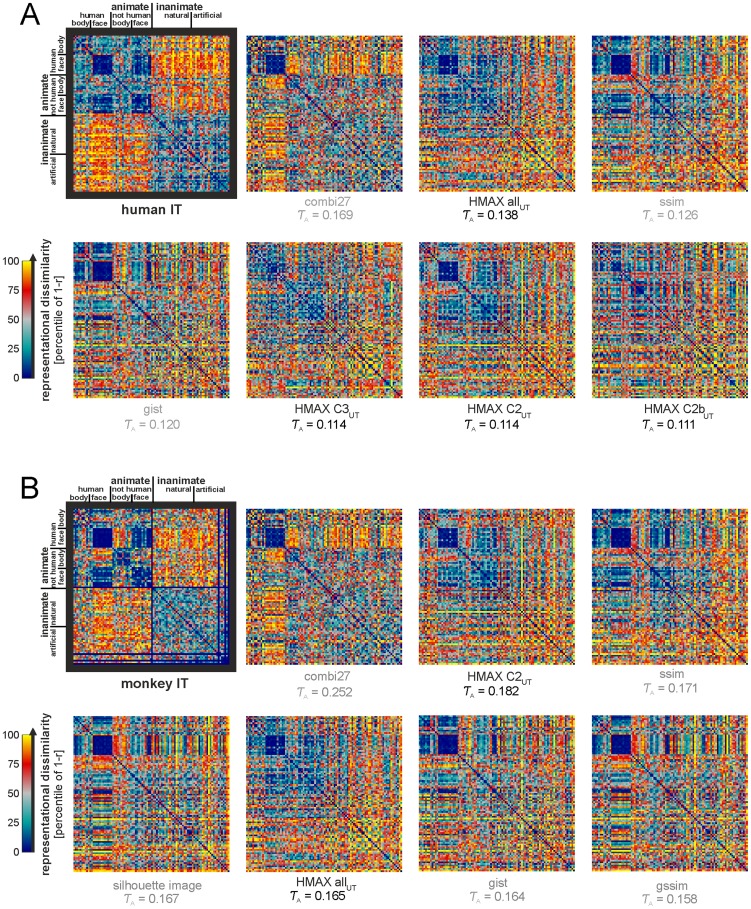
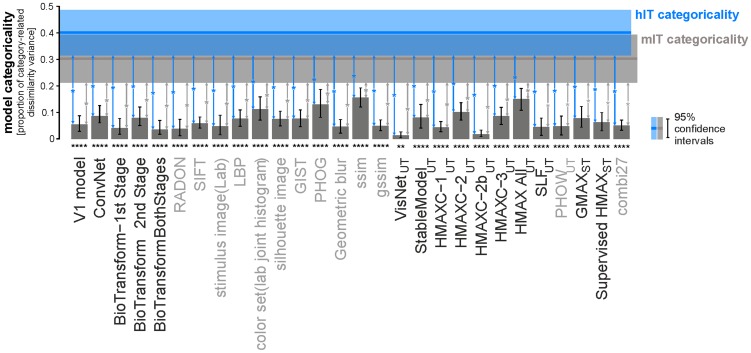
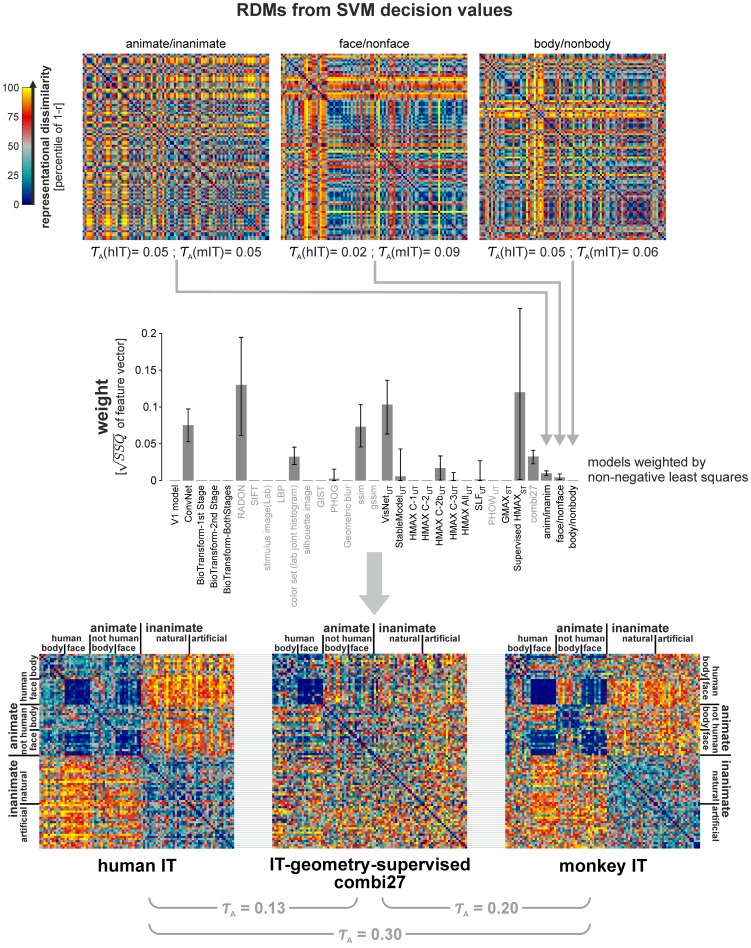
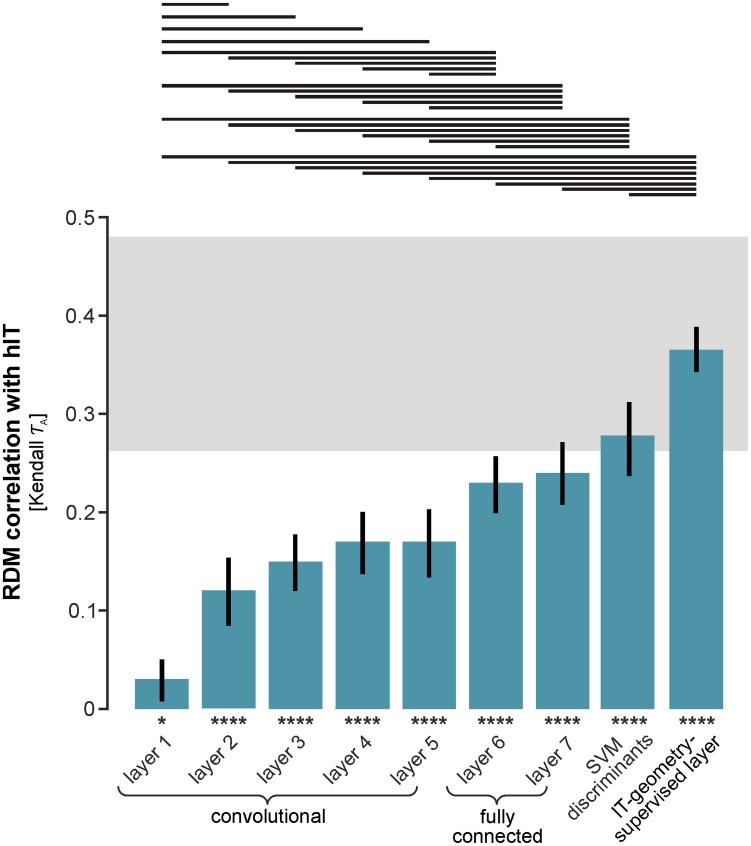
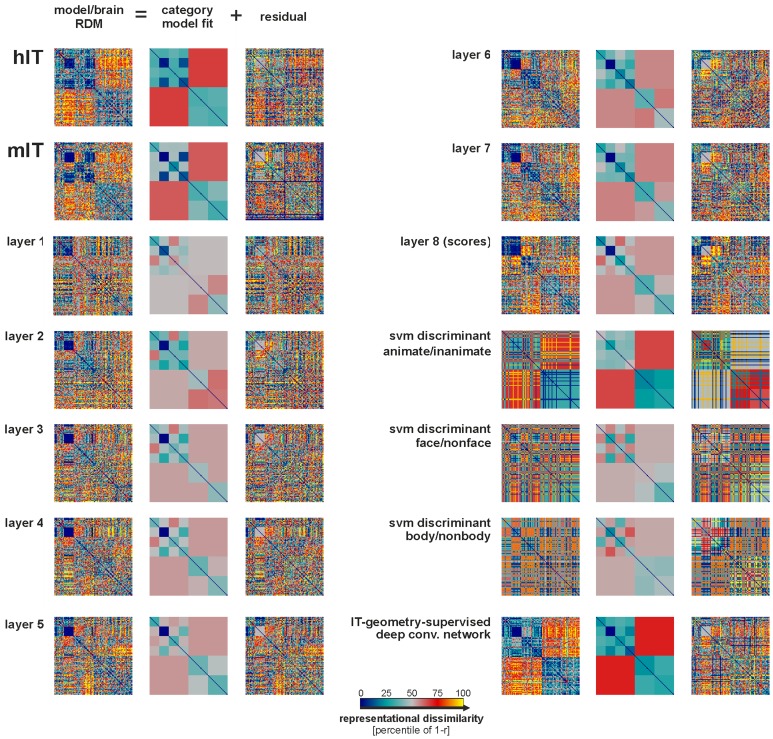
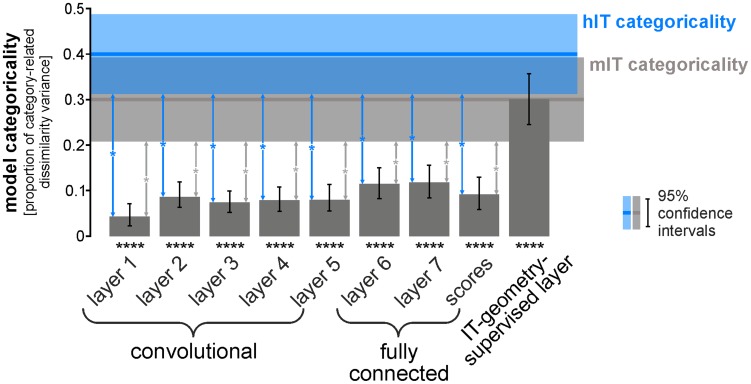
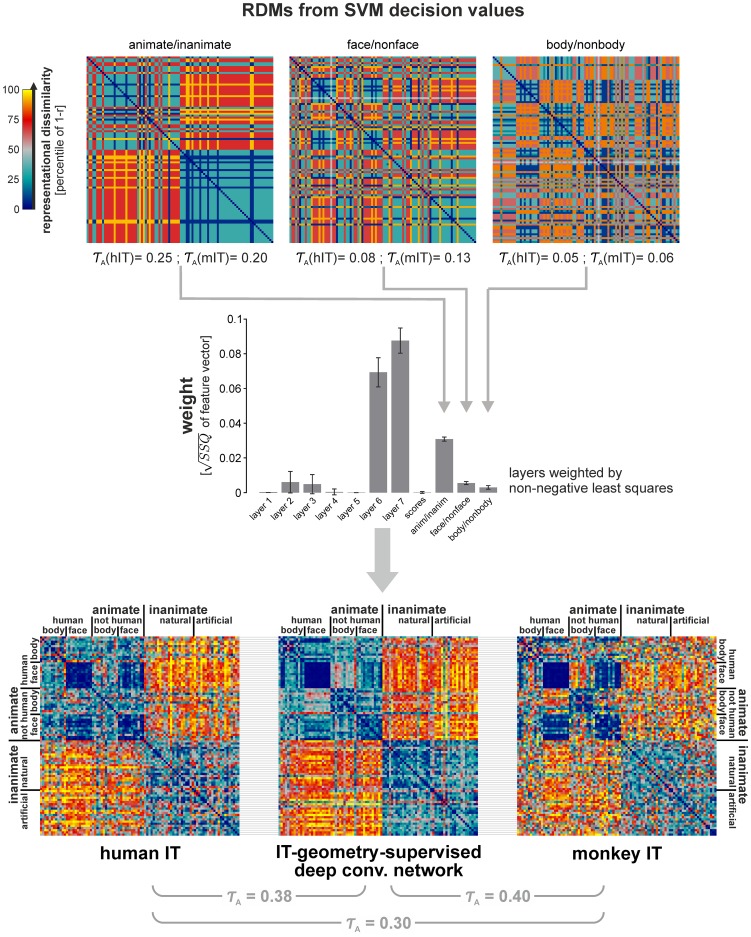
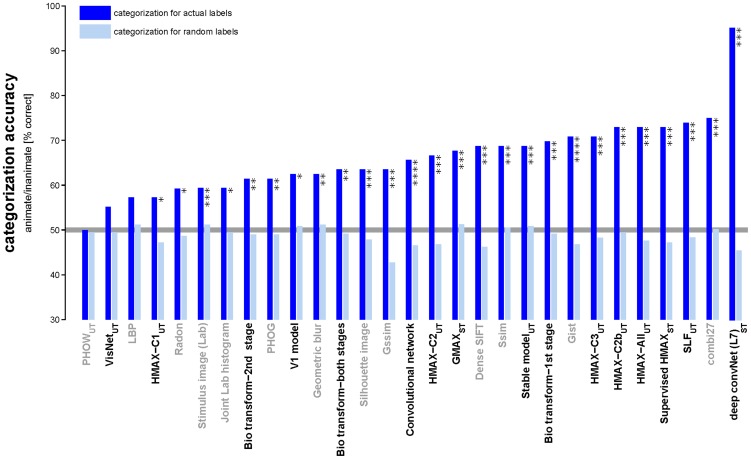
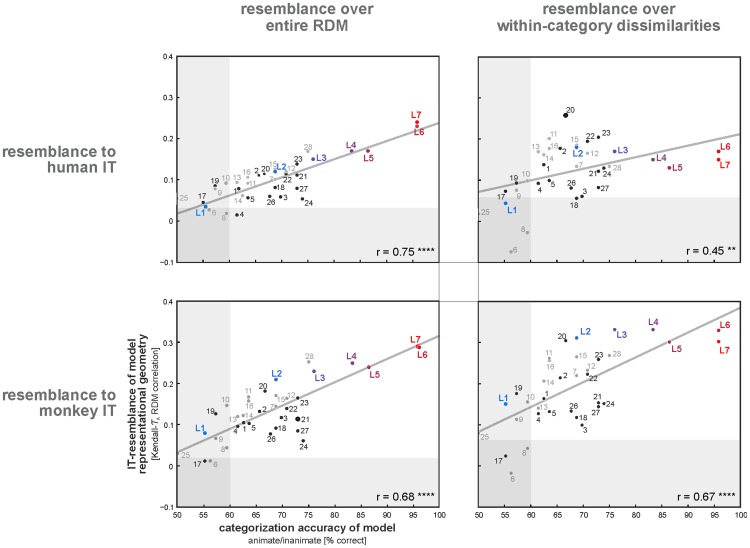
Inferior temporal (IT) cortex in human and nonhuman primates serves visual object recognition. Computational object-vision models, although continually improving, do not yet reach human performance. It is unclear to what extent the internal representations of computational models can explain the IT representation. Here we investigate a wide range of computational model representations (37 in total), testing their categorization performance and their ability to account for the IT representational geometry. The models include well-known neuroscientific object-recognition models (e.g. HMAX, VisNet) along with several models from computer vision (e.g. SIFT, GIST, self-similarity features, and a deep convolutional neural network). We compared the representational dissimilarity matrices (RDMs) of the model representations with the RDMs obtained from human IT (measured with fMRI) and monkey IT (measured with cell recording) for the same set of stimuli (not used in training the models). Better performing models were more similar to IT in that they showed greater clustering of representational patterns by category. In addition, better performing models also more strongly resembled IT in terms of their within-category representational dissimilarities. Representational geometries were significantly correlated between IT and many of the models. However, the categorical clustering observed in IT was largely unexplained by the unsupervised models. The deep convolutional network, which was trained by supervision with over a million category-labeled images, reached the highest categorization performance and also best explained IT, although it did not fully explain the IT data. Combining the features of this model with appropriate weights and adding linear combinations that maximize the margin between animate and inanimate objects and between faces and other objects yielded a representation that fully explained our IT data. Overall, our results suggest that explaining IT requires computational features trained through supervised learning to emphasize the behaviorally important categorical divisions prominently reflected in IT.
Overview
The claims and statistics of this paper haven’t been checked yet.
Free: it reads the open-access text and checks the first 5 claims that cite a source we can check. Create a free account to check every claim.
Integrity signals
Registry
Cites
Statistics
Figures



Verification
Claims the paper makes
The claims and statistics of this paper haven’t been checked yet.
Free: it reads the open-access text and checks the first 5 claims that cite a source we can check. Create a free account to check every claim.
Claims other papers make about this one
Each is checked against this paper’s own text: does it say what the citing paper says it does?
The cited source says what the claim attributes to it.
In the citing paper
“Using this approach, known as neuroconnectionism, numerous studies have identified shared representational structure across brains and ANN models, as well as factors influencing this alignment [5–11]”
From The Umwelt Representation Hypothesis: rethinking Universality (2026) · cites this paper as [10]
The cited source says what the claim attributes to it.
In the citing paper
“Analogous approaches have proven successful in relating the structure of neural activity to computational functions in other domains, including vision 17–19, audition 20, olfaction 21,22, thermosensation 23, perceptual discrimination 24, facial perception 25, and navigation 26,27.”
From A virtual rodent predicts the structure of neural activity across behaviours (2024) · cites this paper as [19]
Self-check
Percentages, sums and reported differences re-computed from the paper’s own numbers.
The self-check needs the paper’s full text.
Citations
Cites
ImageNet classification with deep convolutional neural networks
Krizhevsky, A., Sutskever, I., & Hinton, G. E. (2017) · Communications of the ACM · doi:10.1145/3065386 · Cited by 112,155
ImageNet: A large-scale hierarchical image database
Deng, J., Dong, W., Socher, R., Li, L.-J., Li, K., & Fei-Fei, L. (2009) · 2009 IEEE Conference on Computer Vision and Pattern Recognition · doi:10.1109/cvpr.2009.5206848 · Cited by 65,333 · cited 2×
“This is a supervised convolutional neural network, trained with 1.2 million labelled images from ImageNet (1000 category labels) [52].”
MethodInfluentialDistinctive Image Features from Scale-Invariant Keypoints
Lowe, D. G. (2004) · International Journal of Computer Vision · doi:10.1023/b:visi.0000029664.99615.94 · Cited by 55,589
LIBSVM: A library for support vector machines
Chang, C.-C., & Lin, C.-J. (2011) · ACM Transactions on Intelligent Systems and Technology · doi:10.1145/1961189.1961199 · Cited by 40,918
Object recognition from local scale-invariant features
Lowe, D. G. (1999) · Proceedings of the Seventh IEEE International Conference on Computer Vision · doi:10.1109/iccv.1999.790410 · Cited by 16,472
A fast learning algorithm for deep belief nets
Hinton, G. E., Osindero, S., & Teh, Y.-W. (2006) · Neural Computation · doi:10.1162/neco.2006.18.7.1527 · Cited by 16,336 · cited 1×
“In recent years, the advent of efficient training algorithms for deep neural networks [40,71,72,41] has made it possible to learn from image data not just the final classification step, but also the internal representations.”
BackgroundVisualizing and understanding convolutional networks
Zeiler, M. D., & Fergus, R. (2014) · Lecture Notes in Computer Science · doi:10.1007/978-3-319-10590-1_53 · Cited by 15,839
Multiresolution gray-scale and rotation invariant texture classification with local binary patterns
Ojala, T., Pietikainen, M., & Maenpaa, T. (2002) · IEEE Transactions on Pattern Analysis and Machine Intelligence · doi:10.1109/tpami.2002.1017623 · Cited by 15,398
Receptive fields, binocular interaction and functional architecture in the cat’s visual cortex
Hubel, D. H., & Wiesel, T. N. (1962) · The Journal of Physiology · doi:10.1113/jphysiol.1962.sp006837 · Cited by 13,680
Libsvm : A library for support vector machines
Ferrari, V. (2008) · Medical Entomology and Zoology · Cited by 10,122
Research works printed but not linked: 1
- Krizhevsky A., Sutskever I. and Hinton, G E. (2012) ImageNet Classification with Deep Convolutional Neural Networks. NIPS. Lake Tahoe, Nevada.
Cited by
Items 901–1,000 of 1,003
Unraveling the complexity of rat object vision requires a full convolutional network and beyond
Muratore, P., Alemi, A., & Zoccolan, D. (2025) · Patterns · doi:10.1016/j.patter.2024.101149 · Cited by 3
Compression-enabled interpretability of voxelwise encoding models
Kamali, F., Suratgar, A. A., Menhaj, M., & Abbasi-Asl, R. (2025) · PLoS Computational Biology · doi:10.1371/journal.pcbi.1012822 · Cited by 2
Summary statistics of learning link changing neural representations to behavior
Zavatone-Veth, J. A., Bordelon, B., & Pehlevan, C. (2025) · Frontiers in Neural Circuits · doi:10.3389/fncir.2025.1618351 · Cited by 5
Baba, A. (2025) · Brain Informatics · doi:10.1186/s40708-025-00266-x · Cited by 2
Naturally Computed Scale Invariance in the Residual Stream of ResNet18
Longon, A. (2025) · IEEE/CVF Conference on Computer Vision and Pattern Recognition Workshops (CVPRW) · doi:10.1109/cvprw67362.2025.00467 · Cited by 1
Neural mechanisms of visual quality perception and adaptability in the visual pathway
Zhang, Y., Chen, Y., Hu, Y., Han, X., Xie, Z., Wang, X., Zhou, Y., Min, X., & Zhai, G. (2025) · Patterns · doi:10.1016/j.patter.2025.101368 · Cited by 2
The self as an image: Appearance and belief in visual representations of one's own face
De, A., Liu, S. F., Monaragala, K., Shoura, M., Cunningham, W., & Nestor, A. (2026) · Cognition · doi:10.1016/j.cognition.2026.106639 · Cited by 1
Kataoka, A., Nagano, Y., & Oizumi, M. (2025) · Frontiers in Computational Neuroscience · doi:10.3389/fncom.2025.1613291 · Cited by 2
Investigation of Numerosity Representation in Convolution Neural Networks
Karami, A., Truong, N., & Manuela Piazza, A. (2025) · Conference on Cognitive Computational Neuroscience (CCN) · doi:10.32470/4j01408 · Cited by 1
Brain3D: Generating 3D Objects from fMRI
Yang, Y., Zhang, L., Xie, Z., Yuan, Z., Feng, J., Zhu, X., & Jiang, Y. (2026) · International Journal of Computer Vision · doi:10.1007/s11263-025-02609-x · Cited by 1
Mapping concept and relational semantic representation in the brain using large language models
Bogdan, P. C., Howard, C. M., Cabeza, R. E. L., & Davis, S. W. (2026) · Current Biology · doi:10.1016/j.cub.2026.01.064 · Cited by 2
Representation Biases: Variance Is Not Always a Good Proxy for Importance
Lampinen, A. K., Chan, S. C. Y., Li, Y., & Hermann, K. L. (2026) · eNeuro · doi:10.1523/eneuro.0461-25.2026 · Cited by 4
Layer-specific feature preference in a trained AlexNet model revealed by stylized image analysis
Wagatsuma, N., Ito, K., & Hidaka, A. (2026) · Scientific Reports · doi:10.1038/s41598-026-53152-9 · Cited by 1
Making models disagree to learn how brains compute
Golan, T., Schütt, H. H., & Kriegeskorte, N. (2026) · Nature reviews. Neuroscience · doi:10.1038/s41583-026-01070-0 · Cited by 2
Self-citationSpriet, C., Rostami, F., Hochmann, J., & Papeo, L. (2026) · Journal of Cognitive Neuroscience · doi:10.1162/jocn.a.2721 · Cited by 2
The neuroscience of transformers
König, P., & Negrello, M. (2026) · Cognitive Neurodynamics · doi:10.1007/s11571-026-10566-5 · Cited by 3
Identification of letters distorted by physiologically-inspired spatial scrambling
Zhu, X., & Baldwin, A. S. (2026) · PLoS Computational Biology · doi:10.1371/journal.pcbi.1014856 · Cited by 1
Privileged representational axes in biological and artificial neural networks
Khosla, M., Srivastava, S., Williams, A. H., McDermott, J. H., & Kanwisher, N. (2026) · Nature Human Behaviour · doi:10.1038/s41562-026-02515-3 · Cited by 1
An empirical model of activity in macaque inferior temporal cortex
Khan, S. A., & Tripp, B. (2016) · Neural Networks · doi:10.1016/j.neunet.2016.12.001 · Cited by 1
Tutorial Workshop on Contemporary Deep Neural Network Models.
McClelland, J. L., Hansen, S., & Saxe, A. (2016) · eScholarship (California Digital Library) · Cited by 1
Learning to predict visual brain activity by predicting future sensory states
Fonseca, M. (2019) · Cited by 1
Lal, R., Sharma, P., & Patel, D. K. (2023) · Communications in computer and information science · doi:10.1007/978-3-031-31417-9_33 · Cited by 1
Askari, E., & Motamed, S. (2023) · Journal of Information Systems and Telecommunication (JIST) · doi:10.52547/jist.34031.11.42.102 · Cited by 1
How Can We Track Cognitive Representations with Deep Neural Networks and Intracranial EEG?
Pacheco, D. (2023) · Studies in neuroscience, psychology and behavioral economics · doi:10.1007/978-3-031-20910-9_50 · Cited by 1
Velarde, O. M., Makse, H. A., & Parra, L. C. (2023) · PLoS Computational Biology · doi:10.1371/journal.pcbi.1011078 · Cited by 5
CEO Leadership and Its Contribution to Diversity Management
Rafiq, M., Dastane, O., & Xiuqing, D. (2023) · Advances in human resources management and organizational development book series · doi:10.4018/979-8-3693-1050-2.ch001 · Cited by 1
Peng, Y., Gong, X., Lu, H., & Fang, F. (2024) · Journal of Cognitive Neuroscience · doi:10.1162/jocn_a_02233 · Cited by 3
Topological Representations of Heterogeneous Learning Dynamics of Recurrent Spiking Neural Networks
Chakraborty, B., & Mukhopadhyay, S. (2024) · International Joint Conference on Neural Networks (IJCNN) · doi:10.1109/ijcnn60899.2024.10650857 · Cited by 4
Visual search and real-image similarity: An empirical assessment through the lens of deep learning
Petilli, M. A., Rodio, F., Günther, F., & Marelli, M. (2024) · Psychonomic Bulletin & Review · doi:10.3758/s13423-024-02583-4 · Cited by 3
Sparse high-dimensional decomposition of non-primary auditory cortical receptive fields
Mukherjee, S., Babadi, B., & Shamma, S. (2025) · PLoS Computational Biology · doi:10.1371/journal.pcbi.1012721 · Cited by 1
Coordinating multiple mental faculties during learning
Luo, X., Mok, R. M., Roads, B. D., & Love, B. C. (2025) · Scientific Reports · doi:10.1038/s41598-025-89732-4 · Cited by 2
Do Primates and Deep Artificial Neural Networks Perform Object Categorization in a Similar Manner?
Gangopadhyay, P., & Das, J. (2019) · Journal of Neuroscience · doi:10.1523/jneurosci.2458-18.2018 · Cited by 1
Learning Representational Invariance Instead of Categorization
Hernández-García, Á., & Peter König, B. (2019) · IEEE International Conference on Computer Vision Workshops · doi:10.1109/iccvw.2019.00561 · Cited by 1
Chen, W., Liu, B., Zheng, J., Li, X., Wang, P., & Wang, B. (2020) · Journal of the Neurological Sciences · doi:10.1016/j.jns.2020.116805 · Cited by 1
Constrained sampling from deep generative image models reveals mechanisms of human target detection
Fruend, I. (2020) · Journal of Vision · doi:10.1167/jov.20.7.32 · Cited by 1
Deep Representational Similarity Learning for Analyzing Neural Signatures in Task-based fMRI Dataset
Yousefnezhad, M., Sawalha, J., Selvitella, A., & Zhang, D. (2020) · Neuroinformatics · doi:10.1007/s12021-020-09494-4 · Cited by 1
Face-sketch learning with human sketch-drawing order enforcement
Chang, L., Jin, L., Weng, L., Chao, W., Wang, X., Deng, X., & Dong, Q. (2020) · Science China Information Sciences · doi:10.1007/s11432-019-2890-8 · Cited by 1
3D shape estimation in a constraint optimization neural network
Mishra, P., & Hélie, S. (2020) · Vision Research · doi:10.1016/j.visres.2020.08.010 · Cited by 1
de Beeck, H. O., & Nakatani, C. (2019) · Cambridge University Press eBooks · doi:10.1017/9781316847916.009 · Cited by 1
How does the brain represent the semantic content of an image?
Xu, H., Liu, M., & Zhang, D. (2022) · Neural Networks · doi:10.1016/j.neunet.2022.06.034 · Cited by 1
Sadeghnejad, N., Ezoji, M., Ebrahimpour, R., & Zabbah, S. (2022) · Neuroscience Research · doi:10.1016/j.neures.2022.12.002 · Cited by 2
Representing multiple visual objects in the human brain and convolutional neural networks
Mocz, V., Jeong, S. K., Chun, M. M., & Xu, Y. (2022) · Journal of Vision · doi:10.1167/jov.22.14.3665 · Cited by 1
Taylor, J., & Xu, Y. (2023) · Journal of Cognitive Neuroscience · doi:10.1162/jocn_a_01979 · Cited by 1
Characterizing the temporal dynamics of object recognition by deep neural networks : role of depthPreprint
Ramakrishnan, K., Groen, I. I. A., Smeulders, A. W. M., Scholte, H. S., & Ghebreab, S. (2017) · bioRxiv (Cold Spring Harbor Laboratory) · doi:10.1101/178541 · Cited by 1
Sharpening of hierarchical visual feature representations of blurred imagesPreprint
Abdelhack, M., & Kamitani, Y. (2017) · bioRxiv (Cold Spring Harbor Laboratory) · doi:10.1101/230078 · Cited by 1
Sensory cheating: adversarial body patterns can fool a convolutional visual system during signalingPreprint
Laan, A., & de Polavieja, G. G. (2018) · bioRxiv (Cold Spring Harbor Laboratory) · doi:10.1101/326652 · Cited by 1
Blurred Images Lead to Bad Local MinimaPreprint
Katzhendler, G., & Weinshall, D. (2019) · arXiv (Cornell University) · doi:10.48550/arxiv.1901.10788 · Cited by 1
Brain network organization as the computational architecture of cognitionPreprint
Ito, T., Hearne, L. J., Mill, R. D., Cocuzza, C. V., & Cole, M. W. (2019) · arXiv (Cornell University) · Cited by 1
Predicting stimulus representations in the visual cortex using computational principlesPreprint
Lage‐Castellanos, A., & Martino, F. D. (2019) · bioRxiv (Cold Spring Harbor Laboratory) · doi:10.1101/687731 · Cited by 1
A convolutional neural-network framework for modelling auditory sensory cells and synapsesPreprint
Drakopoulos, F., Baby, D., & Verhulst, S. (2020) · bioRxiv (Cold Spring Harbor Laboratory) · doi:10.1101/2020.11.25.388546 · Cited by 1
Kar, K. (2021) · bioRxiv (Cold Spring Harbor Laboratory) · doi:10.1101/2021.03.24.436640 · Cited by 1
da Costa, D., Goebel, R., & Senden, M. (2021) · bioRxiv (Cold Spring Harbor Laboratory) · doi:10.1101/2021.11.02.466130 · Cited by 2
Human learning follows the dynamics of gradient descentPreprint
Barry, D. N., & Love, B. C. (2021) · PsyArXiv (OSF Preprints) · doi:10.31234/osf.io/75e4t · Cited by 2
Thorat, S. (2019) · Thesis Commons (OSF Preprints) · doi:10.31237/osf.io/fxz4q · Cited by 1
Karapetian, A., Boyanova, A., Pandaram, M., Obermayer, K., Kietzmann, T. C., & Cichy, R. M. (2023) · bioRxiv (Cold Spring Harbor Laboratory) · doi:10.1101/2023.01.22.525084 · Cited by 1
Wang, X., & Jadi, M. P. (2023) · SSRN Electronic Journal · doi:10.1101/2023.05.09.540022 · Cited by 1
Reconstructing voice identity from noninvasive auditory cortex recordingsPreprint
Lamothe, C., Thoret, E., Trapeau, R., Giordano, B. L., Sein, J., Takerkart, S., Ayache, S., Artières, T., & Belin, P. (2024) · eLife · doi:10.7554/elife.98047 · Cited by 2
Equivariant neuronal populations enable simultaneous tuning and invariancePreprint
Hoeller, J., Zhong, L., Heinrich, L., Saalfeld, S., Pachitariu, M., & Romani, S. (2024) · bioRxiv (Cold Spring Harbor Laboratory) · doi:10.1101/2024.08.02.606398 · Cited by 2
The inevitability and superfluousness of cell types in spatial cognitionPreprint
Luo, X., Mok, R. M., & Love, B. C. (2024) · eLife · doi:10.7554/elife.99047.1 · Cited by 4
The inevitability and superfluousness of cell types in spatial cognitionPreprint
Luo, X., Mok, R. M., & Love, B. C. (2024) · eLife · doi:10.7554/elife.99047 · Cited by 3
Tugsbayar, M., Li, M., Muller, E. B., & Richards, B. A. (2025) · eLife · doi:10.1101/2024.10.01.615270 · Cited by 2
The mechanism at hand: A goal-driven approach to modeling the human sensorimotor system
Weidler, T. (2024) · Research Publications (Maastricht University) · doi:10.26481/dis.20250110tw · Cited by 1
Local and distributed information coding in the ventral stream
Bogdan, P. C., Howard, C. M., Gillette, K. D., Cabeza, R. E. L., & Davis, S. W. (2026) · Imaging Neuroscience · doi:10.1101/2025.03.09.642235 · Cited by 1
A high-throughput approach for the efficient prediction of perceived similarity of natural objectsPreprint
Kaniuth, P., Mahner, F. P., Perkuhn, J., & Hebart, M. N. (2025) · eLife · doi:10.7554/elife.105394 · Cited by 5
A high-throughput approach for the efficient prediction of perceived similarity of natural objectsPreprint
Kaniuth, P., Mahner, F. P., Perkuhn, J., & Hebart, M. N. (2025) · eLife · doi:10.7554/elife.105394.1 · Cited by 2
Abudarham, N., & Yovel, G. (2025) · bioRxiv (Cold Spring Harbor Laboratory) · doi:10.1101/2025.11.25.690208 · Cited by 1
How attention saves energy in visionPreprint
Butkus, E., Ying, Z., & Kriegeskorte, N. (2026) · bioRxiv (Cold Spring Harbor Laboratory) · doi:10.64898/2026.03.18.710397 · Cited by 2
Self-citationDipani, A., & Murty, N. A. R. (2026) · bioRxiv (Cold Spring Harbor Laboratory) · doi:10.64898/2026.05.29.728609 · Cited by 2
Rostami, F., Spriet, C., de Beeck, H. O., Hochmann, J., & Papeo, L. (2026) · bioRxiv (Cold Spring Harbor Laboratory) · doi:10.64898/2026.06.15.732334 · Cited by 1
Zhang, H., Zheng, Z., Hu, J., Wang, Q., Xu, M., Zhou, Z., Li, Z., & Okazawa, G. (2026) · eLife · doi:10.7554/elife.111725 · Cited by 1
Zero-shot evaluations expose structured generalization limits in predictive models of the brainPreprint
Wang, R., Deb, M., Abate, A., Dipani, A., Dudipala, K. R., Chillarege, S., Ravikanti, K., Li, Y., Al-Tahan, H., Koushik, R., et al. (2026) · bioRxiv (Cold Spring Harbor Laboratory) · doi:10.64898/2026.09.15.751562 · Cited by 1
Plebe, A., & Cruz, V. M. D. L. (2016) · Lecture notes in morphogenesis · doi:10.1007/978-3-319-29483-4_10
Neurosemantics of Visual Objects
Plebe, A., & Cruz, V. M. D. L. (2016) · Studies in brain and mind · doi:10.1007/978-3-319-28552-8_6
A Rich Source of Labels for Deep Network Models of the Primate Dorsal Visual StreamPreprint
Rezai, O., Jentsch, P. B., & Tripp, B. (2016) · arXiv (Cornell University) · doi:10.48550/arxiv.1610.04962
Abbreviated title: Eye movements and MEG responses to scenes
Henriksson, L., Ölander, K., & Hari, R. (2016)
Gwilliams, L., & King, J.-R. (2017) · bioRxiv (Cold Spring Harbor Laboratory) · doi:10.1101/221630 · Cited by 1
Liao, F., Hu, X., & Song, S. (2018) · bioRxiv (Cold Spring Harbor Laboratory) · doi:10.1101/244350
Human Sensitivity to Perturbations Constrained by a Model of the Natural Image ManifoldPreprint
Fruend, I., & Stalker, E. (2018) · bioRxiv (Cold Spring Harbor Laboratory) · doi:10.1101/320531
Visual Attention on the Sun: What Do Existing Models Actually Predict?Preprint
Li, J., Li, D., Fu, K., & Xu, L. (2018) · arXiv (Cornell University) · doi:10.48550/arxiv.1811.10004
Conflicting Bottom-up and Top-down Signals during Misrecognition of Visual ObjectsPreprint
Abdelhack, M., & Kamitani, Y. (2019) · bioRxiv (Cold Spring Harbor Laboratory) · doi:10.1101/521252
Unsupervised deep neural network for fMRI feedback modelling
Svanera, M., Morgan, A., Petro, L. S., & Muckli, L. F. (2018) · Conference on Cognitive Computational Neuroscience (CCN) · doi:10.32470/ccn.2018.1055-0
Superstitious Perception: Comparing Perceptual Prediction by Humans and Neural Networks
Laflamme, P., & Enns, J. T. (2018) · Current topics in behavioral neurosciences · doi:10.1007/7854_2018_65
A CNN-Based Computational Encoding Model for Human V2 Cortex
Hu, Y., Qiao, K., Wang, L., Li, T., Zhang, C., Gao, H., & Yan, B. (2018) · International Conference on Computational Intelligence and Applications (ICCIA) · doi:10.1109/iccia.2018.00037
Deep Neural Networks Abstract Like Humans.Preprint
Gain, A., & Siegelmann, H. T. (2019) · arXiv (Cornell University)
Mechanistic philosophy and the use of deep neural networks in neuroscience
Harrison, D. C. (2018) · ERA
Contrast invariant tuning in human perception of image contentPreprint
Fruend, I., Patel, J. Y., & Stalker, E. D. (2019) · bioRxiv (Cold Spring Harbor Laboratory) · doi:10.1101/711804 · Cited by 1
Visual asymmetry in artificial neural networks
Shah, A. D. (2019)
Representational content in human cortical systems and visual consciousness
Schneider (2019) · Research Publications (Maastricht University) · doi:10.26481/dis.20191009ms
Taxonomic and Whole Object Constraints: A Deep Architecture
Cerrato, M., Arnaudo, E., Gliozzi, V., & Esposito, R. (2019) · eScholarship (California Digital Library)
Face representation by deep learning: a linear encoding in a parameter space?Preprint
Dong, Q., Sun, J., & Hu, Z. (2019) · arXiv (Cornell University) · doi:10.48550/arxiv.1910.09768 · Cited by 1
Perconti, P., & Plebe, A. (2019)
Receptive Field Encoding Model for Dynamic Natural Vision
Kamali, F., Suratgar, A. A., Menhaj, M. B., & Abbasi-Asl, R. (2019) · The Neuroscience Journal of Shefaye Khatam · doi:10.29252/shefa.7.4.1
Mathematical Models of the Representation of Faces in Humans
O’Keeffe, J. (2017) · Apollo (University of Cambridge) · doi:10.17863/cam.46702
Electromagnetic Field of the Brain
de Beeck, H. O., & Nakatani, C. (2019) · Cambridge University Press eBooks · doi:10.1017/9781316847916.013
The Physics behind Magnetic Resonance Imaging (MRI)
de Beeck, H. O., & Nakatani, C. (2019) · Cambridge University Press eBooks · doi:10.1017/9781316847916.004
Designing a Hemodynamic Imaging Experiment
de Beeck, H. O., & Nakatani, C. (2019) · Cambridge University Press eBooks · doi:10.1017/9781316847916.008
Causal Methods to Modulate Brain Activity
de Beeck, H. O., & Nakatani, C. (2019) · Cambridge University Press eBooks · doi:10.1017/9781316847916.019
de Beeck, H. O., & Nakatani, C. (2019) · Cambridge University Press eBooks · doi:10.1017/9781316847916.010
Metadata
- Authors
- Khaligh-Razavi, S.-M., & Kriegeskorte, N.
- Affiliations
- MRC Cognition and Brain Sciences Unit (GB)
- Corresponding author
- Kriegeskorte, Nikolaus
- Venue
- PLoS Computational Biology
- Publisher
- Public Library of Science (PLoS)
- Published
- 2014-11-06
- Volume
- 10
- Issue
- 11
- Pages
- e1003915
- ISSN
- 1553-734X (ISSN-L)
- 1553-7358
- PMC
- PMC4222664
- OpenAlex
- W2040036684
- Cited by
- 1,204
- References
- 98
- Citations by year
- 2026: 75 · 2025: 100 · 2024: 110 · 2023: 127 · 2022: 112 · 2021: 124 · 2020: 125 · 2019: 151 · 2018: 97 · 2017: 87 · 2016: 75 · 2015: 20 · 2014: 1
- FWCI
- 34.02
- Type
- journal article
- Language
- en
- Open access
- gold
- doi.org
- Locations
- PLoS Computational Biology (publishedVersion, cc-by)
- Europe PMC (PubMed Central) (publishedVersion, cc-by)
- PubMed Central (publishedVersion, cc-by)
- PubMed (publishedVersion)
- DOAJ (DOAJ: Directory of Open Access Journals) (submittedVersion, cc-by-sa)
- Figshare (submittedVersion, cc-by)
- Funders
- Cambridge Overseas Trust
- Medical Research Council (MC-A060- 5PR20)
- FP7 Ideas: European Research Council (261352)
- Topics
- Life Sciences › Neuroscience › Cognitive Neuroscience › Visual perception and processing mechanisms
- Life Sciences › Neuroscience › Cognitive Neuroscience › Face Recognition and Perception
- Physical Sciences › Computer Science › Computer Vision and Pattern Recognition › Advanced Neural Network Applications
- Keywords
- inferior temporal cortex, visual object recognition, representational geometry, representational dissimilarity matrices, supervised learning, unsupervised learning, deep convolutional neural networks, categorical clustering, HMAX, monkey visual cortex, human visual cortex
- MeSH terms
- Animals, Haplorhini, Humans, Models, Neurological, Temporal Lobe, Computational Biology, Support Vector Machine
About these checks
Registry, retraction, Cites and statistics results are computed, not judged, with one exception: a printed reference that no index lists is read once by a model before it counts as a citation error. Claims are extracted by a model and kept only when their quote appears verbatim in the text; each cited source is then checked, with a model’s help, for whether it says what the claim relies on. Those verdicts can be wrong — read the claim’s quote and the cited source before relying on one.
Statistics and arithmetic are recomputed, not judged.
Confidence bands are shown only for fields calibrated on our annotated test set. None is calibrated yet, so no band is shown.
What counts as a claim ›How we measure confidence ›How we check this ›
Are you an author, or do you see a problem with this page? Request a review
Data sources
Bibliographic data: Semantic Scholar, OpenAlex, Crossref.
Contains information from the Semantic Scholar Academic Graph Datasets, made available under the ODC Attribution License (ODC-BY 1.0).
Semantic Scholar’s data is described in: Kinney, R., et al. (2023). The Semantic Scholar Open Data Platform. arXiv:2301.10140.
