

Deep Supervised, but Not Unsupervised, Models May Explain IT Cortical Representation
Open accessThe DOI matches its Crossref record; 99 of the 99 references it cites were found in a registry or an index.
Abstract
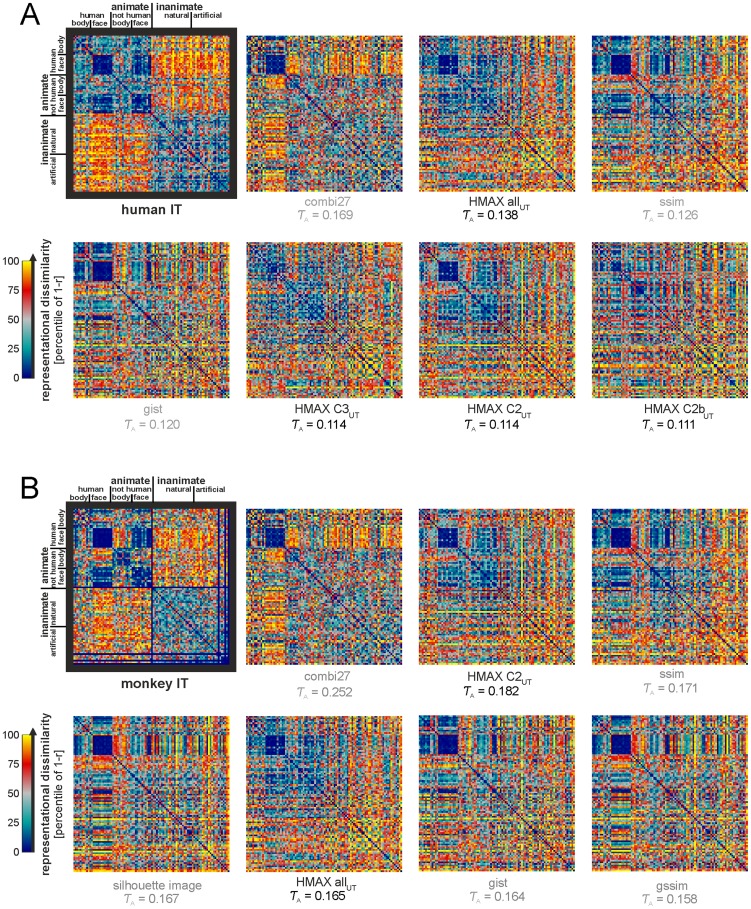
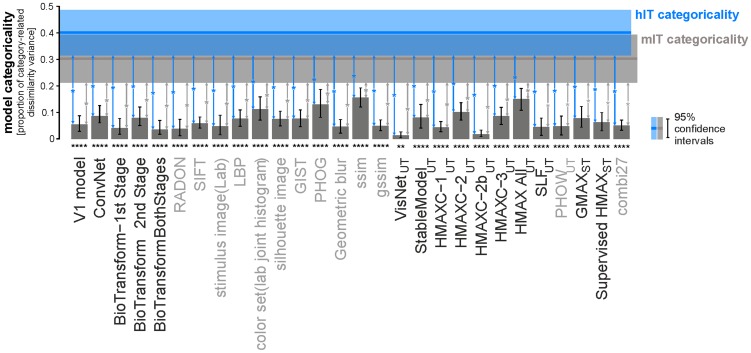
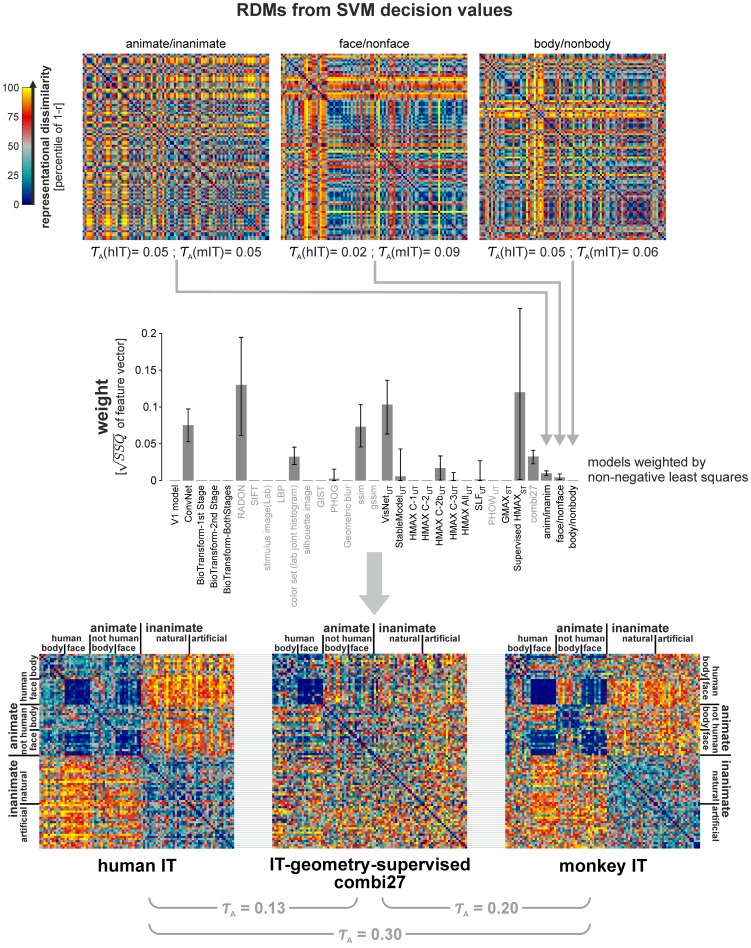
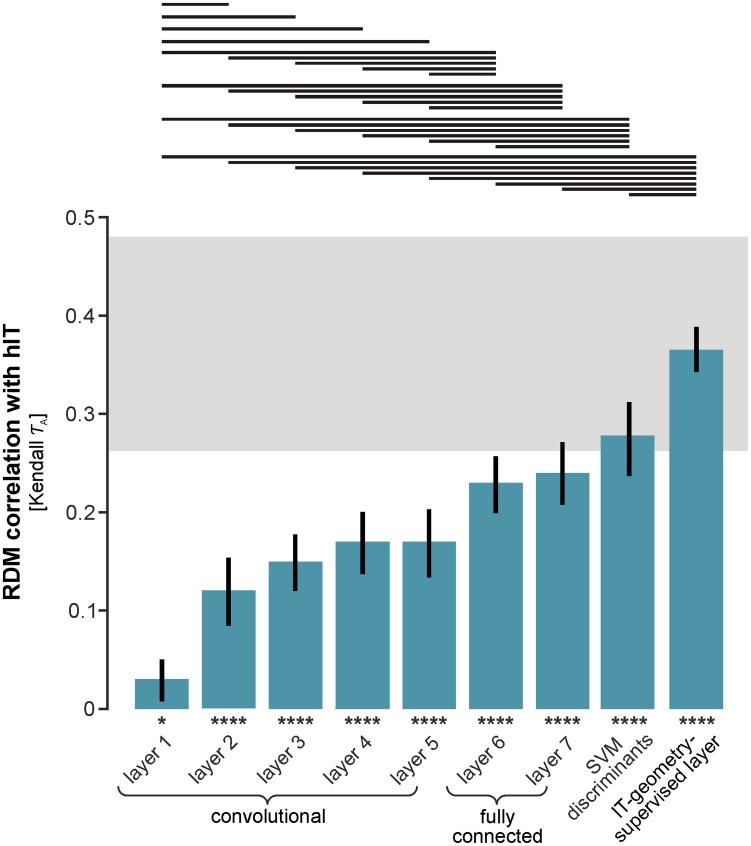
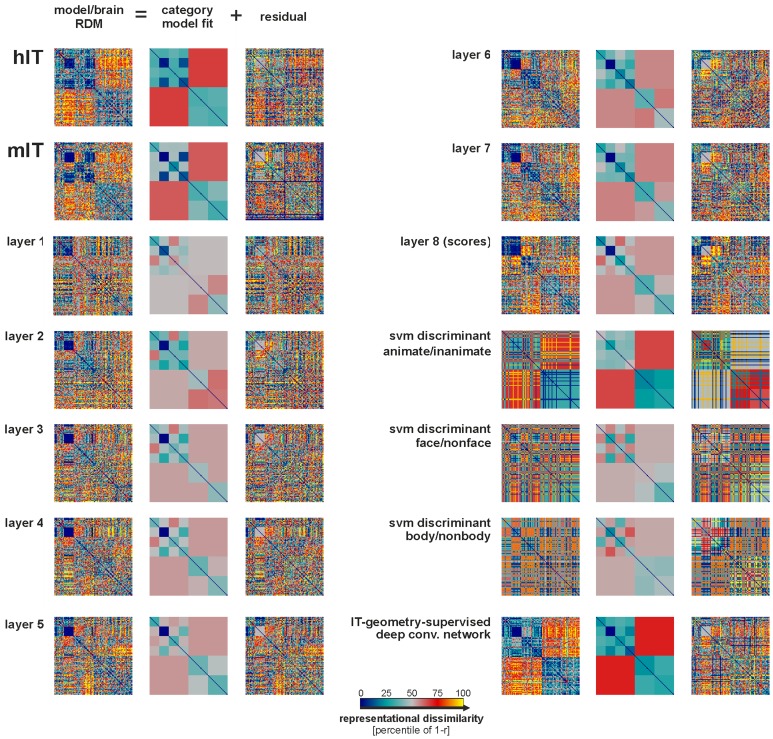
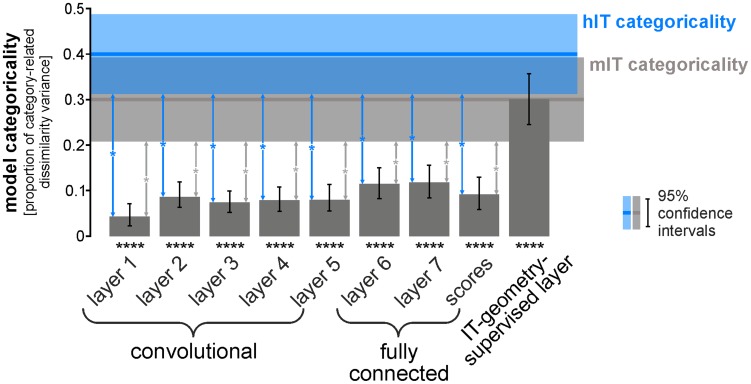
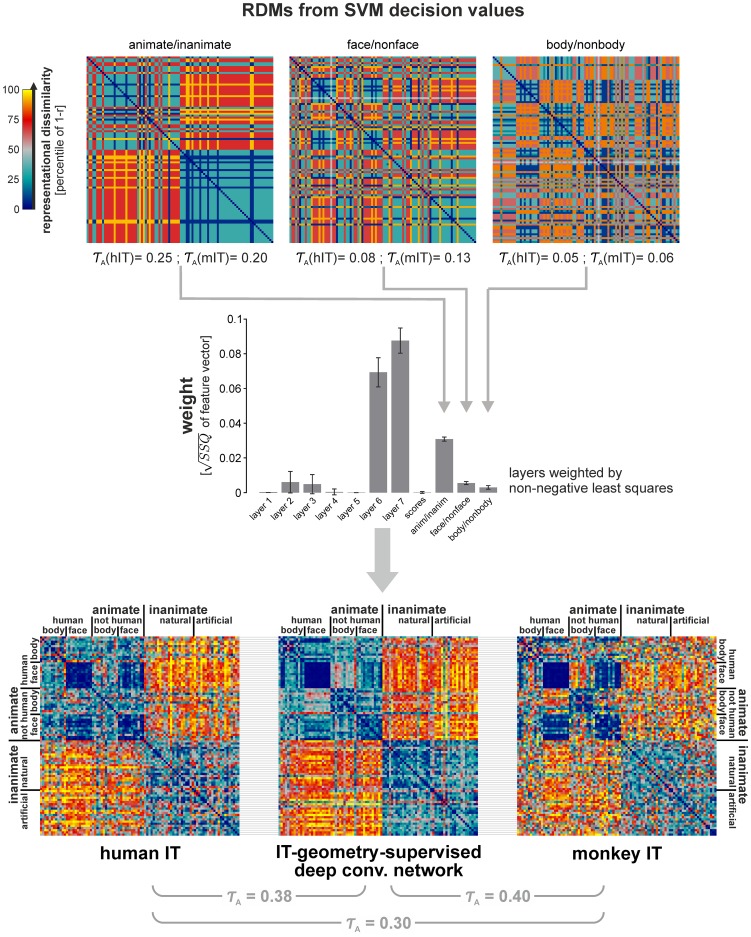
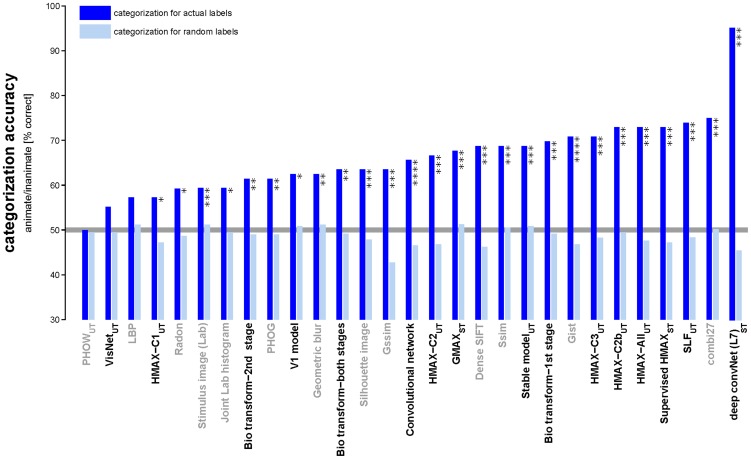
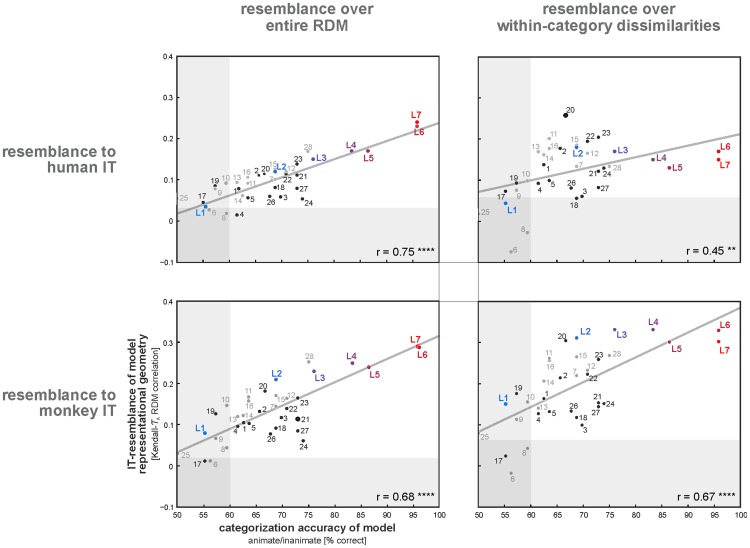
Inferior temporal (IT) cortex in human and nonhuman primates serves visual object recognition. Computational object-vision models, although continually improving, do not yet reach human performance. It is unclear to what extent the internal representations of computational models can explain the IT representation. Here we investigate a wide range of computational model representations (37 in total), testing their categorization performance and their ability to account for the IT representational geometry. The models include well-known neuroscientific object-recognition models (e.g. HMAX, VisNet) along with several models from computer vision (e.g. SIFT, GIST, self-similarity features, and a deep convolutional neural network). We compared the representational dissimilarity matrices (RDMs) of the model representations with the RDMs obtained from human IT (measured with fMRI) and monkey IT (measured with cell recording) for the same set of stimuli (not used in training the models). Better performing models were more similar to IT in that they showed greater clustering of representational patterns by category. In addition, better performing models also more strongly resembled IT in terms of their within-category representational dissimilarities. Representational geometries were significantly correlated between IT and many of the models. However, the categorical clustering observed in IT was largely unexplained by the unsupervised models. The deep convolutional network, which was trained by supervision with over a million category-labeled images, reached the highest categorization performance and also best explained IT, although it did not fully explain the IT data. Combining the features of this model with appropriate weights and adding linear combinations that maximize the margin between animate and inanimate objects and between faces and other objects yielded a representation that fully explained our IT data. Overall, our results suggest that explaining IT requires computational features trained through supervised learning to emphasize the behaviorally important categorical divisions prominently reflected in IT.
Overview
The claims and statistics of this paper haven’t been checked yet.
Free: it reads the open-access text and checks the first 5 claims that cite a source we can check. Create a free account to check every claim.
Integrity signals
Registry
Cites
Statistics
Figures



Verification
Claims the paper makes
The claims and statistics of this paper haven’t been checked yet.
Free: it reads the open-access text and checks the first 5 claims that cite a source we can check. Create a free account to check every claim.
Claims other papers make about this one
Each is checked against this paper’s own text: does it say what the citing paper says it does?
The cited source says what the claim attributes to it.
In the citing paper
“Using this approach, known as neuroconnectionism, numerous studies have identified shared representational structure across brains and ANN models, as well as factors influencing this alignment [5–11]”
From The Umwelt Representation Hypothesis: rethinking Universality (2026) · cites this paper as [10]
The cited source says what the claim attributes to it.
In the citing paper
“Analogous approaches have proven successful in relating the structure of neural activity to computational functions in other domains, including vision 17–19, audition 20, olfaction 21,22, thermosensation 23, perceptual discrimination 24, facial perception 25, and navigation 26,27.”
From A virtual rodent predicts the structure of neural activity across behaviours (2024) · cites this paper as [19]
Self-check
Percentages, sums and reported differences re-computed from the paper’s own numbers.
The self-check needs the paper’s full text.
Citations
Cites
ImageNet classification with deep convolutional neural networks
Krizhevsky, A., Sutskever, I., & Hinton, G. E. (2017) · Communications of the ACM · doi:10.1145/3065386 · Cited by 112,155
ImageNet: A large-scale hierarchical image database
Deng, J., Dong, W., Socher, R., Li, L.-J., Li, K., & Fei-Fei, L. (2009) · 2009 IEEE Conference on Computer Vision and Pattern Recognition · doi:10.1109/cvpr.2009.5206848 · Cited by 65,333 · cited 2×
“This is a supervised convolutional neural network, trained with 1.2 million labelled images from ImageNet (1000 category labels) [52].”
MethodInfluentialDistinctive Image Features from Scale-Invariant Keypoints
Lowe, D. G. (2004) · International Journal of Computer Vision · doi:10.1023/b:visi.0000029664.99615.94 · Cited by 55,589
LIBSVM: A library for support vector machines
Chang, C.-C., & Lin, C.-J. (2011) · ACM Transactions on Intelligent Systems and Technology · doi:10.1145/1961189.1961199 · Cited by 40,918
Object recognition from local scale-invariant features
Lowe, D. G. (1999) · Proceedings of the Seventh IEEE International Conference on Computer Vision · doi:10.1109/iccv.1999.790410 · Cited by 16,472
A fast learning algorithm for deep belief nets
Hinton, G. E., Osindero, S., & Teh, Y.-W. (2006) · Neural Computation · doi:10.1162/neco.2006.18.7.1527 · Cited by 16,336 · cited 1×
“In recent years, the advent of efficient training algorithms for deep neural networks [40,71,72,41] has made it possible to learn from image data not just the final classification step, but also the internal representations.”
BackgroundVisualizing and understanding convolutional networks
Zeiler, M. D., & Fergus, R. (2014) · Lecture Notes in Computer Science · doi:10.1007/978-3-319-10590-1_53 · Cited by 15,839
Multiresolution gray-scale and rotation invariant texture classification with local binary patterns
Ojala, T., Pietikainen, M., & Maenpaa, T. (2002) · IEEE Transactions on Pattern Analysis and Machine Intelligence · doi:10.1109/tpami.2002.1017623 · Cited by 15,398
Receptive fields, binocular interaction and functional architecture in the cat’s visual cortex
Hubel, D. H., & Wiesel, T. N. (1962) · The Journal of Physiology · doi:10.1113/jphysiol.1962.sp006837 · Cited by 13,680
Libsvm : A library for support vector machines
Ferrari, V. (2008) · Medical Entomology and Zoology · Cited by 10,122
Research works printed but not linked: 1
- Krizhevsky A., Sutskever I. and Hinton, G E. (2012) ImageNet Classification with Deep Convolutional Neural Networks. NIPS. Lake Tahoe, Nevada.
Cited by
Items 201–300 of 1,003
Explanatory models in neuroscience, Part 1: Taking mechanistic abstraction seriously
Cao, R., & Yamins, D. (2024) · Cognitive Systems Research · doi:10.1016/j.cogsys.2024.101244 · Cited by 64
Language in Brains, Minds, and Machines
Tuckute, G., Kanwisher, N., & Fedorenko, E. G. (2024) · Annual Review of Neuroscience · doi:10.1146/annurev-neuro-120623-101142 · Cited by 115
A unifying framework for functional organization in early and higher ventral visual cortex
Margalit, E., Lee, H., Finzi, D., DiCarlo, J. J., Grill-Spector, K., & Yamins, D. L. K. (2024) · Neuron · doi:10.1016/j.neuron.2024.04.018 · Cited by 112
Deep Neural Networks in Computational NeurosciencePreprint
Kietzmann, T. C., McClure, P., & Kriegeskorte, N. (2017) · bioRxiv (Cold Spring Harbor Laboratory) · doi:10.1101/133504 · Cited by 108
Self-citationDeep Learning for Cognitive Neuroscience
Storrs, K. R., & Kriegeskorte, N. (2020) · The Cognitive Neurosciences · doi:10.7551/mitpress/11442.003.0077 · Cited by 67
Self-citationZeman, A. A., Ritchie, J. B., Bracci, S., & de Beeck, H. O. (2020) · Scientific Reports · doi:10.1038/s41598-020-59175-0 · Cited by 81
Computational insights into human perceptual expertise for familiar and unfamiliar face recognition
Blauch, N. M., Behrmann, M., & Plaut, D. C. (2021) · Cognition · doi:10.1016/j.cognition.2020.104341 · Cited by 69
NeuroRA: A Python Toolbox of Representational Analysis From Multi-Modal Neural Data
Lu, Z., & Ku, Y. (2020) · Frontiers in Neuroinformatics · doi:10.3389/fninf.2020.563669 · Cited by 72
Texture-like representation of objects in human visual cortex
Jagadeesh, A. V., & Gardner, J. L. (2022) · Proceedings of the National Academy of Sciences · doi:10.1073/pnas.2115302119 · Cited by 91
Rapid Invariant Encoding of Scene Layout in Human OPA
Henriksson, L., Mur, M., & Kriegeskorte, N. (2019) · Neuron · doi:10.1016/j.neuron.2019.04.014 · Cited by 80
Self-citationKhaligh-Razavi, S.-M., Henriksson, L., Kay, K., & Kriegeskorte, N. (2017) · Journal of Mathematical Psychology · doi:10.1016/j.jmp.2016.10.007 · Cited by 70
Self-citationMorgan, A., Petro, L. S., & Muckli, L. F. (2019) · Journal of Neuroscience · doi:10.1523/jneurosci.0852-19.2019 · Cited by 73
What shapes feature representations? Exploring datasets, architectures, and training
Hermann, K. L., & Lampinen, A. K. (2020) · arXiv · doi:10.48550/arxiv.2006.12433
Discovering the Computational Relevance of Brain Network Organization
Ito, T., Hearne, L. J., Mill, R. D., Cocuzza, C. V., & Cole, M. W. (2019) · Trends in Cognitive Sciences · doi:10.1016/j.tics.2019.10.005 · Cited by 73
Qiao, L., Zhang, L., Chen, A., & Egner, T. (2017) · Journal of Neuroscience · doi:10.1523/jneurosci.0935-17.2017 · Cited by 78
Cognition as a Window into Neuronal Population Space
Ruff, D. A., Ni, A. M., & Cohen, M. R. (2018) · Annual Review of Neuroscience · doi:10.1146/annurev-neuro-080317-061936 · Cited by 63
“…been in the study of visual object processing where population recordings and deep-learning neural networks have begun to elucidate the nature of high-level object representations (Cadieu et al. 2014, Khaligh-Razavi & Kriegeskorte 2014, Pagan et al. 2013, Yamins et al. 2014, Yamins & DiCarlo 2016).”
BackgroundCommon Object Representations for Visual Production and Recognition
Fan, J. E., Yamins, D. L. K., & Turk‐Browne, N. B. (2018) · Cognitive Science · doi:10.1111/cogs.12676 · Cited by 78
Untangling the Animacy Organization of Occipitotemporal Cortex
Ritchie, J. B., Zeman, A. A., Bosmans, J., Sun, S., Verhaegen, K. A., & de Beeck, H. O. (2021) · Journal of Neuroscience · doi:10.1523/jneurosci.2628-20.2021 · Cited by 77
Nayebi, A., Sagastuy-Breña, J., Bear, D. M., Kar, K., Kubilius, J., Ganguli, S., Sussillo, D., DiCarlo, J. J., & Yamins, D. L. K. (2022) · Neural Computation · doi:10.1162/neco_a_01506 · Cited by 77
Predictive models avoid excessive reductionism in cognitive neuroimaging
Varoquaux, G. P., & Poldrack, R. A. (2018) · Current Opinion in Neurobiology · doi:10.1016/j.conb.2018.11.002 · Cited by 76
King, M. L., Groen, I. I. A., Steel, A., Kravitz, D. J., & Baker, C. I. (2019) · NeuroImage · doi:10.1016/j.neuroimage.2019.04.079 · Cited by 85
Anatomy and physiology of word-selective visual cortex: from visual features to lexical processing
Caffarra, S., Karipidis, I. I., Yablonski, M., & Yeatman, J. D. (2021) · Brain Structure and Function · doi:10.1007/s00429-021-02384-8 · Cited by 79
Tuckute, G., Feather, J., Boebinger, D., & McDermott, J. H. (2023) · PLoS Biology · doi:10.1371/journal.pbio.3002366 · Cited by 126
Wallis, T. S. A., Funke, C. M., Ecker, A. S., Gatys, L. A., Wichmann, F. A., & Bethge, M. (2017) · Journal of Vision · doi:10.1167/17.12.5 · Cited by 76
Bakhtiari, S., Mineault, P., Lillicrap, T., Pack, C. C., & Richards, B. A. (2021) · bioRxiv (Cold Spring Harbor Laboratory) · doi:10.1101/2021.06.18.448989 · Cited by 36
Tasks and their role in visual neuroscience
Kay, K., Bonnen, K., Denison, R. N., Arcaro, M. J., & Barack, D. L. (2023) · Neuron · doi:10.1016/j.neuron.2023.03.022 · Cited by 61
Davis, S. W., Geib, B. R., Wing, E. A., Wang, W., Hovhannisyan, M., Monge, Z. A., & Cabeza, R. E. L. (2020) · Cerebral Cortex · doi:10.1093/cercor/bhaa269 · Cited by 70
A Predictive Processing Model of Episodic Memory and Time Perception
Fountas, Z., Sylaidi, A., Nikiforou, K., Seth, A. K., Shanahan, M., & Roseboom, W. (2022) · Neural Computation · doi:10.1162/neco_a_01514 · Cited by 77
Diedrichsen, J., Yokoi, A., & Arbuckle, S. A. (2017) · NeuroImage · doi:10.1016/j.neuroimage.2017.08.051 · Cited by 77
Greene, M. R., & Hansen, B. C. (2020) · Journal of Neuroscience · doi:10.1523/jneurosci.2088-19.2020 · Cited by 74
Cheyette, S., & Plaut, D. C. (2016) · Cognition · doi:10.1016/j.cognition.2016.10.016 · Cited by 66
Shape from Contour: Computation and Representation
Elder, J. H. (2018) · Annual Review of Vision Science · doi:10.1146/annurev-vision-091517-034110 · Cited by 68
Model metamers reveal divergent invariances between biological and artificial neural networks
Feather, J., Leclerc, G., Mądry, A., & McDermott, J. H. (2023) · Nature Neuroscience · doi:10.1038/s41593-023-01442-0 · Cited by 59
“We used this upper bound rather than noise correcting the human–model RDM correlation to be consistent with prior modeling papers 102 .”
Method(2017) · doi:10.3389/fncom.2016.00131 · Cited by 59
“Several studies have shown that DNNs trained only to perform object recognition learn representations that are similar to those found in the human ventral stream (Khaligh-Razavi and Kriegeskorte, 2014; Yamins et al., 2014; Güçlü and van Gerven, 2015).”
BackgroundMethodSelf-citationMethods for computing the maximum performance of computational models of fMRI responses
Lage‐Castellanos, A., Valente, G., Formisano, E., & Martino, F. D. (2019) · PLoS Computational Biology · doi:10.1371/journal.pcbi.1006397 · Cited by 75
Learning divisive normalization in primary visual cortex
Burg, M. F., Cadena, S. A., Denfield, G. H., Walker, E. Y., Tolias, A. S., Bethge, M., & Ecker, A. S. (2021) · PLoS Computational Biology · doi:10.1371/journal.pcbi.1009028 · Cited by 84
Representation learning of resting state fMRI with variational autoencoder
Kim, J., Zhang, Y., Han, K., Wen, Z., Choi, M., & Liu, Z. (2021) · NeuroImage · doi:10.1016/j.neuroimage.2021.118423 · Cited by 78
Visual representations are dominated by intrinsic fluctuations correlated between areas
Henriksson, L., Khaligh‐Razavi, S., Kay, K., & Kriegeskorte, N. (2015) · NeuroImage · doi:10.1016/j.neuroimage.2015.04.026 · Cited by 63
Self-citationSong, Y., Lukasiewicz, T., Xu, Z., & Bogacz, R. (2020) · PubMed · Cited by 125
Visual category representations in the infant brain
Xie, S., Hoehl, S., Moeskops, M., Kayhan, E., Kliesch, C., Turtleton, B., Köster, M., & Cichy, R. M. (2022) · Current Biology · doi:10.1016/j.cub.2022.11.016 · Cited by 68
Gradual Development of Visual Texture-Selective Properties Between Macaque Areas V2 and V4
Okazawa, G., Tajima, S., & Komatsu, H. (2016) · Cerebral Cortex · doi:10.1093/cercor/bhw282 · Cited by 76
Invariant representation of physical stability in the human brain
Pramod, R. T., Cohen, M., Tenenbaum, J. B., & Kanwisher, N. (2022) · eLife · doi:10.7554/elife.71736 · Cited by 76
A primer on encoding models in sensory neuroscience
van Gerven, M. A. J. (2016) · Journal of Mathematical Psychology · doi:10.1016/j.jmp.2016.06.009 · Cited by 73
Reassessing hierarchical correspondences between brain and deep networks through direct interface
Sexton, N. J., & Love, B. C. (2022) · Science Advances · doi:10.1126/sciadv.abm2219 · Cited by 80
St-Yves, G., Allen, E. J., Wu, Y., Kay, K., & Naselaris, T. (2023) · Nature Communications · doi:10.1038/s41467-023-38674-4 · Cited by 49
Comparing representational geometries using whitened unbiased-distance-matrix similarity
Diedrichsen, J., Berlot, E., Mur, M., Schütt, H. H., Shahbazi, M., & Kriegeskorte, N. (2021) · Neurons Behavior Data analysis and Theory · doi:10.51628/001c.27664 · Cited by 78
Self-citationPriority coding in the visual system
Rust, N. C., & Cohen, M. R. (2022) · Nature reviews. Neuroscience · doi:10.1038/s41583-022-00582-9 · Cited by 65
Multitask representations in the human cortex transform along a sensory-to-motor hierarchy
Ito, T., & Murray, J. D. (2022) · Nature Neuroscience · doi:10.1038/s41593-022-01224-0 · Cited by 68
Cottaris, N. P., Jiang, H., Ding, X., Wandell, B. A., & Brainard, D. H. (2019) · Journal of Vision · doi:10.1167/19.4.8 · Cited by 57
Structural Basis of Semantic Memory ☆
Nastase, S. A., & Haxby, J. V. (2017) · Elsevier eBooks · doi:10.1016/b978-0-12-809324-5.21073-0 · Cited by 58
A compositional neural code in high-level visual cortex can explain jumbled word reading
Agrawal, A., Hari, K. V. S., & Arun, S. P. (2020) · eLife · doi:10.7554/elife.54846 · Cited by 59
Statistical inference on representational geometries
Schütt, H. H., Kipnis, A. D., Diedrichsen, J., & Kriegeskorte, N. (2023) · eLife · doi:10.7554/elife.82566 · Cited by 74
Self-citationYour head is there to move you around: Goal-driven models of the primate dorsal pathwayPreprint
Mineault, P., Bakhtiari, S., Richards, B. A., & Pack, C. C. (2021) · bioRxiv (Cold Spring Harbor Laboratory) · doi:10.1101/2021.07.09.451701 · Cited by 65
A Novel Tensor Network for Tropical Cyclone Intensity Estimation
Chen, Z., & Yu, X. (2020) · IEEE Transactions on Geoscience and Remote Sensing · doi:10.1109/tgrs.2020.3017709 · Cited by 58
Black Boxes or Unflattering Mirrors? Comparative Bias in the Science of Machine Behaviour
Buckner, C. J. (2021) · The British Journal for the Philosophy of Science · doi:10.1086/714960 · Cited by 73
Mineault, P. (2025) · Springer eBooks · doi:10.1007/978-3-031-84300-6_13 · Cited by 58
Adjudicating between face-coding models with individual-face fMRI responses
Carlin, J. D., & Kriegeskorte, N. (2017) · PLoS Computational Biology · doi:10.1371/journal.pcbi.1005604 · Cited by 66
Self-citationThornton, M. A., & Tamir, D. (2020) · Cortex · doi:10.1016/j.cortex.2019.12.012 · Cited by 62
Unveiling functions of the visual cortex using task-specific deep neural networks
Dwivedi, K., Bonner, M. F., Cichy, R. M., & Roig, G. (2021) · PLOS Computational Biology · doi:10.1371/journal.pcbi.1009267 · Cited by 52
Interpreting the retinal neural code for natural scenes: from computations to neurons
Maheswaranathan, N., McIntosh, L. T., Tanaka, H., Grant, S., Kastner, D. B., Melander, J. B., Nayebi, A., Brezovec, L. E., Wang, J. H., Ganguli, S., et al. (2023) · Neuron · doi:10.1016/j.neuron.2023.06.007 · Cited by 52
Testolin, A., & Zorzi, M. (2016) · Frontiers in Computational Neuroscience · doi:10.3389/fncom.2016.00073 · Cited by 59
What the success of brain imaging implies about the neural code
Guest, O., & Love, B. C. (2017) · eLife · doi:10.7554/elife.21397 · Cited by 59
Margalit, E., Jamison, K. W., Weiner, K. S., Vizioli, L., Zhang, R., Kay, K., & Grill-Spector, K. (2020) · Journal of Neuroscience · doi:10.1523/jneurosci.2106-19.2020 · Cited by 59
Dendritic error backpropagation in deep cortical microcircuitsPreprint
Sacramento, J., Costa, R. P., Bengio, Y., & Senn, W. (2018) · arXiv (Cornell University) · doi:10.48550/arxiv.1801.00062 · Cited by 56
Jang, H., & Tong, F. (2024) · Nature Communications · doi:10.1038/s41467-024-45679-0 · Cited by 70
Inferring brain-computational mechanisms with models of activity measurements
Kriegeskorte, N., & Diedrichsen, J. (2016) · Philosophical Transactions of the Royal Society B Biological Sciences · doi:10.1098/rstb.2016.0278 · Cited by 60
Self-citationHow much intelligence is there in artificial intelligence? A 2020 update
van der Maas, H. L. J., Snoek, L., & Stevenson, C. E. (2021) · Intelligence · doi:10.1016/j.intell.2021.101548 · Cited by 68
Cao, R., & Yamins, D. L. K. (2023) · Cognitive Systems Research · doi:10.1016/j.cogsys.2023.101200 · Cited by 97
Increasing stimulus similarity drives nonmonotonic representational change in hippocampus
Wammes, J. D., Norman, K. A., & Turk‐Browne, N. B. (2022) · eLife · doi:10.7554/elife.68344 · Cited by 59
On the distribution of cross-validated Mahalanobis distancesPreprint
Diedrichsen, J., Provost, S. B., & Zareamoghaddam, H. (2016) · arXiv (Cornell University) · doi:10.48550/arxiv.1607.01371 · Cited by 63
High-performing neural network models of visual cortex benefit from high latent dimensionality
Elmoznino, E., & Bonner, M. F. (2024) · PLOS Computational Biology · doi:10.1371/journal.pcbi.1011792 · Cited by 49
Abnar, S., Ahmed, R., Mijnheer, M., & Zuidema, W. H. (2018) · Workshop on Cognitive Modeling and Computational Linguistics (CMCL) · doi:10.18653/v1/w18-0107 · Cited by 66
Tracking the Spatiotemporal Neural Dynamics of Real-world Object Size and Animacy in the Human Brain
Khaligh‐Razavi, S., Cichy, R. M., Pantazis, D., & Oliva, A. (2018) · Journal of Cognitive Neuroscience · doi:10.1162/jocn_a_01290 · Cited by 55
Self-citationDeep learning—Using machine learning to study biological vision
Majaj, N. J., & Pelli, D. G. (2018) · Journal of Vision · doi:10.1167/18.13.2 · Cited by 56
Flachot, A., & Gegenfurtner, K. R. (2021) · Vision Research · doi:10.1016/j.visres.2020.09.010 · Cited by 51
Language processing in brains and deep neural networks: computational convergence and its limits
Caucheteux, C., & King, J.-R. (2020) · bioRxiv (Cold Spring Harbor Laboratory) · doi:10.1101/2020.07.03.186288 · Cited by 47
Flesch, T., Nagy, D., Saxe, A., & Summerfield, C. (2023) · PLoS Computational Biology · doi:10.1371/journal.pcbi.1010808 · Cited by 61
A neural network account of memory replay and knowledge consolidation
Barry, D. N., & Love, B. C. (2022) · Cerebral Cortex · doi:10.1093/cercor/bhac054 · Cited by 55
Multivariate pattern dependence
Anzellotti, S., Caramazza, A., & Saxe, R. R. (2017) · PLoS Computational Biology · doi:10.1371/journal.pcbi.1005799 · Cited by 54
From deep learning to mechanistic understanding in neuroscience: the structure of retinal prediction
Tanaka, H., Nayebi, A., Maheswaranathan, N., McIntosh, L., Baccus, S. A., & Ganguli, S. (2019) · PubMed · doi:10.48550/arxiv.1912.06207 · Cited by 41
Rajalingham, R., Kar, K., Sanghavi, S., Dehaene, S., & DiCarlo, J. J. (2020) · Nature Communications · doi:10.1038/s41467-020-17714-3 · Cited by 57
Jang, H., McCormack, D. R., & Tong, F. (2021) · PLoS Biology · doi:10.1371/journal.pbio.3001418 · Cited by 61
Pulvermüller, F. (2023) · Progress in Neurobiology · doi:10.1016/j.pneurobio.2023.102511 · Cited by 55
Semantics of the Visual Environment Encoded in Parahippocampal Cortex
Bonner, M. F., Price, A. R., Peelle, J. E., & Grossman, M. (2016) · Journal of Cognitive Neuroscience · doi:10.1162/jocn_a_00908 · Cited by 45
Nonlinear processing of shape information in rat lateral extrastriate cortex
Matteucci, G., Marotti, R. B., Riggi, M., Rosselli, F. B., & Zoccolan, D. (2019) · Journal of Neuroscience · doi:10.1523/jneurosci.1938-18.2018 · Cited by 60
Modarres, M. H., Kalafatis, C., Apostolou, P., Marefat, H., Khanbagi, M., Karimi, H., Vahabi, Z., Aarsland, D., & Khaligh‐Razavi, S. (2021) · Frontiers in Psychiatry · doi:10.3389/fpsyt.2021.706695 · Cited by 53
Self-citationComparing the Visual Representations and Performance of Humans and Deep Neural Networks
Jacobs, R. A., & Bates, C. (2018) · Current Directions in Psychological Science · doi:10.1177/0963721418801342 · Cited by 47
Recurrent processes support a cascade of hierarchical decisions
Gwilliams, L., & King, J.-R. (2020) · eLife · doi:10.7554/elife.56603 · Cited by 55
Machine learning in neuroimaging: from research to clinical practice
Nenning, K., & Langs, G. (2022) · Die Radiologie · doi:10.1007/s00117-022-01051-1 · Cited by 56
Visual shape perception as Bayesian inference of 3D object-centered shape representations.
Erdogan, G., & Jacobs, R. A. (2017) · Psychological Review · doi:10.1037/rev0000086 · Cited by 54
Capsule networks as recurrent models of grouping and segmentation
Doerig, A., Schmittwilken, L., Sayim, B., Manassi, M., & Herzog, M. H. (2020) · PLoS Computational Biology · doi:10.1371/journal.pcbi.1008017 · Cited by 56
Dado, T., Güçlütürk, Y., Ambrogioni, L., Ras, G., Bosch, S., van Gerven, M. A. J., & Güçlü, U. (2022) · Scientific Reports · doi:10.1038/s41598-021-03938-w · Cited by 64
Deep neuroethology of a virtual rodent
Merel, J., Aldarondo, D., Marshall, J., Tassa, Y., Wayne, G., & Ölveczky, B. (2019) · arXiv · doi:10.48550/arxiv.1911.09451 · Cited by 44
Muttenthaler, L., & Hebart, M. N. (2021) · Frontiers in Neuroinformatics · doi:10.3389/fninf.2021.679838 · Cited by 67
The neural code for “face cells” is not face-specific
Vinken, K., Prince, J. S., Konkle, T., & Livingstone, M. S. (2023) · Science Advances · doi:10.1126/sciadv.adg1736 · Cited by 54
Category-Selectivity in Human Visual Cortex Follows Cortical Topology: A Grouped icEEG Study
Kadipasaoglu, C. M., Conner, C. R., Whaley, M. L., Baboyan, V. G., & Tandon, N. (2016) · PLoS ONE · doi:10.1371/journal.pone.0157109 · Cited by 45
Shared spatiotemporal category representations in biological and artificial deep neural networks
Greene, M. R., & Hansen, B. C. (2018) · PLoS Computational Biology · doi:10.1371/journal.pcbi.1006327 · Cited by 58
Massive datasets and machine learning for computational biomedicine: trends and challenges
Андреевич, К. А., Pardalos, P. M., & Karakitsiou, A. (2018) · Annals of Operations Research · doi:10.1007/s10479-018-2891-2 · Cited by 58
Wagner, D. D., Chavez, R. S., & Broom, T. W. (2018) · Wiley Interdisciplinary Reviews Cognitive Science · doi:10.1002/wcs.1482 · Cited by 51
Metadata
- Authors
- Khaligh-Razavi, S.-M., & Kriegeskorte, N.
- Affiliations
- MRC Cognition and Brain Sciences Unit (GB)
- Corresponding author
- Kriegeskorte, Nikolaus
- Venue
- PLoS Computational Biology
- Publisher
- Public Library of Science (PLoS)
- Published
- 2014-11-06
- Volume
- 10
- Issue
- 11
- Pages
- e1003915
- ISSN
- 1553-734X (ISSN-L)
- 1553-7358
- PMC
- PMC4222664
- OpenAlex
- W2040036684
- Cited by
- 1,204
- References
- 98
- Citations by year
- 2026: 75 · 2025: 100 · 2024: 110 · 2023: 127 · 2022: 112 · 2021: 124 · 2020: 125 · 2019: 151 · 2018: 97 · 2017: 87 · 2016: 75 · 2015: 20 · 2014: 1
- FWCI
- 34.02
- Type
- journal article
- Language
- en
- Open access
- gold
- doi.org
- Locations
- PLoS Computational Biology (publishedVersion, cc-by)
- Europe PMC (PubMed Central) (publishedVersion, cc-by)
- PubMed Central (publishedVersion, cc-by)
- PubMed (publishedVersion)
- DOAJ (DOAJ: Directory of Open Access Journals) (submittedVersion, cc-by-sa)
- Figshare (submittedVersion, cc-by)
- Funders
- Cambridge Overseas Trust
- Medical Research Council (MC-A060- 5PR20)
- FP7 Ideas: European Research Council (261352)
- Topics
- Life Sciences › Neuroscience › Cognitive Neuroscience › Visual perception and processing mechanisms
- Life Sciences › Neuroscience › Cognitive Neuroscience › Face Recognition and Perception
- Physical Sciences › Computer Science › Computer Vision and Pattern Recognition › Advanced Neural Network Applications
- Keywords
- inferior temporal cortex, visual object recognition, representational geometry, representational dissimilarity matrices, supervised learning, unsupervised learning, deep convolutional neural networks, categorical clustering, HMAX, monkey visual cortex, human visual cortex
- MeSH terms
- Animals, Haplorhini, Humans, Models, Neurological, Temporal Lobe, Computational Biology, Support Vector Machine
About these checks
Registry, retraction, Cites and statistics results are computed, not judged, with one exception: a printed reference that no index lists is read once by a model before it counts as a citation error. Claims are extracted by a model and kept only when their quote appears verbatim in the text; each cited source is then checked, with a model’s help, for whether it says what the claim relies on. Those verdicts can be wrong — read the claim’s quote and the cited source before relying on one.
Statistics and arithmetic are recomputed, not judged.
Confidence bands are shown only for fields calibrated on our annotated test set. None is calibrated yet, so no band is shown.
What counts as a claim ›How we measure confidence ›How we check this ›
Are you an author, or do you see a problem with this page? Request a review
Data sources
Bibliographic data: Semantic Scholar, OpenAlex, Crossref.
Contains information from the Semantic Scholar Academic Graph Datasets, made available under the ODC Attribution License (ODC-BY 1.0).
Semantic Scholar’s data is described in: Kinney, R., et al. (2023). The Semantic Scholar Open Data Platform. arXiv:2301.10140.
