

Deep Supervised, but Not Unsupervised, Models May Explain IT Cortical Representation
Open accessThe DOI matches its Crossref record; 99 of the 99 references it cites were found in a registry or an index.
Abstract
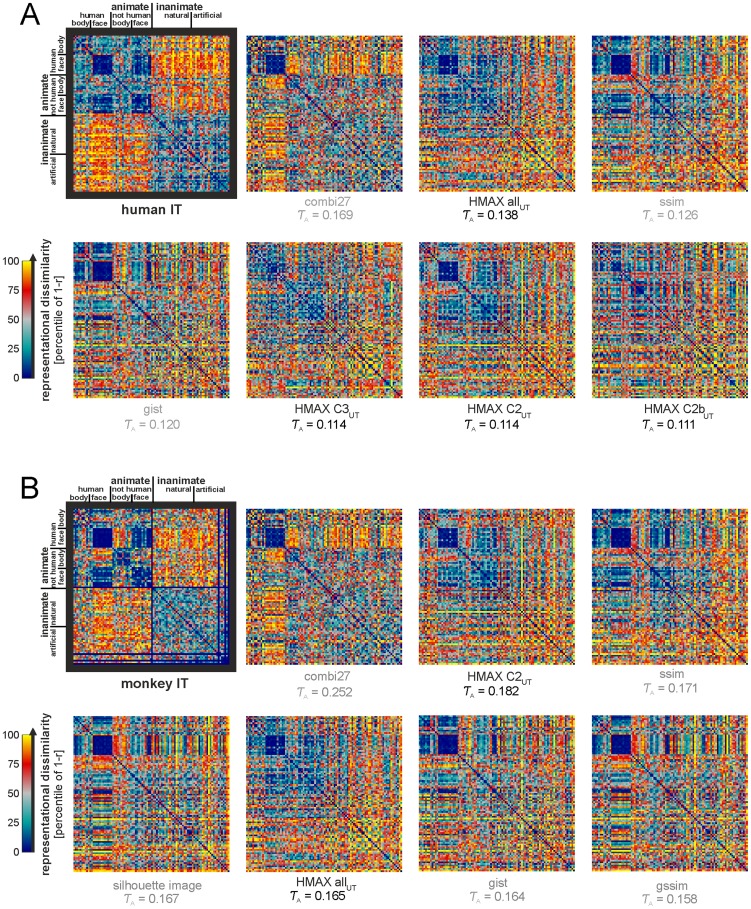
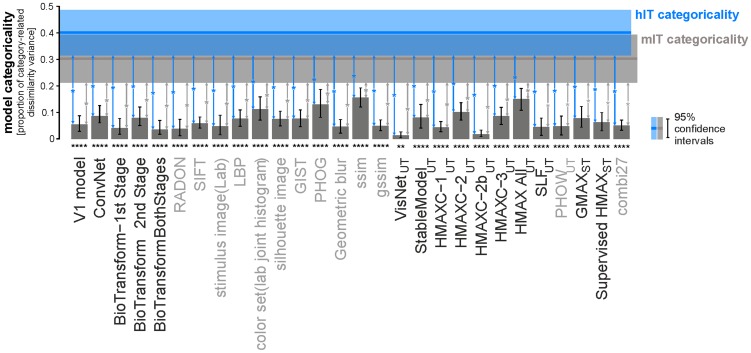
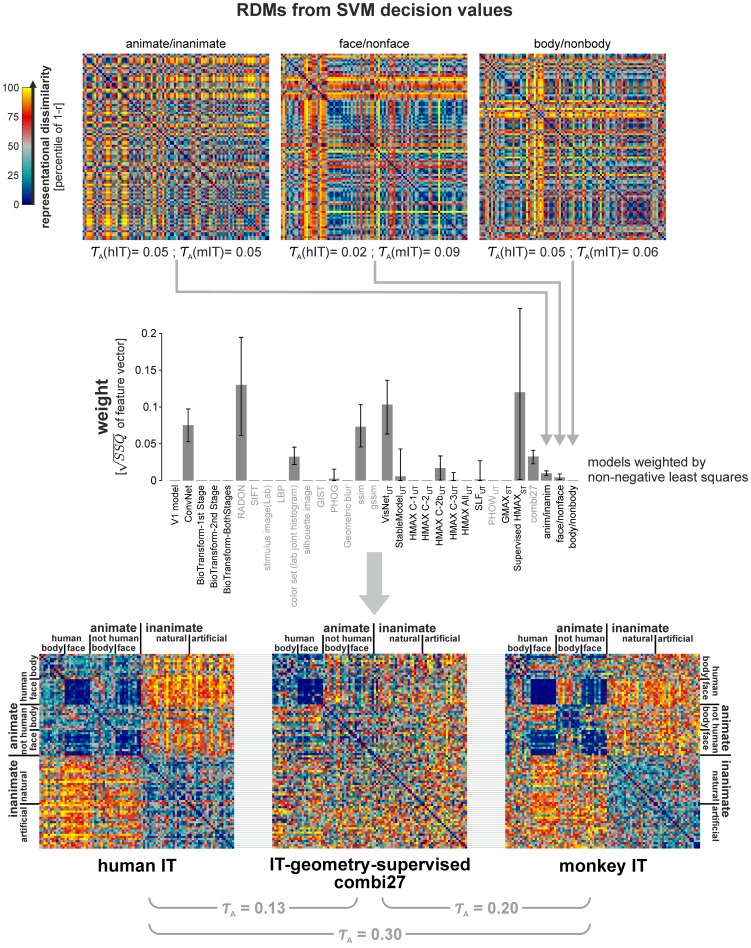
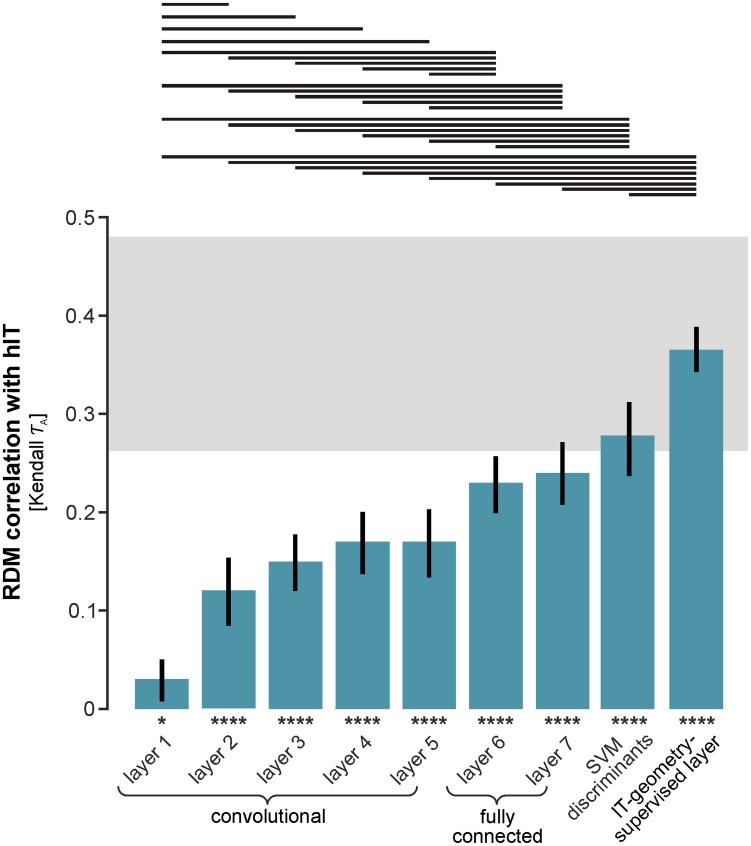
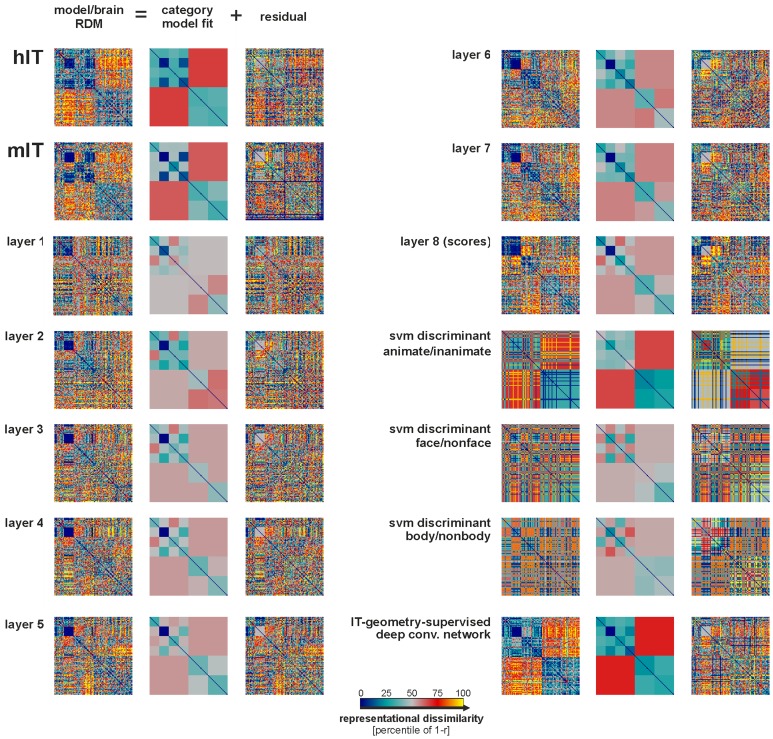
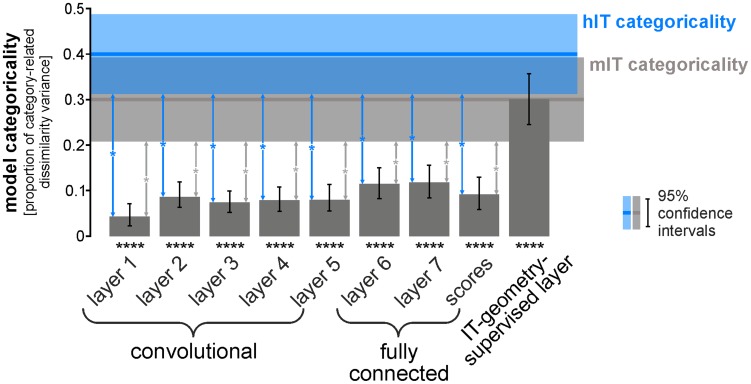
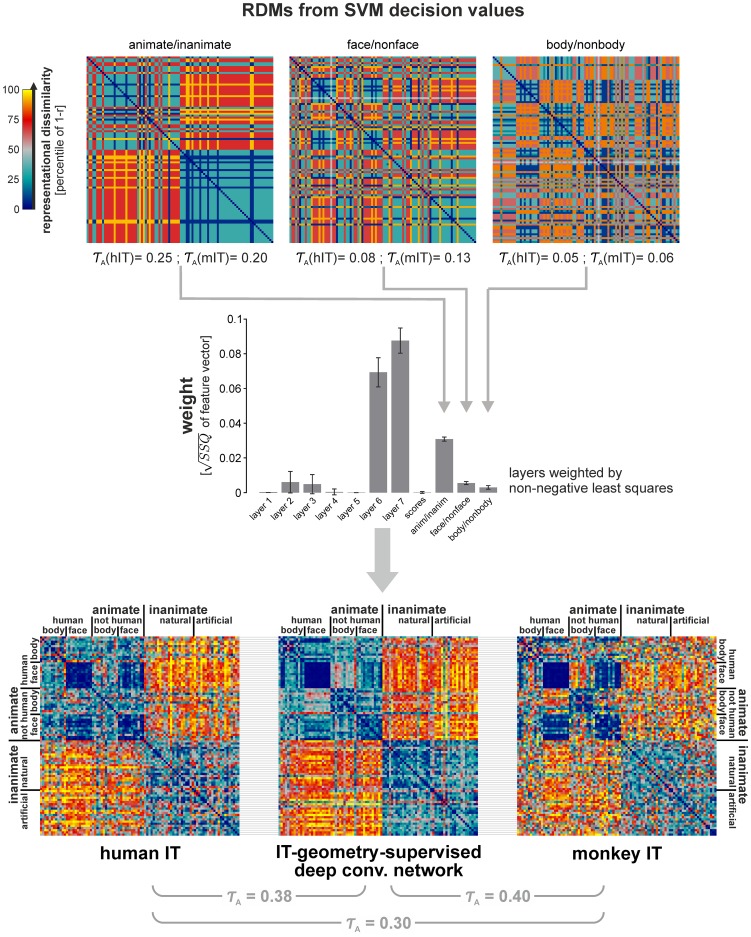
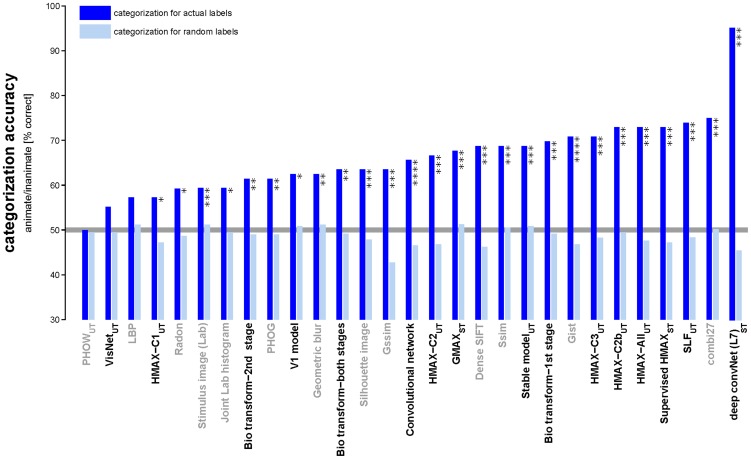
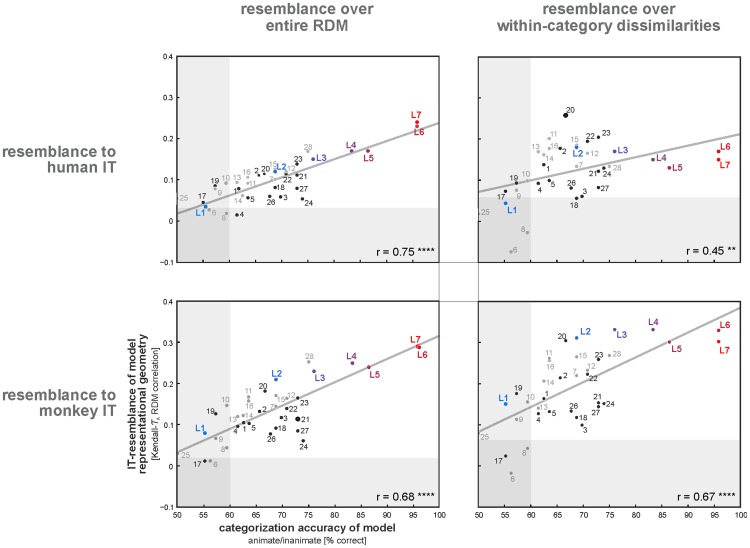
Inferior temporal (IT) cortex in human and nonhuman primates serves visual object recognition. Computational object-vision models, although continually improving, do not yet reach human performance. It is unclear to what extent the internal representations of computational models can explain the IT representation. Here we investigate a wide range of computational model representations (37 in total), testing their categorization performance and their ability to account for the IT representational geometry. The models include well-known neuroscientific object-recognition models (e.g. HMAX, VisNet) along with several models from computer vision (e.g. SIFT, GIST, self-similarity features, and a deep convolutional neural network). We compared the representational dissimilarity matrices (RDMs) of the model representations with the RDMs obtained from human IT (measured with fMRI) and monkey IT (measured with cell recording) for the same set of stimuli (not used in training the models). Better performing models were more similar to IT in that they showed greater clustering of representational patterns by category. In addition, better performing models also more strongly resembled IT in terms of their within-category representational dissimilarities. Representational geometries were significantly correlated between IT and many of the models. However, the categorical clustering observed in IT was largely unexplained by the unsupervised models. The deep convolutional network, which was trained by supervision with over a million category-labeled images, reached the highest categorization performance and also best explained IT, although it did not fully explain the IT data. Combining the features of this model with appropriate weights and adding linear combinations that maximize the margin between animate and inanimate objects and between faces and other objects yielded a representation that fully explained our IT data. Overall, our results suggest that explaining IT requires computational features trained through supervised learning to emphasize the behaviorally important categorical divisions prominently reflected in IT.
Overview
The claims and statistics of this paper haven’t been checked yet.
Free: it reads the open-access text and checks the first 5 claims that cite a source we can check. Create a free account to check every claim.
Integrity signals
Registry
Cites
Statistics
Figures



Verification
Claims the paper makes
The claims and statistics of this paper haven’t been checked yet.
Free: it reads the open-access text and checks the first 5 claims that cite a source we can check. Create a free account to check every claim.
Claims other papers make about this one
Each is checked against this paper’s own text: does it say what the citing paper says it does?
The cited source says what the claim attributes to it.
In the citing paper
“Using this approach, known as neuroconnectionism, numerous studies have identified shared representational structure across brains and ANN models, as well as factors influencing this alignment [5–11]”
From The Umwelt Representation Hypothesis: rethinking Universality (2026) · cites this paper as [10]
The cited source says what the claim attributes to it.
In the citing paper
“Analogous approaches have proven successful in relating the structure of neural activity to computational functions in other domains, including vision 17–19, audition 20, olfaction 21,22, thermosensation 23, perceptual discrimination 24, facial perception 25, and navigation 26,27.”
From A virtual rodent predicts the structure of neural activity across behaviours (2024) · cites this paper as [19]
Self-check
Percentages, sums and reported differences re-computed from the paper’s own numbers.
The self-check needs the paper’s full text.
Citations
Cites
ImageNet classification with deep convolutional neural networks
Krizhevsky, A., Sutskever, I., & Hinton, G. E. (2017) · Communications of the ACM · doi:10.1145/3065386 · Cited by 112,155
ImageNet: A large-scale hierarchical image database
Deng, J., Dong, W., Socher, R., Li, L.-J., Li, K., & Fei-Fei, L. (2009) · 2009 IEEE Conference on Computer Vision and Pattern Recognition · doi:10.1109/cvpr.2009.5206848 · Cited by 65,333 · cited 2×
“This is a supervised convolutional neural network, trained with 1.2 million labelled images from ImageNet (1000 category labels) [52].”
MethodInfluentialDistinctive Image Features from Scale-Invariant Keypoints
Lowe, D. G. (2004) · International Journal of Computer Vision · doi:10.1023/b:visi.0000029664.99615.94 · Cited by 55,589
LIBSVM: A library for support vector machines
Chang, C.-C., & Lin, C.-J. (2011) · ACM Transactions on Intelligent Systems and Technology · doi:10.1145/1961189.1961199 · Cited by 40,918
Object recognition from local scale-invariant features
Lowe, D. G. (1999) · Proceedings of the Seventh IEEE International Conference on Computer Vision · doi:10.1109/iccv.1999.790410 · Cited by 16,472
A fast learning algorithm for deep belief nets
Hinton, G. E., Osindero, S., & Teh, Y.-W. (2006) · Neural Computation · doi:10.1162/neco.2006.18.7.1527 · Cited by 16,336
Visualizing and understanding convolutional networks
Zeiler, M. D., & Fergus, R. (2014) · Lecture Notes in Computer Science · doi:10.1007/978-3-319-10590-1_53 · Cited by 15,839
Multiresolution gray-scale and rotation invariant texture classification with local binary patterns
Ojala, T., Pietikainen, M., & Maenpaa, T. (2002) · IEEE Transactions on Pattern Analysis and Machine Intelligence · doi:10.1109/tpami.2002.1017623 · Cited by 15,398
Receptive fields, binocular interaction and functional architecture in the cat’s visual cortex
Hubel, D. H., & Wiesel, T. N. (1962) · The Journal of Physiology · doi:10.1113/jphysiol.1962.sp006837 · Cited by 13,680
Libsvm : A library for support vector machines
Ferrari, V. (2008) · Medical Entomology and Zoology · Cited by 10,122
Research works printed but not linked: 1
- Krizhevsky A., Sutskever I. and Hinton, G E. (2012) ImageNet Classification with Deep Convolutional Neural Networks. NIPS. Lake Tahoe, Nevada.
Cited by
Items 301–400 of 1,003
From Unconscious Inference to the Beholder’s Share: Predictive Perception and Human Experience
Seth, A. K. (2019) · European Review · doi:10.1017/s1062798719000061 · Cited by 53
Sanders, C. A., & Nosofsky, R. M. (2020) · Computational Brain & Behavior · doi:10.1007/s42113-020-00073-z · Cited by 59
Scale and translation-invariance for novel objects in human vision
Han, Y., Roig, G., Geiger, G., & Poggio, T. (2020) · Scientific Reports · doi:10.1038/s41598-019-57261-6 · Cited by 58
Predictive coding feedback results in perceived illusory contours in a recurrent neural network
Pang, Z., O’May, C. B., Choksi, B., & VanRullen, R. (2021) · Neural Networks · doi:10.1016/j.neunet.2021.08.024 · Cited by 44
Kaniuth, P., & Hebart, M. N. (2022) · NeuroImage · doi:10.1016/j.neuroimage.2022.119294 · Cited by 43
What do adversarial images tell us about human vision?
Dujmović, M., Malhotra, G., & Bowers, J. S. (2020) · eLife · doi:10.7554/elife.55978 · Cited by 44
Self-attention in vision transformers performs perceptual grouping, not attention
Mehrani, P., & Tsotsos, J. K. (2023) · Frontiers in Computer Science · doi:10.3389/fcomp.2023.1178450 · Cited by 57
Eight open questions in the computational modeling of higher sensory cortex
Yamins, D. L., & DiCarlo, J. J. (2016) · Current Opinion in Neurobiology · doi:10.1016/j.conb.2016.02.001 · Cited by 43
Ürgen, B. A., Pehlivan, S., & Saygın, A. P. (2019) · Neuropsychologia · doi:10.1016/j.neuropsychologia.2019.02.006 · Cited by 50
Deep Predictive Learning in Neocortex and Pulvinar
O’Reilly, R. C., Russin, J., Zolfaghar, M., & Rohrlich, J. (2021) · Journal of Cognitive Neuroscience · doi:10.1162/jocn_a_01708 · Cited by 57
Adapting Deep Network Features to Capture Psychological RepresentationsPreprint
Peterson, J. C., Abbott, J. T., & Griffiths, T. L. (2016) · arXiv (Cornell University) · doi:10.48550/arxiv.1608.02164 · Cited by 55
Crowding reveals fundamental differences in local vs. global processing in humans and machines
Doerig, A., Bornet, A., Choung, O.-H., & Herzog, M. H. (2020) · Vision Research · doi:10.1016/j.visres.2019.12.006 · Cited by 54
Toward the Next Generation of Retinal Neuroprosthesis: Visual Computation with Spikes
Yu, Z., Liu, J. K., Jia, S., Zhang, Y., Zheng, Y., Tian, Y., & Huang, T. (2020) · Engineering · doi:10.1016/j.eng.2020.02.004 · Cited by 50
Deep learning models fail to capture the configural nature of human shape perception
Baker, N., & Elder, J. H. (2022) · iScience · doi:10.1016/j.isci.2022.104913 · Cited by 54
Enriching ImageNet with Human Similarity Judgments and Psychological Embeddings
Roads, B. D., & Love, B. C. (2021) · IEEE Computer Society Conference on Computer Vision and Pattern Recognition/Proceedings - IEEE Computer Society Conference on Computer Vision and Pattern Recognition/Proceedings · doi:10.1109/cvpr46437.2021.00355 · Cited by 83
Morton, N. W., Zippi, E. L., Noh, S. M., & Preston, A. R. (2021) · Journal of Neuroscience · doi:10.1523/jneurosci.2034-19.2021 · Cited by 51
Eigen-Distortions of Hierarchical RepresentationsPreprint
Berardino, A., Ballé, J., Laparra, V., & Simoncelli, E. P. (2017) · arXiv (Cornell University) · doi:10.48550/arxiv.1710.02266 · Cited by 74
Ormerod, M., del Rincón, J. M., & Devereux, B. J. (2021) · JMIR Medical Informatics · doi:10.2196/23099 · Cited by 46
Representational formats of human memory traces
Heinen, R. M., Bierbrauer, A., Wolf, O. T., & Axmacher, N. (2023) · Brain Structure and Function · doi:10.1007/s00429-023-02636-9 · Cited by 49
Celeghin, A., Borriero, A., Orsenigo, D., Diano, M., Guerrero, C. A. M., Perotti, A., Petri, G., & Tamietto, M. (2023) · Frontiers in Computational Neuroscience · doi:10.3389/fncom.2023.1153572 · Cited by 62
Invariant Recognition Shapes Neural Representations of Visual Input
Tacchetti, A., Işık, L., & Poggio, T. (2018) · Annual Review of Vision Science · doi:10.1146/annurev-vision-091517-034103 · Cited by 47
Abudarham, N., Grosbard, I. D., & Yovel, G. (2021) · Cognitive Science · doi:10.1111/cogs.13031 · Cited by 46
Inferring exemplar discriminability in brain representations
Nili, H., Walther, A., Alink, A., & Kriegeskorte, N. (2020) · PLoS ONE · doi:10.1371/journal.pone.0232551 · Cited by 41
Self-citationWilleke, K. F., Restivo, K., Franke, K., Nix, A., Cadena, S. A., Shinn, T., Nealley, C., Rodriguez, G., Patel, S. S., Ecker, A. S., et al. (2023) · bioRxiv (Cold Spring Harbor Laboratory) · doi:10.1101/2023.05.12.540591 · Cited by 45
Predicting eye movement patterns from fMRI responses to natural scenes
O’Connell, T. P., & Chun, M. M. (2018) · Nature Communications · doi:10.1038/s41467-018-07471-9 · Cited by 47
Primary visual cortex straightens natural video trajectories
Hénaff, O. J., Bai, Y., Charlton, J. A., Nauhaus, I., Simoncelli, E. P., & Goris, R. L. T. (2021) · Nature Communications · doi:10.1038/s41467-021-25939-z · Cited by 74
Recent Advances at the Interface of Neuroscience and Artificial Neural Networks
Cohen, Y., Engel, T. A., Langdon, C., Lindsay, G. W., Ott, T., Peters, M. A. K., Shine, J. M., Breton‐Provencher, V., & Ramaswamy, S. (2022) · Journal of Neuroscience · doi:10.1523/jneurosci.1503-22.2022 · Cited by 49
Dimensions underlying the representational alignment of deep neural networks with humans
Mahner, F. P., Muttenthaler, L., Güçlü, U., & Hebart, M. N. (2025) · Nature Machine Intelligence · doi:10.1038/s42256-025-01041-7 · Cited by 68
Visual Place Recognition by spatial matching of high-level CNN features
Camara, L. G., & Přeučil, L. (2020) · Robotics and Autonomous Systems · doi:10.1016/j.robot.2020.103625 · Cited by 47
Age-related dedifferentiation and hyperdifferentiation of perceptual and mnemonic representations
Deng, L., Davis, S. W., Monge, Z. A., Wing, E. A., Geib, B. R., Raghunandan, A., & Cabeza, R. E. L. (2021) · Neurobiology of Aging · doi:10.1016/j.neurobiolaging.2021.05.021 · Cited by 46
Deep recurrent neural network reveals a hierarchy of process memory during dynamic natural vision
Shi, J., Wen, H., Zhang, Y., Han, K., & Liu, Z. (2018) · Human Brain Mapping · doi:10.1002/hbm.24006 · Cited by 41
The Unbearable Shallow Understanding of Deep Learning
Plebe, A., & Grasso, G. M. (2019) · Minds and Machines · doi:10.1007/s11023-019-09512-8 · Cited by 49
A convolutional neural-network framework for modelling auditory sensory cells and synapses
Drakopoulos, F., Baby, D., & Verhulst, S. (2021) · Communications Biology · doi:10.1038/s42003-021-02341-5 · Cited by 44
Processing of chromatic information in a deep convolutional neural network
Flachot, A., & Gegenfurtner, K. R. (2018) · Journal of the Optical Society of America A · doi:10.1364/josaa.35.00b334 · Cited by 44
Untangling in Invariant Speech RecognitionPreprint
Stephenson, C., Feather, J., Padhy, S., Elibol, O. H., Tang, H., McDermott, J. H., & Chung, S. (2020) · arXiv (Cornell University) · doi:10.48550/arxiv.2003.01787 · Cited by 50
Diverse deep neural networks all predict human IT well, after training and fitting
Storrs, K. R., Kietzmann, T. C., Walther, A., Mehrer, J., & Kriegeskorte, N. (2020) · bioRxiv (Cold Spring Harbor Laboratory) · doi:10.1101/2020.05.07.082743 · Cited by 25
Self-citationGeneralization in data-driven models of primary visual cortexPreprint
Lurz, K.-K., Bashiri, M., Willeke, K. F., Jagadish, A. K., Wang, E. Y., Walker, E. Y., Cadena, S. A., Muhammad, T., Cobos, E., Tolias, A. S., et al. (2020) · bioRxiv (Cold Spring Harbor Laboratory) · doi:10.1101/2020.10.05.326256 · Cited by 72
Jozwik, K. M., Kietzmann, T. C., Cichy, R. M., Kriegeskorte, N., & Mur, M. (2023) · Journal of Neuroscience · doi:10.1523/jneurosci.1424-22.2022 · Cited by 40
Self-citationInvariant visual object recognition: biologically plausible approaches
Robinson, L., & Rolls, E. T. (2015) · Biological Cybernetics · doi:10.1007/s00422-015-0658-2 · Cited by 39
Yu, C.-P., Maxfield, J. T., & Zelinsky, G. J. (2016) · Psychological Science · doi:10.1177/0956797616640237 · Cited by 41
Do Computational Models Differ Systematically from Human Object Perception?
Pramod, R. T., & Arun, S. P. (2016) · IEEE Computer Society Conference on Computer Vision and Pattern Recognition/Proceedings - IEEE Computer Society Conference on Computer Vision and Pattern Recognition/Proceedings · doi:10.1109/cvpr.2016.177 · Cited by 42
Cichy, R. M., & Teng, S. (2017) · Philosophical Transactions of the Royal Society B: Biological Sciences · doi:10.1098/rstb.2016.0108 · Cited by 38
Convergent Temperature Representations in Artificial and Biological Neural Networks
Haesemeyer, M., Schier, A. F., & Engert, F. (2018) · Neuron · doi:10.1016/j.neuron.2019.07.003 · Cited by 37
Khaligh‐Razavi, S., Habibi, S., Sadeghi, M., Marefat, H., Khanbagi, M., Nabavi, S. M., Sadeghi, E., & Kalafatis, C. (2019) · Scientific Reports · doi:10.1038/s41598-018-37709-x · Cited by 44
Self-citationCascaded Tuning to Amplitude Modulation for Natural Sound Recognition
Koumura, T., Terashima, H., & Furukawa, S. (2019) · Journal of Neuroscience · doi:10.1523/jneurosci.2914-18.2019 · Cited by 43
Transferring and Generalizing Deep-Learning-based Neural Encoding Models across Subjects
Wen, H., Shi, J., Chen, W., & Liu, Z. (2017) · NeuroImage · doi:10.1016/j.neuroimage.2018.04.053 · Cited by 42
Scene complexity modulates degree of feedback activity during object detection in natural scenes
Groen, I. I. A., Jahfari, S., Seijdel, N., Ghebreab, S., Lamme, V. A. F., & Scholte, H. S. (2018) · PLoS Computational Biology · doi:10.1371/journal.pcbi.1006690 · Cited by 42
From convolutional neural networks to models of higher‐level cognition (and back again)
Battleday, R. M., Peterson, J. C., & Griffiths, T. L. (2021) · Annals of the New York Academy of Sciences · doi:10.1111/nyas.14593 · Cited by 48
Degrees of algorithmic equivalence between the brain and its DNN models
Schyns, P. G., Snoek, L., & Daube, C. (2022) · Trends in Cognitive Sciences · doi:10.1016/j.tics.2022.09.003 · Cited by 44
Representation of Naturalistic Image Structure in the Primate Visual Cortex
Movshon, J. A., & Simoncelli, E. P. (2014) · Cold Spring Harbor Symposia on Quantitative Biology · doi:10.1101/sqb.2014.79.024844 · Cited by 46
Towards real-world capable spatial memory in the LIDA cognitive architecture
Madl, T., Franklin, S., Chen, K., Montaldi, D., & Trappl, R. (2016) · Biologically Inspired Cognitive Architectures · doi:10.1016/j.bica.2016.02.001 · Cited by 41
Helpless infants are learning a foundation model
Cusack, R., Ranzato, M., & Charvet, C. J. (2024) · Trends in Cognitive Sciences · doi:10.1016/j.tics.2024.05.001 · Cited by 48
Advances in techniques for imposing reciprocity in brain-behavior relations
Turner, B. M., Palestro, J. J., Miletić, S., & Forstmann, B. U. (2019) · Neuroscience & Biobehavioral Reviews · doi:10.1016/j.neubiorev.2019.04.018 · Cited by 37
A general-purpose mechanism of visual feature association in visual word identification and beyond
Vidal, Y., Viviani, E., Zoccolan, D., & Crepaldi, D. (2021) · Current Biology · doi:10.1016/j.cub.2020.12.017 · Cited by 39
Karimi-Rouzbahani, H., Bagheri, N., & Ebrahimpour, R. (2017) · Scientific Reports · doi:10.1038/s41598-017-13756-8 · Cited by 34
Ferko, K. M., Blumenthal, A., Martin, C. B., Proklova, D., Minos, A., Saksida, L. M., Bussey, T. J., Khan, A. R., & Köhler, S. (2022) · eLife · doi:10.7554/elife.66884 · Cited by 36
Symmetry-Based Representations for Artificial and Biological General Intelligence
Higgins, I., Racanière, S., & Rezende, D. J. (2022) · Frontiers in Computational Neuroscience · doi:10.3389/fncom.2022.836498 · Cited by 62
Farzmahdi, A., Rajaei, K., Ghodrati, M., Ebrahimpour, R., & Khaligh‐Razavi, S. (2016) · Scientific Reports · doi:10.1038/srep25025 · Cited by 34
Self-citationThe language of the brain: real-world neural population codes
Pruszynski, J. A., & Zylberberg, J. (2019) · Current Opinion in Neurobiology · doi:10.1016/j.conb.2019.06.005 · Cited by 35
Perceptual dissociations among views of objects, scenes, and reachable spaces.
Josephs, E., & Konkle, T. (2019) · Journal of Experimental Psychology Human Perception & Performance · doi:10.1037/xhp0000626 · Cited by 32
Mei, N., Santana, R., & Soto, D. (2022) · Nature Human Behaviour · doi:10.1038/s41562-021-01274-7 · Cited by 40
Neural mechanisms underlying the hierarchical construction of perceived aesthetic value
Iigaya, K., Yi, S., Wahle, I. A., Tanwisuth, S., Cross, L., & O’Doherty, J. P. (2023) · Nature Communications · doi:10.1038/s41467-022-35654-y · Cited by 48
Emergence of Visual Center-Periphery Spatial Organization in Deep Convolutional Neural Networks
Mohsenzadeh, Y., Mullin, C., Lahner, B., & Oliva, A. (2020) · Scientific Reports · doi:10.1038/s41598-020-61409-0 · Cited by 31
Using distance on the Riemannian manifold to compare representations in brain and in models
Shahbazi, M., Shirali, A., Aghajan, H. K., & Nili, H. (2021) · NeuroImage · doi:10.1016/j.neuroimage.2021.118271 · Cited by 52
Efficient neural codes naturally emerge through gradient descent learning
Benjamin, A. S., Zhang, L.-Q., Qiu, C., Stocker, A. A., & Kording, K. P. (2022) · Nature Communications · doi:10.1038/s41467-022-35659-7 · Cited by 40
Aligning machine and human visual representations across abstraction levels
Muttenthaler, L., Greff, K., Born, F., Spitzer, B., Kornblith, S., Mozer, M. C., Müller, K. R., Unterthiner, T., & Lampinen, A. K. (2025) · Nature · doi:10.1038/s41586-025-09631-6 · Cited by 95
Representational Dynamics of Facial Viewpoint Encoding
Kietzmann, T. C., Gert, A. L., Tong, F., & König, P. (2016) · Journal of Cognitive Neuroscience · doi:10.1162/jocn_a_01070 · Cited by 34
How thoughts arise from sights: inferotemporal and prefrontal contributions to vision
Kornblith, S., & Tsao, D. Y. (2017) · Current Opinion in Neurobiology · doi:10.1016/j.conb.2017.08.016 · Cited by 32
Dima, D. C., Perry, G., & Singh, K. D. (2018) · NeuroImage · doi:10.1016/j.neuroimage.2018.06.033 · Cited by 36
Wardle, S. G., & Baker, C. I. (2020) · F1000Research · doi:10.12688/f1000research.22296.1 · Cited by 34
Federer, C., Xu, H., Fyshe, A., & Zylberberg, J. (2020) · Neural Networks · doi:10.1016/j.neunet.2020.07.013 · Cited by 47
Zheng, Y., Jia, S., Yu, Z., Liu, J. K., & Huang, T. (2021) · Patterns · doi:10.1016/j.patter.2021.100350 · Cited by 42
Contrasting action and posture coding with hierarchical deep neural network models of proprioception
Sandbrink, K. J., Mamidanna, P., Michaelis, C., Bethge, M., Mathis, M. W., & Mathis, A. (2023) · eLife · doi:10.7554/elife.81499 · Cited by 37
Nayebi, A., Kong, N. C. L., Zhuang, C., Gardner, J. L., Norcia, A. M., & Yamins, D. L. K. (2023) · PLoS Computational Biology · doi:10.1371/journal.pcbi.1011506 · Cited by 56
Shoham, A., Grosbard, I. D., Patashnik, O., Cohen‐Or, D., & Yovel, G. (2024) · Nature Human Behaviour · doi:10.1038/s41562-024-01816-9 · Cited by 45
Adapting Deep Network Features to Capture Psychological Representations: An Abridged Report
Peterson, J. C., Abbott, J. T., & Griffiths, T. L. (2017) · International Joint Conference on Artificial Intelligence · doi:10.24963/ijcai.2017/697 · Cited by 35
Characterisation of nonlinear receptive fields of visual neurons by convolutional neural network
Ukita, J., Yoshida, T., & Ohki, K. (2019) · Scientific Reports · doi:10.1038/s41598-019-40535-4 · Cited by 28
Estimating the functional dimensionality of neural representations
Ahlheim, C., & Love, B. C. (2018) · NeuroImage · doi:10.1016/j.neuroimage.2018.06.015 · Cited by 34
High-level visual prediction errors in early visual cortex
Richter, D., Kietzmann, T. C., & de Lange, F. P. (2024) · PLoS Biology · doi:10.1371/journal.pbio.3002829 · Cited by 41
Humans and Deep Networks Largely Agree on Which Kinds of Variation Make Object Recognition Harder
Kheradpisheh, S. R., Ghodrati, M., Ganjtabesh, M., & Masquelier, T. (2016) · Frontiers in Computational Neuroscience · doi:10.3389/fncom.2016.00092 · Cited by 35
Magri, C., Konkle, T., & Caramazza, A. (2021) · NeuroImage · doi:10.1016/j.neuroimage.2021.118098 · Cited by 33
Sörensen, L. K. A., Bohté, S. M., Slagter, H. A., & Scholte, H. S. (2022) · PLoS Computational Biology · doi:10.1371/journal.pcbi.1009976 · Cited by 40
Toward computational neuroconstructivism: a framework for developmental systems neuroscience
Astle, D. E., Johnson, M. H., & Akarca, D. (2023) · Trends in Cognitive Sciences · doi:10.1016/j.tics.2023.04.009 · Cited by 38
Hierarchical Models of the Visual System
Serre, T. (2015) · Springer eBooks · doi:10.1007/978-1-4614-6675-8_345 · Cited by 29
Dapello, J., Kar, K., Schrimpf, M., Geary, R. B., Ferguson, M., Cox, D., & DiCarlo, J. J. (2022) · bioRxiv (Cold Spring Harbor Laboratory) · doi:10.1101/2022.07.01.498495 · Cited by 55
Shea, N. J. (2024) · doi:10.1093/9780191997167.001.0001 · Cited by 36
Insight predicts subsequent memory via cortical representational change and hippocampal activity
Becker, M., Sommer, T., & Cabeza, R. E. L. (2025) · Nature Communications · doi:10.1038/s41467-025-59355-4 · Cited by 34
What does the mind learn? A comparison of human and machine learning representations
Spicer, J., & Sanborn, A. N. (2019) · Current Opinion in Neurobiology · doi:10.1016/j.conb.2019.02.004 · Cited by 37
Visual perception of liquids: Insights from deep neural networks
van Assen, J. J. R., Nishida, S., & Fleming, R. W. (2020) · PLoS Computational Biology · doi:10.1371/journal.pcbi.1008018 · Cited by 33
Deep neural networks and image classification in biological vision
Leek, E. C., Leonardis, A., & Heinke, D. G. (2022) · Vision Research · doi:10.1016/j.visres.2022.108058 · Cited by 31
Brady, T. F., & Störmer, V. S. (2023) · Memory & Cognition · doi:10.3758/s13421-023-01485-5 · Cited by 34
Neural pattern similarity underlies the mnemonic advantages for living words
Xiao, X., Dong, Q., Chen, C., & Xue, G. (2016) · Cortex · doi:10.1016/j.cortex.2016.03.016 · Cited by 31
Neural Tuning to Low-Level Features of Speech throughout the Perisylvian Cortex
Berezutskaya, J., Freudenburg, Z. V., Güçlü, U., van Gerven, M. A. J., & Ramsey, N. F. (2017) · Journal of Neuroscience · doi:10.1523/jneurosci.0238-17.2017 · Cited by 34
Visual pathways from the perspective of cost functions and multi-task deep neural networks
Scholte, H. S., Losch, M., Ramakrishnan, K., de Haan, E. H. F., & Bohté, S. M. (2017) · Cortex · doi:10.1016/j.cortex.2017.09.019 · Cited by 31
Vu, H., Kim, H., Jung, M., & Lee, J. (2020) · NeuroImage · doi:10.1016/j.neuroimage.2020.117328 · Cited by 37
Learning From Brains How to Regularize MachinesPreprint
Li, Z., Brendel, W., Walker, E. Y., Cobos, E., Muhammad, T., Reimer, J., Bethge, M., Sinz, F. H., Pitkow, X., & Tolias, A. S. (2019) · arXiv (Cornell University) · doi:10.48550/arxiv.1911.05072 · Cited by 61
The brain of the beholder: honouring individual representational idiosyncrasies
Charest, I., & Kriegeskorte, N. (2015) · Language, Cognition and Neuroscience · doi:10.1080/23273798.2014.1002505 · Cited by 27
Self-citationThe speed of human social interaction perception
Işık, L., Mynick, A., Pantazis, D., & Kanwisher, N. (2020) · NeuroImage · doi:10.1016/j.neuroimage.2020.116844 · Cited by 37
Kiat, J. E., Luck, S. J., Beckner, A. G., Hayes, T. R., Pomaranski, K. I., Henderson, J. M., & Oakes, L. M. (2021) · Developmental Science · doi:10.1111/desc.13155 · Cited by 33
Heinke, D. G., Wachman, P., van Zoest, W., & Leek, E. C. (2021) · Vision Research · doi:10.1016/j.visres.2021.09.004 · Cited by 33
Metadata
- Authors
- Khaligh-Razavi, S.-M., & Kriegeskorte, N.
- Affiliations
- MRC Cognition and Brain Sciences Unit (GB)
- Corresponding author
- Kriegeskorte, Nikolaus
- Venue
- PLoS Computational Biology
- Publisher
- Public Library of Science (PLoS)
- Published
- 2014-11-06
- Volume
- 10
- Issue
- 11
- Pages
- e1003915
- ISSN
- 1553-734X (ISSN-L)
- 1553-7358
- PMC
- PMC4222664
- OpenAlex
- W2040036684
- Cited by
- 1,204
- References
- 98
- Citations by year
- 2026: 75 · 2025: 100 · 2024: 110 · 2023: 127 · 2022: 112 · 2021: 124 · 2020: 125 · 2019: 151 · 2018: 97 · 2017: 87 · 2016: 75 · 2015: 20 · 2014: 1
- FWCI
- 34.02
- Type
- journal article
- Language
- en
- Open access
- gold
- doi.org
- Locations
- PLoS Computational Biology (publishedVersion, cc-by)
- Europe PMC (PubMed Central) (publishedVersion, cc-by)
- PubMed Central (publishedVersion, cc-by)
- PubMed (publishedVersion)
- DOAJ (DOAJ: Directory of Open Access Journals) (submittedVersion, cc-by-sa)
- Figshare (submittedVersion, cc-by)
- Funders
- Cambridge Overseas Trust
- Medical Research Council (MC-A060- 5PR20)
- FP7 Ideas: European Research Council (261352)
- Topics
- Life Sciences › Neuroscience › Cognitive Neuroscience › Visual perception and processing mechanisms
- Life Sciences › Neuroscience › Cognitive Neuroscience › Face Recognition and Perception
- Physical Sciences › Computer Science › Computer Vision and Pattern Recognition › Advanced Neural Network Applications
- Keywords
- inferior temporal cortex, visual object recognition, representational geometry, representational dissimilarity matrices, supervised learning, unsupervised learning, deep convolutional neural networks, categorical clustering, HMAX, monkey visual cortex, human visual cortex
- MeSH terms
- Animals, Haplorhini, Humans, Models, Neurological, Temporal Lobe, Computational Biology, Support Vector Machine
About these checks
Registry, retraction, Cites and statistics results are computed, not judged, with one exception: a printed reference that no index lists is read once by a model before it counts as a citation error. Claims are extracted by a model and kept only when their quote appears verbatim in the text; each cited source is then checked, with a model’s help, for whether it says what the claim relies on. Those verdicts can be wrong — read the claim’s quote and the cited source before relying on one.
Statistics and arithmetic are recomputed, not judged.
Confidence bands are shown only for fields calibrated on our annotated test set. None is calibrated yet, so no band is shown.
What counts as a claim ›How we measure confidence ›How we check this ›
Are you an author, or do you see a problem with this page? Request a review
Data sources
Bibliographic data: Semantic Scholar, OpenAlex, Crossref.
Contains information from the Semantic Scholar Academic Graph Datasets, made available under the ODC Attribution License (ODC-BY 1.0).
Semantic Scholar’s data is described in: Kinney, R., et al. (2023). The Semantic Scholar Open Data Platform. arXiv:2301.10140.
