

Deep Supervised, but Not Unsupervised, Models May Explain IT Cortical Representation
Open accessThe DOI matches its Crossref record; 99 of the 99 references it cites were found in a registry or an index.
Abstract
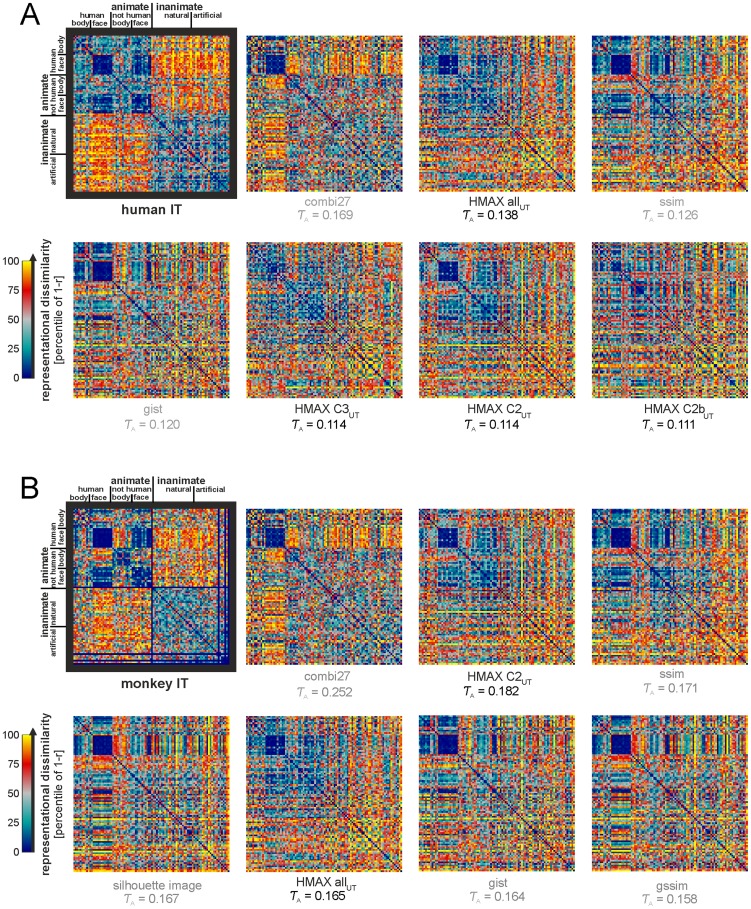
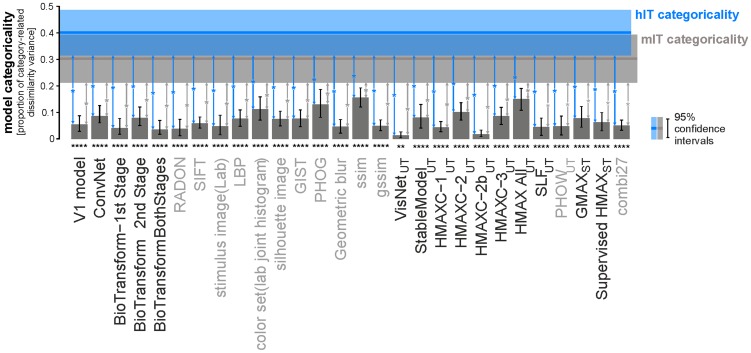
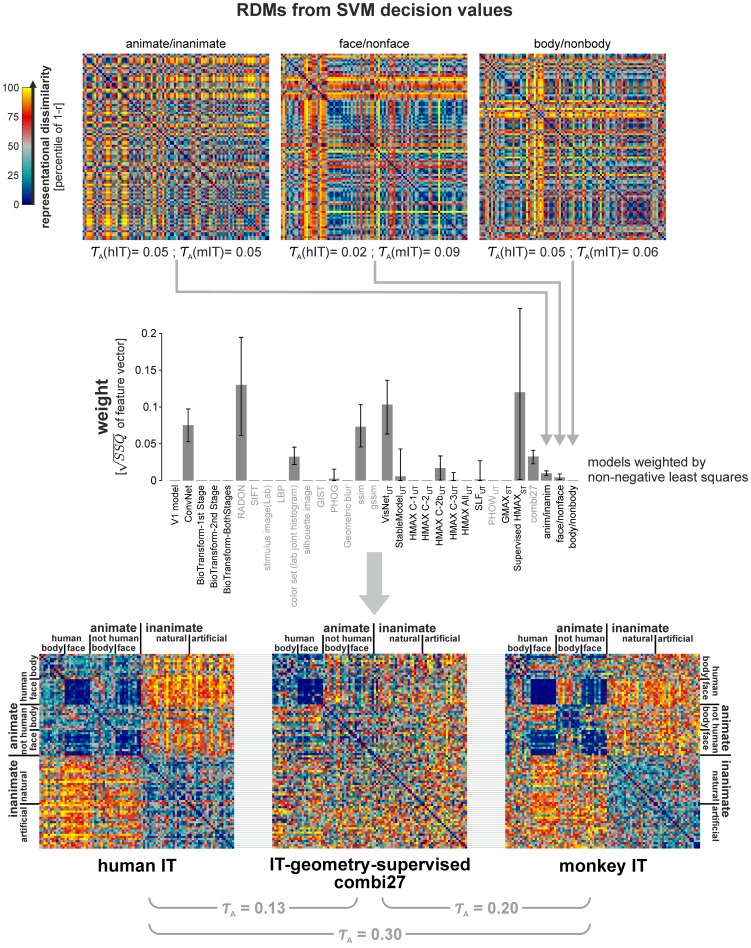
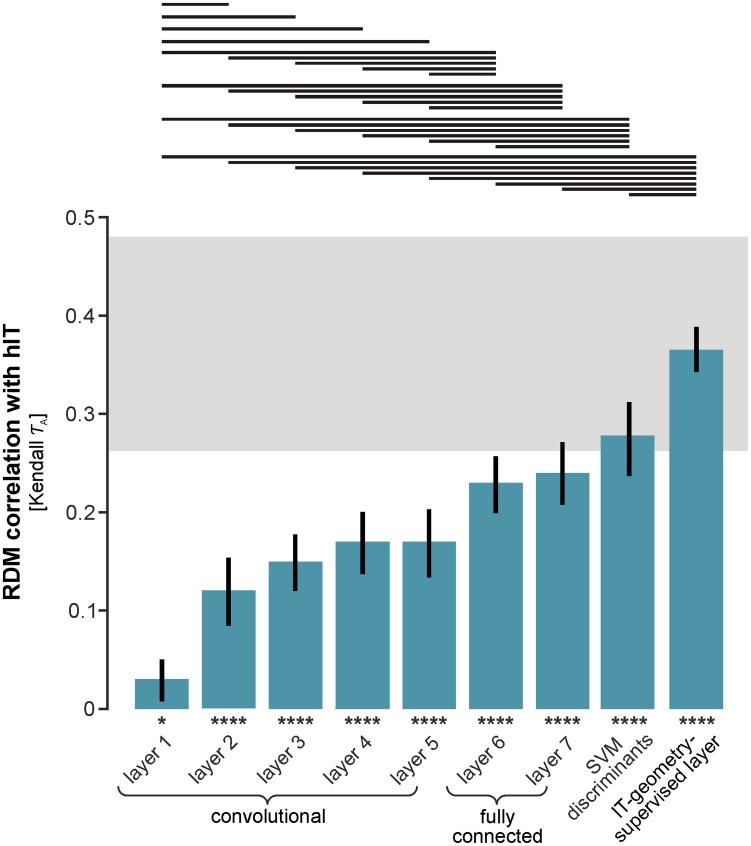
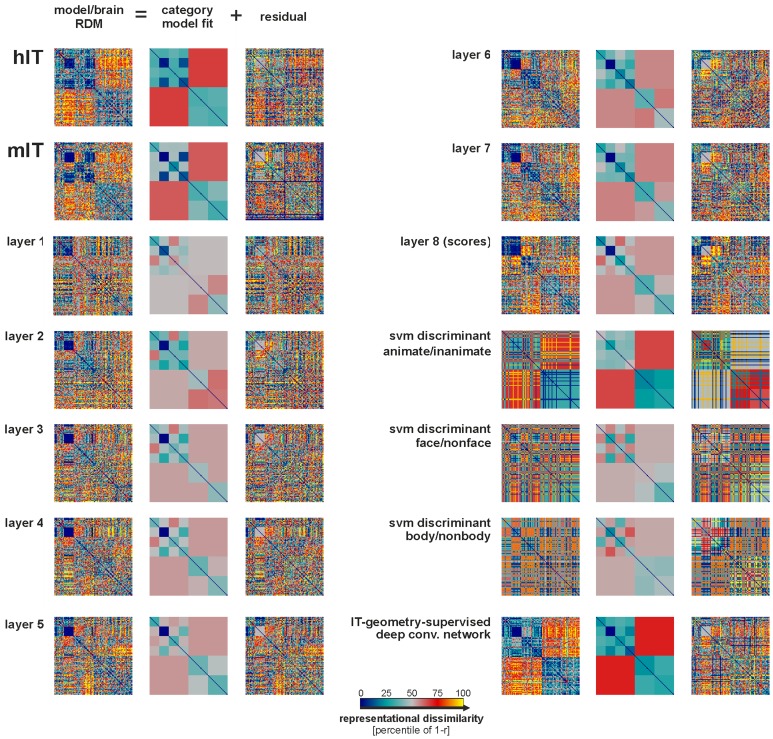
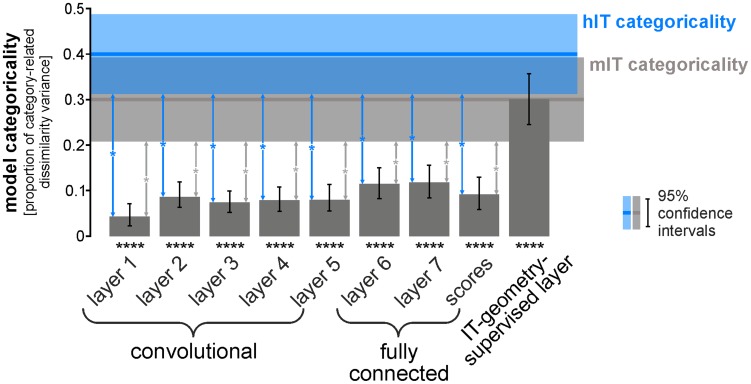
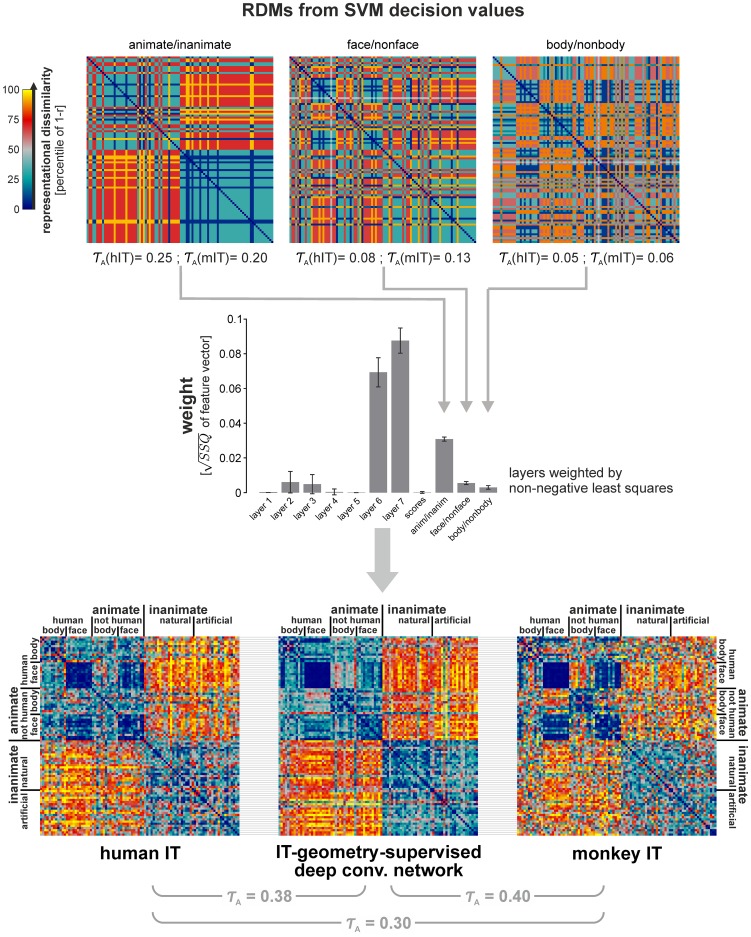
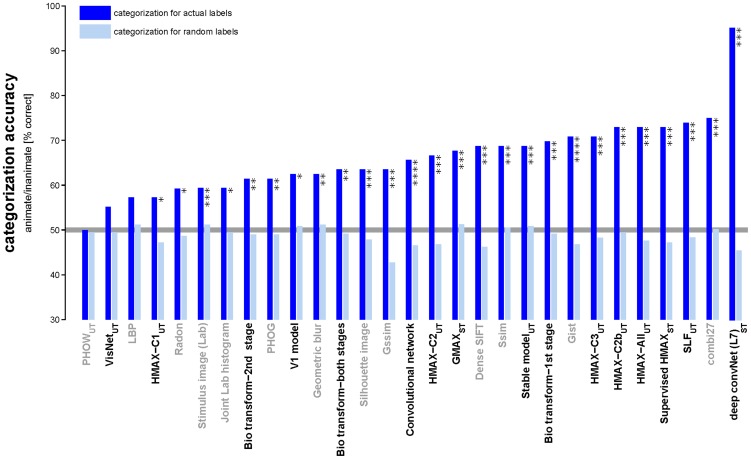
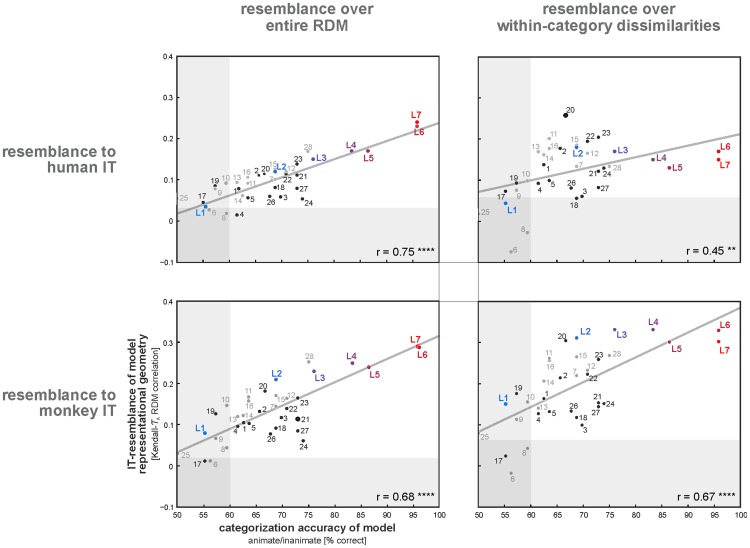
Inferior temporal (IT) cortex in human and nonhuman primates serves visual object recognition. Computational object-vision models, although continually improving, do not yet reach human performance. It is unclear to what extent the internal representations of computational models can explain the IT representation. Here we investigate a wide range of computational model representations (37 in total), testing their categorization performance and their ability to account for the IT representational geometry. The models include well-known neuroscientific object-recognition models (e.g. HMAX, VisNet) along with several models from computer vision (e.g. SIFT, GIST, self-similarity features, and a deep convolutional neural network). We compared the representational dissimilarity matrices (RDMs) of the model representations with the RDMs obtained from human IT (measured with fMRI) and monkey IT (measured with cell recording) for the same set of stimuli (not used in training the models). Better performing models were more similar to IT in that they showed greater clustering of representational patterns by category. In addition, better performing models also more strongly resembled IT in terms of their within-category representational dissimilarities. Representational geometries were significantly correlated between IT and many of the models. However, the categorical clustering observed in IT was largely unexplained by the unsupervised models. The deep convolutional network, which was trained by supervision with over a million category-labeled images, reached the highest categorization performance and also best explained IT, although it did not fully explain the IT data. Combining the features of this model with appropriate weights and adding linear combinations that maximize the margin between animate and inanimate objects and between faces and other objects yielded a representation that fully explained our IT data. Overall, our results suggest that explaining IT requires computational features trained through supervised learning to emphasize the behaviorally important categorical divisions prominently reflected in IT.
Overview
The claims and statistics of this paper haven’t been checked yet.
Free: it reads the open-access text and checks the first 5 claims that cite a source we can check. Create a free account to check every claim.
Integrity signals
Registry
Cites
Statistics
Figures



Verification
Claims the paper makes
The claims and statistics of this paper haven’t been checked yet.
Free: it reads the open-access text and checks the first 5 claims that cite a source we can check. Create a free account to check every claim.
Claims other papers make about this one
Each is checked against this paper’s own text: does it say what the citing paper says it does?
The cited source says what the claim attributes to it.
In the citing paper
“Using this approach, known as neuroconnectionism, numerous studies have identified shared representational structure across brains and ANN models, as well as factors influencing this alignment [5–11]”
From The Umwelt Representation Hypothesis: rethinking Universality (2026) · cites this paper as [10]
The cited source says what the claim attributes to it.
In the citing paper
“Analogous approaches have proven successful in relating the structure of neural activity to computational functions in other domains, including vision 17–19, audition 20, olfaction 21,22, thermosensation 23, perceptual discrimination 24, facial perception 25, and navigation 26,27.”
From A virtual rodent predicts the structure of neural activity across behaviours (2024) · cites this paper as [19]
Self-check
Percentages, sums and reported differences re-computed from the paper’s own numbers.
The self-check needs the paper’s full text.
Citations
Cites
ImageNet classification with deep convolutional neural networks
Krizhevsky, A., Sutskever, I., & Hinton, G. E. (2017) · Communications of the ACM · doi:10.1145/3065386 · Cited by 112,155
ImageNet: A large-scale hierarchical image database
Deng, J., Dong, W., Socher, R., Li, L.-J., Li, K., & Fei-Fei, L. (2009) · 2009 IEEE Conference on Computer Vision and Pattern Recognition · doi:10.1109/cvpr.2009.5206848 · Cited by 65,333 · cited 2×
“This is a supervised convolutional neural network, trained with 1.2 million labelled images from ImageNet (1000 category labels) [52].”
MethodInfluentialDistinctive Image Features from Scale-Invariant Keypoints
Lowe, D. G. (2004) · International Journal of Computer Vision · doi:10.1023/b:visi.0000029664.99615.94 · Cited by 55,589
LIBSVM: A library for support vector machines
Chang, C.-C., & Lin, C.-J. (2011) · ACM Transactions on Intelligent Systems and Technology · doi:10.1145/1961189.1961199 · Cited by 40,918
Object recognition from local scale-invariant features
Lowe, D. G. (1999) · Proceedings of the Seventh IEEE International Conference on Computer Vision · doi:10.1109/iccv.1999.790410 · Cited by 16,472
A fast learning algorithm for deep belief nets
Hinton, G. E., Osindero, S., & Teh, Y.-W. (2006) · Neural Computation · doi:10.1162/neco.2006.18.7.1527 · Cited by 16,336
Visualizing and understanding convolutional networks
Zeiler, M. D., & Fergus, R. (2014) · Lecture Notes in Computer Science · doi:10.1007/978-3-319-10590-1_53 · Cited by 15,839
Multiresolution gray-scale and rotation invariant texture classification with local binary patterns
Ojala, T., Pietikainen, M., & Maenpaa, T. (2002) · IEEE Transactions on Pattern Analysis and Machine Intelligence · doi:10.1109/tpami.2002.1017623 · Cited by 15,398
Receptive fields, binocular interaction and functional architecture in the cat’s visual cortex
Hubel, D. H., & Wiesel, T. N. (1962) · The Journal of Physiology · doi:10.1113/jphysiol.1962.sp006837 · Cited by 13,680
Libsvm : A library for support vector machines
Ferrari, V. (2008) · Medical Entomology and Zoology · Cited by 10,122
Research works printed but not linked: 1
- Krizhevsky A., Sutskever I. and Hinton, G E. (2012) ImageNet Classification with Deep Convolutional Neural Networks. NIPS. Lake Tahoe, Nevada.
Cited by
Items 101–200 of 1,003
Evaluating (and Improving) the Correspondence Between Deep Neural Networks and Human Representations
Peterson, J. C., Abbott, J. T., & Griffiths, T. L. (2018) · Cognitive Science · doi:10.1111/cogs.12670 · Cited by 130
Zabicki, A., de Haas, B., Zentgraf, K., Stark, R. M., Munzert, J., & Krüger, B. (2016) · Cerebral Cortex · doi:10.1093/cercor/bhw257 · Cited by 148
Beyond Functional Connectivity: Investigating Networks of Multivariate Representations
Anzellotti, S., & Coutanche, M. N. (2018) · Trends in Cognitive Sciences · doi:10.1016/j.tics.2017.12.002 · Cited by 141
The representational dynamics of visual objects in rapid serial visual processing streams
Grootswagers, T., Robinson, A. K., & Carlson, T. A. (2018) · NeuroImage · doi:10.1016/j.neuroimage.2018.12.046 · Cited by 168
A neural network trained for prediction mimics diverse features of biological neurons and perception
Lotter, W., Kreiman, G., & Cox, D. (2020) · Nature Machine Intelligence · doi:10.1038/s42256-020-0170-9 · Cited by 128
Jozwik, K. M., Kriegeskorte, N., Storrs, K. R., & Mur, M. (2017) · Frontiers in Psychology · doi:10.3389/fpsyg.2017.01726 · Cited by 131
Self-citationGüçlü, U., & van Gerven, M. A. J. (2015) · NeuroImage · doi:10.1016/j.neuroimage.2015.12.036 · Cited by 148
Category selectivity in human visual cortex: Beyond visual object recognition
Peelen, M. V., & Downing, P. E. (2017) · Neuropsychologia · doi:10.1016/j.neuropsychologia.2017.03.033 · Cited by 146
Bracci, S., Ritchie, J. B., & de Beeck, H. O. (2017) · Neuropsychologia · doi:10.1016/j.neuropsychologia.2017.06.010 · Cited by 127
Toward an integration of deep learning and neuroscience
Marblestone, A. H., Wayne, G., & Kording, K. P. (2016) · Frontiers in Computational Neuroscience · doi:10.3389/fncom.2016.00094 · Cited by 119
Representation Similarity Analysis for Efficient Task Taxonomy & Transfer Learning
Dwivedi, K., & Roig, G. (2019) · 2019 IEEE/CVF Conference on Computer Vision and Pattern Recognition (CVPR) · doi:10.1109/cvpr.2019.01267 · Cited by 101
Structure learning and the posterior parietal cortex
Summerfield, C., Luyckx, F., & Sheahan, H. (2020) · Progress in Neurobiology · doi:10.1016/j.pneurobio.2019.101717 · Cited by 118
Seeliger, K., Fritsche, M., Güçlü, U., Schoenmakers, S., Schoffelen, J.-M., Bosch, S. E., & van Gerven, M. A. J. (2018) · NeuroImage · doi:10.1016/j.neuroimage.2017.07.018 · Cited by 121
Selectivity and tolerance for visual texture in macaque V2
Ziemba, C. M., Freeman, J., Movshon, J. A., & Simoncelli, E. P. (2016) · Proceedings of the National Academy of Sciences · doi:10.1073/pnas.1510847113 · Cited by 136
Hagendorff, T. (2022) · AI and Ethics · doi:10.1007/s43681-021-00122-8 · Cited by 103
Modeling the Dynamics of Human Brain Activity with Recurrent Neural Networks
Güçlü, U., & van Gerven, M. A. J. (2017) · Frontiers in Computational Neuroscience · doi:10.3389/fncom.2017.00007 · Cited by 97
Grossman, S., Gaziv, G., Yeagle, E. M., Harel, M., Mégevand, P., Groppe, D. M., Khuvis, S., Herrero, J. L., Irani, M., Mehta, A. D., et al. (2019) · Nature Communications · doi:10.1038/s41467-019-12623-6 · Cited by 116
Recurrent neural networks can explain flexible trading of speed and accuracy in biological vision
Spoerer, C. J., Kietzmann, T. C., Mehrer, J., Charest, I., & Kriegeskorte, N. (2020) · PLOS Computational Biology · doi:10.1371/journal.pcbi.1008215 · Cited by 121
Self-citationBeyond core object recognition: Recurrent processes account for object recognition under occlusion
Rajaei, K., Mohsenzadeh, Y., Ebrahimpour, R., & Khaligh-Razavi, S.-M. (2019) · PLOS Computational Biology · doi:10.1371/journal.pcbi.1007001 · Cited by 114
Self-citationA Deep-Dream Virtual Reality Platform for Studying Altered Perceptual Phenomenology
Suzuki, K., Roseboom, W., Schwartzman, D. J., & Seth, A. K. (2017) · Scientific Reports · doi:10.1038/s41598-017-16316-2 · Cited by 109
Jang, H., Plis, S. M., Calhoun, V. D., & Lee, J.-H. (2017) · NeuroImage · doi:10.1016/j.neuroimage.2016.04.003 · Cited by 110
Not-So-CLEVR: learning same–different relations strains feedforward neural networks
Kim, J., Ricci, M., & Serre, T. (2018) · Interface Focus · doi:10.1098/rsfs.2018.0011 · Cited by 103
Analyzing biological and artificial neural networks: challenges with opportunities for synergy?
Barrett, D. G., Morcos, A. S., & Macke, J. H. (2019) · Current Opinion in Neurobiology · doi:10.1016/j.conb.2019.01.007 · Cited by 109
Computational models of category-selective brain regions enable high-throughput tests of selectivity
Ratan Murty, N. A., Bashivan, P., Abate, A., DiCarlo, J. J., & Kanwisher, N. (2021) · Nature Communications · doi:10.1038/s41467-021-25409-6 · Cited by 112
Horikawa, T., & Kamitani, Y. (2017) · Frontiers in Computational Neuroscience · doi:10.3389/fncom.2017.00004 · Cited by 111
Devereux, B. J., Clarke, A., & TYLER, L. K. (2018) · Scientific Reports · doi:10.1038/s41598-018-28865-1 · Cited by 119
Controversial stimuli: Pitting neural networks against each other as models of human cognition
Golan, T., Raju, P. C., & Kriegeskorte, N. (2020) · Proceedings of the National Academy of Sciences · doi:10.1073/pnas.1912334117 · Cited by 106
Self-citationComparison of Object Recognition Behavior in Human and Monkey
Rajalingham, R., Schmidt, K., & DiCarlo, J. J. (2015) · The Journal of Neuroscience · doi:10.1523/jneurosci.0573-15.2015 · Cited by 105
Kuzovkin, I., Vicente, R., Petton, M., Lachaux, J.-P., Baciu, M., Kahane, P., Rheims, S., Vidal, J. R., & Aru, J. (2018) · Communications Biology · doi:10.1038/s42003-018-0110-y · Cited by 104
Illusory Motion Reproduced by Deep Neural Networks Trained for Prediction
Watanabe, E., Kitaoka, A., Sakamoto, K., Yasugi, M., & Tanaka, K. (2018) · Frontiers in Psychology · doi:10.3389/fpsyg.2018.00345 · Cited by 101
Conwell, C., Prince, J. S., Kay, K. N., Alvarez, G. A., & Konkle, T. (2024) · Nature Communications · doi:10.1038/s41467-024-53147-y · Cited by 100
Ghodrati, M., Khaligh‐Razavi, S., & Lehky, S. R. (2017) · Progress in Neurobiology · doi:10.1016/j.pneurobio.2017.06.002 · Cited by 120
Self-citationContextual modulation of primary visual cortex by auditory signals
Petro, L. S., Paton, A. T., & Muckli, L. (2017) · Philosophical Transactions of the Royal Society B: Biological Sciences · doi:10.1098/rstb.2016.0104 · Cited by 101
Deep neural network models of sensory systems: windows onto the role of task constraints
Kell, A. J. E., & McDermott, J. H. (2019) · Current Opinion in Neurobiology · doi:10.1016/j.conb.2019.02.003 · Cited by 120
Francl, A., & McDermott, J. H. (2022) · Nature Human Behaviour · doi:10.1038/s41562-021-01244-z · Cited by 92
Overcoming Occlusion in the Automotive Environment—A Review
Gilroy, S., Jones, E., & Glavin, M. (2020) · IEEE Transactions on Intelligent Transportation Systems · doi:10.1109/tits.2019.2956813 · Cited by 117
On Logical Inference over Brains, Behaviour, and Artificial Neural Networks
Guest, O., & Martin, A. E. (2023) · Computational Brain & Behavior · doi:10.1007/s42113-022-00166-x · Cited by 93
Predictive Coding Approximates Backprop Along Arbitrary Computation Graphs
Millidge, B., Tschantz, A., & Buckley, C. L. (2022) · Neural Computation · doi:10.1162/neco_a_01497 · Cited by 95
Computational mechanisms underlying cortical responses to the affordance properties of visual scenes
Bonner, M. F., & Epstein, R. A. (2018) · PLOS Computational Biology · doi:10.1371/journal.pcbi.1006111 · Cited by 94
The neural representation of facial-emotion categories reflects conceptual structure
Brooks, J. A., Chikazoe, J., Sadato, N., & Freeman, J. B. (2019) · Proceedings of the National Academy of Sciences · doi:10.1073/pnas.1816408116 · Cited by 107
Shape-independent object category responses revealed by MEG and fMRI decoding
KAISER, D. H., Azzalini, D., & Peelen, M. V. (2016) · Journal of Neurophysiology · doi:10.1152/jn.01074.2015 · Cited by 105
Theories of Person Perception Predict Patterns of Neural Activity During Mentalizing
Thornton, M. A., & Mitchell, J. P. (2017) · Cerebral Cortex · doi:10.1093/cercor/bhx216 · Cited by 102
Universality and individuality in neural dynamics across large populations of recurrent networks
Maheswaranathan, N., Williams, A. H., Golub, M. D., Ganguli, S., & Sussillo, D. (2019) · PubMed · doi:10.48550/arxiv.1907.08549 · Cited by 36
Going in circles is the way forward: the role of recurrence in visual inference
van Bergen, R. S., & Kriegeskorte, N. (2020) · Current Opinion in Neurobiology · doi:10.1016/j.conb.2020.11.009 · Cited by 93
Self-citationDecoding subjective emotional arousal from EEG during an immersive virtual reality experience
Hofmann, S., Klotzsche, F., Mariola, A., Nikulin, V. V., Villringer, A., & Gaebler, M. (2021) · eLife · doi:10.7554/elife.64812 · Cited by 110
High-level visual representations in the human brain are aligned with large language models
Doerig, A., Kietzmann, T. C., Allen, E., Wu, Y., Naselaris, T., Kay, K., & Charest, I. (2025) · Nature Machine Intelligence · doi:10.1038/s42256-025-01072-0 · Cited by 173
Unsupervised learning predicts human perception and misperception of gloss
Storrs, K. R., Anderson, B. L., & Fleming, R. W. (2021) · Nature Human Behaviour · doi:10.1038/s41562-021-01097-6 · Cited by 92
Neural representation for object recognition in inferotemporal cortex
Lehky, S. R., & Tanaka, K. (2016) · Current Opinion in Neurobiology · doi:10.1016/j.conb.2015.12.001 · Cited by 101
Norman-Haignere, S., & McDermott, J. H. (2018) · PLoS Biology · doi:10.1371/journal.pbio.2005127 · Cited by 109
Bracci, S., Ritchie, J. B., Kalfas, I., & de Beeck, H. O. (2019) · Journal of Neuroscience · doi:10.1523/jneurosci.1714-18.2019 · Cited by 107
The features underlying the memorability of objects
Kramer, M. A., Hebart, M. N., Baker, C. I., & Bainbridge, W. A. (2023) · Science Advances · doi:10.1126/sciadv.add2981 · Cited by 118
Wardle, S. G., Kriegeskorte, N., Grootswagers, T., Khaligh‐Razavi, S., & Carlson, T. A. (2016) · NeuroImage · doi:10.1016/j.neuroimage.2016.02.019 · Cited by 106
Self-citationMattioni, S., Rezk, M., Battal, C., Bottini, R., Mendoza, K. E. C., Oosterhof, N. N., & Collignon, O. (2020) · eLife · doi:10.7554/elife.50732 · Cited by 106
Efficient inverse graphics in biological face processing
Yildirim, I., Belledonne, M., Freiwald, W., & Tenenbaum, J. (2020) · Science Advances · doi:10.1126/sciadv.aax5979 · Cited by 88
The spatiotemporal neural dynamics underlying perceived similarity for real-world objects
Cichy, R. M., Kriegeskorte, N., Jozwik, K. M., van den Bosch, J. J. F., & Charest, I. (2019) · NeuroImage · doi:10.1016/j.neuroimage.2019.03.031 · Cited by 106
Self-citationCortical recycling in high-level visual cortex during childhood development
Nordt, M., Gomez, J., Natu, V. S., Rezai, A. A., Finzi, D., Kular, H., & Grill-Spector, K. (2021) · Nature Human Behaviour · doi:10.1038/s41562-021-01141-5 · Cited by 99
Functional neuroimaging in psychiatry and the case for failing better
Nour, M. M., Liu, Y., & Dolan, R. J. (2022) · Neuron · doi:10.1016/j.neuron.2022.07.005 · Cited by 104
Does the brain's ventral visual pathway compute object shape?
Ayzenberg, V., & Behrmann, M. (2022) · Trends in Cognitive Sciences · doi:10.1016/j.tics.2022.09.019 · Cited by 110
A LIDA cognitive model tutorial
Franklin, S., Madl, T., Strain, S., Faghihi, U., Dong, D., Kugele, S., Snaider, J., Agrawal, P., & Chen, S. (2016) · Biologically Inspired Cognitive Architectures · doi:10.1016/j.bica.2016.04.003 · Cited by 101
Five points to check when comparing visual perception in humans and machines
Funke, C. M., Borowski, J., Stosio, K., Brendel, W., Wallis, T. S. A., & Bethge, M. (2021) · Journal of Vision · doi:10.1167/jov.21.3.16 · Cited by 70
Jozwik, K. M., Kriegeskorte, N., & Mur, M. (2015) · Neuropsychologia · doi:10.1016/j.neuropsychologia.2015.10.023 · Cited by 99
Self-citationDynamic interactive theory as a domain-general account of social perception
Freeman, J. B., Stolier, R. M., & Brooks, J. A. (2019) · Advances in experimental social psychology · doi:10.1016/bs.aesp.2019.09.005 · Cited by 107
Visual Object Recognition: Do We (Finally) Know More Now Than We Did?
Gauthier, L., & Tarr, M. J. (2016) · Annual Review of Vision Science · doi:10.1146/annurev-vision-111815-114621 · Cited by 97
Inferring neural activity before plasticity as a foundation for learning beyond backpropagation
Song, Y., Millidge, B., Salvatori, T., Lukasiewicz, T., Xu, Z., & Bogacz, R. (2024) · Nature Neuroscience · doi:10.1038/s41593-023-01514-1 · Cited by 85
(2021) · doi:10.1162/jocn_a_01755 · Cited by 85
Self-citationCross-species neuroscience: closing the explanatory gap
Barron, H. C., Mars, R. B., Dupret, D., Lerch, J. P., & Sampaio-Baptista, C. (2021) · Philosophical Transactions of the Royal Society B: Biological Sciences · doi:10.1098/rstb.2019.0633 · Cited by 88
Explainable AI: A review of applications to neuroimaging data
Farahani, F. V., Fiok, K., Lahijanian, B., Karwowski, W., & Douglas, P. K. (2022) · Frontiers in Neuroscience · doi:10.3389/fnins.2022.906290 · Cited by 98
Brain hierarchy score: Which deep neural networks are hierarchically brain-like?
Nonaka, S., Majima, K., Aoki, S. C., & Kamitani, Y. (2021) · iScience · doi:10.1016/j.isci.2021.103013 · Cited by 89
Principles for models of neural information processing
Kay, K. N. (2018) · NeuroImage · doi:10.1016/j.neuroimage.2017.08.016 · Cited by 88
Deep Neural Networks for Modeling Visual Perceptual Learning
Wenliang, L. K., & Seitz, A. R. (2018) · The Journal of Neuroscience · doi:10.1523/jneurosci.1620-17.2018 · Cited by 83
Texture and art with deep neural networks
Gatys, L. A., Ecker, A. S., & Bethge, M. (2017) · Current Opinion in Neurobiology · doi:10.1016/j.conb.2017.08.019 · Cited by 95
Perception science in the age of deep neural networks.
VanRullen, R. (2017) · Frontiers in Psychology · doi:10.3389/fpsyg.2017.00142 · Cited by 82
“…(and differences) between patterns of activity obtained from specific layers of deep networks, and from specific brain regions (Cadieu et al., 2014; Khaligh-Razavi and Kriegeskorte, 2014; Güçlü and van Gerven, 2015; Cichy et al., 2016a,b) or from human behavior (Kheradpisheh et al., 2016b,c).”
BackgroundDeep learning and cognitive science
Perconti, P., & Plebe, A. (2020) · Cognition · doi:10.1016/j.cognition.2020.104365 · Cited by 80
Bankson, B., Hebart, M. N., Groen, I. I. A., & Baker, C. I. (2018) · NeuroImage · doi:10.1016/j.neuroimage.2018.05.037 · Cited by 99
The Brain Abstracted: Simplification in the History and Philosophy of Neuroscience
Chirimuuta, M. (2024) · The MIT Press eBooks · doi:10.7551/mitpress/13804.001.0001 · Cited by 132
Evolving artificial neural networks with feedback
Herzog, S., Tetzlaff, C., & Wörgötter, F. (2019) · Neural Networks · doi:10.1016/j.neunet.2019.12.004 · Cited by 83
FFA and OFA Encode Distinct Types of Face Identity Information
Tsantani, M., Kriegeskorte, N., Storrs, K. R., Williams, A. L., McGettigan, C., & Garrido, L. (2021) · Journal of Neuroscience · doi:10.1523/jneurosci.1449-20.2020 · Cited by 101
Self-citationStimulus complexity shapes response correlations in primary visual cortex
Bányai, M., Lazăr, A., Klein, L., Klon-Lipok, J., Stippinger, M., Singer, W., & Orbán, G. (2019) · Proceedings of the National Academy of Sciences · doi:10.1073/pnas.1816766116 · Cited by 84
Poldrack, R. A. (2020) · Synthese · doi:10.1007/s11229-020-02793-y · Cited by 97
Predictive processing of scenes and objects
Peelen, M. V., Berlot, E., & de Lange, F. P. (2023) · Nature Reviews Psychology · doi:10.1038/s44159-023-00254-0 · Cited by 101
Reconstructing Natural Scenes from fMRI Patterns using BigBiGAN
Mozafari, M., Reddy, L., & VanRullen, R. (2020) · International Joint Conference on Neural Networks (IJCNN) · doi:10.1109/ijcnn48605.2020.9206960 · Cited by 82
The functional neuroanatomy of face perception: from brain measurements to deep neural networks
Grill-Spector, K., Weiner, K. S., Gomez, J., Anthony Stigliani, A., & Natu, V. S. (2018) · Interface Focus · doi:10.1098/rsfs.2018.0013 · Cited by 84
Anderson, A. J., Bruni, E., Lopopolo, A., Poesio, M., & Baroni, M. (2015) · NeuroImage · doi:10.1016/j.neuroimage.2015.06.093 · Cited by 77
Capturing the objects of vision with neural networks
Peters, B., & Kriegeskorte, N. (2021) · Nature Human Behaviour · doi:10.1038/s41562-021-01194-6 · Cited by 75
Self-citationMasson, H. L., & Işık, L. (2021) · NeuroImage · doi:10.1016/j.neuroimage.2021.118741 · Cited by 100
How biological attention mechanisms improve task performance in a large-scale visual system model
Lindsay, G. W., & Miller, K. D. (2018) · eLife · doi:10.7554/elife.38105 · Cited by 91
Ito, T., Yang, G. R., Laurent, P. A., Schultz, D. H., & Cole, M. W. (2022) · Nature Communications · doi:10.1038/s41467-022-28323-7 · Cited by 95
Perceptual straightening of natural videos
Hénaff, O. J., Goris, R. L. T., & Simoncelli, E. P. (2019) · Nature Neuroscience · doi:10.1038/s41593-019-0377-4 · Cited by 127
Model-based cognitive neuroscience
Palmeri, T. J., Love, B. C., & Turner, B. M. (2016) · Journal of Mathematical Psychology · doi:10.1016/j.jmp.2016.10.010 · Cited by 85
Cross, L., Cockburn, J., Yue, Y., & O’Doherty, J. P. (2020) · Neuron · doi:10.1016/j.neuron.2020.11.021 · Cited by 87
Evolutionary aspects of reservoir computing
Seoane, L. F. (2019) · Philosophical Transactions of the Royal Society B: Biological Sciences · doi:10.1098/rstb.2018.0377 · Cited by 74
Functional annotation of human cognitive states using deep graph convolution
Zhang, Y., Tetrel, L., Thirion, B., & Bellec, P. (2021) · NeuroImage · doi:10.1016/j.neuroimage.2021.117847 · Cited by 84
Blauch, N. M., Behrmann, M., & Plaut, D. C. (2022) · Proceedings of the National Academy of Sciences · doi:10.1073/pnas.2112566119 · Cited by 74
Interpreting BOLD: towards a dialogue between cognitive and cellular neuroscience
Hall, C. N., Howarth, C., Kurth-Nelson, Z., & Mishra, A. (2016) · Philosophical Transactions of the Royal Society B: Biological Sciences · doi:10.1098/rstb.2015.0348 · Cited by 73
'Artiphysiology' reveals V4-like shape tuning in a deep network trained for image classification
Pospisil, D. A., Pasupathy, A., & Bair, W. (2018) · eLife · doi:10.7554/elife.38242 · Cited by 91
Visual Features in the Perception of Liquids
van Assen, J. J. R., Barla, P., & Fleming, R. W. (2018) · Current Biology · doi:10.1016/j.cub.2017.12.037 · Cited by 79
Wen, H., Shi, J., Chen, W., & Liu, Z. (2018) · Scientific Reports · doi:10.1038/s41598-018-22160-9 · Cited by 90
Novel procedure for generating continuous flash suppression: Seurat meets Mondrian
Cha, O., Son, G., Chong, S. C., Tovar, D. A., & Blake, R. (2019) · Journal of Vision · doi:10.1167/19.14.1 · Cited by 72
A virtual rodent predicts the structure of neural activity across behaviours
Aldarondo, D., Merel, J., Marshall, J. D., Hasenclever, L., Klibaite, U., Gellis, A., Tassa, Y., Wayne, G., Botvinick, M., & Ölveczky, B. P. (2024) · Nature · doi:10.1038/s41586-024-07633-4 · Cited by 70
Bielczyk, N., Uithol, S., van Mourik, T., Anderson, P., Glennon, J. C., & Buitelaar, J. K. (2018) · Network Neuroscience · doi:10.1162/netn_a_00062 · Cited by 85
Metadata
- Authors
- Khaligh-Razavi, S.-M., & Kriegeskorte, N.
- Affiliations
- MRC Cognition and Brain Sciences Unit (GB)
- Corresponding author
- Kriegeskorte, Nikolaus
- Venue
- PLoS Computational Biology
- Publisher
- Public Library of Science (PLoS)
- Published
- 2014-11-06
- Volume
- 10
- Issue
- 11
- Pages
- e1003915
- ISSN
- 1553-734X (ISSN-L)
- 1553-7358
- PMC
- PMC4222664
- OpenAlex
- W2040036684
- Cited by
- 1,204
- References
- 98
- Citations by year
- 2026: 75 · 2025: 100 · 2024: 110 · 2023: 127 · 2022: 112 · 2021: 124 · 2020: 125 · 2019: 151 · 2018: 97 · 2017: 87 · 2016: 75 · 2015: 20 · 2014: 1
- FWCI
- 34.02
- Type
- journal article
- Language
- en
- Open access
- gold
- doi.org
- Locations
- PLoS Computational Biology (publishedVersion, cc-by)
- Europe PMC (PubMed Central) (publishedVersion, cc-by)
- PubMed Central (publishedVersion, cc-by)
- PubMed (publishedVersion)
- DOAJ (DOAJ: Directory of Open Access Journals) (submittedVersion, cc-by-sa)
- Figshare (submittedVersion, cc-by)
- Funders
- Cambridge Overseas Trust
- Medical Research Council (MC-A060- 5PR20)
- FP7 Ideas: European Research Council (261352)
- Topics
- Life Sciences › Neuroscience › Cognitive Neuroscience › Visual perception and processing mechanisms
- Life Sciences › Neuroscience › Cognitive Neuroscience › Face Recognition and Perception
- Physical Sciences › Computer Science › Computer Vision and Pattern Recognition › Advanced Neural Network Applications
- Keywords
- inferior temporal cortex, visual object recognition, representational geometry, representational dissimilarity matrices, supervised learning, unsupervised learning, deep convolutional neural networks, categorical clustering, HMAX, monkey visual cortex, human visual cortex
- MeSH terms
- Animals, Haplorhini, Humans, Models, Neurological, Temporal Lobe, Computational Biology, Support Vector Machine
About these checks
Registry, retraction, Cites and statistics results are computed, not judged, with one exception: a printed reference that no index lists is read once by a model before it counts as a citation error. Claims are extracted by a model and kept only when their quote appears verbatim in the text; each cited source is then checked, with a model’s help, for whether it says what the claim relies on. Those verdicts can be wrong — read the claim’s quote and the cited source before relying on one.
Statistics and arithmetic are recomputed, not judged.
Confidence bands are shown only for fields calibrated on our annotated test set. None is calibrated yet, so no band is shown.
What counts as a claim ›How we measure confidence ›How we check this ›
Are you an author, or do you see a problem with this page? Request a review
Data sources
Bibliographic data: Semantic Scholar, OpenAlex, Crossref.
Contains information from the Semantic Scholar Academic Graph Datasets, made available under the ODC Attribution License (ODC-BY 1.0).
Semantic Scholar’s data is described in: Kinney, R., et al. (2023). The Semantic Scholar Open Data Platform. arXiv:2301.10140.
