

Deep Supervised, but Not Unsupervised, Models May Explain IT Cortical Representation
Open accessThe DOI matches its Crossref record; 99 of the 99 references it cites were found in a registry or an index.
Abstract
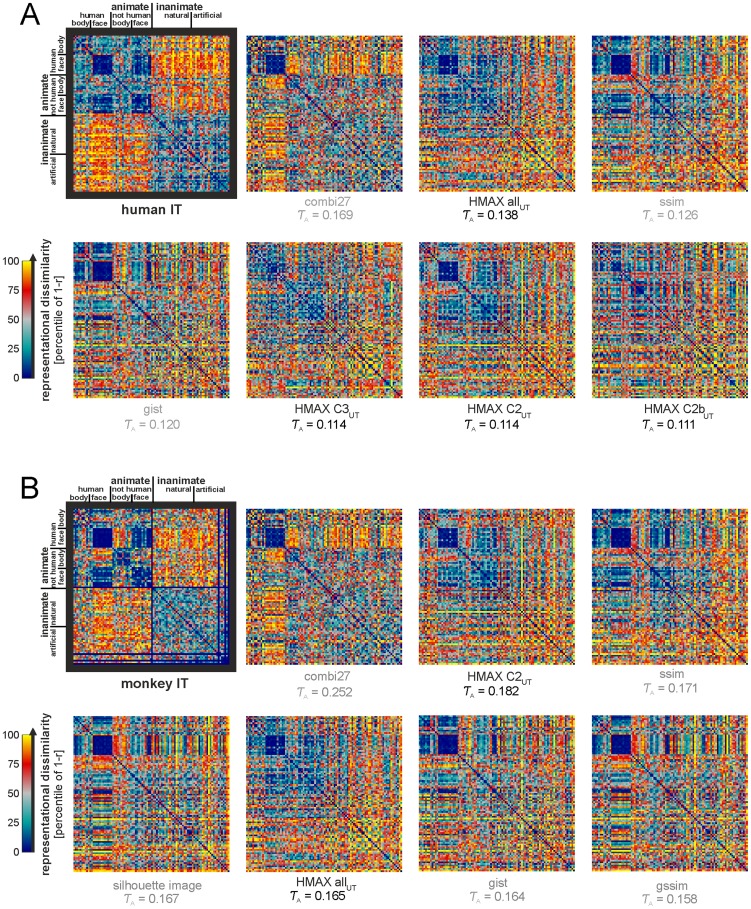
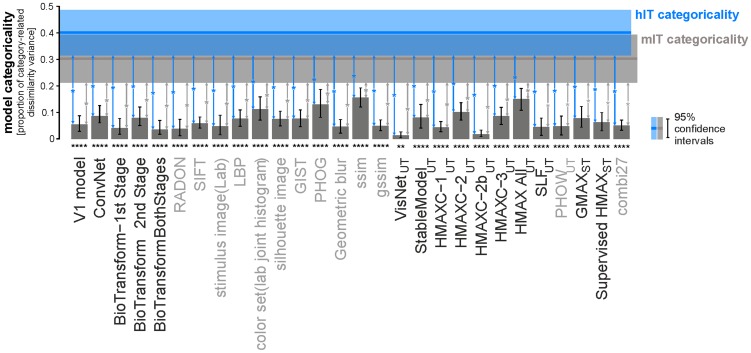
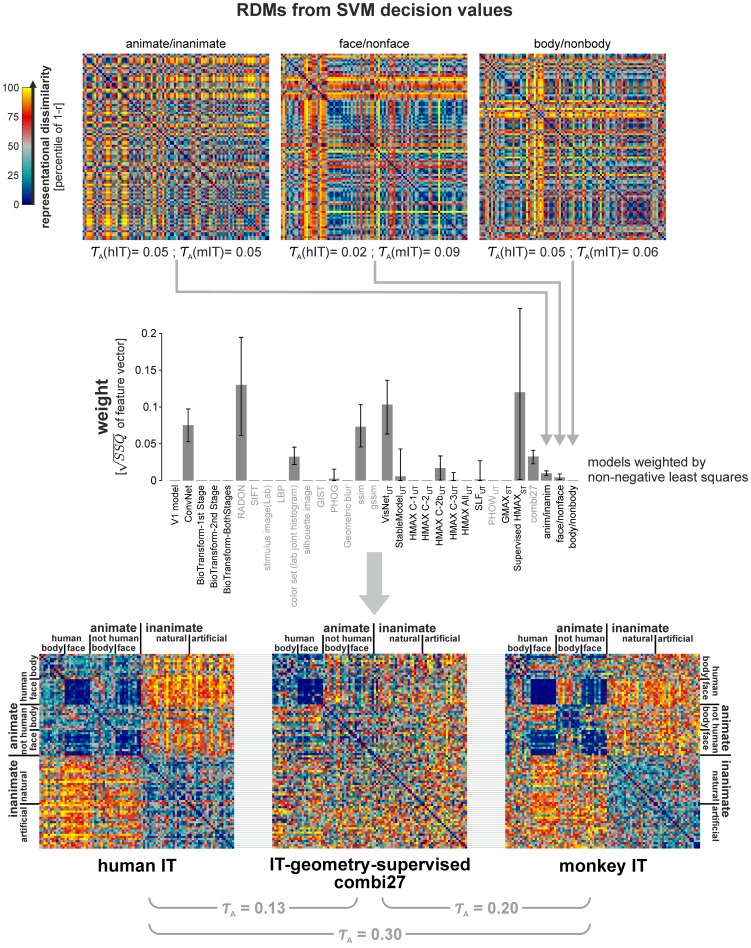
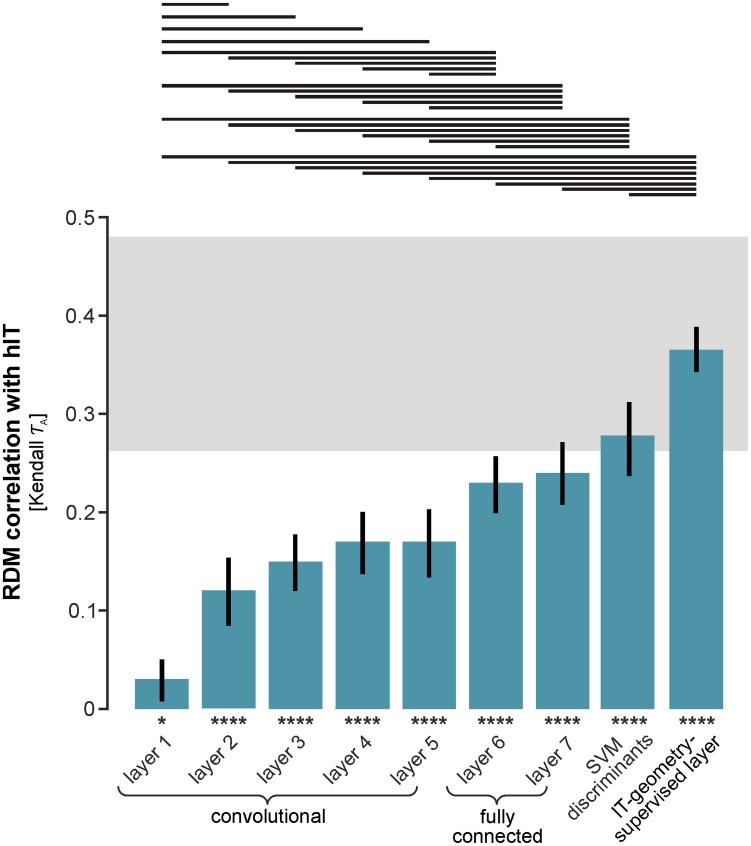
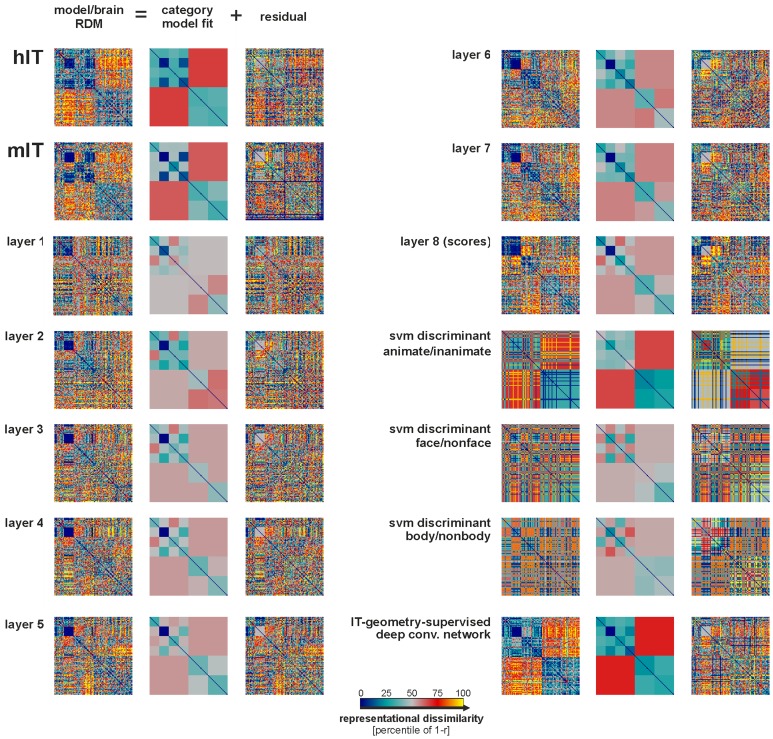
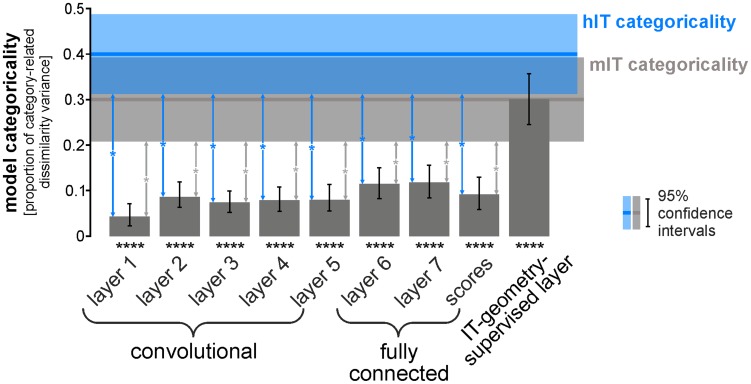
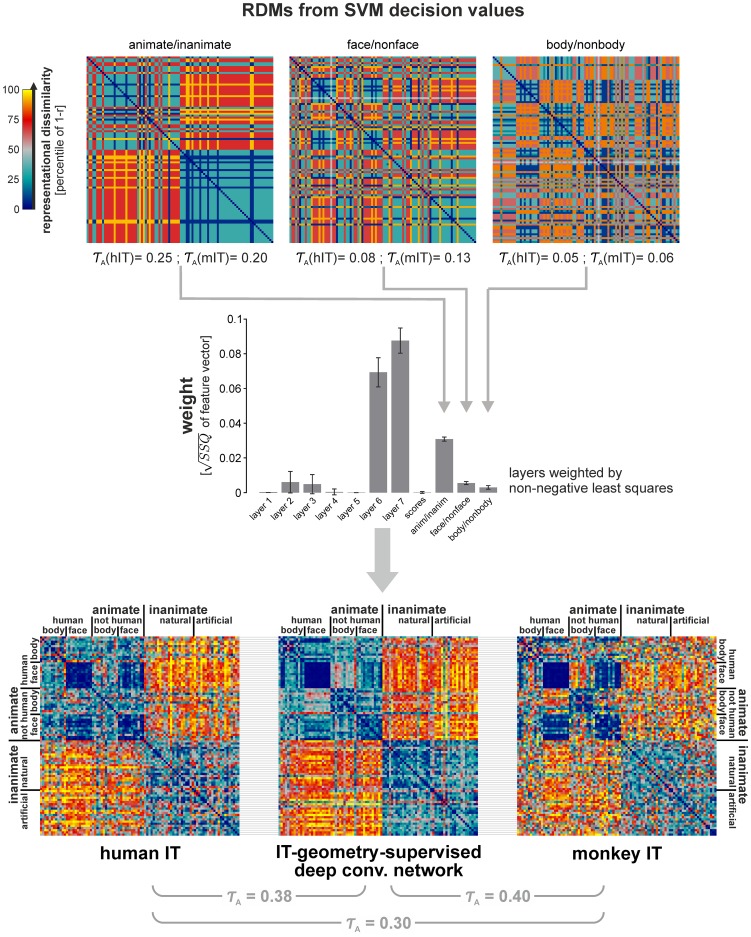
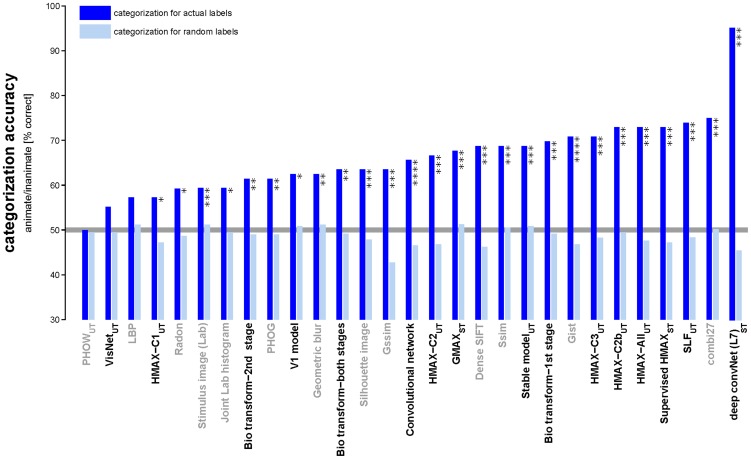
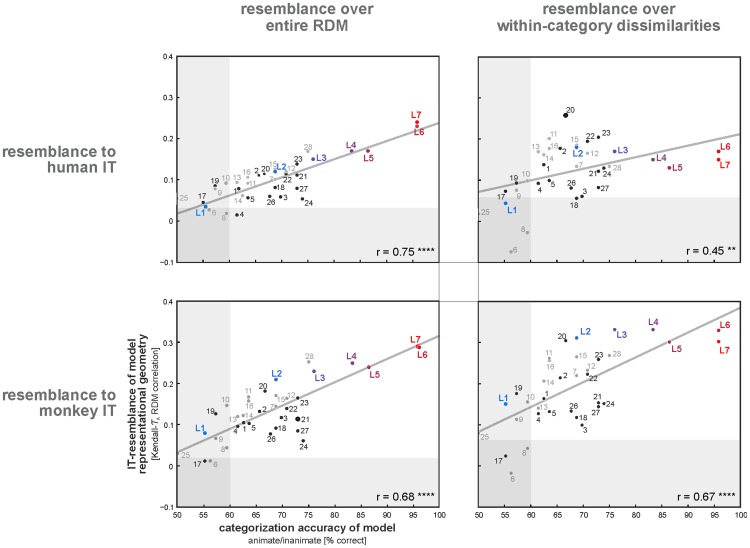
Inferior temporal (IT) cortex in human and nonhuman primates serves visual object recognition. Computational object-vision models, although continually improving, do not yet reach human performance. It is unclear to what extent the internal representations of computational models can explain the IT representation. Here we investigate a wide range of computational model representations (37 in total), testing their categorization performance and their ability to account for the IT representational geometry. The models include well-known neuroscientific object-recognition models (e.g. HMAX, VisNet) along with several models from computer vision (e.g. SIFT, GIST, self-similarity features, and a deep convolutional neural network). We compared the representational dissimilarity matrices (RDMs) of the model representations with the RDMs obtained from human IT (measured with fMRI) and monkey IT (measured with cell recording) for the same set of stimuli (not used in training the models). Better performing models were more similar to IT in that they showed greater clustering of representational patterns by category. In addition, better performing models also more strongly resembled IT in terms of their within-category representational dissimilarities. Representational geometries were significantly correlated between IT and many of the models. However, the categorical clustering observed in IT was largely unexplained by the unsupervised models. The deep convolutional network, which was trained by supervision with over a million category-labeled images, reached the highest categorization performance and also best explained IT, although it did not fully explain the IT data. Combining the features of this model with appropriate weights and adding linear combinations that maximize the margin between animate and inanimate objects and between faces and other objects yielded a representation that fully explained our IT data. Overall, our results suggest that explaining IT requires computational features trained through supervised learning to emphasize the behaviorally important categorical divisions prominently reflected in IT.
Overview
The claims and statistics of this paper haven’t been checked yet.
Free: it reads the open-access text and checks the first 5 claims that cite a source we can check. Create a free account to check every claim.
Integrity signals
Registry
Cites
Statistics
Figures



Verification
Claims the paper makes
The claims and statistics of this paper haven’t been checked yet.
Free: it reads the open-access text and checks the first 5 claims that cite a source we can check. Create a free account to check every claim.
Claims other papers make about this one
Each is checked against this paper’s own text: does it say what the citing paper says it does?
The cited source says what the claim attributes to it.
In the citing paper
“Using this approach, known as neuroconnectionism, numerous studies have identified shared representational structure across brains and ANN models, as well as factors influencing this alignment [5–11]”
From The Umwelt Representation Hypothesis: rethinking Universality (2026) · cites this paper as [10]
The cited source says what the claim attributes to it.
In the citing paper
“Analogous approaches have proven successful in relating the structure of neural activity to computational functions in other domains, including vision 17–19, audition 20, olfaction 21,22, thermosensation 23, perceptual discrimination 24, facial perception 25, and navigation 26,27.”
From A virtual rodent predicts the structure of neural activity across behaviours (2024) · cites this paper as [19]
Self-check
Percentages, sums and reported differences re-computed from the paper’s own numbers.
The self-check needs the paper’s full text.
Citations
Cites
ImageNet classification with deep convolutional neural networks
Krizhevsky, A., Sutskever, I., & Hinton, G. E. (2017) · Communications of the ACM · doi:10.1145/3065386 · Cited by 112,155
ImageNet: A large-scale hierarchical image database
Deng, J., Dong, W., Socher, R., Li, L.-J., Li, K., & Fei-Fei, L. (2009) · 2009 IEEE Conference on Computer Vision and Pattern Recognition · doi:10.1109/cvpr.2009.5206848 · Cited by 65,333 · cited 2×
“This is a supervised convolutional neural network, trained with 1.2 million labelled images from ImageNet (1000 category labels) [52].”
MethodInfluentialDistinctive Image Features from Scale-Invariant Keypoints
Lowe, D. G. (2004) · International Journal of Computer Vision · doi:10.1023/b:visi.0000029664.99615.94 · Cited by 55,589
LIBSVM: A library for support vector machines
Chang, C.-C., & Lin, C.-J. (2011) · ACM Transactions on Intelligent Systems and Technology · doi:10.1145/1961189.1961199 · Cited by 40,918
Object recognition from local scale-invariant features
Lowe, D. G. (1999) · Proceedings of the Seventh IEEE International Conference on Computer Vision · doi:10.1109/iccv.1999.790410 · Cited by 16,472
A fast learning algorithm for deep belief nets
Hinton, G. E., Osindero, S., & Teh, Y.-W. (2006) · Neural Computation · doi:10.1162/neco.2006.18.7.1527 · Cited by 16,336
Visualizing and understanding convolutional networks
Zeiler, M. D., & Fergus, R. (2014) · Lecture Notes in Computer Science · doi:10.1007/978-3-319-10590-1_53 · Cited by 15,839
Multiresolution gray-scale and rotation invariant texture classification with local binary patterns
Ojala, T., Pietikainen, M., & Maenpaa, T. (2002) · IEEE Transactions on Pattern Analysis and Machine Intelligence · doi:10.1109/tpami.2002.1017623 · Cited by 15,398
Receptive fields, binocular interaction and functional architecture in the cat’s visual cortex
Hubel, D. H., & Wiesel, T. N. (1962) · The Journal of Physiology · doi:10.1113/jphysiol.1962.sp006837 · Cited by 13,680
Libsvm : A library for support vector machines
Ferrari, V. (2008) · Medical Entomology and Zoology · Cited by 10,122
Research works printed but not linked: 1
- Krizhevsky A., Sutskever I. and Hinton, G E. (2012) ImageNet Classification with Deep Convolutional Neural Networks. NIPS. Lake Tahoe, Nevada.
Cited by
Items 401–500 of 1,003
Jang, H., & Tong, F. (2021) · Journal of Vision · doi:10.1167/jov.21.12.6 · Cited by 37
Modality-independent encoding of individual concepts in the left parietal cortex
Handjaras, G., Leo, A., Cecchetti, L., Papale, P., Lenci, A., Marotta, G., Pietrini, P., & Ricciardi, E. (2017) · Neuropsychologia · doi:10.1016/j.neuropsychologia.2017.05.001 · Cited by 31
Shape Selectivity of Middle Superior Temporal Sulcus Body Patch Neurons
Kalfas, I., Kumar, S., & Vogels, R. (2017) · eNeuro · doi:10.1523/eneuro.0113-17.2017 · Cited by 32
Fine-grained neural decoding with distributed word representations
Wang, S., Zhang, J., Wang, H., Lin, N., & Zong, C. (2019) · Information Sciences · doi:10.1016/j.ins.2019.08.043 · Cited by 37
Transfer learning of deep neural network representations for fMRI decoding
Svanera, M., Savardi, M., Benini, S., Signoroni, A., Raz, G., Hendler, T., Muckli, L. F., Goebel, R., & Valente, G. (2019) · Journal of Neuroscience Methods · doi:10.1016/j.jneumeth.2019.108319 · Cited by 32
Cueva, C. J., Wang, P. Y., Chin, M., & Wei, X.-X. (2019) · arXiv · doi:10.48550/arxiv.1912.10189 · Cited by 27
The Quest for an Integrated Set of Neural Mechanisms Underlying Object Recognition in Primates
Kar, K., & DiCarlo, J. J. (2024) · Annual Review of Vision Science · doi:10.1146/annurev-vision-112823-030616 · Cited by 46
Kalfas, I., Vinken, K., & Vogels, R. (2018) · PLoS Computational Biology · doi:10.1371/journal.pcbi.1006557 · Cited by 29
Causal importance of low-level feature selectivity for generalization in image recognition
Ukita, J. (2020) · Neural Networks · doi:10.1016/j.neunet.2020.02.009 · Cited by 29
NeuroGen: Activation optimized image synthesis for discovery neuroscience
Gu, Z., Jamison, K. W., Khosla, M., Allen, E., Wu, Y., St-Yves, G., Naselaris, T., Kay, K., Sabuncu, M. R., & Kuceyeski, A. F. (2021) · NeuroImage · doi:10.1016/j.neuroimage.2021.118812 · Cited by 53
Multimodal neural networks better explain multivoxel patterns in the hippocampus
Choksi, B., Mozafari, M., VanRullen, R., & Reddy, L. (2022) · Neural Networks · doi:10.1016/j.neunet.2022.07.033 · Cited by 30
Biological convolutions improve DNN robustness to noise and generalisation
Evans, B. D., Malhotra, G., & Bowers, J. S. (2021) · Neural Networks · doi:10.1016/j.neunet.2021.12.005 · Cited by 39
Photons guided by axons may enable backpropagation-based learning in the brain
Zarkeshian, P., Kergan, T., Ghobadi, R., Nicola, W., & Simon, C. (2022) · Scientific Reports · doi:10.1038/s41598-022-24871-6 · Cited by 35
Maintenance and transformation of representational formats during working memory prioritization
Pacheco, D., Fellner, M.-C., Kunz, L., Zhang, H., Reinacher, P. C., Roy, C., Brandt, A., Schulze‐Bonhage, A., Yang, L., Wang, S., et al. (2024) · Nature Communications · doi:10.1038/s41467-024-52541-w · Cited by 32
Brains on BeatsPreprint
Güçlü, U., Thielen, J., Hanke, M., & van Gerven, M. A. J. (2016) · arXiv (Cornell University) · Cited by 26
End-to-end topographic networks as models of cortical map formation and human visual behaviour
Lu, Z., Doerig, A., Bosch, V. M., Krahmer, B., KAISER, D. H., Cichy, R. M., & Kietzmann, T. C. (2025) · Nature Human Behaviour · doi:10.1038/s41562-025-02220-7 · Cited by 41
Revealing nonlinear neural decoding by analyzing choices
Yang, Q., Walker, E. Y., Cotton, R. J., Tolias, A. S., & Pitkow, X. (2021) · Nature Communications · doi:10.1038/s41467-021-26793-9 · Cited by 33
Singer, J., Seeliger, K., Kietzmann, T. C., & Hebart, M. N. (2022) · Journal of Vision · doi:10.1167/jov.22.2.4 · Cited by 34
Exploring the Brain-like Properties of Deep Neural Networks: A Neural Encoding Perspective
Zhou, Q., Du, C., & He, H. (2022) · Machine Intelligence Research · doi:10.1007/s11633-022-1348-x · Cited by 31
Characterising and dissecting human perception of scene complexity
Kyle-Davidson, C., Zhou, E., Walther, D. B., Bors, A. G., & Evans, K. K. (2022) · Cognition · doi:10.1016/j.cognition.2022.105319 · Cited by 37
Suzuki, K., Seth, A. K., & Schwartzman, D. J. (2024) · Frontiers in Human Neuroscience · doi:10.3389/fnhum.2023.1159821 · Cited by 29
Conwell, C., Graham, D., Boccagno, C. E., & Vessel, E. A. (2025) · Proceedings of the National Academy of Sciences · doi:10.1073/pnas.2306025121 · Cited by 40
Karimi-Rouzbahani, H., Bagheri, N., & Ebrahimpour, R. (2017) · Neuroscience · doi:10.1016/j.neuroscience.2017.02.050 · Cited by 28
Is predictive coding falsifiable?
Bowman, H., Collins, D., Nayak, A. K., & Cruse, D. (2023) · Neuroscience & Biobehavioral Reviews · doi:10.1016/j.neubiorev.2023.105404 · Cited by 29
Models of visual categorization
Serre, T. (2016) · Wiley Interdisciplinary Reviews Cognitive Science · doi:10.1002/wcs.1385 · Cited by 30
Revealing Fine Structures of the Retinal Receptive Field by Deep-Learning Networks
Yan, Q., Zheng, Y., Jia, S., Zhang, Y., Yu, Z., Chen, F., Tian, Y., Huang, T., & Liu, J. K. (2020) · IEEE Transactions on Cybernetics · doi:10.1109/tcyb.2020.2972983 · Cited by 32
Xu, Y., & Vaziri-Pashkam, M. (2021) · Journal of Neuroscience · doi:10.1523/jneurosci.1993-20.2021 · Cited by 25
Toward Goal-Driven Neural Network Models for the Rodent Whisker-Trigeminal SystemPreprint
Zhuang, C., Kubilius, J., Hartmann, M. J. Z., & Yamins, D. L. K. (2017) · arXiv (Cornell University) · doi:10.48550/arxiv.1706.07555 · Cited by 30
Characterization of deep neural network features by decodability from human brain activity
Horikawa, T., Aoki, S., Tsukamoto, M., & Kamitani, Y. (2019) · Scientific Data · doi:10.1038/sdata.2019.12 · Cited by 29
Conscious perception of natural images is constrained by category-related visual features
Lindh, D., Sligte, I. G., Assecondi, S., Shapiro, K. L., & Charest, I. (2019) · Nature Communications · doi:10.1038/s41467-019-12135-3 · Cited by 27
DNNBrain: A Unifying Toolbox for Mapping Deep Neural Networks and Brains
Chen, X. S., Zhou, M. Q., Gong, Z., Xu, W., Liu, X., Huang, T., Zhen, Z., & Liu, J. (2020) · Frontiers in Computational Neuroscience · doi:10.3389/fncom.2020.580632 · Cited by 26
Contrast sensitivity function in deep networks
Akbarinia, A., Morgenstern, Y., & Gegenfurtner, K. R. (2023) · Neural Networks · doi:10.1016/j.neunet.2023.04.032 · Cited by 31
Distinguishing mirror from glass: A “big data” approach to material perception
Tamura, H., Prokott, K. E., & Fleming, R. W. (2022) · Journal of Vision · doi:10.1167/jov.22.4.4 · Cited by 25
Depth in convolutional neural networks solves scene segmentation
Seijdel, N., Tsakmakidis, N., de Haan, E. H. F., Bohté, S. M., & Scholte, H. S. (2020) · PLoS Computational Biology · doi:10.1371/journal.pcbi.1008022 · Cited by 27
Al-Tahan, H., & Mohsenzadeh, Y. (2021) · PLoS Computational Biology · doi:10.1371/journal.pcbi.1008775 · Cited by 26
ImageNet-trained deep neural networks exhibit illusion-like response to the Scintillating grid
Sun, E., & Dekel, R. (2021) · Journal of Vision · doi:10.1167/jov.21.11.15 · Cited by 31
Emergence of Separable Manifolds in Deep Language RepresentationsPreprint
Mamou, J., Le, H., Rio, M. D., Stephenson, C., Tang, H., Kim, Y., & Chung, S. (2020) · arXiv (Cornell University) · doi:10.48550/arxiv.2006.01095 · Cited by 49
Yargholi, E., & de Beeck, H. O. (2023) · Journal of Neuroscience · doi:10.1523/jneurosci.2179-22.2023 · Cited by 29
Towards a Theory of Computation in the Visual Cortex
Mély, D. A., & Serre, T. (2016) · Cognitive science and technology · doi:10.1007/978-981-10-0213-7_4 · Cited by 28
Analysing linear multivariate pattern transformations in neuroimaging data
Basti, A., Mur, M., Kriegeskorte, N., Pizzella, V., Marzetti, L., & Hauk, O. (2019) · PLoS ONE · doi:10.1371/journal.pone.0223660 · Cited by 25
Self-citationCompact deep neural network models of the visual cortex
Cowley, B. R., Stan, P. L., Pillow, J. W., & Smith, M. A. (2026) · Nature · doi:10.1038/s41586-026-10150-1 · Cited by 26
A comparative biology approach to DNN modeling of vision: A focus on differences, not similarities
Lonnqvist, B., Bornet, A., Doerig, A., & Herzog, M. H. (2021) · Journal of Vision · doi:10.1167/jov.21.10.17 · Cited by 21
Kong, N. C. L., Margalit, E., Gardner, J. L., & Norcia, A. M. (2022) · PLoS Computational Biology · doi:10.1371/journal.pcbi.1009739 · Cited by 31
How far is brain-inspired artificial intelligence away from brain?
Chen, Y., Wei, Z., Gou, H., Liu, H., Gao, L., He, X., & Zhang, X. (2022) · Frontiers in Neuroscience · doi:10.3389/fnins.2022.1096737 · Cited by 27
Advancing Naturalistic Affective Science with Deep Learning
Lin, C., Bulls, L. S., Tepfer, L. J., Vyas, A. D., & Thornton, M. A. (2023) · Affective Science · doi:10.1007/s42761-023-00215-z · Cited by 22
The mid-level vision toolbox for computing structural properties of real-world images
Walther, D. B., Farzanfar, D., Han, S., & Rezanejad, M. (2023) · Frontiers in Computer Science · doi:10.3389/fcomp.2023.1140723 · Cited by 23
Crossing the Cleft: Communication Challenges Between Neuroscience and Artificial Intelligence
Chance, F. S., Aimone, J. B., Musuvathy, S., Smith, M. R., Vineyard, C. M., & Wang, F. (2020) · Frontiers in Computational Neuroscience · doi:10.3389/fncom.2020.00039 · Cited by 22
Jusoh, W. F. A., Ballantyne, L., & Chan, K. O. (2020) · Biological Journal of the Linnean Society · doi:10.1093/biolinnean/blaa072 · Cited by 21
Levels of Representation in a Deep Learning Model of CategorizationPreprint
Guest, O., & Love, B. C. (2019) · bioRxiv (Cold Spring Harbor Laboratory) · doi:10.1101/626374 · Cited by 26
Novel Cognitive Functions Arise at the Convergence of Macroscale Gradients
Jung, H., Wager, T. D., & Carter, R. M. (2022) · Journal of Cognitive Neuroscience · doi:10.1162/jocn_a_01803 · Cited by 25
Behavioral Studies Using Large-Scale Brain Networks – Methods and Validations
Liu, M., Amey, R. C., Backer, R., Simon, J. P., & Forbes, C. E. (2022) · Frontiers in Human Neuroscience · doi:10.3389/fnhum.2022.875201 · Cited by 25
Marmoset core visual object recognition behavior is comparable to that of macaques and humans
Kell, A. J. E., Bokor, S. L., Jeon, Y.-N., Toosi, T., & Issa, E. B. (2022) · iScience · doi:10.1016/j.isci.2022.105788 · Cited by 25
Hierarchical temporal prediction captures motion processing along the visual pathway
Singer, Y., Taylor, L., Willmore, B. D. B., King, A. J., & Harper, N. S. (2023) · eLife · doi:10.7554/elife.52599 · Cited by 27
Li, Y., Yan, F., Xiang, J., Wang, W., Xie, K., & Luo, L. (2024) · Biochimica et Biophysica Acta (BBA) - Molecular Basis of Disease · doi:10.1016/j.bbadis.2024.167300 · Cited by 23
A data driven approach to understanding the organization of high-level visual cortex
Watson, D. M., Andrews, T. J., & Hartley, T. (2017) · Scientific Reports · doi:10.1038/s41598-017-03974-5 · Cited by 23
Khaligh‐Razavi, S., Bainbridge, W. A., Pantazis, D., & Oliva, A. (2016) · bioRxiv (Cold Spring Harbor Laboratory) · doi:10.1101/049700 · Cited by 20
Self-citationForeground-Background Segmentation Revealed during Natural Image Viewing
Papale, P., Leo, A., Cecchetti, L., Handjaras, G., Kay, K., Pietrini, P., & Ricciardi, E. (2018) · eNeuro · doi:10.1523/eneuro.0075-18.2018 · Cited by 26
Tran, A., Yang, P., Yang, J. Y. H., & Ormerod, J. T. (2022) · NAR Genomics and Bioinformatics · doi:10.1093/nargab/lqac023 · Cited by 19
Mapping representational mechanisms with deep neural networks
Kieval, P. H. (2022) · Synthese · doi:10.1007/s11229-022-03694-y · Cited by 22
MouseNet: A biologically constrained convolutional neural network model for the mouse visual cortex
Shi, J., Buice, M. A., Shea‐Brown, E., Mihalaş, Ş., & Tripp, B. (2022) · PLoS Computational Biology · doi:10.1371/journal.pcbi.1010427 · Cited by 33
Modeling Biological Face Recognition with Deep Convolutional Neural Networks
van Dyck, L. E., & Gruber, W. R. (2023) · Journal of Cognitive Neuroscience · doi:10.1162/jocn_a_02040 · Cited by 25
Karami, A., Castaldi, E., Eger, E., & Piazza, M. (2025) · Communications Biology · doi:10.1038/s42003-025-08395-z · Cited by 22
Multimodal evidence on shape and surface information in individual face processing
Nemrodov, D., Behrmann, M., Niemeier, M., Drobotenko, N., & Nestor, A. (2018) · NeuroImage · doi:10.1016/j.neuroimage.2018.09.083 · Cited by 22
Data-Driven Approaches to Understanding Visual Neuron Activity
Butts, D. A. (2019) · Annual Review of Vision Science · doi:10.1146/annurev-vision-091718-014731 · Cited by 23
Deep neural networks capture texture sensitivity in V2
Laskar, M. N. U., Giraldo, L. G. S., & Schwartz, O. (2020) · Journal of Vision · doi:10.1167/jov.20.7.21 · Cited by 23
Computational approaches to the neuroscience of social perception
Brooks, J. A., Stolier, R. M., & Freeman, J. B. (2020) · Social Cognitive and Affective Neuroscience · doi:10.1093/scan/nsaa127 · Cited by 24
Reverse Differentiation via Predictive Coding
Salvatori, T., Song, Y., Xu, Z., Lukasiewicz, T., & Bogacz, R. (2022) · Proceedings of the AAAI Conference on Artificial Intelligence · doi:10.1609/aaai.v36i7.20788 · Cited by 50
Mechanisms of human dynamic object recognition revealed by sequential deep neural networks
Sörensen, L. K. A., Bohté, S. M., de Jong, D., Slagter, H. A., & Scholte, H. S. (2023) · PLoS Computational Biology · doi:10.1371/journal.pcbi.1011169 · Cited by 24
Tripp, B. (2017) · International Joint Conference on Neural Networks (IJCNN) · doi:10.1109/ijcnn.2017.7966303 · Cited by 20
Individual differences among deep neural network modelsPreprint
Mehrer, J., Spoerer, C. J., Kriegeskorte, N., & Kietzmann, T. C. (2020) · bioRxiv (Cold Spring Harbor Laboratory) · doi:10.1101/2020.01.08.898288 · Cited by 24
Self-citationUsing deep neural networks to evaluate object vision tasks in rats
Vinken, K., & de Beeck, H. O. (2021) · PLoS Computational Biology · doi:10.1371/journal.pcbi.1008714 · Cited by 21
Fox, K. J., Birman, D., & Gardner, J. L. (2023) · eLife · doi:10.7554/elife.78392 · Cited by 23
Taylor, J., & Kriegeskorte, N. (2023) · Scientific Reports · doi:10.1038/s41598-023-40807-0 · Cited by 24
Self-citationBraunlich, K., Liu, Z., & Seger, C. A. (2017) · Journal of Neuroscience · doi:10.1523/jneurosci.3825-16.2017 · Cited by 20
Assessing Neural Network Scene Classification from Degraded Images
Tadros, T., Cullen, N. C., Greene, M. R., & Cooper, E. A. (2019) · ACM Transactions on Applied Perception · doi:10.1145/3342349 · Cited by 21
Raman, R., & Hosoya, H. (2020) · Communications Biology · doi:10.1038/s42003-020-0945-x · Cited by 22
Pramod, R. T., & Arun, S. P. (2020) · IEEE Transactions on Pattern Analysis and Machine Intelligence · doi:10.1109/tpami.2020.3008107 · Cited by 20
A zero-shot deep metric learning approach to Brain–Computer Interfaces for image retrieval
McCartney, B., Devereux, B. J., & del Rincón, J. M. (2022) · Knowledge-Based Systems · doi:10.1016/j.knosys.2022.108556 · Cited by 24
Modeling second-order boundary perception: A machine learning approach
DiMattina, C., & Baker, C. L. (2019) · PLoS Computational Biology · doi:10.1371/journal.pcbi.1006829 · Cited by 18
Visual Shape and Object Perception
Pasupathy, A., El-Shamayleh, Y., & Popovkina, D. V. (2018) · Oxford University Press eBooks · doi:10.1093/acrefore/9780190264086.013.75 · Cited by 22
Recent advances in functional neuroimaging analysis for cognitive neuroscience
Williams, N., & Henson, R. N. (2018) · Brain and Neuroscience Advances · doi:10.1177/2398212817752727 · Cited by 20
Storrs, K. R., Khaligh-Razavi, S.-M., & Kriegeskorte, N. (2020) · doi:10.1101/2020.03.23.003046 · Cited by 17
“Noise ceilings should not have been included in the plots of Khaligh-Razavi and Kriegeskorte (2014) showing correlations between models and human inferior temporal (hIT) data (Figures 2A and 7, and Supplementary Figures 2, 3 and 12), as they were not statistically appropriate.”
BackgroundMethodSelf-citationSubtle adversarial image manipulations influence both human and machine perception
Veerabadran, V., Goldman, J., Shankar, S., Cheung, B., Papernot, N., Kurakin, A., Goodfellow, I., Shlens, J., Sohl‐Dickstein, J., Mozer, M. C., et al. (2023) · Nature Communications · doi:10.1038/s41467-023-40499-0 · Cited by 35
Zhuang, C., Wang, Y., Yamins, D. L. K., & Hu, X. (2017) · Frontiers in Computational Neuroscience · doi:10.3389/fncom.2017.00100 · Cited by 20
Adeli, H., & Zelinsky, G. J. (2018) · IEEE/CVF Conference on Computer Vision and Pattern Recognition Workshops (CVPRW) · doi:10.1109/cvprw.2018.00259 · Cited by 27
Vinken, K., Boix, X., & Kreiman, G. (2020) · Science Advances · doi:10.1126/sciadv.abd4205 · Cited by 23
Cesarei, A. D., Cavicchi, S., Cristadoro, G., & Lippi, M. (2021) · Cognitive Science · doi:10.1111/cogs.13009 · Cited by 23
Correspondence of Deep Neural Networks and the Brain for Visual Textures
Laskar, M. N. U., Giraldo, L. G. S., & Schwartz, O. (2018) · arXiv (Cornell University) · doi:10.48550/arxiv.1806.02888 · Cited by 24
Deeper Interpretability of Deep NetworksPreprint
Xu, T., Zhan, J., Garrod, O., Torr, P. H. S., Zhu, S. C., Ince, R. A. A., & Schyns, P. G. (2018) · arXiv (Cornell University) · doi:10.48550/arxiv.1811.07807 · Cited by 18
He, T., Kong, R., Holmes, A. J., Nguyen, M., Sabuncu, M. R., Eickhoff, S. B., Bzdok, D., Feng, J., & Yeo, B. T. T. (2018) · doi:10.1101/473603 · Cited by 16
The Notorious Difficulty of Comparing Human and Machine Perception
Funke, C. M., Borowski, J., Stosio, K., Brendel, W., Wallis, T. S. A., & Bethge, M. (2020) · Cited by 16
Neyens, V., Bruffaerts, R., Liuzzi, A. G., Kalfas, I., Peeters, R. R., Keuleers, E., Vogels, R., Deyne, S. D., Storms, G., Dupont, P. J., et al. (2017) · Frontiers in Human Neuroscience · doi:10.3389/fnhum.2017.00402 · Cited by 18
Sharpening of Hierarchical Visual Feature Representations of Blurred Images
Abdelhack, M., & Kamitani, Y. (2018) · eNeuro · doi:10.1523/eneuro.0443-17.2018 · Cited by 21
Time-Varying Effective Connectivity during Visual Object Naming as a Function of Semantic Demands
Poch, C., Garrido, M. I., Igoa, J. M., Carmona, M. B., García‐Morales, I., & Campo, P. (2015) · Journal of Neuroscience · doi:10.1523/jneurosci.4888-14.2015 · Cited by 19
Invariant recognition drives neural representations of action sequences
Tacchetti, A., Işık, L., & Poggio, T. (2017) · PLoS Computational Biology · doi:10.1371/journal.pcbi.1005859 · Cited by 21
Characterizing the Shape of Activation Space in Deep Neural Networks
Gebhart, T., Schrater, P., & Hylton, A. (2019) · International Conference on Machine Learning and Applications · doi:10.1109/icmla.2019.00254 · Cited by 32
Brain-optimized extraction of complex sound features that drive continuous auditory perception
Berezutskaya, J., Freudenburg, Z. V., Güçlü, U., van Gerven, M. A. J., & Ramsey, N. F. (2020) · PLoS Computational Biology · doi:10.1371/journal.pcbi.1007992 · Cited by 17
Towards Biologically Plausible Convolutional NetworksPreprint
Pogodin, R., Mehta, Y., Lillicrap, T., & Latham, P. E. (2021) · arXiv (Cornell University) · doi:10.48550/arxiv.2106.13031 · Cited by 31
Long-range and hierarchical language predictions in brains and algorithmsPreprint
Caucheteux, C., Gramfort, A., & King, J.-R. (2021) · arXiv (Cornell University) · doi:10.48550/arxiv.2111.14232 · Cited by 25
Predictive Coding Can Do Exact Backpropagation on Convolutional and Recurrent Neural Networks
Salvatori, T., Song, Y., Lukasiewicz, T., Bogacz, R., & Xu, Z. (2021) · arXiv · doi:10.48550/arxiv.2103.03725 · Cited by 16
“…since the flourishing of BP, because on the one hand, the underlying principles of BP are unrealistic for an implementation in the brain [30], but on the other hand, BP outperforms all alternative discovered frameworks [3] and closely reproduces activity patterns observed in the cortex [12, 32, 11].”
Background
Metadata
- Authors
- Khaligh-Razavi, S.-M., & Kriegeskorte, N.
- Affiliations
- MRC Cognition and Brain Sciences Unit (GB)
- Corresponding author
- Kriegeskorte, Nikolaus
- Venue
- PLoS Computational Biology
- Publisher
- Public Library of Science (PLoS)
- Published
- 2014-11-06
- Volume
- 10
- Issue
- 11
- Pages
- e1003915
- ISSN
- 1553-734X (ISSN-L)
- 1553-7358
- PMC
- PMC4222664
- OpenAlex
- W2040036684
- Cited by
- 1,204
- References
- 98
- Citations by year
- 2026: 75 · 2025: 100 · 2024: 110 · 2023: 127 · 2022: 112 · 2021: 124 · 2020: 125 · 2019: 151 · 2018: 97 · 2017: 87 · 2016: 75 · 2015: 20 · 2014: 1
- FWCI
- 34.02
- Type
- journal article
- Language
- en
- Open access
- gold
- doi.org
- Locations
- PLoS Computational Biology (publishedVersion, cc-by)
- Europe PMC (PubMed Central) (publishedVersion, cc-by)
- PubMed Central (publishedVersion, cc-by)
- PubMed (publishedVersion)
- DOAJ (DOAJ: Directory of Open Access Journals) (submittedVersion, cc-by-sa)
- Figshare (submittedVersion, cc-by)
- Funders
- Cambridge Overseas Trust
- Medical Research Council (MC-A060- 5PR20)
- FP7 Ideas: European Research Council (261352)
- Topics
- Life Sciences › Neuroscience › Cognitive Neuroscience › Visual perception and processing mechanisms
- Life Sciences › Neuroscience › Cognitive Neuroscience › Face Recognition and Perception
- Physical Sciences › Computer Science › Computer Vision and Pattern Recognition › Advanced Neural Network Applications
- Keywords
- inferior temporal cortex, visual object recognition, representational geometry, representational dissimilarity matrices, supervised learning, unsupervised learning, deep convolutional neural networks, categorical clustering, HMAX, monkey visual cortex, human visual cortex
- MeSH terms
- Animals, Haplorhini, Humans, Models, Neurological, Temporal Lobe, Computational Biology, Support Vector Machine
About these checks
Registry, retraction, Cites and statistics results are computed, not judged, with one exception: a printed reference that no index lists is read once by a model before it counts as a citation error. Claims are extracted by a model and kept only when their quote appears verbatim in the text; each cited source is then checked, with a model’s help, for whether it says what the claim relies on. Those verdicts can be wrong — read the claim’s quote and the cited source before relying on one.
Statistics and arithmetic are recomputed, not judged.
Confidence bands are shown only for fields calibrated on our annotated test set. None is calibrated yet, so no band is shown.
What counts as a claim ›How we measure confidence ›How we check this ›
Are you an author, or do you see a problem with this page? Request a review
Data sources
Bibliographic data: Semantic Scholar, OpenAlex, Crossref.
Contains information from the Semantic Scholar Academic Graph Datasets, made available under the ODC Attribution License (ODC-BY 1.0).
Semantic Scholar’s data is described in: Kinney, R., et al. (2023). The Semantic Scholar Open Data Platform. arXiv:2301.10140.
