

Deep Supervised, but Not Unsupervised, Models May Explain IT Cortical Representation
Open accessThe DOI matches its Crossref record; 99 of the 99 references it cites were found in a registry or an index.
Abstract
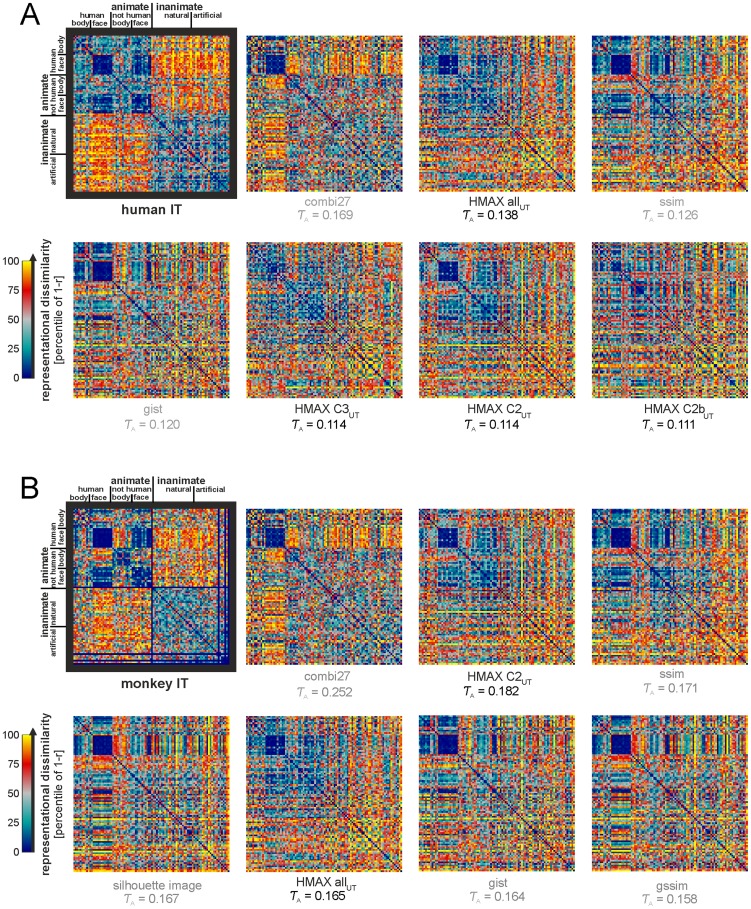
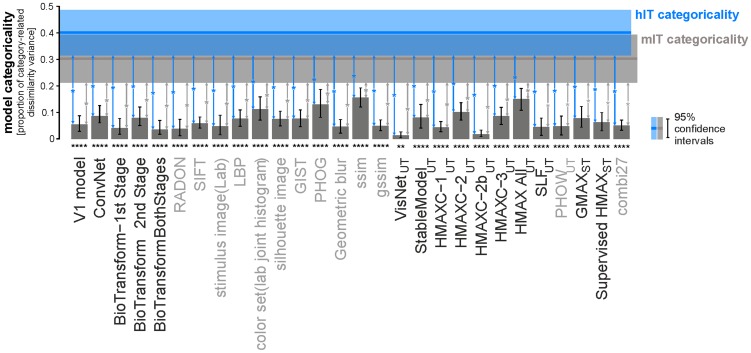
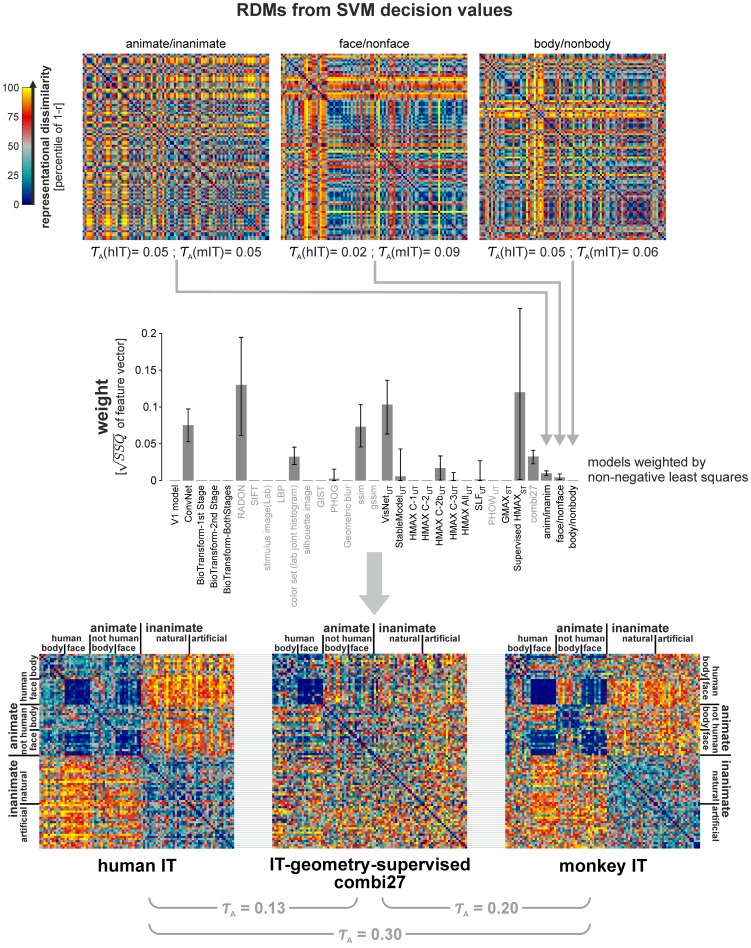
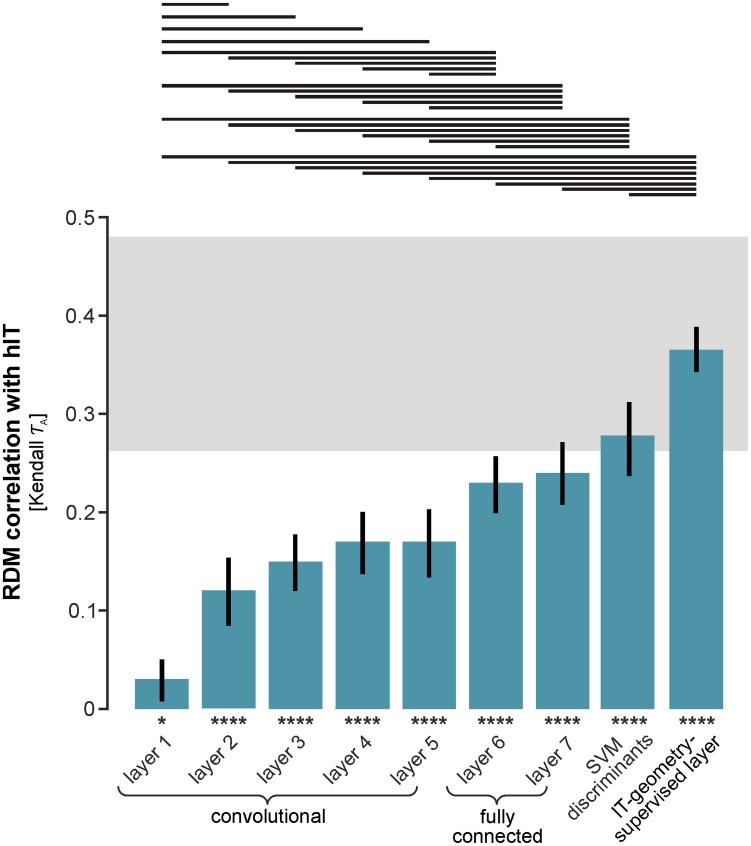
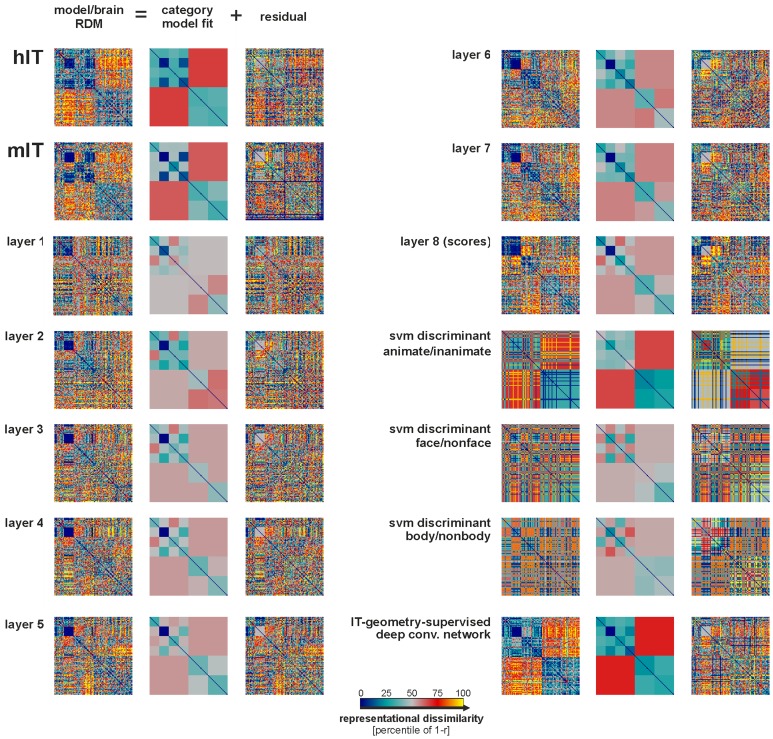
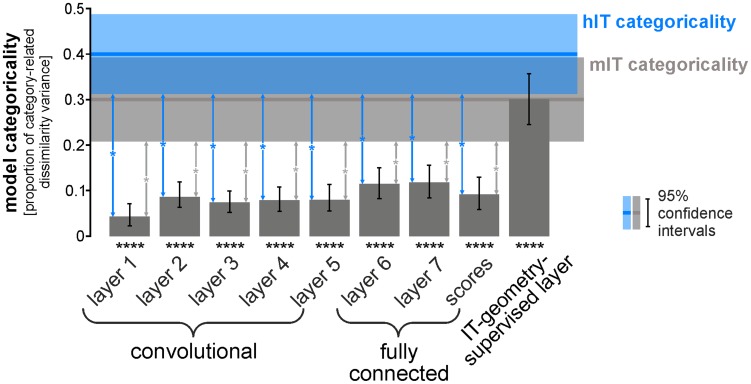
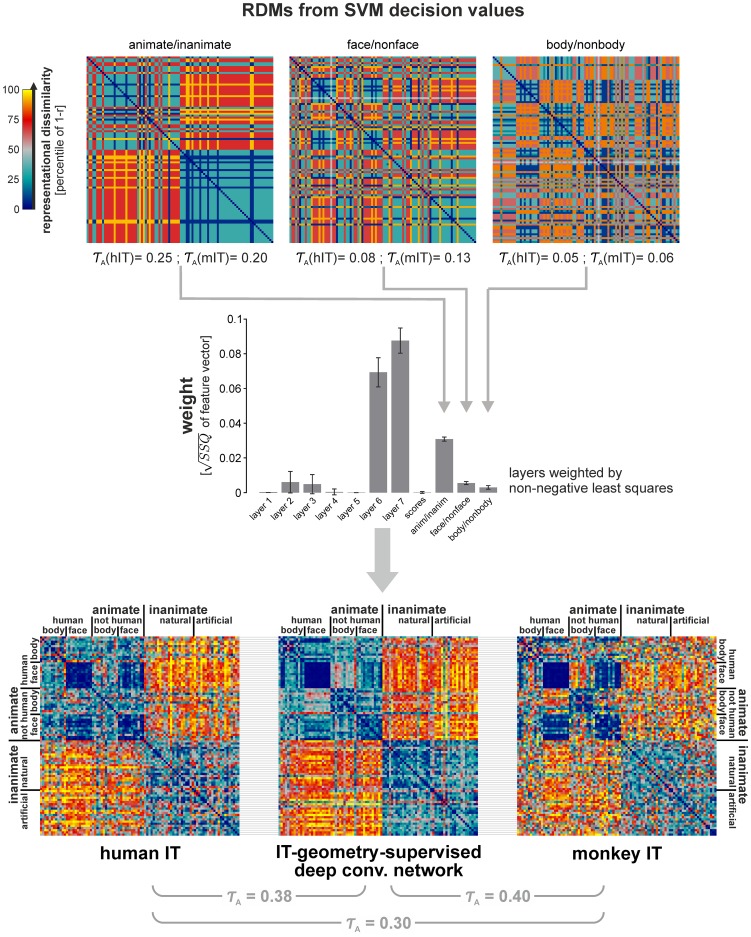
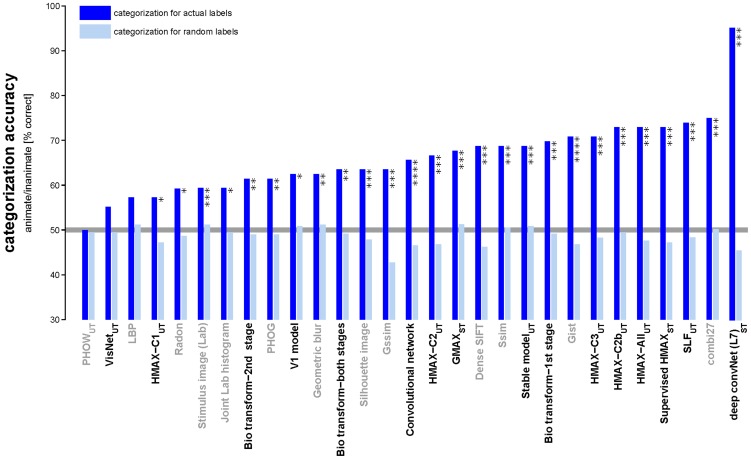
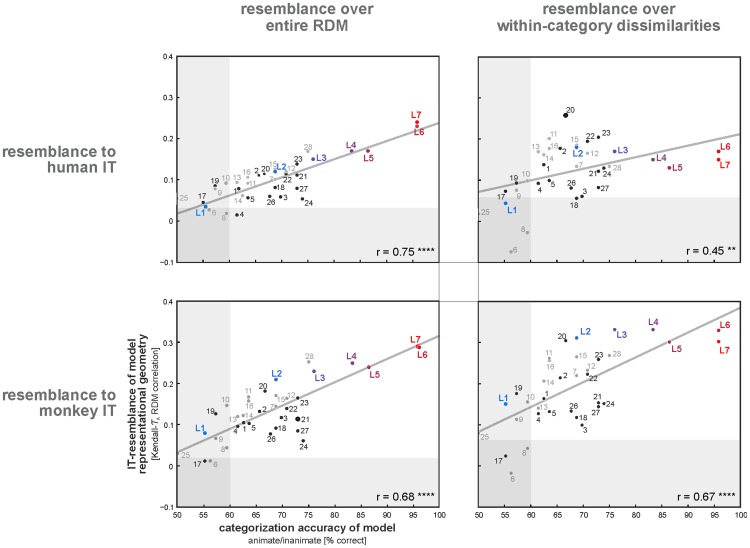
Inferior temporal (IT) cortex in human and nonhuman primates serves visual object recognition. Computational object-vision models, although continually improving, do not yet reach human performance. It is unclear to what extent the internal representations of computational models can explain the IT representation. Here we investigate a wide range of computational model representations (37 in total), testing their categorization performance and their ability to account for the IT representational geometry. The models include well-known neuroscientific object-recognition models (e.g. HMAX, VisNet) along with several models from computer vision (e.g. SIFT, GIST, self-similarity features, and a deep convolutional neural network). We compared the representational dissimilarity matrices (RDMs) of the model representations with the RDMs obtained from human IT (measured with fMRI) and monkey IT (measured with cell recording) for the same set of stimuli (not used in training the models). Better performing models were more similar to IT in that they showed greater clustering of representational patterns by category. In addition, better performing models also more strongly resembled IT in terms of their within-category representational dissimilarities. Representational geometries were significantly correlated between IT and many of the models. However, the categorical clustering observed in IT was largely unexplained by the unsupervised models. The deep convolutional network, which was trained by supervision with over a million category-labeled images, reached the highest categorization performance and also best explained IT, although it did not fully explain the IT data. Combining the features of this model with appropriate weights and adding linear combinations that maximize the margin between animate and inanimate objects and between faces and other objects yielded a representation that fully explained our IT data. Overall, our results suggest that explaining IT requires computational features trained through supervised learning to emphasize the behaviorally important categorical divisions prominently reflected in IT.
Overview
The claims and statistics of this paper haven’t been checked yet.
Free: it reads the open-access text and checks the first 5 claims that cite a source we can check. Create a free account to check every claim.
Integrity signals
Registry
Cites
Statistics
Figures



Verification
Claims the paper makes
The claims and statistics of this paper haven’t been checked yet.
Free: it reads the open-access text and checks the first 5 claims that cite a source we can check. Create a free account to check every claim.
Claims other papers make about this one
Each is checked against this paper’s own text: does it say what the citing paper says it does?
The cited source says what the claim attributes to it.
In the citing paper
“Using this approach, known as neuroconnectionism, numerous studies have identified shared representational structure across brains and ANN models, as well as factors influencing this alignment [5–11]”
From The Umwelt Representation Hypothesis: rethinking Universality (2026) · cites this paper as [10]
The cited source says what the claim attributes to it.
In the citing paper
“Analogous approaches have proven successful in relating the structure of neural activity to computational functions in other domains, including vision 17–19, audition 20, olfaction 21,22, thermosensation 23, perceptual discrimination 24, facial perception 25, and navigation 26,27.”
From A virtual rodent predicts the structure of neural activity across behaviours (2024) · cites this paper as [19]
Self-check
Percentages, sums and reported differences re-computed from the paper’s own numbers.
The self-check needs the paper’s full text.
Citations
Cites
ImageNet classification with deep convolutional neural networks
Krizhevsky, A., Sutskever, I., & Hinton, G. E. (2017) · Communications of the ACM · doi:10.1145/3065386 · Cited by 112,155
ImageNet: A large-scale hierarchical image database
Deng, J., Dong, W., Socher, R., Li, L.-J., Li, K., & Fei-Fei, L. (2009) · 2009 IEEE Conference on Computer Vision and Pattern Recognition · doi:10.1109/cvpr.2009.5206848 · Cited by 65,333 · cited 2×
“This is a supervised convolutional neural network, trained with 1.2 million labelled images from ImageNet (1000 category labels) [52].”
MethodInfluentialDistinctive Image Features from Scale-Invariant Keypoints
Lowe, D. G. (2004) · International Journal of Computer Vision · doi:10.1023/b:visi.0000029664.99615.94 · Cited by 55,589
LIBSVM: A library for support vector machines
Chang, C.-C., & Lin, C.-J. (2011) · ACM Transactions on Intelligent Systems and Technology · doi:10.1145/1961189.1961199 · Cited by 40,918
Object recognition from local scale-invariant features
Lowe, D. G. (1999) · Proceedings of the Seventh IEEE International Conference on Computer Vision · doi:10.1109/iccv.1999.790410 · Cited by 16,472
A fast learning algorithm for deep belief nets
Hinton, G. E., Osindero, S., & Teh, Y.-W. (2006) · Neural Computation · doi:10.1162/neco.2006.18.7.1527 · Cited by 16,336
Visualizing and understanding convolutional networks
Zeiler, M. D., & Fergus, R. (2014) · Lecture Notes in Computer Science · doi:10.1007/978-3-319-10590-1_53 · Cited by 15,839
Multiresolution gray-scale and rotation invariant texture classification with local binary patterns
Ojala, T., Pietikainen, M., & Maenpaa, T. (2002) · IEEE Transactions on Pattern Analysis and Machine Intelligence · doi:10.1109/tpami.2002.1017623 · Cited by 15,398
Receptive fields, binocular interaction and functional architecture in the cat’s visual cortex
Hubel, D. H., & Wiesel, T. N. (1962) · The Journal of Physiology · doi:10.1113/jphysiol.1962.sp006837 · Cited by 13,680
Libsvm : A library for support vector machines
Ferrari, V. (2008) · Medical Entomology and Zoology · Cited by 10,122
Research works printed but not linked: 1
- Krizhevsky A., Sutskever I. and Hinton, G E. (2012) ImageNet Classification with Deep Convolutional Neural Networks. NIPS. Lake Tahoe, Nevada.
Cited by
Items 601–700 of 1,003
Conwell, C., Mayo, D., Buice, M. A., Katz, B., Alvarez, G. A., & Barbu, A. (2021) · bioRxiv (Cold Spring Harbor Laboratory) · doi:10.1101/2021.06.18.448431 · Cited by 18
Modeling dynamic social vision highlights gaps between deep learning and humansPreprint
Garcia, K., McMahon, E., Conwell, C., Bonner, M., & Işık, L. (2024) · PsyArXiv (OSF Preprints) · doi:10.31234/osf.io/4mpd9 · Cited by 20
The Scope and Limits of Fine-Grained Image and Category Information in the Ventral Visual Pathway
Badwal, M. W., Bergmann, J., Roth, J., Doeller, C. F., & Hebart, M. N. (2024) · Journal of Neuroscience · doi:10.1523/jneurosci.0936-24.2024 · Cited by 9
Cortical networks of dynamic scene category representation in the human brain
Çelik, E., Keleş, Ü., Kiremitçi, İ., Gallant, J. L., & Çukur, T. (2021) · Cortex · doi:10.1016/j.cortex.2021.07.008 · Cited by 17
Oculo-retinal dynamics can explain the perception of minimal recognizable configurations
Gruber, L. Z., Ullman, S., & Ahissar, E. (2021) · Proceedings of the National Academy of Sciences · doi:10.1073/pnas.2022792118 · Cited by 11
Recurrent connections facilitate symmetry perception in deep networks
Sundaram, S., Sinha, D., Groth, M., Sasaki, T., & Boix, X. (2022) · Scientific Reports · doi:10.1038/s41598-022-25219-w · Cited by 12
St-Yves, G., Allen, E., Wu, Y., Kay, K., & Naselaris, T. (2022) · Journal of Vision · doi:10.1167/jov.22.14.4322 · Cited by 12
Zhao, L., Dai, H., Wu, Z., Xiao, Z., Zhang, L., Liu, D. W., Hu, X., Jiang, X., Li, S., Zhu, D., et al. (2023) · IEEE Transactions on Cognitive and Developmental Systems · doi:10.1109/tcds.2023.3287184 · Cited by 15
Exploring the categorical nature of colour perception: Insights from artificial networks
Akbarinia, A. (2024) · Neural Networks · doi:10.1016/j.neunet.2024.106758 · Cited by 16
The perceptual dimensions of natural dynamic flow
Morgenstern, Y., & Kersten, D. (2017) · Journal of Vision · doi:10.1167/17.12.7 · Cited by 9
Exploring spatiotemporal neural dynamics of the human visual cortex
Yang, Y., Tarr, M. J., Kass, R. E., & Aminoff, E. (2019) · Human Brain Mapping · doi:10.1002/hbm.24697 · Cited by 9
Exemplar based regular texture synthesis using LSTM
Cai, X., Song, B., & Fang, Z. (2019) · Pattern Recognition Letters · doi:10.1016/j.patrec.2019.09.006 · Cited by 9
Alamia, A., Mozafari, M., Choksi, B., & VanRullen, R. (2022) · Neural Networks · doi:10.1016/j.neunet.2022.10.020 · Cited by 18
Challenging the Classical View: Recognition of Identity and Expression as Integrated Processes
Schwartz, E., O’Nell, K. C., Saxe, R. R., & Anzellotti, S. (2023) · Brain Sciences · doi:10.3390/brainsci13020296 · Cited by 12
Decoding Language from the Brain
Murphy, B., Wehbe, L., & Fyshe, A. (2017) · Cambridge University Press eBooks · doi:10.1017/9781316676974.003 · Cited by 15
Biologically inspired visual computing: the state of the art
Hao, W., Andolina, I. M., Wang, W., & Zhang, Z. (2020) · Frontiers of Computer Science · doi:10.1007/s11704-020-9001-8 · Cited by 9
Henderson, M. M., Tarr, M. J., & Wehbe, L. (2023) · Journal of Vision · doi:10.1167/jov.23.4.8 · Cited by 18
New advances in encoding and decoding of brain signals
Baker, C. I., & van Gerven, M. A. J. (2018) · NeuroImage · doi:10.1016/j.neuroimage.2018.06.064 · Cited by 10
Tong, F. (2018) · Wiley eBooks · doi:10.1002/9781119170174.epcn201 · Cited by 10
Tang, J., LeBel, A., & Huth, A. G. (2021) · bioRxiv (Cold Spring Harbor Laboratory) · doi:10.1101/2021.05.19.444701 · Cited by 11
Computational insights into human perceptual expertise for familiar and unfamiliar face recognitionPreprint
Blauch, N. M., Behrmann, M., & Plaut, D. C. (2019) · PsyArXiv (OSF Preprints) · doi:10.31234/osf.io/bv5mp · Cited by 10
Hierarchical Models of the Visual System
Ricci, M. R., & Serre, T. (2022) · Springer eBooks · doi:10.1007/978-1-0716-1006-0_345 · Cited by 9
State and capacity in neural models of cognition and consciousness
Wang, P., Liu, H., Ilievski, F., Ganushchak, L., Zou, L., Laureys, S., & Paas, F. (2026) · Trends Open · doi:10.1016/j.treopn.2026.04.004 · Cited by 8
Ramirez, J. G., Vanhoyland, M., Murty, N. A. R., Decramer, T., Paesschen, W. V., Bracci, S., de Beeck, H. O., Kanwisher, N., Janssen, P., & Theys, T. (2024) · Proceedings of the National Academy of Sciences · doi:10.1073/pnas.2408871121 · Cited by 10
Learning reshapes the hippocampal representation hierarchy
Chiossi, H. S. C., Nardin, M., Tkačik, G., & Csicsvari, J. (2025) · Proceedings of the National Academy of Sciences · doi:10.1073/pnas.2417025122 · Cited by 11
Top-down perceptual inference shaping the activity of early visual cortex
Csikor, F., Meszéna, B., Ócsai, K., & Orbán, G. (2025) · Nature Communications · doi:10.1038/s41467-025-64967-x · Cited by 14
Learning online visual invariances for novel objects via supervised and self-supervised training
Biscione, V., & Bowers, J. S. (2022) · Neural Networks · doi:10.1016/j.neunet.2022.02.017 · Cited by 12
Afzalian, N., & Rajimehr, R. (2021) · Journal of Neuroscience · doi:10.1523/jneurosci.1580-20.2021 · Cited by 10
Ding, X., & Zhang, H. (2022) · NeuroImage · doi:10.1016/j.neuroimage.2022.119769 · Cited by 8
Do Machines Really Understand Meaning? (Again)
Perconti, P., & Plebe, A. (2023) · Journal of Artificial Intelligence and Consciousness · doi:10.1142/s2705078522500205 · Cited by 14
Karapetian, A., Boyanova, A., Pandaram, M., Obermayer, K., Kietzmann, T. C., & Cichy, R. M. (2023) · Journal of Cognitive Neuroscience · doi:10.1162/jocn_a_02043 · Cited by 10
Adversarial attacks and defenses using feature-space stochasticity
Ukita, J., & Ohki, K. (2023) · Neural Networks · doi:10.1016/j.neunet.2023.08.022 · Cited by 8
da Costa, D., Kornemann, L., Goebel, R., & Senden, M. (2024) · Scientific Reports · doi:10.1038/s41598-024-59376-x · Cited by 12
Neuronal Firing Rate As Code Length: a Hypothesis
Qian, N., & Zhang, J. (2019) · Computational Brain & Behavior · doi:10.1007/s42113-019-00028-z · Cited by 9
Wingfield, C., Su, L., Liu, X., Zhang, C., Woodland, P. C., Thwaites, A., Fonteneau, E., & Marslen‐Wilson, W. D. (2017) · PLoS Computational Biology · doi:10.1371/journal.pcbi.1005617 · Cited by 11
McClure, P., Moraczewski, D., Lam, K. C., Thomas, A. G., & Pereira, F. (2023) · Aperture Neuro · doi:10.52294/001c.85074 · Cited by 10
Identifying Objects and Remembering Images: Insights From Deep Neural Networks
Rust, N. C., & Jannuzi, B. G. L. (2022) · Current Directions in Psychological Science · doi:10.1177/09637214221083663 · Cited by 8
Tamura, H. (2024) · Scientific Reports · doi:10.1038/s41598-024-59930-7 · Cited by 8
Sörensen, L. K. A., Zambrano, D., Slagter, H. A., Bohté, S. M., & Scholte, H. S. (2022) · Journal of Cognitive Neuroscience · doi:10.1162/jocn_a_01819 · Cited by 13
Guiding visual attention in deep convolutional neural networks based on human eye movements
van Dyck, L. E., Denzler, S. J., & Gruber, W. R. (2022) · Frontiers in Neuroscience · doi:10.3389/fnins.2022.975639 · Cited by 10
Dobs, K., Kell, A. J. E., Palmer, I., Cohen, M. A., & Kanwisher, N. (2019) · Conference on Cognitive Computational Neuroscience (CCN) · doi:10.32470/ccn.2019.1405-0 · Cited by 9
Capacity Limitations of Visual Search in Deep Convolutional Neural Networks
Põder, E. (2022) · Neural Computation · doi:10.1162/neco_a_01538 · Cited by 9
Deep adversarial neural decodingPreprint
Güçlütürk, Y., Güçlü, U., Seeliger, K., Bosch, S., van Lier, R., & van Gerven, M. A. J. (2017) · arXiv (Cornell University) · doi:10.48550/arxiv.1705.07109 · Cited by 13
Transfer entropy-based feedback improves performance in artificial neural networksPreprint
Herzog, S., Tetzlaff, C., & Wörgötter, F. (2017) · arXiv (Cornell University) · doi:10.48550/arxiv.1706.04265 · Cited by 11
Commentary: Using goal-driven deep learning models to understand sensory cortex
Dong, Q., Wang, H., & Hu, Z. (2018) · Frontiers in Computational Neuroscience · doi:10.3389/fncom.2018.00004 · Cited by 8
Structure Learning and the Parietal CortexPreprint
Summerfield, C., Luyckx, F., & Sheahan, H. (2019) · PsyArXiv (OSF Preprints) · doi:10.31234/osf.io/zfxj2 · Cited by 9
Computing a human-like reaction time metric from stable recurrent vision modelsPreprint
Goetschalckx, L., Govindarajan, L. N., Ashok, A. K., Ahuja, A., Sheinberg, D. L., & Serre, T. (2023) · arXiv (Cornell University) · doi:10.48550/arxiv.2306.11582 · Cited by 9
Schrimpf, M., McGrath, P., Margalit, E., & DiCarlo, J. J. (2024) · bioRxiv (Cold Spring Harbor Laboratory) · doi:10.1101/2024.01.09.572970 · Cited by 15
Soni, A. K., Srivastava, S., Maechler, M. R., Kording, K. P., & Khosla, M. (2024) · bioRxiv (Cold Spring Harbor Laboratory) · doi:10.1101/2024.08.07.607035 · Cited by 28
Better artificial intelligence does not mean better models of biology
Linsley, D., Feng, P., & Serre, T. (2026) · Trends in Cognitive Sciences · doi:10.1016/j.tics.2025.11.016 · Cited by 7
Human Visual Cortex and Deep Convolutional Neural Network Care Deeply about Object Background
Loke, J., Seijdel, N., Snoek, L., Sörensen, L. K. A., van de Klundert, R., van der Meer, M., Quispel, E., Cappaert, N. L. M., & Scholte, H. S. (2024) · Journal of Cognitive Neuroscience · doi:10.1162/jocn_a_02098 · Cited by 10
Parallel development of object recognition in newborn chicks and deep neural networks
Pandey, L., Lee, D., Wood, S. M. W., & Wood, J. N. (2024) · PLoS Computational Biology · doi:10.1371/journal.pcbi.1012600 · Cited by 7
Orthogonal neural representations support perceptual judgments of natural stimuli
Srinath, R., Ni, A. M., Marucci, C., Cohen, M. R., & Brainard, D. H. (2025) · Scientific Reports · doi:10.1038/s41598-025-88910-8 · Cited by 11
Zhang, J., & Zhang, H. (2025) · Mathematics · doi:10.3390/math13132087 · Cited by 10
Evolutionary Constraints on Human Object Perception
Koopman, S. E., Mahon, B. Z., & Cantlon, J. F. (2016) · Cognitive Science · doi:10.1111/cogs.12470 · Cited by 8
Mocz, V., Jeong, S. K., Chun, M. M., & Xu, Y. (2023) · Scientific Reports · doi:10.1038/s41598-023-36029-z · Cited by 10
Modeling Visual Impairments with Artificial Neural Networks: a Review
Schiatti, L., Gori, M., Schrimpf, M., Cappagli, G., Morelli, F., Signorini, S. G., Katz, B., & Barbu, A. (2023) · IEEE International Conference on Computer Vision Workshops · doi:10.1109/iccvw60793.2023.00213 · Cited by 10
Profiles of visual perceptual learning in feature space
Shen, S., Sun, Y., Lu, J., Li, C., Chen, Q., Mo, C., Fang, F., & Zhang, X. (2024) · iScience · doi:10.1016/j.isci.2024.109128 · Cited by 7
Tool Representations in Human Visual Cortex
Cortinovis, D., Peelen, M. V., & Bracci, S. (2024) · Journal of Cognitive Neuroscience · doi:10.1162/jocn_a_02281 · Cited by 14
Brain Representation in Conscious and Unconscious Vision
Mei, N., & Soto, D. (2025) · Journal of Cognition · doi:10.5334/joc.443 · Cited by 10
Afzalian, N., & Rajimehr, R. (2021) · Journal of Neuroscience · doi:10.17863/cam.78751 · Cited by 8
Loke, J., Seijdel, N., Snoek, L., van der Meer, M., van de Klundert, R., Quispel, E., Cappaert, N. L. M., & Scholte, H. S. (2022) · Journal of Cognitive Neuroscience · doi:10.1162/jocn_a_01914 · Cited by 9
Tsvetkov, C., Malhotra, G., Evans, B. D., & Bowers, J. S. (2023) · Neural Networks · doi:10.1016/j.neunet.2023.01.011 · Cited by 8
Grill-Spector, K., Kay, K., & Weiner, K. S. (2017) · Advances in computer vision and pattern recognition · doi:10.1007/978-3-319-61657-5_1 · Cited by 8
Human EEG and Recurrent Neural Networks Exhibit Common Temporal Dynamics During Speech Recognition
Hashemnia, S., Grasse, L., Soni, S., & Tata, M. S. (2021) · Frontiers in Systems Neuroscience · doi:10.3389/fnsys.2021.617605 · Cited by 7
Controlling for Spurious Nonlinear Dependence in Connectivity Analyses
Poskanzer, C., Fang, M., Aglinskas, A., & Anzellotti, S. (2021) · Neuroinformatics · doi:10.1007/s12021-021-09540-9 · Cited by 8
How Well Do Unsupervised Learning Algorithms Model Human Real-time and Life-long Learning?
Zhuang, C., Xiang, V., Bai, Y., Jia, X., Turk‐Browne, N. B., Norman, K. A., DiCarlo, J. J., & Yamins, D. L. K. (2022) · PubMed · Cited by 9
Applying artificial vision models to human scene understanding
Aminoff, E., Toneva, M., Shrivastava, A., Chen, X., Misra, I., Gupta, A., & Tarr, M. J. (2015) · Frontiers in Computational Neuroscience · doi:10.3389/fncom.2015.00008 · Cited by 7
Image-based pencil drawing synthesized using convolutional neural network feature maps
Cai, X., & Song, B. (2018) · Machine Vision and Applications · doi:10.1007/s00138-018-0906-2 · Cited by 7
Temporal dynamics of animacy categorization in the brain of patients with mild cognitive impairment
Karimi, H., Marefat, H., Khanbagi, M., Kalafatis, C., Modarres, M. H., Vahabi, Z., & Khaligh‐Razavi, S. (2022) · PLoS ONE · doi:10.1371/journal.pone.0264058 · Cited by 8
Self-citationSvanera, M., Morgan, A., Petro, L. S., & Muckli, L. F. (2021) · Journal of Vision · doi:10.1167/jov.21.7.5 · Cited by 12
Rapid category selectivity for animals versus man-made objects: An N2pc study
Moon, A., He, C., Ditta, A. S., Cheung, O. S., & Wu, R. (2021) · International Journal of Psychophysiology · doi:10.1016/j.ijpsycho.2021.11.004 · Cited by 7
Human perception in computer visionPreprint
Dekel, R. (2017) · arXiv (Cornell University) · doi:10.48550/arxiv.1701.04674 · Cited by 8
Neural coding of fine-grained object knowledge in perirhinal cortexPreprint
Price, A. R., Bonner, M., Peelle, J. E., & Grossman, M. (2017) · bioRxiv (Cold Spring Harbor Laboratory) · doi:10.1101/194829 · Cited by 9
DeWind, N. K. (2019) · bioRxiv (Cold Spring Harbor Laboratory) · doi:10.1101/609347 · Cited by 8
Deep learning with segregated dendritesPreprint
Guergiuev, J., Lillicrap, T., & Richards, B. A. (2016) · arXiv (Cornell University) · Cited by 10
Data augmentation and image understandingPreprint
Hernández-García, Á. (2020) · arXiv (Cornell University) · doi:10.48550/arxiv.2012.14185 · Cited by 10
Hierarchical Models of the Visual System
Ricci, M. R., & Serre, T. (2020) · Springer eBooks · doi:10.1007/978-1-4614-7320-6_345-2 · Cited by 13
Contributions of early and mid-level visual cortex to high-level object categorizationPreprint
Kramer, L. E., Chen, Y.-C., Long, B., Konkle, T., & Cohen, M. R. (2023) · bioRxiv (Cold Spring Harbor Laboratory) · doi:10.1101/2023.05.31.541514 · Cited by 10
A Python Toolbox for Representational Similarity AnalysisPreprint
van den Bosch, J. J. F., Golan, T., Peters, B., Taylor, J., Shahbazi, M., Lin, B., Charest, I., Diedrichsen, J., Kriegeskorte, N., Mur, M., et al. (2025) · eLife · doi:10.7554/elife.107828.1 · Cited by 9
Self-citationMutual influence between language and perception in multi-agent communication games
Ohmer, X., Marino, M., Franke, M., & König, P. (2022) · PLOS Computational Biology · doi:10.1371/journal.pcbi.1010658 · Cited by 6
“In terms of visual perception and representation learning, DNNs have been used to model brain activations in the visual cortex [12, 13, 14] and judgments of image similarity [15, 16].”
Reverse predictivity for bidirectional comparison of neural networks and biological brains
Muzellec, S., & Kar, K. (2026) · Nature Machine Intelligence · doi:10.1038/s42256-026-01204-0 · Cited by 11
A controller-peripheral architecture and costly energy principle for learning
Luo, X., Mok, R. M., Roads, B. D., & Love, B. C. (2023) · Conference on Cognitive Computational Neuroscience (CCN) · doi:10.32470/ccn.2023.1593-0 · Cited by 5
Neural computations in prosopagnosia
Faghel-Soubeyrand, S., Richoz, A.-R., Waeber, D., Woodhams, J., Caldara, R., Gosselin, F., & Charest, I. (2024) · Cerebral Cortex · doi:10.1093/cercor/bhae211 · Cited by 7
Learning to integrate parts for whole through correlated neural variability
Zhu, Z., Qi, Y., Lu, W., & Feng, J. (2024) · PLoS Computational Biology · doi:10.1371/journal.pcbi.1012401 · Cited by 8
Modeling attention and binding in the brain through bidirectional recurrent gating
Salehi, S., Lei, J., Benjamin, A. S., Müller, K., & Kording, K. P. (2026) · Nature Communications · doi:10.1038/s41467-026-72146-9 · Cited by 10
Human-like face pareidolia emerges in deep neural networks optimized for face and object recognition
Gupta, P., & Dobs, K. (2025) · PLoS Computational Biology · doi:10.1371/journal.pcbi.1012751 · Cited by 11
Structural connectivity differs between males and females in the brain object manipulation network
Lee, D., & Son, T. (2021) · PLoS ONE · doi:10.1371/journal.pone.0253273 · Cited by 7
Inferring Mechanisms of Auditory Attentional Modulation with Deep Neural Networks
Kuo, T., Liao, Y., Li, K., Hong, B., & Hu, X. (2022) · Neural Computation · doi:10.1162/neco_a_01537 · Cited by 12
On the encoding of natural music in computational models and human brains
Kim, S. (2022) · Frontiers in Neuroscience · doi:10.3389/fnins.2022.928841 · Cited by 11
Başgöl, H., Ayhan, İ., & Uğur, E. (2023) · Cognitive Systems Research · doi:10.1016/j.cogsys.2023.101167 · Cited by 9
Emergence of brain-like mirror-symmetric viewpoint tuning in convolutional neural networks
Farzmahdi, A., Zarco, W., Freiwald, W. A., Kriegeskorte, N., & Golan, T. (2024) · eLife · doi:10.7554/elife.90256 · Cited by 8
Self-citationThe timecourse of inter-object contextual facilitation
Quek, G. L., Theodorou, A., & Peelen, M. V. (2025) · Cortex · doi:10.1016/j.cortex.2025.05.020 · Cited by 7
A CNN-based computational encoding model for human V1 cortex
Hu, Y., Qiao, K., Tong, L., Zhang, C., Gao, H., & Yan, B. (2018) · International Conference on Advanced Computational Intelligence (ICACI) · doi:10.1109/icaci.2018.8377494 · Cited by 6
Han, C., Yoon, W., Kwon, G., Kim, D., & Nam, S. (2019) · International Joint Conference on Neural Networks (IJCNN) · doi:10.1109/ijcnn.2019.8851763 · Cited by 7
Superposition mechanism as a neural basis for understanding others
Noguchi, W., Iizuka, H., Yamamoto, M., & Taguchi, S. (2022) · Scientific Reports · doi:10.1038/s41598-022-06717-3 · Cited by 7
Tang, K., Chin, M., Chun, M. M., & Xu, Y. (2022) · PLoS ONE · doi:10.1371/journal.pone.0270667 · Cited by 7
How Well Do Contrastive Learning Algorithms Model Human Real-time and Life-long Learning?
Zhuang, C., Xiang, V., Bai, Y., Jia, X., DiCarlo, J. J., & Yamins, D. L. K. (2022) · Conference on Cognitive Computational Neuroscience (CCN) · doi:10.32470/ccn.2022.1155-0 · Cited by 6
Mocz, V., Vaziri-Pashkam, M., Chun, M. M., & Xu, Y. (2022) · Journal of Cognitive Neuroscience · doi:10.1162/jocn_a_01916 · Cited by 7
Wingfield, C., Zhang, C., Devereux, B. J., Fonteneau, E., Thwaites, A., Liu, X., Woodland, P. C., Marslen‐Wilson, W. D., & Su, L. (2022) · Frontiers in Computational Neuroscience · doi:10.3389/fncom.2022.1057439 · Cited by 7
Metadata
- Authors
- Khaligh-Razavi, S.-M., & Kriegeskorte, N.
- Affiliations
- MRC Cognition and Brain Sciences Unit (GB)
- Corresponding author
- Kriegeskorte, Nikolaus
- Venue
- PLoS Computational Biology
- Publisher
- Public Library of Science (PLoS)
- Published
- 2014-11-06
- Volume
- 10
- Issue
- 11
- Pages
- e1003915
- ISSN
- 1553-734X (ISSN-L)
- 1553-7358
- PMC
- PMC4222664
- OpenAlex
- W2040036684
- Cited by
- 1,204
- References
- 98
- Citations by year
- 2026: 75 · 2025: 100 · 2024: 110 · 2023: 127 · 2022: 112 · 2021: 124 · 2020: 125 · 2019: 151 · 2018: 97 · 2017: 87 · 2016: 75 · 2015: 20 · 2014: 1
- FWCI
- 34.02
- Type
- journal article
- Language
- en
- Open access
- gold
- doi.org
- Locations
- PLoS Computational Biology (publishedVersion, cc-by)
- Europe PMC (PubMed Central) (publishedVersion, cc-by)
- PubMed Central (publishedVersion, cc-by)
- PubMed (publishedVersion)
- DOAJ (DOAJ: Directory of Open Access Journals) (submittedVersion, cc-by-sa)
- Figshare (submittedVersion, cc-by)
- Funders
- Cambridge Overseas Trust
- Medical Research Council (MC-A060- 5PR20)
- FP7 Ideas: European Research Council (261352)
- Topics
- Life Sciences › Neuroscience › Cognitive Neuroscience › Visual perception and processing mechanisms
- Life Sciences › Neuroscience › Cognitive Neuroscience › Face Recognition and Perception
- Physical Sciences › Computer Science › Computer Vision and Pattern Recognition › Advanced Neural Network Applications
- Keywords
- inferior temporal cortex, visual object recognition, representational geometry, representational dissimilarity matrices, supervised learning, unsupervised learning, deep convolutional neural networks, categorical clustering, HMAX, monkey visual cortex, human visual cortex
- MeSH terms
- Animals, Haplorhini, Humans, Models, Neurological, Temporal Lobe, Computational Biology, Support Vector Machine
About these checks
Registry, retraction, Cites and statistics results are computed, not judged, with one exception: a printed reference that no index lists is read once by a model before it counts as a citation error. Claims are extracted by a model and kept only when their quote appears verbatim in the text; each cited source is then checked, with a model’s help, for whether it says what the claim relies on. Those verdicts can be wrong — read the claim’s quote and the cited source before relying on one.
Statistics and arithmetic are recomputed, not judged.
Confidence bands are shown only for fields calibrated on our annotated test set. None is calibrated yet, so no band is shown.
What counts as a claim ›How we measure confidence ›How we check this ›
Are you an author, or do you see a problem with this page? Request a review
Data sources
Bibliographic data: Semantic Scholar, OpenAlex, Crossref.
Contains information from the Semantic Scholar Academic Graph Datasets, made available under the ODC Attribution License (ODC-BY 1.0).
Semantic Scholar’s data is described in: Kinney, R., et al. (2023). The Semantic Scholar Open Data Platform. arXiv:2301.10140.
