

Deep Supervised, but Not Unsupervised, Models May Explain IT Cortical Representation
Open accessThe DOI matches its Crossref record; 99 of the 99 references it cites were found in a registry or an index.
Abstract
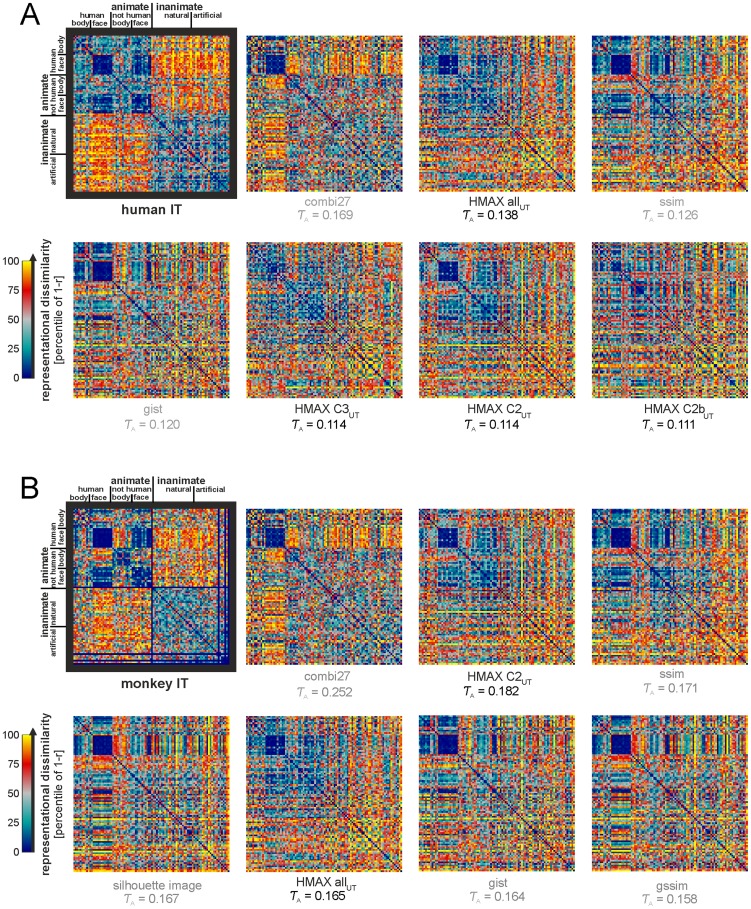
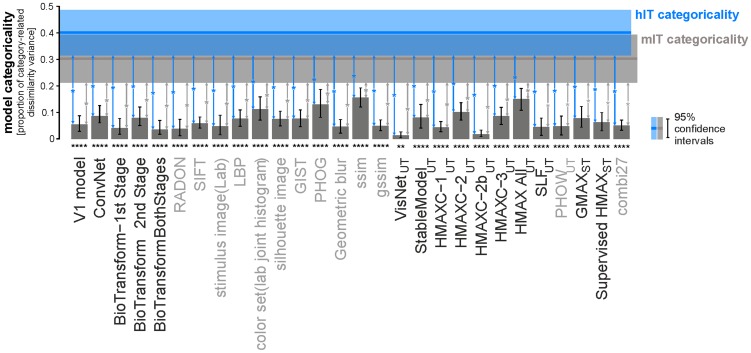
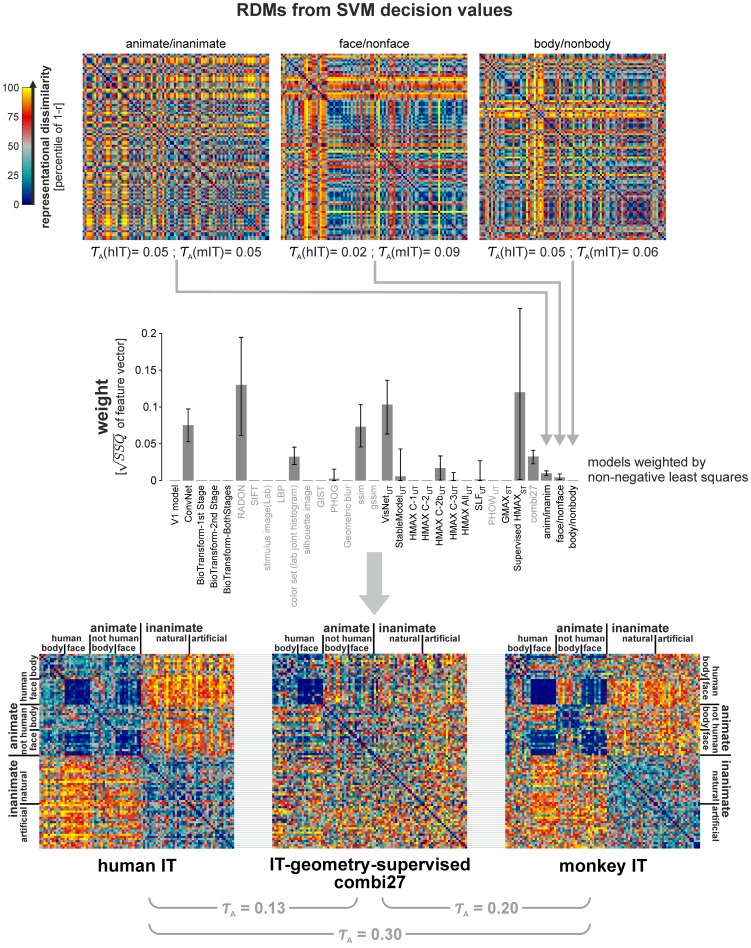
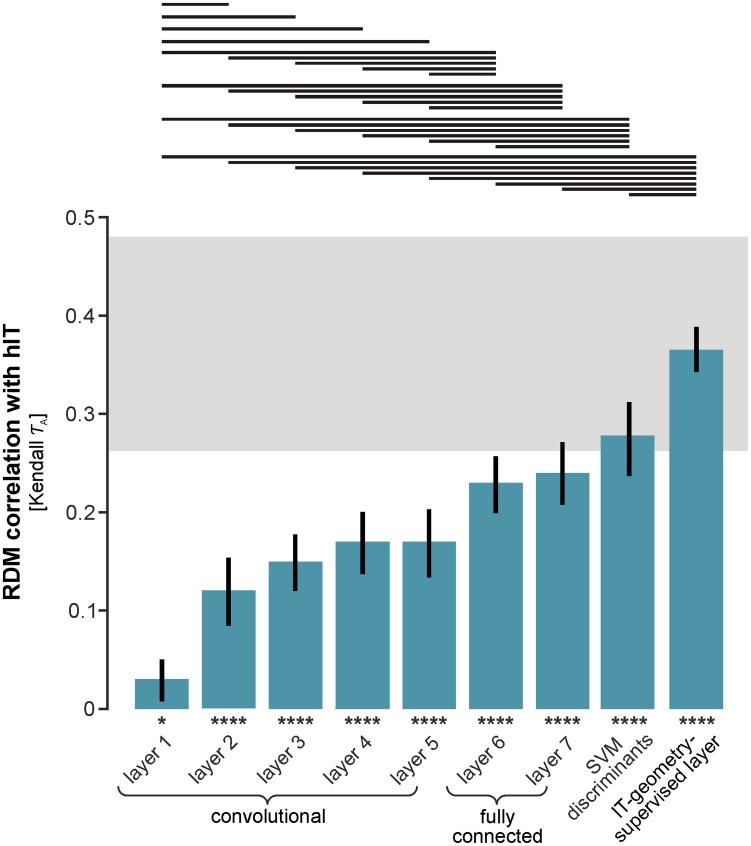
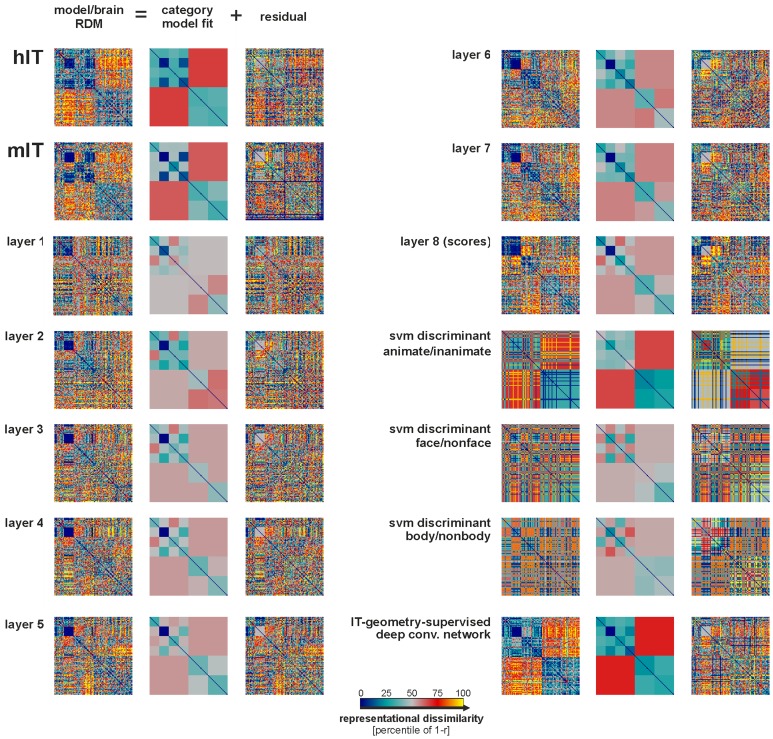
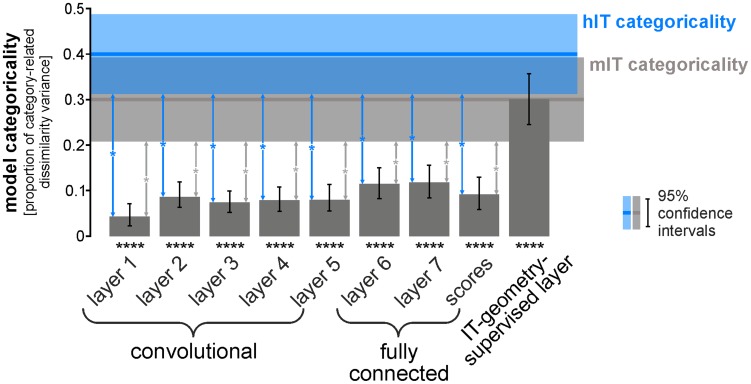
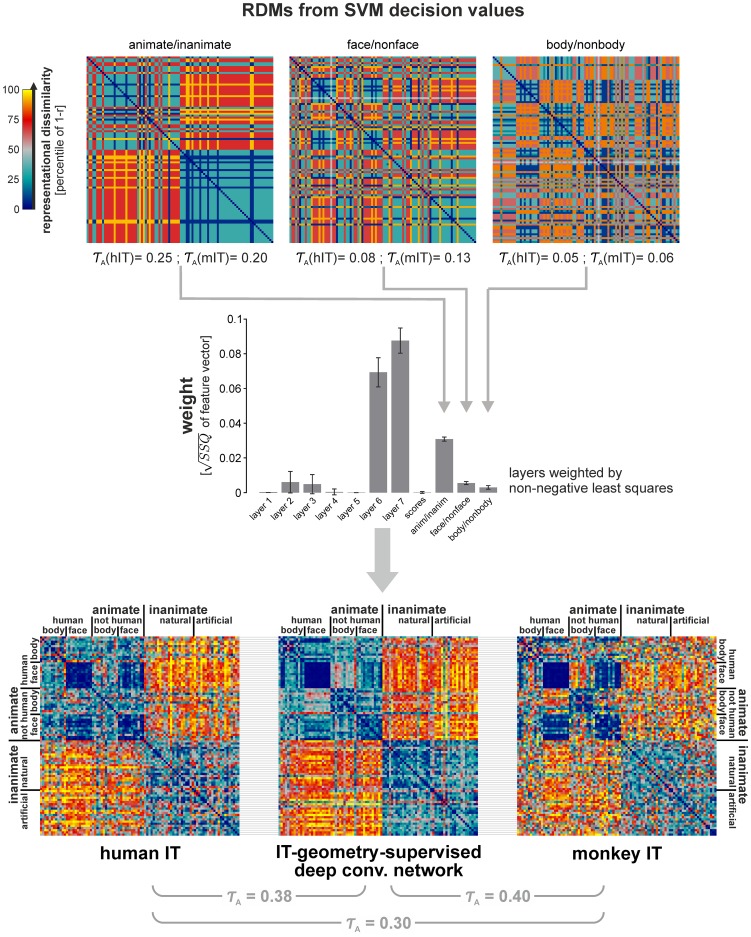
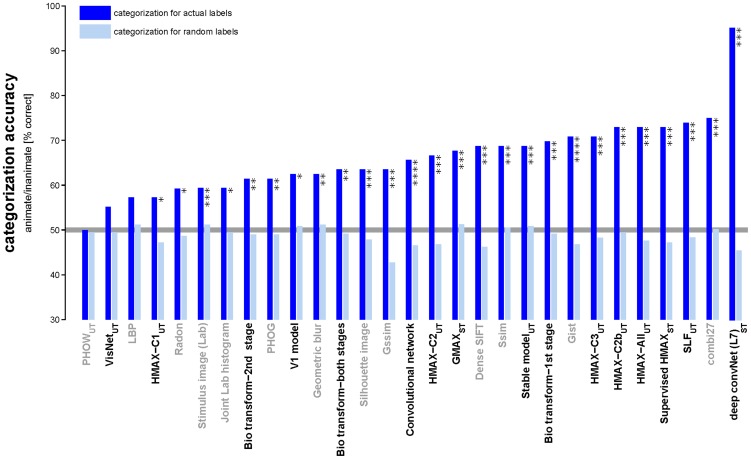
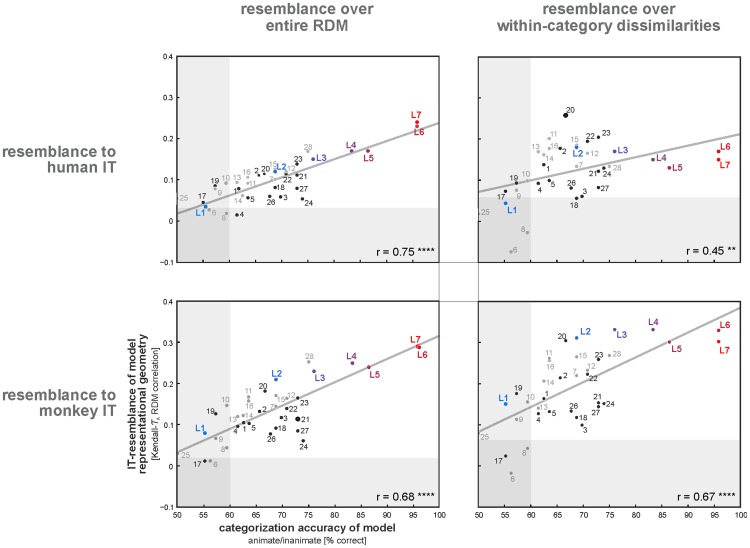
Inferior temporal (IT) cortex in human and nonhuman primates serves visual object recognition. Computational object-vision models, although continually improving, do not yet reach human performance. It is unclear to what extent the internal representations of computational models can explain the IT representation. Here we investigate a wide range of computational model representations (37 in total), testing their categorization performance and their ability to account for the IT representational geometry. The models include well-known neuroscientific object-recognition models (e.g. HMAX, VisNet) along with several models from computer vision (e.g. SIFT, GIST, self-similarity features, and a deep convolutional neural network). We compared the representational dissimilarity matrices (RDMs) of the model representations with the RDMs obtained from human IT (measured with fMRI) and monkey IT (measured with cell recording) for the same set of stimuli (not used in training the models). Better performing models were more similar to IT in that they showed greater clustering of representational patterns by category. In addition, better performing models also more strongly resembled IT in terms of their within-category representational dissimilarities. Representational geometries were significantly correlated between IT and many of the models. However, the categorical clustering observed in IT was largely unexplained by the unsupervised models. The deep convolutional network, which was trained by supervision with over a million category-labeled images, reached the highest categorization performance and also best explained IT, although it did not fully explain the IT data. Combining the features of this model with appropriate weights and adding linear combinations that maximize the margin between animate and inanimate objects and between faces and other objects yielded a representation that fully explained our IT data. Overall, our results suggest that explaining IT requires computational features trained through supervised learning to emphasize the behaviorally important categorical divisions prominently reflected in IT.
Overview
The claims and statistics of this paper haven’t been checked yet.
Free: it reads the open-access text and checks the first 5 claims that cite a source we can check. Create a free account to check every claim.
Integrity signals
Registry
Cites
Statistics
Figures



Verification
Claims the paper makes
The claims and statistics of this paper haven’t been checked yet.
Free: it reads the open-access text and checks the first 5 claims that cite a source we can check. Create a free account to check every claim.
Claims other papers make about this one
Each is checked against this paper’s own text: does it say what the citing paper says it does?
The cited source says what the claim attributes to it.
In the citing paper
“Using this approach, known as neuroconnectionism, numerous studies have identified shared representational structure across brains and ANN models, as well as factors influencing this alignment [5–11]”
From The Umwelt Representation Hypothesis: rethinking Universality (2026) · cites this paper as [10]
The cited source says what the claim attributes to it.
In the citing paper
“Analogous approaches have proven successful in relating the structure of neural activity to computational functions in other domains, including vision 17–19, audition 20, olfaction 21,22, thermosensation 23, perceptual discrimination 24, facial perception 25, and navigation 26,27.”
From A virtual rodent predicts the structure of neural activity across behaviours (2024) · cites this paper as [19]
Self-check
Percentages, sums and reported differences re-computed from the paper’s own numbers.
The self-check needs the paper’s full text.
Citations
Cites
ImageNet classification with deep convolutional neural networks
Krizhevsky, A., Sutskever, I., & Hinton, G. E. (2017) · Communications of the ACM · doi:10.1145/3065386 · Cited by 112,155
ImageNet: A large-scale hierarchical image database
Deng, J., Dong, W., Socher, R., Li, L.-J., Li, K., & Fei-Fei, L. (2009) · 2009 IEEE Conference on Computer Vision and Pattern Recognition · doi:10.1109/cvpr.2009.5206848 · Cited by 65,333 · cited 2×
“This is a supervised convolutional neural network, trained with 1.2 million labelled images from ImageNet (1000 category labels) [52].”
MethodInfluentialDistinctive Image Features from Scale-Invariant Keypoints
Lowe, D. G. (2004) · International Journal of Computer Vision · doi:10.1023/b:visi.0000029664.99615.94 · Cited by 55,589
LIBSVM: A library for support vector machines
Chang, C.-C., & Lin, C.-J. (2011) · ACM Transactions on Intelligent Systems and Technology · doi:10.1145/1961189.1961199 · Cited by 40,918
Object recognition from local scale-invariant features
Lowe, D. G. (1999) · Proceedings of the Seventh IEEE International Conference on Computer Vision · doi:10.1109/iccv.1999.790410 · Cited by 16,472
A fast learning algorithm for deep belief nets
Hinton, G. E., Osindero, S., & Teh, Y.-W. (2006) · Neural Computation · doi:10.1162/neco.2006.18.7.1527 · Cited by 16,336 · cited 1×
“In recent years, the advent of efficient training algorithms for deep neural networks [40,71,72,41] has made it possible to learn from image data not just the final classification step, but also the internal representations.”
BackgroundVisualizing and understanding convolutional networks
Zeiler, M. D., & Fergus, R. (2014) · Lecture Notes in Computer Science · doi:10.1007/978-3-319-10590-1_53 · Cited by 15,839
Multiresolution gray-scale and rotation invariant texture classification with local binary patterns
Ojala, T., Pietikainen, M., & Maenpaa, T. (2002) · IEEE Transactions on Pattern Analysis and Machine Intelligence · doi:10.1109/tpami.2002.1017623 · Cited by 15,398
Receptive fields, binocular interaction and functional architecture in the cat’s visual cortex
Hubel, D. H., & Wiesel, T. N. (1962) · The Journal of Physiology · doi:10.1113/jphysiol.1962.sp006837 · Cited by 13,680
Libsvm : A library for support vector machines
Ferrari, V. (2008) · Medical Entomology and Zoology · Cited by 10,122
Research works printed but not linked: 1
- Krizhevsky A., Sutskever I. and Hinton, G E. (2012) ImageNet Classification with Deep Convolutional Neural Networks. NIPS. Lake Tahoe, Nevada.
Cited by
Items 701–800 of 1,003
Development of Character Recognition Model Inspired by Visual Explanations
Ralekar, C., Choudhary, S., Gandhi, T. K., & Chaudhury, S. (2023) · IEEE Transactions on Artificial Intelligence · doi:10.1109/tai.2023.3289167 · Cited by 6
Human sensitivity to perturbations constrained by a model of the natural image manifold
Fruend, I., & Stalker, E. D. (2018) · Journal of Vision · doi:10.1167/18.11.20 · Cited by 7
Xu, T., Garrod, O., Scholte, H. S., Ince, R. A. A., & Schyns, P. G. (2018) · IEEE/CVF Conference on Computer Vision and Pattern Recognition Workshops (CVPRW) · doi:10.1109/cvprw.2018.00266 · Cited by 7
The role of textural statistics vs. outer contours in deep CNN and neural responses to objects
Long, B., & Konkle, T. (2018) · Conference on Cognitive Computational Neuroscience (CCN) · doi:10.32470/ccn.2018.1118-0 · Cited by 9
Yu, C.-P., Liu, H., Samaras, D., & Zelinsky, G. J. (2019) · Visual Cognition · doi:10.1080/13506285.2019.1661927 · Cited by 6
Jozwik, K. M., Schrimpf, M., Kanwisher, N., & DiCarlo, J. J. (2019) · bioRxiv (Cold Spring Harbor Laboratory) · doi:10.1101/688390 · Cited by 6
Dissimilarity learning via Siamese network predicts brain imaging dataPreprint
Agrawal, A. (2019) · arXiv (Cornell University) · doi:10.48550/arxiv.1907.02591 · Cited by 7
A general-purpose mechanism of visual feature association in visual word identification and beyondPreprint
Vidal, Y., Viviani, E., Zoccolan, D., & Crepaldi, D. (2020) · bioRxiv (Cold Spring Harbor Laboratory) · doi:10.1101/2020.07.14.202176 · Cited by 6
Line drawings reveal the structure of internal visual models conveyed by cortical feedback.Preprint
Morgan, A., Petro, L. S., & Muckli, L. F. (2016) · bioRxiv (Cold Spring Harbor Laboratory) · doi:10.1101/041186 · Cited by 7
Recognition of identity and expressions as integrated processesPreprint
O’Nell, K. C., Saxe, R. R., & Anzellotti, S. (2019) · PsyArXiv (OSF Preprints) · doi:10.31234/osf.io/9c2e5 · Cited by 6
Object Based Attention Through Internal GatingPreprint
Lei, J., Benjamin, A. S., & Kording, K. P. (2021) · arXiv (Cornell University) · doi:10.48550/arxiv.2106.04540 · Cited by 7
From unconscious inference to the beholder's share: predictive perception and human experiencePreprint
Seth, A. K. (2017) · PsyArXiv (OSF Preprints) · doi:10.31234/osf.io/zvbkp · Cited by 7
The inevitability and superfluousness of cell types in spatial cognitionPreprint
Luo, X., Mok, R. M., & Love, B. C. (2024) · bioRxiv (Cold Spring Harbor Laboratory) · doi:10.1101/2024.01.10.575026 · Cited by 7
How does the primate brain combine generative and discriminative computations in vision?Preprint
Peters, B., DiCarlo, J. J., Gureckis, T. M., Haefner, R. M., Işık, L., Tenenbaum, J. B., Konkle, T., Naselaris, T., Stachenfeld, K., Tavares, Z., et al. (2024) · PubMed Central · doi:10.48550/arxiv.2401.06005 · Cited by 22
Self-citationNumerosity is directly sensed and dynamically transformed in the human brain
Karami, A., Castaldi, E., Eger, E., Hebart, M. N., & Piazza, M. (2026) · Nature Communications · doi:10.1101/2025.11.15.687894 · Cited by 6
Less is more: Aesthetic liking is inversely related to metabolic expense by the visual system
Tang, Y., Cunningham, W. A., & Walther, D. B. (2025) · PNAS Nexus · doi:10.1093/pnasnexus/pgaf347 · Cited by 13
Deep learning in fetal, infant, and toddler neuroimaging research
Chin, J., Wyburd, M. K., Ayzenberg, V., Bayet, L., Bilgiç, B., Chen, E. M., Chen, Y., Dineen, Á. T., Fujita, S., Liu, J., et al. (2026) · Developmental Cognitive Neuroscience · doi:10.1016/j.dcn.2026.101680 · Cited by 8
Garagnani, M. (2024) · Cognitive Neurodynamics · doi:10.1007/s11571-023-10061-1 · Cited by 6
May, L., Dauphin, A., & Gjorgjieva, J. (2025) · PLoS Computational Biology · doi:10.1371/journal.pcbi.1012830 · Cited by 7
What have we learned about infant visual attention in the first 25 years of the 21st century?
Hunter, B. K., Kızıldere, E., Klotz, S. M., Nelson, C. M., Markant, J. C., & Oakes, L. M. (2025) · Infant Behavior and Development · doi:10.1016/j.infbeh.2025.102135 · Cited by 6
Task-relevant representational spaces in human memory traces
Heinen, R. M., Rau, E. M. B., Herweg, N. A., & Axmacher, N. (2025) · PLoS Computational Biology · doi:10.1371/journal.pcbi.1013476 · Cited by 6
Takahashi, S., Sasaki, M., Takeda, K., & Oizumi, M. (2025) · Neural Networks · doi:10.1016/j.neunet.2025.108222 · Cited by 9
Seijdel, N., Scholte, H. S., & de Haan, E. H. F. (2021) · Neuropsychologia · doi:10.1016/j.neuropsychologia.2021.108017 · Cited by 5
Using unsupervised capsule neural network reveal spatial representations in the human brain
Wang, G., Jiang, N., Liu, T., Wang, L., Suo, D., Chen, D., Funahashi, S., & Yan, T. (2024) · Human Brain Mapping · doi:10.1002/hbm.26573 · Cited by 5
Zhang, Y., & Tang, G. (2020) · Journal of Ambient Intelligence and Humanized Computing · doi:10.1007/s12652-020-01734-4 · Cited by 5
RetractedOn the role of feedback in visual processing: a predictive coding perspective
Alamia, A., Mozafari, M., Choksi, B., & VanRullen, R. (2022) · Conference on Cognitive Computational Neuroscience (CCN) · doi:10.32470/ccn.2022.1062-0 · Cited by 5
Exploring Hierarchical Auditory Representation via a Neural Encoding Model
Wang, L., Liu, H., Zhang, X., Zhao, S., Guo, L., Han, J., & Hu, X. (2022) · Frontiers in Neuroscience · doi:10.3389/fnins.2022.843988 · Cited by 5
Estimating heading from optic flow: Comparing deep learning network and human performance
Maus, N., & Layton, O. W. (2022) · Neural Networks · doi:10.1016/j.neunet.2022.07.007 · Cited by 8
Mokari-Mahallati, M., Ebrahimpour, R., Bagheri, N., & Karimi-Rouzbahani, H. (2023) · Neuroscience Research · doi:10.1016/j.neures.2023.01.007 · Cited by 5
Revsine, C., González-Castillo, J., Merriam, E. P., Bandettini, P. A., & Ramírez, F. (2024) · Journal of Neuroscience · doi:10.1523/jneurosci.0296-23.2024 · Cited by 7
Population codes of prior knowledge learned through environmental regularities
Quax, S. C., Bosch, S., Peelen, M. V., & van Gerven, M. A. J. (2021) · Scientific Reports · doi:10.1038/s41598-020-79366-z · Cited by 12
Within-category representational stability through the lens of manipulable objects
Lee, D., & Almeida, J. (2021) · Cortex · doi:10.1016/j.cortex.2020.12.026 · Cited by 5
Matsumoto, N., Mototake, Y.-I., Kawano, K., Okada, M., & Sugase-Miyamoto, Y. (2021) · Journal of Computational Neuroscience · doi:10.1007/s10827-021-00778-5 · Cited by 5
Nicholson, D., & Prinz, A. A. (2022) · Journal of Vision · doi:10.1167/jov.22.7.3 · Cited by 9
Reinforcement Learning: Application to fMRI
Man, V. Y., & O’Doherty, J. P. (2023) · Springer eBooks · doi:10.1007/978-3-031-45271-0_3 · Cited by 5
Eguchi, A., Humphreys, G. W., & Stringer, S. M. (2016) · Psychological Review · doi:10.1037/rev0000042 · Cited by 5
Behavioral and neural constraints on hierarchical representations
Schwartz, O., & Giraldo, L. G. S. (2017) · Journal of Vision · doi:10.1167/17.3.13 · Cited by 6
Tsai, C.-Y., & Cox, D. (2015) · arXiv (Cornell University) · doi:10.48550/arxiv.1502.04972 · Cited by 7
Deep driven fMRI decoding of visual categoriesPreprint
Svanera, M., Benini, S., Raz, G., Hendler, T., Goebel, R., & Valente, G. (2017) · arXiv (Cornell University) · doi:10.48550/arxiv.1701.02133 · Cited by 5
Biologically feasible deep learning with segregated dendritesPreprint
Guergiuev, J., Lillicrap, T., & Richards, B. A. (2016) · arXiv (Cornell University) · Cited by 6
What deep learning can tell us about higher cognitive functions like mindreading?Preprint
Aru, J., & Vicente, R. (2018) · PsyArXiv (OSF Preprints) · doi:10.31234/osf.io/9skeq · Cited by 5
Abstraction Mechanisms Predict Generalization in Deep Neural Networks
Gain, A., & Siegelmann, H. T. (2019) · arXiv (Cornell University) · doi:10.48550/arxiv.1905.11515 · Cited by 5
Thompson, J. A. F., Bengio, Y., Formisano, E., & Schönwiesner, M. (2021) · bioRxiv (Cold Spring Harbor Laboratory) · doi:10.1101/2021.01.26.428323 · Cited by 6
Kaniuth, P., & Hebart, M. N. (2021) · bioRxiv (Cold Spring Harbor Laboratory) · doi:10.1101/2021.09.27.462005 · Cited by 5
Anatomy and physiology of word-selective visual cortex: From visual features to lexical processingPreprint
Caffarra, S., Karipidis, I. I., Yablonski, M., & Yeatman, J. D. (2021) · OSF Preprints (OSF Preprints) · doi:10.31219/osf.io/hv3y2 · Cited by 5
Mooney Face Image Processing in Deep Convolutional Neural Networks Compared to HumansPreprint
Zeman, A. A., Leers, T., & de Beeck, H. O. (2022) · bioRxiv (Cold Spring Harbor Laboratory) · doi:10.1101/2022.03.21.485240 · Cited by 6
What do deep neural networks tell us about biological vision?
Heinke, D. G., Leonardis, A., & Leek, E. C. (2022) · Vision Research · doi:10.1016/j.visres.2022.108069 · Cited by 7
Disentangling Fact from Grid Cell Fiction in Trained Deep Path IntegratorsPreprint
Schaeffer, R., Khona, M., Koyejo, S., & Fiete, I. (2023) · PubMed · doi:10.48550/arxiv.2312.03954 · Cited by 5
Challenging Backpropagation: Evidence for Target Learning in the NeocortexPreprint
Aceituno, P. V., de Haan, S., Loidl, R., Beumer, L., & Grewe, B. F. (2024) · bioRxiv (Cold Spring Harbor Laboratory) · doi:10.1101/2024.04.10.588837 · Cited by 15
Delrocq, A., Wu, Z., Bellec, G., & Gerstner, W. (2024) · bioRxiv (Cold Spring Harbor Laboratory) · doi:10.1101/2024.12.20.629674 · Cited by 7
Schwartz, E., Alreja, A., Richardson, R. M., Ghuman, A. S., & Anzellotti, S. (2023) · Journal of Neuroscience · doi:10.1523/jneurosci.1277-22.2023 · Cited by 6
Moore, J. A., Wilms, M., Gutierrez, A., Ismail, Z., Fakhar, K., Hadaeghi, F., Hilgetag, C. C., & Forkert, N. D. (2023) · Frontiers in Computational Neuroscience · doi:10.3389/fncom.2023.1274824 · Cited by 5
Cortical Encoding of Spatial Structure and Semantic Content in 3D Natural Scenes
Mononen, R., Saarela, T., Vallinoja, J., Olkkonen, M., & Henriksson, L. (2025) · Journal of Neuroscience · doi:10.1523/jneurosci.2157-23.2024 · Cited by 4
A feedforward mechanism for human-like contour integration
Doshi, F. R., Konkle, T., & Alvarez, G. A. (2025) · PLoS Computational Biology · doi:10.1371/journal.pcbi.1013391 · Cited by 4
Mattioni, S., Rezk, M., Gao, X., Nam, J.-H., Liu, Z., Gau, R., Goffaux, V., Costantino, A. I., de Beeck, H. O., Lewis, T., et al. (2025) · Nature Communications · doi:10.1038/s41467-025-65468-7 · Cited by 6
Hierarchical VAEs provide a normative account of motion processing in the primate brain
Vafaii, H., Yates, J. L., & Butts, D. (2023) · neural information processing systems · doi:10.52202/075280-2002 · Cited by 14
Ogg, M., Bose, R., Scharf, J. A., Ratto, C. R., & Wolmetz, M. E. (2026) · iScience · doi:10.1016/j.isci.2026.116400 · Cited by 9
Neural traveling waves in cortex: Network mechanisms and potential roles in neural computation
Muller, L., Busch, A. N., Davis, Z. W., & Reynolds, J. H. (2026) · Neuron · doi:10.1016/j.neuron.2026.06.019 · Cited by 7
Multivariate connectivity: A brief introduction and an open question
Fang, M., Poskanzer, C., & Anzellotti, S. (2023) · Frontiers in Neuroscience · doi:10.3389/fnins.2022.1082120 · Cited by 4
Sensory encoding of emotion conveyed by the face and visual context
Soderberg, K. M., Jang, G., & Kragel, P. A. (2026) · Social Cognitive and Affective Neuroscience · doi:10.1093/scan/nsag028 · Cited by 4
Net2Brain: a toolbox to compare artificial vision models with human brain responses
Bersch, D., Vilas, M. G., Saba-Sadiya, S., Schaumlöffel, T., Dwivedi, K., Sartzetaki, C., Cichy, R. M., & Roig, G. (2025) · Frontiers in Neuroinformatics · doi:10.3389/fninf.2025.1515873 · Cited by 9
Chapalain, T., Thirion, B., & Eger, E. (2025) · Neural Computation · doi:10.1162/neco.a.30 · Cited by 7
From retinotopic to ordinal coding: Dissecting the cortical stages of visual word recognition
Agrawal, A., & Dehaene, S. (2025) · Proceedings of the National Academy of Sciences · doi:10.1073/pnas.2507291122 · Cited by 6
How Invariant Feature Selectivity Is Achieved in Cortex
Sharpee, T. O. (2016) · Frontiers in Synaptic Neuroscience · doi:10.3389/fnsyn.2016.00026 · Cited by 4
Can Deep Learning Model Perceptual Learning?
Bakhtiari, S. (2019) · Journal of Neuroscience · doi:10.1523/jneurosci.2209-18.2018 · Cited by 5
Neural Population Control via Deep ANN Image Synthesis
Bashivan, P., Kar, K., & DiCarlo, J. J. (2018) · Conference on Cognitive Computational Neuroscience (CCN) · doi:10.32470/ccn.2018.1222-0 · Cited by 4
Cui, Y., Zhang, C., Qiao, K., Wang, L., Yan, B., & Tong, L. (2020) · Brain Sciences · doi:10.3390/brainsci10090602 · Cited by 6
Shape-selective processing in deep networks: integrating the evidence on perceptual integration
Jarvers, C., & Neumann, H. (2023) · Frontiers in Computer Science · doi:10.3389/fcomp.2023.1113609 · Cited by 9
Hauk, O., Jackson, R. L., & Rahimi, S. (2023) · Language Cognition and Neuroscience · doi:10.1080/23273798.2023.2226268 · Cited by 5
Lu, Z., & Golomb, J. D. (2025) · eLife · doi:10.1101/2023.08.19.553999 · Cited by 5
Pan, X., DeForge, A., & Schwartz, O. (2023) · PLoS Computational Biology · doi:10.1371/journal.pcbi.1011486 · Cited by 12
Peng, Y., Burling, J. M., Todorova, G. K., Neary, C., Pollick, F. E., & Lu, H. (2024) · Psychonomic Bulletin & Review · doi:10.3758/s13423-024-02454-y · Cited by 5
Inferring Event-Predictive Goal-Directed Object Manipulations in REPRISE
Butz, M. V., Menge, T., Humaidan, D., & Otte, S. (2019) · Lecture notes in computer science · doi:10.1007/978-3-030-30487-4_49 · Cited by 4
Deep Neural Networks Point to Mid-level Complexity of Rodent Object Vision
Vinken, K., & de Beeck, H. O. (2020) · Journal of Vision · doi:10.1167/jov.20.11.417 · Cited by 4
Combining inconsistent textures using convolutional neural networks
Cai, X., & Song, B. (2016) · Journal of Visual Communication and Image Representation · doi:10.1016/j.jvcir.2016.07.009 · Cited by 4
A video-driven model of response statistics in the primate middle temporal area
Rezai, O., Jentsch, P. B., & Tripp, B. (2018) · Neural Networks · doi:10.1016/j.neunet.2018.09.004 · Cited by 4
Visualizing Representational Dynamics with Multidimensional Scaling Alignment
Lin, B., Mur, M., Kietzmann, T. C., & Kriegeskorte, N. (2019) · Conference on Cognitive Computational Neuroscience (CCN) · doi:10.32470/ccn.2019.1424-0 · Cited by 7
Self-citationde Beeck, H. O., & Nakatani, C. (2019) · Cambridge University Press eBooks · doi:10.1017/9781316847916.017 · Cited by 4
Groen, I. I. A., Greene, M. R., Baldassano, C. A., Fei-Fei, L., Beck, D. M., & Baker, C. I. (2017) · bioRxiv (Cold Spring Harbor Laboratory) · doi:10.1101/207530 · Cited by 4
Large-scale hyperparameter search for predicting human brain responses in the Algonauts challengePreprint
Jozwik, K. M., Lee, M., Marques, T., Schrimpf, M., & Bashivan, P. (2019) · bioRxiv (Cold Spring Harbor Laboratory) · doi:10.1101/689844 · Cited by 4
van Dyck, L. E., & Gruber, W. R. (2020) · arXiv (Cornell University) · doi:10.48550/arxiv.2007.06294 · Cited by 5
Deep learning models of perceptual expertise support a domain-specific accountPreprint
Yovel, G., Grosbard, I. D., & Abudarham, N. (2022) · bioRxiv (Cold Spring Harbor Laboratory) · doi:10.1101/2022.12.01.518342 · Cited by 4
Multimodal Deep Learning Model Unveils Behavioral Dynamics of V1 Activity in Freely Moving MicePreprint
Xu, A., Hou, Y., Niell, C. M., & Beyeler, M. (2023) · bioRxiv (Cold Spring Harbor Laboratory) · doi:10.1101/2023.05.30.542912 · Cited by 5
A high-throughput approach for the efficient prediction of perceived similarity of natural objectsPreprint
Kaniuth, P., Mahner, F. P., Perkuhn, J., & Hebart, M. N. (2024) · bioRxiv (Cold Spring Harbor Laboratory) · doi:10.1101/2024.06.28.601184 · Cited by 8
Predicting the neural response of primary visual cortex (v1) using deep learning approach
Dehsorkh, S. A., & Hosseini, R. (2023) · International Computer Conference, Computer Society of Iran (CSICC) · doi:10.1109/csicc58665.2023.10105321 · Cited by 3
Object recognition in primates: what can early visual areas contribute?
Quaia, C., & Krauzlis, R. J. (2024) · Frontiers in Behavioral Neuroscience · doi:10.3389/fnbeh.2024.1425496 · Cited by 5
Watson, D. M., & Andrews, T. J. (2024) · Journal of Neuroscience · doi:10.1523/jneurosci.1318-24.2024 · Cited by 4
Approximating Human-Level 3D Visual Inferences With Deep Neural Networks
O’Connell, T. P., Bonnen, T., Friedman, Y., Tewari, A., Sitzmann, V., Tenenbaum, J. B., & Kanwisher, N. (2025) · Open Mind · doi:10.1162/opmi_a_00189 · Cited by 7
Configural processing as an optimized strategy for robust object recognition in neural networks
Jang, H., Sinha, P., & Boix, X. (2025) · Communications Biology · doi:10.1038/s42003-025-07672-1 · Cited by 5
Cox, G. E. (2025) · Psychonomic Bulletin & Review · doi:10.3758/s13423-025-02828-w · Cited by 4
Investigating action topography in visual cortex and deep artificial neural networks
Cortinovis, D., Truong, N., de Beeck, H. O., & Bracci, S. (2025) · Nature Communications · doi:10.1038/s41467-025-67855-6 · Cited by 6
A decade of comparing brains to DNNs: Progress and perspectives
Schmitt, L., Dong, D. T., Çelik, E., de Lange, F. P., & Toneva, M. (2026) · Trends in Cognitive Sciences · doi:10.1016/j.tics.2026.06.011 · Cited by 3
A Computational Deep Learning Model of Animacy Perception in the Human Brain
Duyck, S., Costantino, A. I., Bracci, S., & de Beeck, H. O. (2022) · Communications Biology · doi:10.1038/s42003-024-07415-8 · Cited by 6
Towards Foundation Models for 3D Vision: How Close are We?
Zuo, Y., Kayan, K., Wang, M., Jeon, K., Deng, J., & Griffiths, T. L. (2025) · International Conference on 3D Vision (3DV) · doi:10.1109/3dv66043.2025.00122 · Cited by 17
Variation in the geometry of concept manifolds across human visual cortex
St-Yves, G., Kay, K., & Naselaris, T. (2025) · PLoS Computational Biology · doi:10.1371/journal.pcbi.1013416 · Cited by 4
Comparison of human and marmoset basic-level face categorization based on shape
Jeon, Y.-N., Cho, H., Green, A. C., & Issa, E. B. (2025) · Scientific Reports · doi:10.1038/s41598-025-31437-9 · Cited by 4
Rajaei, K., Cichy, R. M., & Soltanian-Zadeh, H. (2026) · Array · doi:10.1016/j.array.2026.100731 · Cited by 4
Representational similarity of actions in the human brain
Ürgen, B. A., Pehlivan, S., & Saygın, A. P. (2016) · International Workshop on Pattern Recognition in NeuroImaging · doi:10.1109/prni.2016.7552341 · Cited by 3
Learning to attend in a brain-inspired deep neural network
Adeli, H., & Zelinsky, G. J. (2018) · Conference on Cognitive Computational Neuroscience (CCN) · doi:10.32470/ccn.2018.1264-0 · Cited by 4
Layer-Specific Characteristics of Artificial Representations in the Trained AlexNet Model
Ito, K., Hidaka, A., & Wagatsuma, N. (2023) · International Conference on Emerging Techniques in Computational Intelligence (ICETCI) · doi:10.1109/icetci58599.2023.10331607 · Cited by 3
Metadata
- Authors
- Khaligh-Razavi, S.-M., & Kriegeskorte, N.
- Affiliations
- MRC Cognition and Brain Sciences Unit (GB)
- Corresponding author
- Kriegeskorte, Nikolaus
- Venue
- PLoS Computational Biology
- Publisher
- Public Library of Science (PLoS)
- Published
- 2014-11-06
- Volume
- 10
- Issue
- 11
- Pages
- e1003915
- ISSN
- 1553-734X (ISSN-L)
- 1553-7358
- PMC
- PMC4222664
- OpenAlex
- W2040036684
- Cited by
- 1,204
- References
- 98
- Citations by year
- 2026: 75 · 2025: 100 · 2024: 110 · 2023: 127 · 2022: 112 · 2021: 124 · 2020: 125 · 2019: 151 · 2018: 97 · 2017: 87 · 2016: 75 · 2015: 20 · 2014: 1
- FWCI
- 34.02
- Type
- journal article
- Language
- en
- Open access
- gold
- doi.org
- Locations
- PLoS Computational Biology (publishedVersion, cc-by)
- Europe PMC (PubMed Central) (publishedVersion, cc-by)
- PubMed Central (publishedVersion, cc-by)
- PubMed (publishedVersion)
- DOAJ (DOAJ: Directory of Open Access Journals) (submittedVersion, cc-by-sa)
- Figshare (submittedVersion, cc-by)
- Funders
- Cambridge Overseas Trust
- Medical Research Council (MC-A060- 5PR20)
- FP7 Ideas: European Research Council (261352)
- Topics
- Life Sciences › Neuroscience › Cognitive Neuroscience › Visual perception and processing mechanisms
- Life Sciences › Neuroscience › Cognitive Neuroscience › Face Recognition and Perception
- Physical Sciences › Computer Science › Computer Vision and Pattern Recognition › Advanced Neural Network Applications
- Keywords
- inferior temporal cortex, visual object recognition, representational geometry, representational dissimilarity matrices, supervised learning, unsupervised learning, deep convolutional neural networks, categorical clustering, HMAX, monkey visual cortex, human visual cortex
- MeSH terms
- Animals, Haplorhini, Humans, Models, Neurological, Temporal Lobe, Computational Biology, Support Vector Machine
About these checks
Registry, retraction, Cites and statistics results are computed, not judged, with one exception: a printed reference that no index lists is read once by a model before it counts as a citation error. Claims are extracted by a model and kept only when their quote appears verbatim in the text; each cited source is then checked, with a model’s help, for whether it says what the claim relies on. Those verdicts can be wrong — read the claim’s quote and the cited source before relying on one.
Statistics and arithmetic are recomputed, not judged.
Confidence bands are shown only for fields calibrated on our annotated test set. None is calibrated yet, so no band is shown.
What counts as a claim ›How we measure confidence ›How we check this ›
Are you an author, or do you see a problem with this page? Request a review
Data sources
Bibliographic data: Semantic Scholar, OpenAlex, Crossref.
Contains information from the Semantic Scholar Academic Graph Datasets, made available under the ODC Attribution License (ODC-BY 1.0).
Semantic Scholar’s data is described in: Kinney, R., et al. (2023). The Semantic Scholar Open Data Platform. arXiv:2301.10140.
