

Deep Supervised, but Not Unsupervised, Models May Explain IT Cortical Representation
Open accessThe DOI matches its Crossref record; 99 of the 99 references it cites were found in a registry or an index.
Abstract
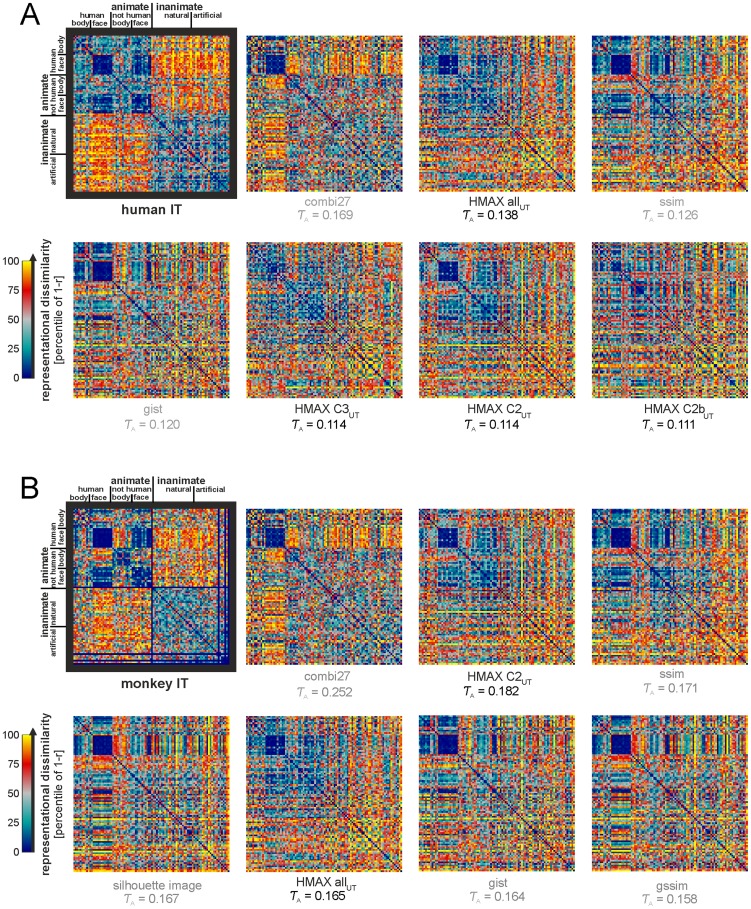
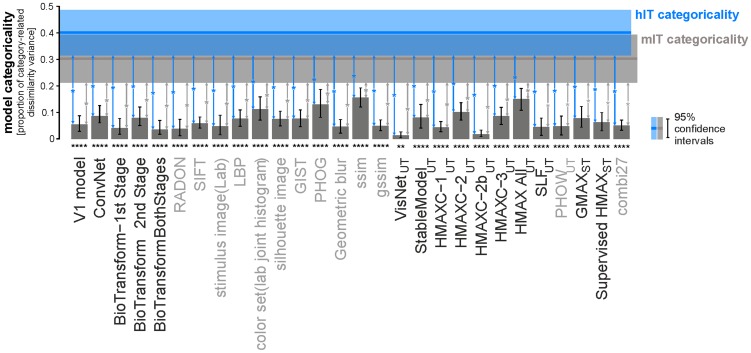
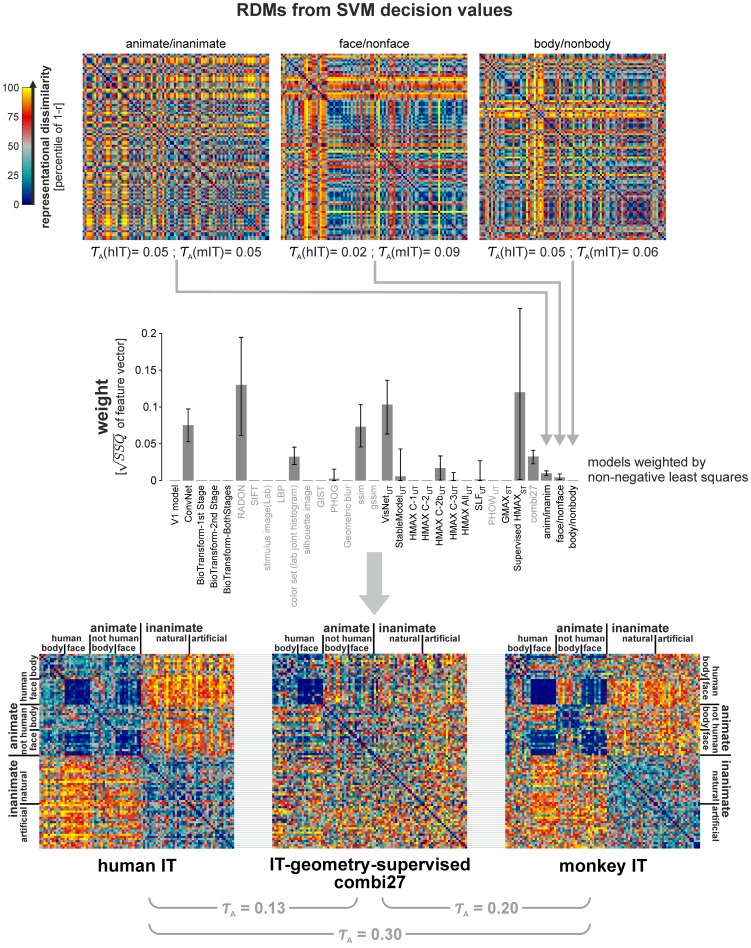
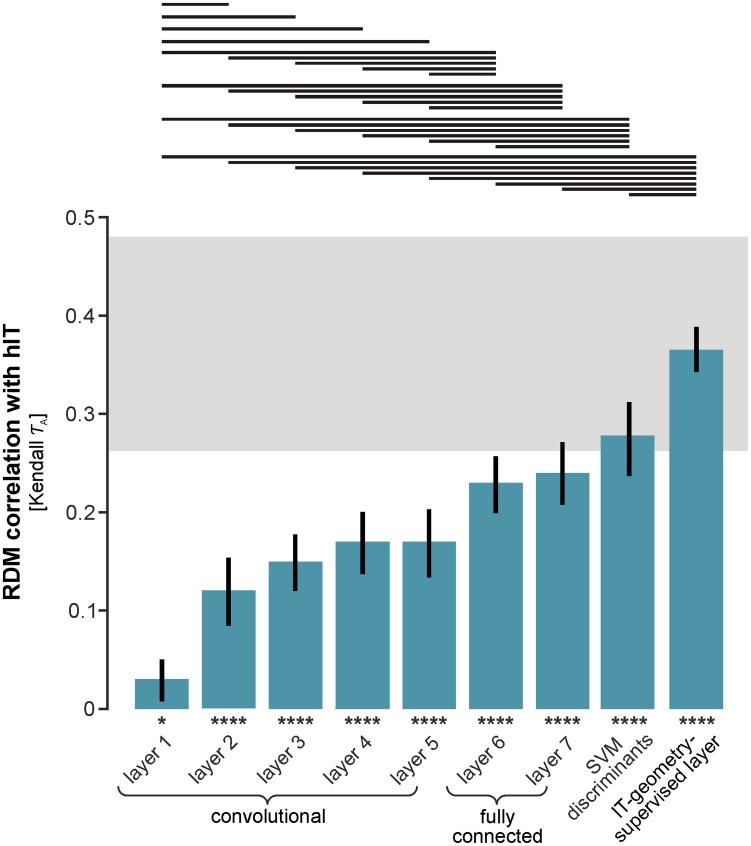
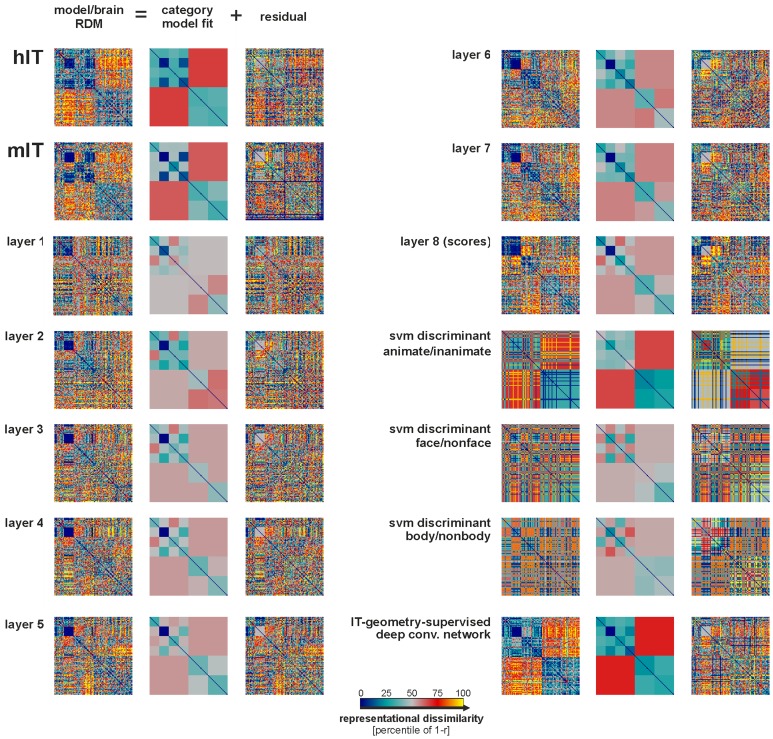
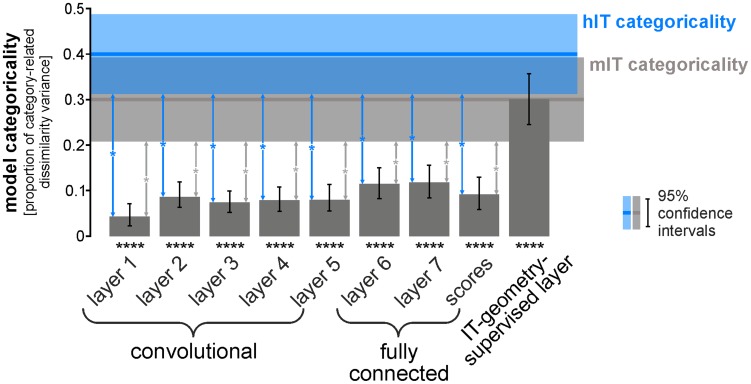
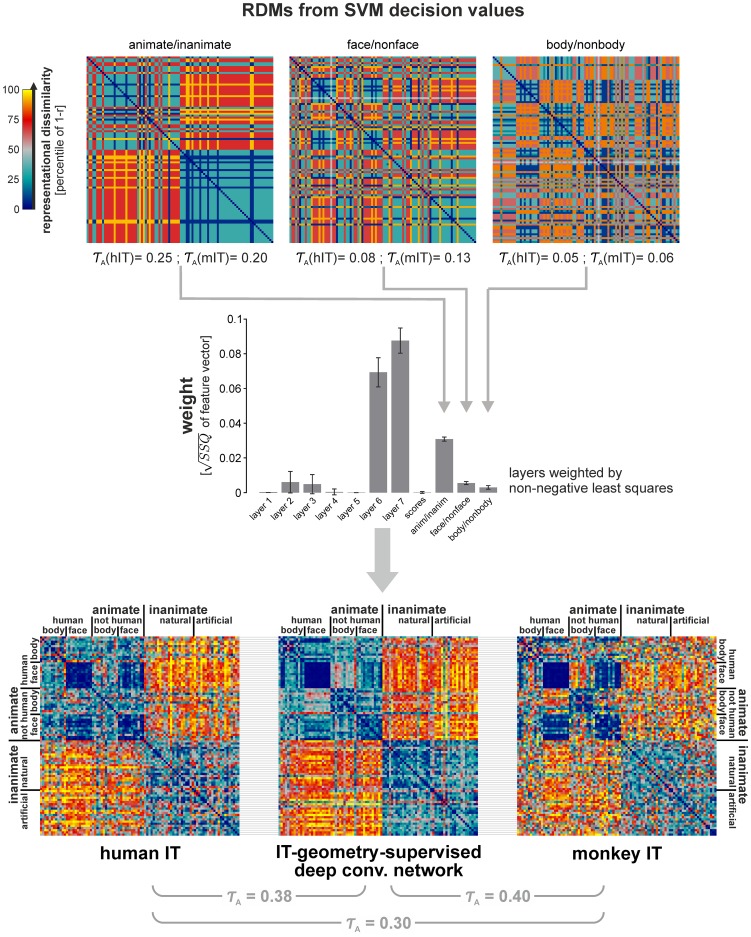
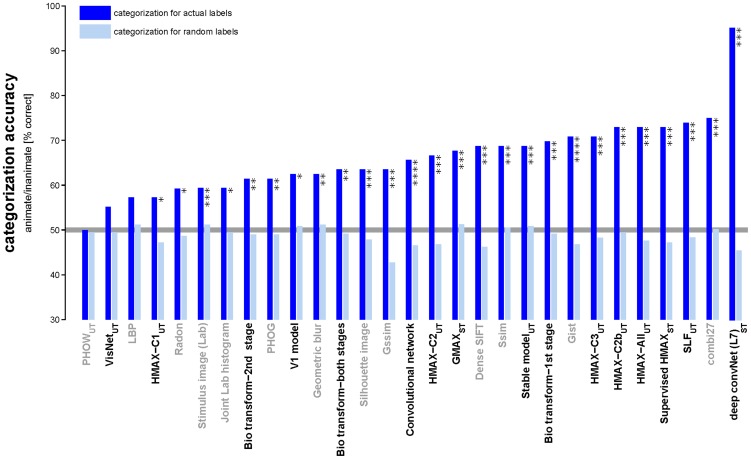
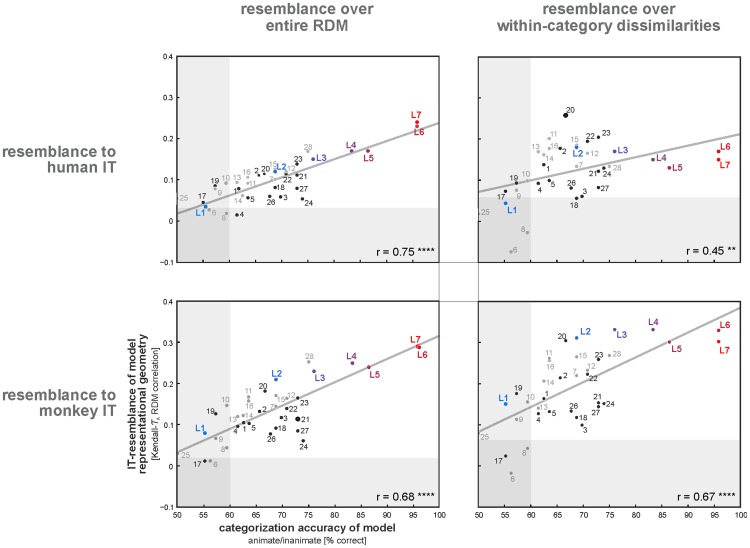
Inferior temporal (IT) cortex in human and nonhuman primates serves visual object recognition. Computational object-vision models, although continually improving, do not yet reach human performance. It is unclear to what extent the internal representations of computational models can explain the IT representation. Here we investigate a wide range of computational model representations (37 in total), testing their categorization performance and their ability to account for the IT representational geometry. The models include well-known neuroscientific object-recognition models (e.g. HMAX, VisNet) along with several models from computer vision (e.g. SIFT, GIST, self-similarity features, and a deep convolutional neural network). We compared the representational dissimilarity matrices (RDMs) of the model representations with the RDMs obtained from human IT (measured with fMRI) and monkey IT (measured with cell recording) for the same set of stimuli (not used in training the models). Better performing models were more similar to IT in that they showed greater clustering of representational patterns by category. In addition, better performing models also more strongly resembled IT in terms of their within-category representational dissimilarities. Representational geometries were significantly correlated between IT and many of the models. However, the categorical clustering observed in IT was largely unexplained by the unsupervised models. The deep convolutional network, which was trained by supervision with over a million category-labeled images, reached the highest categorization performance and also best explained IT, although it did not fully explain the IT data. Combining the features of this model with appropriate weights and adding linear combinations that maximize the margin between animate and inanimate objects and between faces and other objects yielded a representation that fully explained our IT data. Overall, our results suggest that explaining IT requires computational features trained through supervised learning to emphasize the behaviorally important categorical divisions prominently reflected in IT.
Overview
The claims and statistics of this paper haven’t been checked yet.
Free: it reads the open-access text and checks the first 5 claims that cite a source we can check. Create a free account to check every claim.
Integrity signals
Registry
Cites
Statistics
Figures



Verification
Claims the paper makes
The claims and statistics of this paper haven’t been checked yet.
Free: it reads the open-access text and checks the first 5 claims that cite a source we can check. Create a free account to check every claim.
Claims other papers make about this one
Each is checked against this paper’s own text: does it say what the citing paper says it does?
The cited source says what the claim attributes to it.
In the citing paper
“Using this approach, known as neuroconnectionism, numerous studies have identified shared representational structure across brains and ANN models, as well as factors influencing this alignment [5–11]”
From The Umwelt Representation Hypothesis: rethinking Universality (2026) · cites this paper as [10]
The cited source says what the claim attributes to it.
In the citing paper
“Analogous approaches have proven successful in relating the structure of neural activity to computational functions in other domains, including vision 17–19, audition 20, olfaction 21,22, thermosensation 23, perceptual discrimination 24, facial perception 25, and navigation 26,27.”
From A virtual rodent predicts the structure of neural activity across behaviours (2024) · cites this paper as [19]
Self-check
Percentages, sums and reported differences re-computed from the paper’s own numbers.
The self-check needs the paper’s full text.
Citations
Cites
ImageNet classification with deep convolutional neural networks
Krizhevsky, A., Sutskever, I., & Hinton, G. E. (2017) · Communications of the ACM · doi:10.1145/3065386 · Cited by 112,155
ImageNet: A large-scale hierarchical image database
Deng, J., Dong, W., Socher, R., Li, L.-J., Li, K., & Fei-Fei, L. (2009) · 2009 IEEE Conference on Computer Vision and Pattern Recognition · doi:10.1109/cvpr.2009.5206848 · Cited by 65,333 · cited 2×
“This is a supervised convolutional neural network, trained with 1.2 million labelled images from ImageNet (1000 category labels) [52].”
MethodInfluentialDistinctive Image Features from Scale-Invariant Keypoints
Lowe, D. G. (2004) · International Journal of Computer Vision · doi:10.1023/b:visi.0000029664.99615.94 · Cited by 55,589
LIBSVM: A library for support vector machines
Chang, C.-C., & Lin, C.-J. (2011) · ACM Transactions on Intelligent Systems and Technology · doi:10.1145/1961189.1961199 · Cited by 40,918
Object recognition from local scale-invariant features
Lowe, D. G. (1999) · Proceedings of the Seventh IEEE International Conference on Computer Vision · doi:10.1109/iccv.1999.790410 · Cited by 16,472
A fast learning algorithm for deep belief nets
Hinton, G. E., Osindero, S., & Teh, Y.-W. (2006) · Neural Computation · doi:10.1162/neco.2006.18.7.1527 · Cited by 16,336 · cited 1×
“In recent years, the advent of efficient training algorithms for deep neural networks [40,71,72,41] has made it possible to learn from image data not just the final classification step, but also the internal representations.”
BackgroundVisualizing and understanding convolutional networks
Zeiler, M. D., & Fergus, R. (2014) · Lecture Notes in Computer Science · doi:10.1007/978-3-319-10590-1_53 · Cited by 15,839
Multiresolution gray-scale and rotation invariant texture classification with local binary patterns
Ojala, T., Pietikainen, M., & Maenpaa, T. (2002) · IEEE Transactions on Pattern Analysis and Machine Intelligence · doi:10.1109/tpami.2002.1017623 · Cited by 15,398
Receptive fields, binocular interaction and functional architecture in the cat’s visual cortex
Hubel, D. H., & Wiesel, T. N. (1962) · The Journal of Physiology · doi:10.1113/jphysiol.1962.sp006837 · Cited by 13,680
Libsvm : A library for support vector machines
Ferrari, V. (2008) · Medical Entomology and Zoology · Cited by 10,122
Research works printed but not linked: 1
- Krizhevsky A., Sutskever I. and Hinton, G E. (2012) ImageNet Classification with Deep Convolutional Neural Networks. NIPS. Lake Tahoe, Nevada.
Cited by
Image Style Transfer Using Convolutional Neural Networks
Gatys, L. A., Ecker, A. S., & Bethge, M. (2016) · 2016 IEEE Conference on Computer Vision and Pattern Recognition (CVPR) · doi:10.1109/cvpr.2016.265 · Cited by 6,025
A Neural Algorithm of Artistic Style
Gatys, L., Ecker, A., & Bethge, M. (2016) · Journal of Vision · doi:10.1167/16.12.326 · Cited by 2,612
Building machines that learn and think like people
Lake, B. M., Ullman, T. D., Tenenbaum, J. B., & Gershman, S. J. (2017) · Behavioral and Brain Sciences · doi:10.1017/s0140525x16001837 · Cited by 2,550
Building Machines That Learn and Think Like People
Lake, B. M., Ullman, T. D., Tenenbaum, J. B., & Gershman, S. J. (2016) · arXiv · doi:10.48550/arxiv.1604.00289 · Cited by 2,550
Causability and explainability of artificial intelligence in medicine
Holzinger, A., Langs, G., Denk, H., Zatloukal, K., & Müller, H. (2019) · WIREs Data Mining and Knowledge Discovery · doi:10.1002/widm.1312 · Cited by 1,885
“For instance, humans organize their ideas hierarchically (Bengio, 2009; Schmidhuber, 2015), and recent work has observed evidence about how learned models in CNNs are similar to those found in the human visual ventral pathway (Khaligh-Razavi & Kriegeskorte, 2014).”
BackgroundUsing goal-driven deep learning models to understand sensory cortex
Yamins, D. L. K., & DiCarlo, J. J. (2016) · Nature Neuroscience · doi:10.1038/nn.4244 · Cited by 1,621
Neuroscience-Inspired Artificial Intelligence
Hassabis, D., Kumaran, D., Summerfield, C., & Botvinick, M. (2017) · Neuron · doi:10.1016/j.neuron.2017.06.011 · Cited by 1,557
Kriegeskorte, N. (2015) · Annual Review of Vision Science · doi:10.1146/annurev-vision-082114-035447 · Cited by 1,093
Self-citationA deep learning framework for neuroscience
Richards, B. A., Lillicrap, T. P., Beaudoin, P., Bengio, Y., Bogacz, R., Christensen, A., Clopath, C., Costa, R. P., de Berker, A., Ganguli, S., et al. (2019) · Nature Neuroscience · doi:10.1038/s41593-019-0520-2 · Cited by 1,027
Self-citationGuclu, U., & van Gerven, M. A. J. (2015) · Journal of Neuroscience · doi:10.1523/jneurosci.5023-14.2015 · Cited by 961
Texture Synthesis Using Convolutional Neural Networks
Gatys, L. A., Ecker, A. S., & Bethge, M. (2015) · arXiv (Cornell University) · doi:10.48550/arxiv.1505.07376 · Cited by 378
Lillicrap, T. P., Santoro, A., Marris, L., Akerman, C. J., & Hinton, G. (2020) · Nature Reviews Neuroscience · doi:10.1038/s41583-020-0277-3 · Cited by 908
STDP-based spiking deep convolutional neural networks for object recognition
Kheradpisheh, S. R., Ganjtabesh, M., Thorpe, S. J., & Masquelier, T. (2018) · Neural Networks · doi:10.1016/j.neunet.2017.12.005 · Cited by 768
What Learning Systems do Intelligent Agents Need? Complementary Learning Systems Theory Updated
Kumaran, D., Hassabis, D., & McClelland, J. L. (2016) · Trends in Cognitive Sciences · doi:10.1016/j.tics.2016.05.004 · Cited by 759
Similarity of Neural Network Representations Revisited
Kornblith, S., Norouzi, M., Lee, H., & Hinton, G. (2019) · arXiv · doi:10.48550/arxiv.1905.00414 · Cited by 724
“…brain areas (Haxby et al., 2001; Freiwald & Tsao, 2010), individuals (Connolly et al., 2012), species (Kriegeskorte et al., 2008b), and behaviors (Elsayed et al., 2016), as well as between brains and neural networks (Yamins et al., 2014; Khaligh-Razavi & Kriegeskorte, 2014; Sussillo et al., 2015).”
BackgroundCichy, R. M., Khosla, A., Pantazis, D., Torralba, A., & Oliva, A. (2016) · Scientific Reports · doi:10.1038/srep27755 · Cited by 716
Reinforcement learning, fast and slow
Botvinick, M., Ritter, S., Wang, J. X., Kurth-Nelson, Z., Blundell, C., & Hassabis, D. (2019) · Trends in Cognitive Sciences · doi:10.1016/j.tics.2019.02.006 · Cited by 667
A massive 7T fMRI dataset to bridge cognitive neuroscience and artificial intelligence
Allen, E. J., St-Yves, G., Wu, Y., Breedlove, J. L., Prince, J. S., Dowdle, L. T., Nau, M., Caron, B., Pestilli, F., Charest, I., et al. (2022) · Nature Neuroscience · doi:10.1038/s41593-021-00962-x · Cited by 577
Convolutional Neural Networks as a Model of the Visual System: Past, Present, and Future
Lindsay, G. W. (2021) · Journal of Cognitive Neuroscience · doi:10.1162/jocn_a_01544 · Cited by 557
Neural network models and deep learning
Kriegeskorte, N., & Golan, T. (2019) · Current Biology · doi:10.1016/j.cub.2019.02.034 · Cited by 543
Self-citationKell, A. J. E., Yamins, D. L. K., Shook, E. N., Norman-Haignere, S. V., & McDermott, J. H. (2018) · Neuron · doi:10.1016/j.neuron.2018.03.044 · Cited by 544
Cognitive computational neuroscience
Kriegeskorte, N., & Douglas, P. K. (2018) · Nature Neuroscience · doi:10.1038/s41593-018-0210-5 · Cited by 535
Self-citationGeneric decoding of seen and imagined objects using hierarchical visual features
Horikawa, T., & Kamitani, Y. (2017) · Nature Communications · doi:10.1038/ncomms15037 · Cited by 516
Brain-Score: Which Artificial Neural Network for Object Recognition is most Brain-Like?
Schrimpf, M., Kubilius, J., Hong, H., Majaj, N. J., Rajalingham, R., Issa, E. B., Kar, K., Bashivan, P., Prescott-Roy, J., Geiger, F., et al. (2018) · bioRxiv (Cold Spring Harbor Laboratory) · doi:10.1101/407007 · Cited by 458
Deep Neural Networks as Scientific Models
Cichy, R. M., & Kaiser, D. (2019) · Trends in Cognitive Sciences · doi:10.1016/j.tics.2019.01.009 · Cited by 454
Neural population control via deep image synthesis
Bashivan, P., Kar, K., & DiCarlo, J. J. (2019) · Science · doi:10.1126/science.aav9436 · Cited by 434
Recurrence is required to capture the representational dynamics of the human visual system
Kietzmann, T. C., Spoerer, C. J., Sörensen, L. K. A., Cichy, R. M., Hauk, O., & Kriegeskorte, N. (2019) · Proceedings of the National Academy of Sciences · doi:10.1073/pnas.1905544116 · Cited by 406
“This stimulus set was used across multiple studies and laboratories to collect human fMRI (20), and MEG data (16, 43), human perceptual similarity judgments (44), macaque single cell data (27), and was used in previous investigations of deep neural network models (25, 45).”
MethodSelf-citationTowards deep learning with segregated dendrites
Guerguiev, J., Lillicrap, T. P., & Richards, B. A. (2017) · eLife · doi:10.7554/elife.22901 · Cited by 371
If deep learning is the answer, what is the question?
Saxe, A., Nelli, S., & Summerfield, C. (2021) · Nature Reviews Neuroscience · doi:10.1038/s41583-020-00395-8 · Cited by 397
“Representational similarity analysis discloses a superficial resemblance between brains and networks, but this agreement may be driven principally by shared similarity structure for stimuli that are physically similar, such as faces 14 .”
BackgroundArtificial Neural Networks for Neuroscientists: A Primer
Yang, G. R., & Wang, X.-J. (2020) · Neuron · doi:10.1016/j.neuron.2020.09.005 · Cited by 376
Rajalingham, R., Issa, E. B., Bashivan, P., Kar, K., Schmidt, K., & DiCarlo, J. J. (2018) · The Journal of Neuroscience · doi:10.1523/jneurosci.0388-18.2018 · Cited by 358
Deep convolutional networks do not classify based on global object shape
Baker, N., Lu, H., Erlikhman, G., & Kellman, P. J. (2018) · PLOS Computational Biology · doi:10.1371/journal.pcbi.1006613 · Cited by 345
Deep convolutional models improve predictions of macaque V1 responses to natural images
Cadena, S. A., Denfield, G. H., Walker, E. Y., Gatys, L. A., Tolias, A. S., Bethge, M., & Ecker, A. S. (2019) · PLOS Computational Biology · doi:10.1371/journal.pcbi.1006897 · Cited by 347
Seeing it all: Convolutional network layers map the function of the human visual system
Eickenberg, M., Gramfort, A., Varoquaux, G., & Thirion, B. (2017) · NeuroImage · doi:10.1016/j.neuroimage.2016.10.001 · Cited by 338
Diedrichsen, J., & Kriegeskorte, N. (2017) · PLOS Computational Biology · doi:10.1371/journal.pcbi.1005508 · Cited by 333
Self-citationExplicit information for category-orthogonal object properties increases along the ventral stream
Hong, H., Yamins, D. L. K., Majaj, N. J., & DiCarlo, J. J. (2016) · Nature Neuroscience · doi:10.1038/nn.4247 · Cited by 337
Brains and algorithms partially converge in natural language processing
Caucheteux, C., & King, J.-R. (2022) · Communications Biology · doi:10.1038/s42003-022-03036-1 · Cited by 318
THINGS: A database of 1,854 object concepts and more than 26,000 naturalistic object images
Hebart, M. N., Dickter, A. H., Kidder, A., Kwok, W. Y., Corriveau, A., Van Wicklin, C., & Baker, C. I. (2019) · PLOS ONE · doi:10.1371/journal.pone.0223792 · Cited by 281
Neural Encoding and Decoding with Deep Learning for Dynamic Natural Vision
Wen, H., Shi, J., Zhang, Y., Lu, K.-H., Cao, J., & Liu, Z. (2018) · Cerebral Cortex · doi:10.1093/cercor/bhx268 · Cited by 303
Deep Neural Networks as a Computational Model for Human Shape Sensitivity
Kubilius, J., Bracci, S., & Op de Beeck, H. P. (2016) · PLOS Computational Biology · doi:10.1371/journal.pcbi.1004896 · Cited by 295
Neural population geometry: An approach for understanding biological and artificial neural networks
Chung, S., & Abbott, L. F. (2021) · Current Opinion in Neurobiology · doi:10.1016/j.conb.2021.10.010 · Cited by 270
He, T., Kong, R., Holmes, A. J., Nguyen, M., Sabuncu, M. R., Eickhoff, S. B., Bzdok, D., Feng, J., & Yeo, B. T. T. (2020) · NeuroImage · doi:10.1016/j.neuroimage.2019.116276 · Cited by 271
“First, deep learning models have been used to simulate actual brain mechanisms, such as in vision (Khaligh-Razavi and Kriegeskorte, 2014; Yamins et al., 2014; Eickenberg et al., 2017) and auditory perception (Kell et al.”
MethodThe Functional Neuroanatomy of Human Face Perception
Grill-Spector, K., Weiner, K. S., Kay, K., & Gomez, J. (2017) · Annual Review of Vision Science · doi:10.1146/annurev-vision-102016-061214 · Cited by 262
Deep Learning: The Good, the Bad, and the Ugly
Serre, T. (2019) · Annual Review of Vision Science · doi:10.1146/annurev-vision-091718-014951 · Cited by 267
The Organization and Operation of Inferior Temporal Cortex
Conway, B. R. (2018) · Annual Review of Vision Science · doi:10.1146/annurev-vision-091517-034202 · Cited by 255
Mid-level visual features underlie the high-level categorical organization of the ventral stream
Long, B., Yu, C.-P., & Konkle, T. (2018) · Proceedings of the National Academy of Sciences · doi:10.1073/pnas.1719616115 · Cited by 243
Interpreting encoding and decoding models
Kriegeskorte, N., & Douglas, P. K. (2019) · Current Opinion in Neurobiology · doi:10.1016/j.conb.2019.04.002 · Cited by 230
Self-citationThe neuroconnectionist research programme
Doerig, A., Sommers, R. P., Seeliger, K., Richards, B., Ismael, J., Lindsay, G. W., Kording, K. P., Konkle, T., van Gerven, M. A. J., Kriegeskorte, N., et al. (2023) · Nature Reviews Neuroscience · doi:10.1038/s41583-023-00705-w · Cited by 233
Self-citationComputational approaches to fMRI analysis
Cohen, J. D., Daw, N., Engelhardt, B., Hasson, U., Li, K., Niv, Y., Norman, K. A., Pillow, J., Ramadge, P. J., Turk-Browne, N. B., et al. (2017) · Nature Neuroscience · doi:10.1038/nn.4499 · Cited by 226
Groen, I. I. A., Silson, E. H., & Baker, C. I. (2017) · Philosophical Transactions of the Royal Society B: Biological Sciences · doi:10.1098/rstb.2016.0102 · Cited by 220
Recurrent Convolutional Neural Networks: A Better Model of Biological Object Recognition
Spoerer, C. J., McClure, P., & Kriegeskorte, N. (2017) · Frontiers in Psychology · doi:10.3389/fpsyg.2017.01551 · Cited by 211
Self-citationA Model of Representational Spaces in Human Cortex
Guntupalli, J. S., Hanke, M., Halchenko, Y. O., Connolly, A. C., Ramadge, P. J., & Haxby, J. V. (2016) · Cerebral Cortex · doi:10.1093/cercor/bhw068 · Cited by 203
Quilty-Dunn, J., Porot, N., & Mandelbaum, E. (2023) · Behavioral and Brain Sciences · doi:10.1017/s0140525x22002849 · Cited by 205
Deep problems with neural network models of human vision
Bowers, J. S., Malhotra, G., Dujmović, M., Llera Montero, M., Tsvetkov, C., Biscione, V., Puebla, G., Adolfi, F., Hummel, J. E., Heaton, R. F., et al. (2023) · Behavioral and Brain Sciences · doi:10.1017/s0140525x22002813 · Cited by 204
Brain-Like Object Recognition with High-Performing Shallow Recurrent ANNs
Kubilius, J., Schrimpf, M., Kar, K., Hong, H., Majaj, N. J., Rajalingham, R., Issa, E. B., Bashivan, P., Prescott-Roy, J., Schmidt, K., et al. (2019) · arXiv (Cornell University) · doi:10.48550/arxiv.1909.06161 · Cited by 98
Hyperalignment: Modeling shared information encoded in idiosyncratic cortical topographies
Haxby, J. V., Guntupalli, J. S., Nastase, S. A., & Feilong, M. (2020) · eLife · doi:10.7554/elife.56601 · Cited by 184
Emotion schemas are embedded in the human visual system
Kragel, P. A., Reddan, M. C., LaBar, K. S., & Wager, T. D. (2019) · Science Advances · doi:10.1126/sciadv.aaw4358 · Cited by 202
Inference in the age of big data: Future perspectives on neuroscience
Bzdok, D., & Yeo, B. T. T. (2017) · NeuroImage · doi:10.1016/j.neuroimage.2017.04.061 · Cited by 189
“Therefore, despite the growing literature applying DNNs to neuroscience applications (e.g., Kim et al., 2014; Plis et al., 2014; Khaligh-Razavi et al., 2014; Yamins et al., 2014; Zhang et al., 2015; Güçlü et al., 2015; Eickenberg et al., 2016; Jang et al., 2017), exploiting DNNs in neuroscience may be hindered by the…”
Neural tuning and representational geometry
Kriegeskorte, N., & Wei, X.-X. (2021) · Nature Reviews Neuroscience · doi:10.1038/s41583-021-00502-3 · Cited by 187
Self-citationCerebral cortex : principles of operation
Rolls, E. T. (2016) · doi:10.82444/warw.33712699 · Cited by 175
BOLD5000, a public fMRI dataset while viewing 5000 visual images
Chang, N., Pyles, J. A., Marcus, A., Gupta, A., Tarr, M. J., & Aminoff, E. M. (2019) · Scientific Data · doi:10.1038/s41597-019-0052-3 · Cited by 159
Deep neural networks in computational neuroscience
Kietzmann, T. C., McClure, P., & Kriegeskorte, N. (2019) · Oxford Research Encyclopedia of Neuroscience · doi:10.1093/acrefore/9780190264086.013.46 · Cited by 186
Self-citationSeparability and geometry of object manifolds in deep neural networks
Cohen, U., Chung, S., Lee, D. D., & Sompolinsky, H. (2020) · Nature Communications · doi:10.1038/s41467-020-14578-5 · Cited by 188
Using artificial neural networks to ask ‘why’ questions of minds and brains
Kanwisher, N., Khosla, M., & Dobs, K. (2023) · Trends in Neurosciences · doi:10.1016/j.tins.2022.12.008 · Cited by 182
Han, K., Wen, H., Shi, J., Lu, K.-H., Zhang, Y., Fu, D., & Liu, Z. (2019) · NeuroImage · doi:10.1016/j.neuroimage.2019.05.039 · Cited by 186
Aesthetic preference for art can be predicted from a mixture of low- and high-level visual features
Iigaya, K., Yi, S., Wahle, I. A., Tanwisuth, K., & O’Doherty, J. P. (2021) · Nature Human Behaviour · doi:10.1038/s41562-021-01124-6 · Cited by 226
Neural Representations of Emotion Are Organized around Abstract Event Features
Skerry, A. E., & Saxe, R. (2015) · Current Biology · doi:10.1016/j.cub.2015.06.009 · Cited by 182
The Origins and Prevalence of Texture Bias in Convolutional Neural Networks
Hermann, K. L., Chen, T., & Kornblith, S. (2019) · arXiv (Cornell University) · doi:10.48550/arxiv.1911.09071 · Cited by 110
CORnet: Modeling the Neural Mechanisms of Core Object Recognition
Kubilius, J., Schrimpf, M., Nayebi, A., Bear, D., Yamins, D. L. K., & DiCarlo, J. J. (2018) · bioRxiv (Cold Spring Harbor Laboratory) · doi:10.1101/408385 · Cited by 177
Biological constraints on neural network models of cognitive function
Pulvermüller, F., Tomasello, R., Henningsen-Schomers, M. R., & Wennekers, T. (2021) · Nature Reviews Neuroscience · doi:10.1038/s41583-021-00473-5 · Cited by 173
Next-generation deep learning based on simulators and synthetic data
de Melo, C. M., Torralba, A., Guibas, L., DiCarlo, J., Chellappa, R., & Hodgins, J. (2022) · Trends in Cognitive Sciences · doi:10.1016/j.tics.2021.11.008 · Cited by 164
Martin Cichy, R., Khosla, A., Pantazis, D., & Oliva, A. (2017) · NeuroImage · doi:10.1016/j.neuroimage.2016.03.063 · Cited by 178
Toward a unified framework for interpreting machine-learning models in neuroimaging
Kohoutová, L., Heo, J., Cha, S., Lee, S., Moon, T., Wager, T. D., & Woo, C.-W. (2020) · Nature Protocols · doi:10.1038/s41596-019-0289-5 · Cited by 176
Multivariate pattern analysis for MEG: A comparison of dissimilarity measures
Guggenmos, M., Sterzer, P., & Cichy, R. M. (2018) · NeuroImage · doi:10.1016/j.neuroimage.2018.02.044 · Cited by 182
Tamir, D. I., Thornton, M. A., Contreras, J. M., & Mitchell, J. P. (2016) · Proceedings of the National Academy of Sciences · doi:10.1073/pnas.1511905112 · Cited by 167
Engineering a Less Artificial Intelligence
Sinz, F. H., Pitkow, X., Reimer, J., Bethge, M., & Tolias, A. S. (2019) · Neuron · doi:10.1016/j.neuron.2019.08.034 · Cited by 167
Deep Networks Can Resemble Human Feed-forward Vision in Invariant Object Recognition
Kheradpisheh, S. R., Ghodrati, M., Ganjtabesh, M., & Masquelier, T. (2016) · Scientific Reports · doi:10.1038/srep32672 · Cited by 134
Higgins, I., Chang, L., Langston, V., Hassabis, D., Summerfield, C., Tsao, D., & Botvinick, M. (2021) · Nature Communications · doi:10.1038/s41467-021-26751-5 · Cited by 162
“Hence, we extracted N ∈ [10 , 50] independent components with ten random initialisation seeds each, resulting in 41 ICA model instances.”
BackgroundMethodInfluentialNeural pattern similarity reveals the inherent intersection of social categories
Stolier, R. M., & Freeman, J. B. (2016) · Nature Neuroscience · doi:10.1038/nn.4296 · Cited by 161
End-to-End Deep Image Reconstruction From Human Brain Activity
Shen, G., Dwivedi, K., Majima, K., Horikawa, T., & Kamitani, Y. (2019) · Frontiers in Computational Neuroscience · doi:10.3389/fncom.2019.00021 · Cited by 163
Conwell, C., Prince, J. S., Kay, K. N., Alvarez, G. A., & Konkle, T. (2022) · doi:10.1101/2022.03.28.485868 · Cited by 160
Xu, Y., & Vaziri-Pashkam, M. (2021) · Nature Communications · doi:10.1038/s41467-021-22244-7 · Cited by 153
Macpherson, T., Churchland, A., Sejnowski, T., DiCarlo, J., Kamitani, Y., Takahashi, H., & Hikida, T. (2021) · Neural Networks · doi:10.1016/j.neunet.2021.09.018 · Cited by 144
The roles of supervised machine learning in systems neuroscience
Glaser, J. I., Benjamin, A. S., Farhoodi, R., & Kording, K. P. (2019) · Progress in Neurobiology · doi:10.1016/j.pneurobio.2019.01.008 · Cited by 173
Deep learning: A philosophical introduction
Buckner, C. (2019) · Philosophy Compass · doi:10.1111/phc3.12625 · Cited by 152
Making Sense of Real-World Scenes
Malcolm, G. L., Groen, I. I. A., & Baker, C. I. (2016) · Trends in Cognitive Sciences · doi:10.1016/j.tics.2016.09.003 · Cited by 180
Groen, I. I., Greene, M. R., Baldassano, C., Fei-Fei, L., Beck, D. M., & Baker, C. I. (2018) · eLife · doi:10.7554/elife.32962 · Cited by 169
Performance vs. competence in human–machine comparisons
Firestone, C. (2020) · Proceedings of the National Academy of Sciences · doi:10.1073/pnas.1905334117 · Cited by 150
Empiricism without magic: transformational abstraction in deep convolutional neural networks
Buckner, C. (2018) · Synthese · doi:10.1007/s11229-018-01949-1 · Cited by 149
Vascular and neural basis of the BOLD signal
Drew, P. J. (2019) · Current Opinion in Neurobiology · doi:10.1016/j.conb.2019.06.004 · Cited by 139
Nonmonotonic Plasticity: How Memory Retrieval Drives Learning
Ritvo, V. J. H., Turk-Browne, N. B., & Norman, K. A. (2019) · Trends in Cognitive Sciences · doi:10.1016/j.tics.2019.06.007 · Cited by 145
Bottom-up and top-down computations in word- and face-selective cortex
Kay, K., & Yeatman, J. D. (2017) · eLife · doi:10.7554/elife.22341 · Cited by 158
Activity in perceptual classification networks as a basis for human subjective time perception
Roseboom, W., Fountas, Z., Nikiforou, K., Bhowmik, D., Shanahan, M., & Seth, A. K. (2019) · Nature Communications · doi:10.1038/s41467-018-08194-7 · Cited by 165
The unfolding argument: Why IIT and other causal structure theories cannot explain consciousness
Doerig, A., Schurger, A., Hess, K., & Herzog, M. H. (2019) · Consciousness and Cognition · doi:10.1016/j.concog.2019.04.002 · Cited by 140
An ecologically motivated image dataset for deep learning yields better models of human vision
Mehrer, J., Spoerer, C. J., Jones, E. C., Kriegeskorte, N., & Kietzmann, T. C. (2021) · Proceedings of the National Academy of Sciences · doi:10.1073/pnas.2011417118 · Cited by 140
Self-citationSimulating a Primary Visual Cortex at the Front of CNNs Improves Robustness to Image Perturbations
Dapello, J., Marques, T., Schrimpf, M., Geiger, F., Cox, D. D., & DiCarlo, J. J. (2020) · bioRxiv (Cold Spring Harbor Laboratory) · doi:10.1101/2020.06.16.154542 · Cited by 117
Is the statistic value all we should care about in neuroimaging?
Chen, G., Taylor, P. A., & Cox, R. W. (2017) · NeuroImage · doi:10.1016/j.neuroimage.2016.09.066 · Cited by 139
A self-supervised domain-general learning framework for human ventral stream representation
Konkle, T., & Alvarez, G. A. (2022) · Nature Communications · doi:10.1038/s41467-022-28091-4 · Cited by 133
Task-Driven Convolutional Recurrent Models of the Visual System
Nayebi, A., Bear, D. M., Kubilius, J., Kar, K., Ganguli, S., Sussillo, D., DiCarlo, J. J., & Yamins, D. L. K. (2018) · arXiv (Cornell University) · doi:10.48550/arxiv.1807.00053 · Cited by 120
Individual differences among deep neural network models
Mehrer, J., Spoerer, C. J., Kriegeskorte, N., & Kietzmann, T. C. (2020) · Nature Communications · doi:10.1038/s41467-020-19632-w · Cited by 133
Self-citation
Metadata
- Authors
- Khaligh-Razavi, S.-M., & Kriegeskorte, N.
- Affiliations
- MRC Cognition and Brain Sciences Unit (GB)
- Corresponding author
- Kriegeskorte, Nikolaus
- Venue
- PLoS Computational Biology
- Publisher
- Public Library of Science (PLoS)
- Published
- 2014-11-06
- Volume
- 10
- Issue
- 11
- Pages
- e1003915
- ISSN
- 1553-734X (ISSN-L)
- 1553-7358
- PMC
- PMC4222664
- OpenAlex
- W2040036684
- Cited by
- 1,204
- References
- 98
- Citations by year
- 2026: 75 · 2025: 100 · 2024: 110 · 2023: 127 · 2022: 112 · 2021: 124 · 2020: 125 · 2019: 151 · 2018: 97 · 2017: 87 · 2016: 75 · 2015: 20 · 2014: 1
- FWCI
- 34.02
- Type
- journal article
- Language
- en
- Open access
- gold
- doi.org
- Locations
- PLoS Computational Biology (publishedVersion, cc-by)
- Europe PMC (PubMed Central) (publishedVersion, cc-by)
- PubMed Central (publishedVersion, cc-by)
- PubMed (publishedVersion)
- DOAJ (DOAJ: Directory of Open Access Journals) (submittedVersion, cc-by-sa)
- Figshare (submittedVersion, cc-by)
- Funders
- Cambridge Overseas Trust
- Medical Research Council (MC-A060- 5PR20)
- FP7 Ideas: European Research Council (261352)
- Topics
- Life Sciences › Neuroscience › Cognitive Neuroscience › Visual perception and processing mechanisms
- Life Sciences › Neuroscience › Cognitive Neuroscience › Face Recognition and Perception
- Physical Sciences › Computer Science › Computer Vision and Pattern Recognition › Advanced Neural Network Applications
- Keywords
- inferior temporal cortex, visual object recognition, representational geometry, representational dissimilarity matrices, supervised learning, unsupervised learning, deep convolutional neural networks, categorical clustering, HMAX, monkey visual cortex, human visual cortex
- MeSH terms
- Animals, Haplorhini, Humans, Models, Neurological, Temporal Lobe, Computational Biology, Support Vector Machine
About these checks
Registry, retraction, Cites and statistics results are computed, not judged, with one exception: a printed reference that no index lists is read once by a model before it counts as a citation error. Claims are extracted by a model and kept only when their quote appears verbatim in the text; each cited source is then checked, with a model’s help, for whether it says what the claim relies on. Those verdicts can be wrong — read the claim’s quote and the cited source before relying on one.
Statistics and arithmetic are recomputed, not judged.
Confidence bands are shown only for fields calibrated on our annotated test set. None is calibrated yet, so no band is shown.
What counts as a claim ›How we measure confidence ›How we check this ›
Are you an author, or do you see a problem with this page? Request a review
Data sources
Bibliographic data: Semantic Scholar, OpenAlex, Crossref.
Contains information from the Semantic Scholar Academic Graph Datasets, made available under the ODC Attribution License (ODC-BY 1.0).
Semantic Scholar’s data is described in: Kinney, R., et al. (2023). The Semantic Scholar Open Data Platform. arXiv:2301.10140.
