

The DOI matches its Crossref record; 50 of the 50 references it cites were found in a registry or an index.
The Sense of Confidence during Probabilistic Learning: A Normative Account
Open accessAbstract
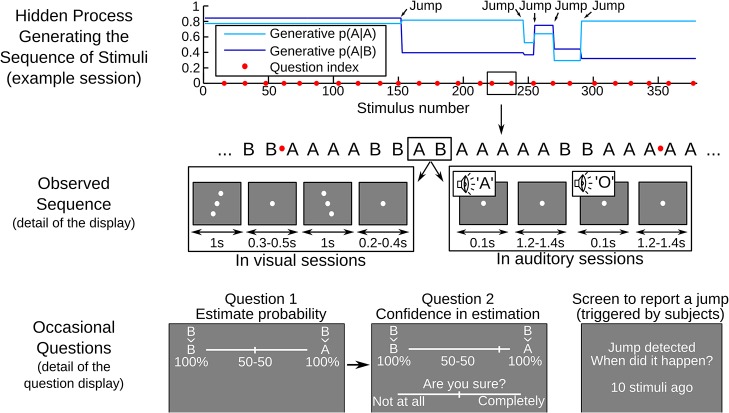
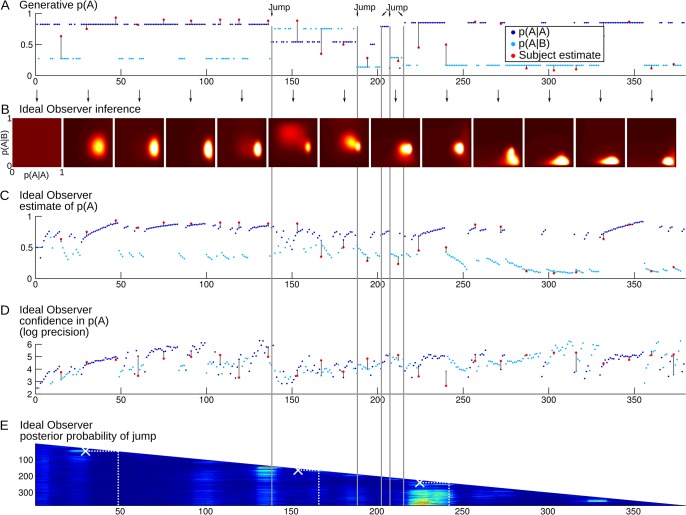
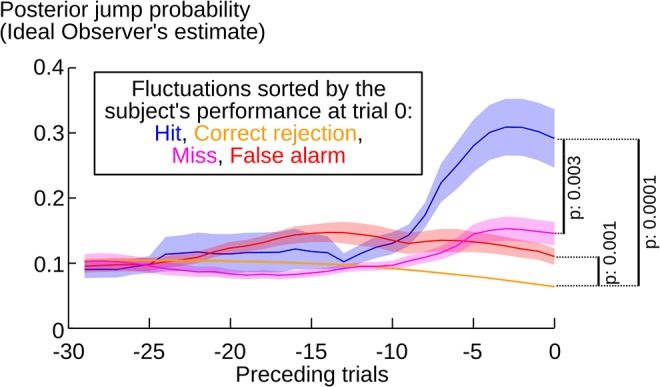
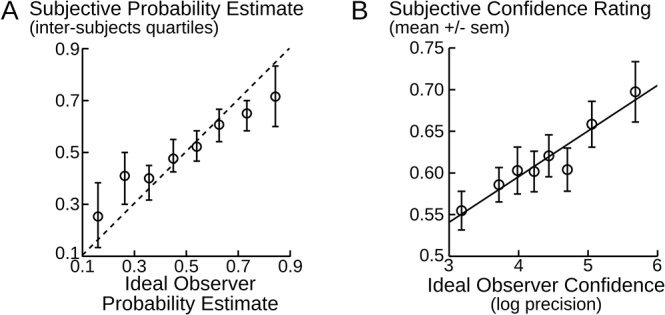
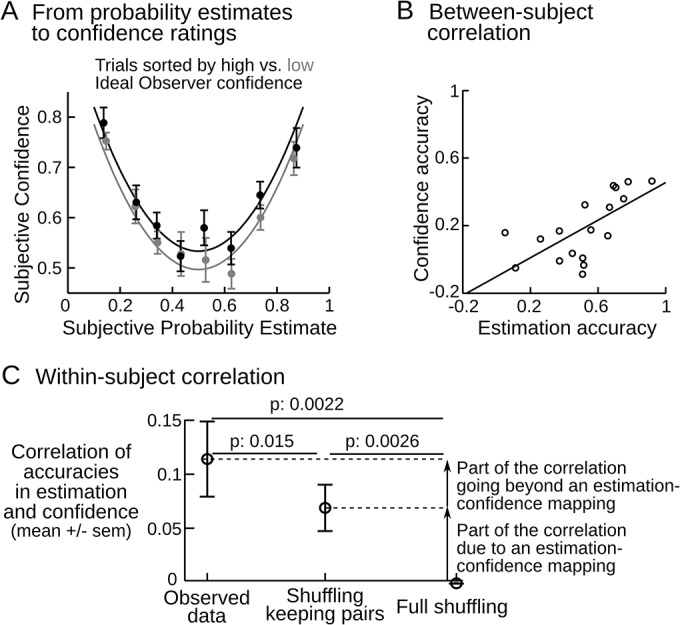
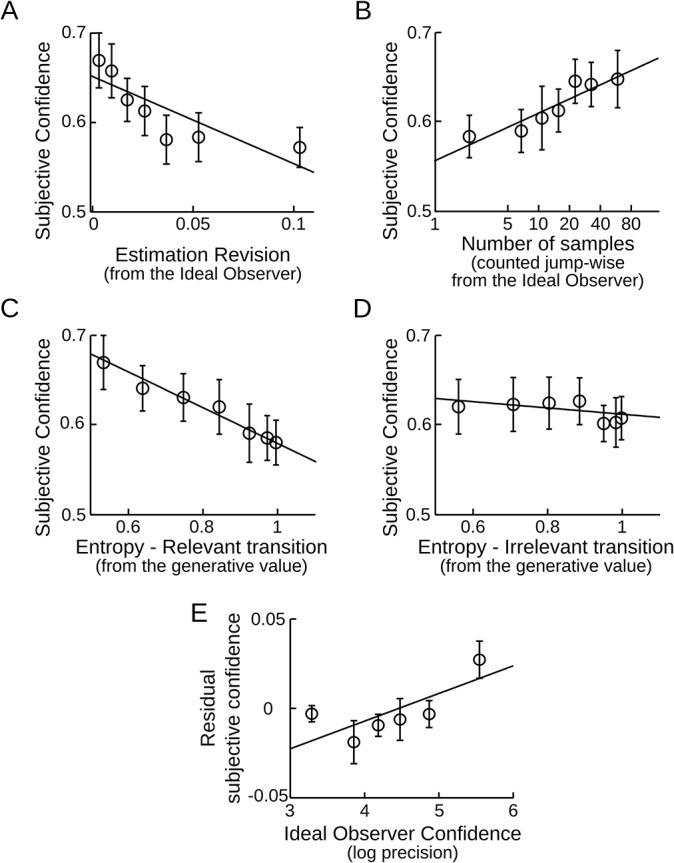
Learning in a stochastic environment consists of estimating a model from a limited amount of noisy data, and is therefore inherently uncertain. However, many classical models reduce the learning process to the updating of parameter estimates and neglect the fact that learning is also frequently accompanied by a variable "feeling of knowing" or confidence. The characteristics and the origin of these subjective confidence estimates thus remain largely unknown. Here we investigate whether, during learning, humans not only infer a model of their environment, but also derive an accurate sense of confidence from their inferences. In our experiment, humans estimated the transition probabilities between two visual or auditory stimuli in a changing environment, and reported their mean estimate and their confidence in this report. To formalize the link between both kinds of estimate and assess their accuracy in comparison to a normative reference, we derive the optimal inference strategy for our task. Our results indicate that subjects accurately track the likelihood that their inferences are correct. Learning and estimating confidence in what has been learned appear to be two intimately related abilities, suggesting that they arise from a single inference process. We show that human performance matches several properties of the optimal probabilistic inference. In particular, subjective confidence is impacted by environmental uncertainty, both at the first level (uncertainty in stimulus occurrence given the inferred stochastic characteristics) and at the second level (uncertainty due to unexpected changes in these stochastic characteristics). Confidence also increases appropriately with the number of observations within stable periods. Our results support the idea that humans possess a quantitative sense of confidence in their inferences about abstract non-sensory parameters of the environment. This ability cannot be reduced to simple heuristics, it seems instead a core property of the learning process.
Overview
The claims and statistics of this paper haven’t been checked yet.
Run the check — free, no account needed. It reads the open-access text and checks the sources it cites.
Integrity signals
Registry
Cites
Statistics
Figures
Verification
Claims the paper makes
The claims and statistics of this paper haven’t been checked yet.
Run the check — free, no account needed. It reads the open-access text and checks the sources it cites.
Self-check
Percentages, sums and reported differences re-computed from the paper’s own numbers.
The self-check needs the paper’s full text.
Citations
Cites
Prospect Theory: An Analysis of Decision under Risk
Kahneman, D., & Tversky, A. (1979) · Econometrica · doi:10.2307/1914185 · Cited by 48,524
Prospect theory: An analysis of decision under risk
Kahneman, D. J., & Tversky, A. (1988) · Cambridge University Press eBooks · doi:10.1017/cbo9780511609220.014 · Cited by 32,720
Rescorla, R. A. (1972) · Medical Entomology and Zoology · Cited by 7,268
Subjective probability: A judgment of representativeness
Kahneman, D. J., & Tversky, A. (1972) · Cognitive Psychology · doi:10.1016/0010-0285(72)90016-3 · Cited by 4,996
Probability theory the logic of science
Jaynes, E. T., & Bretthorst, G. L. (2003) · Cited by 4,600
Classical conditioning II: Current research and theory.
Black, A. H., & Prokasy, W. F. (1972) · Appleton-Century-Crofts eBooks · Cited by 4,449
Bayesian t tests for accepting and rejecting the null hypothesis
Rouder, J. N., Speckman, P. L., Sun, D., Morey, R. D., & Iverson, G. (2009) · Psychonomic Bulletin & Review · doi:10.3758/pbr.16.2.225 · Cited by 3,688
The Bayesian brain: The role of uncertainty in neural coding and computation
Knill, D. C., & Pouget, A. (2004) · Trends in Neurosciences · doi:10.1016/j.tins.2004.10.007 · Cited by 2,588
Learning the value of information in an uncertain world
Behrens, T. E. J., Woolrich, M. W., Walton, M. E., & Rushworth, M. F. S. (2007) · Nature Neuroscience · doi:10.1038/nn1954 · Cited by 2,053
Probabilistic mental models: a Brunswikian theory of confidence
Gigerenzer, G., Hoffrage, U., & Kleinbölting, H. (1991) · Psychological Review · doi:10.1037/0033-295x.98.4.506 · Cited by 1,506
Neural systems responding to degrees of uncertainty in human decision-making
Hsu, M., Bhatt, M., Adolphs, R., Tranel, D., & Camerer, C. F. (2005) · Science · doi:10.1126/science.1115327 · Cited by 1,411
Fleming, S. M., & Lau, H. C. (2014) · Frontiers in Human Neuroscience · doi:10.3389/fnhum.2014.00443 · Cited by 1,408 · cited 2×
“Signal detection theory formalized this readout process in perceptual decisions, postulating that the second-order estimate corresponds to a statistical quantity (d-prime) characterizing the first-order process [32].”
BackgroundRepresentation of Confidence Associated with a Decision by Neurons in the Parietal Cortex
Kiani, R., & Shadlen, M. N. (2009) · Science · doi:10.1126/science.1169405 · Cited by 1,027
Dolan, R. J., & Dayan, P. (2013) · Neuron · doi:10.1016/j.neuron.2013.09.007 · Cited by 977
Timing of the brain events underlying access to consciousness during the attentional blink
Sergent, C., Baillet, S., & Dehaene, S. (2005) · Nature Neuroscience · doi:10.1038/nn1549 · Cited by 888
Self-citationNeural correlates, computation and behavioural impact of decision confidence
Kepecs, A., Uchida, N., Zariwala, H. A., & Mainen, Z. F. (2008) · Nature · doi:10.1038/nature07200 · Cited by 809
Kahneman, D. J., & Tversky, A. (1982) · Cognition · doi:10.1016/0010-0277(82)90023-3 · Cited by 791
The neural basis of metacognitive ability
Fleming, S. M., & Dolan, R. J. (2012) · Philosophical Transactions of the Royal Society B: Biological Sciences · doi:10.1098/rstb.2011.0417 · Cited by 747 · cited 1×
“It is in fact an open issue whether the primary response and the confidence in this response arise in parallel or serially, and from a single brain circuit or not [11,40].”
BackgroundBahrami, B., Olsen, K., Latham, P. E., Roepstorff, A., Rees, G., & Frith, C. D. (2010) · Science · doi:10.1126/science.1185718 · Cited by 738
Statistically optimal perception and learning: from behavior to neural representations
Fiser, J., Berkes, P., Orbán, G., & Lengyel, M. (2010) · Trends in Cognitive Sciences · doi:10.1016/j.tics.2010.01.003 · Cited by 672
Metacognition in human decision-making: confidence and error monitoring
Yeung, N., & Summerfield, C. (2012) · Philosophical Transactions of the Royal Society B: Biological Sciences · doi:10.1098/rstb.2011.0416 · Cited by 667
Probabilistic brains: knowns and unknowns
Pouget, A., Beck, J. M., Ma, W. J., & Latham, P. E. (2013) · Nature Neuroscience · doi:10.1038/nn.3495 · Cited by 615 · cited 1×
“Future work should determine whether learning relies on simplified computations involving only summary statistics such as mean and variance [5], on sampling schemes [17,47], or on full computations over distributions [15].”
BackgroundNassar, M. R., Wilson, R. C., Heasly, B. S., & Gold, J. I. (2010) · Journal of Neuroscience · doi:10.1523/jneurosci.0822-10.2010 · Cited by 607
Confidence in value-based choice
De Martino, B., Fleming, S. M., Garrett, N., & Dolan, R. J. (2013) · Nature Neuroscience · doi:10.1038/nn.3279 · Cited by 534
Bayesian data analysis, third edition
Gelman, A., Carlin, J. B., Stern, H., Dunson, D., Vehtari, A., & Rubin, D. (2013) · Cited by 488
Post-decision wagering objectively measures awareness
Persaud, N., McLeod, P., & Cowey, A. (2007) · Nature Neuroscience · doi:10.1038/nn1840 · Cited by 454
The self-consistency model of subjective confidence.
Koriat, A. (2011) · Psychological Review · doi:10.1037/a0025648 · Cited by 355
Knowing how much you don't know: a neural organization of uncertainty estimates
Bach, D. R., & Dolan, R. J. (2012) · Nature Reviews Neuroscience · doi:10.1038/nrn3289 · Cited by 339
Koriat, A., Sheffer, L., & Ma’ayan, H. (2002) · Journal of Experimental Psychology General · doi:10.1037/0096-3445.131.2.147 · Cited by 308
A computational framework for the study of confidence in humans and animals
Kepecs, A., & Mainen, Z. F. (2012) · Philosophical Transactions of the Royal Society B: Biological Sciences · doi:10.1098/rstb.2012.0037 · Cited by 305
Pure Reasoning in 12-Month-Old Infants as Probabilistic Inference
Téglás, E., Vul, E., Girotto, V., Gonzalez, M., Tenenbaum, J., & Bonatti, L. (2011) · Science · doi:10.1126/science.1196404 · Cited by 296
Making sense of randomness: Implicit encoding as a basis for judgment.
Falk, R., & Konold, C. (1997) · Psychological Review · doi:10.1037/0033-295x.104.2.301 · Cited by 291
Risk, unexpected uncertainty, and estimation uncertainty: Bayesian learning in unstable settings
Payzan-LeNestour, E., & Bossaerts, P. (2011) · PLoS Computational Biology · doi:10.1371/journal.pcbi.1001048 · Cited by 267
Responses of pulvinar neurons reflect a subject's confidence in visual categorization
Komura, Y., Nikkuni, A., Hirashima, N., Uetake, T., & Miyamoto, A. (2013) · Nature Neuroscience · doi:10.1038/nn.3393 · Cited by 226
Distinct brain mechanisms for conscious versus subliminal error detection
Charles, L., Van Opstal, F., Marti, S., & Dehaene, S. (2013) · NeuroImage · doi:10.1016/j.neuroimage.2013.01.054 · Cited by 208 · cited 2×
“Parallel extraction by distinct circuits could account for the fact that confidence and performance are often correlated, but still dissociable [44,45], for instance in situations of speeded judgment [29], overconfidence [46], or when the accuracy of confidence is impaired while performance is preserved.”
BackgroundSelf-citationJuslin, P., & Olsson, H. (1997) · Psychological Review · doi:10.1037/0033-295x.104.2.344 · Cited by 177
Does Confidence Use a Common Currency Across Two Visual Tasks?
de Gardelle, V., & Mamassian, P. (2014) · Psychological Science · doi:10.1177/0956797614528956 · Cited by 131
Perceptual learning as improved probabilistic inference in early sensory areas
Bejjanki, V. R., Beck, J. M., Lu, Z., & Pouget, A. (2011) · Nature Neuroscience · doi:10.1038/nn.2796 · Cited by 127
Bonawitz, E. B., Denison, S., Griffiths, T. L., & Alison Gopnik, C. (2014) · Trends in Cognitive Sciences · doi:10.1016/j.tics.2014.06.006 · Cited by 117
The perception of probability.
Gallistel, C. R., Krishan, M., Liu, Y., Miller, R., & Latham, P. E. (2014) · Psychological Review · doi:10.1037/a0035232 · Cited by 114
Positive bias in the perception of covariation.
Kareev, Y. (1995) · Psychological Review · doi:10.1037/0033-295x.102.3.490 · Cited by 100
Evaluation of Objective Uncertainty in the Visual System
Barthelmé, S., & Mamassian, P. (2009) · PLoS Computational Biology · doi:10.1371/journal.pcbi.1000504 · Cited by 92
Not that bad after all: Generation of random sequences.
Kareev, Y. (1992) · Journal of Experimental Psychology Human Perception & Performance · doi:10.1037//0096-1523.18.4.1189 · Cited by 91
Higher order thoughts in action: consciousness as an unconscious re-description process
Timmermans, B., Schilbach, L., Pasquali, A., & Axel Cleeremans, B. (2012) · Philosophical Transactions of the Royal Society B Biological Sciences · doi:10.1098/rstb.2011.0421 · Cited by 91
Flexible mechanisms underlie the evaluation of visual confidence
Barthelmé, S., & Mamassian, P. (2010) · Proceedings of the National Academy of Sciences · doi:10.1073/pnas.1007704107 · Cited by 87
King, J.-R., & Dehaene, S. (2014) · Philosophical Transactions of the Royal Society B: Biological Sciences · doi:10.1098/rstb.2013.0204 · Cited by 82
Self-citationPerceptual Classification in a Rapidly Changing Environment
Summerfield, C., Behrens, T. E. J., & Koechlin, É. (2011) · Neuron · doi:10.1016/j.neuron.2011.06.022 · Cited by 76
Overconfidence in an Objective Anticipatory Motor Task
Mamassian, P. (2008) · Psychological Science · doi:10.1111/j.1467-9280.2008.02129.x · Cited by 69
Legenstein, R. A., & Maass, W. (2014) · PLoS Computational Biology · doi:10.1371/journal.pcbi.1003859 · Cited by 55
Not that bad after all: Generation of random sequences.
Kareev, Y. (1992) · Journal of Experimental Psychology Human Perception & Performance · doi:10.1037/0096-1523.18.4.1189 · Cited by 47
Cited by
Sorted by citations
What is consciousness, and could machines have it?
Dehaene, S., Lau, H., & Kouider, S. (2017) · Science · doi:10.1126/science.aan8871 · Cited by 855
Self-citationConfidence and certainty: Distinct probabilistic quantities for different goals
Pouget, A., Drugowitsch, J., & Kepecs, A. (2016) · Nature Neuroscience · doi:10.1038/nn.4240 · Cited by 528
Joint probabilistic modeling of single-cell multi-omic data with totalVI
Gayoso, A., Steier, Z., Lopez, R., Regier, J., Nazor, K. L., Streets, A., & Yosef, N. (2021) · Nature Methods · doi:10.1038/s41592-020-01050-x · Cited by 592
Self-Evaluation of Decision-Making: A General Bayesian Framework for Metacognitive Computation
Fleming, S. M., & Daw, N. D. (2017) · Psychological Review · doi:10.1037/rev0000045 · Cited by 584
Confidence as Bayesian probability: From neural origins to behavior
Meyniel, F., Sigman, M., & Mainen, Z. F. (2015) · Neuron · doi:10.1016/j.neuron.2015.09.039 · Cited by 349
“Similarly, in a probabilistic learning task, subjective confidence in the learned estimates followed the optimal Bayesian confidence levels in a tighter parallel than a whole list of ‘‘cues’’ taken together, suggesting that the representation from which confidence is read out was particularly rich and most likely prob…”
InfluentialSelf-citation
Metadata
- Authors
- Meyniel, F., Schlunegger, D., & Dehaene, S.
- Affiliations
- Inserm (FR)
- Corresponding author
- Meyniel, Florent
- Venue
- PLOS Computational Biology
- Publisher
- Public Library of Science (PLoS)
- Published
- 2015-06-15
- Volume
- 11
- Issue
- 6
- Pages
- e1004305
- ISSN
- 1553-734X (ISSN-L)
- 1553-7358
- PMC
- PMC4468157
- OpenAlex
- W580437509
- Cited by
- 163
- References
- 49
- Citations by year
- 2026: 13 · 2025: 15 · 2024: 13 · 2023: 16 · 2022: 15 · 2021: 20 · 2020: 13 · 2019: 12 · 2018: 16 · 2017: 14 · 2016: 15 · 2015: 1
- FWCI
- 15.03
- Type
- journal article
- Language
- en
- Open access
- gold
- doi.org
- Licence
- Locations
- PLoS Computational Biology (publishedVersion, cc-by)
- Europe PMC (PubMed Central) (publishedVersion, cc-by)
- PubMed Central (publishedVersion, cc-by)
- PubMed (publishedVersion)
- HAL (submittedVersion, other-oa)
- RePEc: Research Papers in Economics (submittedVersion)
- DOAJ (DOAJ: Directory of Open Access Journals) (submittedVersion, cc-by-sa)
- Figshare (submittedVersion, cc-by)
- Funders
- European Commission (604102, 2007–2013, FP7 2007-2013, FP7/2007)
- Institut National de la Santé et de la Recherche Médicale
- Topics
- Physical Sciences › Computer Science › Artificial Intelligence › Bayesian Modeling and Causal Inference
- Life Sciences › Neuroscience › Cognitive Neuroscience › Memory and Neural Mechanisms
- Life Sciences › Neuroscience › Cognitive Neuroscience › Visual perception and processing mechanisms
- Keywords
- feeling of knowing, probabilistic learning, Bayesian inference, normative model, environmental uncertainty, transition probability estimation, sequential sampling, environmental change detection
- MeSH terms
- Adult, Algorithms, Female, Humans, Learning, Male, Models, Neurological, Task Performance and Analysis, Models, Statistical, Computational Biology, Uncertainty, Young Adult
About these checks
Registry, retraction, Cites and statistics results are computed, not judged, with one exception: a printed reference that no index lists is read once by a model before it counts as a citation error. Claims are extracted by a model and kept only when their quote appears verbatim in the text; each cited source is then checked, with a model’s help, for whether it says what the claim relies on. Those verdicts can be wrong — read the claim’s quote and the cited source before relying on one.
Statistics and arithmetic are recomputed, not judged.
Confidence bands are shown only for fields calibrated on our annotated test set. None is calibrated yet, so no band is shown.
What counts as a claim ›How we measure confidence ›How we check this ›
Are you an author, or do you see a problem with this page? Request a review
