

The DOI matches its Crossref record; 50 of the 50 references it cites were found in a registry or an index.
The Sense of Confidence during Probabilistic Learning: A Normative Account
Open accessAbstract
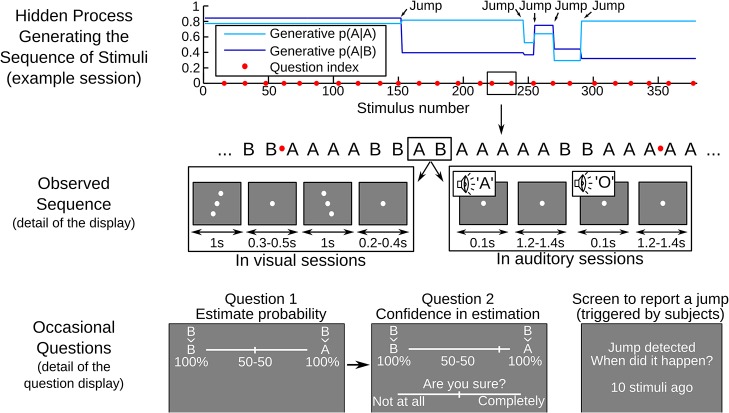
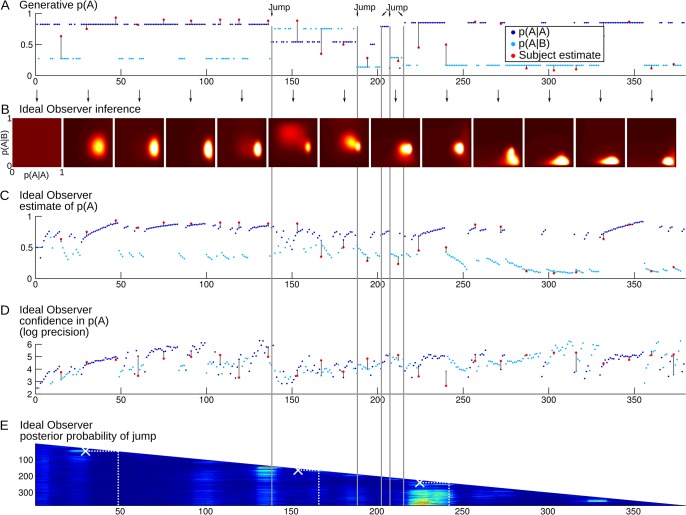
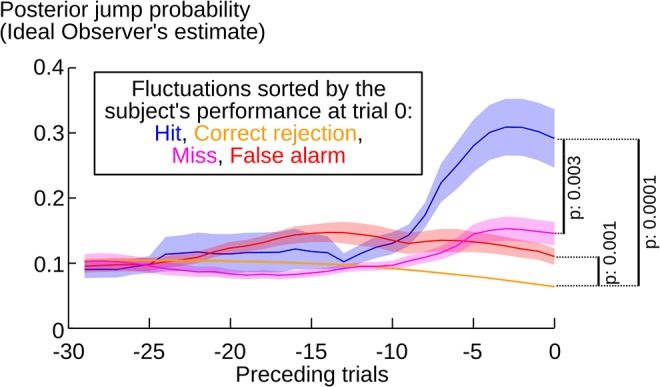
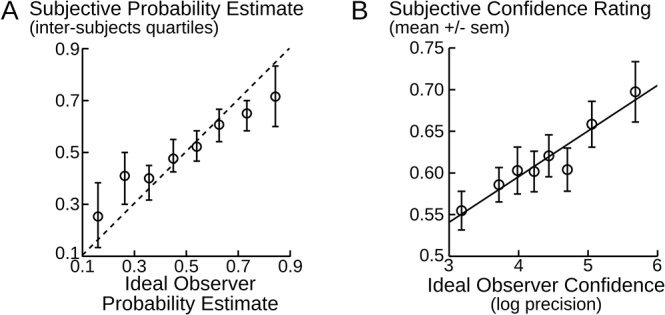
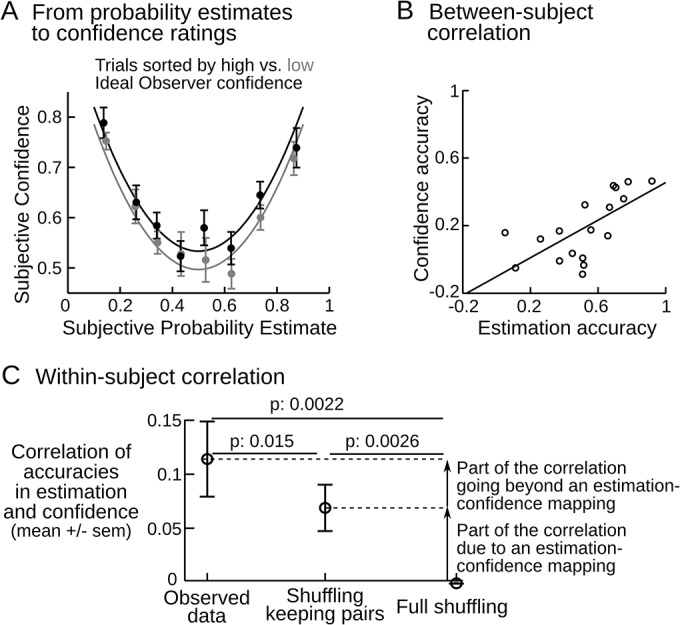
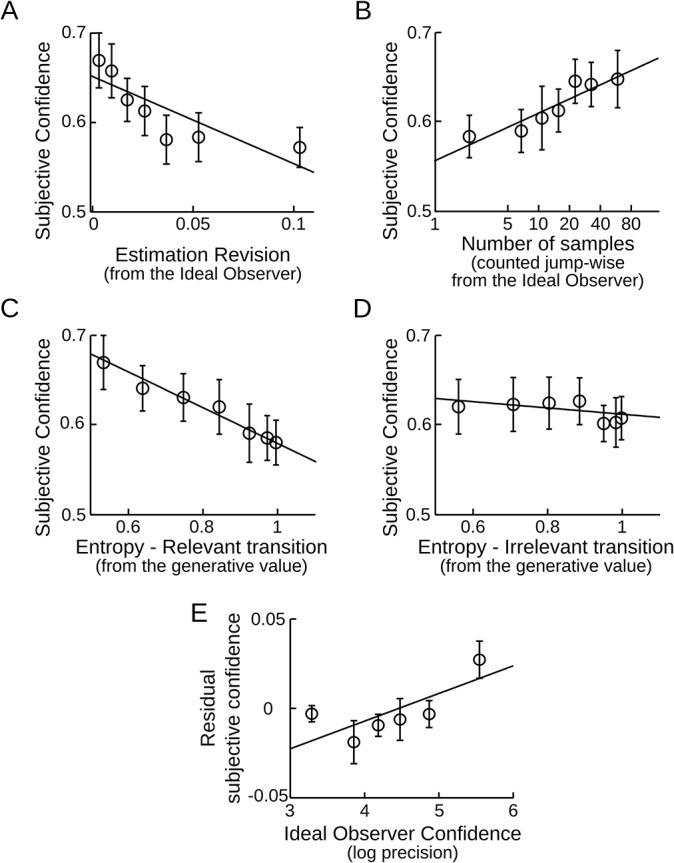
Learning in a stochastic environment consists of estimating a model from a limited amount of noisy data, and is therefore inherently uncertain. However, many classical models reduce the learning process to the updating of parameter estimates and neglect the fact that learning is also frequently accompanied by a variable "feeling of knowing" or confidence. The characteristics and the origin of these subjective confidence estimates thus remain largely unknown. Here we investigate whether, during learning, humans not only infer a model of their environment, but also derive an accurate sense of confidence from their inferences. In our experiment, humans estimated the transition probabilities between two visual or auditory stimuli in a changing environment, and reported their mean estimate and their confidence in this report. To formalize the link between both kinds of estimate and assess their accuracy in comparison to a normative reference, we derive the optimal inference strategy for our task. Our results indicate that subjects accurately track the likelihood that their inferences are correct. Learning and estimating confidence in what has been learned appear to be two intimately related abilities, suggesting that they arise from a single inference process. We show that human performance matches several properties of the optimal probabilistic inference. In particular, subjective confidence is impacted by environmental uncertainty, both at the first level (uncertainty in stimulus occurrence given the inferred stochastic characteristics) and at the second level (uncertainty due to unexpected changes in these stochastic characteristics). Confidence also increases appropriately with the number of observations within stable periods. Our results support the idea that humans possess a quantitative sense of confidence in their inferences about abstract non-sensory parameters of the environment. This ability cannot be reduced to simple heuristics, it seems instead a core property of the learning process.
Overview
The claims and statistics of this paper haven’t been checked yet.
Run the check — free, no account needed. It reads the open-access text and checks the sources it cites.
Integrity signals
Registry
Cites
Statistics
Figures
Verification
Claims the paper makes
The claims and statistics of this paper haven’t been checked yet.
Run the check — free, no account needed. It reads the open-access text and checks the sources it cites.
Self-check
Percentages, sums and reported differences re-computed from the paper’s own numbers.
The self-check needs the paper’s full text.
Citations
Cites
Prospect Theory: An Analysis of Decision under Risk
Kahneman, D., & Tversky, A. (1979) · Econometrica · doi:10.2307/1914185 · Cited by 48,524
Prospect theory: An analysis of decision under risk
Kahneman, D. J., & Tversky, A. (1988) · Cambridge University Press eBooks · doi:10.1017/cbo9780511609220.014 · Cited by 32,720
Rescorla, R. A. (1972) · Medical Entomology and Zoology · Cited by 7,268
Subjective probability: A judgment of representativeness
Kahneman, D. J., & Tversky, A. (1972) · Cognitive Psychology · doi:10.1016/0010-0285(72)90016-3 · Cited by 4,996
Probability theory the logic of science
Jaynes, E. T., & Bretthorst, G. L. (2003) · Cited by 4,600
Classical conditioning II: Current research and theory.
Black, A. H., & Prokasy, W. F. (1972) · Appleton-Century-Crofts eBooks · Cited by 4,449
Bayesian t tests for accepting and rejecting the null hypothesis
Rouder, J. N., Speckman, P. L., Sun, D., Morey, R. D., & Iverson, G. (2009) · Psychonomic Bulletin & Review · doi:10.3758/pbr.16.2.225 · Cited by 3,688
The Bayesian brain: The role of uncertainty in neural coding and computation
Knill, D. C., & Pouget, A. (2004) · Trends in Neurosciences · doi:10.1016/j.tins.2004.10.007 · Cited by 2,588
Learning the value of information in an uncertain world
Behrens, T. E. J., Woolrich, M. W., Walton, M. E., & Rushworth, M. F. S. (2007) · Nature Neuroscience · doi:10.1038/nn1954 · Cited by 2,053
Probabilistic mental models: a Brunswikian theory of confidence
Gigerenzer, G., Hoffrage, U., & Kleinbölting, H. (1991) · Psychological Review · doi:10.1037/0033-295x.98.4.506 · Cited by 1,506
Cited by
Sorted by citations
What is consciousness, and could machines have it?
Dehaene, S., Lau, H., & Kouider, S. (2017) · Science · doi:10.1126/science.aan8871 · Cited by 855
Self-citationConfidence and certainty: Distinct probabilistic quantities for different goals
Pouget, A., Drugowitsch, J., & Kepecs, A. (2016) · Nature Neuroscience · doi:10.1038/nn.4240 · Cited by 528
Joint probabilistic modeling of single-cell multi-omic data with totalVI
Gayoso, A., Steier, Z., Lopez, R., Regier, J., Nazor, K. L., Streets, A., & Yosef, N. (2021) · Nature Methods · doi:10.1038/s41592-020-01050-x · Cited by 592
Self-Evaluation of Decision-Making: A General Bayesian Framework for Metacognitive Computation
Fleming, S. M., & Daw, N. D. (2017) · Psychological Review · doi:10.1037/rev0000045 · Cited by 584
Confidence as Bayesian probability: From neural origins to behavior
Meyniel, F., Sigman, M., & Mainen, Z. F. (2015) · Neuron · doi:10.1016/j.neuron.2015.09.039 · Cited by 349
“Similarly, in a probabilistic learning task, subjective confidence in the learned estimates followed the optimal Bayesian confidence levels in a tighter parallel than a whole list of ‘‘cues’’ taken together, suggesting that the representation from which confidence is read out was particularly rich and most likely prob…”
InfluentialSelf-citationPerceptual confidence neglects decision-incongruent evidence in the brain
Peters, M. A. K., Thesen, T., Ko, Y., Maniscalco, B., Carlson, C., Davidson, M., Doyle, W., Kuzniecky, R., Devinsky, O., Halgren, E., et al. (2017) · Nature Human Behaviour · doi:10.1038/s41562-017-0139 · Cited by 265
Infants ask for help when they know they don’t know
Goupil, L., Romand-Monnier, M., & Kouider, S. (2016) · Proceedings of the National Academy of Sciences · doi:10.1073/pnas.1515129113 · Cited by 226
“Frith C (2010) What is consciousness for? Pragmat Cogn 18(3):497–551.”
BackgroundMetacognitive Failure as a Feature of Those Holding Radical Beliefs
Rollwage, M., Dolan, R. J., & Fleming, S. M. (2018) · Current Biology · doi:10.1016/j.cub.2018.10.053 · Cited by 193
“A useful future extension of our work will be to extrapolate our findings to situations where learning is required over extended periods of time [35, 36].”
BackgroundHuman Metacognition Across Domains: Insights from Individual Differences and Neuroimaging
Rouault, M., McWilliams, A., Allen, M. G., & Fleming, S. M. (2018) · Personality Neuroscience · doi:10.1017/pen.2018.16 · Cited by 176
Brain networks for confidence weighting and hierarchical inference during probabilistic learning
Meyniel, F., & Dehaene, S. (2017) · Proceedings of the National Academy of Sciences · doi:10.1073/pnas.1615773114 · Cited by 138
“The confidence in the estimated statistic relates to the width of the estimated posterior distribution, which can be summarized as the negative log SD (12, 13, 24).”
BackgroundMethodResultInfluentialSelf-citationExplicit representation of confidence informs future value-based decisions
Folke, T., Jacobsen, C., Fleming, S. M., & Martino, B. D. (2016) · Nature Human Behaviour · doi:10.1038/s41562-016-0002 · Cited by 175
Human Inferences about Sequences: A Minimal Transition Probability Model
Meyniel, F., Maheu, M., & Dehaene, S. (2016) · PLoS Computational Biology · doi:10.1371/journal.pcbi.1005260 · Cited by 145
“Additional sources of evidence that human subjects learn transition probabilities is provided by studies of “repetition suppression” [68,69], choices in decision-making problems [70] and explicit reports of learned transition probabilities [60].”
BackgroundSelf-citationForming global estimates of self-performance from local confidence
Rouault, M., Dayan, P., & Fleming, S. M. (2019) · Nature Communications · doi:10.1038/s41467-019-09075-3 · Cited by 134
Confidence modulates exploration and exploitation in value-based learning
Boldt, A., Blundell, C., & Martino, B. D. (2019) · Neuroscience of Consciousness · doi:10.1093/nc/niz004 · Cited by 120
The idiosyncratic nature of confidence
Navajas, J., Hindocha, C., Foda, H., Keramati, M., Latham, P. E., & Bahrami, B. (2017) · Nature Human Behaviour · doi:10.1038/s41562-017-0215-1 · Cited by 136
“We assumed that they are able to compute the true variance associated with equation (1) (although our findings do not require this assumption, see Supplementary Notes).”
BackgroundMethodInfluentialSocial information is integrated into value and confidence judgments according to its reliability
De Martino, B., Bobadilla-Suarez, S., Nouguchi, T., Sharot, T., & Love, B. C. (2017) · The Journal of Neuroscience · doi:10.1523/jneurosci.3880-16.2017 · Cited by 118
“This finding is consistent with the idea that verbal reports of confidence closely match the formal concept of precision as defined in Bayesian probability (Meyniel et al., 2015a, 2015b; but see Pouget et al., 2016).”
Behavior- and Modality-General Representation of Confidence in Orbitofrontal Cortex
Masset, P., Ott, T., Lak, A., Hirokawa, J., & Kepecs, A. (2020) · Cell · doi:10.1016/j.cell.2020.05.022 · Cited by 109
“…estimating con-fidence is essential for learning in probabilistic environments (Drugowitsch et al., 2019; Lak et al., 2020a, Lak et al., 2020b; Meyniel et al., 2015b), and dopamine neurons have been shown to represent confidence-scaled prediction errors that are used for choice updating (Lak…”
BackgroundPurcell, B. A., & Kiani, R. (2016) · Proceedings of the National Academy of Sciences · doi:10.1073/pnas.1524685113 · Cited by 106
Brain signatures of a multiscale process of sequence learning in humans
Maheu, M., Dehaene, S., & Meyniel, F. (2019) · eLife · doi:10.7554/elife.41541 · Cited by 103
Self-citationPost-decisional accounts of biases in confidence
Navajas, J., Bahrami, B., & Latham, P. E. (2016) · Current Opinion in Behavioral Sciences · doi:10.1016/j.cobeha.2016.05.005 · Cited by 97
On-line confidence monitoring during decision making
Dotan, D., Meyniel, F., & Dehaene, S. (2017) · Cognition · doi:10.1016/j.cognition.2017.11.001 · Cited by 104
Self-citationSharot, T., Rollwage, M., Sunstein, C. R., & Fleming, S. M. (2022) · Perspectives on Psychological Science · doi:10.1177/17456916221082967 · Cited by 99
“In standard decision-making tasks, people are more likely to gather additional information when decision confidence is low (De Martino et al., 2013; Desender et al., 2018, 2019; Fleming et al., 2018; Folke et al., 2016; Meyniel et al., 2015; Schulz et al., 2020).”
BackgroundA theory of memory for binary sequences: Evidence for a mental compression algorithm in humans
Planton, S., van Kerkoerle, T., Abbih, L., Maheu, M., Meyniel, F., Sigman, M., Wang, L., Figueira, S. D., Romano, S., & Dehaene, S. (2021) · PLoS Computational Biology · doi:10.1371/journal.pcbi.1008598 · Cited by 94
“The degree of confidence in a prediction can also be predicted using such a computational approach [79,80].”
BackgroundSelf-citationBelief formation – A driving force for brain evolution
Seitz, R. J., & Angel, H. (2020) · Brain and Cognition · doi:10.1016/j.bandc.2020.105548 · Cited by 100
Two sides of the same coin: Monetary incentives concurrently improve and bias confidence judgments
Lebreton, M. P., Langdon, S., Slieker, M. J., Nooitgedacht, J. S., Goudriaan, A. E., Denys, D. A. J. P., van Holst, R. J., & Luigjes, J. (2018) · Science Advances · doi:10.1126/sciadv.aaq0668 · Cited by 90
“Altogether, the importance of confidence as a cognitive variable mitigating decision-making and the societal relevance of its miscalibration have considerably stimulated the search for the computational and neurobiological mechanisms subsuming confidence estimation (14, 15).”
BackgroundContextual influence on confidence judgments in human reinforcement learning
Lebreton, M. P., Bacily, K., Palminteri, S., & Engelmann, J. B. (2019) · PLoS Computational Biology · doi:10.1371/journal.pcbi.1006973 · Cited by 91
“First, confidence judgments accurately track the probability of being correct in stochastic environments, integrating expected and unexpected uncertainty in a close-to-optimal fashion [21,22].”
BackgroundLi, H.-H., & Ma, W. J. (2020) · Nature Communications · doi:10.1038/s41467-020-15581-6 · Cited by 92
Disentangling signal and noise in autism spectrum disorder
de Cruys, S. V., der Hallen, R. V., & Wagemans, J. P. (2016) · Brain and Cognition · doi:10.1016/j.bandc.2016.08.004 · Cited by 83
Glaze, C. M., Filipowicz, A. L. S., Kable, J. W., Balasubramanian, V., & Gold, J. I. (2018) · Nature Human Behaviour · doi:10.1038/s41562-018-0297-4 · Cited by 84
What Is Consciousness, and Could Machines Have It?
Dehaene, S., Lau, H. C., & Kouider, S. (2021) · Springer eBooks · doi:10.1007/978-3-030-54173-6_4 · Cited by 80
Self-citationComputation noise in human learning and decision-making: origin, impact, function
Findling, C., & Wyart, V. (2021) · Current Opinion in Behavioral Sciences · doi:10.1016/j.cobeha.2021.02.018 · Cited by 83
Track It to Crack It: Dissecting Processing Stages with Finger Tracking
Dotan, D., Pinheiro‐Chagas, P., Roumi, F. A., & Dehaene, S. (2019) · Trends in Cognitive Sciences · doi:10.1016/j.tics.2019.10.002 · Cited by 73
“Third, unlike other measures of confidence [21,73,74], which typically involve an explicit post-decision report, the finger/mouse speed is an implicit measure.”
BackgroundSelf-citationFrom Believing to Belief: A General Theoretical Model
Seitz, R. J., Paloutzian, R. F., & Angel, H. (2018) · Journal of Cognitive Neuroscience · doi:10.1162/jocn_a_01292 · Cited by 65
Counterfactual Reasoning Underlies the Learning of Priors in Decision Making
Zylberberg, A., Wolpert, D. M., & Shadlen, M. N. (2018) · Neuron · doi:10.1016/j.neuron.2018.07.035 · Cited by 63
“, 1980) and even use these observations to infer changes in the state of the environment (Summerfield et al., 2011; Behrens et al., 2007; Meyniel et al., 2015; Purcell and Kiani, 2016; Nassar et al., 2010; Rapoport, 1964; Carpenter and Williams, 1995).”
BackgroundResponse-based outcome predictions and confidence regulate feedback processing and learning
Frömer, R., Nassar, M. R., Bruckner, R., Stürmer, B., Sommer, W., & Yeung, N. (2021) · eLife · doi:10.7554/elife.62825 · Cited by 67
“…learning from feedback by providing a read-out of the subjective precision of predicted outcomes ( Nassar et al., 2010 ; Vaghi et al., 2017 ; Meyniel et al., 2015 ; Pouget et al., 2016 ), possibly relying on shared neural correlates of confidence with error detection ( Boldt and Yeung, 2015…”
BackgroundResultComputational validity: using computation to translate behaviours across species
Redish, A. D., Kepecs, Á., Anderson, L. M., Calvin, O. L., Grissom, N. M., Haynos, A. F., Heilbronner, S. R., Herman, A. B., Jacob, S., Ma, S., et al. (2021) · Philosophical Transactions of the Royal Society B Biological Sciences · doi:10.1098/rstb.2020.0525 · Cited by 63
Benwell, C., Mohr, G., Wallberg, J., Kouadio, A., & Ince, R. A. A. (2022) · npj Mental Health Research · doi:10.1038/s44184-022-00009-4 · Cited by 65
Studying the neural representations of uncertainty
Walker, E. Y., Pohl, S., Denison, R. N., Barack, D. L., Lee, J., Block, N., Ma, W. J., & Meyniel, F. (2023) · Nature Neuroscience · doi:10.1038/s41593-023-01444-y · Cited by 56
Self-citationConfidence resets reveal hierarchical adaptive learning in humans
Heilbron, M., & Meyniel, F. (2019) · PLoS Computational Biology · doi:10.1371/journal.pcbi.1006972 · Cited by 57
Self-citationUncertainty-driven regulation of learning and exploration in adolescents: A computational account
Jepma, M., Schaaf, J. V., Visser, I., & Huizenga, H. M. (2020) · PLoS Computational Biology · doi:10.1371/journal.pcbi.1008276 · Cited by 48
“32 compare adolescents’ and adults’ performance on learning tasks involving continuous [48, 697 49] versus discrete [50, 51] change.”
BackgroundDynamic influences on static measures of metacognition
Desender, K., Vermeylen, L., & Verguts, T. (2022) · Nature Communications · doi:10.1038/s41467-022-31727-0 · Cited by 62
Brain dynamics for confidence-weighted learning
Meyniel, F. (2020) · PLoS Computational Biology · doi:10.1371/journal.pcbi.1007935 · Cited by 55
“Those different types of confidence correspond theoretically to different constructs: confidence about a memory or decisions correspond to the probability of the decision or memory being correct [60,65], whereas confidence about a learned estimate (even when this estimate is itself a probability) corresponds to a high…”
BackgroundMethodResultInfluentialSelf-citationTransdiagnostic computations of uncertainty: towards a new lens on intolerance of uncertainty
Sandhu, T. R., Xiao, B., & Lawson, R. P. (2023) · Neuroscience & Biobehavioral Reviews · doi:10.1016/j.neubiorev.2023.105123 · Cited by 51
The perceptual and social components of metacognition.
Pescetelli, N., Rees, G. E., & Bahrami, B. (2016) · Journal of Experimental Psychology General · doi:10.1037/xge0000180 · Cited by 58
From likely to likable: The role of statistical typicality in human social assessment of faces
Ryali, C. K., Goffin, S., Winkielman, P., & Yu, A. J. (2020) · Proceedings of the National Academy of Sciences · doi:10.1073/pnas.1912343117 · Cited by 49
Predictions Shape Confidence in Right Inferior Frontal Gyrus
Sherman, M. T., Seth, A. K., & Kanai, R. (2016) · Journal of Neuroscience · doi:10.1523/jneurosci.1092-16.2016 · Cited by 59
Metzinger, T. K. (2024) · The MIT Press eBooks · doi:10.7551/mitpress/15196.001.0001 · Cited by 60
Model-Based Approaches to Active Perception and Control
Pezzulo, G., Donnarumma, F., Iodice, P., Maisto, D., & Stoianov, I. P. (2017) · Entropy · doi:10.3390/e19060266 · Cited by 42
“Another process of model-based systems that is usually associated with internal representation (and meta-cognitive abilities) concerns confidence estimation and the monitoring of internal variables such as beliefs and hidden states [79].”
BackgroundHainguerlot, M., Vergnaud, J., & de Gardelle, V. (2018) · Scientific Reports · doi:10.1038/s41598-018-23936-9 · Cited by 46
Processes of believing: Where do they come from? What are they good for?
Seitz, R. J., Paloutzian, R. F., & Angel, H. (2016) · F1000Research · doi:10.12688/f1000research.9773.2 · Cited by 44
“For example, learning invokes a sense of confidence that increases in proportion to the number of observations of a task as well as task performance (Meyniel et al., 2015).”
Human online adaptation to changes in prior probability
Norton, E. H., Acerbi, L., Ma, W. J., & Landy, M. S. (2019) · PLoS Computational Biology · doi:10.1371/journal.pcbi.1006681 · Cited by 42
Neural surprise in somatosensory Bayesian learning
Gijsen, S., Grundei, M., Lange, R. T., Ostwald, D., & Blankenburg, F. (2021) · PLoS Computational Biology · doi:10.1371/journal.pcbi.1008068 · Cited by 43
On the origins of logarithmic number-to-position mapping.
Dotan, D., & Dehaene, S. (2016) · Psychological Review · doi:10.1037/rev0000038 · Cited by 42
Self-citationvon Braun, J., Archer, M. S., Reichberg, G. M., & Sorondo, M. S. (2021) · Springer eBooks · doi:10.1007/978-3-030-54173-6 · Cited by 44
Active Inference, Belief Propagation, and the Bethe Approximation
Schwöbel, S., Kiebel, S. J., & Marković, D. (2018) · Neural Computation · doi:10.1162/neco_a_01108 · Cited by 37
“…evidence that belief updating in humans closely follows that of a rational Bayesian agent (FitzGerald, Hämmerer, Friston, Li, & Dolan, 2017; Meyniel, Schlunegger, & Dehaene, 2015; Lake, Salakhut-dinov, & Tenenbaum, 2015; Vossel et al., 2013; Payzan-LeNestour, Dunne, Bossaerts, & O’Doherty,…”
Rational arbitration between statistics and rules in human sequence processing
Maheu, M., Meyniel, F., & Dehaene, S. (2022) · Nature Human Behaviour · doi:10.1038/s41562-021-01259-6 · Cited by 42
Self-citationConfidence of probabilistic predictions modulates the cortical response to pain
Mulders, D., Seymour, B., Mouraux, A., & Mancini, F. (2023) · Proceedings of the National Academy of Sciences · doi:10.1073/pnas.2212252120 · Cited by 31
Towards a common conceptual space for metacognition in perception and memory
Mazancieux, A., Pereira, M., Faivre, N., Mamassian, P., Moulin, C. J. A., & Souchay, C. (2023) · Nature Reviews Psychology · doi:10.1038/s44159-023-00245-1 · Cited by 44
“They have been extensively used in decision-making 15 , notably to investigate cross-domain comparisons 10,11,39 , but also in other tasks such as statistical learning 203 .”
BackgroundNatural statistics support a rational account of confidence biases
Webb, T. W., Miyoshi, K., So, T. Y., Rajananda, S., & Lau, H. (2023) · Nature Communications · doi:10.1038/s41467-023-39737-2 · Cited by 31
Wichmann, F. A., & Jäkel, F. (2018) · Wiley eBooks · doi:10.1002/9781119170174.epcn507 · Cited by 31
Discrete confidence levels revealed by sequential decisions
Lisi, M., Mongillo, G., Milne, G. A., Dekker, T. M., & Goréa, A. (2020) · Nature Human Behaviour · doi:10.1038/s41562-020-00953-1 · Cited by 28
Suprathreshold perceptual decisions constrain models of confidence
Locke, S. M., Landy, M. S., & Mamassian, P. (2022) · PLoS Computational Biology · doi:10.1371/journal.pcbi.1010318 · Cited by 25
Towards characterizing the canonical computations generating phenomenal experience
Peters, M. A. K. (2022) · Neuroscience & Biobehavioral Reviews · doi:10.1016/j.neubiorev.2022.104903 · Cited by 25
Arthur, T., & Harris, D. (2021) · Cortex · doi:10.1016/j.cortex.2021.09.017 · Cited by 24
Understanding learning through uncertainty and bias
Bruckner, R., Heekeren, H. R., & Nassar, M. R. (2025) · Communications Psychology · doi:10.1038/s44271-025-00203-y · Cited by 39
Humans adapt their anticipatory eye movements to the volatility of visual motion properties
Pasturel, C., Montagnini, A., & Perrinet, L. (2020) · PLoS Computational Biology · doi:10.1371/journal.pcbi.1007438 · Cited by 19
“correctly inferred, as compared to a random choice, as reported previously [67].”
Stochastic satisficing account of confidence in uncertain value-based decisions
Hertz, U., Bahrami, B., & Keramati, M. (2018) · PLoS ONE · doi:10.1371/journal.pone.0195399 · Cited by 22
“The second-order model [18] and other recent studies [14,17,19,32] have formulized confidence as the probability of having made a correct choice over tracked outcome or evidence distribution.”
BackgroundControllability boosts neural and cognitive signatures of changes-of-mind in uncertain environments
Rouault, M., Weiss, A., Lee, J. K., Drugowitsch, J., Chambon, V., & Wyart, V. (2022) · eLife · doi:10.7554/elife.75038 · Cited by 24
The Neurobiology of Confidence: From Beliefs to NeuronsPreprint
Ott, T., Masset, P., & Kepecs, Á. (2018) · Cold Spring Harbor Symposia on Quantitative Biology · doi:10.1101/sqb.2018.83.038794 · Cited by 17
“…research area has been thoroughly reviewed (Metcalfe 2008; Rolls et al. 2010; Kepecs and Mainen 2012; Middlebrooks and Sommer 2012; Shadlen and Kiani 2013; Fleming and Dolan 2014; Fleming and Lau 2014; Grimaldi et al. 2015; Meyniel et al. 2015b; Pouget et al. 2016), a task we will not attempt here.”
BackgroundFirst‐impression bias effects on mismatch negativity to auditory spatial deviants
Fitzgerald, K., Provost, A. L., & Todd, J. (2017) · Psychophysiology · doi:10.1111/psyp.13013 · Cited by 17
Schustek, P., Hyafil, A., & Moreno‐Bote, R. (2019) · Nature Communications · doi:10.1038/s41467-019-13472-z · Cited by 13
Foucault, C., & Meyniel, F. (2021) · eLife · doi:10.7554/elife.71801 · Cited by 16
Self-citationMarković, D., Reiter, A. M. F., & Kiebel, S. J. (2019) · PLoS Computational Biology · doi:10.1371/journal.pcbi.1006707 · Cited by 13
Believing and social interactions: effects on bodily expressions and personal narratives
Seitz, R. J., Angel, H., Paloutzian, R. F., & Taves, A. (2022) · Frontiers in Behavioral Neuroscience · doi:10.3389/fnbeh.2022.894219 · Cited by 17
“estimating confidence in what has been learned are intimately related (Meyniel et al., 2015).”
BackgroundSurprise About Sensory Event Timing Drives Cortical Transients in the Beta Frequency Band
Meindertsma, T., Kloosterman, N. A., Engel, A. K., Wagenmakers, E., & Donner, T. H. (2018) · Journal of Neuroscience · doi:10.1523/jneurosci.0307-18.2018 · Cited by 15
“Richer experimental designs, that are volatile and include unmarked changes, allow for probing into richer, presumably hierarchical dynamics (Sugrue et al., 2004; Nassar et al., 2012; Meyniel et al., 2015).”
BackgroundUnderstanding Learning Through Uncertainty and BiasPreprint
Bruckner, R., Heekeren, H. R., & Nassar, M. R. (2022) · doi:10.31234/osf.io/xjkbg · Cited by 13
Confidence and risky decision-making in gambling disorder
Hoven, M., Hirmas, A., Engelmann, J., & van Holst, R. V. (2023) · Journal of Behavioral Addictions · doi:10.1556/2006.2023.00041 · Cited by 10
Metacognition biases information seeking in assessing ambiguous news
Guigon, V., Villeval, M. C., & Dreher, J. (2024) · Communications Psychology · doi:10.1038/s44271-024-00170-w · Cited by 18
Miyoshi, K., Kuwahara, A., & Kawaguchi, J. (2018) · Journal of Memory and Language · doi:10.1016/j.jml.2018.06.001 · Cited by 14
History biases reveal novel dissociations between perceptual and metacognitive decision-making
Benwell, C., Beyer, R., Wallington, F., & Ince, R. A. A. (2023) · Journal of Vision · doi:10.1167/jov.23.5.14 · Cited by 13
Frömer, R., Nassar, M. R., Bruckner, R., Stürmer, B., Sommer, W., & Yeung, N. (2018) · bioRxiv (Cold Spring Harbor Laboratory) · doi:10.1101/442822 · Cited by 13
“Recent research shows ‘Confidence weightings’ in learning transition probabilities (Meyniel & Dehaene, 2017; Meyniel et al., 2015) and confidence based regulation of information seeking/exploration in decision making (Boldt, Blundell, & De Martino, 2017; Desender, Boldt, & Yeung, 2018).”
BackgroundThe idiosyncratic nature of confidencePreprint
Navajas, J., Hindocha, C., Foda, H., Keramati, M., Latham, P. E., & Bahrami, B. (2017) · bioRxiv (Cold Spring Harbor Laboratory) · doi:10.1101/102269 · Cited by 11
Initial Expectations and Confidence Affect the Formation of Novel Self-Beliefs and Their Revision
Schröder, A., Czekalla, N., Mayer, A. V., Zhang, L., Stolz, D. S., Korn, C. W., Diekelmann, S., Luebber, F., Paulus, F. M., Müller‐Pinzler, L., et al. (2025) · Open Mind · doi:10.1162/opmi.a.36 · Cited by 10
“Previous studies have examined confidence in the context of decision-making under uncertainty, such as choices between stimuli with volatile reward probabilities (Meyniel & Dehaene, 2017; Meyniel et al., 2015).”
Confidence in risky value-based choice
Castanheira, K. D. S., Fleming, S. M., & Otto, A. R. (2021) · Psychonomic Bulletin & Review · doi:10.3758/s13423-020-01848-y · Cited by 11
“Confidence can also guide future behavior due to its role in both controlling information seeking (Desender, Boldt, & Yeung, 2018), postdecisional processing (Rollwage et al., 2020), and learning by weighting incoming evidence (Meyniel & Dehaene, 2017; Meyniel et al., 2015).”
Confirmation bias is adaptive when coupled with efficient metacognitionPreprint
Rollwage, M., & Fleming, S. M. (2020) · bioRxiv (Cold Spring Harbor Laboratory) · doi:10.1101/2020.07.28.225029 · Cited by 10
A characterization of the neural representation of confidence during probabilistic learning
Bounmy, T., Eger, E., & Meyniel, F. (2023) · NeuroImage · doi:10.1016/j.neuroimage.2022.119849 · Cited by 16
Self-citationInformation search under uncertainty across transdiagnostic psychopathology and healthy ageing
Mohr, G., Ince, R. A. A., & Benwell, C. (2024) · Translational Psychiatry · doi:10.1038/s41398-024-03065-w · Cited by 11
30th Annual Computational Neuroscience Meeting: CNS*2021–Meeting Abstracts
Arora, K., Zulfiqar, I., Schultheiss, H., Martino, F. D., Gulban, O. F., Lage‐Castellanos, A., & Moerel, M. (2021) · Journal of Computational Neuroscience · doi:10.1007/s10827-021-00801-9 · Cited by 9
Havenith, M. N., Zijderveld, P. M., van Heukelum, S., Abghari, S., Tiesinga, P. H. E., & Glennon, J. C. (2019) · Scientific Reports · doi:10.1038/s41598-019-41250-w · Cited by 8
Zhang, X., Ma, L., Chen, J., Fu, J., Wang, J., Wang, Y., Zhu, M., Yu, M., & Chen, D. (2025) · Displays · doi:10.1016/j.displa.2025.103038 · Cited by 8
Metacognitive judgments during visuomotor learning reflect the integration of error history
Hewitson, C. L., Al-Fawakhiri, N., Forrence, A. D., & McDougle, S. D. (2023) · Journal of Neurophysiology · doi:10.1152/jn.00022.2023 · Cited by 7
Ryali, C. K., Reddy, G., & Yu, A. J. (2016) · bioRxiv (Cold Spring Harbor Laboratory) · doi:10.1101/077719 · Cited by 7
“It is quite possible that different parts of the 267 brain implement different kinds of learning/prediction algorithms, for example only representing 268 uncertainty when explicitly required to do so [9].”
BackgroundDirect brain recordings reveal continuous encoding of structure in random stimuliPreprint
Fuhrer, J., Glette, K., Ivanović, J., Larsson, P. G., Bekinschtein, T. A., Kochen, S. S., Knight, R. T., Tørresen, J., Solbakk, A., Endestad, T., et al. (2021) · bioRxiv (Cold Spring Harbor Laboratory) · doi:10.1101/2021.10.01.462295 · Cited by 7
The energy metabolic footprint of predictive processing in the human brainPreprint
Hechler, A., de Lange, F. P., & Riedl, V. (2023) · bioRxiv (Cold Spring Harbor Laboratory) · doi:10.1101/2023.12.08.570804 · Cited by 8
How Sure is the Driver? Modelling Drivers’ Confidence in Left-Turn Gap Acceptance Decisions
Bontje, F., & Zgonnikov, A. (2024) · Computational Brain & Behavior · doi:10.1007/s42113-024-00207-7 · Cited by 9
“The first account states that the amount of evidence accumulated at the time the decision is made determines the confidence judgment (Boundy-Singer et al., 2022; Kiani et al., 2014; Meyniel et al., 2015).”
Berlemont, K., Martin, J., Sackur, J., & Nadal, J. (2020) · Scientific Reports · doi:10.1038/s41598-020-63582-8 · Cited by 7
Theta Activity Supports Landmark-Based Correction of Naturalistic Human Path Integration
Naveilhan, C., Zory, R., Gramann, K., & Ramanoël, S. (2025) · Journal of Neuroscience · doi:10.1523/jneurosci.1005-25.2025 · Cited by 8
Interpersonal trust modelling through multi-agent Reinforcement Learning
Frey, V., & Martinez, J. (2023) · Cognitive Systems Research · doi:10.1016/j.cogsys.2023.101157 · Cited by 5
Mehimeh, S., Tang, X., & Zhao, W. Z. (2023) · Knowledge-Based Systems · doi:10.1016/j.knosys.2023.111036 · Cited by 5
Decision-Making under UncertaintyPreprint
Bruckner, R., & Nassar, M. R. (2024) · doi:10.31234/osf.io/ce8jf · Cited by 5
Metadata
- Authors
- Meyniel, F., Schlunegger, D., & Dehaene, S.
- Affiliations
- Inserm (FR)
- Corresponding author
- Meyniel, Florent
- Venue
- PLOS Computational Biology
- Publisher
- Public Library of Science (PLoS)
- Published
- 2015-06-15
- Volume
- 11
- Issue
- 6
- Pages
- e1004305
- ISSN
- 1553-734X (ISSN-L)
- 1553-7358
- PMC
- PMC4468157
- OpenAlex
- W580437509
- Cited by
- 163
- References
- 49
- Citations by year
- 2026: 13 · 2025: 15 · 2024: 13 · 2023: 16 · 2022: 15 · 2021: 20 · 2020: 13 · 2019: 12 · 2018: 16 · 2017: 14 · 2016: 15 · 2015: 1
- FWCI
- 15.03
- Type
- journal article
- Language
- en
- Open access
- gold
- doi.org
- Licence
- Locations
- PLoS Computational Biology (publishedVersion, cc-by)
- Europe PMC (PubMed Central) (publishedVersion, cc-by)
- PubMed Central (publishedVersion, cc-by)
- PubMed (publishedVersion)
- HAL (submittedVersion, other-oa)
- RePEc: Research Papers in Economics (submittedVersion)
- DOAJ (DOAJ: Directory of Open Access Journals) (submittedVersion, cc-by-sa)
- Figshare (submittedVersion, cc-by)
- Funders
- European Commission (604102, 2007–2013, FP7 2007-2013, FP7/2007)
- Institut National de la Santé et de la Recherche Médicale
- Topics
- Physical Sciences › Computer Science › Artificial Intelligence › Bayesian Modeling and Causal Inference
- Life Sciences › Neuroscience › Cognitive Neuroscience › Memory and Neural Mechanisms
- Life Sciences › Neuroscience › Cognitive Neuroscience › Visual perception and processing mechanisms
- Keywords
- feeling of knowing, probabilistic learning, Bayesian inference, normative model, environmental uncertainty, transition probability estimation, sequential sampling, environmental change detection
- MeSH terms
- Adult, Algorithms, Female, Humans, Learning, Male, Models, Neurological, Task Performance and Analysis, Models, Statistical, Computational Biology, Uncertainty, Young Adult
About these checks
Registry, retraction, Cites and statistics results are computed, not judged, with one exception: a printed reference that no index lists is read once by a model before it counts as a citation error. Claims are extracted by a model and kept only when their quote appears verbatim in the text; each cited source is then checked, with a model’s help, for whether it says what the claim relies on. Those verdicts can be wrong — read the claim’s quote and the cited source before relying on one.
Statistics and arithmetic are recomputed, not judged.
Confidence bands are shown only for fields calibrated on our annotated test set. None is calibrated yet, so no band is shown.
What counts as a claim ›How we measure confidence ›How we check this ›
Are you an author, or do you see a problem with this page? Request a review
