

A Histone Deacetylase Adjusts Transcription Kinetics at Coding Sequences during Candida albicans Morphogenesis
Open accessThe DOI matches its Crossref record; 50 of the 50 references it cites were found in a registry or an index.
Abstract
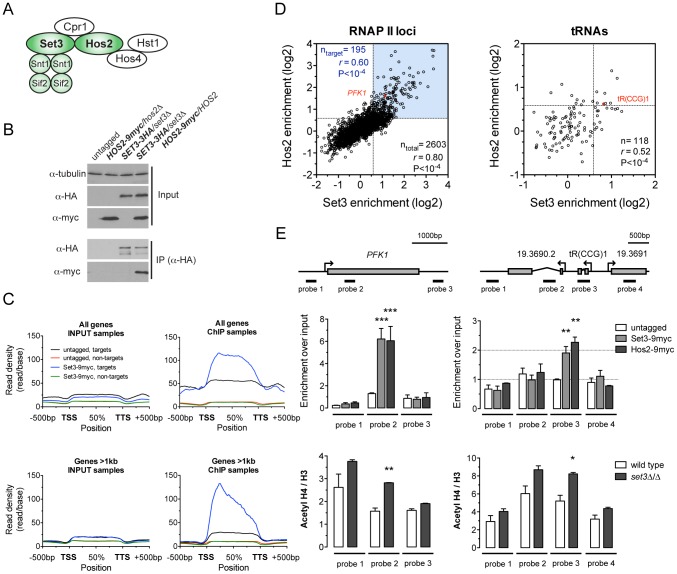
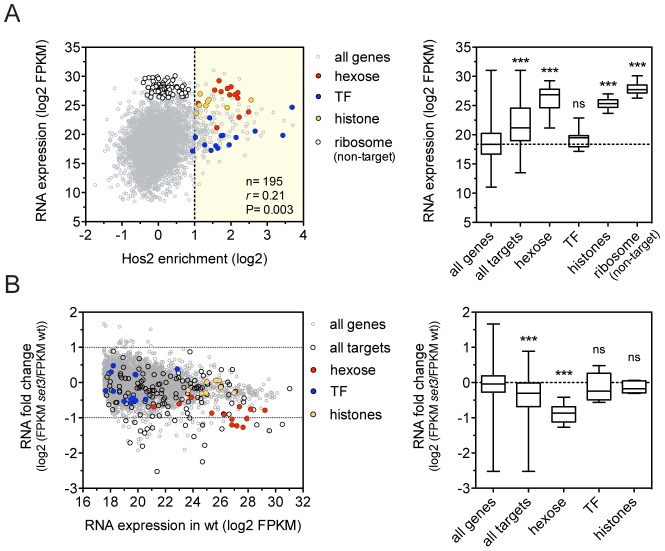
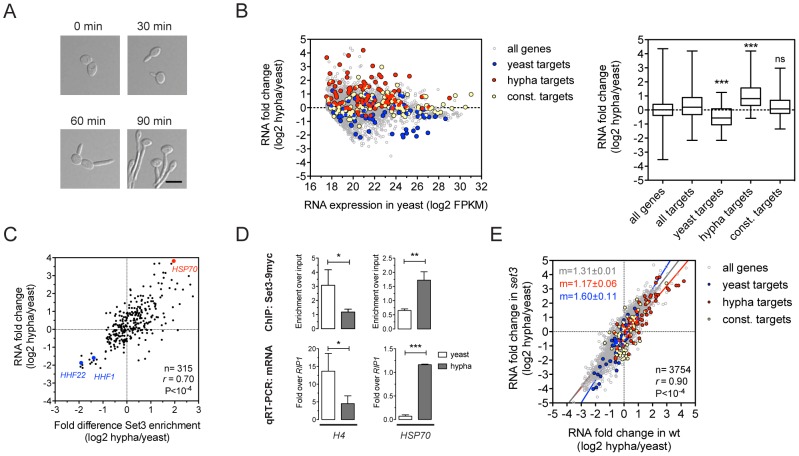
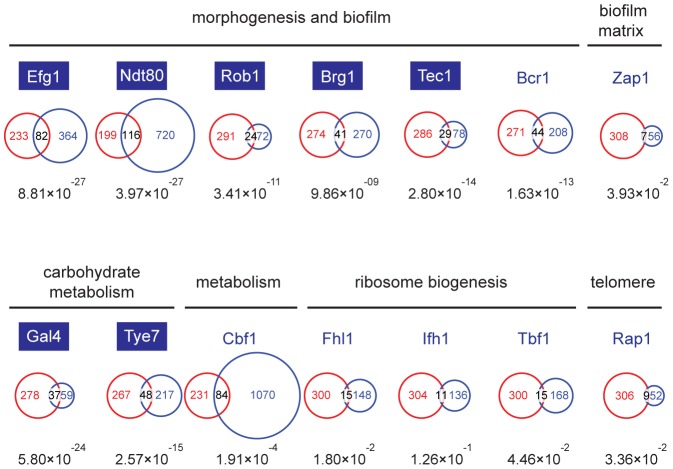
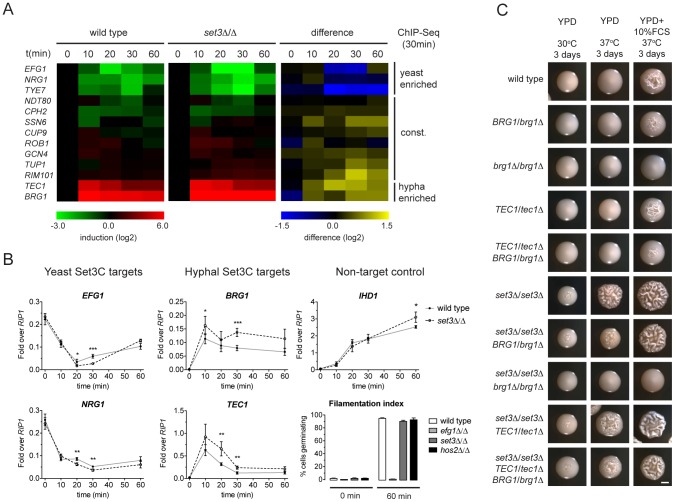
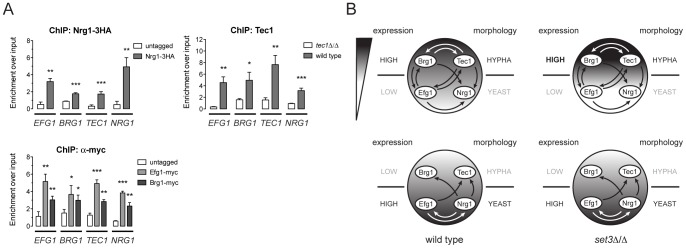
Despite their classical role as transcriptional repressors, several histone deacetylases, including the baker's yeast Set3/Hos2 complex (Set3C), facilitate gene expression. In the dimorphic human pathogen Candida albicans, the homologue of the Set3C inhibits the yeast-to-filament transition, but the precise molecular details of this function have remained elusive. Here, we use a combination of ChIP-Seq and RNA-Seq to show that the Set3C acts as a transcriptional co-factor of metabolic and morphogenesis-related genes in C. albicans. Binding of the Set3C correlates with gene expression during fungal morphogenesis; yet, surprisingly, deletion of SET3 leaves the steady-state expression level of most genes unchanged, both during exponential yeast-phase growth and during the yeast-filament transition. Fine temporal resolution of transcription in cells undergoing this transition revealed that the Set3C modulates transient expression changes of key morphogenesis-related genes. These include a transcription factor cluster comprising of NRG1, EFG1, BRG1, and TEC1, which form a regulatory circuit controlling hyphal differentiation. Set3C appears to restrict the factors by modulating their transcription kinetics, and the hyperfilamentous phenotype of SET3-deficient cells can be reverted by mutating the circuit factors. These results indicate that the chromatin status at coding regions represents a dynamic platform influencing transcription kinetics. Moreover, we suggest that transcription at the coding sequence can be transiently decoupled from potentially conflicting promoter information in dynamic environments.
Overview
The claims and statistics of this paper haven’t been checked yet.
Free: it reads the open-access text and checks the first 5 claims that cite a source we can check. Create a free account to check every claim.
Integrity signals
Registry
Cites
Statistics
Figures
Verification
Claims the paper makes
The claims and statistics of this paper haven’t been checked yet.
Free: it reads the open-access text and checks the first 5 claims that cite a source we can check. Create a free account to check every claim.
Claims other papers make about this one
Each is checked against this paper’s own text: does it say what the citing paper says it does?
The source backs part of the claim, not all of it — or backs it for a different population, condition or comparison.
In the citing paper
“Nrg1 probably acts through a Set3 chromatin-modifying complex (77, 139).”
From Candida albicans Biofilms and Human Disease (2015) · cites this paper as [77]
Experimental — accuracy not yet measuredThe source backs part of the claim, not all of it — or backs it for a different population, condition or comparison.
In the citing paper
“of the 116 genes upregulated at least 2-fold in the set3Δ/Δ mutant, 69 have unknown biological functions, 15 are involved in drug response, and 9 are implicated in septin organization and cell cycle progression on the basis of CGD Gene Ontology Slim Mapper (Candida GO-Slim Process), i.e., SEP7, CEK1, DDC1, HAC1, SGO1, ORF19.1363, ORF19.2713, ORF19.2922, and ORF19.7450 (46–48)”
From A Histone Deacetylase Complex Mediates Biofilm Dispersal and Drug Resistance in Candida albicans (2014) · cites this paper as [23]
Experimental — accuracy not yet measuredThe source backs part of the claim, not all of it — or backs it for a different population, condition or comparison.
In the citing paper
“Of the 33 genes downregulated at least 2-fold in the set3Δ/Δ mutant, 9 have unknown biological functions, 9 are involved in drug response, and 3 play roles in septin organization and cell cycle progression, based on CGD Gene Ontology Slim Mapper (Candida GO-Slim Process), i.e., GIN4, CCN1, and MCD1 (43–45)”
From A Histone Deacetylase Complex Mediates Biofilm Dispersal and Drug Resistance in Candida albicans (2014) · cites this paper as [23]
Experimental — accuracy not yet measuredThe source backs part of the claim, not all of it — or backs it for a different population, condition or comparison.
In the citing paper
“In C. albicans, only the core complex has been studied and, as discussed above, was recently found to be involved in the modulation of morphogenesis-related processes (23, 24).”
From A Histone Deacetylase Complex Mediates Biofilm Dispersal and Drug Resistance in Candida albicans (2014) · cites this paper as [23]
Experimental — accuracy not yet measuredThe cited source says what the claim attributes to it.
In the citing paper
“the Set3 complex mutants are hyperfilamentous (23)”
From A Histone Deacetylase Complex Mediates Biofilm Dispersal and Drug Resistance in Candida albicans (2014) · cites this paper as [23]
4 more claims about this paper
Create a free account to see every claim other papers make about this one.
Self-check
Percentages, sums and reported differences re-computed from the paper’s own numbers.
The self-check needs the paper’s full text.
Citations
Cites
Ultrafast and memory-efficient alignment of short DNA sequences to the human genome.
Langmead, B., Trapnell, C., Pop, M., & Salzberg, S. L. (2009) · Genome Biology · doi:10.1186/gb-2009-10-3-r25 · Cited by 21,849
Model-based Analysis of ChIP-Seq (MACS)
Zhang, Y., Liu, T., Meyer, C. A., Eeckhoute, J., Johnson, D. S., Bernstein, B. E., Nusbaum, C., Myers, R. M., Brown, M., Li, W., et al. (2008) · Genome Biology · doi:10.1186/gb-2008-9-9-r137 · Cited by 18,386 · cited 8×
“(B) Correlation of MACS fold enrichment values with the enrichment measured by the RPKM method in one representative Set3 and Hos2 ChIP-Seq experiment.”
MethodInfluentialTrapnell, C., Williams, B. A., Pertea, G., Mortazavi, A., Kwan, G., van Baren, M. J., Salzberg, S. L., Wold, B. J., & Pachter, L. (2010) · Nature Biotechnology · doi:10.1038/nbt.1621 · Cited by 15,556
Mapping and quantifying mammalian transcriptomes by RNA-Seq
Mortazavi, A., Williams, B. A., McCue, K., Schaeffer, L., & Wold, B. (2008) · Nature Methods · doi:10.1038/nmeth.1226 · Cited by 13,696 · cited 1×
“known [48].”
Comparative Protein Modelling by Satisfaction of Spatial Restraints
Šali, A., & Blundell, T. L. (1993) · Journal of Molecular Biology · doi:10.1006/jmbi.1993.1626 · Cited by 12,977 · cited 1×
“The right side shows the structural model of the CaSet3 PHD overlayed on the crystal structure on the left using Modeller [50] with identical color-coding.”
MethodTopHat: discovering splice junctions with RNA-Seq
Trapnell, C., Pachter, L., & Salzberg, S. L. (2009) · Bioinformatics · doi:10.1093/bioinformatics/btp120 · Cited by 11,617
The distinct morphogenic states of Candida albicans
Sudbery, P., Gow, N., & Berman, J. (2004) · Trends in Microbiology · doi:10.1016/j.tim.2004.05.008 · Cited by 876 · cited 1×
“morphologies ranging from unicellular yeast-like, to multicellular pseudohyphal, and hyphal structures [1,2].”
BackgroundProgression through the RNA Polymerase II CTD Cycle
Buratowski, S. (2009) · Molecular Cell · doi:10.1016/j.molcel.2009.10.019 · Cited by 772 · cited 1×
“Indeed, the plethora of modifications of the RNAPII C-terminal domain (CTD) has been postulated to constitute a ‘‘CTD code’’, whereby specific CTD modifications orchestrate the binding of protein factors that affect RNA processing, RNAPII termination or histone modifications [37,38,39].”
BackgroundThe SAT1 flipper, an optimized tool for gene disruption in Candida albicans
Reuß, O., Vik, Å., Kolter, R., & Morschhäuser, J. (2004) · Gene · doi:10.1016/j.gene.2004.06.021 · Cited by 742
A Recently Evolved Transcriptional Network Controls Biofilm Development in Candida albicans
Nobile, C. J., Fox, E. P., Nett, J. E., Sorrells, T. R., Mitrovich, Q. M., Hernday, A. D., Tuch, B. B., Andes, D. R., & Johnson, A. D. (2012) · Cell · doi:10.1016/j.cell.2011.10.048 · Cited by 711 · cited 17×
“By contrast, a rapid 50–100-fold induction of transcripts of the hyphal-specific targets BRG1 and TEC1 were visible after only 10 minutes (Figure 5A).”
BackgroundMethodInfluentialSelf-citation
Cited by
Candida albicans Biofilms and Human Disease
Nobile, C. J., & Johnson, A. D. (2015) · Annual Review of Microbiology · doi:10.1146/annurev-micro-091014-104330 · Cited by 1,057
Self-citationCandida albicans biofilms: development, regulation, and molecular mechanisms
Gulati, M., & Nobile, C. J. (2016) · Microbes and Infection · doi:10.1016/j.micinf.2016.01.002 · Cited by 738
Self-citationDevelopment and regulation of single- and multi-species Candida albicans biofilms
Lohse, M. B., Gulati, M., Johnson, A. D., & Nobile, C. J. (2018) · Nature Reviews Microbiology · doi:10.1038/nrmicro.2017.107 · Cited by 643
Self-citationCandida albicans hyphal initiation and elongation
Lu, Y., Su, C., & Liu, H. (2014) · Trends in Microbiology · doi:10.1016/j.tim.2014.09.001 · Cited by 193
“In addition, the Set3/Hos2 complex also modulates the transcription kinetics of BRG1 during hyphal development [71].”
Candida albicans biofilms: building a heterogeneous, drug-tolerant environment
Bonhomme, J., & d’Enfert, C. (2013) · Current Opinion in Microbiology · doi:10.1016/j.mib.2013.03.007 · Cited by 120
Rossoni, R. D., de Barros, P. P., de Alvarenga, J. A., Ribeiro, F. D. C., Velloso, M. D. S., Fuchs, B. B., Mylonakis, E., Jorge, A. O. C., & Junqueira, J. C. (2018) · Biofouling · doi:10.1080/08927014.2018.1425402 · Cited by 99
“The primers for the genes analyzed in the present study were described and used as indicated by Nailis et al. (2010), Hnisz et al. (2012) and Granger (2012).”
MethodCandida Biofilms: An Update on Developmental Mechanisms and Therapeutic Challenges
de Barros, P. P., Rossoni, R. D., de Souza, C. M., Scorzoni, L., Fenley, J. D. C., & Junqueira, J. C. (2020) · Mycopathologia · doi:10.1007/s11046-020-00445-w · Cited by 121
A Histone Deacetylase Complex Mediates Biofilm Dispersal and Drug Resistance in Candida albicans
Nobile, C. J., Fox, E. P., Hartooni, N., Mitchell, K. F., Hnisz, D., Andes, D. R., Kuchler, K., & Johnson, A. D. (2014) · mBio · doi:10.1128/mbio.01201-14 · Cited by 87
“Not surprisingly, Sfu1, Crz2, and Nrg1 have been implicated in various aspects of biofilm formation; Sfu1 represses iron uptake genes and enhances commensalism in the gastrointestinal tract (18) and thus may play a role in biofilm formation on mucosal surfaces in the gut; Crz2 is required for the first step of biofilm…”
BackgroundMethodSelf-citationHistone Deacetylases and Their Inhibition in Candida Species
Garnaud, C., Champleboux, M., Maubon, D., Cornet, M., & Govin, J. (2016) · Frontiers in Microbiology · doi:10.3389/fmicb.2016.01238 · Cited by 81
“The same authors later showed that the set3 mutant induces transient upregulation of EFG1 and NRG1, and downregulation of other hyphal associated genes, such as BRG1 and TEC1 (Hnisz et al., 2012).”
BackgroundMethodInfluentialImpact of the host on Toxoplasma stage differentiation
Lüder, C. G. K., & Rahman, T. (2017) · Microbial Cell · doi:10.15698/mic2017.07.579 · Cited by 87
“[2], or between Anopheles-transmitted sporozoites and liver stage merozoites of Plasmodium spp.”
Ribeiro, F. C., de Barros, P. P., Rossoni, R. D., Junqueira, J. C., & Jorge, A. O. C. (2017) · Journal of Applied Microbiology · doi:10.1111/jam.13324 · Cited by 80
Amorim-Vaz, S., Tran, V. D. T., Pradervand, S., Pagni, M., Coste, A. T., & Sanglard, D. (2015) · mBio · doi:10.1128/mbio.00942-15 · Cited by 80
Ras Signaling Gets Fine-Tuned: Regulation of Multiple Pathogenic Traits of Candida albicans
Inglis, D. O., & Sherlock, G. (2013) · Eukaryotic Cell · doi:10.1128/ec.00094-13 · Cited by 66
“, using a combination of RNA-seq and ChIP-seq, showed that Set3C modulates the expression of key regulators of hyphal morphogenesis, including genes for the transcription factors NRG1, EFG1, BRG1, and TEC1 (95).”
BackgroundMethodThe Rpd3/Hda1 family of histone deacetylases regulates azole resistance in Candida albicans
Li, X., Cai, Q., Mei, H., Zhou, X., Shen, Y., Li, D., & Liu, W. (2015) · Journal of Antimicrobial Chemotherapy · doi:10.1093/jac/dkv070 · Cited by 64
Shivarathri, R., Tscherner, M., Zwolanek, F., Singh, N. K., Chauhan, N., & Kuchler, K. (2019) · Scientific Reports · doi:10.1038/s41598-019-45817-5 · Cited by 58
Self-citationTscherner, M., Zwolanek, F., Jenull, S., Sedlazeck, F. J., Petryshyn, A., Frohner, I. E., Mavrianos, J., Chauhan, N., von Haeseler, A., & Kuchler, K. (2015) · PLOS Pathogens · doi:10.1371/journal.ppat.1005218 · Cited by 57
Self-citationCellular Subcompartments through Cytoplasmic Streaming
Pieuchot, L., Lai, J., Loh, R. A., Leong, F. Y., Chiam, K., Stajich, J., & Jedd, G. (2015) · Developmental Cell · doi:10.1016/j.devcel.2015.07.017 · Cited by 62
“In yeast and filamentous fungi, this HDAC is required for the induction of dynamically regulated genes (Baidyaroy et al., 2001; Wang et al., 2002; Hnisz et al., 2012).”
BackgroundBiofilm formation in Candida glabrata: What have we learnt from functional genomics approaches?
d'Enfert, C., & Janbon, G. (2016) · FEMS Yeast Research · doi:10.1093/femsyr/fov111 · Cited by 53
“…to modulate the transcription kinetics of several key regulators of biofilm formation and promote biofilm dispersal and decreased drug tolerance (Hnisz et al. 2012; Nobile et al. 2014) while the contribution of the Sir2 NAD-dependent histone deacetylase to biofilm formation has not been tested.”
Backgroundde Barros, P. P., Scorzoni, L., Ribeiro, F. D. C., Fugisaki, L. R. D. O., Fuchs, B. B., Mylonakis, E. E., Jorge, A. O. C., Junqueira, J. C., & Rossoni, R. D. (2018) · Microbial Pathogenesis · doi:10.1016/j.micpath.2018.02.019 · Cited by 62
From Genes to Networks: The Regulatory Circuitry Controlling Candida albicans Morphogenesis
Basso, V., d’Enfert, C., Znaidi, S., & Bachellier‐Bassi, S. (2018) · Current topics in microbiology and immunology · doi:10.1007/82_2018_144 · Cited by 60
Elías-Villalobos, A., Fernández-Álvarez, A., Moreno-Sánchez, I., Helmlinger, D., & Ibeas, J. I. (2015) · PLoS Pathogens · doi:10.1371/journal.ppat.1005134 · Cited by 59
“albicansHos2 is recruited to gene bodies in a transcription dependent manner [29, 50].”
BackgroundLan, H., Wu, L., Sun, R., Keller, N. P., Yang, K., Ye, L., He, S., Zhang, F., & Wang, S. (2019) · Molecular Plant-Microbe Interactions · doi:10.1094/mpmi-01-19-0033-r · Cited by 53
de Barros, P. P., Ribeiro, F. D. C., Rossoni, R. D., Junqueira, J. C., & Jorge, A. O. C. (2016) · Archives of Oral Biology · doi:10.1016/j.archoralbio.2016.01.005 · Cited by 49
Candida tropicalis affects the virulence profile of Candida albicans: an in vitro and in vivo study
de Barros, P. P., Rossoni, R. D., Freire, F., Ribeiro, F. D. C., Lopes, L. A. D. C., Junqueira, J. C., & Jorge, A. O. C. (2018) · Pathogens and Disease · doi:10.1093/femspd/fty014 · Cited by 47
“The primers for all analyzed genes in the present study were described and used in the same way as indicated by Nailis et al. (2010) and Hnisz et al. (2012).”
MethodHistone deacetylase-mediated morphological transition in Candida albicans
Kim, J., Lee, J., & Lee, J. (2015) · The Journal of Microbiology · doi:10.1007/s12275-015-5488-3 · Cited by 47
“, 2009, 2010) and has histone deacetylase activity in vivo (Hnisz et al., 2012).”
BackgroundInfluentialFungal KATs/KDACs: A New Highway to Better Antifungal Drugs?
Kuchler, K., Jenull, S., Shivarathri, R., & Chauhan, N. (2016) · PLOS Pathogens · doi:10.1371/journal.ppat.1005938 · Cited by 40
Self-citationMorphogenic plasticity: the pathogenic attribute of Candida albicans
Prasad, P., & Tippana, M. (2023) · Current Genetics · doi:10.1007/s00294-023-01263-5 · Cited by 41
de Barros, P. P., Rossoni, R. D., Garcia, M. T., Kaminski, V. D. L., Loures, F. V., Fuchs, B. B., Mylonakis, E. E., & Junqueira, J. C. (2021) · Frontiers in Cellular and Infection Microbiology · doi:10.3389/fcimb.2021.700305 · Cited by 45
Cai, Q., Tong, S., Shao, W., Ying, S., & Feng, M. (2018) · Cellular Microbiology · doi:10.1111/cmi.12839 · Cited by 43
“In Candida albicans, Hos2 regulates gene expression essential for the conversion of white phase to virulent opaque phase (Hnisz et al., 2012; Hnisz, Schwarzmuller, & Kuchler, 2009).”
BackgroundHistone Acetylation/Deacetylation in Candida Albicans and their Potential as Antifungal Targets
Su, S., Li, X., Yang, X., Li, Y., Chen, X., Sun, S., & Jia, S. (2020) · Future Microbiology · doi:10.2217/fmb-2019-0343 · Cited by 36
Anderson, M. Z., Gerstein, A. C., Wigen, L., Baller, J. A., & Berman, J. G. (2014) · PLoS Genetics · doi:10.1371/journal.pgen.1004436 · Cited by 39
“Additionally, the Set3C complex, Set3 and Hos2, inhibit the yeast-to-filamentous transition by modulating transcriptional kinetics of key morphogenic regulators [46].”
BackgroundA quest to find good primers for gene expression analysis of Candida albicans from clinical samples
Alonso, G. C., Pavarina, A. C., de Sousa, T. V., & Klein, M. I. (2018) · Journal of Microbiological Methods · doi:10.1016/j.mimet.2018.02.010 · Cited by 38
“Previous studies on virulence gene expression have not described step wise primer optimization experiments (Alves et al., 2014; Chen and Lan, 2015; Dai et al., 2013; Green et al., 2004; Hnisz et al., 2012; Komalapriya et al., 2015; Martchenko et al., 2004; Naglik et al., 2003b; Nailis et al., 2010; Zhu et al., 2011).”
InfluentialSaputo, S., Kumar, A., & Krysan, D. J. (2014) · Eukaryotic Cell · doi:10.1128/ec.00148-14 · Cited by 37
“Like Tec1, Brg1 is an important regulator of gene expression during hypha formation (37, 43).”
BackgroundInfluentialPromoter nucleosome dynamics regulated by signalling through the CTD code
Materne, P., Anandhakumar, J., Migeot, V., Soriano, I., Yague‐Sanz, C., Hidalgo, E., Mignion, C., Quintales, L. A. M., Antequera, F., & Hermand, D. (2015) · eLife · doi:10.7554/elife.09008 · Cited by 32
“The Rpd3C(L) has been proposed to regulate transcriptional burst frequency, while the SET3C complex is thought to modulate the burst size (Hnisz et al., 2012; Weinberger et al., 2012), so the involvement of different HDAC complexes is likely related to gene-specific induction dynamics.”
Jenull, S., Tscherner, M., Gulati, M., Nobile, C. J., Chauhan, N., & Kuchler, K. (2017) · Scientific Reports · doi:10.1038/s41598-017-08239-9 · Cited by 28
Self-citationde Barros, P. P., Rossoni, R. D., Ribeiro, F. D. C., Junqueira, J. C., & Jorge, A. O. C. (2016) · Mycopathologia · doi:10.1007/s11046-016-0088-2 · Cited by 28
Song, S., Sun, X., Meng, L., Wu, Q., Wang, K., & Deng, Y. (2020) · Microbial Biotechnology · doi:10.1111/1751-7915.13601 · Cited by 28
“…study the mechanism by which hypocrellins inhibit mycelium formation by C. albicans, we further studied whether hypocrellins interfered with the signalling pathways associated with mycelial development (Sudbery et al., 2004; Lu et al., 2011; Shareck and Belhumeur, 2011; Hnisz et al., 2012).”
BackgroundFreire, F., de Barros, P. P., Pereira, C. A., Junqueira, J. C., & Jorge, A. O. C. (2018) · Lasers in Medical Science · doi:10.1007/s10103-018-2487-8 · Cited by 27
“The genes EFG1 and TEC1 are transcription factors and are related tomorphogenesis, which form a regulating circuit of hyphal differentiation [30].”
Genetic Analysis of Sirtuin Deacetylases in Hyphal Growth of Candida albicans
Zhao, G., & Rusché, L. N. (2021) · mSphere · doi:10.1128/msphere.00053-21 · Cited by 29
Epigenetic determinants of phenotypic plasticity in Candida albicans
Rai, L. S., Singha, R., Brahma, P., & Sanyal, K. (2017) · Fungal Biology Reviews · doi:10.1016/j.fbr.2017.07.002 · Cited by 26
Xie, J., Jenull, S., Tscherner, M., & Kuchler, K. (2016) · mBio · doi:10.1128/mbio.01807-16 · Cited by 26
“For example, the SET3C histone deacetylase (HDAC) complex operates in concert with transcription factors to modulate W/O switching (15), as well as filamentation (21) and biofilm formation (22).”
BackgroundMethodSelf-citationWooten, D. J., Zañudo, J. G. T., Murrugarra, D., Perry, A. M., Dongari‐Bagtzoglou, A. I., Laubenbacher, R., Nobile, C. J., & Albert, R. (2021) · PLoS Computational Biology · doi:10.1371/journal.pcbi.1008690 · Cited by 24
Self-citationJenull, S., Tscherner, M., Mair, T., & Kuchler, K. (2020) · Journal of Fungi · doi:10.3390/jof6030182 · Cited by 23
“Remarkably, genetic ablation of SET3 abrogates fungal virulence [20].”
BackgroundSelf-citationMorphogenesis-regulated localization of protein kinase A to genomic sites in Candida albicans
Schaekel, A., Desai, P. R., & Ernst, J. F. (2013) · BMC Genomics · doi:10.1186/1471-2164-14-842 · Cited by 24
“Tpk2 target genes are often bound also by Efg1 [13,25,26] in promoter regions or by the Set3C histone deacetylase complex [27] within their ORFs (superscripts d, e, in Figure 3).”
BackgroundInfluentialDectin-1 is required for miR155 upregulation in murine macrophages in response toCandida albicans
Agustinho, D. P., de Oliveira, M. A., Tavares, A. H., Derengowski, L. D. S., Stolz, V., Guilhelmelli, F., Mortari, M. R., Kuchler, K., & Silva-Pereira, I. (2016) · Virulence · doi:10.1080/21505594.2016.1200215 · Cited by 23
“grams are fully activated within 30 minutes of cultivation under these conditions, even when yeast cell morphology persists.(31) We (Fig.”
BackgroundSelf-citationMcCrory, C., Verma, J., Tucey, T. M., Turner, R., Weerasinghe, H., Beilharz, T. H., & Traven, A. (2023) · mBio · doi:10.1128/mbio.02605-23 · Cited by 21
Shaping Up for Battle: Morphological Control Mechanisms in Human Fungal Pathogens
Kadosh, D. (2013) · PLoS Pathogens · doi:10.1371/journal.ppat.1003795 · Cited by 22
“albicans yeast-filament transition (Figure 1) [33,34].”
Streptococcus mutans Secreted Products Inhibit Candida albicans Induced Oral Candidiasis
dos Santos, J. D., Fugisaki, L. R. D. O., Medina, R. P., Scorzoni, L., Alves, M. D. S., de Barros, P. P., Ribeiro, F. D. C., Fuchs, B. B., Mylonakis, E. E., Silva, D. H. S., et al. (2020) · Frontiers in Microbiology · doi:10.3389/fmicb.2020.01605 · Cited by 23
Chromatin Structure and Drug Resistance in Candida spp.
O’Kane, C. J., Weild, R., & M. Hyland, E. (2020) · Journal of Fungi · doi:10.3390/jof6030121 · Cited by 18
Jordão, C. C., Klein, M. I., Carmello, J. C., Dias, L. M., & Pavarina, A. C. (2021) · Photodiagnosis and Photodynamic Therapy · doi:10.1016/j.pdpdt.2020.102155 · Cited by 20
Lan, H., Wu, L., Fan, K., Sun, R., Yang, G., Zhang, F., Yang, K., Lin, X., Chen, Y., Tian, J., et al. (2019) · Frontiers in Microbiology · doi:10.3389/fmicb.2019.00530 · Cited by 19
Qasim, M. N., Arevalo, A. V., Nobile, C. J., & Hernday, A. D. (2021) · Journal of Fungi · doi:10.3390/jof7010037 · Cited by 20
Self-citationTranscriptional response of Candida albicans to Pseudomonas aeruginosa in a polymicrobial biofilm
Fourie, R., Cason, E. D., Albertyn, J., & Pohl, C. H. (2021) · G3 Genes Genomes Genetics · doi:10.1093/g3journal/jkab042 · Cited by 20
Palma, A. L. D. R., Domingues, N., de Barros, P. P., Back‐Brito, G. N., & Jorge, A. O. C. (2018) · Folia Microbiologica · doi:10.1007/s12223-018-0645-9 · Cited by 17
Freire, F., de Barros, P. P., Ávila, D. D. S., Back‐Brito, G. N., Junqueira, J. C., & Jorge, A. O. C. (2015) · Lasers in Medical Science · doi:10.1007/s10103-015-1747-0 · Cited by 21
Osorio-Concepción, M., Lax, C., Navarro, E., Nicolás, F. E., & Garre, V. (2021) · Journal of Fungi · doi:10.3390/jof7090738 · Cited by 16
Tyc, K. M., Herwald, S. E., Hogan, J. A., Pierce, J. V., Klipp, E., & Kumamoto, C. A. (2016) · BMC Systems Biology · doi:10.1186/s12918-016-0268-1 · Cited by 16
“HDA1, SET3, HOS2, SIN3, and RPD3 encode components of histone deacetylase complexes (HDAC) and they are known to regulate the expression of EFG1 [58–60].”
BackgroundCandida auris : host interactions, antifungal drug resistance, and diagnostics
Chowdhary, A., Lionakis, M. S., & Chauhan, N. (2025) · Microbiology and Molecular Biology Reviews · doi:10.1128/mmbr.00187-22 · Cited by 22
Fourie, R., Albertyn, J., Sebolai, O. M., Gcilitshana, O. M. N., & Pohl, C. H. (2021) · Frontiers in Cellular and Infection Microbiology · doi:10.3389/fcimb.2021.680732 · Cited by 13
“Thus, although binding of the Set3C correlates with gene expression during morphogenesis, deletion of SET3 leaves the expression of most genes unaffected (Hnisz et al., 2012) and may only transiently affect expression levels of key morphogenesis-related genes.”
BackgroundBudding off: bringing functional genomics to Candida albicans
Anderson, M. Z., & Bennett, R. J. (2016) · Briefings in Functional Genomics · doi:10.1093/bfgp/elv035 · Cited by 11
“where it modulates their transcription kinetics and thereby controls the yeast-to-hyphal transition [69].”
BackgroundLong, Z., Peiying, W., Yu, Q., Wang, B., Li, D., Yang, C., Liu, L., Duan, G., & Sun, W. (2024) · Phytopathology Research · doi:10.1186/s42483-024-00230-3 · Cited by 11
“Histone deacetylases in phytopathogenic fungi play important roles in hyphal growth and development, secondary metabolism, and virulence through distinct mechanisms (Baidyaroy et al. 2001; Tribus et al. 2010; Hnisz et al. 2012).”
BackgroundFungal Lysine Deacetylases in Virulence, Resistance, and Production of Small Bioactive Compounds
Bauer, I., & Graessle, S. (2021) · Genes · doi:10.3390/genes12101470 · Cited by 14
“albicans Set3C complex represses the virulence-critical yeast to hypha transition by precisely modulating the expression timing of critical factors governing morphogenesis [61,65].”
BackgroundThe SAGA and NuA4 component Tra1 regulates Candida albicans drug resistance and pathogenesis
Razzaq, I., Berg, M. D., Jiang, Y., Genereaux, J. L., Uthayakumar, D., Kim, G. H., Agyare-Tabbi, M. R., Halder, V., Brandl, C. J., Lajoie, P., et al. (2021) · Genetics · doi:10.1093/genetics/iyab131 · Cited by 11
Alonso, G. C., Klein, M. I., Jordão, C. C., Carmello, J. C., & Pavarina, A. C. (2021) · Photodiagnosis and Photodynamic Therapy · doi:10.1016/j.pdpdt.2021.102292 · Cited by 10
Fenley, J. D. C., de Barros, P. P., do Carmo, P. H. F., Garcia, M. T., Rossoni, R. D., & Junqueira, J. C. (2022) · Current Issues in Molecular Biology · doi:10.3390/cimb44110364 · Cited by 10
“Candida albicans BCR1 and SAP2 primers were used [27,28].”
MethodAnti-virulence strategy of diaryl chalcogenide compounds against Candida albicans infection
Song, S., Zhao, S., Sun, X., Meng, L., Wang, Z., Tan, H., Liu, J., Zhang, M., & Deng, Y. (2023) · Virulence · doi:10.1080/21505594.2023.2265012 · Cited by 8
“To establish a hypothetical model to elucidate the effects of diaryl chalcogenides on the yeast-to-hypha transition of C. albicans , it was further investigated whether compounds 3 and 8 impaired the signalling pathways in mycelium development [36,41–43].”
BackgroundAntivirulence activity and in vivo efficacy of a thiazole derivative against candidiasis
de Sá, N. P., de Barros, P. P., Junqueira, J. C., Valério, A. D., Lino, C. I., de Oliveira, R. B., Rosa, C. A., & Johann, S. (2021) · Journal de Mycologie Médicale · doi:10.1016/j.mycmed.2021.101134 · Cited by 8
Yu, Y., Zhou, H., Deng, X., Wang, W., & Lü, H. (2016) · Scientific Reports · doi:10.1038/srep31752 · Cited by 11
Functional characterization of Candida albicans Hos2 histone deacetylase
Karthikeyan, G., Satyaseela, M. P., Moorthy, N. D., Gopalaswamy, R., & Narayanan, S. (2013) · F1000Research · doi:10.12688/f1000research.2-238.v3 · Cited by 8
“Hos2 along with Set3 (SET domain-containing protein 3) an associated protein, plays an important role in controlling gene expression by associating with transcriptionally active regions of the chromatin 31 .”
Novel Approaches for Fungal Transcriptomics from Host Samples
Amorim-Vaz, S., & Sanglard, D. (2016) · Frontiers in Microbiology · doi:10.3389/fmicb.2015.01571 · Cited by 11
“RNA-seq has been used in several genome-wide C. albicans transcriptional studies in vitro (Bruno et al., 2010; Dhamgaye et al., 2012; Hnisz et al., 2012) or with C. albicans-infected mammalian cells with different resolutions (Table 1; Tierney et al., 2012; Liu et al., 2015).”
BackgroundMethodCao, M., Zhang, Z., Tian, H., Yu, W., Zhao, X., Yang, W., Zhang, R., Sun, G., & Liang, X. (2022) · Phytopathology Research · doi:10.1186/s42483-022-00144-y · Cited by 7
Jordão, C. C., Klein, M. I., Barbugli, P. A., Ferrisse, T. M., de Moraes, J. C. G., & Pavarina, A. C. (2025) · Photochemical & Photobiological Sciences · doi:10.1007/s43630-025-00727-6 · Cited by 4
“The hyphal wall protein 1 ( HWP1 ) gene enables the fungal adhesion and invasion of host tissue [27], while the enhanced filamentous growth protein 1 (EFG1) gene regulates the transcription of genes responsible for biofilm formation [28].”
Melmaiee, K., Kalavacharla, V. K., Brown, A., Todd, A., Thurston, Y., & Elavarthi, S. (2015) · International Journal of Genomics · doi:10.1155/2015/153243 · Cited by 4
“Hence, the specificity of HDACs for regulation of distinct gene programs depends on cell identity (cell state identified by gene regulation programs) and the scale of available partner proteins along with the signaling networks of the cell [13, 14].”
BackgroundIn Vitro Antifungal Activity of Gallic Acid-Coated Gold Nanorods against Candida albicans
do Carmo, P. H. F., Lage, A. C. P., da Silva, N. S., Rezende, M. D. A. R., Ferreira, G. F., Garcia, M. T., Mylonakis, E. E., & Junqueira, J. C. (2025) · ACS Applied Nano Materials · doi:10.1021/acsanm.5c03208 · Cited by 4
Singha, R., Aggarwal, R., & Sanyal, K. (2023) · Molecular Microbiology · doi:10.1111/mmi.15050 · Cited by 3
“…identified in regulating morphological growth transitions in the human fungal pathogen Candida albicans (Hnisz et al., 2009; Hnisz et al., 2010; Hnisz et al., 2012; Jenull et al., 2017; Li et al., 2015; Nobile et al., 2014; Robbins et al., 2012; Shivarathri et al., 2019; Srikantha et al.,…”
BackgroundBaalsrud, H. T., Byrtusová, D., To, T., Larsen, I. E., Bøe, V. A., Grønvold, L., Fu, J., Árnyasi, M., Shapaval, V., & Sandve, S. R. (2025) · G3 Genes Genomes Genetics · doi:10.1093/g3journal/jkaf207 · Cited by 3
Genome-Wide Chromatin Immunoprecipitation in Candida albicans and Other Yeasts
Lohse, M. B., Kongsomboonvech, P., Madrigal, M., Hernday, A. D., & Nobile, C. J. (2015) · Methods in molecular biology · doi:10.1007/978-1-4939-3079-1_10 · Cited by 3
“That said, entirely different sets of assumptions may apply with other types of proteins, such as histone deacetylases, where certain categories of peaks, including peaks covering ORFs, may be physiologically relevant [21].”
BackgroundSelf-citationUpSET-ing the balance: Modulating open chromatin features in metazoan genomes
Rincón‐Arano, H., Parkhurst, S. M., & Groudine, M. T. (2013) · Fly · doi:10.4161/fly.24732 · Cited by 3
Zhou, X., Chen, X., Pan, Q., Wang, S., Li, J., & Yang, Y. (2024) · American Journal of Translational Research · doi:10.62347/izym9087 · Cited by 3
Clinical Significance, Molecular Formation, and Natural Antibiofilm Agents of Candida albicans
Abdulghani, M. M. M., & Zore, G. B. (2024) · Springer eBooks · doi:10.1007/978-981-97-5165-5_9 · Cited by 2
Liu, S., Ye, Z., Song, J., Liu, Y., & Li, S. (2025) · World Journal of Microbiology and Biotechnology · doi:10.1007/s11274-025-04479-4 · Cited by 1
“Hos2 has a coregulatory role in pathogenic fungi, which not only regulates the cellular dimorphic transition in C. albicans (Hnisz et al. 2009, 2012), spore-producing infestation in M. oryzae (Lee et al. 2019), and pathogenicity in F. graminearum (Li et al. 2011), but also affects pathogenicity by…”
3 Systems Biology Approaches to Understanding and Predicting Fungal Virulence
Tierney, L., Tyc, K. M., Klipp, E., & Kuchler, K. (2013) · Springer eBooks · doi:10.1007/978-3-642-39432-4_3 · Cited by 1
Self-citationSeneviratne, C. J., Truong, T., & Wang, Y. (2017) · CRC Press eBooks · doi:10.4324/9781315120119-5 · Cited by 1
Efeitos da terapia fotodinâmica na expressão dos genes SAP5, LIP9 e PLB2 em Candida albicans
Freire, F. (2013) · Americanae (AECID Library)
Impact of Chromatin Changes in Pathogenesis of Infectious Diseases
Ropolo, A. S., & Touz, M. C. (2016) · Elsevier eBooks · doi:10.1016/b978-0-12-802389-1.00019-8
Candida Biofilms: Properties, Antifungal Resistance and Novel Therapeutic Options
Seneviratne, C. J., Truong, T., & Wang, Y. (2017) · Routledge eBooks · doi:10.1201/9781315120119-6 · Cited by 1
Cao, M., Zhang, Z., Tian, H., Yu, W., Zhao, X., Yang, W., Zhang, R., Sun, G., & Liang, X. (2022) · Figshare · doi:10.6084/m9.figshare.21385894
Epigenetic Regulation in Early-Diverging Fungi
Lax, C., & Garre, V. (2024) · The mycota · doi:10.1007/978-3-031-75666-5_7 · Cited by 1
Nabeela, S., & Uppuluri, P. (2025) · Springer series on biofilms · doi:10.1007/978-3-031-93315-8_9 · Cited by 1
Raorane, C. J., Shastri, D., Raj, V., Kim, S., & Lee, S.-K. (2025) · Chemical Engineering Journal · doi:10.1016/j.cej.2025.170732
Cao, M., Zhang, Z., Tian, H., Yu, W., Zhao, X., Yang, W., Zhang, R., Sun, G., & Liang, X. (2022) · Figshare · doi:10.6084/m9.figshare.21385891
Long, Z., Peiying, W., Yu, Q., Wang, B., Li, D., Yang, C., Liu, L., Duan, G., & Sun, W. (2024) · Figshare · doi:10.6084/m9.figshare.26677670
Long, Z., Peiying, W., Yu, Q., Wang, B., Li, D., Yang, C., Liu, L., Duan, G., & Sun, W. (2024) · Figshare · doi:10.6084/m9.figshare.26677673
Cao, M., Zhang, Z., Tian, H., Yu, W., Zhao, X., Yang, W., Zhang, R., Sun, G., & Liang, X. (2022) · Figshare · doi:10.6084/m9.figshare.21385888
Cao, M., Zhang, Z., Tian, H., Yu, W., Zhao, X., Yang, W., Zhang, R., Sun, G., & Liang, X. (2022) · Figshare · doi:10.6084/m9.figshare.21385897
Etude fonctionnelle et inhibition de la protéine Bdf1 chez Candida albicans
Champleboux, M. (2016) · theses.fr (ABES) · doi:10.70675/07079ce8z25e3z45dfz98e6ze8e3ccbc6182 · Cited by 1
Environmental adaptation of Candida albicans : the examples of persistence and chlamydosporulation
Denega, I. (2020) · theses.fr (ABES) · doi:10.70675/748584ddzf6f4z4124z9237z56d0535d3352
Moraes, J. C., Jordão, C. C., Barbugli, P. A., Abreu‐Pereira, C. A., Martins, P. C., & Pavarina, A. C. (2026) · Photochemical & Photobiological Sciences · doi:10.1007/s43630-026-00994-x
Impact of chromatin changes in pathogenesis of infectious diseases: A pathogen view
Ropolo, A., Touz, M. C., Feliziani, C., & Rivero, M. R. (2026) · Elsevier eBooks · doi:10.1016/b978-0-443-19001-8.00029-5
Metadata
- Authors
- Hnisz, D., Bardet, A. F., Nobile, C. J., Petryshyn, A., Glaser, W., Schöck, U., Stark, A., & Kuchler, K.
- Affiliations
- Max Perutz Labs (AT)
- Research Institute of Molecular Pathology (AT)
- University of California, San Francisco (US)
- GATC Biotech (Germany) (DE)
- Corresponding author
- Kuchler, Karl
- Venue
- PLoS Genetics
- Publisher
- Public Library of Science (PLoS)
- Published
- 2012-12-06
- Volume
- 8
- Issue
- 12
- Pages
- e1003118
- ISSN
- 1553-7390 (ISSN-L)
- 1553-7404
- PMC
- PMC3516536
- OpenAlex
- W1981441725
- Cited by
- 100
- References
- 50
- Citations by year
- 2026: 2 · 2025: 7 · 2024: 5 · 2023: 4 · 2022: 5 · 2021: 12 · 2020: 7 · 2019: 3 · 2018: 9 · 2017: 6 · 2016: 13 · 2015: 13 · 2014: 6 · 2013: 8
- FWCI
- 3.47
- Type
- journal article
- Language
- en
- Open access
- gold
- doi.org
- Locations
- PLoS Genetics (publishedVersion, cc-by)
- Europe PMC (PubMed Central) (publishedVersion, cc-by)
- PubMed Central (publishedVersion, cc-by)
- PubMed (publishedVersion)
- DOAJ (DOAJ: Directory of Open Access Journals) (submittedVersion, cc-by-sa)
- eScholarship (California Digital Library) (submittedVersion)
- Figshare (submittedVersion, cc-by)
- Funders
- Austrian Science Fund
- National Institutes of Health (FP7/2007-2013)
- National Institute of Allergy and Infectious Diseases (R01AI049187, F32AI088822)
- FP7 Ideas: European Research Council (242922)
- Topics
- Life Sciences › Biochemistry, Genetics and Molecular Biology › Molecular Biology › Fungal and yeast genetics research
- Life Sciences › Biochemistry, Genetics and Molecular Biology › Molecular Biology › Genomics and Chromatin Dynamics
- Life Sciences › Biochemistry, Genetics and Molecular Biology › Molecular Biology › Histone Deacetylase Inhibitors Research
- Keywords
- histone deacetylase, Candida albicans, fungal morphogenesis, transcription kinetics, chromatin dynamics, transcriptional cofactors, hyphal differentiation, neuregulin-1, EFG1, SMARCA4, Tec1, dimorphic fungi
- MeSH terms
- Candida albicans, Chromatin, Histone Deacetylases, Kinetics, Morphogenesis, Promoter Regions, Genetic, Protein Binding, Transcription Factors, Transcription, Genetic, Gene Expression Regulation, Fungal, Open Reading Frames, Hyphae
About these checks
Registry, retraction, Cites and statistics results are computed, not judged, with one exception: a printed reference that no index lists is read once by a model before it counts as a citation error. Claims are extracted by a model and kept only when their quote appears verbatim in the text; each cited source is then checked, with a model’s help, for whether it says what the claim relies on. Those verdicts can be wrong — read the claim’s quote and the cited source before relying on one.
Statistics and arithmetic are recomputed, not judged.
Confidence bands are shown only for fields calibrated on our annotated test set. None is calibrated yet, so no band is shown.
What counts as a claim ›How we measure confidence ›How we check this ›
Are you an author, or do you see a problem with this page? Request a review
Data sources
Bibliographic data: Semantic Scholar, OpenAlex, Crossref.
Contains information from the Semantic Scholar Academic Graph Datasets, made available under the ODC Attribution License (ODC-BY 1.0).
Semantic Scholar’s data is described in: Kinney, R., et al. (2023). The Semantic Scholar Open Data Platform. arXiv:2301.10140.
