

Comparative Efficacy of Seven Psychotherapeutic Interventions for Patients with Depression: A Network Meta-Analysis
Open accessThe DOI matches its Crossref record; 62 of the 63 references it cites were found in a registry or an index.
Abstract
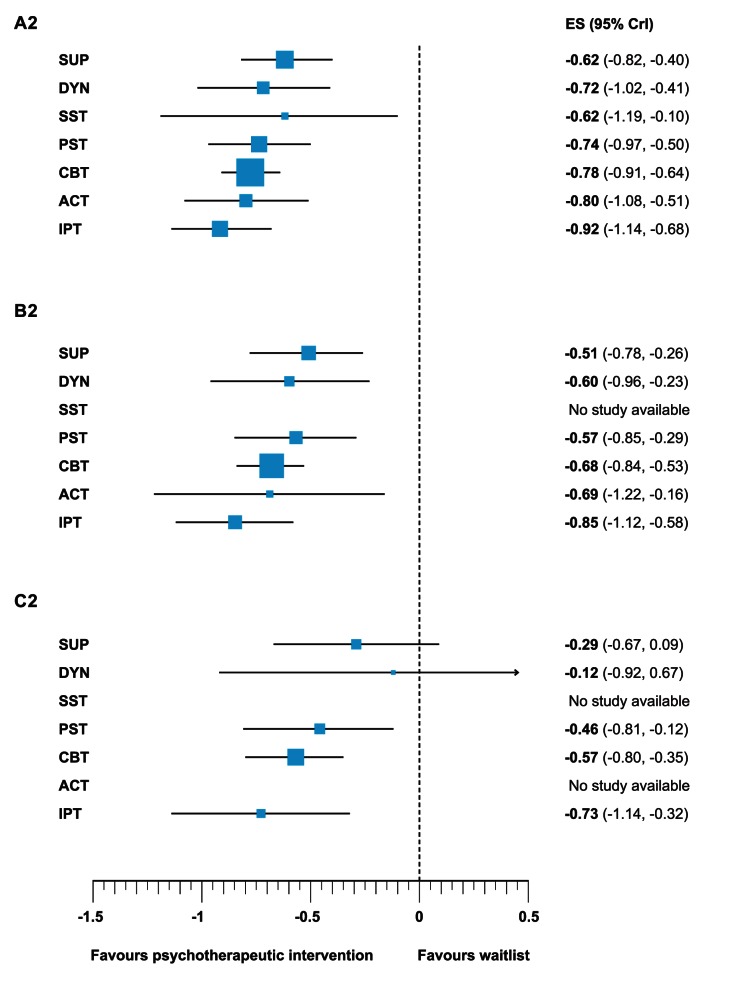
BACKGROUND: Previous meta-analyses comparing the efficacy of psychotherapeutic interventions for depression were clouded by a limited number of within-study treatment comparisons. This study used network meta-analysis, a novel methodological approach that integrates direct and indirect evidence from randomised controlled studies, to re-examine the comparative efficacy of seven psychotherapeutic interventions for adult depression. METHODS AND FINDINGS: We conducted systematic literature searches in PubMed, PsycINFO, and Embase up to November 2012, and identified additional studies through earlier meta-analyses and the references of included studies. We identified 198 studies, including 15,118 adult patients with depression, and coded moderator variables. Each of the seven psychotherapeutic interventions was superior to a waitlist control condition with moderate to large effects (range d = -0.62 to d = -0.92). Relative effects of different psychotherapeutic interventions on depressive symptoms were absent to small (range d = 0.01 to d = -0.30). Interpersonal therapy was significantly more effective than supportive therapy (d = -0.30, 95% credibility interval [CrI] [-0.54 to -0.05]). Moderator analysis showed that patient characteristics had no influence on treatment effects, but identified aspects of study quality and sample size as effect modifiers. Smaller effects were found in studies of at least moderate (Δd = 0.29 [-0.01 to 0.58]; p = 0.063) and large size (Δd = 0.33 [0.08 to 0.61]; p = 0.012) and those that had adequate outcome assessment (Δd = 0.38 [-0.06 to 0.87]; p = 0.100). Stepwise restriction of analyses by sample size showed robust effects for cognitive-behavioural therapy, interpersonal therapy, and problem-solving therapy (all d>0.46) compared to waitlist. Empirical evidence from large studies was unavailable or limited for other psychotherapeutic interventions. CONCLUSIONS: Overall our results are consistent with the notion that different psychotherapeutic interventions for depression have comparable benefits. However, the robustness of the evidence varies considerably between different psychotherapeutic treatments.
Overview
The claims and statistics of this paper haven’t been checked yet.
Free: it reads the open-access text and checks the first 5 claims that cite a source we can check. Create a free account to check every claim.
Integrity signals
Registry
Cites
Statistics
Figures
Verification
Claims the paper makes
The claims and statistics of this paper haven’t been checked yet.
Free: it reads the open-access text and checks the first 5 claims that cite a source we can check. Create a free account to check every claim.
Claims other papers make about this one
Each is checked against this paper’s own text: does it say what the citing paper says it does?
The source backs part of the claim, not all of it — or backs it for a different population, condition or comparison.
In the citing paper
“all psychotherapeutic interventions were superior to psychological control conditions.28”
From Comparative efficacy and acceptability of antidepressants, psychotherapies, and their combination for acute treatment of children and adolescents with depressive disorder: a systematic review and network meta-analysis (2020) · cites this paper as [28]
Experimental — accuracy not yet measuredThe source backs part of the claim, not all of it — or backs it for a different population, condition or comparison.
In the citing paper
“Network meta-analyses revealed the same phenomenon with psychotherapy: researchers once concluded there was a dodo bird verdict, whereby “everybody has won, and all must have prizes,”67 until network meta-analyses showed some interventions were robustly more effective than others.6 26”
From Effect of exercise for depression: systematic review and network meta-analysis of randomised controlled trials (2024) · cites this paper as [26]
Experimental — accuracy not yet measuredThe source backs part of the claim, not all of it — or backs it for a different population, condition or comparison.
In the citing paper
“Barth and associates (2013) did not find a significant difference between CBT and behavioral activation therapy for treating depression, but they did find a significant difference between interpersonal psychotherapy and supportive counseling (d = -0.16;95% CI, -0.33 to 0.22).”
From The Role of Common Factors in Psychotherapy Outcomes (2019) · cites this paper as Barth et al. 2013
Experimental — accuracy not yet measuredThe source backs part of the claim, not all of it — or backs it for a different population, condition or comparison.
In the citing paper
“Despite varying theoretical rationales of different therapeutic approaches, they lead to similar outcomes (Barth et al., 2013).”
From TONI - One for all? Participatory development of a transtheoretic and transdiagnostic online intervention for blended care (2024) · cites this paper as Barth et al., 2013
Experimental — accuracy not yet measuredThe cited source says what the claim attributes to it.
In the citing paper
“It is notable, too, that the authors included Internet-delivered therapies and those delivered face to face, together with studies of participants whose primary disorder was a medical condition, resulting in a more heterogeneous set of populations and interventions than those included in the current review.”
From 'Third wave' cognitive and behavioural therapies versus treatment as usual for depression (2013) · cites this paper as Barth 2013
10 more claims about this paper
Create a free account to see every claim other papers make about this one.
Self-check
Percentages, sums and reported differences re-computed from the paper’s own numbers.
The self-check needs the paper’s full text.
Citations
Cites
Statistical power analysis for the behavioral sciences
(1990) · Computers, Environment and Urban Systems · doi:10.1016/0198-9715(90)90050-4 · Cited by 65,269
Projections of Global Mortality and Burden of Disease from 2002 to 2030
Mathers, C. D., & Loncar, D. (2006) · PLoS Medicine · doi:10.1371/journal.pmed.0030442 · Cited by 11,386
Statistical Methods for Meta-Analysis
Wasserman, S., Hedges, L. V., & Olkin, I. (1988) · Journal of Educational Statistics · doi:10.2307/1164953 · Cited by 10,326
Cognitive Therapy for Depression: (675542012-001)
(2012) · PsycEXTRA Dataset · doi:10.1037/e675542012-001 · Cited by 9,663
(2000) · Cited by 9,198
General methods for monitoring convergence of iterative simulations
Brooks, S. P., & Gelman, A. (1998) · Journal of Computational and Graphical Statistics · doi:10.1080/10618600.1998.10474787 · Cited by 6,045 · cited 1×
“Convergence of Markov chains was considered achieved when plots of the Gelman-Rubin statistics indicated that widths of pooled runs and individual runs stabilised around the same value and their ratio was around one [40].”
MethodSchulz (1995) · doi:10.1001/jama.1995.03520290060030 · Cited by 5,634
Assessing the quality of controlled clinical trials
Jüni, P., Altman, D. G., & Egger, M. (2001) · BMJ · doi:10.1136/bmj.323.7303.42 · Cited by 3,309 · cited 1×
“The quality of primary studies potentially threatens the validity of meta-analyses [23–25].”
BackgroundSelf-citationWood, L., Egger, M., Gluud, L. L., Schulz, K. F., Jüni, P., Altman, D. G., Gluud, C., Martin, R. M., Wood, A. J. G., & Sterne, J. A. C. (2008) · BMJ · doi:10.1136/bmj.39465.451748.ad · Cited by 2,538 · cited 1×
“, if analysis is not intention-to-treat), and lack of blinding of outcome assessors [26–28] are known to have a biasing effect.”
BackgroundSelf-citationCombination of direct and indirect evidence in mixed treatment comparisons
Lu, G., & Ades, A. E. (2004) · Statistics in Medicine · doi:10.1002/sim.1875 · Cited by 2,166 · cited 2×
“For the network meta-analysis, we used an extension of this model to compare various interventions [20,38].”
Method
Cited by
Items 401–500 of 570
Development of the Japanese version of the Depression Literacy Scale
Imano, T., Yokoyama, K., Itoh, H., Shoji, E., & Asano, K. (2022) · International Journal of Social Psychiatry · doi:10.1177/00207640211057728 · Cited by 3
“This result could indicate that psychiatrists in Japan consider counseling to be as effective as cognitive behavioral therapy for depression; indeed, authors such as Barth et al. (2013) have reported that both these measures can effectively reduce depressive symptoms.”
ResultJonas, M., Kerwer, M., Stoll, M., Benz, G., & Chasiotis, A. (2024) · PLoS ONE · doi:10.1371/journal.pone.0300675 · Cited by 3
Dardas, L. A., Habashneh, R., Keyan, D., Ali, A., Saleh, R., Aqel, I. S., Abualhaija, A., & Bryant, R. A. (2025) · Nursing and Health Sciences · doi:10.1111/nhs.70054 · Cited by 4
Kalamatianos, A., Kounenou, K., & Pezirkianidis, C. (2025) · Healthcare · doi:10.3390/healthcare13050511 · Cited by 6
Queirazza, F., & Philiastides, M. G. (2025) · npj Mental Health Research · doi:10.1038/s44184-025-00165-3 · Cited by 2
Schene, A. H. (2014) · Journal of Depression & Anxiety · doi:10.4172/2167-1044.s2-001 · Cited by 2
“Given the effect sizes it is not unreasonable to expect that we might have found more statistical significant effects of treatment type with a larger sample size although such a larger sample size might reduce effect sizes [11].”
„Cognitive Behavioral Analysis System of Psychotherapy“: Psychotherapie bei chronischer Depression
Wambach, K., & Schramm, E. (2016) · Psychotherapeut · doi:10.1007/s00278-016-0080-9 · Cited by 2
Kva klinisk nytte har me av dagens psykiatriske diagnosar - og kva er alternativet?
Aarre, T. F., & Larsen, K. Ø. (2017) · Tidsskrift for psykisk helsearbeid · doi:10.18261/issn.1504-3010-2017-01-02 · Cited by 2
Guven, E., & Gökçe, G. (2018) · Turkish Journal of Psychiatry · doi:10.5080/u22706 · Cited by 12
Thiel, C., Richter, C., Samos, F.-A. Z., Heise, M., Frese, T., & Fankhänel, T. (2021) · Journal of Occupational Medicine and Toxicology · doi:10.1186/s12995-021-00306-2 · Cited by 2
Emotion-Centered Problem-Solving Therapy
Nezu, A. M., Nezu, C. M., Gerber, H. R., & Damico, J. L. (2021) · Elsevier eBooks · doi:10.1016/b978-0-12-818697-8.00201-6 · Cited by 8
Kuzminskaite, E., Lemmens, L. H. J. M., van Bronswijk, S. C., Peeters, F. P. M. L., & Huibers, M. J. H. (2021) · American Journal of Psychotherapy · doi:10.1176/appi.apt.2020.2020.0042 · Cited by 8
Sarabandi, H., Toozandehjani, H., & Nejat, H. (2019) · Journal of North Khorasan University of Medical Sciences · doi:10.52547/nkums.11.1.44 · Cited by 2
Gajic‐Veljanoski, O., Sanyal, C., McMartin, K., Xie, X., Walter, M. C., Higgins, C., Sikich, N., Dhalla, I. A., & Ng, V. (2018) · Canadian Psychology/Psychologie canadienne · doi:10.1037/cap0000155 · Cited by 3
Penedo, J. M. G., Krieger, T., Koditek, M. C., & Holtforth, M. G. (2020) · Journal of Behavior Therapy and Experimental Psychiatry · doi:10.1016/j.jbtep.2020.101576 · Cited by 2
Humanistische und experientielle Psychotherapieverfahren
Gaab, J., Ziem, M., & Flückiger, C. (2020) · Springer eBooks · doi:10.1007/978-3-662-61814-1_17 · Cited by 2
Is Non-invasive Brain Stimulation the Low-Hanging Fruit?
de Graaf, T. A., Janssens, S. E. W., & Sack, A. T. (2021) · Springer eBooks · doi:10.1007/978-3-030-62351-7_8 · Cited by 2
Psychopathy and Mood Disorders
Dargis, M. A. (2022) · Dangerous behavior in clinical and forensic psychology · doi:10.1007/978-3-030-83156-1_8 · Cited by 2
Bockting, C. (2015) · Utrecht University Repository (Utrecht University) · Cited by 2
Beelmann, A., & Heinrichs, N. (2015) · Elsevier eBooks · doi:10.1016/b978-0-08-097086-8.21081-7 · Cited by 2
Behr, S., Fenski, F., Böttcher, J., Knaevelsrud, C., Hammelrath, L., Kovacs, G., Schirmer, W., Becker, P., & Schaeuffele, C. (2023) · doi:10.31234/osf.io/8xu5z · Cited by 2
Another Interpersonal Psychotherapy Milestone
Markowitz, J. C. (2014) · American Journal of Psychotherapy · doi:10.1176/appi.psychotherapy.2014.68.4.355 · Cited by 2
Selinheimo, S., Gluschkoff, K., Kausto, J., Turunen, J., & Väänänen, A. (2025) · BMC Psychiatry · doi:10.1186/s12888-025-07140-4 · Cited by 2
“Despite that psychotherapy is among the most effective treatments for depressive and anxiety disorders [5–9], relatively few studies have established psychotherapy’s effectiveness on work disability [10, 11] and even less is known about the relationship between various psychotherapy orientations…”
Resolving the Personalisation Agenda in Psychological Therapy Through a Biomedical Approach
Seymour, J. (2025) · BioMed · doi:10.3390/biomed5030019 · Cited by 1
“In psychological therapy research, NMA has been used since 2012 [42] to create hierarchies of different genres of therapy, including comparing CBT with trauma-based therapies, and has been thought to be able to address current gaps in research including the personalisation agenda by re-analysis of…”
von Cederwald, A. F., Salomonsson, S., Isacsson, N. H., & Kaldo, V. (2025) · BMC Health Services Research · doi:10.1186/s12913-025-13232-4 · Cited by 1
Dølven, S., Moroń, M., Eriksen, I., Toft, J. E. G., & Semkovska, M. (2025) · Neuropsychology Review · doi:10.1007/s11065-025-09686-2 · Cited by 2
Yoga for Chronic Depressive Symptoms in Pregnancy: A Commentary and Call to Action
Kinser, P. (2015) · Journal of Yoga & Physical Therapy · doi:10.4172/2157-7595.1000197 · Cited by 1
“Other studies have revealed that only 22% of individuals with moderate-severe symptoms receive adequate treatment11 and the majority of those treated with UC experience recurrences and/or discontinue treatment before achieving remission or response [3,3941].”
BackgroundSimpson, A., & Brennan, G. H. (2025) · Oxford University Press eBooks · doi:10.1093/med/9780192864048.003.0008 · Cited by 1
Η θεραπευτική σχέση στη συστημική θεραπεία
Papastylianou, A. (2021) · Psychology the Journal of the Hellenic Psychological Society · doi:10.12681/psy_hps.26874 · Cited by 1
Context sensitivity: A prognostic patient characteristic for digital psychotherapy
Hull, T. D. (2021) · doi:10.7916/d8-ymp7-ny97 · Cited by 1
Benkert, O. (2014) · Springer eBooks · doi:10.1007/978-3-642-54769-0_1 · Cited by 1
A-Tjak, J. G. L., & Hayes, L. (2022) · Oxford University Press eBooks · doi:10.1093/oxfordhb/9780197550076.013.14 · Cited by 2
Second Wave Treatment for Depressive Disorders
Chong, A. K., Molaie, A. M., & Fisher, J. E. (2022) · Springer eBooks · doi:10.1007/978-3-031-11677-3_16 · Cited by 1
Goldwaser, E. L., & Aaronson, S. T. (2023) · Springer eBooks · doi:10.1007/978-3-031-15401-0_17 · Cited by 3
Kumari, D., & Kelkar, P. (2023) · Industrial Psychiatry Journal · doi:10.4103/ipj.ipj_245_23 · Cited by 1
“[4,5] This 38-year-old graduate, married, Hindu, female, baker by profession, of middle socioeconomic status from an urban area was brought to the outpatient department by her husband and sister-in-law for her persistent low mood, crying spells, suicidal thoughts, lack of interest in daily…”
Ramfjord, L. S., Kahn, N., Langsrud, K., Halvorsen, J. Ø., Morken, G., Saksvik, S. B., Engvik, L. S. S., Lydersen, S., & Kallestad, H. (2024) · BMJ Open · doi:10.1136/bmjopen-2023-076039 · Cited by 1
“15 16 As such, TAU can be regarded as an adequate control condition controlling for placebo effects.”
BackgroundYazdian, F. A., & Khodabakhshi‐Koolaee, A. (2024) · SAGE Open · doi:10.1177/21582440241257320 · Cited by 4
“Some efforts have been made to prove the positive effects of psychotherapy (Barth et al., 2013).”
Hattori, A., & Otsuka, Y. (2024) · Discover Psychology · doi:10.1007/s44202-024-00285-5 · Cited by 1
Provision of mental health interventions in women's centres: An exploratory study
Hatchett, V., Pybis, J., Tebbet‐Duffin, U., & Rowland, N. (2015) · Counselling and Psychotherapy Research · doi:10.1002/capr.12026 · Cited by 4
Berger, D. (2015) · F1000Research · doi:10.12688/f1000research.6954.1 · Cited by 2
Complex Cases of Comorbid Depression and Personality Disorder (PD)
Veluri, R., & Nguyen, V. P. K. H. (2018) · Springer eBooks · doi:10.1007/978-3-319-70311-4_13 · Cited by 1
Emerging models of psychotherapy
Spedding, M. F., & Chibanda, D. (2019) · Elsevier eBooks · doi:10.1016/b978-0-12-814932-4.00006-9 · Cited by 2
Velázquez, R. G. (2019) · Cited by 1
Blanchet, V., & Provencher, M. D. (2020) · Santé mentale au Québec · doi:10.7202/1070239ar · Cited by 1
How do we help people regain control over their lives? An introduction to method of levels therapy
Grzegrzółka, J., & Mansell, W. (2021) · Psychiatria i Psychologia Kliniczna · doi:10.15557/pipk.2021.0005 · Cited by 1
Cardozo, B. L., & Mollica, R. F. (2018) · Cambridge University Press eBooks · doi:10.1017/9781107477261.029 · Cited by 1
Neuropsychopharmacotherapy: Complementary Treatments
Moises, H. W. (2022) · Springer eBooks · doi:10.1007/978-3-030-62059-2_23 · Cited by 1
The economic value of depression treatmentin the Netherlands
van Geldrop, A. (2013) · Cited by 1
How do integrative psychotherapists integrate? A qualitative exploration of tales from the trenches
Finnerty, M. (2014) · Middlesex University Research Repository (Middlesex University Of London) · Cited by 1
Marcolongo, E. M. (2014) · Digital Commons - University of South Florida (University of South Florida) · Cited by 4
Donzelli, A., Schivalocchi, A., & Giudicatti, G. (2018) · Osteoporosis International · doi:10.1007/s00198-018-4681-8 · Cited by 1
Lorenzo‐Luaces, L., Wiedemann, M., Huibers, M. J. H., & Lemmens, L. H. J. M. (2020) · doi:10.31234/osf.io/jbzw3 · Cited by 1
Brown, M. J. (2021) · Minds at UW (University of Wisconsin) · Cited by 1
Jankowsky, K., Zimmermann, J., Jaeger, U., Mestel, R., & Schroeders, U. (2023) · doi:10.31234/osf.io/nhs6c · Cited by 1
Straszewski, T., & Siegel, J. T. (2025) · Wiley eBooks · doi:10.1002/9781394179909.ch26 · Cited by 1
Missed opportunities in social media to reduce maternal health disparities for Black women
George, N. (2022) · Scholars Archive - University at Albany (University at Albany, State University of New York) · doi:10.54014/eycn-grne · Cited by 2
PET studies of the serotonin system in major depression and its treatment
Tiger, M. (2014) · Figshare
Karlin, B. E. (2015) · Depression and Anxiety · doi:10.1002/da.22438
“have been developed for a broad array of mental and behavioral health conditions and shown in rigorous, controlled research studies to be efficacious.[1, 2] Moreover, increasing evidence accumulated over the past 10 years has led many evidence-based psychotherapies (EBPs)—psychotherapies validated in randomized contro…”
BackgroundUn modello di counseling interpersonale per la depressione in medicina generale
Berardi, D., Menchetti, M., & Mongelli, F. (2014) · RIVISTA SPERIMENTALE DI FRENIATRIA · doi:10.3280/rsf2014-001006
Review: different psychotherapies have comparable effects on adult depression
Arnow, B. A. (2013) · Evidence-Based Mental Health · doi:10.1136/eb-2013-101522
Verhaltenstherapie und interpersonelle Psychotherapie zeigen robuste Effekte
Wagner, S. (2013) · InFo Neurologie + Psychiatrie · doi:10.1007/s15005-013-0336-7
All Psychotherapies Equally Effective for Depression
Roy‐Byrne, P. (2013) · Journal watch · doi:10.1056/nejm-jw.na31260
De toekomst van de psychotherapie en de psychotherapeut: De rol van e-mental health
van Lankveld, J. J. D. M. (2015) · Tijdschrift voor Psychotherapie · doi:10.1007/s12485-015-0101-0 · Cited by 1
A rejoinder from Gerger and colleagues
Gerger, H., Münder, T., & Barth, J. (2014) · Psychological Medicine · doi:10.1017/s0033291714002037
“…risk of bias that is typically associated with small samples (Egger et al. 1997; Sterne et al. 2000; Cuijpers et al. 2010a, b; Nüesch et al. 2010; Barth et al. 2013; Watts et al. 2013), we do not believe that the authors aimed at fundamentally questioning the relevance of sample size as a…”
BackgroundSelf-citationRelationship Senescence: Biosocial Factors Affecting Relationships
Roberts, T. W., Booth, J., & Beach, S. (2016) · The Family Journal · doi:10.1177/1066480716648699 · Cited by 1
Cuijpers, P. J. (2015)
Self-citationRenner, F. (2014) · Research Publications (Maastricht University) · doi:10.26481/dis.20141024fr
McGrath, R. E., & O’Donohue, W. (2015) · Springer eBooks · doi:10.1007/978-3-319-19036-5_6
Hormonal and reproductive effects
Castle, D. J., & Abel, K. M. (2015) · Cambridge University Press eBooks · doi:10.1017/cbo9781107045132.009
Psychotherapie oder Psychopharmakotherapie oder Kombinationstherapie?
Brunner, J. (2016) · Psychotherapeut · doi:10.1007/s00278-016-0112-5
“Die Effekte für die psychodynamische Psychotherapie waren in der Metaanalyse von Barth et al. (2013) weniger robust.”
BackgroundInfluentialLa TCC et la TIP dans la pratique du psychiatre
Neveux, N. (2015) · European Psychiatry · doi:10.1016/j.eurpsy.2015.09.345
Yoga and Adolescent Psychological Health, Depressive Symptoms, and Flourishing
Schulte, E. C. (2015) · IRL - University of Missouri, St. Louis (University of Missouri–St. Louis) · Cited by 4
Prinzipien der Methodik empirischer Forschung in der Psychiatrie
Möller, H., & Broich, K. (2017) · Springer eBooks · doi:10.1007/978-3-662-49295-6_18
Sabatelli, P. J. (2016) · Texila International Journal of Psychology · doi:10.21522/tijpy.2016.01.02.art001
“It may also be no more effective than other types of psychological therapies for depression [3] including third wave CBT therapies [4].”
BackgroundPsychoanalyse, psychoanalytische psychotherapie en wetenschappelijke evidentie
Draijer, N., & Langeland, W. (2017) · Tijdschrift voor Psychotherapie · doi:10.1007/s12485-016-0170-8
Screening for Depression Through a Glass Darkly—Reply
Olfson, M., Blanco, C., & Marcus, S. C. (2017) · JAMA Internal Medicine · doi:10.1001/jamainternmed.2016.9287
Promoting Self‐Efficacy in Managing Major Depression
Richmond, G. (2017) · Wiley eBooks · doi:10.1002/9781119378785.ch8
O’Shields, J., Purser, G. L., Mowbray, O. P., & Grinnell‐Davis, C. (2017) · Social Work Research · doi:10.1093/swr/svx013
Psychotherapie, Psychopharmakotherapie oder Kombinationstherapie?
Brunner, J. (2017) · DNP - Der Neurologe und Psychiater · doi:10.1007/s15202-017-1507-z
Varieties of Psychotherapy for Major Depressive Disorder in Adults
David, D., Cristea, I. A., & Beck, A. T. (2017) · Wiley eBooks · doi:10.1002/9781119462996.ch2 · Cited by 1
de Manincor, & Michael, J. (2017) · Cited by 2
Bibliometric Analysis of Psychological Literature Based on Web of Science Data
Chao, C. (2018) · International Conference on Education, Economics and Management Research (ICEEMR) · doi:10.2991/iceemr-18.2018.133
Yager, E. K. (2018) · Journal of Psychology Research · doi:10.17265/2159-5542/2018.06.001
Pedersen, E. R., Kandrack, R., Danz, M., Motala, A., Booth, M. J., Larkin, J., & Hempel, S. (2018) · Rand health quarterly · doi:10.7249/rhq-09-01-06
Differenzielle Therapieentscheidung bei unipolaren Depressionen
Gärtner, T., & Voderholzer, U. (2018) · DNP - Der Neurologe und Psychiater · doi:10.1007/s15202-018-2092-5
Cognitieve therapie: Theorie en praktijk
(2019) · Bohn Stafleu van Loghum eBooks · doi:10.1007/978-90-368-2021-9 · Cited by 1
Temple, J. (2019) · University of Liverpool · doi:10.17638/03033174
Tarai, S. (2019) · Advances in medical technologies and clinical practice book series · doi:10.4018/978-1-5225-8567-1.ch010
Dealy, J. A. (2019) · OpenCommons - UConn (University of Connecticut)
Gómez, M. Z., Isaza, D. V., & Gómez, J. R. M. (2019) · Medicina UPB · doi:10.18566/medupb.v38n2.a08
Long-term efficacy of psychotherapy in major depression: protocol of a network meta-analysis
Vieira, P. M., & Cunha, C. A. C. (2019) · The Psychologist Practice & Research Journal · doi:10.33525/pprj.v2i1.35
“In contrast, in the study by Braun et al. (2013), when comparing FUP between one and 24 months (between psychodynamic therapy and interpersonal therapy), and in the study by Driessen et al. (2015), of short-term psychodynamic psychotherapy comparing other psychotherapies, including CBT, with FUP…”
ResultGrahovac, T., Crepulja, M. L., Stevanović, A., Ružić, K., Rončević-Gržeta, I., & Došen, A. (2019) · The European Journal of Psychiatry · doi:10.1016/j.ejpsy.2019.11.001
Вавилонская башня психотерапии
Vasilenko, D., Кучеренко, В. В., & Петренко, В. Ф. (2020) · Психология Журнал Высшей школы экономики · doi:10.17323/1813-8918-2020-1-10-26
Neuropsychopharmacotherapy: Complementary Treatments
Moises, H. W. (2020) · Springer eBooks · doi:10.1007/978-3-319-56015-1_23-1
Personalized treatment strategies for depression
van Bronswijk, S. C. (2020) · Research Publications (Maastricht University) · doi:10.26481/dis.20201211sb
Lithium carbonate toxicity in an elderly patient: a case report
Bhardwaj, A., Roy, V., Ghadlinge’s, M. S., & Dua, A. (2021) · International Journal of Basic & Clinical Pharmacology · doi:10.18203/2319-2003.ijbcp20212091
“Barth et al suggest that damage may be widespread and persist with neurological toxicity due to accumulation and rebound at CNS level.(7)”
BackgroundInfluentialKučuk, I., Beddoe, L., & Noetel, M. (2021) · PsyArXiv (OSF Preprints) · doi:10.31234/osf.io/3jtsq
Technological Interventions for Depression
Cuijpers, P. J., Karyotaki, E., & Riper, H. M. (2020) · Elsevier eBooks · doi:10.1016/b978-0-12-818697-8.00027-3
Self-citationWeitere wissenschaftlich fundierte Psychotherapiemethoden und -verfahren
Backenstraß, M., Bosch, J., Cornelisse, S., Gloster, A. T., Heidenreich, T., Lindenmeyer, J., Michalak, J., Rinner, M. T. B., Schmahl, C. G., & Schramm, E. (2021) · Elsevier eBooks · doi:10.1016/b978-3-437-22601-4.00034-6
Metadata
- Authors
- Barth, J., Munder, T., Gerger, H., Nüesch, E., Trelle, S., Znoj, H., Jüni, P., & Cuijpers, P.
- Affiliations
- University of Bern (CH)
- Vrije Universiteit Amsterdam (NL)
- Corresponding author
- Barth, Jürgen
- Venue
- PLoS Medicine
- Publisher
- Public Library of Science (PLoS)
- Published
- 2013-05-28
- Volume
- 10
- Issue
- 5
- Pages
- e1001454
- ISSN
- 1549-1277 (ISSN-L)
- 1549-1676
- PMC
- PMC3665892
- OpenAlex
- W2114536224
- Cited by
- 569
- References
- 63
- Citations by year
- 2026: 14 · 2025: 21 · 2024: 40 · 2023: 26 · 2022: 31 · 2021: 61 · 2020: 62 · 2019: 69 · 2018: 44 · 2017: 47 · 2016: 40 · 2015: 57 · 2014: 44 · 2013: 11
- FWCI
- 55.87
- Type
- journal article
- Language
- en
- Open access
- gold
- doi.org
- Locations
- PLoS Medicine (publishedVersion, cc-by)
- Europe PMC (PubMed Central) (publishedVersion, cc-by)
- PubMed Central (publishedVersion, cc-by)
- PubMed (publishedVersion)
- EUR Research Repository (Erasmus University Rotterdam) (publishedVersion)
- DSpace (Open University in the Netherlands) (publishedVersion, other-oa)
- LSHTM Research Online (London School of Hygiene and Tropical Medicine) (acceptedVersion)
- RePEc: Research Papers in Economics (submittedVersion, cc-by)
- Data Archiving and Networked Services (DANS) (submittedVersion, other-oa)
- EUR Research Repository (Erasmus University Rotterdam) (submittedVersion)
- BORIS (University Library Bern) (submittedVersion, cc-by)
- Digital Academic REpository of VU University Amsterdam (Vrije Universiteit Amsterdam) (submittedVersion)
- DOAJ (DOAJ: Directory of Open Access Journals) (submittedVersion, cc-by-sa)
- edoc (University of Basel) (submittedVersion)
- Multilingual Matters (Channel View Publications) (submittedVersion, cc-by)
- VU Research Portal (submittedVersion, other-oa)
- Funders
- National Science Foundation
- Amgen
- Eli Lilly and Company
- AstraZeneca
- University of Bern
- Ablynx
- Schweizerischer Nationalfonds zur Förderung der Wissenschaftlichen Forschung (118312, 105314-118312/1, 105314)
- Eisai
- St. Jude Medical
- Abbott Vascular
- Topics
- Social Sciences › Psychology › Clinical Psychology › Psychotherapy Techniques and Applications
- Social Sciences › Psychology › Experimental and Cognitive Psychology › Anxiety, Depression, Psychometrics, Treatment, Cognitive Processes
- Social Sciences › Psychology › Applied Psychology › Digital Mental Health Interventions
- Keywords
- depression, psychotherapeutic interventions, drug efficacy comparison, interpersonal psychotherapy, cognitive behavioral therapy, problem-solving therapy, supportive therapy, waitlist control, sample size, study quality, outcome measurement
- MeSH terms
- Adult, Bayes Theorem, Depression, Female, Humans, Male, Markov Chains, Psychotherapy, Treatment Outcome, Evidence-Based Medicine
About these checks
Registry, retraction, Cites and statistics results are computed, not judged, with one exception: a printed reference that no index lists is read once by a model before it counts as a citation error. Claims are extracted by a model and kept only when their quote appears verbatim in the text; each cited source is then checked, with a model’s help, for whether it says what the claim relies on. Those verdicts can be wrong — read the claim’s quote and the cited source before relying on one.
Statistics and arithmetic are recomputed, not judged.
Confidence bands are shown only for fields calibrated on our annotated test set. None is calibrated yet, so no band is shown.
What counts as a claim ›How we measure confidence ›How we check this ›
Are you an author, or do you see a problem with this page? Request a review
Data sources
Bibliographic data: Semantic Scholar, OpenAlex, Crossref.
Contains information from the Semantic Scholar Academic Graph Datasets, made available under the ODC Attribution License (ODC-BY 1.0).
Semantic Scholar’s data is described in: Kinney, R., et al. (2023). The Semantic Scholar Open Data Platform. arXiv:2301.10140.
