

Comparative Efficacy of Seven Psychotherapeutic Interventions for Patients with Depression: A Network Meta-Analysis
Open accessThe DOI matches its Crossref record; 62 of the 63 references it cites were found in a registry or an index.
Abstract
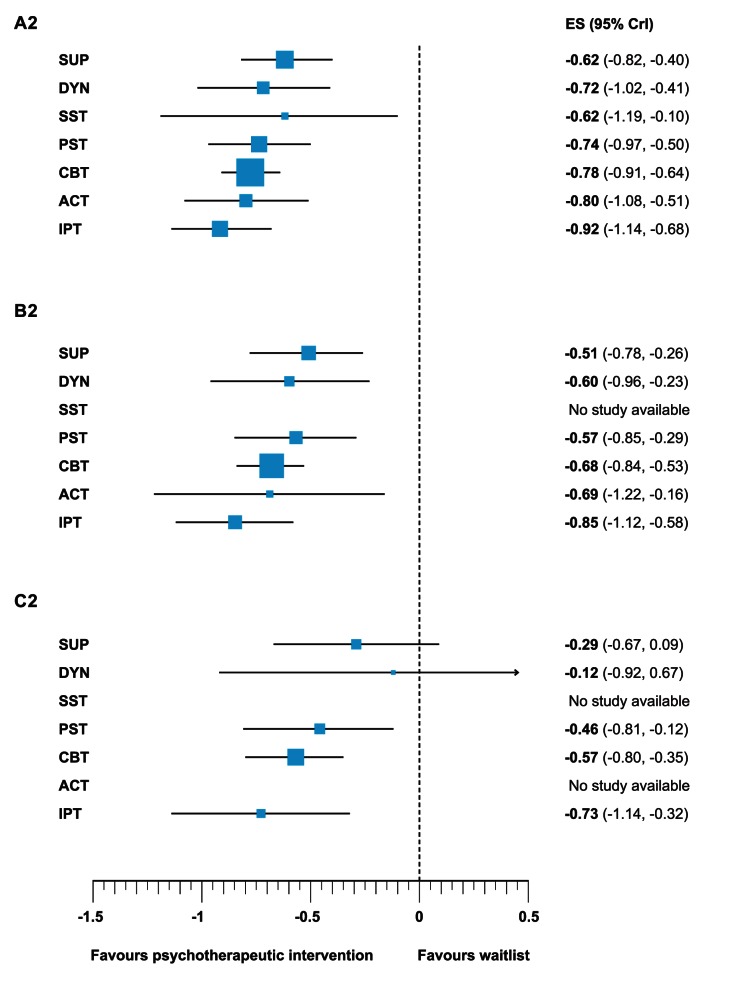
BACKGROUND: Previous meta-analyses comparing the efficacy of psychotherapeutic interventions for depression were clouded by a limited number of within-study treatment comparisons. This study used network meta-analysis, a novel methodological approach that integrates direct and indirect evidence from randomised controlled studies, to re-examine the comparative efficacy of seven psychotherapeutic interventions for adult depression. METHODS AND FINDINGS: We conducted systematic literature searches in PubMed, PsycINFO, and Embase up to November 2012, and identified additional studies through earlier meta-analyses and the references of included studies. We identified 198 studies, including 15,118 adult patients with depression, and coded moderator variables. Each of the seven psychotherapeutic interventions was superior to a waitlist control condition with moderate to large effects (range d = -0.62 to d = -0.92). Relative effects of different psychotherapeutic interventions on depressive symptoms were absent to small (range d = 0.01 to d = -0.30). Interpersonal therapy was significantly more effective than supportive therapy (d = -0.30, 95% credibility interval [CrI] [-0.54 to -0.05]). Moderator analysis showed that patient characteristics had no influence on treatment effects, but identified aspects of study quality and sample size as effect modifiers. Smaller effects were found in studies of at least moderate (Δd = 0.29 [-0.01 to 0.58]; p = 0.063) and large size (Δd = 0.33 [0.08 to 0.61]; p = 0.012) and those that had adequate outcome assessment (Δd = 0.38 [-0.06 to 0.87]; p = 0.100). Stepwise restriction of analyses by sample size showed robust effects for cognitive-behavioural therapy, interpersonal therapy, and problem-solving therapy (all d>0.46) compared to waitlist. Empirical evidence from large studies was unavailable or limited for other psychotherapeutic interventions. CONCLUSIONS: Overall our results are consistent with the notion that different psychotherapeutic interventions for depression have comparable benefits. However, the robustness of the evidence varies considerably between different psychotherapeutic treatments.
Overview
The claims and statistics of this paper haven’t been checked yet.
Free: it reads the open-access text and checks the first 5 claims that cite a source we can check. Create a free account to check every claim.
Integrity signals
Registry
Cites
Statistics
Figures
Verification
Claims the paper makes
The claims and statistics of this paper haven’t been checked yet.
Free: it reads the open-access text and checks the first 5 claims that cite a source we can check. Create a free account to check every claim.
Claims other papers make about this one
Each is checked against this paper’s own text: does it say what the citing paper says it does?
The source backs part of the claim, not all of it — or backs it for a different population, condition or comparison.
In the citing paper
“all psychotherapeutic interventions were superior to psychological control conditions.28”
From Comparative efficacy and acceptability of antidepressants, psychotherapies, and their combination for acute treatment of children and adolescents with depressive disorder: a systematic review and network meta-analysis (2020) · cites this paper as [28]
Experimental — accuracy not yet measuredThe source backs part of the claim, not all of it — or backs it for a different population, condition or comparison.
In the citing paper
“Network meta-analyses revealed the same phenomenon with psychotherapy: researchers once concluded there was a dodo bird verdict, whereby “everybody has won, and all must have prizes,”67 until network meta-analyses showed some interventions were robustly more effective than others.6 26”
From Effect of exercise for depression: systematic review and network meta-analysis of randomised controlled trials (2024) · cites this paper as [26]
Experimental — accuracy not yet measuredThe source backs part of the claim, not all of it — or backs it for a different population, condition or comparison.
In the citing paper
“Barth and associates (2013) did not find a significant difference between CBT and behavioral activation therapy for treating depression, but they did find a significant difference between interpersonal psychotherapy and supportive counseling (d = -0.16;95% CI, -0.33 to 0.22).”
From The Role of Common Factors in Psychotherapy Outcomes (2019) · cites this paper as Barth et al. 2013
Experimental — accuracy not yet measuredThe source backs part of the claim, not all of it — or backs it for a different population, condition or comparison.
In the citing paper
“Despite varying theoretical rationales of different therapeutic approaches, they lead to similar outcomes (Barth et al., 2013).”
From TONI - One for all? Participatory development of a transtheoretic and transdiagnostic online intervention for blended care (2024) · cites this paper as Barth et al., 2013
Experimental — accuracy not yet measuredThe cited source says what the claim attributes to it.
In the citing paper
“It is notable, too, that the authors included Internet-delivered therapies and those delivered face to face, together with studies of participants whose primary disorder was a medical condition, resulting in a more heterogeneous set of populations and interventions than those included in the current review.”
From 'Third wave' cognitive and behavioural therapies versus treatment as usual for depression (2013) · cites this paper as Barth 2013
10 more claims about this paper
Create a free account to see every claim other papers make about this one.
Self-check
Percentages, sums and reported differences re-computed from the paper’s own numbers.
The self-check needs the paper’s full text.
Citations
Cites
Statistical power analysis for the behavioral sciences
(1990) · Computers, Environment and Urban Systems · doi:10.1016/0198-9715(90)90050-4 · Cited by 65,269
Projections of Global Mortality and Burden of Disease from 2002 to 2030
Mathers, C. D., & Loncar, D. (2006) · PLoS Medicine · doi:10.1371/journal.pmed.0030442 · Cited by 11,386
Statistical Methods for Meta-Analysis
Wasserman, S., Hedges, L. V., & Olkin, I. (1988) · Journal of Educational Statistics · doi:10.2307/1164953 · Cited by 10,326
Cognitive Therapy for Depression: (675542012-001)
(2012) · PsycEXTRA Dataset · doi:10.1037/e675542012-001 · Cited by 9,663
(2000) · Cited by 9,198
General methods for monitoring convergence of iterative simulations
Brooks, S. P., & Gelman, A. (1998) · Journal of Computational and Graphical Statistics · doi:10.1080/10618600.1998.10474787 · Cited by 6,045 · cited 1×
“Convergence of Markov chains was considered achieved when plots of the Gelman-Rubin statistics indicated that widths of pooled runs and individual runs stabilised around the same value and their ratio was around one [40].”
MethodSchulz (1995) · doi:10.1001/jama.1995.03520290060030 · Cited by 5,634
Assessing the quality of controlled clinical trials
Jüni, P., Altman, D. G., & Egger, M. (2001) · BMJ · doi:10.1136/bmj.323.7303.42 · Cited by 3,309 · cited 1×
“The quality of primary studies potentially threatens the validity of meta-analyses [23–25].”
BackgroundSelf-citationWood, L., Egger, M., Gluud, L. L., Schulz, K. F., Jüni, P., Altman, D. G., Gluud, C., Martin, R. M., Wood, A. J. G., & Sterne, J. A. C. (2008) · BMJ · doi:10.1136/bmj.39465.451748.ad · Cited by 2,538 · cited 1×
“, if analysis is not intention-to-treat), and lack of blinding of outcome assessors [26–28] are known to have a biasing effect.”
BackgroundSelf-citationCombination of direct and indirect evidence in mixed treatment comparisons
Lu, G., & Ades, A. E. (2004) · Statistics in Medicine · doi:10.1002/sim.1875 · Cited by 2,166 · cited 2×
“For the network meta-analysis, we used an extension of this model to compare various interventions [20,38].”
Method
Cited by
Items 501–570 of 570
Salgado, E. (2021) · Purdue e-Pubs (Purdue University System) · doi:10.25394/pgs.15025419.v1
Constructing and applying explanatory models in clinical psychology
Pfeiff, J. S. (2021) · Institutional Repository of Leibniz Universität Hannover (Leibniz Universität Hannover) · doi:10.15488/11363 · Cited by 1
Rakowska, J. M. (2021) · Wydawnictwa Uniwersytetu Warszawskiego eBooks · doi:10.31338/uw.9788323547655 · Cited by 2
刘剑波, 刘志荣, & 倪进发 (2004) · Zhongguo xiao-yi
Aemissegger, V., López‐Alcalde, J., Witt, C. M., & Barth, J. (2022) · doi:10.2196/preprints.36978
Self-citationHötzel, K., & von Brachel, R. (2018) · Springer eBooks · doi:10.1007/978-3-662-54911-7_32
Giraldi, T. (2017) · Springer eBooks · doi:10.1007/978-3-319-57657-2_12
Cognitieve therapie bij depressieve stoornissen
Bockting, C., & Lemmens, L. H. J. M. (2019) · Bohn Stafleu van Loghum eBooks · doi:10.1007/978-90-368-2021-9_4
Bibliography: Depression: Challenges and Treatments
(2016) · FOCUS The Journal of Lifelong Learning in Psychiatry · doi:10.1176/appi.focus.140206
Publication Bias and Psychotherapy
Haushofer, J. (2017) · AEA Randomized Controlled Trials · doi:10.1257/rct.2574
Psychotherapy helps depression
(2013) · Nature · doi:10.1038/499383e
Dinger, U., & Schauenburg, H. (2021) · Elsevier eBooks · doi:10.1016/b978-3-437-22601-4.00005-x · Cited by 1
Prinzipien der Methodik empirischer Forschung in der Psychiatrie
Möller, H., & Broich, K. (2015) · Springer eBooks · doi:10.1007/978-3-642-45028-0_18-1
Bibliography: Psychotherapy: New Evidence and New Approaches
(2014) · FOCUS The Journal of Lifelong Learning in Psychiatry · doi:10.1176/appi.focus.12.3.317
Publication Bias and Psychotherapy
Haushofer, J. (2017) · AEA Randomized Controlled Trials · doi:10.1257/rct.2574-1.0
Exploring the role of health apps in supporting young people with depression: a mixed methods study
Martinengo, L. (2021) · DR-NTU (Nanyang Technological University) · doi:10.32657/10356/157124
Hooper, N. R., Johnson, T., Sachs, M., Silverio, A., Zhu, L., Bhimla, A., Teal, L., Roth, S. C., Lagrotte, C. A., Stravrakis, J., et al. (2022) · CommonHealth · doi:10.15367/ch.v3i2.500
Liu, Y. (2019) · American Educational Research Association Annual Meeting (AERA) · doi:10.3102/1441769
UDVIKLING OG OPDAGELSER I SYSTEMISK TÆNKNING
Barckmann, C. (2021) · Psyke & Logos · doi:10.7146/pl.v42i1.128767
Pursuit of the Miraculous or Just Piling up Confusion
Caldararo, N. (2022) · Springer eBooks · doi:10.1007/978-3-031-13745-7_3
Depressive Disorder Management in Developing Countries
Obeïd, S., Sacre, H., & Hallit, S. R. (2023) · Springer eBooks · doi:10.1007/978-3-030-74786-2_45-1
Combined Psychotherapy and Somatic Treatments
Teo, D. C. L., Silvio, J. R., Condemarín, R., Nair, S. S., Alfonso, C. A., & Tasman, A. (2023) · Springer eBooks · doi:10.1007/978-3-030-42825-9_95-1
Grunert, G. V., & Meline, J. S. J. (2023) · Journal of European Psychology Students · doi:10.59477/jeps.606
Intervenções para tratamento da depressão perinatal
Charles, C. M. (2020) · doi:10.47749/t/unicamp.2020.1162228
Stangier, U., & Arens, E. A. (2015) · Wiley eBooks · doi:10.1002/9781394259229.ch10
How Smoking Became a Moral Issue: A Complex Systems Perspective on MoralizationPreprint
Vanaman, M. (2024) · PsyArXiv (OSF Preprints) · doi:10.31234/osf.io/y6b4x · Cited by 1
Papastylianou, A., & Travasaros, T. (2024) · International Journal of Group Psychotherapy · doi:10.1080/00207284.2024.2303087
“M any researchers have found that different psychotherapeutic approaches, having different theoretical orientations and using different techniques, often have similar results (Barth et al., 2013; Lambert, 2013).”
ResultThe Role of Mindfulness-Based Interventions in Treating Depression among Population Subgroups
Saiuk, N., Kołodziej, M., Kozicz, M. A., Mądry, W., Mazurkiewicz, A., Męczyńska, J., Seredyński, T., Wojciechowska, A., Marcicka, J., & Salasa, W. (2024) · Journal of Education Health and Sport · doi:10.12775/jehs.2024.66.007
Bharti, J., Srivastava, M., & Saxena, Y. (2023) · Journal for ReAttach Therapy and Developmental Diversities · doi:10.53555/jrtdd.v6i1s.2838
O uso de antidepressivos por estudantes universitários da cidade de Juiz de Fora - MG
Sotto-Maior, L. R., Martiniano, B. P. D. C., Lamarca, S. R., & Campos, L. V. (2024) · Brazilian Journal of Health Review · doi:10.34119/bjhrv7n4-419
Combined Psychotherapy and Somatic Treatments
Teo, D. C. L., Silvio, J. R., Condemarín, R., Nair, S. S., Alfonso, C. A., & Tasman, A. (2024) · Springer eBooks · doi:10.1007/978-3-030-51366-5_95
Quiñones, Á. (2024) · Springer eBooks · doi:10.1007/978-3-031-67412-9_7
Konrad, C. (2024) · Springer eBooks · doi:10.1007/978-3-662-68629-4_1
Leunissen, I., Schuhmann, T., de Graaf, T. A., & Sack, A. T. (2024) · Springer eBooks · doi:10.1007/978-3-031-61992-2_22
Sosiaalisen tuen vaikutus työ- ja toimintakykyyn lyhyessä ja pitkässä psykoterapiassa
Korhonen, E., Lindfors, O., & Knekt, P. (2025) · Psykologia · doi:10.62443/psykologia.v55i5.87840 · Cited by 1
Minimizing Reactance to Increase Help Seeking for Depression
Falco, C., & Rosenberg, B. D. (2025) · Wiley eBooks · doi:10.1002/9781394179909.ch24
Psychosocial Interventions for Mental Illness in South Asia
Tekkalaki, B. V., & Yadav, E. (2025) · Springer eBooks · doi:10.1007/978-981-96-8078-8_10 · Cited by 1
Uzzan, S., Rostevanov, I. S., Prager, O., Nujedat, H., KAPLANSKI, J., Picton, P., Friedman, A., & Azab, A. N. (2025) · Biomedicine & Pharmacotherapy · doi:10.1016/j.biopha.2025.118599
Interpersonelle Psychotherapie bei affektiven Störungen Erwachsener und Jugendlicher
von Lucadou, A., & Schramm, E. (2025) · KJP up2date · doi:10.1055/a-2623-5447
García, N. B., Torres, J. M., Galvis-Pérez, Y., Martínez, S. M., & Gómez, G. F. V. (2025) · Gerencia y Políticas de Salud · doi:10.11144/javeriana.rgps24.dacp · Cited by 1
Depression and Psychotherapy for Adults in Long-Term Care Facilities
Watts, J. (2015) · ScholarWorks (Walden University)
Kappelmann, N., Rein, M., Fietz, J., Mayberg, H. S., Craighead, W. E., Dunlop, B. W., Nemeroff, C. B., Keller, M., Klein, D. N., Arnow, B. A., et al. (2020) · Figshare · doi:10.6084/m9.figshare.12432305
Kappelmann, N., Rein, M., Fietz, J., Mayberg, H. S., Craighead, W. E., Dunlop, B. W., Nemeroff, C. B., Keller, M., Klein, D. N., Arnow, B. A., et al. (2020) · Figshare · doi:10.6084/m9.figshare.12432329
Kappelmann, N., Rein, M., Fietz, J., Mayberg, H. S., Craighead, W. E., Dunlop, B. W., Nemeroff, C. B., Keller, M., Klein, D. N., Arnow, B. A., et al. (2020) · Figshare · doi:10.6084/m9.figshare.12432293
Kappelmann, N., Rein, M., Fietz, J., Mayberg, H. S., Craighead, W. E., Dunlop, B. W., Nemeroff, C. B., Keller, M., Klein, D. N., Arnow, B. A., et al. (2020) · Figshare · doi:10.6084/m9.figshare.12432350
Kappelmann, N., Rein, M., Fietz, J., Mayberg, H. S., Craighead, W. E., Dunlop, B. W., Nemeroff, C. B., Keller, M., Klein, D. N., Arnow, B. A., et al. (2020) · Figshare · doi:10.6084/m9.figshare.12432290
Kappelmann, N., Rein, M., Fietz, J., Mayberg, H. S., Craighead, W. E., Dunlop, B. W., Nemeroff, C. B., Keller, M., Klein, D. N., Arnow, B. A., et al. (2020) · Figshare · doi:10.6084/m9.figshare.12432344
Kappelmann, N., Rein, M., Fietz, J., Mayberg, H. S., Craighead, W. E., Dunlop, B. W., Nemeroff, C. B., Keller, M., Klein, D. N., Arnow, B. A., et al. (2020) · Figshare · doi:10.6084/m9.figshare.12432323
Kappelmann, N., Rein, M., Fietz, J., Mayberg, H. S., Craighead, W. E., Dunlop, B. W., Nemeroff, C. B., Keller, M., Klein, D. N., Arnow, B. A., et al. (2020) · Figshare · doi:10.6084/m9.figshare.12432308
Kappelmann, N., Rein, M., Fietz, J., Mayberg, H. S., Craighead, W. E., Dunlop, B. W., Nemeroff, C. B., Keller, M., Klein, D. N., Arnow, B. A., et al. (2020) · Figshare · doi:10.6084/m9.figshare.12432317
Kappelmann, N., Rein, M., Fietz, J., Mayberg, H. S., Craighead, W. E., Dunlop, B. W., Nemeroff, C. B., Keller, M., Klein, D. N., Arnow, B. A., et al. (2020) · Figshare · doi:10.6084/m9.figshare.12432281
Kappelmann, N., Rein, M., Fietz, J., Mayberg, H. S., Craighead, W. E., Dunlop, B. W., Nemeroff, C. B., Keller, M., Klein, D. N., Arnow, B. A., et al. (2020) · Figshare · doi:10.6084/m9.figshare.12432338
On Multivariate Fractional Brownian Motion And Multivariate Fractional Gaussian Noise
Achard, S., Amblard, P., & Coeurjolly, J. (2010) · INFM-OAR (INFN Catania) · doi:10.5281/zenodo.41970
Kopf‐Beck, J., Zimmermann, P., Egli, S., Rein, M., Kappelmann, N., Fietz, J., Tamm, J., Rek, K., Lucae, S., Brem, A.-K., et al. (2020) · Figshare · doi:10.6084/m9.figshare.13093877
Ophir, Y. (2026) · Current Psychology · doi:10.1007/s12144-025-08920-7 · Cited by 1
“…and meta-analyses have increasingly demonstrated that, perhaps surprisingly, PDT and CBT actually produce comparable therapeutic outcomes, with only minimal differences in efficacy (Barth et al., 2013; Cuijpers et al., 2008; Dries-sen et al., 2015; Malkomsen et al., 2025; Smith & Hewitt, 2024 ).”
Liu, M., Du, J., Cheng, C., Peng, D., & Mao, Q. (2026) · Psychology and Psychotherapy Theory Research and Practice · doi:10.1111/papt.70041
“Although it has been proven effective (Barth et al., 2013; Stein et al., 2021), studies have found that patients' motivational deficits, which result in insufficient activity engagement and low adherence, remain the biggest barrier to BA treatment (Lejuez et al., 2011).”
Depression in Parkinson’s disease: aetiology, assessment and treatment
Ashraf, A. S., Nautiyal, A., & Joseph, V. (2026) · BJPsych Advances · doi:10.1192/bja.2026.10204
Exploring the molecular determinants of behavioral changes induced by ketamine at the nanoscale
Uyttersprot, F. (2024) · theses.fr (ABES) · doi:10.70675/df438baaz92d0z488aza38cz4227b46c9acb
Psychotherapy Compared to Pharmacotherapy
Sunzeri, F. (2026) · Springer eBooks · doi:10.1007/978-3-032-14465-2_18
Li, H., Shen, Z., Jiang, Y., Xiong, Y., Zeng, Y., Zhang, Q., Chen, Q., Xiang, J., & Ye, Z. (2026) · Journal of Nursing Management · doi:10.1155/jonm/1540766
Margetts, E., Elahi, A., & Bowe, J. (2026) · British Journal of Clinical Psychology · doi:10.1111/bjc.70079
Wang, L., Yuan, J., & Lei, F. (2026) · Journal of Affective Disorders · doi:10.1016/j.jad.2026.122336
Dull, dirty, and dangerous facets of human-AI collaboration for psychotherapy
Swinger, N., Baseman, C. M., & Arriaga, R. I. (2026) · Frontiers in Human Dynamics · doi:10.3389/fhumd.2026.1931983
Weitere wissenschaftlich fundierte Psychotherapiemethoden und -verfahren
Rief, W., Schramm, E., & Strauss, B. M. (2026) · Elsevier eBooks · doi:10.1016/b978-3-437-21352-6.00034-1
Peled-Avron, L., Priel, S., & Spitzer, A. (2026) · Journal of Affective Disorders Reports · doi:10.1016/j.jadr.2026.101192
Metadata
- Authors
- Barth, J., Munder, T., Gerger, H., Nüesch, E., Trelle, S., Znoj, H., Jüni, P., & Cuijpers, P.
- Affiliations
- University of Bern (CH)
- Vrije Universiteit Amsterdam (NL)
- Corresponding author
- Barth, Jürgen
- Venue
- PLoS Medicine
- Publisher
- Public Library of Science (PLoS)
- Published
- 2013-05-28
- Volume
- 10
- Issue
- 5
- Pages
- e1001454
- ISSN
- 1549-1277 (ISSN-L)
- 1549-1676
- PMC
- PMC3665892
- OpenAlex
- W2114536224
- Cited by
- 569
- References
- 63
- Citations by year
- 2026: 14 · 2025: 21 · 2024: 40 · 2023: 26 · 2022: 31 · 2021: 61 · 2020: 62 · 2019: 69 · 2018: 44 · 2017: 47 · 2016: 40 · 2015: 57 · 2014: 44 · 2013: 11
- FWCI
- 55.87
- Type
- journal article
- Language
- en
- Open access
- gold
- doi.org
- Locations
- PLoS Medicine (publishedVersion, cc-by)
- Europe PMC (PubMed Central) (publishedVersion, cc-by)
- PubMed Central (publishedVersion, cc-by)
- PubMed (publishedVersion)
- EUR Research Repository (Erasmus University Rotterdam) (publishedVersion)
- DSpace (Open University in the Netherlands) (publishedVersion, other-oa)
- LSHTM Research Online (London School of Hygiene and Tropical Medicine) (acceptedVersion)
- RePEc: Research Papers in Economics (submittedVersion, cc-by)
- Data Archiving and Networked Services (DANS) (submittedVersion, other-oa)
- EUR Research Repository (Erasmus University Rotterdam) (submittedVersion)
- BORIS (University Library Bern) (submittedVersion, cc-by)
- Digital Academic REpository of VU University Amsterdam (Vrije Universiteit Amsterdam) (submittedVersion)
- DOAJ (DOAJ: Directory of Open Access Journals) (submittedVersion, cc-by-sa)
- edoc (University of Basel) (submittedVersion)
- Multilingual Matters (Channel View Publications) (submittedVersion, cc-by)
- VU Research Portal (submittedVersion, other-oa)
- Funders
- National Science Foundation
- Amgen
- Eli Lilly and Company
- AstraZeneca
- University of Bern
- Ablynx
- Schweizerischer Nationalfonds zur Förderung der Wissenschaftlichen Forschung (118312, 105314-118312/1, 105314)
- Eisai
- St. Jude Medical
- Abbott Vascular
- Topics
- Social Sciences › Psychology › Clinical Psychology › Psychotherapy Techniques and Applications
- Social Sciences › Psychology › Experimental and Cognitive Psychology › Anxiety, Depression, Psychometrics, Treatment, Cognitive Processes
- Social Sciences › Psychology › Applied Psychology › Digital Mental Health Interventions
- Keywords
- depression, psychotherapeutic interventions, drug efficacy comparison, interpersonal psychotherapy, cognitive behavioral therapy, problem-solving therapy, supportive therapy, waitlist control, sample size, study quality, outcome measurement
- MeSH terms
- Adult, Bayes Theorem, Depression, Female, Humans, Male, Markov Chains, Psychotherapy, Treatment Outcome, Evidence-Based Medicine
About these checks
Registry, retraction, Cites and statistics results are computed, not judged, with one exception: a printed reference that no index lists is read once by a model before it counts as a citation error. Claims are extracted by a model and kept only when their quote appears verbatim in the text; each cited source is then checked, with a model’s help, for whether it says what the claim relies on. Those verdicts can be wrong — read the claim’s quote and the cited source before relying on one.
Statistics and arithmetic are recomputed, not judged.
Confidence bands are shown only for fields calibrated on our annotated test set. None is calibrated yet, so no band is shown.
What counts as a claim ›How we measure confidence ›How we check this ›
Are you an author, or do you see a problem with this page? Request a review
Data sources
Bibliographic data: Semantic Scholar, OpenAlex, Crossref.
Contains information from the Semantic Scholar Academic Graph Datasets, made available under the ODC Attribution License (ODC-BY 1.0).
Semantic Scholar’s data is described in: Kinney, R., et al. (2023). The Semantic Scholar Open Data Platform. arXiv:2301.10140.
