

Comparative Efficacy of Seven Psychotherapeutic Interventions for Patients with Depression: A Network Meta-Analysis
Open accessThe DOI matches its Crossref record; 62 of the 63 references it cites were found in a registry or an index.
Abstract
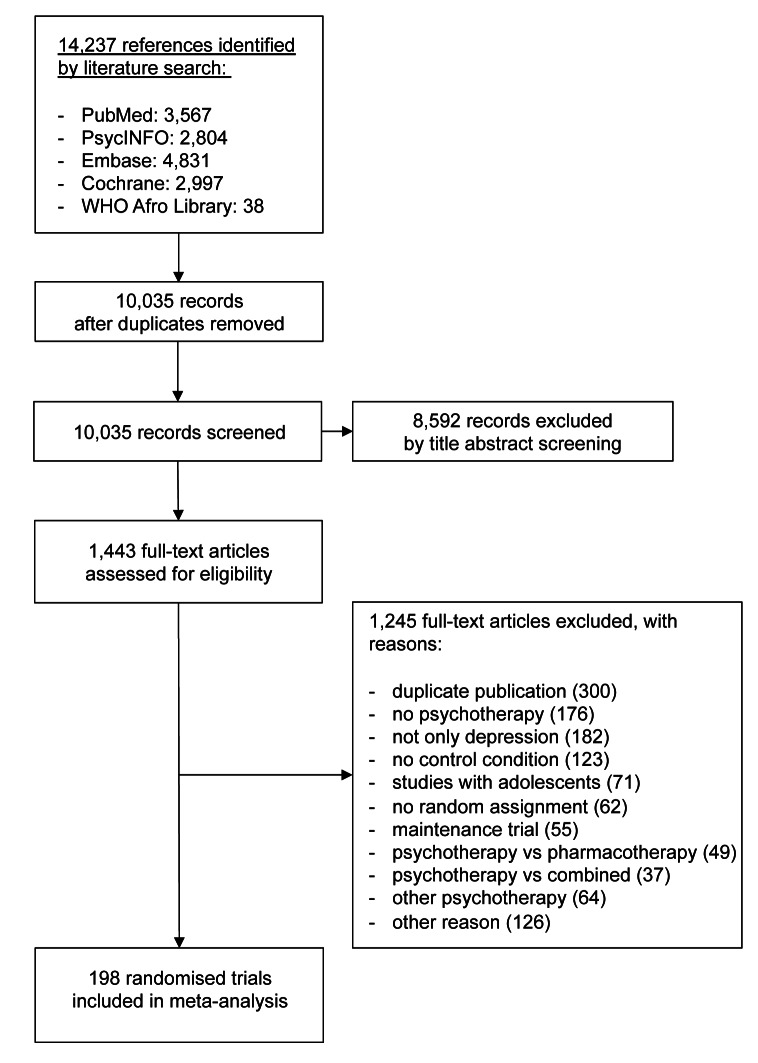
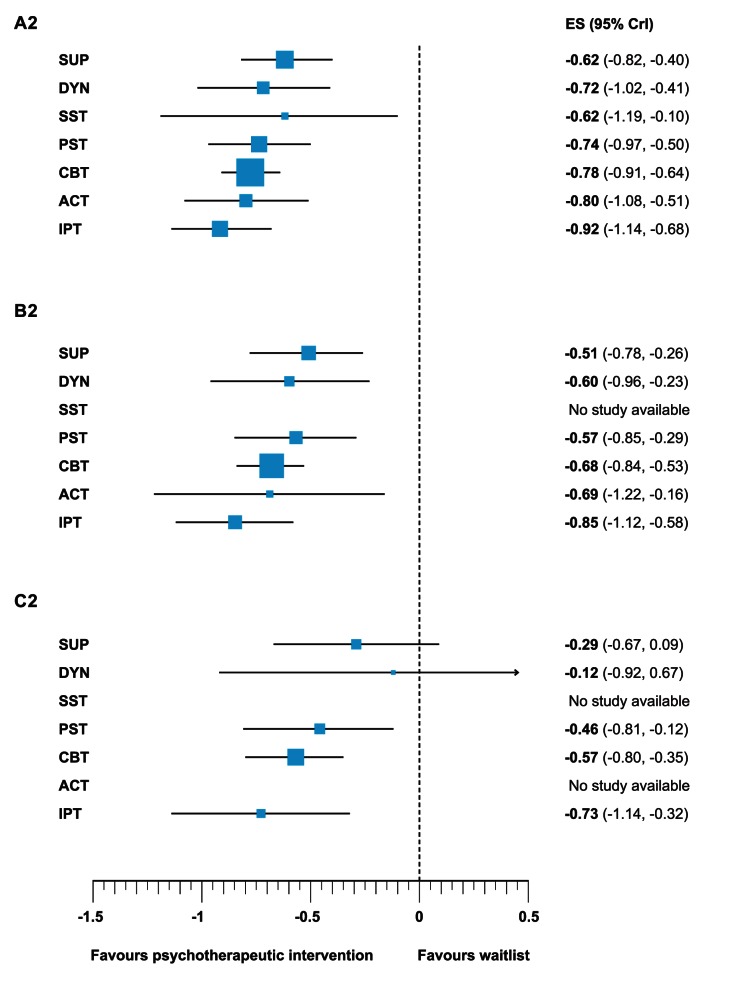
BACKGROUND: Previous meta-analyses comparing the efficacy of psychotherapeutic interventions for depression were clouded by a limited number of within-study treatment comparisons. This study used network meta-analysis, a novel methodological approach that integrates direct and indirect evidence from randomised controlled studies, to re-examine the comparative efficacy of seven psychotherapeutic interventions for adult depression. METHODS AND FINDINGS: We conducted systematic literature searches in PubMed, PsycINFO, and Embase up to November 2012, and identified additional studies through earlier meta-analyses and the references of included studies. We identified 198 studies, including 15,118 adult patients with depression, and coded moderator variables. Each of the seven psychotherapeutic interventions was superior to a waitlist control condition with moderate to large effects (range d = -0.62 to d = -0.92). Relative effects of different psychotherapeutic interventions on depressive symptoms were absent to small (range d = 0.01 to d = -0.30). Interpersonal therapy was significantly more effective than supportive therapy (d = -0.30, 95% credibility interval [CrI] [-0.54 to -0.05]). Moderator analysis showed that patient characteristics had no influence on treatment effects, but identified aspects of study quality and sample size as effect modifiers. Smaller effects were found in studies of at least moderate (Δd = 0.29 [-0.01 to 0.58]; p = 0.063) and large size (Δd = 0.33 [0.08 to 0.61]; p = 0.012) and those that had adequate outcome assessment (Δd = 0.38 [-0.06 to 0.87]; p = 0.100). Stepwise restriction of analyses by sample size showed robust effects for cognitive-behavioural therapy, interpersonal therapy, and problem-solving therapy (all d>0.46) compared to waitlist. Empirical evidence from large studies was unavailable or limited for other psychotherapeutic interventions. CONCLUSIONS: Overall our results are consistent with the notion that different psychotherapeutic interventions for depression have comparable benefits. However, the robustness of the evidence varies considerably between different psychotherapeutic treatments.
Overview
The claims and statistics of this paper haven’t been checked yet.
Free: it reads the open-access text and checks the first 5 claims that cite a source we can check. Create a free account to check every claim.
Integrity signals
Registry
Cites
Statistics
Figures
Verification
Claims the paper makes
The claims and statistics of this paper haven’t been checked yet.
Free: it reads the open-access text and checks the first 5 claims that cite a source we can check. Create a free account to check every claim.
Claims other papers make about this one
Each is checked against this paper’s own text: does it say what the citing paper says it does?
The source backs part of the claim, not all of it — or backs it for a different population, condition or comparison.
In the citing paper
“all psychotherapeutic interventions were superior to psychological control conditions.28”
From Comparative efficacy and acceptability of antidepressants, psychotherapies, and their combination for acute treatment of children and adolescents with depressive disorder: a systematic review and network meta-analysis (2020) · cites this paper as [28]
Experimental — accuracy not yet measuredThe source backs part of the claim, not all of it — or backs it for a different population, condition or comparison.
In the citing paper
“Network meta-analyses revealed the same phenomenon with psychotherapy: researchers once concluded there was a dodo bird verdict, whereby “everybody has won, and all must have prizes,”67 until network meta-analyses showed some interventions were robustly more effective than others.6 26”
From Effect of exercise for depression: systematic review and network meta-analysis of randomised controlled trials (2024) · cites this paper as [26]
Experimental — accuracy not yet measuredThe source backs part of the claim, not all of it — or backs it for a different population, condition or comparison.
In the citing paper
“Barth and associates (2013) did not find a significant difference between CBT and behavioral activation therapy for treating depression, but they did find a significant difference between interpersonal psychotherapy and supportive counseling (d = -0.16;95% CI, -0.33 to 0.22).”
From The Role of Common Factors in Psychotherapy Outcomes (2019) · cites this paper as Barth et al. 2013
Experimental — accuracy not yet measuredThe source backs part of the claim, not all of it — or backs it for a different population, condition or comparison.
In the citing paper
“Despite varying theoretical rationales of different therapeutic approaches, they lead to similar outcomes (Barth et al., 2013).”
From TONI - One for all? Participatory development of a transtheoretic and transdiagnostic online intervention for blended care (2024) · cites this paper as Barth et al., 2013
Experimental — accuracy not yet measuredThe cited source says what the claim attributes to it.
In the citing paper
“It is notable, too, that the authors included Internet-delivered therapies and those delivered face to face, together with studies of participants whose primary disorder was a medical condition, resulting in a more heterogeneous set of populations and interventions than those included in the current review.”
From 'Third wave' cognitive and behavioural therapies versus treatment as usual for depression (2013) · cites this paper as Barth 2013
10 more claims about this paper
Create a free account to see every claim other papers make about this one.
Self-check
Percentages, sums and reported differences re-computed from the paper’s own numbers.
The self-check needs the paper’s full text.
Citations
Cites
Statistical power analysis for the behavioral sciences
(1990) · Computers, Environment and Urban Systems · doi:10.1016/0198-9715(90)90050-4 · Cited by 65,269
Projections of Global Mortality and Burden of Disease from 2002 to 2030
Mathers, C. D., & Loncar, D. (2006) · PLoS Medicine · doi:10.1371/journal.pmed.0030442 · Cited by 11,386
Statistical Methods for Meta-Analysis
Wasserman, S., Hedges, L. V., & Olkin, I. (1988) · Journal of Educational Statistics · doi:10.2307/1164953 · Cited by 10,326
Cognitive Therapy for Depression: (675542012-001)
(2012) · PsycEXTRA Dataset · doi:10.1037/e675542012-001 · Cited by 9,663
(2000) · Cited by 9,198
General methods for monitoring convergence of iterative simulations
Brooks, S. P., & Gelman, A. (1998) · Journal of Computational and Graphical Statistics · doi:10.1080/10618600.1998.10474787 · Cited by 6,045 · cited 1×
“Convergence of Markov chains was considered achieved when plots of the Gelman-Rubin statistics indicated that widths of pooled runs and individual runs stabilised around the same value and their ratio was around one [40].”
MethodSchulz (1995) · doi:10.1001/jama.1995.03520290060030 · Cited by 5,634
Assessing the quality of controlled clinical trials
Jüni, P., Altman, D. G., & Egger, M. (2001) · BMJ · doi:10.1136/bmj.323.7303.42 · Cited by 3,309 · cited 1×
“The quality of primary studies potentially threatens the validity of meta-analyses [23–25].”
BackgroundSelf-citationWood, L., Egger, M., Gluud, L. L., Schulz, K. F., Jüni, P., Altman, D. G., Gluud, C., Martin, R. M., Wood, A. J. G., & Sterne, J. A. C. (2008) · BMJ · doi:10.1136/bmj.39465.451748.ad · Cited by 2,538 · cited 1×
“, if analysis is not intention-to-treat), and lack of blinding of outcome assessors [26–28] are known to have a biasing effect.”
BackgroundSelf-citationCombination of direct and indirect evidence in mixed treatment comparisons
Lu, G., & Ades, A. E. (2004) · Statistics in Medicine · doi:10.1002/sim.1875 · Cited by 2,166 · cited 2×
“For the network meta-analysis, we used an extension of this model to compare various interventions [20,38].”
Method
Cited by
Time for united action on depression: a Lancet–World Psychiatric Association Commission
Herrman, H., Patel, V., Kieling, C., Berk, M., Buchweitz, C., Cuijpers, P., Furukawa, T. A., Kessler, R. C., Kohrt, B. A., Maj, M., et al. (2022) · The Lancet · doi:10.1016/s0140-6736(21)02141-3 · Cited by 1,104
Self-citationMalhi, G. S., Bassett, D., Boyce, P., Bryant, R., Fitzgerald, P. B., Fritz, K., Hopwood, M., Lyndon, B., Mulder, R., Murray, G., et al. (2015) · Australian & New Zealand Journal of Psychiatry · doi:10.1177/0004867415617657 · Cited by 842
“A series of meta-analyses and a network meta-analysis suggest that psychological treatments are equally efficacious in the acute treatment of depression (Barth et al., 2013; Cuijpers et al., 2011a).”
BackgroundCleare, A., Pariante, C., Young, A., Anderson, I., Christmas, D., Cowen, P., Dickens, C., Ferrier, I., Geddes, J., Gilbody, S., et al. (2015) · Journal of Psychopharmacology · doi:10.1177/0269881115581093 · Cited by 759
“A network metaanalysis identified 198 studies, including 15,118 adult patients with depression (Barth et al., 2013).”
BackgroundThe Role of Common Factors in Psychotherapy Outcomes
Cuijpers, P., Reijnders, M., & Huibers, M. J. H. (2019) · Annual Review of Clinical Psychology · doi:10.1146/annurev-clinpsy-050718-095424 · Cited by 748
“It is well established that psychotherapies can effectively treat mental disorders, including depression (Barth et al. 2013, Mohr et al. 2014), anxiety disorders (Cuijpers et al. 2014a, 2016a; Mayo-Wilson et al. 2014; Pompoli et al. 2018), posttraumatic stress disorder (PTSD; Cusack et al. 2016,…”
BackgroundSelf-citationNoetel, M., Sanders, T., Gallardo-Gómez, D., Taylor, P., del Pozo Cruz, B., van den Hoek, D., Smith, J. J., Mahoney, J., Spathis, J., Moresi, M., et al. (2024) · BMJ · doi:10.1136/bmj-2023-075847 · Cited by 707
“6 26”
BackgroundMayo-Wilson, E., Dias, S., Mavranezouli, I., Kew, K., Clark, D. M., Ades, A. E., & Pilling, S. (2014) · The Lancet Psychiatry · doi:10.1016/s2215-0366(14)70329-3 · Cited by 680
Cristea, I. A., Gentili, C., Cotet, C. D., Palomba, D., Barbui, C., & Cuijpers, P. (2017) · JAMA Psychiatry · doi:10.1001/jamapsychiatry.2016.4287 · Cited by 655
Self-citationCuijpers, P., Karyotaki, E., Weitz, E., Andersson, G., Hollon, S. D., & van Straten, A. (2014) · Journal of Affective Disorders · doi:10.1016/j.jad.2014.02.026 · Cited by 586
Self-citationCuijpers, P., Cristea, I. A., Karyotaki, E., Reijnders, M., & Huibers, M. J. H. (2016) · World Psychiatry · doi:10.1002/wps.20346 · Cited by 572
Self-citationEkers, D., Webster, L., Van Straten, A., Cuijpers, P., Richards, D., & Gilbody, S. (2014) · PLoS ONE · doi:10.1371/journal.pone.0100100 · Cited by 565
“We did not explore the comparative effectiveness of BA with other psychotherapies as this has been updated in other recent reviews [3,9] [9,10].”
Self-citationParikh, S. V., Quilty, L. C., Ravitz, P., Rosenbluth, M., Pavlova, B., Grigoriadis, S., Velyvis, V., Kennedy, S. H., Lam, R. W., MacQueen, G. M., et al. (2016) · The Canadian Journal of Psychiatry · doi:10.1177/0706743716659418 · Cited by 562
Cuijpers, P., Sijbrandij, M., Koole, S. L., Andersson, G., Beekman, A. T., & Reynolds, C. F. (2013) · World Psychiatry · doi:10.1002/wps.20038 · Cited by 540
Self-citationCuijpers, P., Noma, H., Karyotaki, E., Vinkers, C. H., Cipriani, A., & Furukawa, T. A. (2020) · World Psychiatry · doi:10.1002/wps.20701 · Cited by 540
Self-citationCuijpers, P., Noma, H., Karyotaki, E., Cipriani, A., & Furukawa, T. A. (2019) · JAMA Psychiatry · doi:10.1001/jamapsychiatry.2019.0268 · Cited by 539
Self-citationStandalone smartphone apps for mental health—a systematic review and meta-analysis
Weisel, K. K., Fuhrmann, L. M., Berking, M., Baumeister, H., Cuijpers, P., & Ebert, D. D. (2019) · npj Digital Medicine · doi:10.1038/s41746-019-0188-8 · Cited by 447
Self-citationDigital interventions for the treatment of depression: a meta-analytic review
Moshe, I., Terhorst, Y., Philippi, P., Domhardt, M., Cuijpers, P., Cristea, I., Pulkki-Råback, L., Baumeister, H., & Sander, L. B. (2021) · Psychological Bulletin · doi:10.1037/bul0000334 · Cited by 390
Self-citationCuijpers, P., Quero, S., Noma, H., Ciharova, M., Miguel, C., Karyotaki, E., Cipriani, A., Cristea, I. A., & Furukawa, T. A. (2021) · World Psychiatry · doi:10.1002/wps.20860 · Cited by 388
Self-citationZhou, X., Teng, T., Zhang, Y., Del Giovane, C., Furukawa, T. A., Weisz, J. R., Li, X., Cuijpers, P., Coghill, D., Xiang, Y., et al. (2020) · The Lancet Psychiatry · doi:10.1016/s2215-0366(20)30137-1 · Cited by 367
Self-citationCuijpers, P., Karyotaki, E., Ciharova, M., Miguel, C., Noma, H., & Furukawa, T. A. (2021) · Acta Psychiatrica Scandinavica · doi:10.1111/acps.13335 · Cited by 336
Self-citationTreatment of Adult Depression in the United States
Olfson, M., Blanco, C., & Marcus, S. C. (2016) · JAMA Internal Medicine · doi:10.1001/jamainternmed.2016.5057 · Cited by 352
Psychological interventions for psychosis: A meta-analysis of comparative outcome studies
Turner, D. T., van der Gaag, M., Karyotaki, E., & Cuijpers, P. (2014) · American Journal of Psychiatry · doi:10.1176/appi.ajp.2013.13081159 · Cited by 350
Self-citationCaldwell, D. M., Davies, S. R., Hetrick, S. E., Palmer, J. C., Caro, P., López-López, J. A., Gunnell, D., Kidger, J., Thomas, J., French, C., et al. (2019) · The Lancet Psychiatry · doi:10.1016/s2215-0366(19)30403-1 · Cited by 336
Zhou, X., Hetrick, S. E., Cuijpers, P., Qin, B., Barth, J., Whittington, C. J., Cohen, D., Del Giovane, C., Liu, Y., Michael, K. D., et al. (2015) · World Psychiatry · doi:10.1002/wps.20217 · Cited by 322
“We previously investigated in this way the comparative efficacy of psychotherapies for adult depressed patients (31) and of augmentation agents in adult treatment-resistant depression (32).”
BackgroundSelf-citationComparative Effectiveness of First-Line Medications for Primary Open-Angle Glaucoma
Li, T., Lindsley, K., Rouse, B., Hong, H., Shi, Q., Friedman, D. S., Wormald, R., & Dickersin, K. (2016) · Ophthalmology · doi:10.1016/j.ophtha.2015.09.005 · Cited by 320
Psychological Treatment of Depression in Primary Care: Recent Developments
Cuijpers, P., Quero, S., Dowrick, C., & Arroll, B. (2019) · Current Psychiatry Reports · doi:10.1007/s11920-019-1117-x · Cited by 296
Self-citationInterpersonal Psychotherapy for Mental Health Problems: A Comprehensive Meta-Analysis
Cuijpers, P., Donker, T., Weissman, M. M., Ravitz, P., & Cristea, I. A. (2016) · American Journal of Psychiatry · doi:10.1176/appi.ajp.2015.15091141 · Cited by 283
“Since then, numerous randomized controlled trials have shown that IPT is indeed effective in the treatment of depression (3), that it may be more effective than other psychotherapies for depression (4, 5), that it may prevent relapse after successful treatment of depression (3), that it may prevent the onset of major…”
BackgroundSelf-citationThe effects of fifteen evidence-supported therapies for adult depression: A meta-analytic review
Cuijpers, P., Karyotaki, E., de Wit, L., & Ebert, D. D. (2020) · Psychotherapy Research · doi:10.1080/10503307.2019.1649732 · Cited by 276
“…suggests that these therapies have comparable effects, although it should be noted that trials in which therapies are directly compared with each other give much stronger evidence on whether therapies are indeed equally effective (Barth et al., 2013; Cuijpers, van Straten, Andersson, et al., 2008).”
BackgroundInfluentialSelf-citationProchaska, J. J., Vogel, E. A., Chieng, A., Kendra, M., Baiocchi, M., Pajarito, S., & Robinson, A. (2021) · Journal of Medical Internet Research · doi:10.2196/24850 · Cited by 257
“CBT evidence-based, guided self-help treatments have ranged in length from 2 to 12 weeks [31-34], and the National Institutes for Clinical Excellence describes guided self-help as including 6 to 8 face-to-face sessions [35].”
BackgroundFurukawa, T. A., Suganuma, A., Ostinelli, E. G., Andersson, G., Beevers, C. G., Shumake, J., Berger, T., Boele, F. W., Buntrock, C., Carlbring, P., et al. (2021) · The Lancet Psychiatry · doi:10.1016/s2215-0366(21)00077-8 · Cited by 255
Self-citationThe effectiveness of psychodynamic psychotherapies: An update
Fonagy, P. (2015) · World Psychiatry · doi:10.1002/wps.20235 · Cited by 249
“Meta-analytic findings on the whole reveal large pre-post treatment effects (93,94) for PDT maintained at 1-year follow-up, with medium effect sizes indicating superiority to inactive controls (31,95) but either no difference (31) or slight inferiority (94) in relation to alternative interventions post-treatment.”
BackgroundEffect of insomnia treatments on depression: A systematic review and meta-analysis
Gebara, M. A., Siripong, N., DiNapoli, E. A., Maree, R. D., Germain, A., Reynolds, C. F., Kasckow, J. W., Weiss, P. M., & Karp, J. F. (2018) · Depression and Anxiety · doi:10.1002/da.22776 · Cited by 247
“Thus, a variety of different treatments–including those for insomnia disorder—may have positive effects on depression (Barth et al., 2013; Cuijpers, Andersson, Donker, & van Straten, 2011).”
BackgroundCuijpers, P., Turner, E. H., Koole, S. L., van Dijke, A., & Smit, F. (2014) · Depression and Anxiety · doi:10.1002/da.22249 · Cited by 242
Self-citationCuijpers, P. (2017) · Canadian Psychology / Psychologie canadienne · doi:10.1037/cap0000096 · Cited by 231
“The effect sizes found for these therapies do not significantly differ from each other (Barth et al., 2013).”
BackgroundMethodInfluentialSelf-citationEffects of Social Media and Mobile Health Apps on Pregnancy Care: Meta-Analysis
Chan, K. L., & Chen, M. (2019) · JMIR mHealth and uHealth · doi:10.2196/11836 · Cited by 221
More treatment but no less depression: The treatment-prevalence paradox
Ormel, J., Hollon, S. D., Kessler, R. C., Cuijpers, P., & Monroe, S. M. (2022) · Clinical Psychology Review · doi:10.1016/j.cpr.2021.102111 · Cited by 213
Self-citationStein, A. T., Carl, E., Cuijpers, P., Karyotaki, E., & Smits, J. A. J. (2021) · Psychological Medicine · doi:10.1017/s0033291720000239 · Cited by 213
Self-citationCommon versus specific factors in psychotherapy: opening the black box
Mulder, R., Murray, G., & Rucklidge, J. (2017) · The Lancet Psychiatry · doi:10.1016/s2215-0366(17)30100-1 · Cited by 198
Linde, K., Sigterman, K., Kriston, L., Rucker, G., Jamil, S., Meissner, K., & Schneider, A. (2015) · The Annals of Family Medicine · doi:10.1370/afm.1719 · Cited by 196
Chaves, C., Lopez-Gomez, I., Hervas, G., & Vazquez, C. (2017) · Cognitive Therapy and Research · doi:10.1007/s10608-016-9778-9 · Cited by 196
“This lack of significant differences is a common finding when comparing modalities in well-planned and executed interventions for depression (e.g., Barth et al. 2013; Cuijpers 2016; Cuijpers et al. 2011a; Forman et al. 2007).”
BackgroundInfluentialBlom, K., Jernelöv, S., Kraepelien, M., Bergdahl, M. O., Jungmarker, K., Ankartjärn, L., Lindefors, N., & Kaldo, V. (2015) · Sleep · doi:10.5665/sleep.4412 · Cited by 193
Chevance, A., Ravaud, P., Tomlinson, A., Le Berre, C., Teufer, B., Touboul, S., Fried, E. I., Gartlehner, G., Cipriani, A., & Tran, V. T. (2020) · The Lancet Psychiatry · doi:10.1016/s2215-0366(20)30191-7 · Cited by 193
Managing depression in older age: psychological interventions
Cuijpers, P., Karyotaki, E., Pot, A. M., Park, M., & Reynolds, C. F. (2014) · Maturitas · doi:10.1016/j.maturitas.2014.05.027 · Cited by 192
Self-citationLorenzo-Luaces, L., German, R. E., & DeRubeis, R. J. (2015) · Clinical Psychology Review · doi:10.1016/j.cpr.2014.12.003 · Cited by 190
“Aside from CBT, the most extensively-researched psychotherapies for depression are IPT and PST (Barth et al., 2013), making the mechanisms implied by their respective theories of change likely candidates as non-cognitive mechanisms of psychotherapeutic change.”
BackgroundInfluentialAssertiveness training: A forgotten evidence‐based treatment.
Speed, B. C., Goldstein, B. L., & Goldfried, M. R. (2018) · Clinical Psychology: Science and Practice · doi:10.1111/cpsp.12216 · Cited by 185
“…psychotherapy outcomes for depression and social anxiety have found that social skills training involving assertiveness was similarly effective compared to other CBT interventions (Barth et al., 2013; Cuijpers, van Straten, Andersson, & van Oppen, 2008; Fedoroff & Taylor, 2001; Taylor, 1996).”
BackgroundMethodResultSommers-Spijkerman, M., Austin, J., Bohlmeijer, E., & Pots, W. (2021) · JMIR Mental Health · doi:10.2196/28168 · Cited by 179
Depression Subtypes in Predicting Antidepressant Response: A Report From the iSPOT-D Trial
Arnow, B. A., Blasey, C., Williams, L. M., Palmer, D. M., Rekshan, W., Schatzberg, A. F., Etkin, A., Kulkarni, J., Luther, J. F., & Rush, A. J. (2015) · American Journal of Psychiatry · doi:10.1176/appi.ajp.2015.14020181 · Cited by 175
“Not only does treatment outcome vary substantially among depressed patients who are treated in a similar fashion (5), but there is little evidence that one treatment is superior to another, whether comparing among antidepressant medications (6), among psychotherapies (7), or between the two (8).”
BackgroundCochrane’s risk of bias tool in the context of psychotherapy outcome research
Munder, T., & Barth, J. (2018) · Psychotherapy Research · doi:10.1080/10503307.2017.1411628 · Cited by 174
“, 2017, for a review), including researcher allegiance and conflict of interest (Munder, Brütsch, Leonhart, Gerger, & Barth, 2013), publication bias (Cuijpers, Smit, Bohlmeijer, Hollon, & Andersson, 2010), and small-study effects (Barth et al., 2013; Nüesch et al., 2010).”
BackgroundResultInfluentialSelf-citationWas Eysenck right after all? A reassessment of the effects of psychotherapy for adult depression
Cuijpers, P., Karyotaki, E., Reijnders, M., & Ebert, D. D. (2019) · Epidemiology and Psychiatric Sciences · doi:10.1017/s2045796018000057 · Cited by 173
“There was no significant difference between the effects of different types of psychotherapy, which is in line with earlier meta-analyses of trials directly comparing different types of therapy (Cuijpers et al. 2008b; Barth et al. 2013).”
ResultSelf-citationRelapse rates after psychotherapy for depression – stable long-term effects? A meta-analysis
Steinert, C., Hofmann, M., Kruse, J., & Leichsenring, F. (2014) · Journal of Affective Disorders · doi:10.1016/j.jad.2014.06.043 · Cited by 172
Psychotherapies for depression in low- and middle-income countries: a meta-analysis
Cuijpers, P., Karyotaki, E., Reijnders, M., Purgato, M., & Barbui, C. (2018) · World Psychiatry · doi:10.1002/wps.20493 · Cited by 159
Self-citationBakker, A. B., & van Wingerden, J. (2021) · Journal of Occupational Health Psychology · doi:10.1037/ocp0000266 · Cited by 153
Labour induction with prostaglandins: a systematic review and network meta-analysis
Alfirević, Ž., Keeney, E., Dowswell, T., Welton, N. J., Dias, S., Jones, L. V., Navaratnam, K., & Caldwell, D. M. (2015) · BMJ · doi:10.1136/bmj.h217 · Cited by 150
Schröder, J., Sautier, L., Kriston, L., Berger, T., Meyer, B., Späth, C., Köther, U., Nestoriuc, Y., Klein, J. P., & Moritz, S. (2015) · Journal of Affective Disorders · doi:10.1016/j.jad.2015.08.044 · Cited by 149
“effective for depression (Barth et al., 2013), but only about half of”
BackgroundCuijpers, P., Pineda, B. S., Quero, S., Karyotaki, E., Struijs, S. Y., Figueroa, C. A., Llamas, J. A., Furukawa, T. A., & Muñoz, R. F. (2021) · Clinical Psychology Review · doi:10.1016/j.cpr.2020.101955 · Cited by 148
Self-citationA Systematic Review and Meta-analysis of Psychotherapy for Late-Life Depression
Huang, A. X., Delucchi, K., Dunn, L. B., & Nelson, J. C. (2014) · American Journal of Geriatric Psychiatry · doi:10.1016/j.jagp.2014.04.003 · Cited by 156
Mei, C., van der Gaag, M., Nelson, B., Smit, F., Yuen, H. P., Berger, M., Krcmar, M., French, P., Amminger, G. P., Bechdolf, A., et al. (2021) · Clinical Psychology Review · doi:10.1016/j.cpr.2021.102005 · Cited by 143
Self-citationPsychosocial interventions for smoking cessation in patients with coronary heart disease
Barth, J., Jacob, T., Daha, I., & Critchley, J. A. (2015) · Cochrane Database of Systematic Reviews · doi:10.1002/14651858.cd006886.pub2 · Cited by 136
Self-citationAn adaptationist perspective on the etiology of depression
Durisko, Z., Mulsant, B. H., & Andrews, P. W. (2015) · Journal of Affective Disorders · doi:10.1016/j.jad.2014.09.032 · Cited by 140
“It responds to both pharmacological and psychotherapeutic treatment interventions but each individual intervention has similar modest efficacy (Barth et al., 2013; Butler et al., 2006; Cuijpers et al., 2008; Dobson et al., 2008).”
BackgroundPsychological treatment of depression: A systematic overview of a 'Meta-Analytic Research Domain'
Cuijpers, P., Miguel, C., Harrer, M., Plessen, C. Y., Ciharova, M., Papola, D., Ebert, D., & Karyotaki, E. (2023) · Journal of Affective Disorders · doi:10.1016/j.jad.2023.05.011 · Cited by 136
Self-citationCristea, I. A., Huibers, M. J. H., David, D., Hollon, S. D., Andersson, G., & Cuijpers, P. (2015) · Clinical Psychology Review · doi:10.1016/j.cpr.2015.08.003 · Cited by 135
“Regarding the first question, three recent meta-analysis found no differences between CBT and other therapies on symptoms of depression (Braun et al., 2013; Barth et al., 2013; Cuijpers, Berking, et al., 2013).”
BackgroundResultInfluentialSelf-citationProblem-solving therapy for adult depression: An updated meta-analysis
Cuijpers, P., de Wit, L., Kleiboer, A., Karyotaki, E., & Ebert, D. D. (2018) · European Psychiatry · doi:10.1016/j.eurpsy.2017.11.006 · Cited by 134
“Furthermore, this area of research has shown that there are no major differences between the effects of these treatments [11], that these treatments can be delivered effectively in individual, group, guided self-help and internet-delivered format [12–14], and that they are effective in several different target groups,…”
BackgroundResultSelf-citationTheories and Models: What They Are, What They Are for, and What They Are About
Fried, E. I. (2020) · Psychological Inquiry · doi:10.1080/1047840x.2020.1854011 · Cited by 128
Laughter-inducing therapies: systematic review and meta-analysis.
van der Wal, C. N., & Kok, R. N. (2019) · Social Science & Medicine · doi:10.1016/j.socscimed.2019.02.018 · Cited by 131
Personalized Psychotherapy for Adult Depression: A Meta-Analytic Review
Cuijpers, P., Ebert, D. D., Acarturk, C., Andersson, G., & Cristea, I. A. (2016) · Behavior Therapy · doi:10.1016/j.beth.2016.04.007 · Cited by 128
Self-citationNegt, P., Brakemeier, E., Michalak, J., Winter, L., Bleich, S., & Kahl, K. G. (2016) · Brain and Behavior · doi:10.1002/brb3.486 · Cited by 126
'Third wave' cognitive and behavioural therapies versus other psychological therapies for depression
Hunot, V., Moore, T. H., Caldwell, D. M., Furukawa, T. A., Davies, P., Jones, H., Honyashiki, M., Chen, P., Lewis, G., & Churchill, R. (2013) · Cochrane Database of Systematic Reviews · doi:10.1002/14651858.cd008704.pub2 · Cited by 124
How to prove that your therapy is effective, even when it is not: a guideline
Cuijpers, P., & Cristea, I. A. (2016) · Epidemiology and Psychiatric Sciences · doi:10.1017/s2045796015000864 · Cited by 122
“Several meta-analytic studies have shown that waiting list control groups result in much larger effects for the therapy than other control groups (Mohr et al. 2009, 2014; Barth et al. 2013; Furukawa et al. 2014).”
BackgroundSelf-citationCohen, Z. D., Kim, T. T., Van, H. L., Dekker, J. J. M., & Driessen, E. (2020) · Psychotherapy Research · doi:10.1080/10503307.2018.1563312 · Cited by 120
“These results are in line with meta-analytic findings reporting no significant differences between CBT and PDT for depression (Barth et al., 2013; Driessen et al., 2015).”
ResultKriston, L., von Wolff, A., Westphal, A., Hölzel, L. P., & Härter, M. (2014) · Depression and Anxiety · doi:10.1002/da.22236 · Cited by 119
Who benefits from psychotherapies for adult depression? A meta-analytic update of the evidence
Cuijpers, P., Karyotaki, E., Reijnders, M., & Huibers, M. J. H. (2018) · Cognitive Behaviour Therapy · doi:10.1080/16506073.2017.1420098 · Cited by 115
“Supplemental data for this article can be accessed https://doi.org/10.1080/16506073.2017.1420098 is also considerable evidence that the effects of these therapies are comparable or have only minimal differences (Barth et al., 2013; Palpacuer et al., 2017).”
InfluentialSelf-citationSchröder, J., Berger, T., Meyer, B., Lutz, W., Hautzinger, M., Späth, C., Eichenberg, C., Klein, J. P., & Moritz, S. (2017) · Cognitive Therapy and Research · doi:10.1007/s10608-017-9850-0 · Cited by 113
“Psychotherapy is effective in the treatment of depression (Barth et al. 2013), but only about half of those afflicted receive adequate treatment (Kohn et al.”
BackgroundInternet and mobile interventions for depression: Opportunities and challenges: Cuijpers et al .
Cuijpers, P., Kleiboer, A., Karyotaki, E., & Riper, H. (2017) · Depression and Anxiety · doi:10.1002/da.22641 · Cited by 112
“The economic costs, in terms of production losses and in health and social care expenditures have been estimated at US$ 2.5 trillion in 2010 worldwide (Barth et al., 2013, Bloom et al., 2011), and these costs are expected to grow to US$ 6.0 trillion by 2030 (Buntrock et al., 2016).”
BackgroundInfluentialSelf-citationQuantifying the association between psychotherapy content and clinical outcomes using deep learning
Ewbank, M. P., Cummins, R., Tablan, V., Bateup, S., Catarino, A., Martin, A. J., & Blackwell, A. D. (2020) · JAMA Psychiatry · doi:10.1001/jamapsychiatry.2019.2664 · Cited by 108
Domhardt, M., Steubl, L., Boettcher, J., Buntrock, C., Karyotaki, E., Ebert, D. D., Cuijpers, P., & Baumeister, H. (2021) · Clinical Psychology Review · doi:10.1016/j.cpr.2020.101953 · Cited by 106
“…with several theoretical backgrounds are effective in treating depressive symptoms, irrespective of whether they are implemented face-to-face (Barth et al., 2013; Cuijpers, Kar-yotaki, de Wit, & Ebert, 2019) or delivered remotely via the Internet (Cuijpers, Noma, Karyotaki, Cipriani, &…”
BackgroundSelf-citationNegative effects of psychotherapies for adult depression: A meta-analysis of deterioration rates
Cuijpers, P., Reijnders, M., Karyotaki, E., de Wit, L., & Ebert, D. D. (2018) · Journal of Affective Disorders · doi:10.1016/j.jad.2018.05.050 · Cited by 105
“There is also considerable evidence that the effects of these therapies do not or only marginally differ from each other (Barth et al., 2013).”
BackgroundSelf-citationLundgren, J. G., Dahlström, Ö., Andersson, G., Jaarsma, T., Kärner Köhler, A., & Johansson, P. (2016) · Journal of Medical Internet Research · doi:10.2196/jmir.5556 · Cited by 104
Kessler, R. C. (2018) · Current Opinion in Psychiatry · doi:10.1097/yco.0000000000000377 · Cited by 103
Management of depressive symptoms in peri- and postmenopausal women: EMAS position statement
Stute, P., Spyropoulou, A. C., Karageorgiou, V., Cano, A., Bitzer, J., Ceauşu, I., Chedraui, P. A., Durmuşoğlu, F., Erkkola, R. U., Goulis, D. G., et al. (2019) · Maturitas · doi:10.1016/j.maturitas.2019.11.002 · Cited by 110
“With increasing symptom severity, cognitive-behavioral therapy, interpersonal therapy and problem-solving therapy are specialized modalities that offer benefit of comparable magnitude [44].”
BackgroundInterpersonal Counseling (IPC) for Depression in Primary Care
Weissman, M. M., Hankerson, S. H., Scorza, P., Olfson, M., Verdeli, H., Shea, S., Lantigua, R., & Wainberg, M. (2014) · American Journal of Psychotherapy · doi:10.1176/appi.psychotherapy.2014.68.4.359 · Cited by 97
“…is derived directly from interpersonal psycho-therapy (IPT), an evidence-based psychotherapy that has undergone numerous efficacy studies, and been translated and adapted for cross-cultural use (Klerman et al., 1984; Weissman et al., 2000, 2007; Markowitz and Weissman, 2012; Barth et al., 2013).”
BackgroundIntegrative Psychotherapy Works
Zarbo, C., Tasca, G. A., Cattafi, F., & Compare, A. (2016) · Frontiers in Psychology · doi:10.3389/fpsyg.2015.02021 · Cited by 144
“At the heart of psychotherapy integration is the important research findings that despite the varying theoretical rationales and approaches of different schools of psychotherapy, they produce similar outcomes (Barth et al., 2013).”
ResultGerger, H., Munder, T., Gemperli, A., Nüesch, E., Trelle, S., Jüni, P., & Barth, J. (2014) · Psychological Medicine · doi:10.1017/s0033291714000853 · Cited by 95
“2011), and in the evaluation of psychological interventions for depression (Barth et al. 2013).”
BackgroundMethodSelf-citationLorenzo‐Luaces, L., DeRubeis, R. J., van Straten, A., & Tiemens, B. G. (2017) · Journal of Affective Disorders · doi:10.1016/j.jad.2017.02.010 · Cited by 110
“It is widely accepted that evidence-based psychotherapies for depression are equally efficacious (Barth et al., 2013; Cuijpers et al., 2014, 2008).”
BackgroundGual-Montolio, P., Jaén, I., Martínez-Borba, V., Castilla, D., & Suso-Ribera, C. (2022) · International Journal of Environmental Research and Public Health · doi:10.3390/ijerph19137737 · Cited by 93
Goodyer, I. M., Reynolds, S. A., Barrett, B. M., Byford, S., Dubicka, B., Hill, J., Holland, F., Kelvin, R. G., Midgley, N., Roberts, C., et al. (2017) · Health Technology Assessment · doi:10.3310/hta21120 · Cited by 113
“Overall, psychological therapies appear to be effective in a broadly equivalent manner, although results vary with methods and measures.(18) Current evidence indicates that findings from adult patients cannot be assumed to reflect comparable efficacy or effectiveness for depressed adolescents.”
ResultCuijpers, P. (2016) · Evidence Based Mental Health · doi:10.1136/eb-2016-102341 · Cited by 86
“That is true for cognitive behaviour therapy, interpersonal psychotherapy (IPT) and behavioural activation therapy.(1) One of the problems in this field is that all types of therapy seem to be equally or about equally effective,(1) and there does not seem to be one type of therapy that is significantly more effective…”
BackgroundSelf-citationLiu, L., Zhou, X., Zhang, Y., Pu, J., Yang, L., Yuan, S., Zhao, L., Zhou, C., Zhang, H., & Xie, P. (2018) · Translational Psychiatry · doi:10.1038/s41398-017-0018-1 · Cited by 92
Translating the BDI and BDI-II into the HAMD and vice versa with equipercentile linking
Furukawa, T. A., Reijnders, M., Kishimoto, S., Sakata, M., DeRubeis, R. J., Dimidjian, S., Dozois, D. J. A., Hegerl, U., Hollon, S. D., Jarrett, R. B., et al. (2020) · Epidemiology and Psychiatric Sciences · doi:10.1017/s2045796019000088 · Cited by 86
Self-citationSchmidt, H. M., Munder, T., Gerger, H., Frühauf, S., & Barth, J. (2014) · The Journal of Sexual Medicine · doi:10.1111/jsm.12520 · Cited by 84
Self-citationPublication Bias under Aggregation Frictions: Theory, Evidence, and a New Correction Method
Furukawa, C. (2019) · SSRN Electronic Journal · doi:10.2139/ssrn.3362053 · Cited by 80
Marshall, J. M., Dunstan, D. A., & Bartik, W. (2020) · Australian & New Zealand Journal of Psychiatry · doi:10.1177/0004867419876700 · Cited by 83
“, 2006), interpersonal therapy (Barth et al., 2013), acceptance and commitment therapy (Ruiz, 2012), positive psychology interventions (Bolier et al.”
Background'Third wave' cognitive and behavioural therapies versus treatment as usual for depression
Churchill, R., Moore, T. H., Furukawa, T. A., Caldwell, D. M., Davies, P., Jones, H., Shinohara, K., Imai, H., Lewis, G., & Hunot, V. (2013) · Cochrane Database of Systematic Reviews · doi:10.1002/14651858.cd008705.pub2 · Cited by 82
The effect of psychotherapy for depression on improvements in social functioning: a meta-analysis
Renner, F., Cuijpers, P., & Huibers, M. J. H. (2014) · Psychological Medicine · doi:10.1017/s0033291713003152 · Cited by 82
Self-citationLeichsenring, F., & Schauenburg, H. (2014) · Journal of Affective Disorders · doi:10.1016/j.jad.2014.08.007 · Cited by 95
“Introduction There is evidence from a large number of randomized controlled trials (RCTs) that psychotherapy is effective in depressive disorders (Barth et al., 2013).”
BackgroundInfluentialGolden, T. L., Springs, S., Kimmel, H. J., Gupta, S., Tiedemann, A., Sandu, C. C., & Magsamen, S. H. (2021) · Frontiers in Psychology · doi:10.3389/fpsyg.2021.649840 · Cited by 97
“A metaanalysis of 198 trials of psychotherapeutic interventions forMDD identified 33 unique outcome measurement tools (Barth et al., 2013).”
BackgroundThe Challenges of Improving Treatments for Depression
Cuijpers, P. (2018) · JAMA · doi:10.1001/jama.2018.17824 · Cited by 78
Self-citationPsychotherapy for Mental Health Symptoms and Disorders in Elite Athletes: A Narrative Review
Stillman, M. A., Glick, I. D., McDuff, D., Reardon, C. L., Hitchcock, M. E., Fitch, V. M., & Hainline, B. (2019) · British Journal of Sports Medicine · doi:10.1136/bjsports-2019-100654 · Cited by 77
Approaches for synthesising complex mental health interventions in meta-analysis
Caldwell, D. M., & Welton, N. J. (2016) · Evidence Based Mental Health · doi:10.1136/eb-2015-102275 · Cited by 75
“The ‘clinically meaningful unit’ classification approach explored above has been applied to a network of psychotherapies for treating depression [26], treating acute depression in primary care [27] and psychotherapies for panic disorder [28].”
BackgroundShould treatment for depression be based more on patient preference?
Winter, S., & Barber, J. (2013) · Patient Preference and Adherence · doi:10.2147/ppa.s52746 · Cited by 73
“Similar results were found by Barth et al.(16) Medication compared with psychotherapy Several meta-analyses have also been conducted comparing the efficacy of medications and various psychotherapies for depression.”
Furukawa, T. A., Weitz, E. S., Tanaka, S., Hollon, S. D., Hofmann, S. G., Andersson, G., Twisk, J., DeRubeis, R. J., Dimidjian, S., Hegerl, U., et al. (2017) · British Journal of Psychiatry · doi:10.1192/bjp.bp.116.187773 · Cited by 73
Self-citationCuijpers, P., Oud, M., Karyotaki, E., Noma, H., Quero, S., Cipriani, A., Arroll, B., & Furukawa, T. A. (2021) · The Annals of Family Medicine · doi:10.1370/afm.2676 · Cited by 67
“We conducted sensitivity analyses in which we limited the analysis to (1) studies with low RoB, (2) studies of cognitive behavior therapy (CBT) alone, or (3) studies with pill placebo excluded (in these studies, patients receiving drugs are blinded, and patients in psychotherapy are not).”
MethodSelf-citation
Metadata
- Authors
- Barth, J., Munder, T., Gerger, H., Nüesch, E., Trelle, S., Znoj, H., Jüni, P., & Cuijpers, P.
- Affiliations
- University of Bern (CH)
- Vrije Universiteit Amsterdam (NL)
- Corresponding author
- Barth, Jürgen
- Venue
- PLoS Medicine
- Publisher
- Public Library of Science (PLoS)
- Published
- 2013-05-28
- Volume
- 10
- Issue
- 5
- Pages
- e1001454
- ISSN
- 1549-1277 (ISSN-L)
- 1549-1676
- PMC
- PMC3665892
- OpenAlex
- W2114536224
- Cited by
- 569
- References
- 63
- Citations by year
- 2026: 14 · 2025: 21 · 2024: 40 · 2023: 26 · 2022: 31 · 2021: 61 · 2020: 62 · 2019: 69 · 2018: 44 · 2017: 47 · 2016: 40 · 2015: 57 · 2014: 44 · 2013: 11
- FWCI
- 55.87
- Type
- journal article
- Language
- en
- Open access
- gold
- doi.org
- Locations
- PLoS Medicine (publishedVersion, cc-by)
- Europe PMC (PubMed Central) (publishedVersion, cc-by)
- PubMed Central (publishedVersion, cc-by)
- PubMed (publishedVersion)
- EUR Research Repository (Erasmus University Rotterdam) (publishedVersion)
- DSpace (Open University in the Netherlands) (publishedVersion, other-oa)
- LSHTM Research Online (London School of Hygiene and Tropical Medicine) (acceptedVersion)
- RePEc: Research Papers in Economics (submittedVersion, cc-by)
- Data Archiving and Networked Services (DANS) (submittedVersion, other-oa)
- EUR Research Repository (Erasmus University Rotterdam) (submittedVersion)
- BORIS (University Library Bern) (submittedVersion, cc-by)
- Digital Academic REpository of VU University Amsterdam (Vrije Universiteit Amsterdam) (submittedVersion)
- DOAJ (DOAJ: Directory of Open Access Journals) (submittedVersion, cc-by-sa)
- edoc (University of Basel) (submittedVersion)
- Multilingual Matters (Channel View Publications) (submittedVersion, cc-by)
- VU Research Portal (submittedVersion, other-oa)
- Funders
- National Science Foundation
- Amgen
- Eli Lilly and Company
- AstraZeneca
- University of Bern
- Ablynx
- Schweizerischer Nationalfonds zur Förderung der Wissenschaftlichen Forschung (118312, 105314-118312/1, 105314)
- Eisai
- St. Jude Medical
- Abbott Vascular
- Topics
- Social Sciences › Psychology › Clinical Psychology › Psychotherapy Techniques and Applications
- Social Sciences › Psychology › Experimental and Cognitive Psychology › Anxiety, Depression, Psychometrics, Treatment, Cognitive Processes
- Social Sciences › Psychology › Applied Psychology › Digital Mental Health Interventions
- Keywords
- depression, psychotherapeutic interventions, drug efficacy comparison, interpersonal psychotherapy, cognitive behavioral therapy, problem-solving therapy, supportive therapy, waitlist control, sample size, study quality, outcome measurement
- MeSH terms
- Adult, Bayes Theorem, Depression, Female, Humans, Male, Markov Chains, Psychotherapy, Treatment Outcome, Evidence-Based Medicine
About these checks
Registry, retraction, Cites and statistics results are computed, not judged, with one exception: a printed reference that no index lists is read once by a model before it counts as a citation error. Claims are extracted by a model and kept only when their quote appears verbatim in the text; each cited source is then checked, with a model’s help, for whether it says what the claim relies on. Those verdicts can be wrong — read the claim’s quote and the cited source before relying on one.
Statistics and arithmetic are recomputed, not judged.
Confidence bands are shown only for fields calibrated on our annotated test set. None is calibrated yet, so no band is shown.
What counts as a claim ›How we measure confidence ›How we check this ›
Are you an author, or do you see a problem with this page? Request a review
Data sources
Bibliographic data: Semantic Scholar, OpenAlex, Crossref.
Contains information from the Semantic Scholar Academic Graph Datasets, made available under the ODC Attribution License (ODC-BY 1.0).
Semantic Scholar’s data is described in: Kinney, R., et al. (2023). The Semantic Scholar Open Data Platform. arXiv:2301.10140.
