

Comparative Efficacy of Seven Psychotherapeutic Interventions for Patients with Depression: A Network Meta-Analysis
Open accessThe DOI matches its Crossref record; 62 of the 63 references it cites were found in a registry or an index.
Abstract
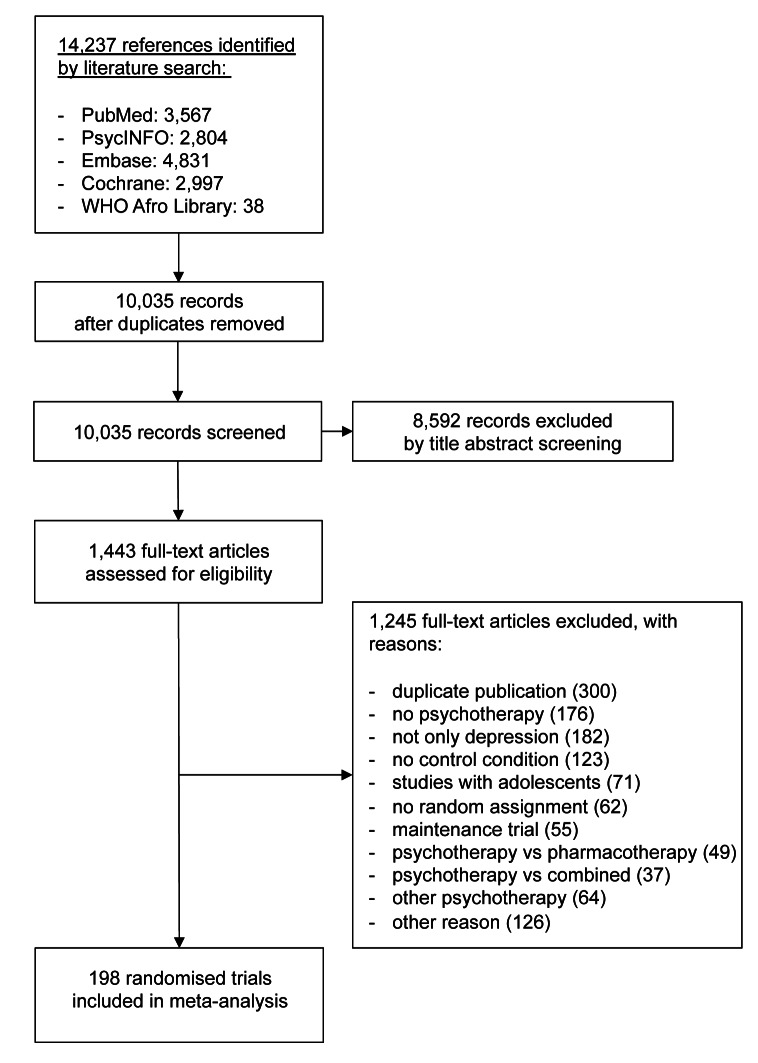
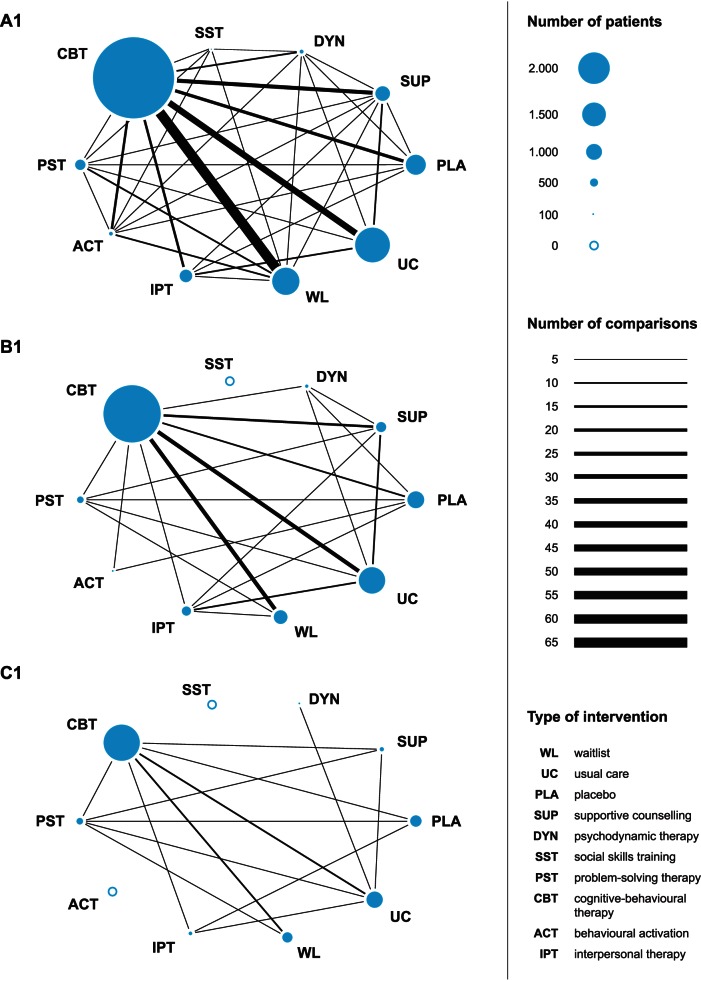
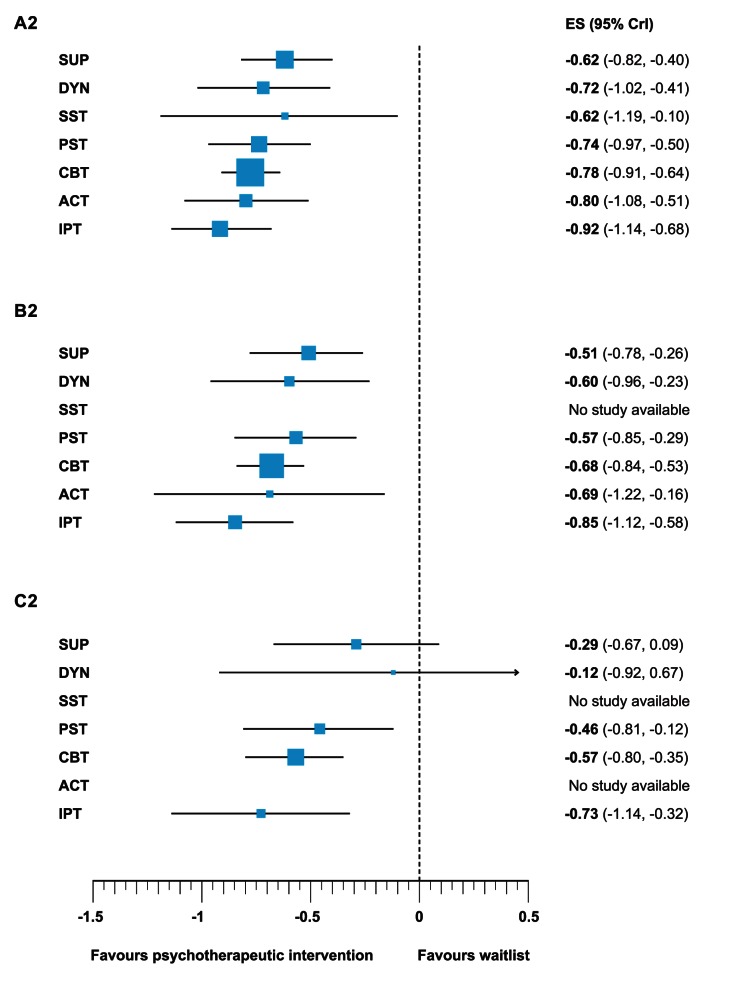
BACKGROUND: Previous meta-analyses comparing the efficacy of psychotherapeutic interventions for depression were clouded by a limited number of within-study treatment comparisons. This study used network meta-analysis, a novel methodological approach that integrates direct and indirect evidence from randomised controlled studies, to re-examine the comparative efficacy of seven psychotherapeutic interventions for adult depression. METHODS AND FINDINGS: We conducted systematic literature searches in PubMed, PsycINFO, and Embase up to November 2012, and identified additional studies through earlier meta-analyses and the references of included studies. We identified 198 studies, including 15,118 adult patients with depression, and coded moderator variables. Each of the seven psychotherapeutic interventions was superior to a waitlist control condition with moderate to large effects (range d = -0.62 to d = -0.92). Relative effects of different psychotherapeutic interventions on depressive symptoms were absent to small (range d = 0.01 to d = -0.30). Interpersonal therapy was significantly more effective than supportive therapy (d = -0.30, 95% credibility interval [CrI] [-0.54 to -0.05]). Moderator analysis showed that patient characteristics had no influence on treatment effects, but identified aspects of study quality and sample size as effect modifiers. Smaller effects were found in studies of at least moderate (Δd = 0.29 [-0.01 to 0.58]; p = 0.063) and large size (Δd = 0.33 [0.08 to 0.61]; p = 0.012) and those that had adequate outcome assessment (Δd = 0.38 [-0.06 to 0.87]; p = 0.100). Stepwise restriction of analyses by sample size showed robust effects for cognitive-behavioural therapy, interpersonal therapy, and problem-solving therapy (all d>0.46) compared to waitlist. Empirical evidence from large studies was unavailable or limited for other psychotherapeutic interventions. CONCLUSIONS: Overall our results are consistent with the notion that different psychotherapeutic interventions for depression have comparable benefits. However, the robustness of the evidence varies considerably between different psychotherapeutic treatments.
Overview
The claims and statistics of this paper haven’t been checked yet.
Free: it reads the open-access text and checks the first 5 claims that cite a source we can check. Create a free account to check every claim.
Integrity signals
Registry
Cites
Statistics
Figures
Verification
Claims the paper makes
The claims and statistics of this paper haven’t been checked yet.
Free: it reads the open-access text and checks the first 5 claims that cite a source we can check. Create a free account to check every claim.
Claims other papers make about this one
Each is checked against this paper’s own text: does it say what the citing paper says it does?
The source backs part of the claim, not all of it — or backs it for a different population, condition or comparison.
In the citing paper
“all psychotherapeutic interventions were superior to psychological control conditions.28”
From Comparative efficacy and acceptability of antidepressants, psychotherapies, and their combination for acute treatment of children and adolescents with depressive disorder: a systematic review and network meta-analysis (2020) · cites this paper as [28]
Experimental — accuracy not yet measuredThe source backs part of the claim, not all of it — or backs it for a different population, condition or comparison.
In the citing paper
“Network meta-analyses revealed the same phenomenon with psychotherapy: researchers once concluded there was a dodo bird verdict, whereby “everybody has won, and all must have prizes,”67 until network meta-analyses showed some interventions were robustly more effective than others.6 26”
From Effect of exercise for depression: systematic review and network meta-analysis of randomised controlled trials (2024) · cites this paper as [26]
Experimental — accuracy not yet measuredThe source backs part of the claim, not all of it — or backs it for a different population, condition or comparison.
In the citing paper
“Barth and associates (2013) did not find a significant difference between CBT and behavioral activation therapy for treating depression, but they did find a significant difference between interpersonal psychotherapy and supportive counseling (d = -0.16;95% CI, -0.33 to 0.22).”
From The Role of Common Factors in Psychotherapy Outcomes (2019) · cites this paper as Barth et al. 2013
Experimental — accuracy not yet measuredThe source backs part of the claim, not all of it — or backs it for a different population, condition or comparison.
In the citing paper
“Despite varying theoretical rationales of different therapeutic approaches, they lead to similar outcomes (Barth et al., 2013).”
From TONI - One for all? Participatory development of a transtheoretic and transdiagnostic online intervention for blended care (2024) · cites this paper as Barth et al., 2013
Experimental — accuracy not yet measuredThe cited source says what the claim attributes to it.
In the citing paper
“It is notable, too, that the authors included Internet-delivered therapies and those delivered face to face, together with studies of participants whose primary disorder was a medical condition, resulting in a more heterogeneous set of populations and interventions than those included in the current review.”
From 'Third wave' cognitive and behavioural therapies versus treatment as usual for depression (2013) · cites this paper as Barth 2013
10 more claims about this paper
Create a free account to see every claim other papers make about this one.
Self-check
Percentages, sums and reported differences re-computed from the paper’s own numbers.
The self-check needs the paper’s full text.
Citations
Cites
Statistical power analysis for the behavioral sciences
(1990) · Computers, Environment and Urban Systems · doi:10.1016/0198-9715(90)90050-4 · Cited by 65,269
Projections of Global Mortality and Burden of Disease from 2002 to 2030
Mathers, C. D., & Loncar, D. (2006) · PLoS Medicine · doi:10.1371/journal.pmed.0030442 · Cited by 11,386
Statistical Methods for Meta-Analysis
Wasserman, S., Hedges, L. V., & Olkin, I. (1988) · Journal of Educational Statistics · doi:10.2307/1164953 · Cited by 10,326
Cognitive Therapy for Depression: (675542012-001)
(2012) · PsycEXTRA Dataset · doi:10.1037/e675542012-001 · Cited by 9,663
(2000) · Cited by 9,198
General methods for monitoring convergence of iterative simulations
Brooks, S. P., & Gelman, A. (1998) · Journal of Computational and Graphical Statistics · doi:10.1080/10618600.1998.10474787 · Cited by 6,045 · cited 1×
“Convergence of Markov chains was considered achieved when plots of the Gelman-Rubin statistics indicated that widths of pooled runs and individual runs stabilised around the same value and their ratio was around one [40].”
MethodSchulz (1995) · doi:10.1001/jama.1995.03520290060030 · Cited by 5,634
Assessing the quality of controlled clinical trials
Jüni, P., Altman, D. G., & Egger, M. (2001) · BMJ · doi:10.1136/bmj.323.7303.42 · Cited by 3,309 · cited 1×
“The quality of primary studies potentially threatens the validity of meta-analyses [23–25].”
BackgroundSelf-citationWood, L., Egger, M., Gluud, L. L., Schulz, K. F., Jüni, P., Altman, D. G., Gluud, C., Martin, R. M., Wood, A. J. G., & Sterne, J. A. C. (2008) · BMJ · doi:10.1136/bmj.39465.451748.ad · Cited by 2,538 · cited 1×
“, if analysis is not intention-to-treat), and lack of blinding of outcome assessors [26–28] are known to have a biasing effect.”
BackgroundSelf-citationCombination of direct and indirect evidence in mixed treatment comparisons
Lu, G., & Ades, A. E. (2004) · Statistics in Medicine · doi:10.1002/sim.1875 · Cited by 2,166 · cited 2×
“For the network meta-analysis, we used an extension of this model to compare various interventions [20,38].”
Method
Cited by
Items 201–300 of 570
Tanguay-Sela, M., Rollins, C. P. E., Pérez, T., Qiang, V., Golden, G. M., Tunteng, J.-F., Perlman, K., Simard, J., Benrimoh, D. A., & Margolese, H. C. (2022) · Journal of Affective Disorders · doi:10.1016/j.jad.2022.08.041 · Cited by 35
Bruijniks, S. J. E., van Grootheest, G., Cuijpers, P. J., de Kluiver, H., Vinkers, C. H., Peeters, F. P. M. L., Penninx, B. W. J. H., Teunissen, C. E., & Huibers, M. J. H. (2020) · Journal of Psychiatric Research · doi:10.1016/j.jpsychires.2020.07.045 · Cited by 28
“Depression is the leading cause of disability worldwide (World Health Organization, 2017) and although several equally effective treatments are available (Barth et al., 2013; Cuijpers et al., 2013), response rates need to be improved (Cuijpers et al.”
BackgroundSelf-citationBartova, L., Fugger, G., Dold, M., Swoboda, M. M. M., Zohar, J., Mendlewicz, J., Souery, D., Montgomery, S., Fabbri, C., Serretti, A., et al. (2021) · Journal of Psychiatric Research · doi:10.1016/j.jpsychires.2021.06.028 · Cited by 25
Misery loves company: Predictors of treatment response to a loneliness intervention
Cruwys, T., Haslam, C., Haslam, S. A., & Dingle, G. A. (2022) · Psychotherapy Research · doi:10.1080/10503307.2022.2143300 · Cited by 28
“This stands in contrast to psychological interventions for depression (where 0.62 < g< 0.92 relative to waitlist; Barth et al., 2013) and anxiety (where g= 1.”
ResultInfluentialO atendimento psicológico ao paciente com diagnóstico de depressão na Atenção Básica
da Motta, C. C. L., Moré, C. L. O. O., & Nunes, C. H. S. D. S. (2017) · Ciência & Saúde Coletiva · doi:10.1590/1413-81232017223.27982015 · Cited by 45
Managing inadequate antidepressant response in depressive illness
Haddad, P. M., Talbot, P. S., Anderson, I. M., & McAllister-Williams, H. (2015) · British Medical Bulletin · doi:10.1093/bmb/ldv034 · Cited by 30
“Of particular note is a recent large, double-blind, placebo controlled, pragmatic RCT that showed that no clinical benefit for folic acid in augmenting antidepressants in MDD.72 However, once again patients were not required to have failed an initial treatment.”
MethodInfluentialde Roten, Y., Ambresin, G., Herrera, F., Fassassi, S., Fournier, N., Preisig, M., & Despland, J. (2016) · Journal of Affective Disorders · doi:10.1016/j.jad.2016.11.013 · Cited by 30
Pike, K. E., Chong, M. S., Hume, C. H., Keech, B. J., Konjarski, M., Landolt, K., Leslie, B. E., Russo, A. M., Thai, C., Vilsten, J. S., et al. (2018) · Australian Psychologist · doi:10.1111/ap.12339 · Cited by 32
“…counterparts, for psychiatric and somatic disorders (Andersson, Cuijpers, Carlbring, Riper, & Hedman, 2014), depression (Andersson et al., 2013; Barth et al., 2013; Spek et al., 2007), caregiver support (Damianakis, Climans, & Marziali, 2008), and post-traumatic stress disorder (Sijbrandiji,…”
BackgroundCuijpers, P., & Gentili, C. (2017) · Research in Psychotherapy: Psychopathology, Process and Outcome · doi:10.4081/ripppo.2017.273 · Cited by 24
“They have also shown that the effects of the different psychological treatments are comparable and there are either no significant differences between them, or these differences are small and clinically not relevant (Barth et al., 2013).”
BackgroundSelf-citationPsychosocial interventions for technological addictions
Sharma, M., & Palanichamy, T. (2018) · Indian Journal of Psychiatry · doi:10.4103/psychiatry.indianjpsychiatry_40_18 · Cited by 28
The Integrative Positive Psychological Intervention for Depression (IPPI-D)
Chaves, C., López‐Gómez, I., Hervás, G., & Vázquez, C. (2019) · Journal of Contemporary Psychotherapy · doi:10.1007/s10879-018-9412-0 · Cited by 34
Psychological treatment of depression in institutional settings: A meta-analytic review
Cuijpers, P. J., Čihařová, M., Miguel, C., Harrer, M., Ebert, D. D., Brakemeier, E.-L., & Karyotaki, E. (2021) · Journal of Affective Disorders · doi:10.1016/j.jad.2021.03.017 · Cited by 27
Self-citationTambling, R. R., Russell, B. S., Fendrich, M., & Park, C. L. (2022) · The Journal of Behavioral Health Services & Research · doi:10.1007/s11414-022-09796-2 · Cited by 29
Tröger, A., Miguel, C., Čihařová, M., de Ponti, N., Durman, G., Cuijpers, P. J., & Karyotaki, E. (2023) · Journal of Affective Disorders · doi:10.1016/j.jad.2023.10.047 · Cited by 25
Self-citationNetwork Meta-Analysis for Complex Social Interventions: Problems and Potential
Grant, E. S., & Calderbank-Batista, T. (2013) · Journal of the Society for Social Work and Research · doi:10.5243/jsswr.2013.25 · Cited by 24
“Three of the five examples of which we are aware were published in the past 2 years (Barth et al., 2013; Chen et al., 2012; Cooper et al., 2012; Hasselblad, 1998; Welton, Caldwell, Journal of the Society for Social Work and Research ISSN 1948-822X Vol. 4 DOI:10.5243/jsswr.2013.18 407 Adamopoulos, &…”
BackgroundMethodInfluentialBernecker, S. L., Banschback, K., Santorelli, G., & Constantino, M. J. (2017) · JMIR Mental Health · doi:10.2196/mental.4751 · Cited by 31
“Purely “supportive” psychotherapies are not as effective as those that contain more “active” ingredients [86].”
Pedersen, E. R., Rubenstein, L. V., Kandrack, R., Danz, M., Belsher, B. E., Motala, A., Booth, M. J., Larkin, J., & Hempel, S. (2018) · Implementation Science · doi:10.1186/s13012-018-0788-8 · Cited by 28
Reducing Barriers to Mental Health Care: Bringing Evidence‐Based Psychotherapy Home
Borson, S., Korpak, A., Carbajal‐Madrid, P., Likar, D., Brown, G. A., & Batra, R. (2019) · Journal of the American Geriatrics Society · doi:10.1111/jgs.16088 · Cited by 23
“Mild to moderate depression and anxiety are prevalent mental health conditions that contribute to poor health and disability in older people(7) and respond well to psychosocial treatments.(8,9) Most older adults prefer psychotherapy to medications for depression,(10) but as few as 15% receive it, and 67% receive medic…”
BackgroundAttitudes About Informed Consent: An Exploratory Qualitative Analysis of UK Psychotherapy Trainees
Blease, C., Arnott, T., Kelley, J. M., Proctor, G., Κube, T., Gaab, J., & Locher, C. (2020) · Frontiers in Psychiatry · doi:10.3389/fpsyt.2020.00183 · Cited by 27
Dumitru, A., Rocchi, L., Saini, F., Rothwell, J. C., Roiser, J. P., David, A. S., Richieri, R. M., Lewis, G., & Lewis, G. (2020) · Cognitive Affective & Behavioral Neuroscience · doi:10.3758/s13415-020-00834-0 · Cited by 27
Katayama, N., Nakagawa, A., Umeda, S., Terasawa, Y., Abe, T., Kurata, C., Sasaki, Y., Mitsuda, D., Kikuchi, T., Tabuchi, H., et al. (2021) · Journal of Affective Disorders · doi:10.1016/j.jad.2021.11.034 · Cited by 25
The future of psychotherapy research: stop the waste and focus on issues that matter
Cuijpers, P. J. (2015) · Epidemiology and Psychiatric Sciences · doi:10.1017/s2045796015000785 · Cited by 26
“It is well-established, however, that all therapies for depression are about equally effective (Barth et al. 2013) and that if a new therapy would indeed be more effective than an existing therapy, it would take a new trial with about 800 patients to show its superiority (Cuijpers & van Straten,…”
BackgroundInfluentialSelf-citationThe antidepressant standoff: Why it continues and how to resolve it
Ormel, J., Spinhoven, P., de Vries, Y. A., Cramer, A. O. J., Siegle, G. J., Bockting, C. L. H., & Hollon, S. D. (2020) · Psychological Medicine · doi:10.1017/s0033291719003295 · Cited by 22
“Compared to PLA, care-as-usual (CAU), and waiting-list controls, meta-analyses indicate that short-term efficacy of psychological treatments is modest in magnitude and comparable to aADM (e.g. Barth et al., 2013; Cuijpers et al., 2014; Cuijpers, Cristea, Karyotaki, Reijnders, & Huibers, 2016).”
Increase value and reduce waste in research on psychological therapies
Cristea, I. A., & Naudet, F. (2019) · Behaviour Research and Therapy · doi:10.1016/j.brat.2019.103479 · Cited by 22
Management of Chronic Non-Cancer Pain: a Framework
Nadeau, S. E., & Lawhern, R. A. (2022) · Pain Management · doi:10.2217/pmt-2022-0017 · Cited by 29
Do individuals with and without depression value depression differently? And if so, why?
Papageorgiou, K., Vermeulen, K. M., Schroevers, M. J., Stiggelbout, A. M., Buskens, E., Krabbe, P. F. M., van den Heuvel, E. R., & Ranchor, A. V. (2015) · Quality of Life Research · doi:10.1007/s11136-015-1018-3 · Cited by 25
“Various types of interventions have been found effective in alleviating depression [5–7].”
Know Thyself: Well-Being and Subjective Experience.
LeDoux, J. E., Brown, R., Pine, D. S., & Hofmann, S. G. (2018) · PubMed Central · Cited by 28
Penedo, J. M. G., Coyne, A. E., Constantino, M. J., Krieger, T., Hayes, A. M., & Holtforth, M. G. (2020) · Journal of Consulting and Clinical Psychology · doi:10.1037/ccp0000502 · Cited by 24
Should rTMS be considered a first-line treatment for major depressive episodes in adults?
O’Sullivan, S. J., Buchanan, D. M., Batail, J.-M. V., & Williams, N. (2024) · Clinical Neurophysiology · doi:10.1016/j.clinph.2024.06.004 · Cited by 24
Qin, B., Zhou, X., Michael, K. D., Liu, Y., Whittington, C., Cohen, D., Zhang, Y., & Xie, P. (2015) · BMJ Open · doi:10.1136/bmjopen-2014-005918 · Cited by 20
Barkham, M., Moller, N. P., & Pybis, J. (2017) · Counselling and Psychotherapy Research · doi:10.1002/capr.12141 · Cited by 28
“Barth et al. (2013) themselves invoked the results of the Cuijpers et al. (2012) meta-analysis that found no difference between NDST and other treatments.”
MethodResultDepression in early adulthood: prevalence and psychosocial correlates among young Swiss men
Barth, J., Hofmann, K., & Schori, D. (2014) · Swiss Medical Weekly · doi:10.4414/smw.2014.13945 · Cited by 26
Self-citationŠtochl, J., Soneson, E., Stuart, F., Fritz, J., Walsh, A. E. L., Croudace, T. J., Hodgekins, J., Patel, U., Russo, D. A., Knight, C., et al. (2021) · Psychological Medicine · doi:10.1017/s0033291720005395 · Cited by 27
“Introduction Evidence abounds for the effectiveness of psychological therapies in treating a wide range of mental health problems (Barth et al., 2013; Cristea et al., 2017; Cuijpers, Cristea, Karyotaki, Reijnders, & Huibers, 2016; Cuijpers et al., 2014a; 2014b; Lambert, 2013).”
BackgroundLiebherz, S., Schmidt, N., & Rabung, S. (2015) · Psychotherapy Research · doi:10.1080/10503307.2015.1044763 · Cited by 21
“Barth et al. (2013) found no differences between outcomes of studies using intention-to-treat (ITT) analyses and studies applying completer analyses.”
ResultImmersive technologies for depression care: scoping review
Reategui-Rivera, C. M., Villarreal-Zegarra, D., De La Cruz-Torralva, K., Díaz-Sánchez, P., & Finkelstein, J. (2024) · JMIR Mental Health · doi:10.2196/56056 · Cited by 19
“By contrast, cognitive behavioral therapy and behavioral activation are considered therapies with solid evidence for reducing depression [61].”
BackgroundFélix Cova, S., García, F. E., Oyanadel, C., Villagrán, L., Páez, D., & Inostroza, C. (2019) · Frontiers in Psychology · doi:10.3389/fpsyg.2019.01943 · Cited by 24
Aemissegger, V., López‐Alcalde, J., Witt, C. M., & Barth, J. (2022) · Journal of Medical Internet Research · doi:10.2196/36978 · Cited by 21
Self-citationLorenzo‐Luaces, L., & Dobson, K. S. (2019) · International Journal of Cognitive Therapy · doi:10.1007/s41811-019-00044-8 · Cited by 23
Driessen, E., Van, H. L., Peen, J., Don, F. J., Kool, S., Westra, D., Hendriksen, M., Cuijpers, P., Twisk, J. W., & Dekker, J. J. (2015) · Journal of Affective Disorders · doi:10.1016/j.jad.2014.08.023 · Cited by 18
Self-citationUrech, A., Krieger, T., Frischknecht, E., Stalder-Lüthy, F., Holtforth, M. G., Müri, R. M., Znoj, H., & Hofer, H. (2020) · Journal of Clinical Medicine · doi:10.3390/jcm9061684 · Cited by 21
Self-citationTransdiagnostic Cognitive Behavioral Therapy and the Return of the Repressed
Roy‐Byrne, P. (2017) · JAMA Psychiatry · doi:10.1001/jamapsychiatry.2017.1982 · Cited by 23
Feasibility of a worker-directed web-based intervention for employees with depressive symptoms
Geraedts, A. S., Kleiboer, A. M., Wiezer, N. M., Cuijpers, P., van Mechelen, W., & Anema, J. R. (2014) · Internet Interventions · doi:10.1016/j.invent.2014.07.001 · Cited by 17
“Many studies on the treatment of depression in mental health care have shown that depression can be treated effectively with different types of psychotherapy such as cognitive behavior therapy, interpersonal therapy, and problem solving therapy (Barth et al., 2013; Cuijpers et al., 2011, 2013).”
BackgroundSelf-citationArtru, E., & Rabeyron, T. (2021) · L Évolution Psychiatrique · doi:10.1016/j.evopsy.2021.03.013 · Cited by 22
A Systematic Review of Machine Learning for Assessment and Feedback of Treatment Fidelity
Ahmadi, A., Noetel, M., Schellekens, M., Parker, P. D., Antczak, D., Beauchamp, M. R., Dicke, T., Diezmann, C. M., Maeder, A., Ntoumanis, N., et al. (2021) · Psychosocial Intervention · doi:10.5093/pi2021a4 · Cited by 20
“When implemented faithfully, psychological treatments are powerful (Barth et al., 2013; Blanck et al., 2018; Kazdin, 2017; Öst & Ollendick, 2017).”
BackgroundBubolz, S., Mayer, G., Gronewold, N., Hilbel, T., & Schultz, J. (2020) · Journal of Medical Internet Research · doi:10.2196/16136 · Cited by 23
“Although psychotherapy is an established, evidence-based treatment for depression [9-12], many individuals in need of mental health services do not receive adequate treatment [13,14].”
Carrera-Arce, M., Cabero, A., González, S., Rodríguez, N., García, C., Hernández, L., & Manjón, J. (2015) · Psychology and Psychotherapy Theory Research and Practice · doi:10.1111/papt.12085 · Cited by 21
“However, the research does not clearly favour any of them (Barth et al., 2013; Cuijpers, van Straten, Andersson,& van Oppen, 2008b) and shows comparable benefits when cognitive–behavioural therapy (CBT), interpersonal therapy (IPT), and/or pharmacotherapy are considered (Van Hees, Rotter,…”
BackgroundEffects of Scheduled Waiting for Psychotherapy in Patients With Major Depression
Ahola, P., Joensuu, M., Knekt, P., Lindfors, O., Saarinen, P., Tolmunen, T., Valkonen-Korhonen, M., Jääskeläinen, T., Virtala, E., Tiihonen, J., et al. (2017) · Journal of Nervous & Mental Disease · doi:10.1097/nmd.0000000000000616 · Cited by 17
Dinger, U., Fuchs, M., Köhling, J., Schauenburg, H., & Ehrenthal, J. C. (2019) · Journal of Personality Disorders · doi:10.1521/pedi_2019_33_420 · Cited by 20
Liu, J., Duan, W., Xiao, Z., & Wu, Y. (2024) · Journal of Affective Disorders · doi:10.1016/j.jad.2024.01.223 · Cited by 16
Kohtala, A., Muotka, J., & Lappalainen, R. (2017) · Journal of Contextual Behavioral Science · doi:10.1016/j.jcbs.2017.03.003 · Cited by 16
“Meta-analyses indicate that psychological interventions and psychotherapy are effective for both clinical and subclinical depression (Barth et al., 2013; Cuijpers, van Straten, van Schaik, & Andersson, 2009; Cuijpers et al., 2014; Linde et al., 2015), and treatments based on the cognitivebehavioral…”
BackgroundLuyten, P., & Fonagy, P. (2014) · Springer eBooks · doi:10.1007/978-1-4939-1314-5_13 · Cited by 24
Kunorubwe, T. (2023) · The Cognitive Behaviour Therapist · doi:10.1017/s1754470x23000302 · Cited by 15
“…(CBT) for the treatment of MDD has demonstrated efficacy compared with control/waitlist groups (Beltman et al ., 2010; Van Straten et al ., 2010) and is as effective as other forms of psychological therapy (Barth et al ., 2013; Cuijpers et al ., 2010; Cuijpers et al ., 2013; Hofmann et al ., 2012).”
BackgroundBedford, L. A., Dietch, J. R., Taylor, D. J., Boals, A., & Zayfert, C. (2017) · Behavior Therapy · doi:10.1016/j.beth.2017.11.010 · Cited by 20
Phatthanasobhon, S., Nochaiwong, S., Thavorn, K., Noppakun, K., Panyathong, S., Suteeka, Y., Hutton, B., Sood, M. M., Knoll, G. A., & Ruengorn, C. (2019) · Scientific Reports · doi:10.1038/s41598-019-55561-5 · Cited by 15
Eccles, H., Nannarone, M., Lashewicz, B., Attridge, M. D., Marchand, A., Aiken, A. B., Ho, K., & Wang, J. (2020) · Journal of Medical Internet Research · doi:10.2196/16961 · Cited by 17
“Despite the growth in treatments for depression [8-10], the rate of depression has remained stable for more than 10 years [11,12].”
Gonon, F., & Keller, P. H. (2020) · L Encéphale · doi:10.1016/j.encep.2020.04.020 · Cited by 19
Zhao, W., Zhu, D., Li, S., Cui, S., Jiang, P., Wang, R., Zhang, Y., Zhu, J., & Yu, Y. (2022) · Progress in Neuro-Psychopharmacology and Biological Psychiatry · doi:10.1016/j.pnpbp.2022.110577 · Cited by 16
Solomonov, N., & Barber, J. P. (2015) · Epidemiology and Psychiatric Sciences · doi:10.1017/s2045796015000815 · Cited by 16
“…in the past two decades has taught us that psychotherapeutic treatments of depression are superior to waitlist and other control conditions (Barth et al. 2013; Lambert, 2013), and that psychotherapy combined with anti-depressant medication is more effective than medication alone (Barber et…”
BackgroundInfluentialN. Fountoulakis, K., S. McIntyre, R., & F. Carvalho, A. (2015) · Current Neuropharmacology · doi:10.2174/1570159x13666150630174343 · Cited by 15
“, cognitive-behavioral therapy) [18-33], Notwitstanding replicated meta analytic data positive with antidepressants important methodological”
BackgroundEFFECTIVE THERAPIES OR EFFECTIVE MECHANISMS IN TREATMENT GUIDELINES FOR DEPRESSION?
Cuijpers, P. J. (2013) · Depression and Anxiety · doi:10.1002/da.22205 · Cited by 17
Self-citationMcCloskey, M. S., Chen, E. Y., Olino, T. M., & Coccaro, E. F. (2022) · Behavior Therapy · doi:10.1016/j.beth.2022.05.001 · Cited by 17
Cai, J., Huang, X., Zheng, Z., Lin, Q., Peng, M., & Shen, D. (2018) · Nephrology Dialysis Transplantation · doi:10.1093/ndt/gfy001 · Cited by 16
Smith, M. M., & Hewitt, P. L. (2024) · Journal of Clinical Psychology · doi:10.1002/jclp.23649 · Cited by 25
Hanson, K. (2018) · Behavioural and Cognitive Psychotherapy · doi:10.1017/s1352465818000218 · Cited by 19
“…problem-solving therapy, psychodynamic therapy, social skills therapy and supportive counselling) is effective at reducing depression symptomology (Barth et al., 2013) and given the evidence for PP for reducing depression symptomology it would be beneficial for patients to have a range of…”
BackgroundTemple, J., Salmon, P., Smith, C. T., Huntley, C. D., & Fisher, P. (2018) · Journal of Psychosomatic Research · doi:10.1016/j.jpsychores.2018.02.013 · Cited by 14
Molassiotis, A., Suen, L. K. P., Lai, C. K. Y., Chan, B., Wat, K. H. Y., Tang, J., To, K.-L., Leung, C.-O., Lee, S., Lee, P. H., et al. (2019) · Aging & Mental Health · doi:10.1080/13607863.2019.1584789 · Cited by 14
Martin-Key, N. A., Schei, T. S., Barker, E., Spadaro, B., Funnell, E. L., Benáček, J., Tomasik, J., & Bahn, S. (2020) · JMIR Research Protocols · doi:10.2196/25382 · Cited by 14
“Despite the well-documented economic and global burdens of mental disorders and the wide range of existing evidence-based treatments, mental health conditions remain largely underdiagnosed or misdiagnosed and undertreated [2,3], even in high-income countries [4,5].”
BackgroundPsychedelic-assisted psychotherapy for depression: How dire is the need? How could we do it?
Earleywine, M., & Leo, J. A. D. (2020) · Journal of Psychedelic Studies · doi:10.1556/2054.2020.00134 · Cited by 14
Wienicke, F. J., Beutel, M. E., Zwerenz, R., Brähler, E., Fonagy, P., Luyten, P., Constantinou, M., Barber, J. P., McCarthy, K. S., Solomonov, N., et al. (2023) · Clinical Psychology Review · doi:10.1016/j.cpr.2023.102269 · Cited by 23
“Associated with decreased quality of life (Bromet et al., 2011), loss of workforce (Stewart, Ricci, Chee, Hahn, & Morganstein, 2003), increased mortality (Cuijpers et al., 2014), and elevated health care costs (Greenberg, Fournier, Sisitsky, Pike, & Kessler, 2015), depression ranks as the leading…”
BackgroundSelf-citationBassett, S. M., Brody, L. R., Jack, D. C., Weber, K. M., Cohen, M. H., Clark, T. M., Dale, S. K., & Moskowitz, J. T. (2021) · AIDS and Behavior · doi:10.1007/s10461-020-03103-w · Cited by 16
Wester, R. A., Rubel, J. A., & Mayer, A. (2022) · Clinical Psychological Science · doi:10.1177/21677026211071043 · Cited by 16
“However, with the progress, limitations of this approach also became apparent: On the one hand, for several mental disorders, such as depression (Barth et al., 2013) and posttraumatic stress disorder (Watts et al., 2013), it has become evident that patients— on average—benefit equally from…”
BackgroundOren‐Yagoda, R., Björgvinsson, Þ., & Aderka, I. M. (2017) · Psychotherapy Research · doi:10.1080/10503307.2017.1292066 · Cited by 16
“A multitude of pharmacological and psychological treatments for MDD have been found to be effective at reducing MDD symptoms (Barth et al., 2013; Butler, Chapman, Forman, & Beck, 2006; Cuijpers et al., 2011; Fournier et al., 2010; Hofmann, Asnaani, Vonk, Sawyer, & Fang, 2012; Khan, Faucett,…”
BackgroundYılmaz, O., MIRÇIK, A. B., Kunduz, M., ÇOMBAŞ, M., Öztürk, A., Deveci, E., & Kırpınar, İ. (2019) · Psychiatry Investigation · doi:10.30773/pi.2019.03.14 · Cited by 16
Effect of Psychotherapy on Intolerance of Uncertainty: A Systematic Review and Meta‐Analysis
Näsling, J., Åström, E., Jacobsson, L., & Ljungberg, J. K. (2024) · Clinical Psychology & Psychotherapy · doi:10.1002/cpp.3026 · Cited by 12
Bourne, J., Harrison, T. L., Wigham, S., Morison, C.-J., & Hackett, S. (2021) · Journal of Applied Research in Intellectual Disabilities · doi:10.1111/jar.12919 · Cited by 15
Montesano, A., Gonçalves, M. M., & Feixas, G. (2015) · Psychotherapy Research · doi:10.1080/10503307.2015.1080874 · Cited by 19
“During the last few decades, several meta-analyses have demonstrated the efficacy of psychotherapy for depression (Barth et al., 2013; Cuijpers, Andersson, Donker, & Van Straten, 2011).”
BackgroundTemple, J., Salmon, P., Smith, C. T., Huntley, C. D., Byrne, A., & Fisher, P. (2020) · Clinical Psychology Review · doi:10.1016/j.cpr.2020.101883 · Cited by 14
Miner, A. S., Fleming, S. L., Haque, A., Fries, J., Althoff, T., Wilfley, D. E., Agras, W. S., Milstein, A. S., Hancock, J. T., Asch, S. M., et al. (2022) · npj Mental Health Research · doi:10.1038/s44184-022-00020-9 · Cited by 28
Behr, S., Fenski, F., Boettcher, J., Knaevelsrud, C., Hammelrath, L., Kovacs, G., Schirmer, W., Petrick, H., Becker, P., & Schaeuffele, C. (2024) · Internet Interventions · doi:10.1016/j.invent.2024.100723 · Cited by 11
“Despite varying theoretical rationales of different therapeutic approaches, they lead to similar outcomes (Barth et al., 2013).”
BackgroundChaimowitz, G. A., Weerasekera, P., & Ravitz, P. (2021) · The Canadian Journal of Psychiatry · doi:10.1177/07067437211040958 · Cited by 12
Alnsasra, H., Khalil, F. M., Perue, R. K., & Azab, A. N. (2023) · International Journal of Molecular Sciences · doi:10.3390/ijms241411270 · Cited by 17
“Different types of psychotherapy can be effective, such as cognitive behavioral therapy or interpersonal therapy [37].”
BackgroundPhillips, T., Castro, M. R., Vas, R., Ferguson, L. A., Harikumar, A., & Leal, S. L. (2023) · Frontiers in Human Neuroscience · doi:10.3389/fnhum.2023.1225836 · Cited by 14
“Many types of medications and psychotherapy are currently available to treat depressive symptoms, which are generally shown to be more effective than controls (Barth et al., 2013; Cipriani et al., 2018).”
BackgroundLuoto, K. E., Lindholm, L. H., Paavonen, V., Koivukangas, A., Lassila, A., Leinonen, E. V. J., & Kampman, O. (2018) · BMC Psychiatry · doi:10.1186/s12888-018-1820-x · Cited by 14
“Often, chosen therapeutic methods are not standardized or evidence based, although there are well-documented therapeutic options available [5, 6].”
BackgroundRasmus, P., Lipert, A., Pękala, K. A., Timler, M., Kozłowska, E., Robaczyńska, K., Sobów, T., Kozłowski, R., Marczak, M., & Timler, D. (2021) · International Journal of Environmental Research and Public Health · doi:10.3390/ijerph18084319 · Cited by 15
“It mostly correlates positively with high self-esteem, self-worth and self-efficacy and internal locus of control but negatively correlates with depression, helplessness and anxiety [18].”
Melamed, O. C., Voineskos, A. N., Vojtila, L., Ashfaq, I., Veldhuizen, S., Dragonetti, R., Carriere, R., LaChance, L., Kohut, S. A., Tulloch, T., et al. (2022) · Early Intervention in Psychiatry · doi:10.1111/eip.13266 · Cited by 13
“This result should be treated with caution given the large number of exploratory outcomes, the relatively small clinical effects expected for depression interventions (Barth et al., 2016), and the small sample size.”
BackgroundLuo, L., Chai, Y., Jiang, R., Chen, X., & Yan, T. (2015) · Aging and Disease · doi:10.14336/ad.2015.0507 · Cited by 13
“2) Psychotherapeutic interventions According to depression symptoms, several different types of psychotherapeutic interventions were employed in this study namely: interpersonal therapy, behavioral activation, cognitive-behavioral therapy, problem solving therapy, social skills training, psychodynamic therapy, and sup…”
MethodIto, M., Okumura, Y., Horikoshi, M., Kato, N., Oe, Y., Miyamae, M., Hirabayashi, N., Kanie, A., Nakagawa, A., & Ono, Y. (2016) · BMC Psychiatry · doi:10.1186/s12888-016-0779-8 · Cited by 18
“Cognitive behavioral therapy (CBT) has been shown to be an efficacious treatment for emotional disorders [18, 19], and is recommended by treatment guidelines as a high-intensity treatments for depressive and anxiety disorders [20–28].”
BackgroundInfluentialAdvancing computational psychiatry through a social lens
Rhoads, S. A., Gu, X., & Barnby, J. M. (2024) · Nature Mental Health · doi:10.1038/s44220-024-00343-w · Cited by 16
Heinonen, E. O., Knekt, P., & Lindfors, O. (2022) · Frontiers in Psychiatry · doi:10.3389/fpsyt.2022.848408 · Cited by 16
Zilcha‐Mano, S., Chui, H. T., Dolev, T., McCarthy, K. S., Dinger, U., & Barber, J. P. (2016) · Journal of Affective Disorders · doi:10.1016/j.jad.2015.12.073 · Cited by 11
“Repeated meta-analyses have shown that treatments of depression based on different theoretical principles are often found equally effective (Barber et al., 2013; Barth et al., 2013; Cuijpers et al., 2008; Leichsenring, 2001).”
Probst, T., Geib, C., Güroff, E., & Mühlberger, A. (2017) · Journal of Behavior Therapy and Experimental Psychiatry · doi:10.1016/j.jbtep.2017.01.006 · Cited by 10
Placebo, usual care and wait-list interventions for all mental health disorders
Faltinsen, E., Todorovac, A., Hróbjartsson, A., Gluud, C., Kongerslev, M. T., Simonsen, E., & Storebø, O. J. (2019) · Cochrane Database of Systematic Reviews · doi:10.1002/14651858.mr000050 · Cited by 9
Titov, N., Dear, B. F., Nielssen, O. B., Barrett, V., Kayrouz, R., & Staples, L. (2024) · Behaviour Research and Therapy · doi:10.1016/j.brat.2024.104536 · Cited by 11
Ravitz, P., Berkhout, S., Lawson, A., Kay, T., & Meikle, S. (2019) · The Canadian Journal of Psychiatry · doi:10.1177/0706743719877031 · Cited by 11
Interpersonal Counseling for College Students: Pilot Feasibility and Acceptability Study
Rafaeli, A. K., Bar‐Kalifa, E., Verdeli, H., & Miller, L. (2021) · American Journal of Psychotherapy · doi:10.1176/appi.psychotherapy.20200038 · Cited by 11
“IPT and IPC focus on the patient’s current life events, including social and interpersonal functioning, as a means of understanding and treating depressive symptoms (24).”
BackgroundA client focused perspective of the effectiveness of Counselling for Depression (CfD)
Goldman, S., Brettle, A., & McAndrew, S. (2016) · Counselling and Psychotherapy Research · doi:10.1002/capr.12088 · Cited by 9
Wang, C., Lan, X., Liu, W., Zhan, Y., Zheng, W., Chen, X., Liu, G., Mai, S., Lu, H., McIntyre, R. S., et al. (2024) · Translational Psychiatry · doi:10.1038/s41398-024-03027-2 · Cited by 10
Anunciação, L., Caregnato, M., & da Silva, F. S. C. (2019) · Jornal Brasileiro de Psiquiatria · doi:10.1590/0047-2085000000231 · Cited by 23
Zajenkowska, A. M., Rajchert, J. M., Macianowicz, O., Holas, P., & Murawic, S. (2019) · International Journal of Group Psychotherapy · doi:10.1080/00207284.2019.1653189 · Cited by 11
“…unexpected as CBT and PDT have been found to be efficacious treatments for depression when compared to usual care, waitlist control, or placebo conditions (for meta-analyses see Butler, Chapman, Forman, & Beck, 2006; Cuijpers et al., 2008 for CBT; Barth et al., 2013; Cuijpers et al., 2014 for PDT).”
The Depression Conundrum and the Advantages of Uncertainty
Celie, J. E., Loeys, T., Desmet, M., & Verhaeghe, P. (2017) · Frontiers in Psychology · doi:10.3389/fpsyg.2017.00939 · Cited by 9
“Within this study, Barth et al. (2013) used a fairly new methodology – network meta-analysis – to study the comparative effectiveness of seven psychotherapeutic interventions for depression.”
MethodResult
Metadata
- Authors
- Barth, J., Munder, T., Gerger, H., Nüesch, E., Trelle, S., Znoj, H., Jüni, P., & Cuijpers, P.
- Affiliations
- University of Bern (CH)
- Vrije Universiteit Amsterdam (NL)
- Corresponding author
- Barth, Jürgen
- Venue
- PLoS Medicine
- Publisher
- Public Library of Science (PLoS)
- Published
- 2013-05-28
- Volume
- 10
- Issue
- 5
- Pages
- e1001454
- ISSN
- 1549-1277 (ISSN-L)
- 1549-1676
- PMC
- PMC3665892
- OpenAlex
- W2114536224
- Cited by
- 569
- References
- 63
- Citations by year
- 2026: 14 · 2025: 21 · 2024: 40 · 2023: 26 · 2022: 31 · 2021: 61 · 2020: 62 · 2019: 69 · 2018: 44 · 2017: 47 · 2016: 40 · 2015: 57 · 2014: 44 · 2013: 11
- FWCI
- 55.87
- Type
- journal article
- Language
- en
- Open access
- gold
- doi.org
- Locations
- PLoS Medicine (publishedVersion, cc-by)
- Europe PMC (PubMed Central) (publishedVersion, cc-by)
- PubMed Central (publishedVersion, cc-by)
- PubMed (publishedVersion)
- EUR Research Repository (Erasmus University Rotterdam) (publishedVersion)
- DSpace (Open University in the Netherlands) (publishedVersion, other-oa)
- LSHTM Research Online (London School of Hygiene and Tropical Medicine) (acceptedVersion)
- RePEc: Research Papers in Economics (submittedVersion, cc-by)
- Data Archiving and Networked Services (DANS) (submittedVersion, other-oa)
- EUR Research Repository (Erasmus University Rotterdam) (submittedVersion)
- BORIS (University Library Bern) (submittedVersion, cc-by)
- Digital Academic REpository of VU University Amsterdam (Vrije Universiteit Amsterdam) (submittedVersion)
- DOAJ (DOAJ: Directory of Open Access Journals) (submittedVersion, cc-by-sa)
- edoc (University of Basel) (submittedVersion)
- Multilingual Matters (Channel View Publications) (submittedVersion, cc-by)
- VU Research Portal (submittedVersion, other-oa)
- Funders
- National Science Foundation
- Amgen
- Eli Lilly and Company
- AstraZeneca
- University of Bern
- Ablynx
- Schweizerischer Nationalfonds zur Förderung der Wissenschaftlichen Forschung (118312, 105314-118312/1, 105314)
- Eisai
- St. Jude Medical
- Abbott Vascular
- Topics
- Social Sciences › Psychology › Clinical Psychology › Psychotherapy Techniques and Applications
- Social Sciences › Psychology › Experimental and Cognitive Psychology › Anxiety, Depression, Psychometrics, Treatment, Cognitive Processes
- Social Sciences › Psychology › Applied Psychology › Digital Mental Health Interventions
- Keywords
- depression, psychotherapeutic interventions, drug efficacy comparison, interpersonal psychotherapy, cognitive behavioral therapy, problem-solving therapy, supportive therapy, waitlist control, sample size, study quality, outcome measurement
- MeSH terms
- Adult, Bayes Theorem, Depression, Female, Humans, Male, Markov Chains, Psychotherapy, Treatment Outcome, Evidence-Based Medicine
About these checks
Registry, retraction, Cites and statistics results are computed, not judged, with one exception: a printed reference that no index lists is read once by a model before it counts as a citation error. Claims are extracted by a model and kept only when their quote appears verbatim in the text; each cited source is then checked, with a model’s help, for whether it says what the claim relies on. Those verdicts can be wrong — read the claim’s quote and the cited source before relying on one.
Statistics and arithmetic are recomputed, not judged.
Confidence bands are shown only for fields calibrated on our annotated test set. None is calibrated yet, so no band is shown.
What counts as a claim ›How we measure confidence ›How we check this ›
Are you an author, or do you see a problem with this page? Request a review
Data sources
Bibliographic data: Semantic Scholar, OpenAlex, Crossref.
Contains information from the Semantic Scholar Academic Graph Datasets, made available under the ODC Attribution License (ODC-BY 1.0).
Semantic Scholar’s data is described in: Kinney, R., et al. (2023). The Semantic Scholar Open Data Platform. arXiv:2301.10140.
