

Comparative Efficacy of Seven Psychotherapeutic Interventions for Patients with Depression: A Network Meta-Analysis
Open accessThe DOI matches its Crossref record; 62 of the 63 references it cites were found in a registry or an index.
Abstract
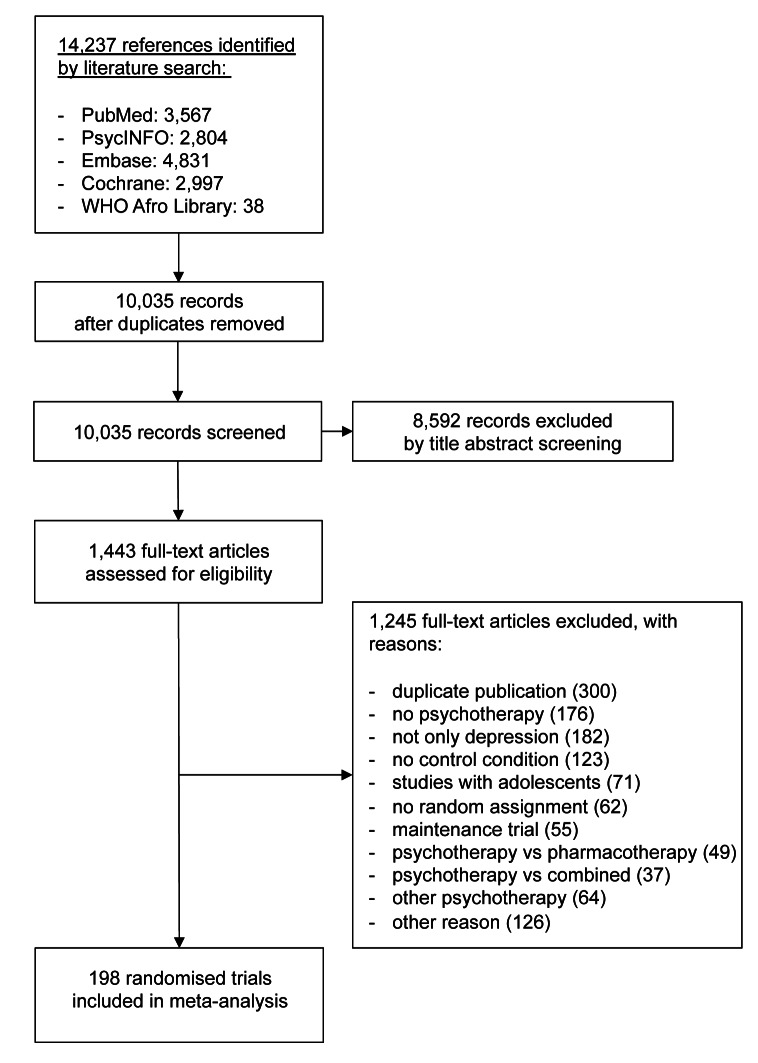
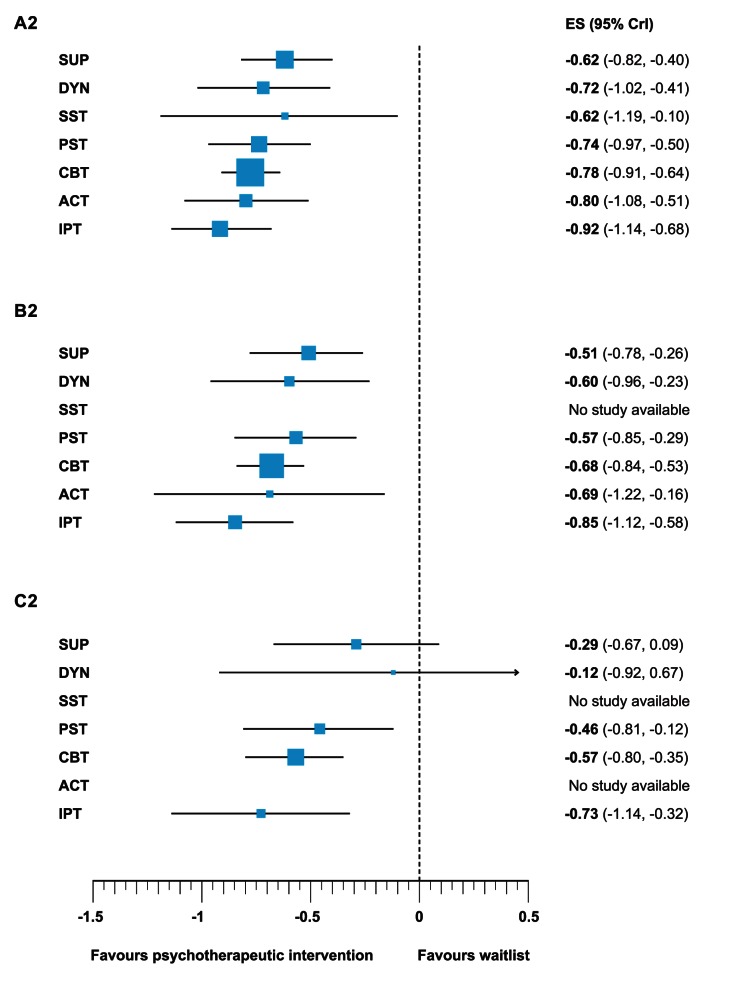
BACKGROUND: Previous meta-analyses comparing the efficacy of psychotherapeutic interventions for depression were clouded by a limited number of within-study treatment comparisons. This study used network meta-analysis, a novel methodological approach that integrates direct and indirect evidence from randomised controlled studies, to re-examine the comparative efficacy of seven psychotherapeutic interventions for adult depression. METHODS AND FINDINGS: We conducted systematic literature searches in PubMed, PsycINFO, and Embase up to November 2012, and identified additional studies through earlier meta-analyses and the references of included studies. We identified 198 studies, including 15,118 adult patients with depression, and coded moderator variables. Each of the seven psychotherapeutic interventions was superior to a waitlist control condition with moderate to large effects (range d = -0.62 to d = -0.92). Relative effects of different psychotherapeutic interventions on depressive symptoms were absent to small (range d = 0.01 to d = -0.30). Interpersonal therapy was significantly more effective than supportive therapy (d = -0.30, 95% credibility interval [CrI] [-0.54 to -0.05]). Moderator analysis showed that patient characteristics had no influence on treatment effects, but identified aspects of study quality and sample size as effect modifiers. Smaller effects were found in studies of at least moderate (Δd = 0.29 [-0.01 to 0.58]; p = 0.063) and large size (Δd = 0.33 [0.08 to 0.61]; p = 0.012) and those that had adequate outcome assessment (Δd = 0.38 [-0.06 to 0.87]; p = 0.100). Stepwise restriction of analyses by sample size showed robust effects for cognitive-behavioural therapy, interpersonal therapy, and problem-solving therapy (all d>0.46) compared to waitlist. Empirical evidence from large studies was unavailable or limited for other psychotherapeutic interventions. CONCLUSIONS: Overall our results are consistent with the notion that different psychotherapeutic interventions for depression have comparable benefits. However, the robustness of the evidence varies considerably between different psychotherapeutic treatments.
Overview
The claims and statistics of this paper haven’t been checked yet.
Free: it reads the open-access text and checks the first 5 claims that cite a source we can check. Create a free account to check every claim.
Integrity signals
Registry
Cites
Statistics
Figures
Verification
Claims the paper makes
The claims and statistics of this paper haven’t been checked yet.
Free: it reads the open-access text and checks the first 5 claims that cite a source we can check. Create a free account to check every claim.
Claims other papers make about this one
Each is checked against this paper’s own text: does it say what the citing paper says it does?
The source backs part of the claim, not all of it — or backs it for a different population, condition or comparison.
In the citing paper
“all psychotherapeutic interventions were superior to psychological control conditions.28”
From Comparative efficacy and acceptability of antidepressants, psychotherapies, and their combination for acute treatment of children and adolescents with depressive disorder: a systematic review and network meta-analysis (2020) · cites this paper as [28]
Experimental — accuracy not yet measuredThe source backs part of the claim, not all of it — or backs it for a different population, condition or comparison.
In the citing paper
“Network meta-analyses revealed the same phenomenon with psychotherapy: researchers once concluded there was a dodo bird verdict, whereby “everybody has won, and all must have prizes,”67 until network meta-analyses showed some interventions were robustly more effective than others.6 26”
From Effect of exercise for depression: systematic review and network meta-analysis of randomised controlled trials (2024) · cites this paper as [26]
Experimental — accuracy not yet measuredThe source backs part of the claim, not all of it — or backs it for a different population, condition or comparison.
In the citing paper
“Barth and associates (2013) did not find a significant difference between CBT and behavioral activation therapy for treating depression, but they did find a significant difference between interpersonal psychotherapy and supportive counseling (d = -0.16;95% CI, -0.33 to 0.22).”
From The Role of Common Factors in Psychotherapy Outcomes (2019) · cites this paper as Barth et al. 2013
Experimental — accuracy not yet measuredThe source backs part of the claim, not all of it — or backs it for a different population, condition or comparison.
In the citing paper
“Despite varying theoretical rationales of different therapeutic approaches, they lead to similar outcomes (Barth et al., 2013).”
From TONI - One for all? Participatory development of a transtheoretic and transdiagnostic online intervention for blended care (2024) · cites this paper as Barth et al., 2013
Experimental — accuracy not yet measuredThe cited source says what the claim attributes to it.
In the citing paper
“It is notable, too, that the authors included Internet-delivered therapies and those delivered face to face, together with studies of participants whose primary disorder was a medical condition, resulting in a more heterogeneous set of populations and interventions than those included in the current review.”
From 'Third wave' cognitive and behavioural therapies versus treatment as usual for depression (2013) · cites this paper as Barth 2013
10 more claims about this paper
Create a free account to see every claim other papers make about this one.
Self-check
Percentages, sums and reported differences re-computed from the paper’s own numbers.
The self-check needs the paper’s full text.
Citations
Cites
Statistical power analysis for the behavioral sciences
(1990) · Computers, Environment and Urban Systems · doi:10.1016/0198-9715(90)90050-4 · Cited by 65,269
Projections of Global Mortality and Burden of Disease from 2002 to 2030
Mathers, C. D., & Loncar, D. (2006) · PLoS Medicine · doi:10.1371/journal.pmed.0030442 · Cited by 11,386
Statistical Methods for Meta-Analysis
Wasserman, S., Hedges, L. V., & Olkin, I. (1988) · Journal of Educational Statistics · doi:10.2307/1164953 · Cited by 10,326
Cognitive Therapy for Depression: (675542012-001)
(2012) · PsycEXTRA Dataset · doi:10.1037/e675542012-001 · Cited by 9,663
(2000) · Cited by 9,198
General methods for monitoring convergence of iterative simulations
Brooks, S. P., & Gelman, A. (1998) · Journal of Computational and Graphical Statistics · doi:10.1080/10618600.1998.10474787 · Cited by 6,045 · cited 1×
“Convergence of Markov chains was considered achieved when plots of the Gelman-Rubin statistics indicated that widths of pooled runs and individual runs stabilised around the same value and their ratio was around one [40].”
MethodSchulz (1995) · doi:10.1001/jama.1995.03520290060030 · Cited by 5,634
Assessing the quality of controlled clinical trials
Jüni, P., Altman, D. G., & Egger, M. (2001) · BMJ · doi:10.1136/bmj.323.7303.42 · Cited by 3,309 · cited 1×
“The quality of primary studies potentially threatens the validity of meta-analyses [23–25].”
BackgroundSelf-citationWood, L., Egger, M., Gluud, L. L., Schulz, K. F., Jüni, P., Altman, D. G., Gluud, C., Martin, R. M., Wood, A. J. G., & Sterne, J. A. C. (2008) · BMJ · doi:10.1136/bmj.39465.451748.ad · Cited by 2,538 · cited 1×
“, if analysis is not intention-to-treat), and lack of blinding of outcome assessors [26–28] are known to have a biasing effect.”
BackgroundSelf-citationCombination of direct and indirect evidence in mixed treatment comparisons
Lu, G., & Ades, A. E. (2004) · Statistics in Medicine · doi:10.1002/sim.1875 · Cited by 2,166 · cited 2×
“For the network meta-analysis, we used an extension of this model to compare various interventions [20,38].”
Method
Cited by
Items 301–400 of 570
Contemporary Advances in Sports Science
Taïar, R. (2021) · IntechOpen eBooks · doi:10.5772/intechopen.93203 · Cited by 8
Andreas, S., Gablonski, T., Tschacher, W., Gebhardt, A., Rabung, S., Schulz, H., & Kadur, J. (2022) · Journal of Clinical Psychology · doi:10.1002/jclp.23411 · Cited by 10
“Efficacious evidence‐based treatments are available, such as cognitive‐behavioral or psychodynamic treatments (Barth et al., 2013; Chen et al., 2020; Driessen et al., 2010; Fonagy et al., 2020).”
BackgroundDomhardt, M., Grund, S., Mayer, A., Büscher, R., Ebert, D. D., Sander, L., Karyotaki, E., Cuijpers, P. J., & Baumeister, H. (2022) · Frontiers in Psychiatry · doi:10.3389/fpsyt.2022.899115 · Cited by 9
Self-citationBarth, J., Michlig, N., & Münder, T. (2014) · Health Psychology and Behavioral Medicine · doi:10.1080/21642850.2014.931231 · Cited by 9
“Descriptive information for the included studies is presented in Table 1, and in an earlier comprehensive review of all of the available studies on depression (Barth et al., 2013).”
BackgroundMethodSelf-citationExpositionsbasierte kognitive Therapie bei Depressionen
Krieger, T., & Holtforth, M. G. (2014) · Nervenheilkunde · doi:10.1055/s-0038-1633391 · Cited by 9
“Journal of Consulting and Clinical Psychology 1996; 64(3): 623–7.”
BackgroundInfluentialOn behalf of the GENKI Project, Hayasaka, Y., Furukawa, T. A., Sozu, T., Imai, H., Kawakami, N., & Horikoshi, M. (2015) · BMC Psychiatry · doi:10.1186/s12888-015-0687-3 · Cited by 10
“Cognitive behavioral therapy (CBT), the psychotherapy for depression and anxiety with the largest number of randomized controlled trials (RCTs) supporting its efficacy [10, 11], has been shown to be effective for subthreshold depression [12] as well.”
BackgroundPlasticity-augmented psychotherapy for refractory depressive and anxiety disorders
Choi, K., & Kim, Y. (2016) · Progress in Neuro-Psychopharmacology and Biological Psychiatry · doi:10.1016/j.pnpbp.2016.04.003 · Cited by 8
Weissman, M. M., & Markowitz, J. C. (2019) · Journal of Women s Health · doi:10.1089/jwh.2018.7492 · Cited by 8
Theories and Models: What They Are, What They Are for, and What They Are AboutPreprint
Fried, E. I. (2020) · Psychological Inquiry · doi:10.31234/osf.io/dt6ev · Cited by 127
Gong, B., Yao, N., Xie, H., Huang, C., Tomoko, K., Berenbaum, H., & Mu, W. (2026) · Journal of Medical Internet Research · doi:10.2196/82677 · Cited by 20
“Given that CBT has consistently demonstrated superiority over other psychothera-peutic interventions and is considered the first-line psychosocial treatment of choice for anxiety and depressive disorders [71,72], this specialized focus may explain the enhanced therapeutic impact.”
Fonagy, P., Chammay, R. E., Ngunu, C., Kumar, M., Verdeli, H., Allison, E., Anani, G., Fearon, P. R. M., Fouad, F. M., Hoare, Z., et al. (2024) · Trials · doi:10.1186/s13063-024-08039-3 · Cited by 11
“A robust body of evidence endorses the utility of psychological therapies for treating adult depression, with several interventions demonstrating moderate to large treatment effects when compared to waitlist controls [18, 19].”
BackgroundKrause, M. S. (2016) · Psychotherapy Research · doi:10.1080/10503307.2016.1222459 · Cited by 7
Kohrt, B. A., & Bhardwaj, A. (2019) · Elsevier eBooks · doi:10.1016/b978-0-12-814932-4.00003-3 · Cited by 7
Goldstone, D. (2016) · South African Journal of Psychology · doi:10.1177/0081246316653860 · Cited by 11
“For patients with mild to moderate depression, CBT seems to be as efficacious as STPP (e.g., Barth et al., 2013; Cuijpers et al., 2008; Driessen et al., 2013; Leichsenring, 2001; Wampold et al., 2002) or more efficacious than STPP in some cases (e.g., Barkham et al., 1999; O’Neal et al., 2014), but…”
BackgroundMethodResultInfluentialJankowsky, K., Zimmermann, J., Jaeger, U., Mestel, R., & Schroeders, U. (2024) · Psychotherapy Research · doi:10.1080/10503307.2024.2411985 · Cited by 8
Kong, Q., Yan, S., Huang, K., Han, B., Han, R., Jiao, Y., Yang, H., Pu, Y., Li, S., & Jia, Y. (2025) · Psychiatry Research · doi:10.1016/j.psychres.2025.116701 · Cited by 7
Selinheimo, S., Gluschkoff, K., Turunen, J., Mattila‐Holappa, P., Kausto, J., & Väänänen, A. (2023) · Journal of Psychiatric Research · doi:10.1016/j.jpsychires.2023.06.001 · Cited by 7
Fukumori, M., Kikuchi, T., Zhou, Y., Hattori, S., & Kudo, T. (2024) · Acta Neuropsychiatrica · doi:10.1017/neu.2024.45 · Cited by 8
“CBT is the most extensively studied and frequently reported psychotherapy for depression (Barth et al ., 2013; Cuijpers et al ., 2021).”
SECCION IX. Síndrome Post COVID-19: complicaciones tardías y rehabilitación
Saavedra, C. (2021) · Infectio · doi:10.22354/in.v25i4.979 · Cited by 15
Saberi, S., Ahmadi, R., Khakpoor, S., Pirzeh, R., Hasani, M., Moradveisi, L., & Saed, O. (2024) · BMC Psychiatry · doi:10.1186/s12888-024-05973-z · Cited by 13
“Although there are differences between these therapies in feasibility, accessibility, and utility [11, 12], CBT has been the most popular in research and treatment.”
BackgroundGlobal Mental Health Praxis: Perspectives from Cultural Psychiatry on Research and Intervention
Kohrt, B. A., & Griffith, J. L. (2015) · Cambridge University Press eBooks · doi:10.1017/cbo9781139424745.025 · Cited by 8
Schaich, A., Heikaus, L., Assmann, N., Köhne, S., Jauch‐Chara, K., Hüppe, M., Wells, A., Schweiger, U., Klein, J. P., & Faßbinder, E. (2018) · Frontiers in Psychiatry · doi:10.3389/fpsyt.2018.00584 · Cited by 7
Sebastianski, M., Gates, M., Gates, A., Nuspl, M., Bialy, L. M., Featherstone, R. M., Breault, L. J., Mason-Lai, P., & Hartling, L. (2019) · BMJ Open · doi:10.1136/bmjopen-2018-026847 · Cited by 7
Murphy, H., & Lahtinen, M. (2014) · Psychology and Psychotherapy Theory Research and Practice · doi:10.1111/papt.12041 · Cited by 6
Protocolo diagnóstico y terapéutico de la depresión
Pereira-Sánchez, V., & Santos, P. M. (2019) · Medicine - Programa de Formación Médica Continuada Acreditado · doi:10.1016/j.med.2019.09.015 · Cited by 11
Berger, T., van Calker, D., Brakemeier, E., & Schramm, E. (2019) · Elsevier eBooks · doi:10.1016/b978-3-437-22485-0.00011-7 · Cited by 9
Kikkert, M., Driessen, E., Peen, J., Barber, J. P., Bockting, C., Schalkwijk, F. W., Dekker, J. J. M., & Dekker, J. (2016) · Journal of Affective Disorders · doi:10.1016/j.jad.2016.08.017 · Cited by 14
“…different theoretical assumptions, studies have found minimal differences between CBT and psychodynamic-in-terpersonal therapies with regard to the reduction of depressive symptom following short-term treatment (Barber et al., 2013; Barth et al., 2013; Cuijpers et al., 2008; Leichsenring, 2001).”
InfluentialMiggiels, M. F., ten Klooster, P. M., Bremer-Hoeve, S., Dekker, J. J. M., Huibers, M. J. H., Reefhuis, E., Van, H. L., & van Dijk, M. K. (2021) · BMC Psychiatry · doi:10.1186/s12888-021-03156-8 · Cited by 5
Kerwer, M., Jonas, M., Stoll, M., Benz, G., & Chasiotis, A. (2025) · Zeitschrift für Psychologie · doi:10.1027/2151-2604/a000570 · Cited by 5
Zhang, Y., Liu, X., Wu, J., Zhang, X., Wei, F., Li, L., Li, H., Wang, X., Wang, B., Wu, W., et al. (2025) · Pharmaceuticals · doi:10.3390/ph18071062 · Cited by 6
“Currently, a range of antidepressant medications and psychother-apeutic approaches have been validated as effective treatments for depression [4,5].”
Braakman, J., & Sterkenburg, P. S. (2023) · Frontiers in Psychology · doi:10.3389/fpsyg.2023.1028084 · Cited by 9
“Multiple psychological and psychosocial interventions are regarded as evidencebased treatment options for various psychological problems in the general population (Hunot et al., 2007; Cuijpers et al., 2008; Barth et al., 2013; Connolly Gibbons et al., 2016).”
BackgroundGordon, A. M., Magruder, M. L., Schwartz, J. M., Ng, M. K., Erez, O., & Mont, M. A. (2024) · The Journal of Arthroplasty · doi:10.1016/j.arth.2024.02.035 · Cited by 5
Ure, S., Gill, C., Evans, T., Windsor, T. D., Scott, J. E. T., WALKER, R. B., Luszcz, M. A., & Mazzucchelli, T. G. (2024) · PLoS ONE · doi:10.1371/journal.pone.0305908 · Cited by 8
“BA has been shown to produce clinically significant improvements in people with depression comparable with other evidence-based approaches such as cognitive-behavioural therapy [19,21,22].”
Psychiatrische Symptome der Huntington-Krankheit
Mühlbäck, A., Hoffmann, R., Pozzi, N. G., Marziniak, M., Brieger, P., Dose, M., & Priller, J. (2024) · Der Nervenarzt · doi:10.1007/s00115-024-01728-z · Cited by 8
Franken, K., ten Klooster, P. M., Bohlmeijer, E. T., Westerhof, G. J., & Kraiss, J. T. (2023) · Frontiers in Psychiatry · doi:10.3389/fpsyt.2023.1236551 · Cited by 7
The Possibilities of Modern Client-Centered and Experiential Psychotherapy
Kocharian, O., Barinova, N. V., & Barinov, S. A. (2023) · Psychological Counseling and Psychotherapy · doi:10.26565/2410-1249-2023-20-01 · Cited by 6
Szulęcka, B. (2024) · Social Science & Medicine · doi:10.1016/j.socscimed.2024.116649 · Cited by 9
Cao, J., Wang, X., Liang, Y., Haonan, H., Lao, C. K., Zheng, Y., Tao, G., & Gan, Y. (2024) · European Journal of Developmental Psychology · doi:10.1080/17405629.2024.2315760 · Cited by 5
“Other effective psychosocial interventions for adults (Barth et al., 2013), such as mindfulness-based and smartphone-based mental health interventions, can be adapted for children with low self-esteem.”
BackgroundInterpersonal Psychotherapy: A Review of Theory, History, and Evidence of Efficacy
Stuart, S. P., Schultz, J. M., Molina, A. P., & Siber, S. (2024) · Psychodynamic Psychiatry · doi:10.1521/pdps.2024.52.3.370 · Cited by 7
Clarke, J. C. (2020) · Psychoanalytic Psychotherapy · doi:10.1080/02668734.2020.1833965 · Cited by 6
Psychotherapeutic Approaches to Addressing Mental Health Problems Among Elite Athletes
Stillman, M. A., & Farmer, H. (2021) · IntechOpen eBooks · doi:10.5772/intechopen.96978 · Cited by 10
Høstmælingen, A., Ulvenes, P., Nissen‐Lie, H. A., Eielsen, M., & Wampold, B. E. (2022) · Journal of Counseling Psychology · doi:10.1037/cou0000572 · Cited by 5
Galvin, M. (2020) · Psychology and Mental Health Care · doi:10.31579/2637-8892/076 · Cited by 12
Gaskin, C. J. (2016) · Psychotherapy and Counselling Journal of Australia · doi:10.59158/001c.71168 · Cited by 6
“Again, this conclusion is in line with previous studies in which psychotherapeutic interventions have been shown to have comparable benefits (e.g., Barth et al., 2013; Gaskin, 2012).”
ResultPsychotherapy for Mixed Depression and Mixed Mania
O’Brien, B., Lee, D. J., Swann, A. C., Mathew, S. J., & Lijffijt, M. (2019) · Psychiatric Clinics of North America · doi:10.1016/j.psc.2019.10.014 · Cited by 6
Sommers, B. (2017) · Digital Commons - Andrews University (Andrews University) · doi:10.32597/dissertations/1633 · Cited by 7
Hopwood, C. J., Yalch, M. M., & Luo, X. (2021) · Rorschachiana Journal of the International Society for the Rorschach · doi:10.1027/1192-5604/a000146 · Cited by 5
Psychotherapy duration and work disability: A prospective Finnish register study
Selinheimo, S., Gluschkoff, K., Kausto, J., Turunen, J., & Väänänen, A. (2024) · Acta Psychiatrica Scandinavica · doi:10.1111/acps.13677 · Cited by 4
Imai, H., Yamada, M., Inagaki, M., Watanabe, N., Chino, B., Mantani, A., & Furukawa, T. A. (2020) · Innovations in clinical neuroscience · Cited by 7
Blay, S. L., Fillenbaum, G. G., & Peluso, É. D. T. P. (2015) · BMC Psychiatry · doi:10.1186/s12888-015-0651-2 · Cited by 7
“Psychotherapy, of which there are multiple types which vary in efficacy [9], can be provided by a wide array of therapists, be obtained by payment out-ofpocket, and may not require a diagnosable mental disorder.”
BackgroundTHE INSTITUTE OF MEDICINE (IOM) SETS A FRAMEWORK FOR EVIDENCE-BASED STANDARDS FOR PSYCHOTHERAPY
Weissman, M. M. (2015) · Depression and Anxiety · doi:10.1002/da.22434 · Cited by 6
“[4] There are an increasing number of evidence-based psychotherapies (EBP) whose procedures have been defined in manuals and efficacy established in controlled clinical trials alone, in comparison or in combination with pharmacotherapy.[5] These studies show that EBP are at least as effective as medication for some di…”
BackgroundApolinário-Hagen, J., Fritsche, L., Albers, L., & Salewski, C. (2018) · Springer eBooks · doi:10.1007/978-981-10-4358-1_21 · Cited by 4
Mennin, D. S. (2019) · JAMA Psychiatry · doi:10.1001/jamapsychiatry.2018.4084 · Cited by 4
A guide to what works for depression: An evidence-based review
Morgan, A. J., Reavley, N. J., Jorm, A. F., Bassilios, B., Hopwood, M., Allen, N. B., & Purcell, R. (2019) · Cited by 5
Dargél, A. (2022) · Bipolar Disorders · doi:10.1111/bdi.13197 · Cited by 4
Consiglio, M. D., Burrai, J., Mari, E., Giannini, A. M., & Couyoumdjian, A. (2023) · Healthcare · doi:10.3390/healthcare11131874 · Cited by 9
Wahle, F., & Kowatsch, T. (2014) · AIS Electronic Library (AISeL) · Cited by 8
Papola, D., Ostuzzi, G., Gastaldon, C., Purgato, M., Giovane, C. D., Pompoli, A., Karyotaki, E., Sijbrandij, M., Furukawa, T. A., Cuijpers, P. J., et al. (2020) · BMJ Open · doi:10.1136/bmjopen-2020-038909 · Cited by 4
Self-citationDropout in brief psychotherapy for major depressive disorder: Randomized clinical trial
Machado, R. D. S., Vieira, I. S., Mondin, T. C., Scaini, C. R., Molina, M. L., Jansen, K., Souza, L. D. D. M., Duarte, M. R., Simjanoski, M., & da Silva, R. A. (2021) · Clinical Psychology & Psychotherapy · doi:10.1002/cpp.2693 · Cited by 4
Sander, L., Beisemann, M., Karyotaki, E., van Ballegooijen, W., Cuijpers, P. J., Teismann, T., Doebler, P., Domhardt, M., Baumeister, H., & Büscher, R. (2023) · PLoS ONE · doi:10.1371/journal.pone.0285622 · Cited by 3
Self-citationArtificial intelligence-based psychotherapy: focusing on common psychotherapeutic factors
Giotakos, O. (2025) · Frontiers in Psychiatry · doi:10.3389/fpsyt.2025.1710715 · Cited by 11
Jafari, M., Basharpour, S., Bazazorde, M., & Hajlo, N. (2022) · Psychological Studies · doi:10.1007/s12646-022-00673-8 · Cited by 3
“Other studies have proved these results by comparing other interventions on depression as well (Barth et al., 2013; Cuijpers, 2016; Cuijpers et al., 2011; Forman et al., 2007).”
ResultComparing targeted intervention modalities for high conflict co‐parents: A quasi‐experimental study
Dealy, J. A., Russell, B. S., & Robinson, J. L. (2023) · Family Court Review · doi:10.1111/fcre.12737 · Cited by 3
A psychological model of predictive factors of distress following long COVID
Brown, S. A., Holland, J. F., Gaynor, K., Bramham, J., O’Keeffe, F. M., O'Flanagan, S., Savinelli, S., Mallon, P. W. G., Feeney, E. R., Kenny, G., et al. (2024) · Journal of Affective Disorders · doi:10.1016/j.jad.2024.12.049 · Cited by 4
Clegg, I., Notebaert, L., Whittle‐Herbert, A., & Richardson, C. E. (2025) · British Journal of Clinical Psychology · doi:10.1111/bjc.12529 · Cited by 4
Gordon, A. M., Nian, P. P., Baidya, J., & Mont, M. A. (2025) · Hip International · doi:10.1177/11207000251317655 · Cited by 3
What Canadian clinical psychologists want from psychotherapy research.
Tasca, G. A. (2015) · Canadian Psychology/Psychologie canadienne · doi:10.1037/cap0000017 · Cited by 3
Is a Combination of Pharmacotherapy and Psychotherapy Superior to Each Alone?
Choi, K., & Kim, Y. (2017) · Springer eBooks · doi:10.1007/978-981-10-6577-4_21 · Cited by 4
Psychological Treatment for Depressive Disorder
Li, X., & Wang, Q. (2019) · Advances in experimental medicine and biology · doi:10.1007/978-981-32-9271-0_13 · Cited by 5
Doing Quantitative Research with Statistics
McBeath, A. G. (2020) · Springer eBooks · doi:10.1007/978-3-030-55127-8_9 · Cited by 3
Leonidaki, V., & Constantinou, M. (2021) · Clinical Psychology & Psychotherapy · doi:10.1002/cpp.2669 · Cited by 4
Schindler‐Gmelch, L., Stalder, T., Kirschbaum, C., Plessow, F., Schönfeld, S., Hoyer, J., Trautmann, S., Weidner, K., & Steudte‐Schmiedgen, S. (2021) · Clinical Psychology in Europe · doi:10.32872/cpe.4105 · Cited by 4
Beal, M. L., Lerman, S. F., & Leppla, I. E. (2022) · European Burn Journal · doi:10.3390/ebj3010010 · Cited by 4
“While psychotherapeutic interventions for depression such as CBT, interpersonal therapy, and problem-solving therapy have all shown large treatment effects compared to waitlist [42], to the best of our knowledge, there are no studies assessing these interventions in burn survivors.”
BackgroundTrinkler, C., Strauss, B. M., & Gumz, A. (2022) · Die Psychotherapie · doi:10.1007/s00278-022-00634-6 · Cited by 3
“2 Prüfkriterien zummethodischenUmgangmit psychischen Komorbiditäten in ausgewähltenMetaanalysen Komorbidität alsKurzquellenangabe Untersuchte Behandlungsmethode(n) Klinischer Faktor in Primäranalyse Klinischer Faktor in Subgruppenanalyse Einschlusskriterium Ausschlusskriterium Abbass et al. (2011) Psychotherapie + – +…”
Kira, Y., Matsumoto, M., Kambara, K., & Ogata, A. (2023) · International Journal of School & Educational Psychology · doi:10.1080/21683603.2023.2243858 · Cited by 7
“Because the latter are associated with depression in high school students (Barth et al., 2013; Caldwell et al., 2019; Kambara et al., 2019; Rose et al., 2014), it is suggested that appropriate improvements in these target variables with the implementation of the program results in decreased…”
Karlsson, P., Bergmark, A., & Lundström, T. (2016) · International Journal of Social Welfare · doi:10.1111/ijsw.12240 · Cited by 3
“Available studies making direct comparisons of bona fide treatments have generally failed to find non-trivial differences (see e.g. Imel, Wampold Miller, & Fleming, 2008, for alcohol abuse treatment; Barth et al., 2013 for depression treatment).”
BackgroundReconstructing the Meaning Effect - The Capacity to Self-Heal Emerges From the Placebo Concept
Walach, H. (2016) · Tidsskrift for Forskning i Sygdom og Samfund · doi:10.7146/tfss.v12i23.23016 · Cited by 6
“115 Reconstructing the Meaning Effect social activation, or meditation, or psychotherapy, and all have a – probably very similar – chance of treating depression (Barth et al., 2013).”
BackgroundJacobs, N., & Reupert, A. E. (2015) · Psychotherapy and Counselling Journal of Australia · doi:10.59158/001c.71152 · Cited by 3
“The effectiveness of ST or NDST as a therapy for adult depression and its equivalence to other therapies is further supported by two meta-analyses in this area (Barth et al., 2013; Cuijpers et al., 2012).”
BackgroundMethodResultBolinski, F., Hendriks, G., Bardoel, S., Hollon, S. D., Martell, C. R., & Huibers, M. J. H. (2018) · International Journal of Cognitive Therapy · doi:10.1007/s41811-018-0027-8 · Cited by 8
Abordaje clínico y manejo de la depresión posparto
Solano, M. S., Mejía, A. L. P., & Madrigal, J. C. (2019) · Revista Medica Sinergia · doi:10.31434/rms.v4i6.248 · Cited by 21
Vilca, L. W., Echabaudes-Ilizarbe, R. I., Aquino-Hidalgo, J. M., Ventura‐León, J., Martinez‐Munive, R., & White, M. (2020) · Psychological Reports · doi:10.1177/0033294120981930 · Cited by 4
Altered effective connectivity within default mode network in major depression disorder
Li, L., Li, B., Bai, Y., Wang, H., Zhang, L., Cui, L., & Lu, H. (2016) · Proceedings of SPIE, the International Society for Optical Engineering/Proceedings of SPIE · doi:10.1117/12.2218363 · Cited by 3
“Numerous studies have reported the alterations in different functional networks in patients with depression([2]).”
BackgroundLeibovich, L., & Zilcha‐Mano, S. (2016) · Journal of Psychotherapy Integration · doi:10.1037/int0000043 · Cited by 3
“A recent meta-analysis validated previous findings that psychotherapy was more effective than a wait list control group in treating depressive disorders (Barth et al., 2013).”
ResultVigod, S. N., Buist, A., & Steiner, M. S. (2015) · Cambridge University Press eBooks · doi:10.1017/cbo9781107045132.011 · Cited by 4
The Scientific Basis of Psychotherapy
Roose, S. P., Fonagy, P., & Rutherford, B. R. (2015) · Wiley eBooks · doi:10.1002/9781118753378.ch18 · Cited by 3
Méthodologie des essais thérapeutiques
Naudet, F., & Falissard, B. (2014) · Time to knit · doi:10.1016/s0246-1072(14)43770-2 · Cited by 4
In the pursuit of truth, we should not prioritize correlational over causal evidence
Cristea, I. A., & Cuijpers, P. J. (2016) · Psychotherapy Research · doi:10.1080/10503307.2016.1249434 · Cited by 3
Self-citationVernmark, K. (2017) · doi:10.3384/diss.diva-142389 · Cited by 7
“These trials have shown that several different psychotherapies, such as cognitive behaviour therapy, interpersonal psychotherapy, behavioural activation, problem solving therapy and psychodynamic psychotherapy are effective when treating depression (Barth et al., 2013; Cuijpers, 2015; Hollon & Ponniah, 2010).”
BackgroundInternet-Delivered Dialectical Behavior Therapy Skills Training for Suicidal and Heavy Drinkers
Wilks, C. R. (2018) · ResearchWorks at the University of Washington (University of Washington) · Cited by 4
Wester, R. A., Rubel, J. A., & Mayer, A. (2021) · doi:10.31234/osf.io/t5843 · Cited by 3
Theories and models: What they are, what they are for, and what they are aboutPreprint
Fried, E. I. (2020) · PsyArXiv (OSF Preprints) · doi:10.31234/osf.io/s2j5a · Cited by 3
Davey, C. G., & Badcock, P. B. (2025) · Entropy · doi:10.3390/e27090970 · Cited by 3
Symptom Networks in Depression: Temporal Dynamics of Mood, Cognition, and Behavior During Treatment
Quaatz, S. M., Benz, S., Just, L., Vierl, L., Tamm, J., Egli, S., & Kopf‐Beck, J. (2026) · Cognitive Therapy and Research · doi:10.1007/s10608-025-10709-8 · Cited by 3
“While several psychotherapeutic interventions show broadly comparable efficacy (Barth et al., 2013; Cuijpers et al., 2014), a more precise understanding of the temporal dynamics of depressive symptoms in daily life is still lacking.”
Psychological treatment of depression in older adults: A network meta-analysis
Cuijpers, P. J., Miguel, C., Karyotaki, E., & Harrer, M. (2026) · International Psychogeriatrics · doi:10.1016/j.inpsyc.2026.100213 · Cited by 2
Self-citationRowland, H. (2026) · Transactional Analysis Journal · doi:10.1080/03621537.2026.2677312 · Cited by 2
“A fourth concern, supported by the work of Barth et al. (2013), cuijpers et al. (2023), and Wampold et al. (2017), is that close statistical analysis of trials featuring legitimate control groups suggests that claims of cBt’s superiority over other modalities are grossly exaggerated. these…”
Use of Psychotherapy in a Representative Adult Community Sample in São Paulo, Brazil
Blay, S. L., Fillenbaum, G. G., da Silva, P. F. R., & Peluso, É. D. T. P. (2014) · The Journal of Nervous and Mental Disease · doi:10.1097/nmd.0000000000000181 · Cited by 6
Freedland, K. E., Lemos, M., Doyle, F., Steinmeyer, B. C., Csik, I., & Carney, R. M. (2016) · Cognitive Therapy and Research · doi:10.1007/s10608-016-9797-6 · Cited by 4
“…behavioral activation and problem-solving, if delivered as stand-alone interventions, are approximately as efficacious for depression as is multicomponent CBT (Barth et al. 2013; Bell and D’Zurilla 2009; Cuijpers et al. 2007, 2013; Dimidjian et al. 2006; Jacobson et al. 1996; Nezu and Perri 1989).”
BackgroundYılmaz, O., MIRÇIK, A. B., Kunduz, M., ÇOMBAŞ, M., Öztürk, A., Deveci, E., & Kırpınar, İ. (2019) · Archives of Clinical Psychiatry (São Paulo) · doi:10.1590/0101-60830000000217 · Cited by 5
PSYKOTERAPIFORSKNING GENNEM 100 ÅR – HVOR LANGT ER VI NÅET?
Hougaard, E. (2021) · Psyke & Logos · doi:10.7146/pl.v42i1.128765 · Cited by 3
“…effekt mellem de forskellige terapiformer i deres første større metaanalyse, og dodokendelsen har fundet støtte i en lang række senere metaanalyser (fx Barth et al., 2013; Cuijpers, van Straten, Andersson, & van Oppen, 2008; Goldberg et al., 2018; Luborsky et al., 2002; Wampold et al., 2017;…”
BackgroundOnline Psychological Intervention in Breast Cancer Survivors: a Review
Popovic, M. M., Rico, V., DeAngelis, C., Lam, H., & Lim, F. (2022) · Hong Kong Journal of Radiology · doi:10.12809/hkjr2217206 · Cited by 3
Metadata
- Authors
- Barth, J., Munder, T., Gerger, H., Nüesch, E., Trelle, S., Znoj, H., Jüni, P., & Cuijpers, P.
- Affiliations
- University of Bern (CH)
- Vrije Universiteit Amsterdam (NL)
- Corresponding author
- Barth, Jürgen
- Venue
- PLoS Medicine
- Publisher
- Public Library of Science (PLoS)
- Published
- 2013-05-28
- Volume
- 10
- Issue
- 5
- Pages
- e1001454
- ISSN
- 1549-1277 (ISSN-L)
- 1549-1676
- PMC
- PMC3665892
- OpenAlex
- W2114536224
- Cited by
- 569
- References
- 63
- Citations by year
- 2026: 14 · 2025: 21 · 2024: 40 · 2023: 26 · 2022: 31 · 2021: 61 · 2020: 62 · 2019: 69 · 2018: 44 · 2017: 47 · 2016: 40 · 2015: 57 · 2014: 44 · 2013: 11
- FWCI
- 55.87
- Type
- journal article
- Language
- en
- Open access
- gold
- doi.org
- Locations
- PLoS Medicine (publishedVersion, cc-by)
- Europe PMC (PubMed Central) (publishedVersion, cc-by)
- PubMed Central (publishedVersion, cc-by)
- PubMed (publishedVersion)
- EUR Research Repository (Erasmus University Rotterdam) (publishedVersion)
- DSpace (Open University in the Netherlands) (publishedVersion, other-oa)
- LSHTM Research Online (London School of Hygiene and Tropical Medicine) (acceptedVersion)
- RePEc: Research Papers in Economics (submittedVersion, cc-by)
- Data Archiving and Networked Services (DANS) (submittedVersion, other-oa)
- EUR Research Repository (Erasmus University Rotterdam) (submittedVersion)
- BORIS (University Library Bern) (submittedVersion, cc-by)
- Digital Academic REpository of VU University Amsterdam (Vrije Universiteit Amsterdam) (submittedVersion)
- DOAJ (DOAJ: Directory of Open Access Journals) (submittedVersion, cc-by-sa)
- edoc (University of Basel) (submittedVersion)
- Multilingual Matters (Channel View Publications) (submittedVersion, cc-by)
- VU Research Portal (submittedVersion, other-oa)
- Funders
- National Science Foundation
- Amgen
- Eli Lilly and Company
- AstraZeneca
- University of Bern
- Ablynx
- Schweizerischer Nationalfonds zur Förderung der Wissenschaftlichen Forschung (118312, 105314-118312/1, 105314)
- Eisai
- St. Jude Medical
- Abbott Vascular
- Topics
- Social Sciences › Psychology › Clinical Psychology › Psychotherapy Techniques and Applications
- Social Sciences › Psychology › Experimental and Cognitive Psychology › Anxiety, Depression, Psychometrics, Treatment, Cognitive Processes
- Social Sciences › Psychology › Applied Psychology › Digital Mental Health Interventions
- Keywords
- depression, psychotherapeutic interventions, drug efficacy comparison, interpersonal psychotherapy, cognitive behavioral therapy, problem-solving therapy, supportive therapy, waitlist control, sample size, study quality, outcome measurement
- MeSH terms
- Adult, Bayes Theorem, Depression, Female, Humans, Male, Markov Chains, Psychotherapy, Treatment Outcome, Evidence-Based Medicine
About these checks
Registry, retraction, Cites and statistics results are computed, not judged, with one exception: a printed reference that no index lists is read once by a model before it counts as a citation error. Claims are extracted by a model and kept only when their quote appears verbatim in the text; each cited source is then checked, with a model’s help, for whether it says what the claim relies on. Those verdicts can be wrong — read the claim’s quote and the cited source before relying on one.
Statistics and arithmetic are recomputed, not judged.
Confidence bands are shown only for fields calibrated on our annotated test set. None is calibrated yet, so no band is shown.
What counts as a claim ›How we measure confidence ›How we check this ›
Are you an author, or do you see a problem with this page? Request a review
Data sources
Bibliographic data: Semantic Scholar, OpenAlex, Crossref.
Contains information from the Semantic Scholar Academic Graph Datasets, made available under the ODC Attribution License (ODC-BY 1.0).
Semantic Scholar’s data is described in: Kinney, R., et al. (2023). The Semantic Scholar Open Data Platform. arXiv:2301.10140.
