

Comparative Efficacy of Seven Psychotherapeutic Interventions for Patients with Depression: A Network Meta-Analysis
Open accessThe DOI matches its Crossref record; 62 of the 63 references it cites were found in a registry or an index.
Abstract
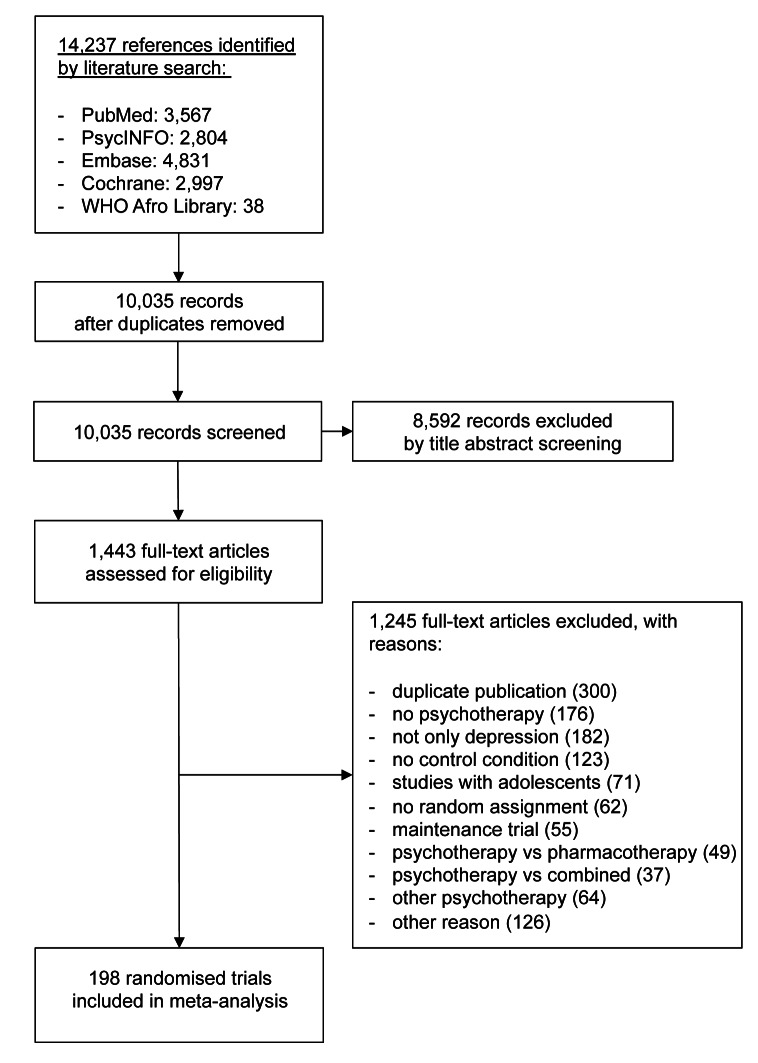
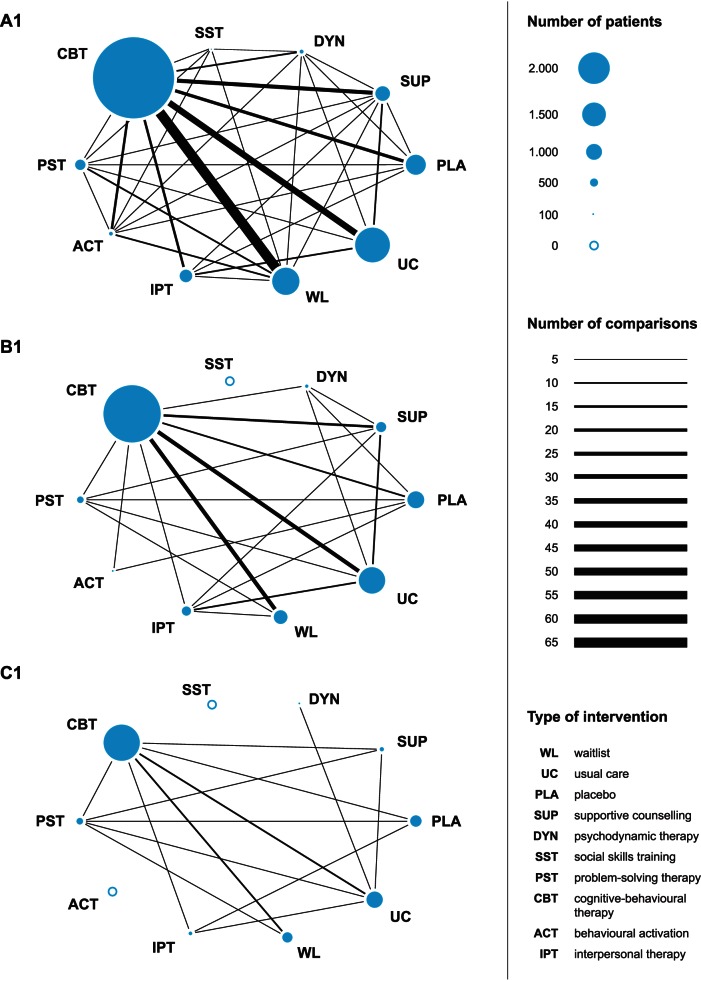
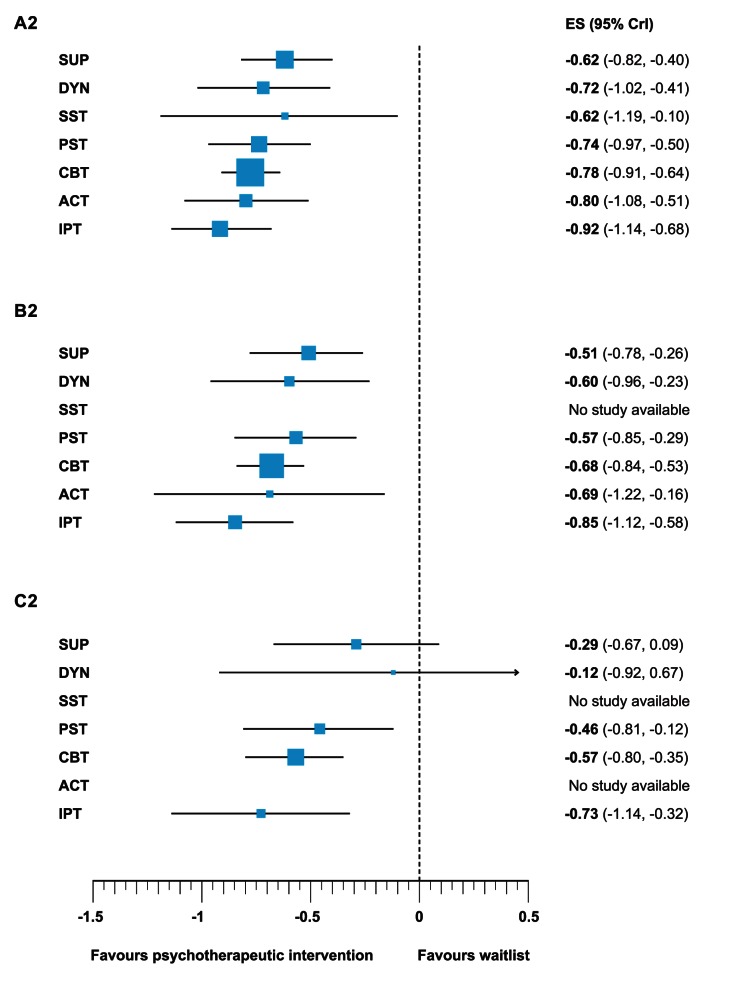
BACKGROUND: Previous meta-analyses comparing the efficacy of psychotherapeutic interventions for depression were clouded by a limited number of within-study treatment comparisons. This study used network meta-analysis, a novel methodological approach that integrates direct and indirect evidence from randomised controlled studies, to re-examine the comparative efficacy of seven psychotherapeutic interventions for adult depression. METHODS AND FINDINGS: We conducted systematic literature searches in PubMed, PsycINFO, and Embase up to November 2012, and identified additional studies through earlier meta-analyses and the references of included studies. We identified 198 studies, including 15,118 adult patients with depression, and coded moderator variables. Each of the seven psychotherapeutic interventions was superior to a waitlist control condition with moderate to large effects (range d = -0.62 to d = -0.92). Relative effects of different psychotherapeutic interventions on depressive symptoms were absent to small (range d = 0.01 to d = -0.30). Interpersonal therapy was significantly more effective than supportive therapy (d = -0.30, 95% credibility interval [CrI] [-0.54 to -0.05]). Moderator analysis showed that patient characteristics had no influence on treatment effects, but identified aspects of study quality and sample size as effect modifiers. Smaller effects were found in studies of at least moderate (Δd = 0.29 [-0.01 to 0.58]; p = 0.063) and large size (Δd = 0.33 [0.08 to 0.61]; p = 0.012) and those that had adequate outcome assessment (Δd = 0.38 [-0.06 to 0.87]; p = 0.100). Stepwise restriction of analyses by sample size showed robust effects for cognitive-behavioural therapy, interpersonal therapy, and problem-solving therapy (all d>0.46) compared to waitlist. Empirical evidence from large studies was unavailable or limited for other psychotherapeutic interventions. CONCLUSIONS: Overall our results are consistent with the notion that different psychotherapeutic interventions for depression have comparable benefits. However, the robustness of the evidence varies considerably between different psychotherapeutic treatments.
Overview
The claims and statistics of this paper haven’t been checked yet.
Free: it reads the open-access text and checks the first 5 claims that cite a source we can check. Create a free account to check every claim.
Integrity signals
Registry
Cites
Statistics
Figures
Verification
Claims the paper makes
The claims and statistics of this paper haven’t been checked yet.
Free: it reads the open-access text and checks the first 5 claims that cite a source we can check. Create a free account to check every claim.
Claims other papers make about this one
Each is checked against this paper’s own text: does it say what the citing paper says it does?
The source backs part of the claim, not all of it — or backs it for a different population, condition or comparison.
In the citing paper
“all psychotherapeutic interventions were superior to psychological control conditions.28”
From Comparative efficacy and acceptability of antidepressants, psychotherapies, and their combination for acute treatment of children and adolescents with depressive disorder: a systematic review and network meta-analysis (2020) · cites this paper as [28]
Experimental — accuracy not yet measuredThe source backs part of the claim, not all of it — or backs it for a different population, condition or comparison.
In the citing paper
“Network meta-analyses revealed the same phenomenon with psychotherapy: researchers once concluded there was a dodo bird verdict, whereby “everybody has won, and all must have prizes,”67 until network meta-analyses showed some interventions were robustly more effective than others.6 26”
From Effect of exercise for depression: systematic review and network meta-analysis of randomised controlled trials (2024) · cites this paper as [26]
Experimental — accuracy not yet measuredThe source backs part of the claim, not all of it — or backs it for a different population, condition or comparison.
In the citing paper
“Barth and associates (2013) did not find a significant difference between CBT and behavioral activation therapy for treating depression, but they did find a significant difference between interpersonal psychotherapy and supportive counseling (d = -0.16;95% CI, -0.33 to 0.22).”
From The Role of Common Factors in Psychotherapy Outcomes (2019) · cites this paper as Barth et al. 2013
Experimental — accuracy not yet measuredThe source backs part of the claim, not all of it — or backs it for a different population, condition or comparison.
In the citing paper
“Despite varying theoretical rationales of different therapeutic approaches, they lead to similar outcomes (Barth et al., 2013).”
From TONI - One for all? Participatory development of a transtheoretic and transdiagnostic online intervention for blended care (2024) · cites this paper as Barth et al., 2013
Experimental — accuracy not yet measuredThe cited source says what the claim attributes to it.
In the citing paper
“It is notable, too, that the authors included Internet-delivered therapies and those delivered face to face, together with studies of participants whose primary disorder was a medical condition, resulting in a more heterogeneous set of populations and interventions than those included in the current review.”
From 'Third wave' cognitive and behavioural therapies versus treatment as usual for depression (2013) · cites this paper as Barth 2013
10 more claims about this paper
Create a free account to see every claim other papers make about this one.
Self-check
Percentages, sums and reported differences re-computed from the paper’s own numbers.
The self-check needs the paper’s full text.
Citations
Cites
Statistical power analysis for the behavioral sciences
(1990) · Computers, Environment and Urban Systems · doi:10.1016/0198-9715(90)90050-4 · Cited by 65,269
Projections of Global Mortality and Burden of Disease from 2002 to 2030
Mathers, C. D., & Loncar, D. (2006) · PLoS Medicine · doi:10.1371/journal.pmed.0030442 · Cited by 11,386
Statistical Methods for Meta-Analysis
Wasserman, S., Hedges, L. V., & Olkin, I. (1988) · Journal of Educational Statistics · doi:10.2307/1164953 · Cited by 10,326
Cognitive Therapy for Depression: (675542012-001)
(2012) · PsycEXTRA Dataset · doi:10.1037/e675542012-001 · Cited by 9,663
(2000) · Cited by 9,198
General methods for monitoring convergence of iterative simulations
Brooks, S. P., & Gelman, A. (1998) · Journal of Computational and Graphical Statistics · doi:10.1080/10618600.1998.10474787 · Cited by 6,045 · cited 1×
“Convergence of Markov chains was considered achieved when plots of the Gelman-Rubin statistics indicated that widths of pooled runs and individual runs stabilised around the same value and their ratio was around one [40].”
MethodSchulz (1995) · doi:10.1001/jama.1995.03520290060030 · Cited by 5,634
Assessing the quality of controlled clinical trials
Jüni, P., Altman, D. G., & Egger, M. (2001) · BMJ · doi:10.1136/bmj.323.7303.42 · Cited by 3,309 · cited 1×
“The quality of primary studies potentially threatens the validity of meta-analyses [23–25].”
BackgroundSelf-citationWood, L., Egger, M., Gluud, L. L., Schulz, K. F., Jüni, P., Altman, D. G., Gluud, C., Martin, R. M., Wood, A. J. G., & Sterne, J. A. C. (2008) · BMJ · doi:10.1136/bmj.39465.451748.ad · Cited by 2,538 · cited 1×
“, if analysis is not intention-to-treat), and lack of blinding of outcome assessors [26–28] are known to have a biasing effect.”
BackgroundSelf-citationCombination of direct and indirect evidence in mixed treatment comparisons
Lu, G., & Ades, A. E. (2004) · Statistics in Medicine · doi:10.1002/sim.1875 · Cited by 2,166 · cited 2×
“For the network meta-analysis, we used an extension of this model to compare various interventions [20,38].”
Method
Cited by
Items 101–200 of 570
Cuijpers, P., Oud, M., Karyotaki, E., Noma, H., Quero, S., Cipriani, A., Arroll, B., & Furukawa, T. A. (2021) · The Annals of Family Medicine · doi:10.1370/afm.2676 · Cited by 67
“We conducted sensitivity analyses in which we limited the analysis to (1) studies with low RoB, (2) studies of cognitive behavior therapy (CBT) alone, or (3) studies with pill placebo excluded (in these studies, patients receiving drugs are blinded, and patients in psychotherapy are not).”
MethodSelf-citationMichopoulos, I., Furukawa, T. A., Noma, H., Kishimoto, S., Onishi, A., Ostinelli, E. G., Ciharova, M., Miguel, C., Karyotaki, E., & Cuijpers, P. (2021) · Journal of Clinical Epidemiology · doi:10.1016/j.jclinepi.2020.12.012 · Cited by 69
Self-citationEvidence for psychodynamic psychotherapy in specific mental disorders: a systematic review
Leichsenring, F., & Klein, S. (2014) · Psychoanalytic Psychotherapy · doi:10.1080/02668734.2013.865428 · Cited by 69
“of more recent meta-analyses by Barth et al. (2013) and Driessen et al.”
BackgroundMethodResultInfluentialWhat is needed to eradicate the depression epidemic, and why
Ormel, J., Cuijpers, P., Jorm, A., & Schoevers, R. A. (2020) · Mental Health & Prevention · doi:10.1016/j.mhp.2019.200177 · Cited by 67
Self-citationPsychotherapy: A World of Meanings
Locher, C., Meier, S., & Gaab, J. (2019) · Frontiers in Psychology · doi:10.3389/fpsyg.2019.00460 · Cited by 67
Tully, P. J., Ang, S. Y., Lee, E. J., Bendig, E., Bauereiß, N., Bengel, J., & Baumeister, H. (2021) · Cochrane Database of Systematic Reviews · doi:10.1002/14651858.cd008012.pub4 · Cited by 64
Bernard, P., Romain, A.-J., Caudroit, J., Chevance, G., Carayol, M., Gourlan, M., Needham Dancause, K., & Moullec, G. (2018) · Health Psychology · doi:10.1037/hea0000578 · Cited by 64
Psychotherapies for adult depression: recent developments
Cuijpers, P. (2015) · Current Opinion in Psychiatry · doi:10.1097/yco.0000000000000121 · Cited by 64
Self-citationSong, R., Sun, N., & Song, X. (2019) · Frontiers in Psychology · doi:10.3389/fpsyg.2019.01816 · Cited by 80
Emergent approaches to the meta-analysis of multiple heterogeneous complex interventions
Melendez-Torres, G. J., Bonell, C., & Thomas, J. (2015) · BMC Medical Research Methodology · doi:10.1186/s12874-015-0040-z · Cited by 64
“For example, Barth and colleagues [20] conducted a multiple interventions meta-analysis of 198 randomised trials of psychotherapeutic interventions for depressive disorders.”
MethodDepression in primary care: part 2—management
Ramanuj, P., Ferenchick, E. K., & Pincus, H. A. (2019) · BMJ · doi:10.1136/bmj.l835 · Cited by 78
Harrer, M., Apolinário-Hagen, J., Fritsche, L., Salewski, C., Zarski, A.-C., Lehr, D., Baumeister, H., Cuijpers, P., & Ebert, D. D. (2021) · Internet Interventions · doi:10.1016/j.invent.2021.100374 · Cited by 63
Self-citationTaylor, S. J. C., Carnes, D., Homer, K., Kahan, B. C., Hounsome, N., Eldridge, S., Spencer, A., Pincus, T., Rahman, A., & Underwood, M. (2016) · PLoS Medicine · doi:10.1371/journal.pmed.1002040 · Cited by 63
Cuijpers, P., Quero, S., Papola, D., Cristea, I. A., & Karyotaki, E. (2021) · Psychological Medicine · doi:10.1017/s0033291719003581 · Cited by 62
Self-citationMenon, V., Rajan, T. M., & Sarkar, S. (2017) · Indian Journal of Psychological Medicine · doi:10.4103/0253-7176.198956 · Cited by 62
“The effect sizes were comparable with findings from meta‑analytic reviews evaluating conventionally administered CBT and other psychological treatments in depression [10,40,41] but somewhat lower than the figures reported in a recent meta‑analysis of treatment efficacy in anxiety disorders.”
ResultLorenzo‐Luaces, L., Peipert, A., Jesús-Romero, R. D., Rutter, L. A., & Rodríguez‐Quintana, N. (2020) · International Journal of Cognitive Therapy · doi:10.1007/s41811-020-00094-3 · Cited by 72
Heim, N., Bobou, M., Tanzer, M., Jenkinson, P. M., Steinert, C., & Fotopoulou, A. (2023) · Psychiatry and Clinical Neurosciences · doi:10.1111/pcn.13576 · Cited by 61
A-Tjak, J. G. L., Morina, N., Topper, M., & Emmelkamp, P. M. G. (2018) · Psychotherapy and Psychosomatics · doi:10.1159/000486807 · Cited by 61
Pedersen, G. A., Lakshmin, P., Schafer, A., Watts, S., Carswell, K., Willhoite, A., Ottman, K. E., Hof, E. V., & Kohrt, B. A. (2020) · Journal of Behavioral and Cognitive Therapy · doi:10.1016/j.jbct.2020.06.001 · Cited by 67
“Although treatment-specific factors in psychological interventions and psychotherapies may contribute to positive outcomes (Arch et al., 2012; Barth et al., 2013; Cuijpers, van Straten, Andersson, & van Oppen, 2008), the exact mechanisms for how these treatments work is often a subject of debate (Cuijpers, Reijnders,…”
BackgroundEye movement desensitization and reprocessing for depression: a systematic review and meta-analysis
Carletto, S., Malandrone, F., Berchialla, P., Oliva, F., Colombi, N., Hase, M., Hofmann, A., & Ostacoli, L. (2021) · European Journal of Psychotraumatology · doi:10.1080/20008198.2021.1894736 · Cited by 72
“However, less than half of the treated patients (Johnston, Powell, Anderson, Szabo, & Cline, 2019) show a positive response to drug therapy (i.e. a reduction in depressive symptoms) and, although the introduction of cognitive behavioural therapy (CBT) has allowed a doubling of the percentage of responders (Hofmann et…”
ResultInfluentialGo open: A plea for transparency in psychotherapy.
Gaab, J., Blease, C., Locher, C., & Gerger, H. (2016) · Psychology of Consciousness: Theory, Research, and Practice · doi:10.1037/cns0000063 · Cited by 60
Self-citationMacroeconomics of Mental Health
Abramson, B., Boerma, J., & Tsyvinski, A. (2024) · National Bureau of Economic Research · doi:10.3386/w32354 · Cited by 77
Blanco, C., Markowitz, J. C., Hellerstein, D. J., Nezu, A. M., Wall, M., Olfson, M., Chen, Y., Levenson, J., Onishi, M., Varona, C., et al. (2019) · Breast Cancer Research and Treatment · doi:10.1007/s10549-018-4994-5 · Cited by 59
Working alliance as a predictor of change in depression during blended cognitive behaviour therapy
Vernmark, K., Hesser, H., Topooco, N., Berger, T., Riper, H., Luuk, L., Backlund, L., Carlbring, P., & Andersson, G. (2019) · Cognitive Behaviour Therapy · doi:10.1080/16506073.2018.1533577 · Cited by 59
“for depression (Barth et al., 2013; Cuijpers, 2015), but there is a lack of therapists and access to effective treatment in the healthcare sector.”
BackgroundRiveros, M. E., Ávila, A., Schruers, K. R. J., & Ezquer, F. E. (2022) · Antioxidants · doi:10.3390/antiox11030540 · Cited by 67
“behaviour therapy, behavioural activation therapy, interpersonal psychotherapy, problemsolving therapy, and non-directive counselling, all of which have comparable efficacy in the treatment of depression [17].”
BackgroundPu, J., Zhou, X., Liu, L., Zhang, Y., Yang, L., Yuan, S., Zhang, H., Han, Y. K., Zou, D., & Xie, P. (2017) · Psychiatry Research · doi:10.1016/j.psychres.2017.03.023 · Cited by 74
“…outcomes than control conditions in various patients with depression, including adults and adolescents (Cohen’s d = 0.63; 95% CI 0.36 to 0.90) (Cuijpers et al., 2011; de Mello et al., 2005), and compared with supportive therapy with adults (d = −0.30; 95% CI −0.54 to −0.05) (Barth et al., 2013).”
ResultInfluentialA-Tjak, J. G. L., Morina, N., Topper, M., & Emmelkamp, P. M. G. (2021) · BMC Psychiatry · doi:10.1186/s12888-020-03020-1 · Cited by 57
Making sense of the evidence in population health intervention research: building a dry stone wall
Ogilvie, D., Bauman, A. E., Foley, L. S., Guell, C., Humphreys, D. K., & Panter, J. (2020) · BMJ Global Health · doi:10.1136/bmjgh-2020-004017 · Cited by 69
“29 What to do, then?”
Rubel, J. A., Zilcha-Mano, S., Giesemann, J., Prinz, J., & Lutz, W. (2020) · Psychotherapy Research · doi:10.1080/10503307.2019.1597994 · Cited by 56
“Introduction For decades, psychotherapy research trials comparing the efficacy of distinct treatments have failed to compellingly demonstrate the differential effects of these treatments (e.g., Barth et al., 2013).”
BackgroundLinde, K., Rücker, G., Sigterman, K., Jamil, S., Meissner, K., Schneider, A., & Kriston, L. (2015) · BMC Family Practice · doi:10.1186/s12875-015-0314-x · Cited by 56
“[5] did not find a difference between individualized face-to-face and all other delivery modes.”
BackgroundMethodInfluentialLorenzo-Luaces, L., & DeRubeis, R. J. (2018) · Cognitive Therapy and Research · doi:10.1007/s10608-018-9893-x · Cited by 56
Norell‐Clarke, A., Jansson‐Fröjmark, M., Tillfors, M., Holländare, F., & Engström, I. (2015) · Behaviour Research and Therapy · doi:10.1016/j.brat.2015.09.005 · Cited by 70
“Looking at reviews of evidence-based treatments of depression, there is a variety of treatment options with different approaches that has an effect on depression (Barth et al., 2013).”
BackgroundIs there an excess of significant findings in published studies of psychotherapy for depression?
Flint, J., Cuijpers, P., Horder, J., Koole, S. L., & Munafò, M. R. (2015) · Psychological Medicine · doi:10.1017/s0033291714001421 · Cited by 56
“However, there seem to be few differences between the effects of different types of psychotherapies for depression (Cuijpers et al. 2008a; Barth et al. 2013).”
BackgroundSelf-citationKaryotaki, E., Smit, Y., de Beurs, D. P., Henningsen, K. H., Robays, J., Huibers, M. J. H., Weitz, E., & Cuijpers, P. (2016) · Depression and Anxiety · doi:10.1002/da.22491 · Cited by 56
“Moreover, the finding that different types of psychotherapy, with the exception of nondirective supportive therapy, result in similar effects in treating depression is consistent with the meta-analyses of direct comparisons of different types of psychotherapy conducted by Cuijpers et al.[17] and Barth et al.[79] These…”
BackgroundSelf-citationZilcha-Mano, S., Keefe, J. R., Chui, H., Rubin, A., Barrett, M. S., & Barber, J. P. (2016) · The Journal of Clinical Psychiatry · doi:10.4088/jcp.15m10081 · Cited by 55
Internet-based treatment of depression
Cuijpers, P. J., Riper, H. M., & Andersson, G. (2015) · Current Opinion in Psychology · doi:10.1016/j.copsyc.2014.12.026 · Cited by 62
Self-citationJi, J. L., Geiles, D., & Saulsman, L. M. (2021) · Behaviour Research and Therapy · doi:10.1016/j.brat.2021.103947 · Cited by 67
Rane, A., Church, S., Bhatia, U., Orford, J., Velleman, R. D. B., & Nadkarni, A. (2017) · Addictive Behaviors · doi:10.1016/j.addbeh.2017.05.015 · Cited by 62
Node-making process in network meta-analysis of nonpharmacological treatment are poorly reported
James, A., Yavchitz, A., Ravaud, P., & Boutron, I. (2017) · Journal of Clinical Epidemiology · doi:10.1016/j.jclinepi.2017.11.018 · Cited by 58
Mullins‐Sweatt, S. N., Hopwood, C. J., Chmielewski, M., Meyer, N. A., Min, J., Helle, A. C., & Walgren, M. D. (2020) · Personality and Mental Health · doi:10.1002/pmh.1464 · Cited by 51
Cristea, I. A., Stefan, S., Karyotaki, E., David, D., Hollon, S. D., & Cuijpers, P. (2017) · Psychological Bulletin · doi:10.1037/bul0000062 · Cited by 50
“T hi s ar tic le is in te nd ed so le ly fo r th e pe rs on al us e of th e in di vi du al us er an d is no t to be di ss em in at ed br oa dl y. outliers, in line with previous meta-analyses of CBT compared to a control group (Barth et al., 2013; Cuijpers et al., 2013).”
BackgroundResultInfluentialSelf-citationMaljanen, T., Knekt, P., Lindfors, O., Virtala, E. T., Tillman, P., & Härkänen, T. (2015) · Journal of Affective Disorders · doi:10.1016/j.jad.2015.09.065 · Cited by 57
“therapy (Barth et al., 2013; Driessen et al., 2013) or after a longer”
BackgroundBarkham, M., Saxon, D. H., Hardy, G. E., Bradburn, M. J., Galloway, D., Wickramasekera, N., Keetharuth, A. D., Bower, P., King, M., Elliott, R., et al. (2021) · The Lancet Psychiatry · doi:10.1016/s2215-0366(21)00083-3 · Cited by 69
Frequency of and Risk Factors for Depression among Participants in the Swiss HIV Cohort Study (SHCS)
Anagnostopoulos, A., Ledergerber, B., Jaccard, R., Shaw, S. A., Stoeckle, M. P., Bernasconi, E., Barth, J., Calmy, A., Berney, A., Jenewein, J., et al. (2015) · PLoS ONE · doi:10.1371/journal.pone.0140943 · Cited by 53
Self-citationKappelmann, N., Rein, M., Fietz, J., Mayberg, H. S., Craighead, W. E., Dunlop, B. W., Nemeroff, C. B., Keller, M. B., Klein, D. N., Arnow, B. A., et al. (2020) · BMC Medicine · doi:10.1186/s12916-020-01623-9 · Cited by 57
D'Agostino, A., Ferrara, P., Terzoni, S., Ostinelli, E. G., Carrara, C., Prunas, C., Gambini, O., & Destrebecq, A. (2020) · Journal of Affective Disorders · doi:10.1016/j.jad.2020.07.026 · Cited by 47
Jia, H., Zack, M. M., Gottesman, I. I., & Thompson, W. (2017) · Value in Health · doi:10.1016/j.jval.2017.08.002 · Cited by 52
Interpersonal Psychotherapy: A Scoping Review and Historical Perspective (1974–2017)
Ravitz, P., Watson, P., Lawson, A., Constantino, M. J., Bernecker, S. L., Park, J., & Swartz, H. A. (2019) · Harvard Review of Psychiatry · doi:10.1097/hrp.0000000000000219 · Cited by 58
Cristea, I. A. (2019) · Epidemiology and Psychiatric Sciences · doi:10.1017/s2045796018000665 · Cited by 47
“Moreover, converging evidence that WL is inferior to other types of control arms comes from a network meta-analysis involving main author Thomas Munder (Barth et al., 2013), as well as from another meta-analysis (Khan et al., 2012), both showing diminished response on depressive symptoms for WL participants, as well a…”
BackgroundDriessen, E., Smits, N., Dekker, J. J. M., Peen, J., Don, F. J., Kool, S., Westra, D., Hendriksen, M., Cuijpers, P., & Van, H. L. (2016) · Psychological Medicine · doi:10.1017/s0033291715001853 · Cited by 45
Self-citationFurukawa, T. A., Karyotaki, E., Suganuma, A., Pompoli, A., Ostinelli, E. G., Cipriani, A., Cuijpers, P., & Efthimiou, O. (2018) · BMJ Open · doi:10.1136/bmjopen-2018-026137 · Cited by 45
Self-citationNetwork Meta-Analysis Techniques for Synthesizing Prevention Science Evidence
Seitidis, G., Nikolakopoulos, S., Hennessy, E., Tanner‐Smith, E. E., & Mavridis, D. (2021) · Prevention Science · doi:10.1007/s11121-021-01289-6 · Cited by 53
“, 2015), psychotherapeutic interventions for depression (Barth et al., 2016), diabetes (Yamaoka et al.”
BackgroundThe motivations of psychotherapists: An in‐depth survey
McBeath, A. G. (2019) · Counselling and Psychotherapy Research · doi:10.1002/capr.12225 · Cited by 54
Frey, A.-L., Frank, M. J., & McCabe, C. (2019) · Psychological Medicine · doi:10.1017/s0033291719003222 · Cited by 51
“Additionally, an examination of the effects of Behavioral Activation therapy with a social skills training component (Lewinsohn, 1974; Barth et al., 2013) on the abovementioned social deficits in depression would be of interest.”
BackgroundMcGorry, P. D., Mei, C., Hartmann, J., Yung, A. R., & Nelson, B. (2021) · Schizophrenia Research · doi:10.1016/j.schres.2020.12.026 · Cited by 44
The Long-Run Effects of Psychotherapy on Depression, Beliefs, and Economic OutcomesPreprint
Bhat, B., de Quidt, J., Haushofer, J., Patel, V., Rao, G., Schilbach, F., & Vautrey, P.-L. (2022) · SSRN Electronic Journal · doi:10.3386/w30011 · Cited by 81
“It is effective in treating common mental-health conditions such as depression and anxiety (Barth et al., 2016; Cuijpers et al., 2016).”
BackgroundSchröder, J., Berger, T., Meyer, B., Lutz, W., Späth, C., Michel, P., Rose, M., Hautzinger, M., Hohagen, F., Klein, J. P., et al. (2018) · Depression and Anxiety · doi:10.1002/da.22727 · Cited by 43
“Psychotherapy is effective in curing depression (Barth et al., 2013), but only about half of those afflicted receive adequate treatment (Kohn, Saxena, Levav,&Saraceno, 2004).”
BackgroundSenra, H., Macedo, A. F., Nunes, N., Balaskas, K., Aslam, T. M., & Costa, E. (2019) · American Journal of Geriatric Psychiatry · doi:10.1016/j.jagp.2019.03.001 · Cited by 41
Boyd, L., Baker, E., & Reilly, J. G. (2019) · PLoS ONE · doi:10.1371/journal.pone.0214715 · Cited by 49
Grosse Holtforth, M., Krieger, T., Zimmermann, J., Altenstein-Yamanaka, D., Dörig, N., Meisch, L., & Hayes, A. M. (2019) · Psychotherapy Research · doi:10.1080/10503307.2017.1397796 · Cited by 42
“Consequently, the finding that EBCT-R and CBT show equal outcomes at post did not come as a surprise, and is in line with meta-analyses that show no differences between various active treatments for depression (Barth et al., 2013).”
ResultLemmens, L. H. J. M., van Bronswijk, S. C., Peeters, F., Arntz, A., Hollon, S. D., & Huibers, M. J. H. (2019) · Psychological Medicine · doi:10.1017/s0033291718001083 · Cited by 41
“Cognitive therapy (CT) and interpersonal psychotherapy (IPT), the two best studied and commonly practiced psychological interventions for the treatment of major depressive disorder (MDD), have shown to be effective treatments for many depressed patients (Cuijpers et al. 2011; Barth et al. 2013; Cuijpers et al. 2013a;…”
BackgroundWhiston, A., Bockting, C. L. H., & Semkovska, M. (2019) · Psychological Medicine · doi:10.1017/s0033291719002812 · Cited by 42
“, 2013) and, more recently, network meta-analyses (Barth et al., 2013) have demonstrated that seven therapy types – cognitive-behavioural, non-directive supportive, behavioural activation,”
BackgroundAtkins, P. W. B., Ciarrochi, J., Gaudiano, B. A., Bricker, J. B., Donald, J., Rovner, G., Smout, M., Livheim, F., Lundgren, T., & Hayes, S. C. (2017) · Behaviour Research and Therapy · doi:10.1016/j.brat.2017.05.016 · Cited by 41
“Larger studies tend to have smaller effect sizes and higher quality ratings (Barth et al., 2013).”
BackgroundLopez‐Gomez, I., Chaves, C., Hervas, G., & Vazquez, C. (2017) · Clinical Psychology & Psychotherapy · doi:10.1002/cpp.2129 · Cited by 39
“In regard to the sample size, although it would be desirable to have included more participants, it could be considered a large sample according to the average size of standard clinical trials (Barth et al., 2013).”
BackgroundBarr, P. J., Forcino, R. C., Mishra, M. K., Blitzer, R., & Elwyn, G. J. (2016) · BMJ Open · doi:10.1136/bmjopen-2015-009585 · Cited by 40
“Isolated rural town (under 2500, 60+min to urban area) 7 (3)”
BackgroundMethodInfluentialFu, C. H. Y., Fan, Y., & Davatzikos, C. A. (2019) · NeuroImage Clinical · doi:10.1016/j.nicl.2019.101997 · Cited by 47
“Distinct formulations and mechanisms have been proposed, however efficacy has either been comparable or no significant differences have been observed between treatments (Weissman et al., 1979; Dimidjian et al., 2006; de Maat et al., 2008; Barth et al., 2013; Palpacuer et al., 2017).”
Psychotherapist effects in meta-analyses: How accurate are treatment effects?
Owen, J. J., Drinane, J. M., Idigo, K. C., & Valentine, J. C. (2015) · Psychotherapy · doi:10.1037/pst0000014 · Cited by 46
Viksveen, P., Relton, C., & Nicholl, J. P. (2017) · Trials · doi:10.1186/s13063-017-2040-2 · Cited by 50
Barbato, A., & D’Avanzo, B. (2020) · Family Process · doi:10.1111/famp.12540 · Cited by 44
Bernecker, S. L., Williams, J. J., Caporale-Berkowitz, N. A., Wasil, A. R., & Constantino, M. J. (2020) · Journal of Medical Internet Research · doi:10.2196/17164 · Cited by 43
Tokgöz, P., Hrynyschyn, R., Hafner, J., Schönfeld, S., & Dockweiler, C. (2021) · JMIR Mental Health · doi:10.2196/26268 · Cited by 36
“Especially for mild and moderate depression, there is good evidence for symptom reduction [73].”
Brakemeier, E., & Herpertz, S. C. (2019) · Der Nervenarzt · doi:10.1007/s00115-019-00808-9 · Cited by 42
Internet-Based Behavioral Activation for Depression: Systematic Review and Meta-Analysis
Alber, C. S., Krämer, L. V., Rosar, S. M., & Mueller-Weinitschke, C. (2023) · Journal of Medical Internet Research · doi:10.2196/41643 · Cited by 47
“Various studies and meta-analyses show that BA is effective as a stand-alone treatment in reducing depression [9-11] and comparably effective to cognitive behavioral therapy (CBT) [9,12-14].”
Rini, C. K., Porter, L. S., Somers, T. J., McKee, D. C., & Keefe, F. J. (2014) · Journal of Medical Internet Research · doi:10.2196/jmir.3374 · Cited by 38
Clinical Practice Guidelines for Practice of Supportive Psychotherapy
Grover, S., Avasthi, A., & Jagiwala, M. (2020) · Indian Journal of Psychiatry · doi:10.4103/psychiatry.indianjpsychiatry_768_19 · Cited by 55
Liu, S., Wang, Z., Lu, S., & Shi, J. (2019) · Journal of Aggression, Maltreatment & Trauma · doi:10.1080/10926771.2018.1466381 · Cited by 34
“Previous studies have showed that intervention programs such as cognitive behavioral therapy, problem solving therapy, andmindfulness-based training are effective in decreasing depressive symptoms (Barth et al., 2013; Kuyken et al., 2015).”
BackgroundCaldwell, D. M., Davies, S. R., Thorn, J. C., Palmer, J. C., Caro, P., Hetrick, S. E., Gunnell, D., Anwer, S., López-López, J. A., French, C. E., et al. (2021) · Public Health Research · doi:10.3310/phr09080 · Cited by 45
Palpacuer, C., Gallet, L., Drapier, D., Reymann, J., Falissard, B., & Naudet, F. (2016) · Journal of Psychiatric Research · doi:10.1016/j.jpsychires.2016.12.015 · Cited by 37
Lukka, L., & Palva, J. M. (2023) · JMIR Serious Games · doi:10.2196/42173 · Cited by 47
“Despite the differences between psychotherapies, their effects seem curiously similar [82].”
BackgroundStewart, M. O., Raffa, S. D., Steele, J. L., Miller, S., Clougherty, K. F., Hinrichsen, G. A., & Karlin, B. E. (2014) · Journal of Consulting and Clinical Psychology · doi:10.1037/a0037410 · Cited by 34
“IPT is effective in short and longer term treatment of depression alone or in combination with antidepressant medication (Barth et al., 2013; Cuijpers et al., 2011). IPT for depression is recommended by the American Psychiatric Association (2010) and as a first-line intervention for military service members and vetera…”
BackgroundKopf‐Beck, J., Zimmermann, P., Egli, S., Rein, M., Kappelmann, N., Fietz, J., Tamm, J., Rek, K., Lucae, S., Brem, A., et al. (2020) · BMC Psychiatry · doi:10.1186/s12888-020-02880-x · Cited by 55
Spackman, E., Richmond, S. J., Sculpher, M., Bland, M., Brealey, S., Gabe, R., Hopton, A., Keding, A., Lansdown, H., Perren, S., et al. (2014) · PLoS ONE · doi:10.1371/journal.pone.0113726 · Cited by 31
“[8] Counselling is widely used for patients with depression, with 9000 primary care practices in England offering referrals [9] despite its limited recommendation [5].”
BackgroundPsychotherapy Versus Pharmacotherapy of Depression: What’s the Evidence?
Leichsenring, F., Steinert, C., & Hoyer, J. (2016) · Zeitschrift für Psychosomatische Medizin und Psychotherapie · doi:10.13109/zptm.2016.62.2.190 · Cited by 32
“There is evidence from a large number of randomized controlled trials (RCTs) that psychotherapy is effective in depressive disorders (e.g., Barth et al. 2013).”
BackgroundFurukawa, T. A., Horikoshi, M., Fujita, H., Tsujino, N., Jinnin, R., Kako, Y., Ogawa, S., Sato, H., Kitagawa, N., Shinagawa, Y., et al. (2018) · JMIR Mental Health · doi:10.2196/mental.9092 · Cited by 32
Mavranezouli, I., Megnin‐Viggars, O., Pedder, H., Welton, N. J., Dias, S., Watkins, E. R., Nixon, N. L., Daly, C., Keeney, E., Eadon, H., et al. (2024) · EClinicalMedicine · doi:10.1016/j.eclinm.2024.102780 · Cited by 46
Kopf-Beck, J., Müller, C. L., Tamm, J., Fietz, J., Rek, N., Just, L., Spock, Z. I., Weweck, K., Takano, K., Rein, M., et al. (2024) · Psychotherapy and Psychosomatics · doi:10.1159/000535492 · Cited by 30
Kamenov, K., Cabello, M., Coenen, M., & Ayuso‐Mateos, J. L. (2015) · Journal of Affective Disorders · doi:10.1016/j.jad.2015.08.035 · Cited by 36
“The majority of psychotherapeutic treatments aim to develop coping strategies for solving problems and stress management, communicational skills for appropriate perception and responses to social cues, behavioral changes towards better interpersonal interactions, and skills for increasing occupational functioning (Bar…”
BackgroundPatient predictors of response to cognitive behaviour therapy and schema therapy for depression
Carter, J. D., McIntosh, V. V. W., Jordan, J., Porter, R., Douglas, K. M., FRAMPTON, C. M. A., & Joyce, P. R. (2018) · Australian & New Zealand Journal of Psychiatry · doi:10.1177/0004867417750756 · Cited by 37
Specificity of CBT for Depression: A Contribution from Multiple Treatments Meta-analyses
Honyashiki, M., Furukawa, T. A., Noma, H., Tanaka, S., Chen, P., Ichikawa, K., Ono, M., Churchill, R. C., Hunot, V., & Caldwell, D. M. (2014) · Cognitive Therapy and Research · doi:10.1007/s10608-014-9599-7 · Cited by 33
“The number of included studies may appear limited in comparison with some recent systematic reviews of CBT for depression (Barth et al. 2013; Jakobsen et al. 2011), but our objective was not to perform a systematic review of CBT in general but to ask a focused question regarding the specificity of CBT by performing a…”
ResultThe Need for Research on Treatments of Chronic Depression
Cuijpers, P. J., Huibers, M. J. H., & Furukawa, T. A. (2017) · JAMA Psychiatry · doi:10.1001/jamapsychiatry.2016.4070 · Cited by 29
Self-citationMeganck, R., Desmet, M., Bockting, C., Inslegers, R., Truijens, F. L., Smet, M. M. D., Geest, R. D., Nieuwenhove, K. V., Hennissen, V., Hermans, G., et al. (2017) · Trials · doi:10.1186/s13063-017-1867-x · Cited by 35
“Moreover, the famous Dodo bird verdict, stating that there is no difference in efficacy between different types of treatment, especially holds in the context of depression [56, 57].”
BackgroundAssociation between depression subtypes and response to repeated‐dose intravenous ketamine
Wang, C., Zhou, Y., Zheng, W., Liu, W., Zhan, Y., Li, H., Chen, L., Zhang, B., Walter, M., Li, M., et al. (2019) · Acta Psychiatrica Scandinavica · doi:10.1111/acps.13096 · Cited by 35
Linde, K., Rücker, G., Schneider, A., & Kriston, L. (2016) · Journal of Clinical Epidemiology · doi:10.1016/j.jclinepi.2015.10.010 · Cited by 28
Savari, Y., Mohagheghi, H., & Petrocchi, N. (2021) · Mindfulness · doi:10.1007/s12671-020-01584-3 · Cited by 38
Stein, A. T., Carl, E., Karyotaki, E., Cuijpers, P. J., & Smits, J. A. J. (2019) · PsyArXiv (OSF Preprints) · doi:10.31234/osf.io/bhyg9 · Cited by 29
Self-citationZemestani, M., Davoodi, I., Honarmand, M. M., Zargar, Y., & Ottaviani, C. (2016) · Journal of Mental Health · doi:10.3109/09638237.2015.1057326 · Cited by 27
“As a recent meta-analysis suggested equivalence across most psychotherapies for depression (Barth et al., 2013), parsimony becomes important to choose the appropriate intervention, especially in the context”
BackgroundMethodResultLiang, J., Li, J., Wu, R.-K., Li, J., Qian, S., Jia, R., Ying-quan, W., Qian, Y., & Xu, Y. (2020) · European Child & Adolescent Psychiatry · doi:10.1007/s00787-020-01492-w · Cited by 32
Lin, Z., Cheng, L., Han, X., Wang, H., Liao, Y., Guo, L., Shi, J., Fan, B., Teopiz, K. M., Jawad, M. Y., et al. (2023) · Journal of Medical Internet Research · doi:10.2196/42786 · Cited by 31
“ICBT is based on the principles of cognitive behavioral therapy (CBT), which aims to evaluate and modify a patient’s dysfunctional thoughts and rectify maladaptive behaviors [12].”
The effect of causal attributions for depression on help-seeking and treatment preferences
Nolan, A., & O’Connor, C. (2019) · Journal of Affective Disorders · doi:10.1016/j.jad.2019.07.017 · Cited by 31
A meta-analysis of cranial electrotherapy stimulation in the treatment of depression
Price, L. R., Briley, J., Haltiwanger, S., & Hitching, R. (2020) · Journal of Psychiatric Research · doi:10.1016/j.jpsychires.2020.12.043 · Cited by 31
“Suggesting that psychotherapy is no more effective than any other treatment or no treatment (Barth et al., 2013; Khan et al., 2012).”
Background
Metadata
- Authors
- Barth, J., Munder, T., Gerger, H., Nüesch, E., Trelle, S., Znoj, H., Jüni, P., & Cuijpers, P.
- Affiliations
- University of Bern (CH)
- Vrije Universiteit Amsterdam (NL)
- Corresponding author
- Barth, Jürgen
- Venue
- PLoS Medicine
- Publisher
- Public Library of Science (PLoS)
- Published
- 2013-05-28
- Volume
- 10
- Issue
- 5
- Pages
- e1001454
- ISSN
- 1549-1277 (ISSN-L)
- 1549-1676
- PMC
- PMC3665892
- OpenAlex
- W2114536224
- Cited by
- 569
- References
- 63
- Citations by year
- 2026: 14 · 2025: 21 · 2024: 40 · 2023: 26 · 2022: 31 · 2021: 61 · 2020: 62 · 2019: 69 · 2018: 44 · 2017: 47 · 2016: 40 · 2015: 57 · 2014: 44 · 2013: 11
- FWCI
- 55.87
- Type
- journal article
- Language
- en
- Open access
- gold
- doi.org
- Locations
- PLoS Medicine (publishedVersion, cc-by)
- Europe PMC (PubMed Central) (publishedVersion, cc-by)
- PubMed Central (publishedVersion, cc-by)
- PubMed (publishedVersion)
- EUR Research Repository (Erasmus University Rotterdam) (publishedVersion)
- DSpace (Open University in the Netherlands) (publishedVersion, other-oa)
- LSHTM Research Online (London School of Hygiene and Tropical Medicine) (acceptedVersion)
- RePEc: Research Papers in Economics (submittedVersion, cc-by)
- Data Archiving and Networked Services (DANS) (submittedVersion, other-oa)
- EUR Research Repository (Erasmus University Rotterdam) (submittedVersion)
- BORIS (University Library Bern) (submittedVersion, cc-by)
- Digital Academic REpository of VU University Amsterdam (Vrije Universiteit Amsterdam) (submittedVersion)
- DOAJ (DOAJ: Directory of Open Access Journals) (submittedVersion, cc-by-sa)
- edoc (University of Basel) (submittedVersion)
- Multilingual Matters (Channel View Publications) (submittedVersion, cc-by)
- VU Research Portal (submittedVersion, other-oa)
- Funders
- National Science Foundation
- Amgen
- Eli Lilly and Company
- AstraZeneca
- University of Bern
- Ablynx
- Schweizerischer Nationalfonds zur Förderung der Wissenschaftlichen Forschung (118312, 105314-118312/1, 105314)
- Eisai
- St. Jude Medical
- Abbott Vascular
- Topics
- Social Sciences › Psychology › Clinical Psychology › Psychotherapy Techniques and Applications
- Social Sciences › Psychology › Experimental and Cognitive Psychology › Anxiety, Depression, Psychometrics, Treatment, Cognitive Processes
- Social Sciences › Psychology › Applied Psychology › Digital Mental Health Interventions
- Keywords
- depression, psychotherapeutic interventions, drug efficacy comparison, interpersonal psychotherapy, cognitive behavioral therapy, problem-solving therapy, supportive therapy, waitlist control, sample size, study quality, outcome measurement
- MeSH terms
- Adult, Bayes Theorem, Depression, Female, Humans, Male, Markov Chains, Psychotherapy, Treatment Outcome, Evidence-Based Medicine
About these checks
Registry, retraction, Cites and statistics results are computed, not judged, with one exception: a printed reference that no index lists is read once by a model before it counts as a citation error. Claims are extracted by a model and kept only when their quote appears verbatim in the text; each cited source is then checked, with a model’s help, for whether it says what the claim relies on. Those verdicts can be wrong — read the claim’s quote and the cited source before relying on one.
Statistics and arithmetic are recomputed, not judged.
Confidence bands are shown only for fields calibrated on our annotated test set. None is calibrated yet, so no band is shown.
What counts as a claim ›How we measure confidence ›How we check this ›
Are you an author, or do you see a problem with this page? Request a review
Data sources
Bibliographic data: Semantic Scholar, OpenAlex, Crossref.
Contains information from the Semantic Scholar Academic Graph Datasets, made available under the ODC Attribution License (ODC-BY 1.0).
Semantic Scholar’s data is described in: Kinney, R., et al. (2023). The Semantic Scholar Open Data Platform. arXiv:2301.10140.
