

Type 2 diabetes genetic loci informed by multi-trait associations point to disease mechanisms and subtypes: A soft clustering analysis
Open accessThe DOI matches its Crossref record; 75 of the 75 references it cites were found in a registry or an index.
Abstract
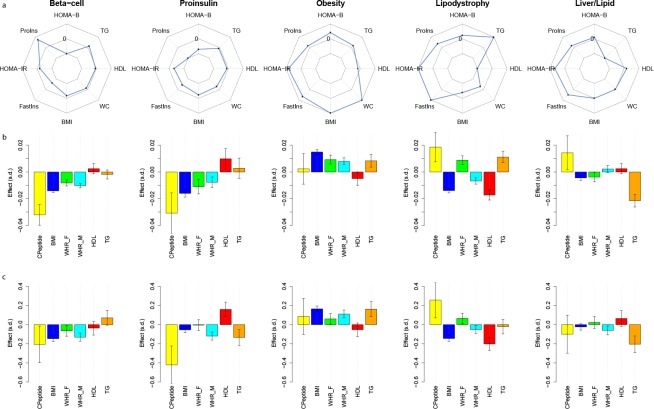
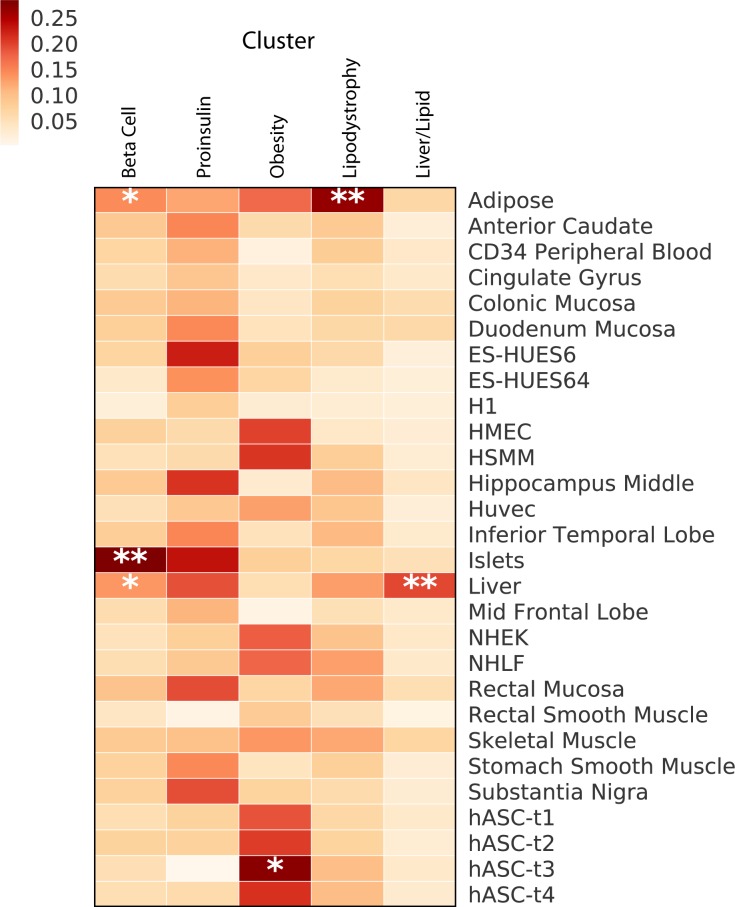
BACKGROUND: Type 2 diabetes (T2D) is a heterogeneous disease for which (1) disease-causing pathways are incompletely understood and (2) subclassification may improve patient management. Unlike other biomarkers, germline genetic markers do not change with disease progression or treatment. In this paper, we test whether a germline genetic approach informed by physiology can be used to deconstruct T2D heterogeneity. First, we aimed to categorize genetic loci into groups representing likely disease mechanistic pathways. Second, we asked whether the novel clusters of genetic loci we identified have any broad clinical consequence, as assessed in four separate subsets of individuals with T2D. METHODS AND FINDINGS: In an effort to identify mechanistic pathways driven by established T2D genetic loci, we applied Bayesian nonnegative matrix factorization (bNMF) clustering to genome-wide association study (GWAS) results for 94 independent T2D genetic variants and 47 diabetes-related traits. We identified five robust clusters of T2D loci and traits, each with distinct tissue-specific enhancer enrichment based on analysis of epigenomic data from 28 cell types. Two clusters contained variant-trait associations indicative of reduced beta cell function, differing from each other by high versus low proinsulin levels. The three other clusters displayed features of insulin resistance: obesity mediated (high body mass index [BMI] and waist circumference [WC]), "lipodystrophy-like" fat distribution (low BMI, adiponectin, and high-density lipoprotein [HDL] cholesterol, and high triglycerides), and disrupted liver lipid metabolism (low triglycerides). Increased cluster genetic risk scores were associated with distinct clinical outcomes, including increased blood pressure, coronary artery disease (CAD), and stroke. We evaluated the potential for clinical impact of these clusters in four studies containing individuals with T2D (Metabolic Syndrome in Men Study [METSIM], N = 487; Ashkenazi, N = 509; Partners Biobank, N = 2,065; UK Biobank [UKBB], N = 14,813). Individuals with T2D in the top genetic risk score decile for each cluster reproducibly exhibited the predicted cluster-associated phenotypes, with approximately 30% of all individuals assigned to just one cluster top decile. Limitations of this study include that the genetic variants used in the cluster analysis were restricted to those associated with T2D in populations of European ancestry. CONCLUSION: Our approach identifies salient T2D genetically anchored and physiologically informed pathways, and supports the use of genetics to deconstruct T2D heterogeneity. Classification of patients by these genetic pathways may offer a step toward genetically informed T2D patient management.
Overview
The claims and statistics of this paper haven’t been checked yet.
Free: it reads the open-access text and checks the first 5 claims that cite a source we can check. Create a free account to check every claim.
Integrity signals
Registry
Cites
Statistics
Figures
Verification
Claims the paper makes
The claims and statistics of this paper haven’t been checked yet.
Free: it reads the open-access text and checks the first 5 claims that cite a source we can check. Create a free account to check every claim.
Claims other papers make about this one
Each is checked against this paper’s own text: does it say what the citing paper says it does?
The cited source says what the claim attributes to it.
In the citing paper
“We previously showed using epigenomic data that this genetic cluster is enriched for enhancers/promoters active in liver tissue (9).”
From Increased genetic risk for β-cell failure is associated with β-cell function decline in people with prediabetes (2024) · cites this paper as [9]
The cited source says what the claim attributes to it.
In the citing paper
“the β-cell pPS included a specific subset of 30 T2D-associated SNPs specifically related to β-cell function (including HNF1A, HNF4A, TCF7L2, and SLC30A8) (9)”
From Increased genetic risk for β-cell failure is associated with β-cell function decline in people with prediabetes (2024) · cites this paper as [9]
Self-check
Percentages, sums and reported differences re-computed from the paper’s own numbers.
The self-check needs the paper’s full text.
Citations
Cites
A global reference for human genetic variation
The 1000 Genomes Project Consortium, authors, C., Auton, A., Abecasis, G. R., Steering committee, Altshuler, D. M., Durbin, R. M., Abecasis, G. R., Bentley, D. R., Chakravarti, A., et al. (2015) · Nature · doi:10.1038/nature15393 · Cited by 18,247
2. Classification and Diagnosis of Diabetes: Standards of Medical Care in Diabetes—2022
American Diabetes Association Professional Practice Committee (2022) · Diabetes Care · doi:10.2337/dc22-s002 · Cited by 4,792
Genetic studies of body mass index yield new insights for obesity biology
Study, T. L. C., Locke, A. E., The ADIPOGen Consortium, The AGEN-BMI Working Group, The CARDIOGRAMplusC4D Consortium, The CKDGen Consortium, The, G. L. G. C., The, I. C. B. P., The MAGIC Investigators, The MuTHER Consortium, et al. (2015) · Nature · doi:10.1038/nature14177 · Cited by 4,534
Self-citationNext-generation genotype imputation service and methods
Das, S., Forer, L., Schönherr, S., Sidore, C., Locke, A. E., Kwong, A., Vrieze, S. I., Chew, E. Y., Levy, S., McGue, M., et al. (2016) · Nature Genetics · doi:10.1038/ng.3656 · Cited by 3,808
Self-citation2. Classification and Diagnosis of Diabetes: Standards of Medical Care in Diabetes—2018
American Diabetes Association (2018) · Diabetes Care · doi:10.2337/dc18-s002 · Cited by 3,159
A reference panel of 64,976 haplotypes for genotype imputation
the Haplotype Reference Consortium (2016) · Nature Genetics · doi:10.1038/ng.3643 · Cited by 2,836
ChromHMM: automating chromatin-state discovery and characterization
Ernst, J., & Kellis, M. (2012) · Nature Methods · doi:10.1038/nmeth.1906 · Cited by 2,475 · cited 1×
“We obtained previously published 13-state ChromHMM [45] chromatin state calls for 28 cell types, excluding cancer cell lines [46].”
MethodComprehensive Molecular Characterization of Muscle-Invasive Bladder Cancer
Robertson, A. G., Kim, J., Al-Ahmadie, H., Bellmunt, J., Guo, G., Cherniack, A. D., Hinoue, T., Laird, P. W., Hoadley, K. A., Akbani, R., et al. (2017) · Cell · doi:10.1016/j.cell.2017.09.007 · Cited by 2,443
Self-citationAhlqvist, E., Storm, P., Käräjämäki, A., Martinell, M., Dorkhan, M., Carlsson, A., Vikman, P., Prasad, R. B., Aly, D. M., Almgren, P., et al. (2018) · The Lancet Diabetes & Endocrinology · doi:10.1016/s2213-8587(18)30051-2 · Cited by 2,335 · cited 5×
“In an attempt to deconstruct the heterogeneity of T2D, recent studies have performed cluster analysis of individuals using serum biomarkers and clinical data to identify T2D subgroups [3,4].”
BackgroundMethodInfluentialNew genetic loci implicated in fasting glucose homeostasis and their impact on type 2 diabetes risk
DIAGRAM Consortium, Dupuis, J., GIANT Consortium, Global BPgen Consortium, Anders Hamsten on behalf of Procardis Consortium, the MAGIC investigators, Langenberg, C., Prokopenko, I., Saxena, R., Soranzo, N., et al. (2010) · Nature Genetics · doi:10.1038/ng.520 · Cited by 2,166
Self-citation
Cited by
Items 501–544 of 544
Genetic polymorphisms associated with type 2 diabetes in Morocco: A systematic literature review
Baha, A. A., Zineb, K., Idrissi, H. H., Habbane, M., Semlali, S., Brini, O. E., Benazzouz, B., Ansari, N. E., & Akhouayri, O. (2026) · Human Gene · doi:10.1016/j.humgen.2026.201531
Disentangling Type 2 Diabetes Risk and Comorbidity Using Genomic Structural Equation ModelingPreprint
Mändul, M., Läll, K., Möls, M., Morris, A. P., Fischer, K., & Mägi, R. (2026) · medRxiv · doi:10.64898/2026.01.26.26344825
Ventresca, C., Varshney, A., Orchard, P., Vu, H. T. H., Tsan, Y.-C., da Rocha, A. M., Mr, E., Lentz, S. I., Kinnunen, L., Lakka, T. A., et al. (2026) · bioRxiv (Cold Spring Harbor Laboratory) · doi:10.64898/2026.02.04.702388
Self-citationPiórkowska, N., Nicigur, K., Leśniewski, M., Franik, G., & Bizoń, A. (2026) · medRxiv · doi:10.64898/2026.02.25.26346893
Shepherd, R. A., Stacey, D., Janetzki, J. L., Clark, S. R., Hyppönen, E., & Suppiah, V. (2026) · Schizophrenia Research · doi:10.1016/j.schres.2026.02.014
AI in multi-omics analysis of type 2 diabetes
Singh, P., Malik, M. Z., Kumar, S., & Srivastava, A. (2026) · Progress in molecular biology and translational science · doi:10.1016/bs.pmbts.2026.02.002
Plasma metabolite association profiles for type 2 diabetes genetic clusters in Finnish men
Peng, R., Liu, L., Chu, X., Xia, Z., Fu, Q., Silva, L. F., Ji, X., Hu, X., Liang, Y., Li, J., et al. (2026) · Diabetologia · doi:10.1007/s00125-026-06710-9 · Cited by 1
“In addition to overall PRS (oPRS) which treats type 2 diabetes as a genetically homogeneous disease and aggregates effects across all genetic variants, genetic cluster-partitioned PRSs (pPRSs) have also been deployed to capture type 2 diabetes biological processes [5–7].”
Self-citationGenetics of skeletal proportions across two different populations
Bartell, E., Lin, K., Tsuo, K., Gan, W., Vedantam, S., Cole, J. B., Baronas, J. M., Yengo, L., Marouli, E., Amariuta, T., et al. (2026) · The American Journal of Human Genetics · doi:10.1016/j.ajhg.2026.02.015 · Cited by 4
Self-citationBerrandou, T.-E. (2026) · Annales d Endocrinologie · doi:10.1016/j.ando.2026.102509
Partitioning genetic pleiotropy within tissue-specific regulatory patterns
Panja, P., Biswas, D., & Bhattacharjee, S. (2026) · Cell Genomics · doi:10.1016/j.xgen.2026.101212
Pascat, V. (2024) · theses.fr (ABES) · doi:10.70675/ee25a652z0aadz46c1z83f4zd89e14223bfb
Sevilla-González, M. D. R., Martinez-Munoz, A. M., Hanson, P. A., Hsu, S. C., Wang, X., Smith, K., Chen, Z., Szczerbiński, Ł., Kaur, V., Taylor, K. D., et al. (2026) · medRxiv · doi:10.64898/2026.04.17.26351136
Self-citationDemidova, T. Y., & Titova, V. V. (2026) · FOCUS Endocrinology · doi:10.62751/2713-0177-2026-7-1-06
Su, C., Hasebe, M., van der Graaf, A., Yang, Y., Tsao, H. M., Smith, L., Butler‐Laporte, G., Zhou, S., Zhang, W., Lu, T., et al. (2026) · medRxiv · doi:10.64898/2026.05.01.26352257
Precision Medicine in Diabetes Phenotypes
Pillai, S. S., Mozumdar, K., & Ashraf, A. P. (2026) · Contemporary Endocrinology · doi:10.1007/978-3-032-17036-1_13
Predicting complications for diabetes in South Asians: Beyond convention
Lin, B., Lim, L.-L., Mohan, V., & Shaw, J. E. (2026) · Best Practice & Research Clinical Endocrinology & Metabolism · doi:10.1016/j.beem.2026.102119
Lin, Y., Li, W., Yang, X., Li, S., Liu, J., Lin, L., & Zhang, B. (2026) · Mammalian Genome · doi:10.1007/s00335-026-10232-5
“We utilized the Bayesian nonnegative matrix factorization (bNMF) (Udler et al. 2018) clustering algorithm to categorize 64 trait pairs based on the association patterns of 1,225 pleiotropic genes, with the aim of exploring the distinct subgroups and their underlying biological mechanisms for these…”
Workload-induced changes to cell state contribute to β-cell failure in diabetesPreprint
Sai, S., Liu, F., Harrington, A. R., Zhu, H., Omar, I., Zeng, C., Mallick, M., Sui, Y., Sander, M., & Wortham, M. (2026) · bioRxiv (Cold Spring Harbor Laboratory) · doi:10.64898/2026.05.13.725004
Zhang, T., Huo, X., Chen, J., & Zhao, X. (2026) · BMC Medicine · doi:10.1186/s12916-026-04955-0
“The superiorities of using fuzzy clustering we showed here resonate well with previous practices in schizophrenia [63] and beyond [149, 150], i.e., that this approach derived clusters with enhanced biological interpretability and clinical usefulness to enable a more accurate representation of…”
Elouafy, Y., Balahbib, A., Fessikh, M. E., Gharby, S., Omari, N. E., Abdulmonem, W. A., Zengin, G., & Bouyahya, A. (2026) · eFood · doi:10.1002/efd2.70162
Sasikala, M., Attunuru, B. P. R., Natarajan, V., Kulkarni, S., Putta, T., Pinninti, S. S., Shankar, D., Dontheneni, S. B., Suryadevara, N., Vasireddy, N. T., et al. (2026) · Research Square · doi:10.21203/rs.3.rs-9907316/v1
Context-dependent molecular responses to heterogeneous metabolic disease traitsPreprint
Michalettou, T.-D., Sharma, S., Atabaki, N. N., Fernandez-Tajes, J. J., Hong, M., Adam, J., Adamski, J., Brunak, S., Masi, F. D., Dermitzakis, E. T., et al. (2026) · medRxiv · doi:10.64898/2026.05.31.26354544
Self-citationMace, K. D., Trang, B. K., Zimmerman, A. J., Valle, E. A. D., Lottes, E. N., Parker, R. E., Choudhury, J., Chesi, A., Grant, S. F. A., & Kayser, M. S. (2026) · bioRxiv (Cold Spring Harbor Laboratory) · doi:10.64898/2026.06.12.731887
Genetic and epigenetic landscape of type 2 diabetes mellitus
Patil, P. C., Surve, S., Kaleem, M., Kayali, A., & Bachhav, R. S. (2026) · Elsevier eBooks · doi:10.1016/b978-0-443-33590-7.00012-5
Arreola, E. V., Knowler, W. C., & Hanson, R. L. (2026) · Diabetes · doi:10.2337/db25-0640
Weber, K. S., Schlesinger, S., Lang, A., Goletzke, J., Övermöhle, C., Strathmann, E. A., Straßburger, K., SINGH, N., Zaharia, O., Trenkamp, S., et al. (2026) · Scientific Reports · doi:10.1038/s41598-026-57026-y
Lipska, K. J., Zawack, K., Yan, L., Mutalik, P., Li, J., Gulanski, B., Ioannou, G. N., & Aslan, M. (2026) · Annals of Internal Medicine · doi:10.7326/annals-25-05216
Heterogeneity of Type 2 Diabetes Mellitus
Faruqi, J., & Balasubramanyam, A. (2026) · Elsevier eBooks · doi:10.1016/b978-0-443-11985-9.00017-2
Raghavan, S., & Lange, L. A. (2026) · Elsevier eBooks · doi:10.1016/b978-0-443-11985-9.00015-9
Piórkowska, N., Nicifur, K., Leśniewski, M., Franik, G., & Bizoń, A. (2026) · Journal of Endocrinological Investigation · doi:10.1007/s40618-026-02998-x · Cited by 2
“The movement toward biologically informed subtyping parallels precision medicine approaches applied in other complex metabolic disorders, including type 2 diabetes [36].”
Deng, K., & Li‐Gao, R. (2026) · Metabolism · doi:10.1016/j.metabol.2026.156719
Refining the Genetic Contribution to Type 2 Diabetes Subtypes
Al‐Thani, N. M., Toor, S. M., Umlai, U. I., Aliyu, U., Suhre, K., & Albagha, O. (2026) · Diabetes Obesity and Metabolism · doi:10.1111/dom.71159
“Moreover, we used previously known associations for the genetic clusters by relying on the strongest reported associations [8, 10, 11], which were only partially replicated in our targeted association analyses.”
InfluentialGenetic basis of Asian diabetes
Ojima, T., & Yamauchi, T. (2026) · Journal of Diabetes Investigation · doi:10.1111/jdi.70409
“43 With the expansion of available datasets, more recent reports have shown that this framework can be extended to yield 12 clusters.”
InfluentialLiao, S., Sung, G. C. Y., Liang, Y., Li, C., & Yeung, S. L. A. (2026) · Diabetes Obesity and Metabolism · doi:10.1111/dom.71253
“Similarly, other genetic studies showed distinctive clusters of genetic determinants of T2D [5–7], where a recent large genome-wide association study (GWAS) identified eight clusters based on their relation with cardiometabolic traits [8], with varying risk of cardiovascular [8] and…”
Immunometabolic endotypes define distinct clinical trajectories in type 2 diabetes
Vuong, T. B., Delépine, C., Ratter-Rieck, J. M., Rinaldi, E., Julla, J., Creussot, E., Diedisheim, M., Raverdy, V., Liu, E., Fischer, J. S., et al. (2026) · Cell Metabolism · doi:10.1016/j.cmet.2026.07.027 · Cited by 1
Jiang, X., Hirschmüller, N., Taylor, H. J., Dalakoti, M., Needham, E. J., Kelemen, M., Jiang, T., Ritchie, S. C., Vidal‐Puig, A., Butterworth, A. S., et al. (2026) · medRxiv · doi:10.64898/2026.08.24.26361276
Gebretsadik, E. T., Aman, A., Lyall, D. M., Tyrrell, J., Hayman, M. M. E., Fajs, N., Lyall, L. M., & Strawbridge, R. J. (2026) · Biological Psychiatry Global Open Science · doi:10.1016/j.bpsgos.2026.100817
“T2D arises through multiple pathophysiological mechanisms (25).”
Shakir, Z., Himanshu, D., Pandey, A., Siddiqui, K. U., & Ali, W. (2026) · International Journal of Diabetes in Developing Countries · doi:10.1007/s13410-026-01714-y
Redefining Polycystic Ovary Syndrome
Vafea, M. T., & Dunaif, A. E. (2026) · Endocrinology and Metabolism Clinics of North America · doi:10.1016/j.ecl.2026.08.002
Genetic factor analysis for characterizing phenome-wide patterns of genetic pleiotropy
Morrison, J., Willwerscheid, J., Sylvertooth, D., He, X., & Stephens, M. (2026) · Nature Genetics · doi:10.1038/s41588-026-02753-1 · Cited by 3
Sahelijo, N. J., Rajagopalan, P., Qian, L., Rahman, R., Goldstein, D., Thomopoulos, S. I., Bennett, D. A. A., Farrer, L. A., Stein, T. D., Shen, L., et al. (2026) · Alzheimer s & Dementia · doi:10.1002/alz.71895
Decomposing polygenic risk of coronary artery disease into distinct biological processesPreprint
Morze, J., Smith, K., Kierczak, M., Bergström, G., Li, H., Gummesson, A., Fall, T., Söderberg, S., Ebbers, T., Smith, J. G., et al. (2026) · medRxiv · doi:10.64898/2026.10.08.26365088 · Cited by 1
Self-citationBurton, E. A., Svenstrup, V., Murali, M., Dashti, H., Loos, R. J. F., & Claussnitzer, M. (2026) · Arteriosclerosis Thrombosis and Vascular Biology · doi:10.1161/atvbaha.126.324811
Hoffmann, K., Pucek, W. F., Skrzypek, W., Kierzkowski, F., Ratajczak, P., Maggio, V., Rizzo, M., El-Tanani, M., Rabbani, S. A., Bhongade, B. A., et al. (2026) · Journal of Pharmacy & Pharmaceutical Sciences · doi:10.3389/jpps.2026.17560
Metadata
- Authors
- Udler, M. S., Kim, J., von Grotthuss, M., Bonàs-Guarch, S., Cole, J. B., Chiou, J., ISGC, C. D. A. O. B. O. M. A. T., Boehnke, M., Laakso, M., Atzmon, G., Glaser, B., Mercader, J. M., Gaulton, K., Flannick, J., Getz, G., & Florez, J. C.
- Affiliations
- Broad Institute (US)
- University of California San Diego (US)
- University of Eastern Finland (FI)
- Albert Einstein College of Medicine (US)
- ORCID
- Venue
- PLOS Medicine
- Publisher
- Public Library of Science (PLoS)
- Published
- 2018-09-21
- Volume
- 15
- Issue
- 9
- Pages
- e1002654
- ISSN
- 1549-1277 (ISSN-L)
- 1549-1676
- PMC
- PMC6150463
- OpenAlex
- W2890555481
- Cited by
- 542
- References
- 75
- Citations by year
- 2026: 59 · 2025: 60 · 2024: 71 · 2023: 89 · 2022: 88 · 2021: 65 · 2020: 72 · 2019: 37 · 2018: 1
- FWCI
- 26.83
- Type
- journal article
- Language
- en
- Open access
- gold
- doi.org
- Licence
- Locations
- PLoS Medicine (publishedVersion, cc-by)
- Europe PMC (PubMed Central) (publishedVersion, cc-by)
- PubMed Central (publishedVersion, cc-by)
- PubMed (publishedVersion)
- UEF eRepo (University of Eastern Finland) (submittedVersion, cc-by)
- DOAJ (DOAJ: Directory of Open Access Journals) (submittedVersion, cc-by-sa)
- Figshare (submittedVersion, cc-by)
- Funders
- National Institute of Diabetes and Digestive and Kidney Diseases (1K23DK114551-01, DK062370)
- National Institute of Neurological Disorders and Stroke (1K23NS086873-04)
- Topics
- Life Sciences › Biochemistry, Genetics and Molecular Biology › Genetics › Genetic Associations and Epidemiology
- Life Sciences › Biochemistry, Genetics and Molecular Biology › Genetics › Diabetes and associated disorders
- Life Sciences › Biochemistry, Genetics and Molecular Biology › Genetics › Genetic Mapping and Diversity in Plants and Animals
- Keywords
- type 2 diabetes, genetic loci, disease heterogeneity, diabetes subtypes, fuzzy clustering, tissue-specific enhancers, beta-cell function, insulin resistance, hepatic lipid metabolism, polygenic risk score, coronary artery disease, stroke, blood pressure, adiponectin, triglycerides
- MeSH terms
- Algorithms, Bayes Theorem, Cross-Sectional Studies, Diabetes Mellitus, Type 2, Female, Multigene Family, Genetic Markers, Humans, Insulin, Insulin Resistance, Male, Phenotype, Prospective Studies, Risk Factors, Cohort Studies, Cluster Analysis, Founder Effect, Genetic Predisposition to Disease, Databases, Genetic, Genome-Wide Association Study, Genetic Loci
About these checks
Registry, retraction, Cites and statistics results are computed, not judged, with one exception: a printed reference that no index lists is read once by a model before it counts as a citation error. Claims are extracted by a model and kept only when their quote appears verbatim in the text; each cited source is then checked, with a model’s help, for whether it says what the claim relies on. Those verdicts can be wrong — read the claim’s quote and the cited source before relying on one.
Statistics and arithmetic are recomputed, not judged.
Confidence bands are shown only for fields calibrated on our annotated test set. None is calibrated yet, so no band is shown.
What counts as a claim ›How we measure confidence ›How we check this ›
Are you an author, or do you see a problem with this page? Request a review
Data sources
Bibliographic data: Semantic Scholar, OpenAlex, Crossref.
Contains information from the Semantic Scholar Academic Graph Datasets, made available under the ODC Attribution License (ODC-BY 1.0).
Semantic Scholar’s data is described in: Kinney, R., et al. (2023). The Semantic Scholar Open Data Platform. arXiv:2301.10140.
