

Sugar-sweetened beverage taxes: Lessons to date and the future of taxation
Open accessThe DOI matches its Crossref record; 44 of the 45 references it cites were found in a registry or an index.
Abstract
DOAJ is a unique and extensive index of diverse open access journals from around the world, driven by a growing community, committed to ensuring quality content is freely available online for everyone.
Overview
The claims and statistics of this paper haven’t been checked yet.
Free: it reads the open-access text and checks the first 5 claims that cite a source we can check. Create a free account to check every claim.
Integrity signals
Registry
Cites
Statistics
Figures
Verification
Claims the paper makes
The claims and statistics of this paper haven’t been checked yet.
Free: it reads the open-access text and checks the first 5 claims that cite a source we can check. Create a free account to check every claim.
Claims other papers make about this one
Each is checked against this paper’s own text: does it say what the citing paper says it does?
The cited source says what the claim attributes to it.
In the citing paper
“In the past decade, some countries have regulated marketing and taxed items such as sugar-sweetened beverages;60 the impacts on obesity prevalence are currently being evaluated.61”
Self-check
Percentages, sums and reported differences re-computed from the paper’s own numbers.
The self-check needs the paper’s full text.
Citations
Cites
Water footprints of nations: Water use by people as a function of their consumption pattern
Hoekstra, A. Y., & Chapagain, A. K. (2006) · Water Resources Management · doi:10.1007/s11269-006-9039-x · Cited by 1,458
Liquid versus solid carbohydrate: effects on food intake and body weight
DiMeglio, D., & Mattes, R. (2000) · International Journal of Obesity · doi:10.1038/sj.ijo.0801229 · Cited by 882 · cited 1×
“Second, high-caloric beverages offer little caloric compensation, so reducing their consumption lowers obesity risk [5,6].”
BackgroundLutsey, P. L., Steffen, L. M., & Stevens, J. (2008) · Circulation · doi:10.1161/circulationaha.107.716159 · Cited by 845
Colchero, M. A., Popkin, B. M., Rivera, J. A., & Ng, S. W. (2016) · BMJ · doi:10.1136/bmj.h6704 · Cited by 822 · cited 1×
“The Mexican and Berkeley evaluations found a shift toward water [37,38].”
BackgroundSelf-citationCurbing the Epidemic Goverment s and the Economics of Tobacco Control
Jha, P., & Chaloupka, F. J. (1999) · Cited by 822
Sweetening of the global diet, particularly beverages: patterns, trends, and policy responses
Popkin, B. M., & Hawkes, C. (2016) · The Lancet Diabetes & Endocrinology · doi:10.1016/s2213-8587(15)00419-2 · Cited by 737 · cited 1×
“NNS consumption is growing in high-income countries, but it is less clear what will happen in low- and middle-income countries, where consumption of diet beverages is minimal [36].”
BackgroundSelf-citationColchero, M. A., Rivera-Dommarco, J., Popkin, B. M., & Ng, S. W. (2017) · Health Affairs · doi:10.1377/hlthaff.2016.1231 · Cited by 679
Self-citationTaillie, L. S., Reyes, M., Colchero, M. A., Popkin, B., & Corvalán, C. (2020) · PLOS Medicine · doi:10.1371/journal.pmed.1003015 · Cited by 510 · cited 1×
“5% decline in calories consumed per capita per day [19].”
BackgroundSelf-citationSweetened beverage consumption, incident coronary heart disease, and biomarkers of risk in men
de Koning, L., Malik, V. S., Kellogg, M. D., Rimm, E. B., Willett, W. C., & Hu, F. B. (2012) · Circulation · doi:10.1161/circulationaha.111.067017 · Cited by 503
Teng, A. M., Jones, A. C., Mizdrak, A., Signal, L., Genç, M., & Wilson, N. (2019) · Obesity Reviews · doi:10.1111/obr.12868 · Cited by 484 · cited 1×
“Nonetheless, a meta-analysis shows that the average consumer will lower his/ her SSB purchases by 10% if SSB prices rise 10% (price elasticity of demand of −1) [24].”
Background
Research works printed but not linked: 2
- World Cancer Research Fund International. Curbing global sugar consumption: Effective food policy actions to help promote healthy diets and tackle obesity 2015. London: World Cancer Research Fund International; 2015.
- World Health Organization. WHO report on the global tobacco epidemic, 2017: monitoring tobacco use and prevention policies. Geneva, Switzerland: World Health Organization; 2017.
Cited by
Items 101–121 of 121
1.2 Challenges to Current Food Systems
Al‐Jawaldeh, A., & Meyer, A. L. (2023) · Open Book Publishers · doi:10.11647/obp.0322.02
2.2 The Increasing Problem of Overweight and Obesity
Al‐Jawaldeh, A., & Meyer, A. L. (2023) · Open Book Publishers · doi:10.11647/obp.0322.06
Drangert, J.-O. (2023) · Medical Research Archives · doi:10.18103/mra.v11i9.4361
Chan, J. (2023) · Seven International Congress of Health · doi:10.56238/homeiiisevenhealth-032
“Some strategies include the introduction of progressive tax rate (e.g., sugar-density tax) and the expansion of tax coverage to include more unhealthy food (e.g., ultra-processed foods and beverages) (BONILLA-CHACÍN et al., 2016; POPKIN & NG, 2021).”
BackgroundTaxes to sugar-sweetened beverages: are changes in obesity and diabetes observable?
Batis, C. (2024) · American Journal of Clinical Nutrition · doi:10.1016/j.ajcnut.2024.01.029
Droog, N. M. S., Dijkstra, S. C., van Selm, N., Poelman, M. P., & Mackenbach, J. D. (2024) · International Journal of Behavioral Nutrition and Physical Activity · doi:10.1186/s12966-024-01625-3
“Yet, there is a wide variation between countries in the extent to which such food policies are implemented, with the Netherlands ranked as the second lowest country compared to eleven European countries [13–15].”
BackgroundIs a sugar-sweetened beverages tax effective in reducing the incidence of type 2 diabetes?
Havelková, T., Klazar, S., & Slintáková, B. (2024) · Český finanční a účetní časopis · doi:10.18267/j.cfuc.606
Implementation of the K-Means Method for Beverage Clustering Based on Calorie and Protein
Rewina, A. E., Hapsari, R. K., Putri, C. N., Lande, G. V. F., Aditya, A. F., & Alamsyah, M. T. B. (2025) · Zeta - Math Journal · doi:10.31102/zeta.2025.10.1.19-29
The effectiveness of sugar tax in controlling sugar consumption
Haniyah, R., Johantri, B., & Sustiyo, J. (2025) · Educoretax · doi:10.54957/educoretax.v5i5.1519
Rejecting Health as a Justification for Junk Food Taxes
Yang, J. (2025) · Journal of Bioethical Inquiry · doi:10.1007/s11673-025-10500-0 · Cited by 1
Azad, A. K., & Huque, R. (2026) · medRxiv · doi:10.64898/2025.12.29.25343155
Spiga, F., Savović, J., Summerbell, C., Picton, H., Moore, T. H. M., Caldwell, D. M., & Higgins, J. P. T. (2026) · Obesity Reviews · doi:10.1111/obr.70090 · Cited by 1
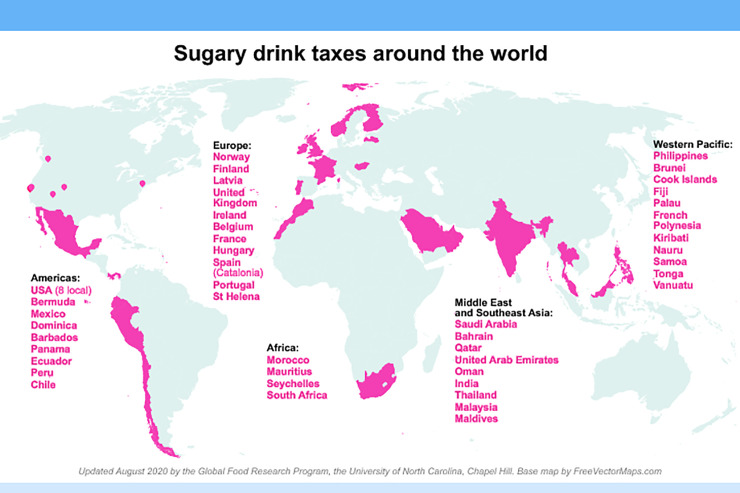
“Examples include taxation policies on sugary beverages, which have been instituted in over 45 countries, cities, and regions across the world including in LMICs in the Americas, Africa, Middle East, Southeast Asia and Western Pacific [9].”
Warner, L. N., Knox, M. A., Fretts, M., Saelens, B. E., & Jones‐Smith, J. C. (2026) · PLoS ONE · doi:10.1371/journal.pone.0340577
“In response, more than 50 jurisdictions worldwide, including eight in the US, have enacted SSB taxes in the past decade to reduce consumption and improve public health [6].”
Wong, Y. Y., Wong, X. J., Nawi, K. N. B., Mohamat, I. A. B., Ramandach, S., Hasim, M. A. B., & Markosyan, A. A. (2026) · Molecules · doi:10.3390/molecules31040649
“This trend is further reinforced by regulatory interventions such as sugar taxes, which aim to curb the intake of high-calorie sweeteners [1,2].”
Essays in Industrial Organization
Abi-Rafeh, R. (2022) · theses.fr (ABES) · doi:10.70675/5f536122z7044z426dz801az5b811677d7f9
Sarumi, A. T., Ibitoye, O., Amafah-Isaac, J., Muhammed, A. O., & Adebayo, A. (2026) · BMC Public Health · doi:10.1186/s12889-026-28578-5
Gilchrist, J., & Dharmasena, S. (2026) · SSRN Electronic Journal · doi:10.2139/ssrn.7513470
Nutritional models of the Middle East
Roudsari, A. H. (2026) · Elsevier eBooks · doi:10.1016/b978-0-443-23671-6.00013-x
Ssempala, R., Kaneko, K., Yawe, B. L., & Bing, N. (2026) · BMJ Open · doi:10.1136/bmjopen-2026-124788
“25–27 36–38 In Uganda, only limited evidence is available.”
Forberger, S., Meshkovska, B., Reisch, L. A., Luszczynska, A., & Zeeb, H. (2026) · Implementation Science Communications · doi:10.1186/s43058-026-01137-0
Metadata
- Authors
- Popkin, B. M., & Ng, S. W.
- Affiliations
- University of North Carolina at Chapel Hill (US)
- Corresponding author
- Popkin, Barry M.
- Venue
- PLOS Medicine
- Publisher
- Public Library of Science (PLoS)
- Published
- 2021-01-07
- Volume
- 18
- Issue
- 1
- Pages
- e1003412
- ISSN
- 1549-1277 (ISSN-L)
- 1549-1676
- PMC
- PMC7790261
- OpenAlex
- W3120874580
- Cited by
- 121
- References
- 45
- Citations by year
- 2026: 14 · 2025: 15 · 2024: 15 · 2023: 37 · 2022: 26 · 2021: 14
- FWCI
- 22.30
- Type
- journal article
- Language
- en
- Open access
- gold
- doi.org
- Licence
- Locations
- PLoS Medicine (publishedVersion, cc-by)
- PubMed Central (publishedVersion, cc-by)
- PubMed (publishedVersion)
- RePEc: Research Papers in Economics (submittedVersion)
- DOAJ (DOAJ: Directory of Open Access Journals) (submittedVersion, cc-by-sa)
- Funders
- Bloomberg Philanthropies
- Arnold Ventures
- NIH (R01DK108148)
- National Institutes of Health (P2C HD0550924)
- Topics
- Health Sciences › Medicine › Public Health, Environmental and Occupational Health › Global Public Health Policies and Epidemiology
- Health Sciences › Medicine › Public Health, Environmental and Occupational Health › Obesity, Physical Activity, Diet
- Social Sciences › Economics, Econometrics and Finance › Economics and Econometrics › Economic and Fiscal Studies
- Keywords
- sugar-sweetened beverage tax, sugar-sweetened beverages, taxation, public health policy, obesity prevention, sugar consumption, fiscal policy
- MeSH terms
- Sugar-Sweetened Beverages, Energy Intake, Forecasting, Humans, Public Health, Taxes
About these checks
Registry, retraction, Cites and statistics results are computed, not judged, with one exception: a printed reference that no index lists is read once by a model before it counts as a citation error. Claims are extracted by a model and kept only when their quote appears verbatim in the text; each cited source is then checked, with a model’s help, for whether it says what the claim relies on. Those verdicts can be wrong — read the claim’s quote and the cited source before relying on one.
Statistics and arithmetic are recomputed, not judged.
Confidence bands are shown only for fields calibrated on our annotated test set. None is calibrated yet, so no band is shown.
What counts as a claim ›How we measure confidence ›How we check this ›
Are you an author, or do you see a problem with this page? Request a review
Data sources
Bibliographic data: Semantic Scholar, OpenAlex, Crossref.
Contains information from the Semantic Scholar Academic Graph Datasets, made available under the ODC Attribution License (ODC-BY 1.0).
Semantic Scholar’s data is described in: Kinney, R., et al. (2023). The Semantic Scholar Open Data Platform. arXiv:2301.10140.
