

Sugar-sweetened beverage taxes: Lessons to date and the future of taxation
Open accessThe DOI matches its Crossref record; 44 of the 45 references it cites were found in a registry or an index.
Abstract
DOAJ is a unique and extensive index of diverse open access journals from around the world, driven by a growing community, committed to ensuring quality content is freely available online for everyone.
Overview
The claims and statistics of this paper haven’t been checked yet.
Free: it reads the open-access text and checks the first 5 claims that cite a source we can check. Create a free account to check every claim.
Integrity signals
Registry
Cites
Statistics
Figures
Verification
Claims the paper makes
The claims and statistics of this paper haven’t been checked yet.
Free: it reads the open-access text and checks the first 5 claims that cite a source we can check. Create a free account to check every claim.
Claims other papers make about this one
Each is checked against this paper’s own text: does it say what the citing paper says it does?
The cited source says what the claim attributes to it.
In the citing paper
“In the past decade, some countries have regulated marketing and taxed items such as sugar-sweetened beverages;60 the impacts on obesity prevalence are currently being evaluated.61”
Self-check
Percentages, sums and reported differences re-computed from the paper’s own numbers.
The self-check needs the paper’s full text.
Citations
Cites
Water footprints of nations: Water use by people as a function of their consumption pattern
Hoekstra, A. Y., & Chapagain, A. K. (2006) · Water Resources Management · doi:10.1007/s11269-006-9039-x · Cited by 1,458
Liquid versus solid carbohydrate: effects on food intake and body weight
DiMeglio, D., & Mattes, R. (2000) · International Journal of Obesity · doi:10.1038/sj.ijo.0801229 · Cited by 882 · cited 1×
“Second, high-caloric beverages offer little caloric compensation, so reducing their consumption lowers obesity risk [5,6].”
BackgroundLutsey, P. L., Steffen, L. M., & Stevens, J. (2008) · Circulation · doi:10.1161/circulationaha.107.716159 · Cited by 845
Colchero, M. A., Popkin, B. M., Rivera, J. A., & Ng, S. W. (2016) · BMJ · doi:10.1136/bmj.h6704 · Cited by 822 · cited 1×
“The Mexican and Berkeley evaluations found a shift toward water [37,38].”
BackgroundSelf-citationCurbing the Epidemic Goverment s and the Economics of Tobacco Control
Jha, P., & Chaloupka, F. J. (1999) · Cited by 822
Sweetening of the global diet, particularly beverages: patterns, trends, and policy responses
Popkin, B. M., & Hawkes, C. (2016) · The Lancet Diabetes & Endocrinology · doi:10.1016/s2213-8587(15)00419-2 · Cited by 737 · cited 1×
“NNS consumption is growing in high-income countries, but it is less clear what will happen in low- and middle-income countries, where consumption of diet beverages is minimal [36].”
BackgroundSelf-citationColchero, M. A., Rivera-Dommarco, J., Popkin, B. M., & Ng, S. W. (2017) · Health Affairs · doi:10.1377/hlthaff.2016.1231 · Cited by 679
Self-citationTaillie, L. S., Reyes, M., Colchero, M. A., Popkin, B., & Corvalán, C. (2020) · PLOS Medicine · doi:10.1371/journal.pmed.1003015 · Cited by 510 · cited 1×
“5% decline in calories consumed per capita per day [19].”
BackgroundSelf-citationSweetened beverage consumption, incident coronary heart disease, and biomarkers of risk in men
de Koning, L., Malik, V. S., Kellogg, M. D., Rimm, E. B., Willett, W. C., & Hu, F. B. (2012) · Circulation · doi:10.1161/circulationaha.111.067017 · Cited by 503
Teng, A. M., Jones, A. C., Mizdrak, A., Signal, L., Genç, M., & Wilson, N. (2019) · Obesity Reviews · doi:10.1111/obr.12868 · Cited by 484 · cited 1×
“Nonetheless, a meta-analysis shows that the average consumer will lower his/ her SSB purchases by 10% if SSB prices rise 10% (price elasticity of demand of −1) [24].”
BackgroundSugar-sweetened and artificially sweetened beverage consumption and risk of type 2 diabetes in men
de Koning, L., Malik, V. S., Rimm, E. B., Willett, W. C., & Hu, F. B. (2011) · The American Journal of Clinical Nutrition · doi:10.3945/ajcn.110.007922 · Cited by 463
Curbing the epidemic: governments and the economics of tobacco control
Bank, T. W. (1999) · Tobacco Control · doi:10.1136/tc.8.2.196 · Cited by 433
Silver, L. D., Ng, S. W., Ryan-Ibarra, S., Taillie, L. S., Induni, M., Miles, D. R., Poti, J. M., & Popkin, B. M. (2017) · PLOS Medicine · doi:10.1371/journal.pmed.1002283 · Cited by 411
Self-citationSugar-Sweetened Beverages and Cardiometabolic Health: An Update of the Evidence
Malik, V. S., & Hu, F. B. (2019) · Nutrients · doi:10.3390/nu11081840 · Cited by 410
Effects of food form on appetite and energy intake in lean and obese young adults
Mourao, D. M., Bressan, J., Campbell, W. W., & Mattes, R. D. (2007) · International Journal of Obesity · doi:10.1038/sj.ijo.0803667 · Cited by 326 · cited 1×
“Second, high-caloric beverages offer little caloric compensation, so reducing their consumption lowers obesity risk [5,6].”
BackgroundScarborough, P., Adhikari, V., Harrington, R. A., Elhussein, A., Briggs, A., Rayner, M., Adams, J., Cummins, S., Penney, T., & White, M. (2020) · PLOS Medicine · doi:10.1371/journal.pmed.1003025 · Cited by 277
Ercin, A. E., Aldaya, M. M., & Hoekstra, A. Y. (2011) · Water Resources Management · doi:10.1007/s11269-010-9723-8 · Cited by 235
Reyes, M., Smith Taillie, L., Popkin, B., Kanter, R., Vandevijvere, S., & Corvalán, C. (2020) · PLOS Medicine · doi:10.1371/journal.pmed.1003220 · Cited by 233 · cited 1×
“Likewise, reformulations are an important driver of change in response to Chile’s integrated food labeling, marketing, and school food regulations [18].”
BackgroundSelf-citationCawley, J., Thow, A. M., Wen, K., & Frisvold, D. (2019) · Annual Review of Nutrition · doi:10.1146/annurev-nutr-082018-124603 · Cited by 207
Sánchez-Romero, L. M., Penko, J., Coxson, P. G., Fernández, A., Mason, A., Moran, A. E., Ávila-Burgos, L., Odden, M., Barquera, S., & Bibbins-Domingo, K. (2016) · PLOS Medicine · doi:10.1371/journal.pmed.1002158 · Cited by 201 · cited 1×
“These levels of reductions, even if sustained, are insufficient to meaningfully impact the broad swath of health outcomes in a timely manner, although research shows that the 10- to 20-year time horizon will produce important results [27,28].”
BackgroundThe Water Footprint of Modern Consumer Society
Hoekstra, A. Y. (2013) · Routledge eBooks · doi:10.4324/9780203126585 · Cited by 181
Pries, A. M., Filteau, S., & Ferguson, E. (2019) · Maternal and Child Nutrition · doi:10.1111/mcn.12729 · Cited by 172
Caro, J. C., Corvalán, C., Reyes, M., Silva, A., Popkin, B., & Taillie, L. S. (2018) · PLOS Medicine · doi:10.1371/journal.pmed.1002597 · Cited by 169
Self-citationDuffey, K. J., Steffen, L. M., Horn, L. V., Jacobs, D. R., & Popkin, B. M. (2012) · American Journal of Clinical Nutrition · doi:10.3945/ajcn.111.026682 · Cited by 168
Self-citationReductions in sugar sales from soft drinks in the UK from 2015 to 2018
Bandy, L. K., Scarborough, P., Harrington, R. A., Rayner, M., & Jebb, S. A. (2020) · BMC Medicine · doi:10.1186/s12916-019-1477-4 · Cited by 167
Alvarado, M., Unwin, N. C., Sharp, S. J., Hambleton, I. R., Murphy, M. M., Samuels, T. A., Suhrcke, M., & Adams, J. (2019) · International Journal of Behavioral Nutrition and Physical Activity · doi:10.1186/s12966-019-0776-7 · Cited by 148 · cited 1×
“Meanwhile, studies have shown that ad valorem taxes on SSBs are less likely to be fully pass through onto prices compared to specific taxes in the form of sales taxes (rather than excise taxes) [25].”
BackgroundPries, A. M., Rehman, A. M., Filteau, S., Sharma, N., Upadhyay, A., & Ferguson, E. (2019) · Journal of Nutrition · doi:10.1093/jn/nxz140 · Cited by 142
The water footprint of modern consumer society
(2014) · Choice Reviews Online · doi:10.5860/choice.51-3799 · Cited by 137
Barrientos-Gutierrez, T., Zepeda-Tello, R., Rodrigues, E. R., Colchero-Aragonés, A., Rojas-Martínez, R., Lazcano-Ponce, E., Hernández-Ávila, M., Rivera-Dommarco, J., & Meza, R. (2017) · PLoS ONE · doi:10.1371/journal.pone.0176336 · Cited by 134 · cited 1×
“These levels of reductions, even if sustained, are insufficient to meaningfully impact the broad swath of health outcomes in a timely manner, although research shows that the 10- to 20-year time horizon will produce important results [27,28].”
BackgroundPiernas, C., Ng, S. W., & Popkin, B. (2013) · Pediatric Obesity · doi:10.1111/j.2047-6310.2013.00153.x · Cited by 112
Self-citationPfinder, M., Heise, T. L., Boon, M. H., Pega, F., Fenton, C., Griebler, U., Gartlehner, G., Sommer, I., Katikireddi, S. V., & Lhachimi, S. K. (2020) · Cochrane Database of Systematic Reviews · doi:10.1002/14651858.cd012333.pub2 · Cited by 109 · cited 1×
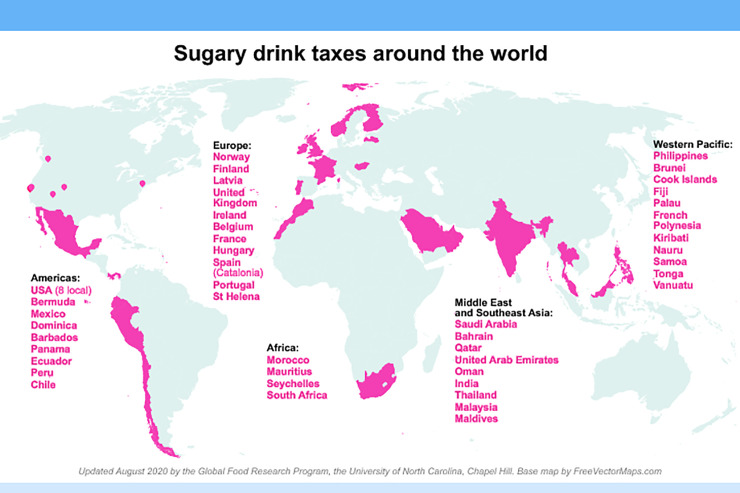
“, Saudi Arabia, Qatar, and the United Arab Emirates) have instituted 50% to 100% excise taxes on subsets of SSBs [29], and Bermuda has implemented a 75% import tax on sugar, SSBs, and candies [30].”
BackgroundTaillie, L. S., Rivera, J. A., Popkin, B. M., & Batis, C. (2017) · Preventive Medicine · doi:10.1016/j.ypmed.2017.07.009 · Cited by 108
Self-citationNon-Nutritive Sweeteners in the Packaged Food Supply—An Assessment across 4 Countries
Dunford, E., Taillie, L. S., Miles, D. R., Eyles, H. C., Tolentino‐Mayo, L., & Ng, S. W. (2018) · Nutrients · doi:10.3390/nu10020257 · Cited by 102
Self-citationNg, S. W., Rivera, J. Á., Popkin, B. M., & Colchero, M. A. (2018) · Public Health Nutrition · doi:10.1017/s136898001800321x · Cited by 94 · cited 1×
“While these taxes specifically affect high consumers [22,26], evaluations to date suggest that the reductions affected by SSB taxes translate to 5 to 22 kilocalories (kcals) per capita per day.”
BackgroundSelf-citationJaacks, L. M., Kavle, J. A., Perry, A., & Nyaku, A. (2017) · Public Health Nutrition · doi:10.1017/s1368980016003323 · Cited by 82
Goiana-da-Silva, F., Severo, M., Cruz-e-Silva, D., Gregório, M. J., Allen, L. N., Muc, M., Nunes, A. M., Torres, D. P. M., Miraldo, M., Ashrafian, H., et al. (2020) · PLoS Medicine · doi:10.1371/journal.pmed.1003036 · Cited by 76
Sugary drink excise tax policy process and implementation: Case study from Saudi Arabia
Alsukait, R. F., Bleich, S. N., Wilde, P., Singh, G. M., & Folta, S. C. (2019) · Food Policy · doi:10.1016/j.foodpol.2019.101789 · Cited by 68 · cited 7×
“Taxation of SSBs is an important start to using fiscal policy to correct the large human and planetary costs of the modern food supply chain and promote improved diet and eventually health [44].”
BackgroundInfluentialThe future of the sweetened beverages tax in Portugal
Goiana-da-Silva, F., Cruz-e-Silva, D., Gregório, M. J., Miraldo, M., Darzi, A., & Araújo, F. (2018) · The Lancet Public Health · doi:10.1016/s2468-2667(18)30240-8 · Cited by 47
Audain, K. A., Levy, L., & Ellahi, B. (2019) · Proceedings of The Nutrition Society · doi:10.1017/s0029665118002860 · Cited by 45
Commercial Snack Food and Beverage Consumption Prevalence among Children 6–59 Months in West Africa
Nordhagen, S., Pries, A. M., & Dissieka, R. (2019) · Nutrients · doi:10.3390/nu11112715 · Cited by 36
Corrective Taxation and Internalities from Food Consumption
Griffith, R., O’Connell, M., & Smith, K. (2017) · CESifo Economic Studies · doi:10.1093/cesifo/ifx018 · Cited by 35 · cited 1×
“Taxation of SSBs is an important start to using fiscal policy to correct the large human and planetary costs of the modern food supply chain and promote improved diet and eventually health [44].”
BackgroundSugary drink taxes around the world
Busey, E. (2020) · Carolina Digital Repository (University of North Carolina at Chapel Hill) · doi:10.17615/2x4b-sr12 · Cited by 31
Pfinder, M., Katikireddi, S. V., Pega, F., Gartlehner, G., Fenton, C., Griebler, U., Sommer, I., Heise, T. L., & Lhachimi, S. K. (2016) · Cochrane Database of Systematic Reviews · doi:10.1002/14651858.cd012333 · Cited by 27
Salgado, J. C., & Ng, S. W. (2019) · Food Policy · doi:10.1016/j.foodpol.2019.101783 · Cited by 25 · cited 1×
“behaviors by beverage companies and retailers [20,21].”
Self-citation
Research works printed but not linked: 2
- World Cancer Research Fund International. Curbing global sugar consumption: Effective food policy actions to help promote healthy diets and tackle obesity 2015. London: World Cancer Research Fund International; 2015.
- World Health Organization. WHO report on the global tobacco epidemic, 2017: monitoring tobacco use and prevention policies. Geneva, Switzerland: World Health Organization; 2017.
Cited by
Phelps, N. H., Singleton, R. K., Zhou, B., Heap, R. A., Mishra, A., Bennett, J. E., Paciorek, C. J., Lhoste, V. P., Carrillo-Larco, R. M., Stevens, G. A., et al. (2024) · The Lancet · doi:10.1016/s0140-6736(23)02750-2 · Cited by 2,544
“55–59 In the past decade, some countries have regulated marketing and taxed items such as sugar-sweetened beverages; 60 the impacts on obesity prevalence are currently being evaluated.”
Karlsen, T. H., Sheron, N., Zelber-Sagi, S., Carrieri, P., Dusheiko, G., Bugianesi, E., Pryke, R., Hutchinson, S. J., Sangro, B., Martin, N. K., et al. (2022) · The Lancet · doi:10.1016/s0140-6736(21)01701-3 · Cited by 652
Health policy and public health implications of obesity in China
Wang, Y., Zhao, L., Gao, L., Pan, A., & Xue, H. (2021) · The Lancet Diabetes & Endocrinology · doi:10.1016/s2213-8587(21)00118-2 · Cited by 526
An Update on the Epidemiology of Type 2 Diabetes
Tinajero, M. G., & Malik, V. S. (2021) · Endocrinology and Metabolism Clinics of North America · doi:10.1016/j.ecl.2021.05.013 · Cited by 471
Obesity and Cardiometabolic Risk Factors: From Childhood to Adulthood
Drozdz, D., Alvarez-Pitti, J., Wójcik, M., Borghi, C., Gabbianelli, R., Mazur, A., Herceg-Čavrak, V., Lopez-Valcarcel, B. G., Brzeziński, M., Lurbe, E., et al. (2021) · Nutrients · doi:10.3390/nu13114176 · Cited by 409
Metadata
- Authors
- Popkin, B. M., & Ng, S. W.
- Affiliations
- University of North Carolina at Chapel Hill (US)
- Corresponding author
- Popkin, Barry M.
- Venue
- PLOS Medicine
- Publisher
- Public Library of Science (PLoS)
- Published
- 2021-01-07
- Volume
- 18
- Issue
- 1
- Pages
- e1003412
- ISSN
- 1549-1277 (ISSN-L)
- 1549-1676
- PMC
- PMC7790261
- OpenAlex
- W3120874580
- Cited by
- 121
- References
- 45
- Citations by year
- 2026: 14 · 2025: 15 · 2024: 15 · 2023: 37 · 2022: 26 · 2021: 14
- FWCI
- 22.30
- Type
- journal article
- Language
- en
- Open access
- gold
- doi.org
- Licence
- Locations
- PLoS Medicine (publishedVersion, cc-by)
- PubMed Central (publishedVersion, cc-by)
- PubMed (publishedVersion)
- RePEc: Research Papers in Economics (submittedVersion)
- DOAJ (DOAJ: Directory of Open Access Journals) (submittedVersion, cc-by-sa)
- Funders
- Bloomberg Philanthropies
- Arnold Ventures
- NIH (R01DK108148)
- National Institutes of Health (P2C HD0550924)
- Topics
- Health Sciences › Medicine › Public Health, Environmental and Occupational Health › Global Public Health Policies and Epidemiology
- Health Sciences › Medicine › Public Health, Environmental and Occupational Health › Obesity, Physical Activity, Diet
- Social Sciences › Economics, Econometrics and Finance › Economics and Econometrics › Economic and Fiscal Studies
- Keywords
- sugar-sweetened beverage tax, sugar-sweetened beverages, taxation, public health policy, obesity prevention, sugar consumption, fiscal policy
- MeSH terms
- Sugar-Sweetened Beverages, Energy Intake, Forecasting, Humans, Public Health, Taxes
About these checks
Registry, retraction, Cites and statistics results are computed, not judged, with one exception: a printed reference that no index lists is read once by a model before it counts as a citation error. Claims are extracted by a model and kept only when their quote appears verbatim in the text; each cited source is then checked, with a model’s help, for whether it says what the claim relies on. Those verdicts can be wrong — read the claim’s quote and the cited source before relying on one.
Statistics and arithmetic are recomputed, not judged.
Confidence bands are shown only for fields calibrated on our annotated test set. None is calibrated yet, so no band is shown.
What counts as a claim ›How we measure confidence ›How we check this ›
Are you an author, or do you see a problem with this page? Request a review
Data sources
Bibliographic data: Semantic Scholar, OpenAlex, Crossref.
Contains information from the Semantic Scholar Academic Graph Datasets, made available under the ODC Attribution License (ODC-BY 1.0).
Semantic Scholar’s data is described in: Kinney, R., et al. (2023). The Semantic Scholar Open Data Platform. arXiv:2301.10140.
