

Sugar-sweetened beverage taxes: Lessons to date and the future of taxation
Open accessThe DOI matches its Crossref record; 44 of the 45 references it cites were found in a registry or an index.
Abstract
DOAJ is a unique and extensive index of diverse open access journals from around the world, driven by a growing community, committed to ensuring quality content is freely available online for everyone.
Overview
The claims and statistics of this paper haven’t been checked yet.
Free: it reads the open-access text and checks the first 5 claims that cite a source we can check. Create a free account to check every claim.
Integrity signals
Registry
Cites
Statistics
Figures
Verification
Claims the paper makes
The claims and statistics of this paper haven’t been checked yet.
Free: it reads the open-access text and checks the first 5 claims that cite a source we can check. Create a free account to check every claim.
Claims other papers make about this one
Each is checked against this paper’s own text: does it say what the citing paper says it does?
The cited source says what the claim attributes to it.
In the citing paper
“In the past decade, some countries have regulated marketing and taxed items such as sugar-sweetened beverages;60 the impacts on obesity prevalence are currently being evaluated.61”
Self-check
Percentages, sums and reported differences re-computed from the paper’s own numbers.
The self-check needs the paper’s full text.
Citations
Cites
Water footprints of nations: Water use by people as a function of their consumption pattern
Hoekstra, A. Y., & Chapagain, A. K. (2006) · Water Resources Management · doi:10.1007/s11269-006-9039-x · Cited by 1,458
Liquid versus solid carbohydrate: effects on food intake and body weight
DiMeglio, D., & Mattes, R. (2000) · International Journal of Obesity · doi:10.1038/sj.ijo.0801229 · Cited by 882 · cited 1×
“Second, high-caloric beverages offer little caloric compensation, so reducing their consumption lowers obesity risk [5,6].”
BackgroundLutsey, P. L., Steffen, L. M., & Stevens, J. (2008) · Circulation · doi:10.1161/circulationaha.107.716159 · Cited by 845
Colchero, M. A., Popkin, B. M., Rivera, J. A., & Ng, S. W. (2016) · BMJ · doi:10.1136/bmj.h6704 · Cited by 822 · cited 1×
“The Mexican and Berkeley evaluations found a shift toward water [37,38].”
BackgroundSelf-citationCurbing the Epidemic Goverment s and the Economics of Tobacco Control
Jha, P., & Chaloupka, F. J. (1999) · Cited by 822
Sweetening of the global diet, particularly beverages: patterns, trends, and policy responses
Popkin, B. M., & Hawkes, C. (2016) · The Lancet Diabetes & Endocrinology · doi:10.1016/s2213-8587(15)00419-2 · Cited by 737 · cited 1×
“NNS consumption is growing in high-income countries, but it is less clear what will happen in low- and middle-income countries, where consumption of diet beverages is minimal [36].”
BackgroundSelf-citationColchero, M. A., Rivera-Dommarco, J., Popkin, B. M., & Ng, S. W. (2017) · Health Affairs · doi:10.1377/hlthaff.2016.1231 · Cited by 679
Self-citationTaillie, L. S., Reyes, M., Colchero, M. A., Popkin, B., & Corvalán, C. (2020) · PLOS Medicine · doi:10.1371/journal.pmed.1003015 · Cited by 510 · cited 1×
“5% decline in calories consumed per capita per day [19].”
BackgroundSelf-citationSweetened beverage consumption, incident coronary heart disease, and biomarkers of risk in men
de Koning, L., Malik, V. S., Kellogg, M. D., Rimm, E. B., Willett, W. C., & Hu, F. B. (2012) · Circulation · doi:10.1161/circulationaha.111.067017 · Cited by 503
Teng, A. M., Jones, A. C., Mizdrak, A., Signal, L., Genç, M., & Wilson, N. (2019) · Obesity Reviews · doi:10.1111/obr.12868 · Cited by 484 · cited 1×
“Nonetheless, a meta-analysis shows that the average consumer will lower his/ her SSB purchases by 10% if SSB prices rise 10% (price elasticity of demand of −1) [24].”
Background
Research works printed but not linked: 2
- World Cancer Research Fund International. Curbing global sugar consumption: Effective food policy actions to help promote healthy diets and tackle obesity 2015. London: World Cancer Research Fund International; 2015.
- World Health Organization. WHO report on the global tobacco epidemic, 2017: monitoring tobacco use and prevention policies. Geneva, Switzerland: World Health Organization; 2017.
Cited by
Phelps, N. H., Singleton, R. K., Zhou, B., Heap, R. A., Mishra, A., Bennett, J. E., Paciorek, C. J., Lhoste, V. P., Carrillo-Larco, R. M., Stevens, G. A., et al. (2024) · The Lancet · doi:10.1016/s0140-6736(23)02750-2 · Cited by 2,544
“55–59 In the past decade, some countries have regulated marketing and taxed items such as sugar-sweetened beverages; 60 the impacts on obesity prevalence are currently being evaluated.”
Karlsen, T. H., Sheron, N., Zelber-Sagi, S., Carrieri, P., Dusheiko, G., Bugianesi, E., Pryke, R., Hutchinson, S. J., Sangro, B., Martin, N. K., et al. (2022) · The Lancet · doi:10.1016/s0140-6736(21)01701-3 · Cited by 652
Health policy and public health implications of obesity in China
Wang, Y., Zhao, L., Gao, L., Pan, A., & Xue, H. (2021) · The Lancet Diabetes & Endocrinology · doi:10.1016/s2213-8587(21)00118-2 · Cited by 526
An Update on the Epidemiology of Type 2 Diabetes
Tinajero, M. G., & Malik, V. S. (2021) · Endocrinology and Metabolism Clinics of North America · doi:10.1016/j.ecl.2021.05.013 · Cited by 471
Obesity and Cardiometabolic Risk Factors: From Childhood to Adulthood
Drozdz, D., Alvarez-Pitti, J., Wójcik, M., Borghi, C., Gabbianelli, R., Mazur, A., Herceg-Čavrak, V., Lopez-Valcarcel, B. G., Brzeziński, M., Lurbe, E., et al. (2021) · Nutrients · doi:10.3390/nu13114176 · Cited by 409
Framing and the formation of global health priorities
Shiffman, J., & Shawar, Y. R. (2022) · The Lancet · doi:10.1016/s0140-6736(22)00584-0 · Cited by 149
Policies to halt and reverse the rise in ultra-processed food production, marketing, and consumption
Scrinis, G., Popkin, B. M., Corvalan, C., Duran, A. C., Nestle, M., Lawrence, M., Baker, P., Monteiro, C. A., Millett, C., Moubarac, J.-C., et al. (2025) · The Lancet · doi:10.1016/s0140-6736(25)01566-1 · Cited by 120
Self-citationLara-Castor, L., O’Hearn, M., Cudhea, F., Miller, V., Shi, P., Zhang, J., Sharib, J. R., Cash, S. B., Barquera, S., Micha, R., et al. (2025) · Nature Medicine · doi:10.1038/s41591-024-03345-4 · Cited by 153
“Taxation based on sugar density also influences product reformulation, promoting the availability of lower-sugar options 50 .”
Self-citationPineda, E., Poelman, M. P., Aaspõllu, A., Bica, M. S., Bouzas, C., Carrano, E., Miguel‐Etayo, P. D., Djojosoeparto, S. K., Blenkuš, M. G., Graça, P., et al. (2022) · The Lancet Regional Health - Europe · doi:10.1016/j.lanepe.2022.100522 · Cited by 114
Rising global burden of cancer attributable to high BMI from 2010 to 2019
Tan, D. J. H., Ng, C. H., Muthiah, M. D., Yong, J. N., Chee, D., Teng, M. L. P., Wong, Z. Y., Zeng, R. W., Chin, Y. H., Wang, J., et al. (2023) · Metabolism · doi:10.1016/j.metabol.2023.155744 · Cited by 87
Global Coverage and Design of Sugar-Sweetened Beverage Taxes
Hattersley, L. A., & Mandeville, K. (2023) · JAMA Network Open · doi:10.1001/jamanetworkopen.2023.1412 · Cited by 64
Consumption of Soft Drinks and Overweight and Obesity Among Adolescents in 107 Countries and Regions
Hu, H., Song, J., MacGregor, G. A., & He, F. J. (2023) · JAMA Network Open · doi:10.1001/jamanetworkopen.2023.25158 · Cited by 62
Phonsuk, P., Vongmongkol, V., Pongutta, S., Suphanchaimat, R., Rojroongwasinkul, N., & Swinburn, B. A. (2021) · PLoS ONE · doi:10.1371/journal.pone.0250841 · Cited by 46
“Evidence suggested that the tax rate should be up to 20% to reveal a better health outcome [10,58].”
BackgroundNutrition policies in Germany: a systematic assessment with the Food Environment Policy Index
von Philipsborn, P., Geffert, K., Klinger, C., Hebestreit, A., Stratil, J., & Rehfuess, E. A. (2021) · Public Health Nutrition · doi:10.1017/s1368980021004742 · Cited by 46
“Although health-related food and beverages taxes – SSB taxes in particular – have gained momentum across the globe (35), so far the German government has been reluctant to consider this approach.”
BackgroundHammond, D. G., Vanderlee, L., White, C. M., Acton, R. B., White, M., Roberto, C. A., Cameron, A. J., Sacks, G., Kirkpatrick, S. I., Dubin, J. A., et al. (2022) · Journal of Nutrition · doi:10.1093/jn/nxac042 · Cited by 43
The economics of malnutrition: Dietary transition and food system transformation
Masters, W. A., Finaret, A. B., & Block, S. (2022) · Handbook of agricultural economics · doi:10.1016/bs.hesagr.2022.03.006 · Cited by 70
Bennett, J. E., O'Driscoll, O. N., Stevens, G. A., Aldea, N., Bray, F., Farzadfar, F., Guillot, M., Rehm, J. T., Patel, V., Livingston, G., et al. (2025) · The Lancet · doi:10.1016/s0140-6736(25)01388-1 · Cited by 53
Association of a Sweetened Beverage Tax With Soda Consumption in High School Students
Edmondson, E. K., Roberto, C. A., Gregory, E. F., Mitra, N., & Virudachalam, S. (2021) · Archives of Pediatrics and Adolescent Medicine · doi:10.1001/jamapediatrics.2021.3991 · Cited by 38
Obesity rise plateaus in developed nations and accelerates in developing nations
Zhou, B., Phelps, N. H., Galeazzi, A., O'Driscoll, O. N., Bennett, J. E., Jain, L., Brisis, Y. D. D., Barradas‐Pires, A., Deo, F., Stevens, G. A., et al. (2026) · Nature · doi:10.1038/s41586-026-10383-0 · Cited by 68
Do taxes on unhealthy foods and beverages influence food purchases?
Sacks, G., Kwon, J., & Backholer, K. (2021) · Current Nutrition Reports · doi:10.1007/s13668-021-00358-0 · Cited by 35
Acton, R. B., Vanderlee, L., Adams, J., Kirkpatrick, S. I., Pedraza, L. S., Sacks, G., White, C. M., White, M., & Hammond, D. G. (2022) · International Journal of Behavioral Nutrition and Physical Activity · doi:10.1186/s12966-022-01277-1 · Cited by 37
“Consequently, there is a growing interest in many countries for strategies to reduce SSB consumption at the population level [2].”
BackgroundSweetened beverage taxes: Economic benefits and costs according to household income
Jones‐Smith, J. C., Knox, M. A., Coe, N. B., Walkinshaw, L. P., Schoof, J., Hamilton, D. T., Hurvitz, P. M., & Krieger, J. W. (2022) · Food Policy · doi:10.1016/j.foodpol.2022.102277 · Cited by 29
“In the US, seven local jurisdictions and the Navajo Nation have implemented sweetened beverage taxes, as have at least than 45 nations (Popkin and Ng, 2021).”
BackgroundControl of childhood obesity and implications for policy in China
Dong, Y., Yuan, C., Dang, J., Song, X., Cheng, G., Chen, Y., Wang, H., Mi, J., Xi, B., & Song, Y. (2024) · The Lancet Public Health · doi:10.1016/s2468-2667(24)00263-9 · Cited by 30
The Political Economy of Food System Transformation: Pathways to Progress in a Polarized World
Resnick, D., & Swinnen, D. R. J. (2023) · doi:10.1093/oso/9780198882121.001.0001 · Cited by 44
A systematic scoping review evaluating sugar-sweetened beverage taxation from a systems perspective
Alvarado, M., Adams, J. M., Penney, T. L., Murphy, M. M., Karim, S. A., Egan, N., Rogers, N. T., Carters-White, L., & White, M. J. (2023) · Nature Food · doi:10.1038/s43016-023-00856-0 · Cited by 30
“To generate a list of influences and impacts, we initially drew on reviews and conceptual papers identified in the first stage of screening, prioritizing those that considered multiple factors 55–68 .”
MethodWarren, C., Hobin, E. P., Manuel, D. G., Anderson, L. N., Hammond, D. G., Jessri, M., Arcand, J., L’Abbé, M. R., Li, Y., Rosella, L. C., et al. (2022) · Canadian Journal of Public Health · doi:10.17269/s41997-021-00602-8 · Cited by 31
“Internationally, SSB taxation policies are associated with reduced SSB sales concentrated among lower SEP groups (Krieger et al., 2021; Popkin & Ng, 2021).”
BackgroundAmeye, H., Hülsen, V., Glatzel, K., Laar, A., & Qaim, M. (2025) · Food Policy · doi:10.1016/j.foodpol.2025.102981 · Cited by 40
Sugar-sweetened beverage tax implementation processes: results of a scoping review
Forberger, S., Reisch, L. A., Meshkovska, B., Łobczowska, K., Scheller, D. A., Wendt, J., Christianson, L., Frense, J., Steinacker, J. M., Łuszczyńska, A., et al. (2022) · Health Research Policy and Systems · doi:10.1186/s12961-022-00832-3 · Cited by 31
“Popki and Ng (2021) argue that SSB taxes are relatively easy to implement from a practical perspective compared to other nutrition policies [53].”
BackgroundRivera, J. Á., Colchero, M. A., Ferrer, C. P., & Barquera, S. (2024) · Advances in Nutrition · doi:10.1016/j.advnut.2024.100180 · Cited by 22
“Fiscal policies are promising as implementation costs are low because most countries have the infrastructure to collect other taxes [17].”
A global survey of national oral health policies and its coverage for young children
Gaffar, B., Schroth, R. J., Foláyan, M. O., Ramos-Gomez, F., & Virtanen, J. I. (2024) · Frontiers in Oral Health · doi:10.3389/froh.2024.1362647 · Cited by 20
Johnson, R. J., García‐Arroyo, F. E., Gonzaga, G., Orozco, K. A. V., Alvarez-Alvarez, Y. Q., Aparicio‐Trejo, O. E., Tapia, E., Osorio‐Alonso, H., Andrés-Hernando, A., Nakagawa, T., et al. (2022) · Nutrients · doi:10.3390/nu14102070 · Cited by 26
“Such action has unknown consequences in the long term, as there is some evidence that NNS can alter gut microbiota, brain response, and heart health [56].”
BackgroundLaws, R., Adam, M., Esdaile, E. K., Love, P., & Campbell, K. J. (2022) · Nutrients · doi:10.3390/nu14040731 · Cited by 23
Sugar-Sweetened Beverage Taxes and Population Health Outcomes
Falbe, J., Grummon, A. H., & Krieger, J. W. (2021) · Archives of Pediatrics and Adolescent Medicine · doi:10.1001/jamapediatrics.2021.5051 · Cited by 24
Wierzejska, R. E. (2022) · International Journal of Environmental Research and Public Health · doi:10.3390/ijerph192114464 · Cited by 18
“Based on the literature, it is estimated that an increase in the price of SSBs by 10% results in a 10% decrease in their consumption [39,40], and in light of a recently published meta-analysis of 62 studies conducted worldwide, a tax on SSBs causes a 15% decrease in sales of these beverages [41].”
BackgroundMehta, N. K. (2023) · Milbank Quarterly · doi:10.1111/1468-0009.12635 · Cited by 20
Bodo, Y. L., Étilé, F., Julia, C., Friant–Perrot, M., Breton, É., Lecocq, S., Boizot, C., Bergeran, C., & Jabot, F. (2022) · Health Policy · doi:10.1016/j.healthpol.2022.04.012 · Cited by 24
Díaz, J., Sánchez, A., Diez‐Canseco, F., Miranda, J. J., & Popkin, B. M. (2023) · Food Policy · doi:10.1016/j.foodpol.2023.102412 · Cited by 20
Self-citationA New Wave of Sugar-Sweetened Beverage Taxes: Are They Meeting Policy Goals and Can We Do Better?
Kiesel, K., Lang, H., & Sexton, R. J. (2023) · Annual Review of Resource Economics · doi:10.1146/annurev-resource-111522-111325 · Cited by 14
How Health Systems World-wide Fail Type 2 Diabetics
Yazbeck, A. S., Nguyen, S. N., & Escobar, M.-L. (2025) · Health Systems & Reform · doi:10.1080/23288604.2024.2437898 · Cited by 17
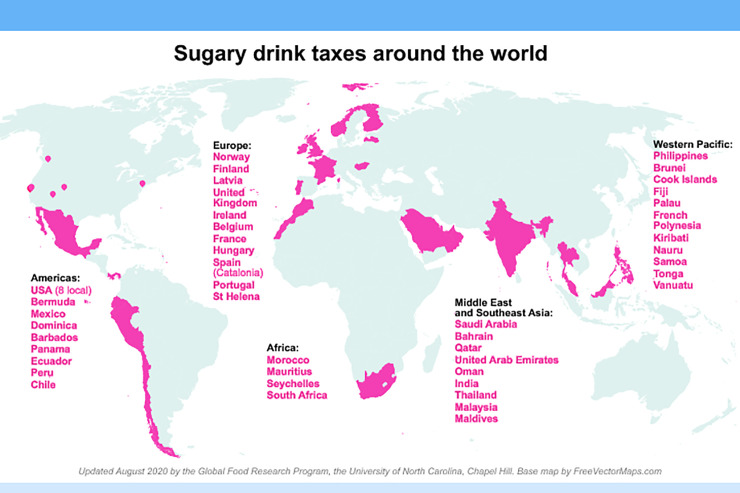
“The list of countries in 2021 added up to 44, 94,95 including large populous countries like India and small island nations in the Pacific Ocean, have implemented taxes on sugary drinks.”
Reshaping Food Systems to improve Nutrition and Health in the Eastern Mediterranean Region
Al‐Jawaldeh, A., & Meyer, A. L. (2023) · Open Book Publishers · doi:10.11647/obp.0322 · Cited by 14
Nguyen, T. M., Tonmukayakul, U., Le, L. K., Singh, A., Lal, A., Ananthapavan, J., Calache, H., & Mihalopoulos, C. (2023) · Health Economics · doi:10.1002/hec.4739 · Cited by 11
“Equity, environmental impact, and other considerations were rated ‘Positive’ except for some concerns regarding possible product substitution with non-nutritive sweeteners of unknown consequences (Popkin & Ng, 2021) with a rating ‘Neutral’.”
BackgroundChatelan, A., Rouche, M., Dzielska, A., Fismen, A., Kelly, C. N. M., Pedroni, C., Desbouys, L., & Castetbon, K. (2022) · Public Health Nutrition · doi:10.1017/s1368980022002361 · Cited by 12
“From the literature (8,9,28 – 30) and personal contacts with local experts, we identified six European countries that introduced or updated a national tax on soda between the first (2001 – 2002) and last (2017 – 2018) survey years, providing at least one time point before and after the tax was…”
BackgroundLou, Z., Yi, S. S., Pomeranz, J. L., Suss, R., Russo, R. G., Rummo, P. E., Eom, H., Liu, J., Zhang, Y., Moran, A. E., et al. (2022) · Journal of Urban Health · doi:10.1007/s11524-022-00699-3 · Cited by 10
“However, young people and those with lower income have been shown to have a larger decrease in the purchase of SSBs as a result of a tax [46, 47].”
BackgroundInfluentialHafner, E., & Pravst, I. (2021) · Frontiers in Nutrition · doi:10.3389/fnut.2021.778178 · Cited by 13
“Although similar benefits of taxation have been seen in other countries, such reformulations might considerably increase the use of LNCS (52), and this could affect health risk analyses.”
BackgroundChen, T., Zhu, J., Tsuei, S. H., Jiang, Y., Zheng, Y., Xu, D., & Fu, H. (2025) · The Lancet Public Health · doi:10.1016/s2468-2667(25)00256-7 · Cited by 13
Sugar taxation for climate and sustainability goals
King, L. C., & van den Bergh, J. C. J. M. (2022) · Nature Sustainability · doi:10.1038/s41893-022-00934-4 · Cited by 8
Thiboonboon, K., Lourenço, R. D. A., Cronin, P., Khoo, T., & Goodall, S. (2024) · Health Policy · doi:10.1016/j.healthpol.2024.105076 · Cited by 11
Online News Coverage of the Sugar-Sweetened Beverages Tax in Malaysia: Content Analysis
Hanim, M. F. M., Sabri, B. A. M., & Yusof, N. (2021) · JMIR Public Health and Surveillance · doi:10.2196/24523 · Cited by 8
“Nonetheless, SSBs taxation is gaining momentum because of its relative ease of implementation compared to other food or nutrition policy options [17].”
BackgroundFood price elasticity estimates in Australia
Davies, T., Saxena, A., Wu, J. H. Y., & Marklund, M. (2025) · Nature Food · doi:10.1038/s43016-025-01184-1 · Cited by 10
“Most notably, the World Health Organization (WHO) advocates for the use of taxes on sugar-sweetened beverages as a cost-effective intervention to reduce sugar consumption 5 , and to date more than 100 countries have implemented such taxes 6 .”
Costa, D., Warkentin, S., & Oliveira, A. (2022) · Porto Biomedical Journal · doi:10.1097/j.pbj.0000000000000172 · Cited by 11
“The existence of multiple systems might be confusing for interpretation79 • As it is voluntary action, some industries might not include any FOP • Might contribute to health inequalities • New formulas might seem a healthy option given the FOP, however be of poor nutrition quality Consumers’ education • Public awarene…”
BackgroundInfluentialInsights from a codesigned dynamic modelling study of child and adolescent obesity in Australia
Chiu, S. K., Baur, L. A., Occhipinti, J., Carrello, J., Golley, R. K., Hayes, A., Hunter, K. E., Kreuger, L. K., Lawson, K. D., Okely, A. D., et al. (2025) · BMJ Public Health · doi:10.1136/bmjph-2024-001164 · Cited by 8
“The scenario analyses show that interventions with high exposure (reach) and high adherence (fidelity), such as a sugar-sweetened beverage tax, can potentially reduce obesity in childhood and adolescence.”
Sajdakowska, M., Jeżewska-Zychowicz, M., Gębski, J., & Kiełb, A. (2024) · Foods · doi:10.3390/foods13223616 · Cited by 10
“Changes to the market offer of sweetened beverages are intended to help reduce the harmful health consequences of consuming large amounts of sugar, such as obesity and non-communicable diseases [29,30].”
Examining the policy process of sugar-sweetened beverage taxation in Ireland
Crosbie, E., Florence, D., Nanthaseang, M., & Godoy, L. (2022) · Health Policy · doi:10.1016/j.healthpol.2022.06.002 · Cited by 7
The environmental and social opportunities of reducing sugar intake
Shepon, A., Sun, Z., Makov, T., & Behrens, P. (2024) · Proceedings of the National Academy of Sciences · doi:10.1073/pnas.2314482121 · Cited by 5
“This overcon - sumption has raised concern among health officials and policymakers, leading to a call for greater regulation and reduced sugar intake ( 29 ).”
Williams, S. V., Hill, S. E., & Oyebode, O. O. (2022) · Globalization and Health · doi:10.1186/s12992-022-00877-7 · Cited by 7
“[4–6] Such ‘sugar taxes’ – most of which are specific to sugar-sweetened beverages (SSBs) - have now been introduced in many regions including the Americas, Europe, sub-Saharan Africa, Southeast Asia and the Pacific.”
BackgroundInfluentialIsrael's repeal of a sweet beverages tax harms public health
Kamin-Friedman, S., Davidovitch, N., & Yang, Y. T. (2023) · Frontiers in Public Health · doi:10.3389/fpubh.2023.1231709 · Cited by 4
“The taxes can also encourage non-price responses such as product reformulation (7).”
BackgroundTrends in the double burden of malnutrition among Indonesian adults, 2007 to 2023
Muharram, F. R., Tjandra, S., Madani, N. J., Rokx, C., & Abdullah, A. (2025) · Scientific Reports · doi:10.1038/s41598-025-17348-9 · Cited by 27
Jones, C., Lawlor, E. R., Forde, H., Theis, D. R. Z., Cummins, S., Adams, J. M., Smith, R., Rayner, M., Rutter, H., Penney, T. L., et al. (2024) · Public Health Nutrition · doi:10.1017/s1368980024000247 · Cited by 5
“Unlike most SSB taxes implemented elsewhere, for example Mexico (7) , Philadelphia, United States of America (USA) (8) , Barbados (9) and Chile (10) , the SDIL is not primarily designed to influence consumer purchasing decisions by directly raising the price of drinks.”
BackgroundElliott, L. M., Waqa, G., Ravuvu, A., Dalglish, S. L., & Topp, S. M. (2024) · Health Promotion International · doi:10.1093/heapro/daae142 · Cited by 7
“To date, the ‘win-win’ rhetoric of the NCD Best Buys has translated into a focus on understanding and measuring the health and economic achievements of SSB taxes post-implementation (Nakhimovsky et al ., 2016; Teng et al ., 2019; Popkin and Ng, 2021; Andreyeva et al ., 2022).”
2.3 Micronutrient Deficiencies
Al‐Jawaldeh, A., & Meyer, A. L. (2023) · Open Book Publishers · doi:10.11647/obp.0322.07 · Cited by 5
Elliott, L. M., Waqa, G., Dalglish, S. L., & Topp, S. M. (2023) · BMJ Global Health · doi:10.1136/bmjgh-2023-012025 · Cited by 5
Is a beverage tax really a healthy start? Worldwide analysis
Wendorf, A., & Rogoń, I. (2025) · Journal of Public Health · doi:10.1007/s10389-025-02528-8 · Cited by 3
Kränkel, N., Scherrenberg, M., Abela, M., Shemesh, E., Kopylova, O., Babu, A. S., Gaber, M. H., Śliż, D., & Salzwedel, A. (2023) · European Journal of Preventive Cardiology · doi:10.1093/eurjpc/zwad312 · Cited by 3
Hambali, M. L. (2022) · BISNIS & BIROKRASI Jurnal Ilmu Administrasi dan Organisasi · doi:10.20476/jbb.v29i1.1325 · Cited by 3
Zaltz, D. A., Prowse, R. J. L., Yi, Y., O’Dea, J., & Harding, S. (2025) · BMC Public Health · doi:10.1186/s12889-025-22432-w · Cited by 2
“One emerging area of SSB tax evaluation is the potential impact of consumers substituting taxed SSBs for beverages with non-nutritive sweeteners (“diet” drinks) [33].”
Crosbie, E., Schmidt, L., Krieger, J., & Nestle, M. (2022) · Oxford University Press eBooks · doi:10.1093/oso/9780197578742.003.0014 · Cited by 2
Creating a Healthy Food Environment as a Radical Population Approach and Japanese Initiatives
Takemi, Y. (2022) · Journal of Nutritional Science and Vitaminology · doi:10.3177/jnsv.68.s78 · Cited by 2
Santiago, V. A., Cassin, S. E., Sockalingam, S., & Carter, A. (2022) · Springer eBooks · doi:10.1007/978-3-030-92392-1_158 · Cited by 2
THE RELATIONSHIP BETWEEN BODY MASS INDEX AND LIFE SATISFACTION AMONG ADULT RUSSIANS
Gromova, D., & Алексеевна, Х. Н. (2023) · Social Aspects of Population Health · doi:10.21045/2071-5021-2023-69-1-5 · Cited by 5
Smith, B. T., Warren, C. M., Anderson, L. N., Hammond, D. G., Manuel, D. G., Li, Y., Andreacchi, A. T., Rosella, L. C., Fu, S. H., & Hobin, E. P. (2024) · Public Health Nutrition · doi:10.1017/s1368980024000545 · Cited by 1
Akhter, S., Mamun, R., Hawkes, S., Buse, K., & Cameron, A. J. (2025) · Archives of Public Health · doi:10.1186/s13690-025-01759-1 · Cited by 2
Almanya’da Gıda Tüketimini Şekillendirmeye Yönelik Maliye Politikalarının Sistematik Değerlendirmesi
Koç, İ. (2026) · Maliye Finans Yazıları · doi:10.33203/mfy.1771249 · Cited by 1
Busch, S., Ferrario, P. G., Henk, A.-K., Engelbert, A. K., Wittek, O., Seifert, S., Bub, A., Mack, C. I., & Hieronimus, B. (2026) · JMIR Research Protocols · doi:10.2196/81857 · Cited by 1
“To mitigate these risks, the use of low-calorie sweeteners has increased in recent years, with further growth anticipated [6].”
The Epidemiology, Prevention, and Control of Type 2 Diabetes in Low- and Middle-Income Countries
Kocher, E. L., Teufel, F., Carrillo-Larco, R. M., Chakkalakal, R. J., & Ali, M. K. (2026) · Annual Review of Public Health · doi:10.1146/annurev-publhealth-081624-060046 · Cited by 3
Product Reformulation in Response to the 2016 FDA Updated Nutrition Facts Label
Hatton, C. R., Petimar, J., Zhang, Y., Collis, C. E., Hou, T., Ross, A., Polacsek, M., Grummon, A. H., Rimm, E. B., & Block, J. P. (2026) · JAMA Health Forum · doi:10.1001/jamahealthforum.2026.1253 · Cited by 1
Polish ‘sugar fee’ in the light of global experience with sugar sweetened beverages taxation
Mazurek-Chwiejczak, M. (2021) · Ekonomia i Prawo · doi:10.12775/eip.2021.017 · Cited by 4
“The arguments of too low sugar taxes’ rates are often raised (Popkin & Ng, 2021, p. 6).”
BackgroundSürdürülebilir Kalkınmada Beslenme ve Besinin Gerçek Fiyatı
Haydaroğlu, M., & Bilgiç, P. (2023) · Journal of Nutrition and Dietetics · doi:10.33076/2023.bdd.1722 · Cited by 1
“Fakat bu uygulamanın beraberinde getirdiği diğer sonuçlar da tartışılmaya başlanmıştır (30).”
Ahles, A., Muhammad, A., Yenerall, J. N., Reedy, J., Shi, P., Zhang, J., Cudhea, F., Erndt‐Marino, J. D., Miller, V., & Mozaffarian, D. (2024) · BMJ Open · doi:10.1136/bmjopen-2023-074562 · Cited by 2
“9 13 14 For instance, taxation in a particular jurisdiction could increase cross-border shopping (ie, purchasing outside of”
BackgroundEffects on Body Mass Index After the Philadelphia Beverage Tax
Janson, A., & Elinder, L. S. (2024) · Archives of Pediatrics and Adolescent Medicine · doi:10.1001/jamapediatrics.2024.4789 · Cited by 1
Zhong, Y., Auchincloss, A. H., Lee, B. K., McKenna, R. M., & Langellier, B. A. (2021) · International Journal of Environmental Research and Public Health · doi:10.3390/ijerph182010930 · Cited by 1
Taxation and Regulation in a Market of Sin Goods with Persuasive AdvertisingPreprint
Colombo, S., Colombo, L., & Galmarini, U. (2022) · SSRN Electronic Journal · doi:10.2139/ssrn.4049479 · Cited by 1
The associations of sleep deficits and consumption of sugar-sweetened beverages in adolescents
Zhang, K. (2021) · cIRcle (University of British Columbia) · doi:10.14288/1.0401561
Santiago, V. A., Cassin, S. E., Sockalingam, S., & Carter, A. (2022) · Springer eBooks · doi:10.1007/978-3-030-67928-6_158-1
Obezite ile Mücadelede Şekerli İçecek Vergilerinin Kullanımı Üzerine Bir Analiz
SEZGİN, B. S., & IŞIK, S. (2022) · Troyacademy · doi:10.31454/troyacademy.1130976
1.1. The Food Systems Approach: Definitions and Concept
Al‐Jawaldeh, A., & Meyer, A. L. (2023) · Open Book Publishers · doi:10.11647/obp.0322.01
3.6 Food Fortification, Including Biofortification
Al‐Jawaldeh, A., & Meyer, A. L. (2023) · Open Book Publishers · doi:10.11647/obp.0322.16
2.5 Dietary Intake and Consumption Patterns of Adults and Adolescents
Al‐Jawaldeh, A., & Meyer, A. L. (2023) · Open Book Publishers · doi:10.11647/obp.0322.09
Al‐Jawaldeh, A., & Meyer, A. L. (2023) · Open Book Publishers · doi:10.11647/obp.0322.18
Al‐Jawaldeh, A., & Meyer, A. L. (2023) · Open Book Publishers · doi:10.11647/obp.0322.12
3.4 Reformulating Food Products
Al‐Jawaldeh, A., & Meyer, A. L. (2023) · Open Book Publishers · doi:10.11647/obp.0322.14
2.1 Undernourishment in the WHO Eastern Mediterranean Region
Al‐Jawaldeh, A., & Meyer, A. L. (2023) · Open Book Publishers · doi:10.11647/obp.0322.05
Al‐Jawaldeh, A., & Meyer, A. L. (2023) · Open Book Publishers · doi:10.11647/obp.0322.17
3.1 Fiscal Policies for Healthy and Sustainable Diets
Al‐Jawaldeh, A., & Meyer, A. L. (2023) · Open Book Publishers · doi:10.11647/obp.0322.11
Bovet, P., Banatvala, N., Ravussin, É., & Nederveen, L. (2023) · Routledge eBooks · doi:10.4324/9781003306689-25
Al‐Jawaldeh, A., & Meyer, A. L. (2023) · Open Book Publishers · doi:10.11647/obp.0322.10
1.3 Food Waste and Losses and Water Use
Al‐Jawaldeh, A., & Meyer, A. L. (2023) · Open Book Publishers · doi:10.11647/obp.0322.03
3.5 Public Food Procurement and Service Policies to Support Healthy Sustainable Diets
Al‐Jawaldeh, A., & Meyer, A. L. (2023) · Open Book Publishers · doi:10.11647/obp.0322.15
1.4 Sustainable Food Systems for Healthy Diets of the Future
Al‐Jawaldeh, A., & Meyer, A. L. (2023) · Open Book Publishers · doi:10.11647/obp.0322.04
Al‐Jawaldeh, A., & Meyer, A. L. (2023) · Open Book Publishers · doi:10.11647/obp.0322.08
3.3 Food Labelling with Focus on Front-of-Pack Labelling
Al‐Jawaldeh, A., & Meyer, A. L. (2023) · Open Book Publishers · doi:10.11647/obp.0322.13
Metadata
- Authors
- Popkin, B. M., & Ng, S. W.
- Affiliations
- University of North Carolina at Chapel Hill (US)
- Corresponding author
- Popkin, Barry M.
- Venue
- PLOS Medicine
- Publisher
- Public Library of Science (PLoS)
- Published
- 2021-01-07
- Volume
- 18
- Issue
- 1
- Pages
- e1003412
- ISSN
- 1549-1277 (ISSN-L)
- 1549-1676
- PMC
- PMC7790261
- OpenAlex
- W3120874580
- Cited by
- 121
- References
- 45
- Citations by year
- 2026: 14 · 2025: 15 · 2024: 15 · 2023: 37 · 2022: 26 · 2021: 14
- FWCI
- 22.30
- Type
- journal article
- Language
- en
- Open access
- gold
- doi.org
- Licence
- Locations
- PLoS Medicine (publishedVersion, cc-by)
- PubMed Central (publishedVersion, cc-by)
- PubMed (publishedVersion)
- RePEc: Research Papers in Economics (submittedVersion)
- DOAJ (DOAJ: Directory of Open Access Journals) (submittedVersion, cc-by-sa)
- Funders
- Bloomberg Philanthropies
- Arnold Ventures
- NIH (R01DK108148)
- National Institutes of Health (P2C HD0550924)
- Topics
- Health Sciences › Medicine › Public Health, Environmental and Occupational Health › Global Public Health Policies and Epidemiology
- Health Sciences › Medicine › Public Health, Environmental and Occupational Health › Obesity, Physical Activity, Diet
- Social Sciences › Economics, Econometrics and Finance › Economics and Econometrics › Economic and Fiscal Studies
- Keywords
- sugar-sweetened beverage tax, sugar-sweetened beverages, taxation, public health policy, obesity prevention, sugar consumption, fiscal policy
- MeSH terms
- Sugar-Sweetened Beverages, Energy Intake, Forecasting, Humans, Public Health, Taxes
About these checks
Registry, retraction, Cites and statistics results are computed, not judged, with one exception: a printed reference that no index lists is read once by a model before it counts as a citation error. Claims are extracted by a model and kept only when their quote appears verbatim in the text; each cited source is then checked, with a model’s help, for whether it says what the claim relies on. Those verdicts can be wrong — read the claim’s quote and the cited source before relying on one.
Statistics and arithmetic are recomputed, not judged.
Confidence bands are shown only for fields calibrated on our annotated test set. None is calibrated yet, so no band is shown.
What counts as a claim ›How we measure confidence ›How we check this ›
Are you an author, or do you see a problem with this page? Request a review
Data sources
Bibliographic data: Semantic Scholar, OpenAlex, Crossref.
Contains information from the Semantic Scholar Academic Graph Datasets, made available under the ODC Attribution License (ODC-BY 1.0).
Semantic Scholar’s data is described in: Kinney, R., et al. (2023). The Semantic Scholar Open Data Platform. arXiv:2301.10140.
