

The DOI matches its Crossref record; 54 of the 54 references it cites were found in a registry or an index.
Low-Load High Volume Resistance Exercise Stimulates Muscle Protein Synthesis More Than High-Load Low Volume Resistance Exercise in Young Men
Open accessAbstract
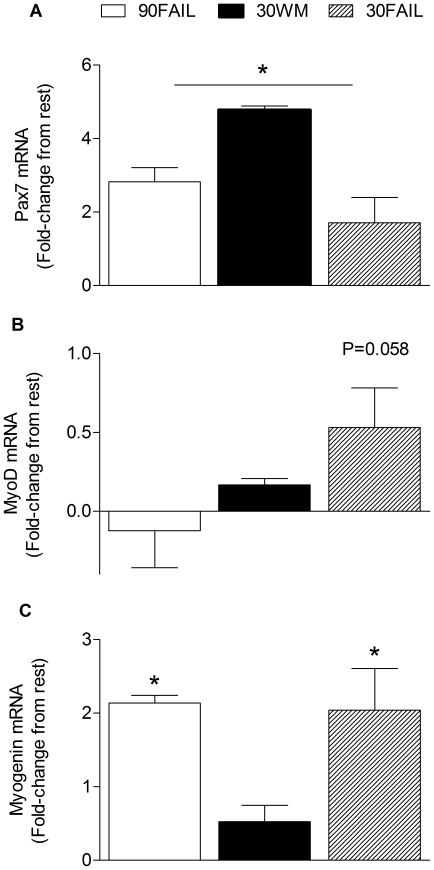
BACKGROUND: We aimed to determine the effect of resistance exercise intensity (%1 repetition maximum-1RM) and volume on muscle protein synthesis, anabolic signaling, and myogenic gene expression. METHODOLOGY/PRINCIPAL FINDINGS: Fifteen men (21+/-1 years; BMI=24.1+/-0.8 kg/m2) performed 4 sets of unilateral leg extension exercise at different exercise loads and/or volumes: 90% of repetition maximum (1RM) until volitional failure (90FAIL), 30% 1RM work-matched to 90%FAIL (30WM), or 30% 1RM performed until volitional failure (30FAIL). Infusion of [ring-13C6] phenylalanine with biopsies was used to measure rates of mixed (MIX), myofibrillar (MYO), and sarcoplasmic (SARC) protein synthesis at rest, and 4 h and 24 h after exercise. Exercise at 30WM induced a significant increase above rest in MIX (121%) and MYO (87%) protein synthesis at 4 h post-exercise and but at 24 h in the MIX only. The increase in the rate of protein synthesis in MIX and MYO at 4 h post-exercise with 90FAIL and 30FAIL was greater than 30WM, with no difference between these conditions; however, MYO remained elevated (199%) above rest at 24 h only in 30FAIL. There was a significant increase in AktSer473 at 24h in all conditions (P=0.023) and mTORSer2448 phosphorylation at 4 h post-exercise (P=0.025). Phosporylation of Erk1/2Tyr202/204, p70S6KThr389, and 4E-BP1Thr37/46 increased significantly (P<0.05) only in the 30FAIL condition at 4 h post-exercise, whereas, 4E-BP1Thr37/46 phosphorylation was greater 24 h after exercise than at rest in both 90FAIL (237%) and 30FAIL (312%) conditions. Pax7 mRNA expression increased at 24 h post-exercise (P=0.02) regardless of condition. The mRNA expression of MyoD and myogenin were consistently elevated in the 30FAIL condition. CONCLUSIONS/SIGNIFICANCE: These results suggest that low-load high volume resistance exercise is more effective in inducing acute muscle anabolism than high-load low volume or work matched resistance exercise modes.
Overview
The claims and statistics of this paper haven’t been checked yet.
Run the check — free, no account needed. It reads the open-access text and checks the sources it cites.
Integrity signals
Registry
Cites
Statistics
Figures
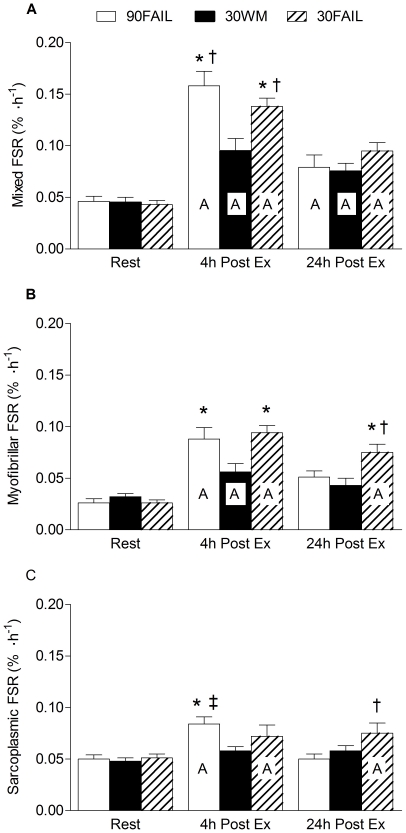
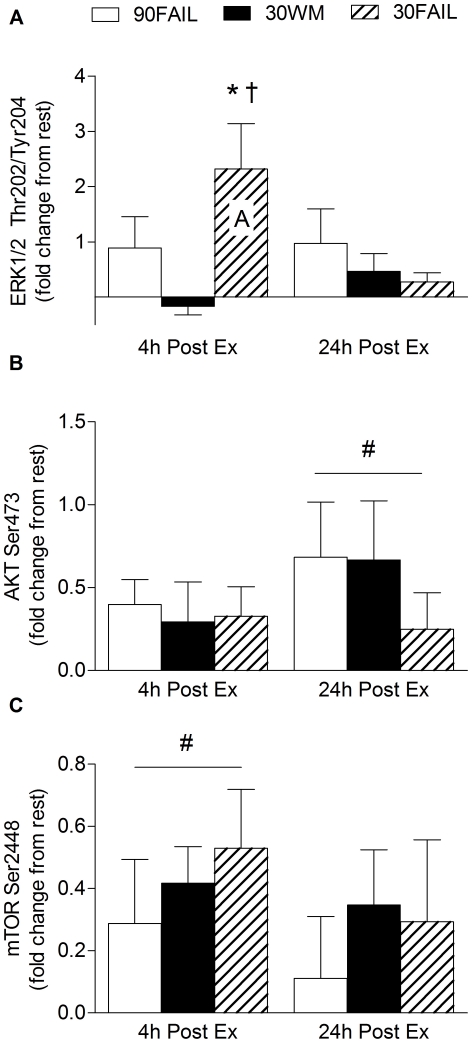
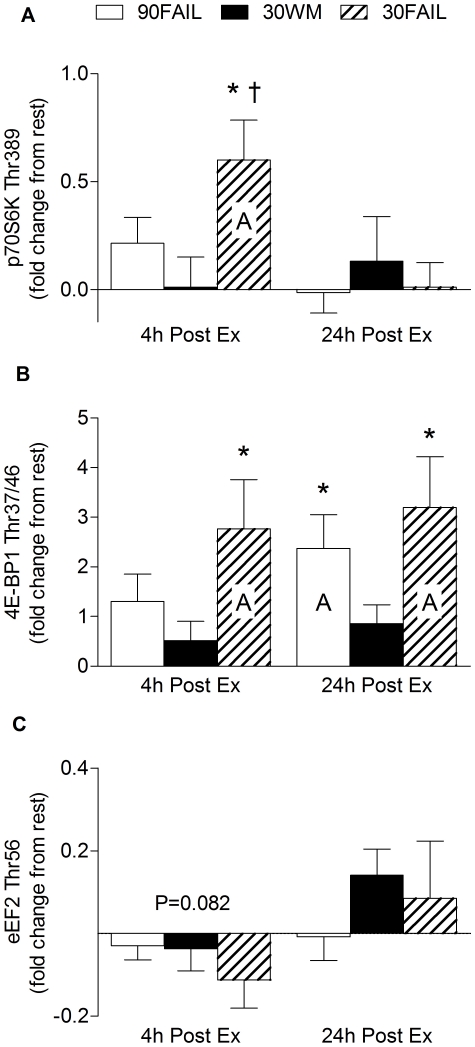
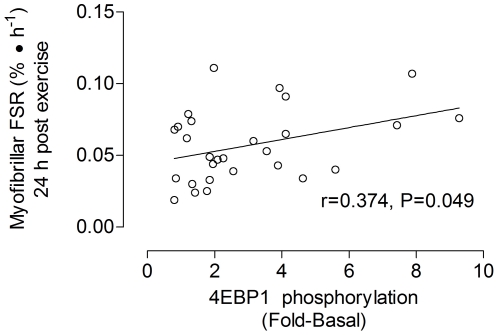
Verification
Claims the paper makes
The claims and statistics of this paper haven’t been checked yet.
Run the check — free, no account needed. It reads the open-access text and checks the sources it cites.
Claims other papers make about this one
Each is checked against this paper’s own text: does it say what the citing paper says it does?
The source backs part of the claim, not all of it — or backs it for a different population, condition or comparison.
In the citing paper
“This strongly indicates that the translational capacity bottleneck possesses a high activation threshold: a minimal mechanical volume is strictly required to sustain the Pol I transcription spark long enough to outpace the basal decay rate of existing ribosomes [35,87,88].”
From Ribosome Biogenesis as a Putative Bottleneck to Skeletal Muscle Hypertrophy: Mechanisms, Human Evidence, and Practical Modulators (2026) · cites this paper as [88]
Experimental — accuracy not yet measuredThe cited source says what the claim attributes to it.
In the citing paper
“Consistent with this line of evidence, research where participants expended a high level of effort suggests that the MPS response to low-load training is at least as robust as when training with heavier loads [39].”
From Loading recommendations for muscle strength, hypertrophy, and local endurance: a re-examination of the repetition continuum. (2021) · cites this paper as [39]
The cited source says what the claim attributes to it.
In the citing paper
“Some studies show an impaired acute MPS response when training with lower loads [37,38] while others report similar increases in mixed and myofibrillar protein synthesis rates [39].”
From Loading recommendations for muscle strength, hypertrophy, and local endurance: a re-examination of the repetition continuum. (2021) · cites this paper as [39]
The check wasn’t confident either way, so it gives no verdict — never disputed.
In the citing paper
“Figueiredo et al. showed that post-exercise cold-water immersion attenuated markers associated with ribosome biogenesis compared with active recovery [88].”
From Ribosome Biogenesis as a Putative Bottleneck to Skeletal Muscle Hypertrophy: Mechanisms, Human Evidence, and Practical Modulators (2026) · cites this paper as [88]
Experimental — accuracy not yet measured
Self-check
Percentages, sums and reported differences re-computed from the paper’s own numbers.
The self-check needs the paper’s full text.
Citations
Cites
Analysis of Relative Gene Expression Data Using Real-Time Quantitative PCR and the 2−ΔΔCT Method
Livak, K. J., & Schmittgen, T. D. (2001) · Methods · doi:10.1006/meth.2001.1262 · Cited by 180,860
American College of Sports Medicine position stand
Otis, C. L. (1997) · Medical Entomology and Zoology · Cited by 4,407
Progression Models in Resistance Training for Healthy Adults
(2009) · Medicine & Science in Sports & Exercise · doi:10.1249/mss.0b013e3181915670 · Cited by 4,332
Progression Models in Resistance Training for Healthy Adults
(2002) · Medicine and Science in Sports and Exercise · doi:10.1097/00005768-200202000-00027 · Cited by 2,979
Pax7 Is Required for the Specification of Myogenic Satellite Cells
Seale, P., Sabourin, L. A., Girgis-Gabardo, A., Mansouri, A., Gruß, P., & Rudnicki, M. A. (2000) · Cell · doi:10.1016/s0092-8674(00)00066-0 · Cited by 2,345
Relation between size of neurons and their susceptibility to discharge
Henneman, E. (1957) · Science · doi:10.1126/science.126.3287.1345 · Cited by 1,227
Anabolic signaling deficits underlie amino acid resistance of wasting, aging muscle
Cuthbertson, D., Smith, K., Babraj, J., Leese, G., Waddell, T., Atherton, P., Wackerhage, H., Taylor, P. M., & Rennie, M. J. (2005) · The FASEB Journal · doi:10.1096/fj.04-2640fje · Cited by 1,211
Self-citationMixed muscle protein synthesis and breakdown after resistance exercise in humans
Phillips, S. M., Tipton, K. D., Aarsland, A., Wolf, S. E., & Wolfe, R. R. (1997) · American Journal of Physiology-Endocrinology and Metabolism · doi:10.1152/ajpendo.1997.273.1.e99 · Cited by 1,132
Self-citationMoore, D. R., Robinson, M. J., Fry, J. L., Tang, J. E., Glover, E. I., Wilkinson, S. B., Prior, T., Tarnopolsky, M. A., & Phillips, S. M. (2009) · The American Journal of Clinical Nutrition · doi:10.3945/ajcn.2008.26401 · Cited by 973
Self-citationKumar, V., Selby, A., Rankin, D., Patel, R., Atherton, P., Hildebrandt, W., Williams, J., Smith, K., Seynnes, O., Hiscock, N., et al. (2009) · The Journal of Physiology · doi:10.1113/jphysiol.2008.164483 · Cited by 740
Self-citation
Cited by
Sorted by citations
Items 401–500 of 529
Tension to Translation: External to Internal Processes in Muscle Hypertrophy
Greyvenstein, D., Newbold, J. P., & Phillips, S. M. (2025) · Physiology · doi:10.1152/physiol.00034.2025 · Cited by 4
Self-citationColosio, A. L., D’hoe, B., Bourgois, J., & Boone, J. (2026) · PeerJ · doi:10.7717/peerj.20909 · Cited by 2
McGlory, C., & Phillips, S. M. (2016) · Elsevier eBooks · doi:10.1016/b978-0-12-802167-5.00006-2 · Cited by 2
Self-citationProppe, C. E., Rivera, P. M., Beltran, E., & Hill, E. C. (2022) · Comparative Exercise Physiology · doi:10.3920/cep220023 · Cited by 2
Exploring Human Muscle Dynamics In Vivo Using Stable Isotope Tracers
Kim, I., Park, S., Jang, J., Kim, Y., & Kim, H. (2022) · 한국정맥경장영양학회지 · doi:10.15747/acnm.2022.14.2.40 · Cited by 2
Paquin, J., St‐Martin, P., Lord, S.-È., Gendron, P., Brochu, M., & Dionne, I. J. (2025) · The Journal of Strength and Conditioning Research · doi:10.1519/jsc.0000000000005096 · Cited by 2
Conceição, M. S., Derchain, S., VECHIN, F. C., Telles, G. D., MAGINADOR, G. F., Sarian, L. O., Libardi, C. A., & Ugrinowitsch, C. (2021) · Frontiers in Physiology · doi:10.3389/fphys.2021.655955 · Cited by 2
The influence of mechanical loading on skeletal muscle protein turnover
Hector, A. J., McGlory, C., & Phillips, S. M. (2015) · doi:10.7457/cmep.v4i1 · Cited by 2
Self-citationControl of muscle protein synthesis in response to exercise and amino acids
Nakai, N., Kawano, F., & Ohira, Y. (2012) · The Journal of Physical Fitness and Sports Medicine · doi:10.7600/jpfsm.1.297 · Cited by 2
Prieto-Fresco, J. M., Medina-Rebollo, D., Gavira, J. F., & Muñoz-Llerena, A. (2022) · International Journal of Environmental Research and Public Health · doi:10.3390/ijerph20010420 · Cited by 2
Proposal and validation of mathematical model for resistance training
Hatanaka, S., & Ishii, N. (2021) · The Journal of Physical Fitness and Sports Medicine · doi:10.7600/jpfsm.10.109 · Cited by 2
THE EFFECTS OF AEROBIC EXERCISE ON HUMAN SKELETAL MUSCLE ADAPTATIONS TO RESISTANCE EXERCISE
Lundberg, T. R. (2014) · Diva portal (Dalarna University Library) · Cited by 2
McDonough, D. J. (2017) · doi:10.18122/b2kx4q · Cited by 2
Is the Dynamic Knee Extension Exercise Inherently Ischemic Already at Low to Moderate Loads?
Wernbom, M. (2025) · Scandinavian Journal of Medicine and Science in Sports · doi:10.1111/sms.70128 · Cited by 2
Muñoz López, M., López-Gil, J. F., Ramírez de la piscina Viúdez, X., Baz-Valle, E., & Tornero Aguilera, J. F. (2026) · Cells · doi:10.3390/cells15111041 · Cited by 1
“Figueiredo et al. showed that post-exercise cold-water immersion attenuated markers associated with ribosome biogenesis compared with active recovery [88].”
Current View on Muscle Hypertrophy: Sarcomerogenesis
Ateş, O., ÇİFTÇİ, E., & KARLIK, E. (2021) · Avrasya Spor Bilimleri ve Eğitim Dergisi · doi:10.47778/ejsse.957282 · Cited by 1
Rao, V. D. (2023) · International Journal Of Pharmaceutical Research And Allied Sciences · doi:10.51847/a01mdvt1cg · Cited by 1
Quadriceps Architectural Adaptations in Team Sports Players: A Meta-analysis
Pecci, J., Sañudo, B., Sánchez-Trigo, H., Reverte-Pagola, G., & Pareja-Galeano, H. (2024) · International Journal of Sports Medicine · doi:10.1055/a-2369-5900 · Cited by 1
Cornejo‐Daza, P. J., Sánchez‐Valdepeñas, J., Páez-Maldonado, J. A., Rodiles-Guerrero, L., Sánchez‐Moreno, M., Gómez-Guerrero, G., León-Prados, J. A., & Pareja‐Blanco, F. (2024) · The Journal of Strength and Conditioning Research · doi:10.1519/jsc.0000000000005021 · Cited by 1
Custodio, R. D., Yanci, J., González, J. R., & Castillo, D. (2024) · Sportis Scientific Journal of School Sport Physical Education and Psychomotricity · doi:10.17979/sportis.2025.11.1.11151 · Cited by 1
Longrak, R. (2025) · Physical Culture Recreation and Rehabilitation · doi:10.15561/physcult.2025.0101 · Cited by 1
Tavares, H., Roschel, H., Souto, V. F., NOBREGA, Á., Hevia-Larraín, V., Gonçalves, L. D. S., BARROS, T. A. R., COSTA, A. S., & do Nascimento, E. (2025) · The Journal of Sports Medicine and Physical Fitness · doi:10.23736/s0022-4707.25.16698-x · Cited by 1
Miçooğulları, Z., Miçooğulları, M., & Angın, S. (2025) · Advances in Gerontology · doi:10.1134/s2079057025600533 · Cited by 1
Hammert, W. B., Moreno, E. N., Sallberg, R. W., Yamada, Y., Metcalf, E. E., Young, E. W., Kataoka, R., & Loenneke, J. P. (2026) · European Journal of Applied Physiology · doi:10.1007/s00421-026-06129-5 · Cited by 1
Mueller, B., Fox, C. D., Parry, H. A., Mesquita, P. H. C., Vann, C. G., Ruple, B. A., Sexton, C. L., Godwin, J. S., McIntosh, M. C., Beck, D. T., et al. (2026) · Experimental Physiology · doi:10.1113/ep093172 · Cited by 1
Self-citationXu, N., Wang, T., Guo, R., Hong, Y., & Dudonienė, V. (2026) · Journal of Clinical Medicine · doi:10.3390/jcm15124706 · Cited by 1
Yang, Z. (2020) · Orthopedics and Sports Medicine Open Access Journal · doi:10.32474/osmoaj.2020.03.000162 · Cited by 1
Cárdenas, L. H. (2019) · Cited by 1
Angleri, V., Damas, F., Stotzer, U. S., Selistre-de-Araújo, H. S., Santanielo, N., Soligon, S. D., Costa, L. A. R., Lixandrão, M. E., Conceição, M. S., VECHIN, F. C., et al. (2022) · Muscles · doi:10.3390/muscles1010002 · Cited by 1
(2019) · Archives of Physiotherapy · doi:10.1186/s40945-019-0069-0 · Cited by 1
Skeletal Muscle Protein Metabolism During Exercise
Joanisse, S., McKendry, J., Nunes, E. A., Thomas, A. C. Q., & Phillips, S. M. (2022) · Physiology in health and disease · doi:10.1007/978-3-030-94305-9_9 · Cited by 2
Self-citationPİŞKİN, N. E., & AKTUĞ, Z. B. (2022) · International Journal of Sport Exercise & Training Sciences · doi:10.18826/useeabd.1095896 · Cited by 1
Effect of resistance training mainly depends on mechanical activation of fast-twitch fiber
Hatanaka, S., & Ishii, N. (2022) · The Journal of Physical Fitness and Sports Medicine · doi:10.7600/jpfsm.11.295 · Cited by 1
Whitley, R., Holmberg, P. M., Jenkins, D. G., & Kelly, V. G. (2022) · International Journal of Strength and Conditioning · doi:10.47206/ijsc.v2i1.151 · Cited by 1
Pearson, J. R., Moodie, N. G., Stout, K. W., Hawkins, W. C., Matuszek, M., Graham, Z., Siedlik, J. A., Vardiman, J. P., & Gallagher, P. M. (2023) · The Journal of Strength and Conditioning Research · doi:10.1519/jsc.0000000000004363 · Cited by 1
Cho, S. I., Yang, S.-J., Park, B. S., Kong, D. H., Lee, J. W., & Lee, D. W. (2024) · The Korean Journal of Sports Medicine · doi:10.5763/kjsm.2024.42.2.67 · Cited by 1
Gu, H., Sun, S., Zhang, Y., Wang, Y., Ding, Q., Lu, M., Xiang, X., Sun, K., & Xu, X. (2024) · BMC Pregnancy and Childbirth · doi:10.1186/s12884-024-06849-6 · Cited by 1
Peinado, P. J. B., & Sotillo, A. A. (2024) · IntechOpen eBooks · doi:10.5772/intechopen.1007051 · Cited by 2
Biral, T. M., Lemos, L. K., Cavina, A. P. D. S., Pizzo, E., Vendrame, J. W., da Silva, G. M., Brandão, G. H. D. S., Pimenta, G. S. O. M., da Silva, G. O., Santos, G. C., et al. (2024) · Apunts Sports Medicine · doi:10.1016/j.apunsm.2024.100470 · Cited by 1
Effets de l’exercice physique sur les maladies musculaires
Boulinguiez, A., Bouragba, D., Crisol, B., Bigot, A., Butler-Browne, G. S., & Trollet, C. (2024) · médecine/sciences · doi:10.1051/medsci/2024161 · Cited by 1
Li, Y., Xiao, N., Wang, Q., Liu, B., Cui, Y., Liu, Y., Ji, Y., & Zheng, M. (2025) · Biochemical and Biophysical Research Communications · doi:10.1016/j.bbrc.2025.151401 · Cited by 1
Cumming, K. T., Elvatun, I. C., Kalenius, R., Divljak, G., Raastad, T., Psilander, N., & Horwath, O. (2025) · Journal of Applied Physiology · doi:10.1152/japplphysiol.00353.2025 · Cited by 1
Matareli, B. M., Teruya, T. T., Romano, F. S., Skau, J. R., Ervilha, U. F., & Mochizuki, L. (2013) · Cited by 1
Cellular and Molecular Mechanisms of Protein Synthesis Among Tissues
Carbone, J. W., Margolis, L. M., & Pasiakos, S. M. (2016) · Elsevier eBooks · doi:10.1016/b978-0-12-802167-5.00004-9 · Cited by 2
Clinical Applications for Platelet Rich Plasma Therapy
Honbo, E. S., & Podesta, L. (2013) · Elsevier eBooks · doi:10.1016/b978-0-323-07747-7.00010-1 · Cited by 1
Efeito da ordem dos exercícios de força sobre o volume, o lactato e o desempenho
Tavares, L. D., Ugrinowitsch, C., Silva, C. M. P. E., Souza, E. O. D., Laurentino, G. C., Pinheiro, F. A., Lasevicius, T., & Tricoli, V. (2017) · Revista Brasileira de Medicina do Esporte · doi:10.1590/1517-869220172303159913 · Cited by 1
Acute Hormonal Responses to Intentionally Slow or Maximal Velocity Resistance Exercise in Men
Dietz, P. R., Fry, A. C., Nicoll, J. X., & Čabarkapa, D. (2022) · Human Physiology · doi:10.1134/s0362119722700037 · Cited by 1
Nutrition for Power and Sprint Training
Burd, N. A., & Phillips, S. M. (2011) · Wiley eBooks · doi:10.1002/9781444344905.ch11 · Cited by 2
Self-citationThe effect of moderate-intensity resistance training on health-related outcomes in older adults
Harper, A. (2015) · SUNScholar (Stellenbosch University) · Cited by 1
Horwath, O., Moberg, M., Hodson, N. W., Edman, S., Johansson, M., Andersson, E. A., van Hall, G., Rooyackers, O., Philp, A., & Apró, W. (2024) · bioRxiv (Cold Spring Harbor Laboratory) · doi:10.1101/2024.06.15.598989 · Cited by 1
Santos, A. D. R. (2013) · Digital Library of Theses and Dissertations (Universidade de São Paulo) · doi:10.11606/d.39.2013.tde-27032013-093640
Ferraz, R. (2014) · Digital Library of Theses and Dissertations (Universidade de São Paulo) · doi:10.11606/d.39.2014.tde-07012015-111600
Proteinsupplementering i samband med styrketräning : En litteraturstudie
Horwath, O., & Löfgren, M. (2013) · KTH Publication Database DiVA (KTH Royal Institute of Technology)
Hernández, J. M. (2013) · Buleria (Universidad de León) · doi:10.18002/10612/2883
Laakso, M. (2015) · Jyväskylä University Digital Archive (University of Jyväskylä)
Rodrigo Branco de Araújo Silveira Ferraz
Educação, E. D. (2014)
Weisgarber, K. (2014) · oURspace (University of Regina) · doi:10.82465/7032
Acute Hormone Response to Slow Velocity and Traditional Velocity Resistance Training Sessions
Dietz, P. R. (2015) · KU ScholarWorks (The University of Kansas)
Paes, S. T. (2016) · LA Referencia (Red Federada de Repositorios Institucionales de Publicaciones Científicas)
Matsuda, K., HONMA, K., Yoshizumi, K., NAGAI, Y., NAKAHARA, M., & Kaneko, H. (2012) · Rigakuryoho Kagaku · doi:10.1589/rika.27.81
Barretti, D. L. M. (2016) · Digital Library of Theses and Dissertations (Universidade de São Paulo) · doi:10.11606/t.39.2016.tde-30052016-161606
Lasevicius, T. (2016) · Digital Library of Theses and Dissertations (Universidade de São Paulo) · doi:10.11606/d.39.2016.tde-10062016-095506
Mechanical and metabolic stresses contribute to high force contraction signaling
Rahnert, J. A. (2012) · SMARTech Repository (Georgia Institute of Technology)
Worthey, C. (2016) · ISU Red - Research and eData (Illinois State University) · doi:10.30707/etd2016.worthey.c
Effects of Resistance Training on aged Skeletal Muscle and Mitochondrial Function
Flack, K. D. (2014) · VTechWorks (Virginia Tech)
Gonzalez, A. M. (2015) · Journal of International Crisis and Risk Communication Research
15: Dietary Protein and Physical Training Effects on Body Composition and Performance
Devries, M. C., Oikawa, S. Y., & Phillips, S. M. (2017) · CRC Press eBooks · doi:10.1201/9781351260008-15
Self-citationDamas, F. (2017) · Digital Library of Theses and Dissertations (Universidade de São Paulo) · doi:10.11606/t.39.2017.tde-11102017-092823
Four Weeks of Muscular Endurance Resistance Training Does Not Alter Fatigue Index
Farrell, J. W., Blackwood, D. J., & Larson, R. D. (2018) · International Journal of Kinesiology and Sports Science · doi:10.7575/aiac.ijkss.v.6n.3p.32
Mike, J. (2018) · Elsevier eBooks · doi:10.1016/b978-0-12-813922-6.00037-0
Neto, A. C. P., do Nascimento, Y. V., & Dantas, R. A. E. (2018) · Programa de Iniciação Científica - PIC/UniCEUB - Relatórios de Pesquisa · doi:10.5102/pic.n3.2017.5869
PROPOSTA DE UM NOVO TESTE CLÍNICO PARA DIAGNÓSTICO DA TENDINOPATIA GLÚTEA
Rosa, T. M., Cassol, F. R., Oliveira, M. V., Freitas, A., & Macedo, S. L. (2018) · Programa de Iniciação Científica - PIC/UniCEUB - Relatórios de Pesquisa · doi:10.5102/pic.n3.2017.5868
Gillett, J. G. (2018) · The University of Queensland · doi:10.14264/uql.2018.856
Bridge, A. D. (2019) · Brock University Digital Repository (Brock University)
Trainingsmethoden und Trainierbarkeit
Behringer, M., Skutschik, C., & Franz, A. (2019) · Der Orthopäde · doi:10.1007/s00132-019-03827-1
Pancevski, K. (2020) · UWSpace (University of Waterloo)
Treinamento de força bi-set em mulheres
Gouvêa, C. M. C. P., & Bueno, J. R. (2020) · Conexões · doi:10.20396/conex.v18i0.8656776
Jang, J.-O., Kim, E.-H., Lee, B.-G., Kwak, T., Lee, Y., & Lee, J.-S. (2020) · Exercise Science · doi:10.15857/ksep.2020.29.3.281
Nutrient Timing Programs in Sport: A Case Study Approach
Kerksick, C. M. (2011) · CRC Press eBooks · doi:10.1201/b11210-18
Rashidi, E., Kakhak, A. H., & Askari, R. (2017) · Salmand · doi:10.32598/sija.13.10.470
Optimizing protein delivery to promote skeletal muscle protein synthesis
Areta, J. L. (2014) · RMIT Research Repository (RMIT University Library) · doi:10.25439/rmt.27351192
Inflammatory signaling in skeletal muscle cell growth
Markworth, J. F. (2012)
Scarfò, G. (2021) · Biomedical Journal of Scientific & Technical Research · doi:10.26717/bjstr.2021.37.005946
The secret to a long ‘musclespan’ is a little hard work
Beals, J. W., & Mittendorfer, B. (2022) · The Journal of Physiology · doi:10.1113/jp282877
O treinamento com restrição do fluxo sanguíneo no ganho de força e hipertrofia em idosos
Santana, G. D. S., & Cantão, E. W. (2021) · Revista Científica Multidisciplinar Núcleo do Conhecimento · doi:10.32749/nucleodoconhecimento.com.br/educacao-fisica/treinamento-com-restricao
15: Dietary Protein and Physical Training Effects on Body Composition and Performance
Devries, M. C., Oikawa, S. Y., & Phillips, S. M. (2017) · CRC Press eBooks · doi:10.1201/9781351260008-20
Self-citationOgasawara, R. (2021) · KAGAKU TO SEIBUTSU · doi:10.1271/kagakutoseibutsu.59.377
Dinardi, R. R., Tourino, F. D., de Lacerda, L. T., Ferreira‐Júnior, J. B., & Martins-Costa, H. C. (2022) · REVISTA CIÊNCIAS EM SAÚDE · doi:10.21876/rcshci.v12i3.1239
Biral, T. M., Lemos, L. K., Cavina, A. P. D. S., Cordeiro, A. J. C., Pizzo, E., Filho, C. A. T. T., Vendrame, J. W., Pastre, C. M., & Vanderlei, F. M. (2022) · Research Square · doi:10.21203/rs.3.rs-2143517/v1
Coleman-Stark, J. Q. (2022) · Queensland University of Technology · doi:10.5204/thesis.eprints.229446
Kenney, L. W., Wilmore, J. H., COSTILL, D. L., & Lindauer, R. (2023) · Bohn Stafleu van Loghum eBooks · doi:10.1007/978-90-368-2921-2_11
Parkington, T. (2022) · Sheffield Hallam University · doi:10.7190/shu-thesis-00509
ผลของการฝกวนยาสะโยคะตอความเครยดในวยทำงาน
สินพิเชธกร, ธ. (2021) · doi:10.58837/chula.the.2021.834
Musculoskeletal Hypertrophy Training for Overweight and Obesity
Trujillo, M. O. E., Rodríguez-Villegas, Á. D., Ruíz, G. H., Tánori-Tapia, J. M., Sierra, A. J. P., Oms, A. B. S., & Perdomo-Ogando, J. M. (2023) · MIGRATION LETTERS · doi:10.59670/ml.v21is1.6080 · Cited by 1
Metadata
- Authors
- Burd, N. A., West, D. W. D., Staples, A. W., Atherton, P. J., Baker, J. M., Moore, D. R., Holwerda, A. M., Parise, G., Rennie, M. J., Baker, S. K., & Phillips, S. M.
- Affiliations
- McMaster University (CA)
- University of Nottingham (GB)
- Corresponding author
- Phillips, Stuart M.
- ORCID
- Venue
- PLoS ONE
- Publisher
- Public Library of Science (PLoS)
- Published
- 2010-08-09
- Volume
- 5
- Issue
- 8
- Pages
- e12033
- ISSN
- 1932-6203 (ISSN-L)
- PMC
- PMC2918506
- OpenAlex
- W2160436389
- Cited by
- 531
- References
- 54
- Citations by year
- 2026: 18 · 2025: 29 · 2024: 37 · 2023: 21 · 2022: 40 · 2021: 31 · 2020: 37 · 2019: 45 · 2018: 30 · 2017: 37 · 2016: 44 · 2015: 38 · 2014: 34 · 2013: 26 · 2012: 37
- FWCI
- 12.45
- Type
- journal article
- Language
- en
- Open access
- gold
- doi.org
- Locations
- PLoS ONE (publishedVersion, cc-by)
- PubMed Central (publishedVersion, cc-by)
- PubMed (publishedVersion)
- DOAJ (DOAJ: Directory of Open Access Journals) (submittedVersion, cc-by-sa)
- Funders
- Natural Sciences and Engineering Research Council of Canada
- Topics
- Health Sciences › Nursing › Nutrition and Dietetics › Muscle metabolism and nutrition
- Life Sciences › Biochemistry, Genetics and Molecular Biology › Molecular Biology › Muscle Physiology and Disorders
- Health Sciences › Medicine › Physiology (medical) › Cardiovascular and exercise physiology
- Keywords
- resistance training, exercise intensity, exercise volume, muscle protein synthesis, myofibrillar protein synthesis, Akt signaling, mTOR signaling, ERK1/2, p70S6K, 4E-BP1, Pax7, myogenic gene expression, leg extension, young men
- MeSH terms
- Gene Expression Regulation, Humans, Male, Muscle Proteins, Phenylalanine, RNA, Messenger, Signal Transduction, Exercise, Weight-Bearing, Myogenic Regulatory Factors, Muscle Fibers, Skeletal, Intracellular Space, PAX7 Transcription Factor, Resistance Training, Young Adult
About these checks
Registry, retraction, Cites and statistics results are computed, not judged, with one exception: a printed reference that no index lists is read once by a model before it counts as a citation error. Claims are extracted by a model and kept only when their quote appears verbatim in the text; each cited source is then checked, with a model’s help, for whether it says what the claim relies on. Those verdicts can be wrong — read the claim’s quote and the cited source before relying on one.
Statistics and arithmetic are recomputed, not judged.
Confidence bands are shown only for fields calibrated on our annotated test set. None is calibrated yet, so no band is shown.
What counts as a claim ›How we measure confidence ›How we check this ›
Are you an author, or do you see a problem with this page? Request a review
