

The DOI matches its Crossref record; 54 of the 54 references it cites were found in a registry or an index.
Low-Load High Volume Resistance Exercise Stimulates Muscle Protein Synthesis More Than High-Load Low Volume Resistance Exercise in Young Men
Open accessAbstract
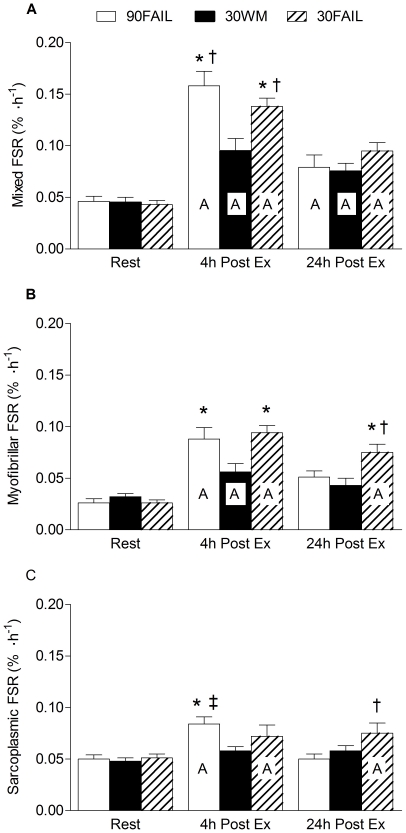
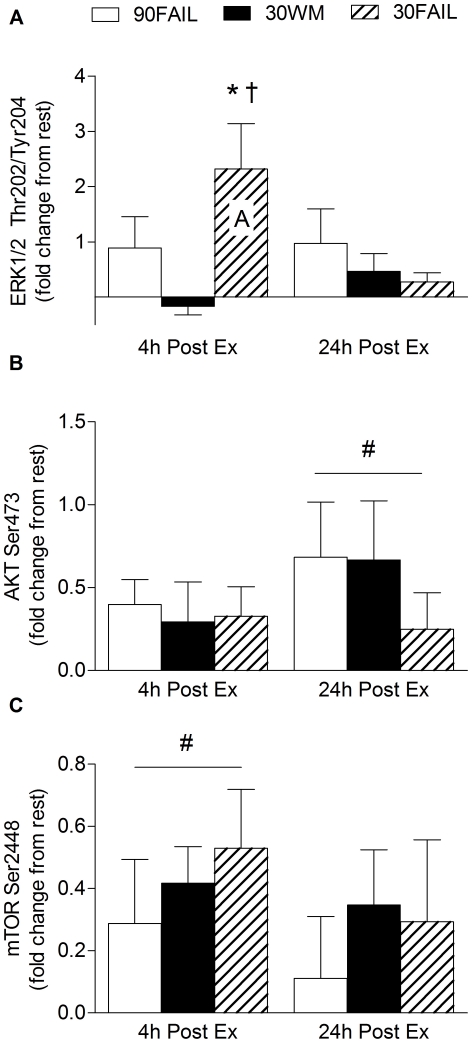
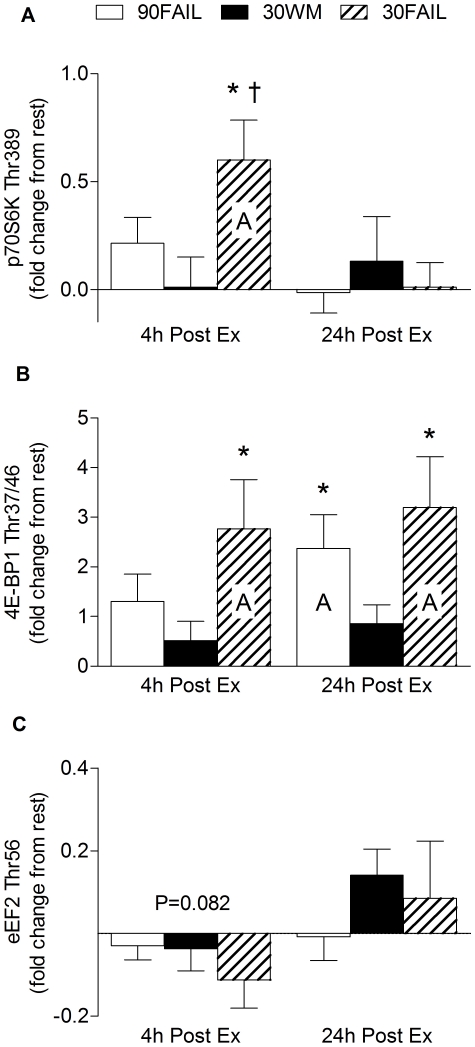
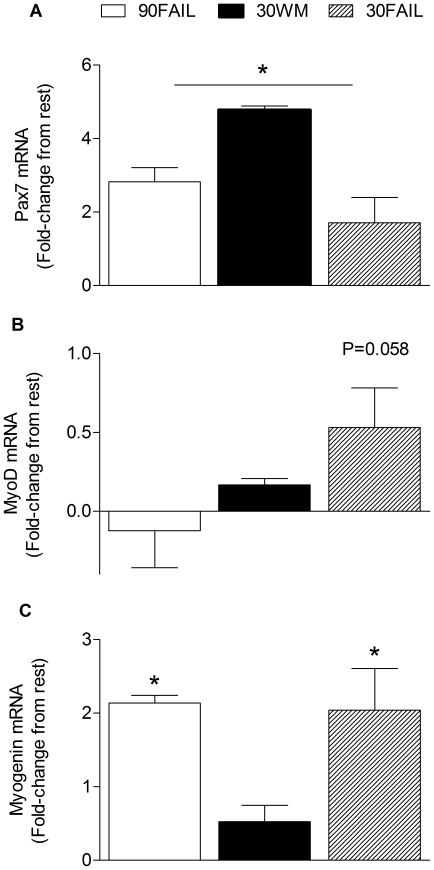
BACKGROUND: We aimed to determine the effect of resistance exercise intensity (%1 repetition maximum-1RM) and volume on muscle protein synthesis, anabolic signaling, and myogenic gene expression. METHODOLOGY/PRINCIPAL FINDINGS: Fifteen men (21+/-1 years; BMI=24.1+/-0.8 kg/m2) performed 4 sets of unilateral leg extension exercise at different exercise loads and/or volumes: 90% of repetition maximum (1RM) until volitional failure (90FAIL), 30% 1RM work-matched to 90%FAIL (30WM), or 30% 1RM performed until volitional failure (30FAIL). Infusion of [ring-13C6] phenylalanine with biopsies was used to measure rates of mixed (MIX), myofibrillar (MYO), and sarcoplasmic (SARC) protein synthesis at rest, and 4 h and 24 h after exercise. Exercise at 30WM induced a significant increase above rest in MIX (121%) and MYO (87%) protein synthesis at 4 h post-exercise and but at 24 h in the MIX only. The increase in the rate of protein synthesis in MIX and MYO at 4 h post-exercise with 90FAIL and 30FAIL was greater than 30WM, with no difference between these conditions; however, MYO remained elevated (199%) above rest at 24 h only in 30FAIL. There was a significant increase in AktSer473 at 24h in all conditions (P=0.023) and mTORSer2448 phosphorylation at 4 h post-exercise (P=0.025). Phosporylation of Erk1/2Tyr202/204, p70S6KThr389, and 4E-BP1Thr37/46 increased significantly (P<0.05) only in the 30FAIL condition at 4 h post-exercise, whereas, 4E-BP1Thr37/46 phosphorylation was greater 24 h after exercise than at rest in both 90FAIL (237%) and 30FAIL (312%) conditions. Pax7 mRNA expression increased at 24 h post-exercise (P=0.02) regardless of condition. The mRNA expression of MyoD and myogenin were consistently elevated in the 30FAIL condition. CONCLUSIONS/SIGNIFICANCE: These results suggest that low-load high volume resistance exercise is more effective in inducing acute muscle anabolism than high-load low volume or work matched resistance exercise modes.
Overview
The claims and statistics of this paper haven’t been checked yet.
Run the check — free, no account needed. It reads the open-access text and checks the sources it cites.
Integrity signals
Registry
Cites
Statistics
Figures
Verification
Claims the paper makes
The claims and statistics of this paper haven’t been checked yet.
Run the check — free, no account needed. It reads the open-access text and checks the sources it cites.
Claims other papers make about this one
Each is checked against this paper’s own text: does it say what the citing paper says it does?
The source backs part of the claim, not all of it — or backs it for a different population, condition or comparison.
In the citing paper
“This strongly indicates that the translational capacity bottleneck possesses a high activation threshold: a minimal mechanical volume is strictly required to sustain the Pol I transcription spark long enough to outpace the basal decay rate of existing ribosomes [35,87,88].”
From Ribosome Biogenesis as a Putative Bottleneck to Skeletal Muscle Hypertrophy: Mechanisms, Human Evidence, and Practical Modulators (2026) · cites this paper as [88]
Experimental — accuracy not yet measuredThe cited source says what the claim attributes to it.
In the citing paper
“Consistent with this line of evidence, research where participants expended a high level of effort suggests that the MPS response to low-load training is at least as robust as when training with heavier loads [39].”
From Loading recommendations for muscle strength, hypertrophy, and local endurance: a re-examination of the repetition continuum. (2021) · cites this paper as [39]
The cited source says what the claim attributes to it.
In the citing paper
“Some studies show an impaired acute MPS response when training with lower loads [37,38] while others report similar increases in mixed and myofibrillar protein synthesis rates [39].”
From Loading recommendations for muscle strength, hypertrophy, and local endurance: a re-examination of the repetition continuum. (2021) · cites this paper as [39]
The check wasn’t confident either way, so it gives no verdict — never disputed.
In the citing paper
“Figueiredo et al. showed that post-exercise cold-water immersion attenuated markers associated with ribosome biogenesis compared with active recovery [88].”
From Ribosome Biogenesis as a Putative Bottleneck to Skeletal Muscle Hypertrophy: Mechanisms, Human Evidence, and Practical Modulators (2026) · cites this paper as [88]
Experimental — accuracy not yet measured
Self-check
Percentages, sums and reported differences re-computed from the paper’s own numbers.
The self-check needs the paper’s full text.
Citations
Cites
Analysis of Relative Gene Expression Data Using Real-Time Quantitative PCR and the 2−ΔΔCT Method
Livak, K. J., & Schmittgen, T. D. (2001) · Methods · doi:10.1006/meth.2001.1262 · Cited by 180,860
American College of Sports Medicine position stand
Otis, C. L. (1997) · Medical Entomology and Zoology · Cited by 4,407
Progression Models in Resistance Training for Healthy Adults
(2009) · Medicine & Science in Sports & Exercise · doi:10.1249/mss.0b013e3181915670 · Cited by 4,332
Progression Models in Resistance Training for Healthy Adults
(2002) · Medicine and Science in Sports and Exercise · doi:10.1097/00005768-200202000-00027 · Cited by 2,979
Pax7 Is Required for the Specification of Myogenic Satellite Cells
Seale, P., Sabourin, L. A., Girgis-Gabardo, A., Mansouri, A., Gruß, P., & Rudnicki, M. A. (2000) · Cell · doi:10.1016/s0092-8674(00)00066-0 · Cited by 2,345
Relation between size of neurons and their susceptibility to discharge
Henneman, E. (1957) · Science · doi:10.1126/science.126.3287.1345 · Cited by 1,227
Anabolic signaling deficits underlie amino acid resistance of wasting, aging muscle
Cuthbertson, D., Smith, K., Babraj, J., Leese, G., Waddell, T., Atherton, P., Wackerhage, H., Taylor, P. M., & Rennie, M. J. (2005) · The FASEB Journal · doi:10.1096/fj.04-2640fje · Cited by 1,211
Self-citationMixed muscle protein synthesis and breakdown after resistance exercise in humans
Phillips, S. M., Tipton, K. D., Aarsland, A., Wolf, S. E., & Wolfe, R. R. (1997) · American Journal of Physiology-Endocrinology and Metabolism · doi:10.1152/ajpendo.1997.273.1.e99 · Cited by 1,132
Self-citationMoore, D. R., Robinson, M. J., Fry, J. L., Tang, J. E., Glover, E. I., Wilkinson, S. B., Prior, T., Tarnopolsky, M. A., & Phillips, S. M. (2009) · The American Journal of Clinical Nutrition · doi:10.3945/ajcn.2008.26401 · Cited by 973
Self-citationKumar, V., Selby, A., Rankin, D., Patel, R., Atherton, P., Hildebrandt, W., Williams, J., Smith, K., Seynnes, O., Hiscock, N., et al. (2009) · The Journal of Physiology · doi:10.1113/jphysiol.2008.164483 · Cited by 740
Self-citation
Cited by
Sorted by citations
Items 501–529 of 529
Yamamoto, T., Kim, A. C., Mettias, S., Pandit, B., Nguyen, T. H., Benna, D. M., Nguyen, T. L., Blatney, A. E., Lechner, R. J., Mologne, M. S., et al. (2024) · Scientific Journal of Sport and Performance · doi:10.55860/ddqj6966
Grek, M., Testa, M., Toussaint, J., Renfree, A., & Desgorces, F.-D. (2024) · The Journal of Sports Medicine and Physical Fitness · doi:10.23736/s0022-4707.24.16428-6
Al-Khaldi, K., Al-Ruzaiqi, K. H., Babji, A. S., Lim, S. J., Sadiq, M. B., & Yimer, N. (2025) · Veterinary World · doi:10.14202/vetworld.2025.178-188
Der weibliche Beckenboden im Sport – Teil II: Das Training für den weiblichen Beckenboden
Leitner, M. (2025) · Sportphysio · doi:10.1055/a-2494-1539
Cumming, K. T., Elvatun, I. C., Kalenius, R., Divljak, G., Raastad, T., Psilander, N., & Horwath, O. (2025) · bioRxiv (Cold Spring Harbor Laboratory) · doi:10.1101/2025.04.28.650925
Blood flow restriction endurance exercise and endurance performance in athletes
Arčon, M., & Črnčič, N. (2025) · Exercise and Quality of Life · doi:10.31382/eqol.250602
Ainhagne, M., Martinho, D. V., do Nascimento, M. A., de Salles, B. F., de Oliveira, M. R., dos Santos, L., & Ribeiro, A. S. (2025) · Brazilian Journal of Kinanthropometry and Human Performance · doi:10.1590/1980-0037.2025v27e99657
Kang, J., Kim, K.-H., & Kim, B.-K. (2025) · Medical Lasers · doi:10.25289/ml.25.013
Mueller, B. J., Fox, C. D., Parry, H. A., Mesquita, P. H. C., Vann, C. G., Ruple, B. A., Sexton, C. L., Godwin, J. S., McIntosh, M. C., Beck, D. T., et al. (2025) · bioRxiv (Cold Spring Harbor Laboratory) · doi:10.1101/2025.07.23.666423
Self-citationToonstra, A., & Smith, J. (2025) · Cardiopulmonary Physical Therapy Journal · doi:10.1097/cpt.0000000000000309
A tissue engineered human skeletal muscle model for use in exercise sciences
Martin, N. R. W. (2012) · University of Bedfordshire Repository (University of Bedfordshire)
Bello, M. L., Arent, S. M., Gillen, Z. M., & Smith, J. W. (2025) · Journal of Functional Morphology and Kinesiology · doi:10.3390/jfmk11010017
How low can you go (and still build muscle)? Why strength training matters at any age
Janssen, T. A. H., & Lees, M. J. (2026) · doi:10.64628/aam.f6d9nkydk
Azzout‐Marniche, D., & Tomé, D. (2026) · Metabolites · doi:10.3390/metabo16040231
Exercise and aging: Unlocking health beyond 65 years old
Puche, J. E. (2026) · Aging advances. · doi:10.4103/agingadv.agingadv-d-25-00036
Maintien de la fonction musculaire : Exercice en hémodialyse : rôles physiologiques de eIF3f
Pavlin, L. (2021) · theses.fr (ABES) · doi:10.70675/47a22f7bz4659z43a7za47dzc83eaf9b4b66
Effects of Rest Interval Length on Muscle Hypertrophy in Amateur Bodybuilders
Keskin, Y., Uzoho, C. M., & Abdulrahman, C. M. (2025) · Qubahan Journal of Coaching and Sports Sciences · doi:10.48161/qcsj.v4n2a52
Uota, C., Nohara, K., Tanaka, N., Fujii, N., Obana, A., Tanaka, K., & Sakai, T. (2026) · Brain and Development · doi:10.1016/j.braindev.2026.104553
Carballo, T. A. G. (2026) · Revista Multidisciplinar Epistemología de las Ciencias · doi:10.71112/pc6wk283
Valero‐Breton, M., Portal-Rodríguez, M., Tacchi, F., Salgado-Valdovinos, J., Miranda‐Pilar, M. C., Cifuentes-Silva, E., Martínez‐Pérez, M. I., Godoy, M., Bonicioli, J., Olguín, H. C., et al. (2026) · Acta Physiologica · doi:10.1111/apha.70274
Mohabbat, M., Nouri, M., & Arazi, H. (2026) · The FASEB Journal · doi:10.1096/fj.202504395r
6주간의 슬링운동이 노인 여성의 일상생활체력 및 슬관절과 요부 등속성 근기능에 미치는 영향*
김, 진., 박, 원., & 이, 만. (2026) · 한국체육학회지 · doi:10.23949/kjpe.2026.5.65.3.40
Ribeiro, A. S., Sansone, G., Cunha, P. M., Kassiano, W., do Nascimento, M. A., Silva, A. M., Buzzachera, C. F., Coelho-e-Silva, M. J., Sardinha, L. B., & Cyrino, E. S. (2026) · Experimental Gerontology · doi:10.1016/j.exger.2026.113261
Albajalan, D. M. A., Sheikholeslami‐Vatani, D., Rostamzadeh, N., Saifalddin, D. L., & Rahim, H. A. (2026) · Sport Sciences for Health · doi:10.1007/s11332-026-01901-8
Kataoka, R., Yamada, Y., Hammert, W. B., Sallberg, R. W., Kang, A., Song, J. S., Kassiano, W., Metcalf, E. E., & Loenneke, J. P. (2026) · The Journal of Strength and Conditioning Research · doi:10.1519/jsc.0000000000005439
Sedentary Lifestyle Consequences in Office Workers with Patellofemoral Pain Syndrome: Case Report
Pereira, P. M., Reis, J., Montanha, T., Beleza, J., Duarte, J., Baptista, J. S., Costa, J. T., & da Conceição, F. A. (2026) · Studies in systems, decision and control · doi:10.1007/978-3-032-02052-9_31
The role of dietary protein in the treatment and prevention of metabolic diseases
Ilovayskaya, I. (2026) · Pharmacoinformatics and pharmaconutritiology Current trends in data analysis · doi:10.63769/3034-7459-2026-2-2-88-98
mTOR Pathway Activation Following Resistance Exercise with Vibration in Human Subjects
Leavitt, M. G. (2013) · ScholarsArchive (Brigham Young University)
Metadata
- Authors
- Burd, N. A., West, D. W. D., Staples, A. W., Atherton, P. J., Baker, J. M., Moore, D. R., Holwerda, A. M., Parise, G., Rennie, M. J., Baker, S. K., & Phillips, S. M.
- Affiliations
- McMaster University (CA)
- University of Nottingham (GB)
- Corresponding author
- Phillips, Stuart M.
- ORCID
- Venue
- PLoS ONE
- Publisher
- Public Library of Science (PLoS)
- Published
- 2010-08-09
- Volume
- 5
- Issue
- 8
- Pages
- e12033
- ISSN
- 1932-6203 (ISSN-L)
- PMC
- PMC2918506
- OpenAlex
- W2160436389
- Cited by
- 531
- References
- 54
- Citations by year
- 2026: 18 · 2025: 29 · 2024: 37 · 2023: 21 · 2022: 40 · 2021: 31 · 2020: 37 · 2019: 45 · 2018: 30 · 2017: 37 · 2016: 44 · 2015: 38 · 2014: 34 · 2013: 26 · 2012: 37
- FWCI
- 12.45
- Type
- journal article
- Language
- en
- Open access
- gold
- doi.org
- Locations
- PLoS ONE (publishedVersion, cc-by)
- PubMed Central (publishedVersion, cc-by)
- PubMed (publishedVersion)
- DOAJ (DOAJ: Directory of Open Access Journals) (submittedVersion, cc-by-sa)
- Funders
- Natural Sciences and Engineering Research Council of Canada
- Topics
- Health Sciences › Nursing › Nutrition and Dietetics › Muscle metabolism and nutrition
- Life Sciences › Biochemistry, Genetics and Molecular Biology › Molecular Biology › Muscle Physiology and Disorders
- Health Sciences › Medicine › Physiology (medical) › Cardiovascular and exercise physiology
- Keywords
- resistance training, exercise intensity, exercise volume, muscle protein synthesis, myofibrillar protein synthesis, Akt signaling, mTOR signaling, ERK1/2, p70S6K, 4E-BP1, Pax7, myogenic gene expression, leg extension, young men
- MeSH terms
- Gene Expression Regulation, Humans, Male, Muscle Proteins, Phenylalanine, RNA, Messenger, Signal Transduction, Exercise, Weight-Bearing, Myogenic Regulatory Factors, Muscle Fibers, Skeletal, Intracellular Space, PAX7 Transcription Factor, Resistance Training, Young Adult
About these checks
Registry, retraction, Cites and statistics results are computed, not judged, with one exception: a printed reference that no index lists is read once by a model before it counts as a citation error. Claims are extracted by a model and kept only when their quote appears verbatim in the text; each cited source is then checked, with a model’s help, for whether it says what the claim relies on. Those verdicts can be wrong — read the claim’s quote and the cited source before relying on one.
Statistics and arithmetic are recomputed, not judged.
Confidence bands are shown only for fields calibrated on our annotated test set. None is calibrated yet, so no band is shown.
What counts as a claim ›How we measure confidence ›How we check this ›
Are you an author, or do you see a problem with this page? Request a review
