

Estimated HIV Incidence in the United States, 2006–2009
Open accessThe DOI matches its Crossref record; 23 of the 23 references it cites were found in a registry or an index.
Abstract
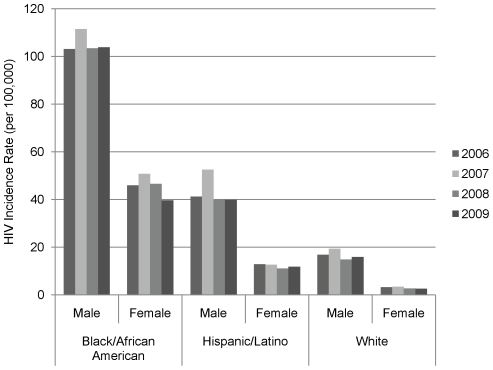
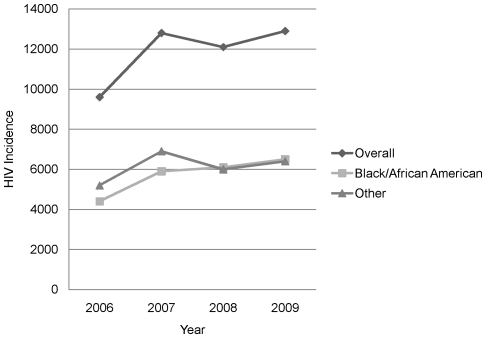
BACKGROUND: The estimated number of new HIV infections in the United States reflects the leading edge of the epidemic. Previously, CDC estimated HIV incidence in the United States in 2006 as 56,300 (95% CI: 48,200-64,500). We updated the 2006 estimate and calculated incidence for 2007-2009 using improved methodology. METHODOLOGY: We estimated incidence using incidence surveillance data from 16 states and 2 cities and a modification of our previously described stratified extrapolation method based on a sample survey approach with multiple imputation, stratification, and extrapolation to account for missing data and heterogeneity of HIV testing behavior among population groups. PRINCIPAL FINDINGS: Estimated HIV incidence among persons aged 13 years and older was 48,600 (95% CI: 42,400-54,700) in 2006, 56,000 (95% CI: 49,100-62,900) in 2007, 47,800 (95% CI: 41,800-53,800) in 2008 and 48,100 (95% CI: 42,200-54,000) in 2009. From 2006 to 2009 incidence did not change significantly overall or among specific race/ethnicity or risk groups. However, there was a 21% (95% CI:1.9%-39.8%; p = 0.017) increase in incidence for people aged 13-29 years, driven by a 34% (95% CI: 8.4%-60.4%) increase in young men who have sex with men (MSM). There was a 48% increase among young black/African American MSM (12.3%-83.0%; p<0.001). Among people aged 13-29, only MSM experienced significant increases in incidence, and among 13-29 year-old MSM, incidence increased significantly among young, black/African American MSM. In 2009, MSM accounted for 61% of new infections, heterosexual contact 27%, injection drug use (IDU) 9%, and MSM/IDU 3%. CONCLUSIONS/SIGNIFICANCE: Overall, HIV incidence in the United States was relatively stable 2006-2009; however, among young MSM, particularly black/African American MSM, incidence increased. HIV continues to be a major public health burden, disproportionately affecting several populations in the United States, especially MSM and racial and ethnic minorities. Expanded, improved, and targeted prevention is necessary to reduce HIV incidence.
Overview
The claims and statistics of this paper haven’t been checked yet.
Free: it reads the open-access text and checks the first 5 claims that cite a source we can check. Create a free account to check every claim.
Integrity signals
Registry
Cites
Statistics
Figures
Verification
Claims the paper makes
The claims and statistics of this paper haven’t been checked yet.
Free: it reads the open-access text and checks the first 5 claims that cite a source we can check. Create a free account to check every claim.
Claims other papers make about this one
Each is checked against this paper’s own text: does it say what the citing paper says it does?
In the citing paper
“HIV is a public health crisis among Black and Latino men in the USA, notably those living in New York City (NYC).”
From Using Syndemic Theory to Understand Vulnerability to HIV Infection among Black and Latino Men in New York City (2014) · cites this paper as [1]
In the citing paper
“That same year, HIV incidence among Black and Latino men was 6.5 and 2.5 times greater, respectively, than it was among White men.”
From Using Syndemic Theory to Understand Vulnerability to HIV Infection among Black and Latino Men in New York City (2014) · cites this paper as [1]
Self-check
Percentages, sums and reported differences re-computed from the paper’s own numbers.
The self-check needs the paper’s full text.
Citations
Cites
Applied Regression Analysis and Other Multivariable Methods
Walker, E. (1989) · Technometrics · doi:10.1080/00401706.1989.10488486 · Cited by 8,538
(2006) · PsycEXTRA Dataset · doi:10.1037/e545592006-001 · Cited by 2,958
Estimation of HIV Incidence in the United States
Hall, H. I. (2008) · JAMA · doi:10.1001/jama.300.5.520 · Cited by 1,317 · cited 6×
“but within the confidence interval of that estimate [4].”
InfluentialSelf-citationMarks, G., Crepaz, N., & Janssen, R. S. (2006) · AIDS · doi:10.1097/01.aids.0000233579.79714.8d · Cited by 1,096 · cited 1×
“, and the majority of new HIV infections transmitted by these individuals”
Parashar, U. (2006) · Medical Entomology and Zoology · Cited by 799
Janssen, R. S. (1998) · JAMA · doi:10.1001/jama.280.1.42 · Cited by 687 · cited 1×
“Since 2004, CDC has funded selected states and localities to conduct HIV incidence surveillance by (1) submitting remnant diagnostic HIV-positive blood specimens for testing using the serologic testing algorithm for recent HIV seroconversion (STARHS)”
BackgroundPurcell, D. W., Johnson, C. H., Lansky, A., Prejean, J., Stein, R., Denning, P., Gau1, Z., Weinstock, H., Su, J., & Crepaz, N. (2012) · The Open AIDS Journal · doi:10.2174/1874613601206010098 · Cited by 356
Self-citationParekh, B. S., Kennedy, M. S., Dobbs, T., Pau, C.-P., Byers, R., Green, T., Hu, D. J., Vanichseni, S., Young, N. L., Choopanya, K., et al. (2002) · AIDS Research and Human Retroviruses · doi:10.1089/088922202753472874 · Cited by 355 · cited 1×
“In addition, the continued refinement of the method for estimating the mean recency period for the BED HIV-1 Capture Enzyme Immunoassay (BED; the assay that currently serves as the serologic marker of recent infection) [6] and for modeling the recency period distribution [7] has allowed for improvement of the method o…”
Self-citationSullivan, P. S., Hamouda, O., Delpech, V., Geduld, J. E., Prejean, J., Semaille, C., Kaldor, J., Folch, C., Op de Coul, E., Marcus, U., et al. (2009) · Annals of Epidemiology · doi:10.1016/j.annepidem.2009.03.004 · Cited by 326
Self-citationUndiagnosed HIV Prevalence Among Adults and Adolescents in the United States at the End of 2006
Campsmith, M. L., Rhodes, P. H., Hall, H. I., & Green, T. A. (2010) · JAIDS Journal of Acquired Immune Deficiency Syndromes · doi:10.1097/qai.0b013e3181bf1c45 · Cited by 219 · cited 1×
“, public health programs are presented with new challenges. There is a need to address the prevention needs both of people at risk for HIV infection as well as of those living with HIV disease—those who are aware of their HIV status and those who are not. With an estimated 21% of people living with HIV unaware of thei…”
BackgroundSelf-citation
Cited by
Items 901–1,000 of 1,000
Vargas, G., Vincent, K. L., Zhu, Y., Szafron, D., Brown, T., Villarreal, P. P., Bourne, N., Milligan, G. N., & Motamedi, M. (2016) · Antimicrobial Agents and Chemotherapy · doi:10.1128/aac.00134-16 · Cited by 4
Díaz‐Cruz, E. S., Bynum, L. A., & Thompson, S. A. J. (2016) · Currents in Pharmacy Teaching and Learning · doi:10.1016/j.cptl.2016.08.015 · Cited by 4
Burt, R. D., & Glick, S. N. (2017) · The Lancet HIV · doi:10.1016/s2352-3018(17)30064-4 · Cited by 5
Curtis, K. A., Hanson, D. L., Price, K. A., & Owen, S. M. (2017) · PLoS ONE · doi:10.1371/journal.pone.0176593 · Cited by 4
Blair, J. M., Paxton, L. A., & Kamb, M. L. (2012) · Elsevier eBooks · doi:10.1016/b978-0-12-384978-6.00033-9 · Cited by 4
HIV and HCV screening among trauma patients
Simoncini, G. M., Oyola-Jimenez, J., Singleton, D., Volgraf, J., Ramsey, F. V., & Goldberg, A. J. (2019) · International Journal of STD & AIDS · doi:10.1177/0956462419829590 · Cited by 4
Ward, L. M., Bruce, M. A., Thorpe, R. J., Mena, L. A., Nunn, A. S., & Crosby, R. A. (2019) · Family & Community Health · doi:10.1097/fch.0000000000000225 · Cited by 4
Hassan, A., Wertheim, J. O., Blumenthal, J. S., Ellorin, E. E., Dubé, M. P., Corado, K., Moore, D. J., & Morris, S. (2019) · Medicine · doi:10.1097/md.0000000000018232 · Cited by 4
Increase in CD4 Count Among New Enrollees in HIV Care in the Modern Antiretroviral Therapy Era
Haines, C. F., Fleishman, J. A., Yehia, B. R., Berry, S. A., Moore, R. D., Bamford, L. P., & Gebo, K. A. (2014) · JAIDS Journal of Acquired Immune Deficiency Syndromes · doi:10.1097/qai.0000000000000228 · Cited by 4
“Although encouraging, this likely represents ,3% of late presenters in the United States, assuming 54% late presentation percentage.(10,18) Our findings suggest that the time to presentation, as assessed by enrollment CD4, is declining slowly, and further interventions for HIV testing and linkage to care are needed.”
BackgroundCaring for women with HIV: Unique needs and challenges
Short, W. R., & Anderson, J. (2014) · Cleveland Clinic Journal of Medicine · doi:10.3949/ccjm.81a.14009 · Cited by 4
Caring for the Adolescent Male
Conway, C. N., Cohen-Tanugi, S., Barbour, D. J., & Bell, D. L. (2016) · Springer eBooks · doi:10.1007/978-3-319-26091-4_6 · Cited by 4
HIV/AIDS: Risk Protective Behaviors among American Young Adults, 2004-2008
Johnston, L. D., O’Malley, P. M., Bachman, J. G., Schulenberg, J. E., Patrick, M. E., & Miech, R. A. (2010) · Deep Blue (University of Michigan) · Cited by 5
Societal experiences of lesbian, gay, bisexual, and transgender people
Fuchs, M., & Potter, J. E. (2020) · Elsevier eBooks · doi:10.1016/b978-0-12-815968-2.00015-3 · Cited by 4
Maley, A. M., & Parker, S. R. S. (2014) · Dermatology Online Journal · doi:10.5070/d3209023916 · Cited by 4
Gay Male Desires and Sexuality in the Twenty-First Century
McNamara, S. (2013) · Journal of the American Psychoanalytic Association · doi:10.1177/0003065113478654 · Cited by 3
“Although AIDS may be less associated with death than it was two decades ago, young gay and bisexual men, especially young black men who have sex with men, are the population mostly heavily affected by HIV in the United States (Prejean 2011).”
BackgroundVoisin, D. R., Walsh, T. S., Flatt, N., Eavou, R., Bertozzi-Villa, C., Eder, M., & Schneider, J. A. (2014) · Journal of Nursing Education and Practice · doi:10.5430/jnep.v4n12p27 · Cited by 3
Using Brochures as Educational Tools to Promote Routine HIV Testing in Youth
Wao, H., Aluoch, M. A., Wright, J., & Rodriguez, C. A. (2014) · Cited by 3
Mgbere, O. O., Rodriguez‐Barradas, M. C., Bell, T. K., Khuwaja, S. A., Arafat, R. R., Essien, E. J., Singh, M., Simmons, P. I., & Aguilar, J. (2014) · Journal of the International Association of Providers of AIDS Care (JIAPAC) · doi:10.1177/2325957414556352 · Cited by 3
Sexual risk taking and the HIV care continuum in an online sample of men who have sex with men
Yoon, I. S., Downing, M. J., Teran, R. A., Chiasson, M. A., Houang, S. T., Parsons, J. T., & Hirshfield, S. (2017) · AIDS Care · doi:10.1080/09540121.2017.1417535 · Cited by 3
“…made up 61% of new HIV infections in the United States in 2009 and only 16% of Black MSM living with HIV are estimated to reach viral suppression (Prejean et al., 2011; Rosenberg et al., 2014); the current study found that 25% of Black MSM achieved viral suppression, which is in line with…”
BackgroundChutuape, K. S. (2014) · Global Journal of Community Psychology Practice · doi:10.7728/0502201404 · Cited by 3
Inter-partner and Temporal Variations in the Perception of Sexual Risk for HIV
Goldenberg, T., Darbes, L. A., & Stephenson, R. B. (2017) · AIDS and Behavior · doi:10.1007/s10461-017-1876-5 · Cited by 3
Ghobadzadeh, M., & Moore, D. (2017) · Issues in Mental Health Nursing · doi:10.1080/01612840.2017.1364810 · Cited by 4
“It is estimated that 39% of newly diagnosed HIV/AIDS cases were among youth aged 13–29 years, and between 2007 and 2010, the only age groups that experienced an increase in HIV/AIDS diagnosis rates were adolescents ages 15–19 and young people ages 20–24 years (Prejean et al., 2011).”
BackgroundCollins, C. B., Baack, B. N., Tomlinson, H. L., Lyles, C., Cleveland, J. C., Purcell, D. W., Ortiz-Ricard, A., & Mermin, J. (2019) · AIDS and Behavior · doi:10.1007/s10461-019-02433-8 · Cited by 3
Self-citationHuman Immunodeficiency Virus/AIDS
Sroussi, H., Kaste, L. M., Epstein, J. B., & Rothpletz‐Puglia, P. (2014) · Springer eBooks · doi:10.1007/978-1-60761-490-6_14 · Cited by 3
How Useful is Universal Screening for HIV Infection? A Review of the Evidence
Kintziger, K. W., & Duffus, W. A. (2014) · Future Virology · doi:10.2217/fvl.13.122 · Cited by 3
Tai, M., Liu, T., & Merchant, R. C. (2015) · Journal of the International Association of Providers of AIDS Care (JIAPAC) · doi:10.1177/2325957415570742 · Cited by 3
Nichols, W. A., Birke, L. L., Dufour, J., Loganantharaj, N., Bagby, G. J., Nelson, S., Molina, P. E., & Amedee, A. M. (2015) · American Journal of Reproductive Immunology · doi:10.1111/aji.12422 · Cited by 3
Patel, S. N., Marks, G. N., Gardner, L. I., Golin, C. E., Shinde, S., Daniels, C. O., Wilson, T. E., Quinlivan, E. B., & Banderas, J. (2012) · Health Education Journal · doi:10.1177/0017896912446740 · Cited by 3
Kandi, V. (2015) · Epidemiology and Health · doi:10.4178/epih/e2015008 · Cited by 3
“viduals to infection with HIV (9 to 12%), HCV (50%) and hepatitis A virus (2%) in the US [19].”
BackgroundPerceptions of HIV transmission risk in commercial and public sex venues
Downing, M. J. (2012) · Journal of Men s Health · doi:10.1016/j.jomh.2012.04.002 · Cited by 3
“Men who have sex with men (MSM) continue to be disproportionately affected by HIV and AIDS, particularly in the United States (U.S.) where 61% of estimated new infections in 2009 were attributed to this population [1].”
Suppressed but Still Infectious
Gianella, S., Haubrich, R., & Morris, S. (2013) · Future Virology · doi:10.2217/fvl.13.89 · Cited by 3
Latino Sexual Beliefs Scale: An Exploratory Factor Analysis of Latino Men Who Have Sex With Men
Zeglin, R. J., Hergenrather, K. C., Poppen, P. J., Choi, J., Reisen, C. A., & Zea, M. C. (2017) · Archives of Sexual Behavior · doi:10.1007/s10508-017-0988-3 · Cited by 5
Conducting Substance Abuse Research: Incarcerated Populations
Kim, S. J., & Puisis, M. (2017) · Springer eBooks · doi:10.1007/978-3-319-55980-3_17 · Cited by 4
Emerging and Innovative Prevention Strategies for HIV Positive Gay Men
Schneider, J. A., & Bouris, A. M. (2017) · Springer eBooks · doi:10.1007/978-1-4419-0203-0_8 · Cited by 3
Infectious Disease Issues in Underserved Populations
Grief, S. N., & Miller, J. P. (2018) · Physician Assistant Clinics · doi:10.1016/j.cpha.2018.08.006 · Cited by 3
Kisler, K. A. (2013) · eScholarship (California Digital Library) · Cited by 6
The 2010 Health Care Act and Barriers to Effective Health Promotion Among Men Who Have Sex With Men
Fessler, D. A., Mitty, J. A., Mayer, K. H., & Makadon, H. J. (2012) · Sexually Transmitted Diseases · doi:10.1097/olq.0b013e31824fc62a · Cited by 4
Editorial Commentary: Unmasking the Bare Bones of HIV Preexposure Prophylaxis
Falutz, J. (2015) · Clinical Infectious Diseases · doi:10.1093/cid/civ329 · Cited by 4
“People still become infected with HIV [2, 3] as effective prevention remains elusive.”
Temporal Patterns and Variations in HIV/AIDS detection: Notifications in Brazil (2013-2022)
Marconato, J. V., Genaro, L. E., Júnior, A. V., & Rosell, F. L. (2024) · Jornal Brasileiro de Doenças Sexualmente Transmissíveis · doi:10.5327/dst-2177-8264-2024361404 · Cited by 2
Alcohol and cannabis use in relation to daily marginalization in transgender individuals.
Puckett, J. A., Dyar, C., Lindley, L. M., Wertz, M., Mustanski, B. S., & Newcomb, M. E. (2025) · Psychology of Sexual Orientation and Gender Diversity · doi:10.1037/sgd0000839 · Cited by 3
Improving measurement of injection drug risk behavior using item response theory
Janulis, P. F. (2013) · The American Journal of Drug and Alcohol Abuse · doi:10.3109/00952990.2013.848212 · Cited by 2
“Janulis Am J Drug Alcohol Abuse, 2014; 40(2): 143–150”
BackgroundInfluentialNeshumaev, D. A., Meirmanova, E. M., Kuntsevich, O. N., Егорович, С. С., & Stasenko, V. L. (2020) · HIV Infection and Immunosuppressive Disorders · doi:10.22328/2077-9828-2020-12-1-68-74 · Cited by 2
“Информация о количестве ранних случаев заражений ВИЧ-инфекцией в популяции позволяет объективно оценивать эффективность профилактических и противоэпидемических мероприятий, проводимых на данной территории [1].”
Perfil epidemiológico do HIV em idosos Brasileiros de 2008 a 2018
Andrade, G. H., Pagnussatt, L. C., Fabiani, T. M., Gheno, V., & Lutinski, J. A. (2021) · Research Society and Development · doi:10.33448/rsd-v10i17.24459 · Cited by 2
Reid, S. C., Wang, V., Assaf, R. D., Kaloper, S., Murray, A. T., SHOPTAW, S. J., Gorbach, P. M., & Cassels, S. L. (2023) · JMIR Formative Research · doi:10.2196/45188 · Cited by 3
Rahm-Knigge, R. L., Norris, A. L., & DUNSIGER, S. I. (2023) · AIDS Care · doi:10.1080/09540121.2023.2206093 · Cited by 2
A Case-control Study of Factors Associated with HIV Infection on Southern Brazilian Elders
Couto, M. C. P. D. P., Diniz, E., Prati, L. E., & Koller, S. H. (2012) · Acta de Investigación Psicológica · doi:10.22201/fpsi.20074719e.2012.3.232 · Cited by 2
“This study found that HIV infection among older adults is independently associated with sex, monthly income, and self-reported STDs (i.e. self-reported history of gonorrhea, syphilis, and viral hepatitis). Multivariate analyses demonstrated that cases had higher odds of being male, earning lower incomes, and reporting…”
BackgroundInfluentialDrugs: the third rail of US politics
Drucker, E. (2012) · The Lancet · doi:10.1016/s0140-6736(12)61889-3 · Cited by 2
Impact of “Sick” and “Recovery” Roles on Brain Injury Rehabilitation Outcomes
Barclay, D. A. (2012) · Rehabilitation Research and Practice · doi:10.1155/2012/725078 · Cited by 2
“Hindawi Publishing Corporation Rehabilitation Research and Practice Volume 2012, Article ID 725078, 10 pages doi:10.1155/2012/725078”
BackgroundInfluentialDeterminants Of Condom Use And Hiv Prevention Among East-African Immigrants In Minnesota
Ahmed, M. (2013) · scholarworks - UTEP (The University of Texas at El Paso) · Cited by 4
Bars and nightclubs associated with higher HIV prevalence
Rossheim, M. E., Thombs, D. L., & Suzuki, S. (2015) · Drug and Alcohol Dependence · doi:10.1016/j.drugalcdep.2015.08.024 · Cited by 2
HIV/AIDS in the Puerto Rican Elderly: Immunological Changes between Gender and Body Mass Index
Maldonado-Martínez, G., Fernández-Santos, D. M., Ríos‐Olivares, E., Mayor, Á. M., & Hunter-Mellado, R. F. (2013) · Journal of Health Care for the Poor and Underserved · doi:10.1353/hpu.2014.0014 · Cited by 3
HIV beyond HAART: Current Strategies for HIV Eradication
Spivak, F. A. T. A. M. (2013) · Journal of AIDS & Clinical Research · doi:10.4172/2155-6113.s6-001 · Cited by 3
“However, among men who have sex with men(MSM) incidence rates increased [2].”
BackgroundThe Whole Family Serves: Supporting Sexual Minority Youth in Military Families
Gyura, A. N., & McCauley, S. O. (2015) · Journal of Pediatric Health Care · doi:10.1016/j.pedhc.2015.10.006 · Cited by 2
Human Immunodeficiency Viruses Types 1 and 2
Kaslow, R. A., Erbelding, E. J., & Goepfert, P. (2014) · Springer eBooks · doi:10.1007/978-1-4899-7448-8_43 · Cited by 2
Racial/Ethnic Health Care Disparities and Inequities: Historical Perspectives
Brummer, S., Reyes, I., Martin, M. L., Walker, L. U., & Heron, S. (2015) · Springer eBooks · doi:10.1007/978-3-319-22840-2_2 · Cited by 2
Vargas, G., Vincent, K. L., Wei, J., Bourne, N., & Motamedi, M. (2016) · Journal of Microscopy · doi:10.1111/jmi.12438 · Cited by 2
“The number of HIV-infected people worldwide exceeds 42 million with approximately 48,200– 64,500 new infections each year in the United States alone (Hall et al., 2008; Prejean et al., 2011).”
Conceptualizing and developing behavioral HIV prevention interventions for black gay men
Follins, L. D., & Dācus, J.-D. (2016) · Journal of HIV/AIDS & Social Services · doi:10.1080/15381501.2015.1116036 · Cited by 2
“The HIV incidence in Black MSM (BMSM)—10,800 in 2009 (Prejean et al., 2011)—rivals the incidence rates of entire nations (Joint United Nations Programme on HIV/AIDS [UNAIDS], 2010).”
BackgroundShepler, D. K., Johnson, K. P., & Width, A. A. (2017) · Journal of Social Behavioral and Health Sciences · doi:10.5590/jsbhs.2017.11.1.10 · Cited by 2
“In 2010, 61% of new HIV cases were contracted by men who identified as gay, bisexual, or men who have sex with men (MSM; Prejean et al., 2011).”
BackgroundAnalysis of Organizational Elements in the Arrangement of HIV Rapid Tests Offer
Biancone, P. P., Secinaro, S. F., Brescia, V., & Bert, F. (2018) · International Journal of Academic Research in Business and Social Sciences · doi:10.6007/ijarbss/v8-i2/3881 · Cited by 2
Rebeiro, P. F., Pettit, A. C., Sizemore, L., Mathieson, S. A., Wester, C. W., Kipp, A. M., Shepherd, B. E., & Sterling, T. R. (2019) · American Journal of Public Health · doi:10.2105/ajph.2019.305180 · Cited by 2
Candidemia in the Growing Opioid Epidemic: A Distinct and Emerging Entity
Andes, D. R. (2019) · Clinical Infectious Diseases · doi:10.1093/cid/ciz1065 · Cited by 2
Epidemiology of HIV Infection in Communities of Color in the United States
Cargill, V. A., & Momplaisir, F. M. (2020) · Springer eBooks · doi:10.1007/978-3-030-48744-7_2 · Cited by 2
Egan, J. E. (2015) · D-Scholarship@Pitt (University of Pittsburgh) · Cited by 2
Marsiglia, F. F., Gallagher, J., Baker, D. S., & Booth, J. M. (2014) · Springer eBooks · doi:10.1007/978-1-4939-0900-1_6 · Cited by 2
Mavian, C. N., Coman, R. M., Zhang, X., Pomeroy, S., Ostrov, D. A., Dunn, B. M., Sleasman, J. W., & Goodenow, M. M. (2020) · bioRxiv (Cold Spring Harbor Laboratory) · doi:10.1101/2020.11.14.382895 · Cited by 2
Williams, N. (2024) · Entropy · doi:10.3390/e26110970 · Cited by 1
“It may be that prevention tools are unfit for use if HIV in the 21st century in the United States is endemic rather Entropy 2024 , 26 , 970 3 of 28 than a series of geographic, resource and racial epidemics, as in the 20th century [14–17].”
Yu, H.-K., Heo, T., Kim, N.-Y., Wang, J.-S., Lee, J.-K., Kim, S. S., & Kee, M. (2014) · Osong Public Health and Research Perspectives · doi:10.1016/j.phrp.2014.06.002 · Cited by 1
Psychosocial Correlates among Adolescents of Responses to HIV Prevention Interventions
STANTON, B. F., Rosenthal, S. L., & Li, X. (2012) · AIDS Research and Treatment · doi:10.1155/2012/864683 · Cited by 1
Literature Review and Theoretical Perspective
Hou, R. (2021) · A sociological view of AIDS · doi:10.1007/978-981-16-1494-1_2 · Cited by 1
Lemos, D. (2015) · Digital Commons-DePaul (DePaul University) · Cited by 1
Advances, Promises, and Challenges in HIV Prevention
Krakower, D., & Mayer, K. H. (2013) · Springer eBooks · doi:10.1007/978-1-4614-8845-3_1 · Cited by 1
Brocato, J., Fisher, D. G., Reynolds, G. L., & Janson, M. (2014) · Journal of HIV/AIDS & Social Services · doi:10.1080/15381501.2013.826611 · Cited by 1
“…exposed through the sharing of injection equipment accounts for 9% to 12% of new cases, and injection drug users share with sexual and racial=ethnic minorities a disproportional disease burden as a consequence of being threatened frommultiple routes of transmission (Prejean et al., 2011).”
BackgroundUpdate of the past year: a review from IDSA 2011.
McCollum, D. L. (2011) · Europe PMC (PubMed Central) · Cited by 1
Who's prepared to make PrEP work?
Mascolini, M. (2012) · Cited by 2
Rice, C. E. (2014) · OhioLink ETD Center (Ohio Library and Information Network) · Cited by 1
Targeting Structural Change for HIV Prevention: A Process and Tool for Community Application
Willard, N. J., Chutuape, K. S., Stewart-Campbell, R., Boyer, C. B., & Ellen, J. M. (2015) · Health Promotion Practice · doi:10.1177/1524839915574831 · Cited by 1
Griffin, D. O., & Metzger, M. J. (2016) · Journal of AIDS & Clinical Research · doi:10.4172/2155-6113.1000558 · Cited by 1
Behavioral Health and the Juvenile Justice System
Dembo, R., Faber, J., Cristiano, J., DiClemente, R. J., & Terminello, A. (2019) · Springer eBooks · doi:10.1007/978-3-030-18435-3_8 · Cited by 1
Living with HIV: Views through the Blog
Eastham, L. A. (2011) · PubMed Central · doi:10.25772/a7ce-jn16 · Cited by 1
Lesbian, Gay, Bisexual, and Transgender/Transsexual People
Lombardi, E. L., & Bettcher, T. M. (2019) · Oxford University Press eBooks · doi:10.1093/oso/9780190914653.003.0007 · Cited by 1
Infections in Injection Drug Users
Levine, D. P., & Brown, P. D. (2015) · Elsevier eBooks · doi:10.1016/b978-1-4557-4801-3.00317-9 · Cited by 4
Samji, H., Hu, J., Otterstatter, M. C., Hull, M., Grennan, T., Moore, D. M., Gilbert, M., Higgins, R., & Wong, J. (2022) · PLoS ONE · doi:10.1371/journal.pone.0261705 · Cited by 1
“Not only are younger, minority gbMSM at higher risk of seroconversion [12, 21, 22] but screening for HIV and other STIs at STI clinics may be one of their few points of engagement with the healthcare system.”
BackgroundMilliyetçilik Yazınının Tarihsel Serüveninin Bibliyometrik Analiz Yöntemiyle İncelenmesi
SAYGILI, R. (2022) · Dumlupınar Üniversitesi Sosyal Bilimler Dergisi · doi:10.51290/dpusbe.1152253 · Cited by 1
Sadiq, I. A., Usman, A. U., Kajuru, J. Y., Zakari, Y., Doguwa, S. I., Sadiq, I. Z., & Ishaq, A. I. (2025) · doi:10.3390/msf2025032002 · Cited by 1
Hergenrather, K. C., Geishecker, S., Clark, G., & Rhodes, S. D. (2014) · Springer eBooks · doi:10.1007/978-1-4939-0900-1_10 · Cited by 1
“Of men with new HIV infections, MSM represent more than 80 % of white men, more than 70 % of Latino/Hispanic men, and more than 60 % of African-American/black men [4, 5].”
BackgroundHealthier Together? A Meta-Analytic Review of Community Identification and LGBTQ Health
Lawley, K. A. (2019) · Western CEDAR (Western Washington University) · Cited by 2
Psycho-social Resilience and Risky HIV Behaviors among Black Males who have Sex with Males
Iyokho, W. O. (2015) · ScholarWorks (Walden University) · Cited by 1
Antiretrovirals and HIV prevention
Mayer, K. H. (2012) · Current Opinion in HIV and AIDS · doi:10.1097/coh.0b013e328358e4d9 · Cited by 1
Editorial Commentary: HIV Chemoprophylaxis for Adolescents: Educable Moment, Not Magic Bullet
Mayer, K. H., & Zanoni, B. C. (2012) · Clinical Infectious Diseases · doi:10.1093/cid/cis1026 · Cited by 1
“order to have an impact on the HIV epidemic in youth [3, 4, 14].”
Training Latinos in Philadelphia to increase community resilience: a qualitative analysis
Lobban, K., & Martínez-Donate, A. P. (2018) · iDEA - Drexel University Institutional Repository · doi:10.17918/yge6-qh37 · Cited by 1
Women, Epidemiology of HIV/AIDS
Haley, D. F., & Farel, C. E. (2018) · Springer eBooks · doi:10.1007/978-1-4939-7101-5_167 · Cited by 1
National Gay Men's HIV/AIDS Awareness Day
(2018) · PsycEXTRA Dataset · doi:10.1037/e516292018-001 · Cited by 1
Surveillance for HIV in the United States
Mokotoff, E. D., & Gibson, J. J. (2014) · Wiley eBooks · doi:10.1002/9781118928646.ch13
Paleau, N. (2013) · University Libraries (University of Maryland)
Francois, B. (2022) · Digital Archive @ GSU · doi:10.57709/4654816
Identifying Barriers to HIV Testing Among Men who have Sex with Men
Ferrusi, C. N. (2013) · SUNY Digital Repository Support (State University of New York System)
Screening for HIV Infection in Pregnancy
Dola, C. P., Martinez, M., Chang, O. H., & Johnso, A. (2013) · InTech eBooks · doi:10.5772/54551
Metadata
- Authors
- Prejean, J., Song, R., Hernandez, A., Ziebell, R., Green, T., Walker, F., Lin, L. S., An, Q., Mermin, J., Lansky, A., Hall, H. I., & for the HIV Incidence Surveillance Group
- Affiliations
- Centers for Disease Control and Prevention (US)
- Corresponding author
- Prejean, Joseph
- ORCID
- Venue
- PLoS ONE
- Publisher
- Public Library of Science (PLoS)
- Published
- 2011-08-03
- Volume
- 6
- Issue
- 8
- Pages
- e17502
- ISSN
- 1932-6203 (ISSN-L)
- PMC
- PMC3149556
- OpenAlex
- W2154463966
- Cited by
- 1,071
- References
- 23
- Citations by year
- 2025: 3 · 2024: 11 · 2023: 9 · 2022: 14 · 2021: 14 · 2020: 14 · 2019: 26 · 2018: 37 · 2017: 80 · 2016: 135 · 2015: 157 · 2014: 184 · 2013: 205 · 2012: 167
- FWCI
- 123.18
- Type
- journal article
- Language
- en
- Open access
- gold
- doi.org
- Licence
- Locations
- PLoS ONE (publishedVersion, public-domain)
- PubMed Central (publishedVersion, public-domain)
- PubMed (publishedVersion)
- DOAJ (DOAJ: Directory of Open Access Journals) (submittedVersion, cc-by-sa)
- University Libraries (University of Maryland) (submittedVersion)
- Figshare (submittedVersion, cc-by)
- Digital Repository at the University of Maryland (University of Maryland College Park)
- Funders
- U.S. Department of Health and Human Services
- U.S. Department of State
- New York State Department of Health
- State of Connecticut Department of Public Health
- New York State Department of Health - Wadsworth Center
- Virginia Department of Health
- Northrop Grumman
- State of New Jersey Department of Health
- Florida Department of Health
- Indiana State Department of Health
- Arizona Department of Health Services
- Washington State University
- Colorado Department of Public Health and Environment
- Louisiana Department of Health
- Missouri Department of Health and Senior Services
- Texas Department of State Health Services
- Mississippi State Department of Health
- Centers for Disease Control and Prevention
- University at Albany
- Topics
- Health Sciences › Medicine › Infectious Diseases › HIV/AIDS Research and Interventions
- Health Sciences › Medicine › Epidemiology › HIV, Drug Use, Sexual Risk
- Health Sciences › Medicine › Public Health, Environmental and Occupational Health › HIV, TB, and STIs Epidemiology
- Keywords
- HIV incidence, HIV epidemic trends, young men who have sex with men, heterosexual transmission, intravenous drug use, HIV testing behavior, HIV risk groups, HIV surveillance, multiple imputation, racial and ethnic disparities
- MeSH terms
- Adolescent, Adult, Female, Humans, Male, Middle Aged, United States, HIV Infections, Incidence, Young Adult
About these checks
Registry, retraction, Cites and statistics results are computed, not judged, with one exception: a printed reference that no index lists is read once by a model before it counts as a citation error. Claims are extracted by a model and kept only when their quote appears verbatim in the text; each cited source is then checked, with a model’s help, for whether it says what the claim relies on. Those verdicts can be wrong — read the claim’s quote and the cited source before relying on one.
Statistics and arithmetic are recomputed, not judged.
Confidence bands are shown only for fields calibrated on our annotated test set. None is calibrated yet, so no band is shown.
What counts as a claim ›How we measure confidence ›How we check this ›
Are you an author, or do you see a problem with this page? Request a review
Data sources
Bibliographic data: Semantic Scholar, OpenAlex, Crossref.
Contains information from the Semantic Scholar Academic Graph Datasets, made available under the ODC Attribution License (ODC-BY 1.0).
Semantic Scholar’s data is described in: Kinney, R., et al. (2023). The Semantic Scholar Open Data Platform. arXiv:2301.10140.
