

The DOI matches its Crossref record; 50 of the 50 references it cites were found in a registry or an index.
Brain Training Game Improves Executive Functions and Processing Speed in the Elderly: A Randomized Controlled Trial
Open accessAbstract
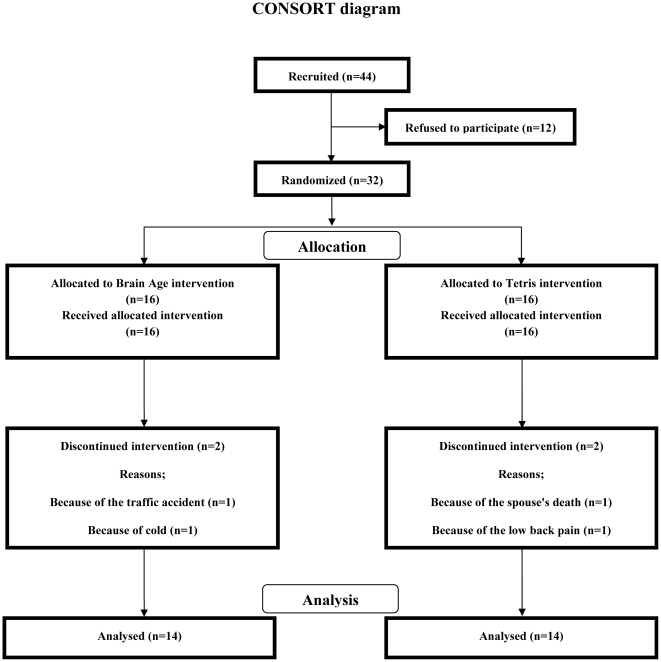
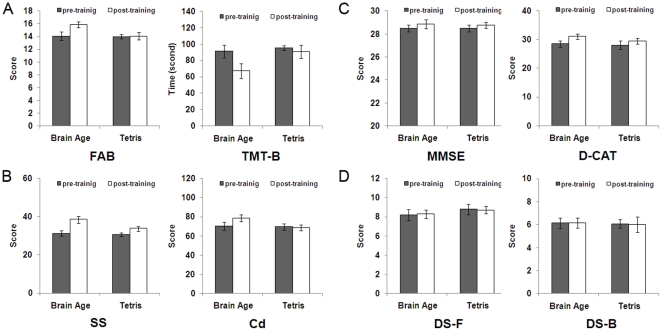
BACKGROUND: The beneficial effects of brain training games are expected to transfer to other cognitive functions, but these beneficial effects are poorly understood. Here we investigate the impact of the brain training game (Brain Age) on cognitive functions in the elderly. METHODS AND RESULTS: Thirty-two elderly volunteers were recruited through an advertisement in the local newspaper and randomly assigned to either of two game groups (Brain Age, Tetris). This study was completed by 14 of the 16 members in the Brain Age group and 14 of the 16 members in the Tetris group. To maximize the benefit of the interventions, all participants were non-gamers who reported playing less than one hour of video games per week over the past 2 years. Participants in both the Brain Age and the Tetris groups played their game for about 15 minutes per day, at least 5 days per week, for 4 weeks. Each group played for a total of about 20 days. Measures of the cognitive functions were conducted before and after training. Measures of the cognitive functions fell into four categories (global cognitive status, executive functions, attention, and processing speed). Results showed that the effects of the brain training game were transferred to executive functions and to processing speed. However, the brain training game showed no transfer effect on any global cognitive status nor attention. CONCLUSIONS: Our results showed that playing Brain Age for 4 weeks could lead to improve cognitive functions (executive functions and processing speed) in the elderly. This result indicated that there is a possibility which the elderly could improve executive functions and processing speed in short term training. The results need replication in large samples. Long-term effects and relevance for every-day functioning remain uncertain as yet. TRIAL REGISTRATION: UMIN Clinical Trial Registry 000002825.
Overview
The claims and statistics of this paper haven’t been checked yet.
Free: it reads the open-access text and checks the first 5 claims that cite a source we can check. Create a free account to check every claim.
Integrity signals
Registry
Cites
Statistics
Figures
Verification
Claims the paper makes
The claims and statistics of this paper haven’t been checked yet.
Free: it reads the open-access text and checks the first 5 claims that cite a source we can check. Create a free account to check every claim.
Claims other papers make about this one
Each is checked against this paper’s own text: does it say what the citing paper says it does?
The source backs part of the claim, not all of it — or backs it for a different population, condition or comparison.
In the citing paper
“only 4 out of the 16 included studies were registered20,22,29,35”
From The use of commercial computerised cognitive games in older adults: a meta-analysis (2020) · cites this paper as [22]
Experimental — accuracy not yet measured
Self-check
Percentages, sums and reported differences re-computed from the paper’s own numbers.
The self-check needs the paper’s full text.
Citations
Cites
1 retracted
Persson, J., & Reuter‐Lorenz, P. A. (2008) · Psychological Science · doi:10.1111/j.1467-9280.2008.02172.x · Cited by 121
RetractedFolstein, M. F., Folstein, S. E., & McHugh, P. R. (1975) · Journal of Psychiatric Research · doi:10.1016/0022-3956(75)90026-6 · Cited by 88,282
Statistical power analysis for the behavioral sciences
(1990) · Computers, Environment and Urban Systems · doi:10.1016/0198-9715(90)90050-4 · Cited by 65,269
Statistical Power Analysis for the Behavioral Sciences (2nd ed.).
Lachenbruch, P. A., & Cohen, J. (1989) · Journal of the American Statistical Association · doi:10.2307/2290095 · Cited by 37,395
Validity of the Trail Making Test as an Indicator of Organic Brain Damage
Reitan, R. M. (1958) · Perceptual and Motor Skills · doi:10.2466/pms.1958.8.3.271 · Cited by 7,928
The processing-speed theory of adult age differences in cognition
Salthouse, T. A. (1996) · Psychological Review · doi:10.1037/0033-295x.103.3.403 · Cited by 5,902 · cited 2×
“Given that both executive functions and processing speed decrease with age [7,43] and that these functions are strongly correlated with the activities of daily life [44], one of main goals in the field of cognitive training for the elderly is to improve executive functions and processing speed.”
BackgroundThe FAB: A frontal assessment battery at bedside
Dubois, B., Slachevsky, A., Litvan, I., & Pillon, B. (2000) · Neurology · doi:10.1212/wnl.55.11.1621 · Cited by 3,913
Action video game modifies visual selective attention
Green, C. S., & Bavelier, D. (2003) · Nature · doi:10.1038/nature01647 · Cited by 2,540
Wechsler Adult Intelligence Scale--Third Edition
Wechsler, D. (2019) · PsycTESTS Dataset · doi:10.1037/t49755-000 · Cited by 2,327
Insights into the ageing mind: a view from cognitive neuroscience
Hedden, T., & Gabrieli, J. D. E. (2004) · Nature Reviews Neuroscience · doi:10.1038/nrn1323 · Cited by 2,223
When and where do we apply what we learn?: A taxonomy for far transfer
Barnett, S. M., & Ceci, S. J. (2002) · Psychological Bulletin · doi:10.1037/0033-2909.128.4.612 · Cited by 2,076 · cited 1×
“The transfer effect also could be classified in terms of a near transfer effect and a far transfer effect [50,51].”
BackgroundAn application of prefrontal cortex function theory to cognitive aging.
West, R. L. (1996) · Psychological Bulletin · doi:10.1037//0033-2909.120.2.272 · Cited by 2,052
Effects of Cognitive Training Interventions With Older Adults: A Randomized Controlled Trial
Ball, K., Berch, D. B., Helmers, K. F., Jobe, J. B., Leveck, M. D., Marsiske, M., Morris, J. N., Rebok, G. W., Smith, D. M., Tennstedt, S. L., et al. (2002) · JAMA · doi:10.1001/jama.288.18.2271 · Cited by 2,049 · cited 1×
“In fact, previous studies showed that several cognitive training programs could improve cognitive functions such as memory [14,15], processing speed [16–18], executive function [19], and attention [20] in the healthy elderly.”
BackgroundPutting brain training to the test
Owen, A. M., Hampshire, A., Grahn, J. A., Stenton, R., Dajani, S., Burns, A. S., Howard, R. J., & Ballard, C. G. (2010) · Nature · doi:10.1038/nature09042 · Cited by 1,056
The effects of video game playing on attention, memory, and executive control
Boot, W. R., Kramer, A. F., Simons, D. J., Fabiani, M., & Gratton, G. (2008) · Acta Psychologica · doi:10.1016/j.actpsy.2008.09.005 · Cited by 990
Transfer of Learning After Updating Training Mediated by the Striatum
Dahlin, E., Neely, A. S., Larsson, A., Bäckman, L., & Nyberg, L. (2008) · Science · doi:10.1126/science.1155466 · Cited by 892
Kempermann, G., Gast, D., & Gage, F. H. (2002) · Annals of Neurology · doi:10.1002/ana.10262 · Cited by 889
Are memory complaints predictive for dementia? A review of clinical and population-based studies
Jonker, C., Geerlings, M. I., & Schmand, B. (2000) · International Journal of Geriatric Psychiatry · doi:10.1002/1099-1166(200011)15:11<983::aid-gps238>3.0.co;2-5 · Cited by 872
Can training in a real-time strategy video game attenuate cognitive decline in older adults?
Basak, C., Boot, W. R., Voss, M. W., & Kramer, A. F. (2008) · Psychology and Aging · doi:10.1037/a0013494 · Cited by 855
Smith, G. E., Housen, P., Yaffe, K., Ruff, R., Kennison, R. F., Mahncke, H. W., & Zelinski, E. M. (2009) · Journal of the American Geriatrics Society · doi:10.1111/j.1532-5415.2008.02167.x · Cited by 785
Short- and long-term benefits of cognitive training
Jaeggi, S. M., Buschkuehl, M., Jonides, J., & Shah, P. (2011) · Proceedings of the National Academy of Sciences · doi:10.1073/pnas.1103228108 · Cited by 769
Aging, Training, and the Brain: A Review and Future Directions
Lustig, C., Shah, P., Seidler, R., & Reuter-Lorenz, P. A. (2009) · Neuropsychology Review · doi:10.1007/s11065-009-9119-9 · Cited by 682
Exercising your brain: A review of human brain plasticity and training-induced learning.
Green, C. S., & Bavelier, D. (2008) · Psychology and Aging · doi:10.1037/a0014345 · Cited by 660
Mahncke, H. W., Connor, B. B., Appelman, J., Ahsanuddin, O. N., Hardy, J. L., Wood, R. A., Joyce, N. M., Boniske, T., Atkins, S. M., & Merzenich, M. M. (2006) · Proceedings of the National Academy of Sciences · doi:10.1073/pnas.0605194103 · Cited by 502
Kennedy, K. M., & Raz, N. (2009) · Neuropsychologia · doi:10.1016/j.neuropsychologia.2009.01.001 · Cited by 475 · cited 1×
“The executive functions and processing speed, which showed a significant transfer effect by the brain training game in our study, are also involved in the prefrontal cortex [48].”
BackgroundThe Impact of Speed of Processing Training on Cognitive and Everyday Functions
Ball, K., Edwards, J. D., & Ross, L. A. (2007) · The Journals of Gerontology Series B: Psychological Sciences and Social Sciences · doi:10.1093/geronb/62.special_issue_1.19 · Cited by 413
Memory function in normal aging: Memory function in normal aging
Nilsson, L.-G. (2003) · Acta Neurologica Scandinavica · doi:10.1034/j.1600-0404.107.s179.5.x · Cited by 406
Royall, D. R., Palmer, R., Chiodo, L. K., & Polk, M. J. (2004) · Journal of the American Geriatrics Society · doi:10.1111/j.1532-5415.2004.52104.x · Cited by 325
The impact of speed of processing training on cognitive and everyday performance
Edwards, J. D., Wadley, V. G., Vance, D. E., Wood, K., Roenker, D. L., & Ball, K. K. (2005) · Aging & Mental Health · doi:10.1080/13607860412331336788 · Cited by 321
Vaughan, L., & Giovanello, K. (2010) · Psychology and Aging · doi:10.1037/a0017729 · Cited by 318
Coppin, A. K., Shumway-Cook, A., Saczynski, J. S., Patel, K. V., Ble, A., Ferrucci, L., & Guralnik, J. M. (2006) · Age and Ageing · doi:10.1093/ageing/afl107 · Cited by 314
Cahn-Weiner, D. A., Malloy, P. F., Boyle, P. A., Marran, M., & Salloway, S. (2000) · The Clinical Neuropsychologist · doi:10.1076/1385-4046(200005)14:2;1-z;ft187 · Cited by 312
Transfer of a Speed of Processing Intervention to Near and Far Cognitive Functions
Edwards, J. D., Wadley, V. G., Myers, R. S., Roenker, D. L., Cissell, G. M., & Ball, K. K. (2002) · Gerontology · doi:10.1159/000065259 · Cited by 208
Goldstein, J., Cajko, L., Oosterbroek, M., Michielsen, M., Van Houten, O., & Salverda, F. (1997) · Social Behavior and Personality: an international journal · doi:10.2224/sbp.1997.25.4.345 · Cited by 199
Cognitive and neural plasticity in aging: General and task-specific limitations
Jones, S., Nyberg, L. H., Sandblom, J., Neely, A. S., Ingvar, M., Petersson, K. M., & Bäckman, L. (2006) · Neuroscience & Biobehavioral Reviews · doi:10.1016/j.neubiorev.2006.06.012 · Cited by 197
A functional MRI study of simple arithmetic—a comparison between children and adults
Kawashima, R., Taira, M., Okita, K., Inoue, K., Tajima, N., Yoshida, H., Sasaki, T., Sugiura, M., Watanabe, J., & Fukuda, H. (2004) · Cognitive Brain Research · doi:10.1016/j.cogbrainres.2003.10.009 · Cited by 189
Self-citationThe Effects of Videogame Playing on the Response Selection Processing of Elderly Adults
Clark, J. E., Lanphear, A. K., & Riddick, C. C. (1987) · Journal of Gerontology · doi:10.1093/geronj/42.1.82 · Cited by 186
Salthouse, T. A. (2003) · Alzheimer Disease & Associated Disorders · doi:10.1097/00002093-200307000-00008 · Cited by 183
Nonpharmacological Cognitive Interventions in Aging and Dementia
Acevedo, A., & Loewenstein, D. A. (2007) · Journal of Geriatric Psychiatry and Neurology · doi:10.1177/0891988707308808 · Cited by 176
Mozolic, J. L., Long, A. B., Morgan, A. R., Rawley‐Payne, M., & Laurienti, P. J. (2009) · Neurobiology of Aging · doi:10.1016/j.neurobiolaging.2009.04.013 · Cited by 169
Association Between Visual Attention and Mobility in Older Adults
Owsley, C. J., & McGwin, G. (2004) · Journal of the American Geriatrics Society · doi:10.1111/j.1532-5415.2004.52516.x · Cited by 164
How does practice makes perfect?
Jonides, J. (2004) · Nature Neuroscience · doi:10.1038/nn0104-10 · Cited by 140
Uchida, S., & Kawashima, R. (2008) · AGE · doi:10.1007/s11357-007-9044-x · Cited by 119
Self-citationThe Effects of Videogame Playing on Neuropsychological Performance of Elderly Individuals
Dustman, R. E., Emmerson, R. Y., Steinhaus, L. A., Shearer, D. E., & Dustman, T. J. (1992) · Journal of Gerontology · doi:10.1093/geronj/47.3.p168 · Cited by 114
Cognitive rehabilitation in the elderly: A randomized trial to evaluate a new protocol
Stuss, D. T., Robertson, I. H., Craik, F. I. M., Levine, B., ALEXANDER, M. P., Black, S. E., DAWSON, D. R., Binns, M. A., Palmer, H., Lamb, M. M. D., et al. (2006) · Journal of the International Neuropsychological Society · doi:10.1017/s1355617707070154 · Cited by 109
Association of cognitive status with functional limitation and disability in older adults
Lee, Y., Kim, J. H., Lee, K. J., Han, G.-S., & Kim, J. L. (2005) · Aging Clinical and Experimental Research · doi:10.1007/bf03337716 · Cited by 59
Impairment of memory and attention in the elderly
Yakhno, N. N., Zakharov, V. V., & Борисовна, Л. А. (2007) · Neuroscience and Behavioral Physiology · doi:10.1007/s11055-007-0002-y · Cited by 41
Cortical activation during reading aloud of long sentences: fMRI study
Miura, N., Iwata, K., Watanabe, J., Sugiura, M., Akitsuki, Y., Sassa, Y., Ikuta, N., Okamoto, H., Watanabe, Y., Riera, J. J., et al. (2003) · Neuroreport · doi:10.1097/00001756-200308260-00004 · Cited by 33
Self-citationCross-cultural comparisons of the Mini-mental State Examination between Japanese and U.S. cohorts
Dodge, H. H., Meguro, K., Ishii, H., Yamaguchi, S., Saxton, J. A., & Ganguli, M. (2008) · International Psychogeriatrics · doi:10.1017/s1041610208007886 · Cited by 28
Fuyuno, I. (2007) · Nature · doi:10.1038/447018a · Cited by 24
Research works printed but not linked: 2
- RH Logie, 2010, Brain training in schools, where is the evidence?, British Journal of Educational Technology, 41, E127, 10.1111/j.1467-8535.2010.01101.x · doi:10.1111/j.1467-8535.2010.01101.x
- N Maki, 2000, The validity of the MMSE and SMQ as screening tests for dementia in the elderly general population– a study of one rural community in Japan., Dement Geriatr Cogn Disord, 11, 193, 10.1159/000017236 · DOI
Cited by
Do “brain-training” programs work?
Simons, D. J., Boot, W. R., Charness, N., Gathercole, S. E., Chabris, C. F., Hambrick, D. Z., & Stine-Morrow, E. A. L. (2016) · Psychological Science in the Public Interest · doi:10.1177/1529100616661983 · Cited by 1,183
Kelly, M. E., Loughrey, D., Lawlor, B. A., Robertson, I. H., Walsh, C., & Brennan, S. (2014) · Ageing Research Reviews · doi:10.1016/j.arr.2014.02.004 · Cited by 509
Abbas, M., Jam, F. A., & Khan, T. I. (2024) · International Journal of Educational Technology in Higher Education · doi:10.1186/s41239-024-00444-7 · Cited by 531
Mayer, R. E. (2019) · Annual Review of Psychology · doi:10.1146/annurev-psych-010418-102744 · Cited by 386
Video game training enhances cognition of older adults: A meta-analytic study.
Toril, P., Reales, J. M., & Ballesteros, S. (2014) · Psychology and Aging · doi:10.1037/a0037507 · Cited by 308
Metadata
- Authors
- Nouchi, R., Taki, Y., Takeuchi, H., Hashizume, H., Akitsuki, Y., Shigemune, Y., Sekiguchi, A., Kotozaki, Y., Tsukiura, T., Yomogida, Y., & Kawashima, R.
- Venue
- PLoS ONE
- Publisher
- Public Library of Science (PLoS)
- Published
- 2012-01-11
- Volume
- 7
- Issue
- 1
- Pages
- e29676
- ISSN
- 1932-6203 (ISSN-L)
- PMC
- PMC3256163
- OpenAlex
- W1973344691
- Cited by
- 347
- References
- 50
- FWCI
- 36.81
- Type
- journal article
- Language
- en
- Open access
- gold
About these checks
Registry, retraction, Cites and statistics results are computed, not judged, with one exception: a printed reference that no index lists is read once by a model before it counts as a citation error. Claims are extracted by a model and kept only when their quote appears verbatim in the text; each cited source is then checked, with a model’s help, for whether it says what the claim relies on. Those verdicts can be wrong — read the claim’s quote and the cited source before relying on one.
Statistics and arithmetic are recomputed, not judged.
Confidence bands are shown only for fields calibrated on our annotated test set. None is calibrated yet, so no band is shown.
What counts as a claim ›How we measure confidence ›How we check this ›
Are you an author, or do you see a problem with this page? Request a review
Data sources
Bibliographic data: Semantic Scholar, OpenAlex, Crossref.
Contains information from the Semantic Scholar Academic Graph Datasets, made available under the ODC Attribution License (ODC-BY 1.0).
Semantic Scholar’s data is described in: Kinney, R., et al. (2023). The Semantic Scholar Open Data Platform. arXiv:2301.10140.
