

Brain Training Game Improves Executive Functions and Processing Speed in the Elderly: A Randomized Controlled Trial
Open accessThe DOI matches its Crossref record; 50 of the 50 references it cites were found in a registry or an index.
Abstract
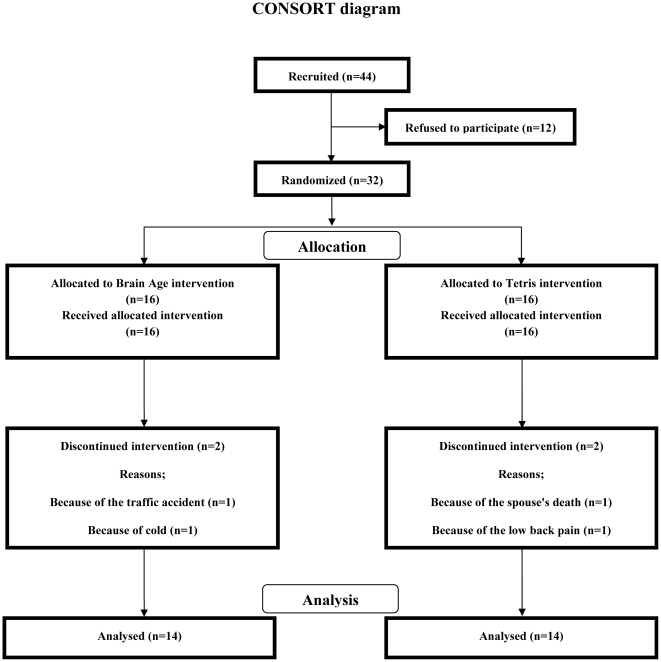
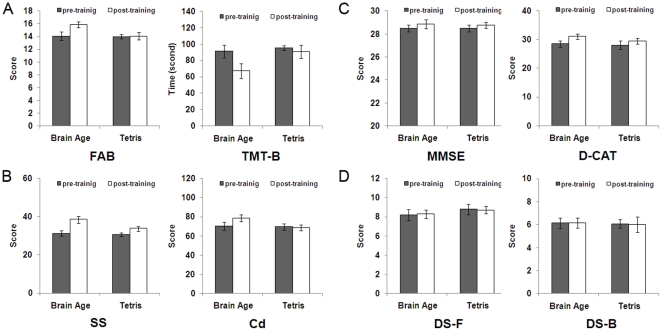
BACKGROUND: The beneficial effects of brain training games are expected to transfer to other cognitive functions, but these beneficial effects are poorly understood. Here we investigate the impact of the brain training game (Brain Age) on cognitive functions in the elderly. METHODS AND RESULTS: Thirty-two elderly volunteers were recruited through an advertisement in the local newspaper and randomly assigned to either of two game groups (Brain Age, Tetris). This study was completed by 14 of the 16 members in the Brain Age group and 14 of the 16 members in the Tetris group. To maximize the benefit of the interventions, all participants were non-gamers who reported playing less than one hour of video games per week over the past 2 years. Participants in both the Brain Age and the Tetris groups played their game for about 15 minutes per day, at least 5 days per week, for 4 weeks. Each group played for a total of about 20 days. Measures of the cognitive functions were conducted before and after training. Measures of the cognitive functions fell into four categories (global cognitive status, executive functions, attention, and processing speed). Results showed that the effects of the brain training game were transferred to executive functions and to processing speed. However, the brain training game showed no transfer effect on any global cognitive status nor attention. CONCLUSIONS: Our results showed that playing Brain Age for 4 weeks could lead to improve cognitive functions (executive functions and processing speed) in the elderly. This result indicated that there is a possibility which the elderly could improve executive functions and processing speed in short term training. The results need replication in large samples. Long-term effects and relevance for every-day functioning remain uncertain as yet. TRIAL REGISTRATION: UMIN Clinical Trial Registry 000002825.
Overview
The claims and statistics of this paper haven’t been checked yet.
Free: it reads the open-access text and checks the first 5 claims that cite a source we can check. Create a free account to check every claim.
Integrity signals
Registry
Cites
Statistics
Figures
Verification
Claims the paper makes
The claims and statistics of this paper haven’t been checked yet.
Free: it reads the open-access text and checks the first 5 claims that cite a source we can check. Create a free account to check every claim.
Claims other papers make about this one
Each is checked against this paper’s own text: does it say what the citing paper says it does?
The source backs part of the claim, not all of it — or backs it for a different population, condition or comparison.
In the citing paper
“only 4 out of the 16 included studies were registered20,22,29,35”
From The use of commercial computerised cognitive games in older adults: a meta-analysis (2020) · cites this paper as [22]
Experimental — accuracy not yet measured
Self-check
Percentages, sums and reported differences re-computed from the paper’s own numbers.
The self-check needs the paper’s full text.
Citations
Cites
1 retracted
Persson, J., & Reuter‐Lorenz, P. A. (2008) · Psychological Science · doi:10.1111/j.1467-9280.2008.02172.x · Cited by 121
RetractedFolstein, M. F., Folstein, S. E., & McHugh, P. R. (1975) · Journal of Psychiatric Research · doi:10.1016/0022-3956(75)90026-6 · Cited by 88,282
Statistical power analysis for the behavioral sciences
(1990) · Computers, Environment and Urban Systems · doi:10.1016/0198-9715(90)90050-4 · Cited by 65,269
Statistical Power Analysis for the Behavioral Sciences (2nd ed.).
Lachenbruch, P. A., & Cohen, J. (1989) · Journal of the American Statistical Association · doi:10.2307/2290095 · Cited by 37,395
Validity of the Trail Making Test as an Indicator of Organic Brain Damage
Reitan, R. M. (1958) · Perceptual and Motor Skills · doi:10.2466/pms.1958.8.3.271 · Cited by 7,928
The processing-speed theory of adult age differences in cognition
Salthouse, T. A. (1996) · Psychological Review · doi:10.1037/0033-295x.103.3.403 · Cited by 5,902 · cited 2×
“Given that both executive functions and processing speed decrease with age [7,43] and that these functions are strongly correlated with the activities of daily life [44], one of main goals in the field of cognitive training for the elderly is to improve executive functions and processing speed.”
BackgroundThe FAB: A frontal assessment battery at bedside
Dubois, B., Slachevsky, A., Litvan, I., & Pillon, B. (2000) · Neurology · doi:10.1212/wnl.55.11.1621 · Cited by 3,913
Action video game modifies visual selective attention
Green, C. S., & Bavelier, D. (2003) · Nature · doi:10.1038/nature01647 · Cited by 2,540 · cited 2×
“Because previous studies used the Tetris as an active control group [31], we included the active control group that played the Tetris published by Nintendo in 2006.”
MethodResultWechsler Adult Intelligence Scale--Third Edition
Wechsler, D. (2019) · PsycTESTS Dataset · doi:10.1037/t49755-000 · Cited by 2,327
Insights into the ageing mind: a view from cognitive neuroscience
Hedden, T., & Gabrieli, J. D. E. (2004) · Nature Reviews Neuroscience · doi:10.1038/nrn1323 · Cited by 2,223
Research works printed but not linked: 2
- RH Logie, 2010, Brain training in schools, where is the evidence?, British Journal of Educational Technology, 41, E127, 10.1111/j.1467-8535.2010.01101.x · doi:10.1111/j.1467-8535.2010.01101.x
- N Maki, 2000, The validity of the MMSE and SMQ as screening tests for dementia in the elderly general population– a study of one rural community in Japan., Dement Geriatr Cogn Disord, 11, 193, 10.1159/000017236 · DOI
Cited by
Do “brain-training” programs work?
Simons, D. J., Boot, W. R., Charness, N., Gathercole, S. E., Chabris, C. F., Hambrick, D. Z., & Stine-Morrow, E. A. L. (2016) · Psychological Science in the Public Interest · doi:10.1177/1529100616661983 · Cited by 1,183
Kelly, M. E., Loughrey, D., Lawlor, B. A., Robertson, I. H., Walsh, C., & Brennan, S. (2014) · Ageing Research Reviews · doi:10.1016/j.arr.2014.02.004 · Cited by 509
Abbas, M., Jam, F. A., & Khan, T. I. (2024) · International Journal of Educational Technology in Higher Education · doi:10.1186/s41239-024-00444-7 · Cited by 531
Mayer, R. E. (2019) · Annual Review of Psychology · doi:10.1146/annurev-psych-010418-102744 · Cited by 386
Video game training enhances cognition of older adults: A meta-analytic study.
Toril, P., Reales, J. M., & Ballesteros, S. (2014) · Psychology and Aging · doi:10.1037/a0037507 · Cited by 308
Gamification and Serious Games for Personalized Health
Simon, M. (2012) · Studies in Health Technology and Informatics · doi:10.3233/978-1-61499-069-7-85 · Cited by 301
Zucchella, C., Sinforiani, E., Tamburin, S., Federico, A., Mantovani, E., Bernini, S., Casale, R., & Bartolo, M. (2018) · Frontiers in Neurology · doi:10.3389/fneur.2018.01058 · Cited by 297
Nouchi, R., Taki, Y., Takeuchi, H., Hashizume, H., Nozawa, T., Kambara, T., Sekiguchi, A., Miyauchi, C. M., Kotozaki, Y., Nouchi, H., et al. (2013) · PLoS ONE · doi:10.1371/journal.pone.0055518 · Cited by 240
Self-citationBallesteros, S., Prieto, A., Mayas, J., Toril, P., Pita, C., Ponce de León, L., Reales, J. M., & Waterworth, J. (2014) · Frontiers in Aging Neuroscience · doi:10.3389/fnagi.2014.00277 · Cited by 189
Weicker, J., Villringer, A., & Thöne-Otto, A. (2016) · Neuropsychology · doi:10.1037/neu0000227 · Cited by 147
The use of commercial computerised cognitive games in older adults: a meta-analysis
Bonnechère, B., Langley, C., & Sahakian, B. J. (2020) · Scientific Reports · doi:10.1038/s41598-020-72281-3 · Cited by 126
Kim, G. H., Jeon, S., Im, K., Kwon, H., Lee, B. H., Kim, G. Y., Jeong, H., Han, N. E., Seo, S. W., Cho, H., et al. (2015) · PLOS ONE · doi:10.1371/journal.pone.0123251 · Cited by 101
A cognitive behavioral intervention (HOBSCOTCH) improves quality of life and attention in epilepsy
Caller, T. A., Ferguson, R. J., Roth, R. M., Secore, K. L., Alexandre, F. P., Zhao, W., Tosteson, T. D., Henegan, P. L., Birney, K., & Jobst, B. C. (2016) · Epilepsy & Behavior · doi:10.1016/j.yebeh.2016.01.024 · Cited by 102
“To evaluate whether there would be additional benefit from structured computerized memory training, a subset of HOBSCOTCH participants (H+) performed additional cognitive training using a Nintendo DS® handheld console and the Brain Age© program (which has been shown to improve memory in other populations [28,29]).”
MethodA Systematic Review on Serious Games in Attention Rehabilitation and Their Effects
Shahmoradi, L., Mohammadian, F., & Rahmani Katigari, M. (2022) · Behavioural Neurology · doi:10.1155/2022/2017975 · Cited by 76
Reasons for playing casual video games and perceived benefits among adults 18 to 80 years old
Whitbourne, S. K., Ellenberg, S., & Akimoto, K. (2013) · Cyberpsychology Behavior and Social Networking · doi:10.1089/cyber.2012.0705 · Cited by 73
Videogames and Health Improvement: A Literature Review of Randomized Controlled Trials
Rahmani, E., & Boren, S. A. (2012) · Games for Health Journal · doi:10.1089/g4h.2012.0031 · Cited by 73
Shams, T. A., Foussias, G., Zawadzki, J. A., Marshe, V. S., Siddiqui, I., Müller, D. J., & Wong, A. H. C. (2015) · Current Psychiatry Reports · doi:10.1007/s11920-015-0609-6 · Cited by 68
Gates, N. J., Rutjes, A. W., Di Nisio, M., Karim, S., Chong, L.-Y., March, E., Martínez, G., & Vernooij, R. W. (2019) · Cochrane Database of Systematic Reviews · doi:10.1002/14651858.cd012278.pub2 · Cited by 46
Zapparrata, N. M., Brooks, P. J., & Ober, T. M. (2023) · Journal of Autism and Developmental Disorders · doi:10.1007/s10803-022-05736-3 · Cited by 44
Hong, J., Su, Y., Wang, J., Xu, X., Qu, W., Fan, H., Tan, Y., Wang, Z., Zhao, Y., & Tan, S. (2023) · Asian Journal of Psychiatry · doi:10.1016/j.ajp.2023.103584 · Cited by 18
Effects of Fast Simple Numerical Calculation Training on Neural Systems
Takeuchi, H., Nagase, T., Taki, Y., Sassa, Y., Hashizume, H., Nouchi, R., & Kawashima, R. (2016) · Neural Plasticity · doi:10.1155/2016/5940634 · Cited by 5
“Furthermore, this study is consistent with our previous study in that training did not lead to improved performance on working memory measures [4].”
BackgroundMethodResultInfluentialSelf-citationOvercoming the Barriers to Uptake: A Study of 6 Danish Health-Based Serious Games Projects
Brown, D. (2013) · International Journal of Game-Based Learning · doi:10.4018/ijgbl.2013070101 · Cited by 2
Metadata
- Authors
- Nouchi, R., Taki, Y., Takeuchi, H., Hashizume, H., Akitsuki, Y., Shigemune, Y., Sekiguchi, A., Kotozaki, Y., Tsukiura, T., Yomogida, Y., & Kawashima, R.
- Venue
- PLoS ONE
- Publisher
- Public Library of Science (PLoS)
- Published
- 2012-01-11
- Volume
- 7
- Issue
- 1
- Pages
- e29676
- ISSN
- 1932-6203 (ISSN-L)
- PMC
- PMC3256163
- OpenAlex
- W1973344691
- Cited by
- 347
- References
- 50
- FWCI
- 36.81
- Type
- journal article
- Language
- en
- Open access
- gold
About these checks
Registry, retraction, Cites and statistics results are computed, not judged, with one exception: a printed reference that no index lists is read once by a model before it counts as a citation error. Claims are extracted by a model and kept only when their quote appears verbatim in the text; each cited source is then checked, with a model’s help, for whether it says what the claim relies on. Those verdicts can be wrong — read the claim’s quote and the cited source before relying on one.
Statistics and arithmetic are recomputed, not judged.
Confidence bands are shown only for fields calibrated on our annotated test set. None is calibrated yet, so no band is shown.
What counts as a claim ›How we measure confidence ›How we check this ›
Are you an author, or do you see a problem with this page? Request a review
Data sources
Bibliographic data: Semantic Scholar, OpenAlex, Crossref.
Contains information from the Semantic Scholar Academic Graph Datasets, made available under the ODC Attribution License (ODC-BY 1.0).
Semantic Scholar’s data is described in: Kinney, R., et al. (2023). The Semantic Scholar Open Data Platform. arXiv:2301.10140.
