

The DOI matches its Crossref record; 65 of the 65 references it cites were found in a registry or an index.
Updating Fearful Memories with Extinction Training during Reconsolidation: A Human Study Using Auditory Aversive Stimuli
Open accessAbstract
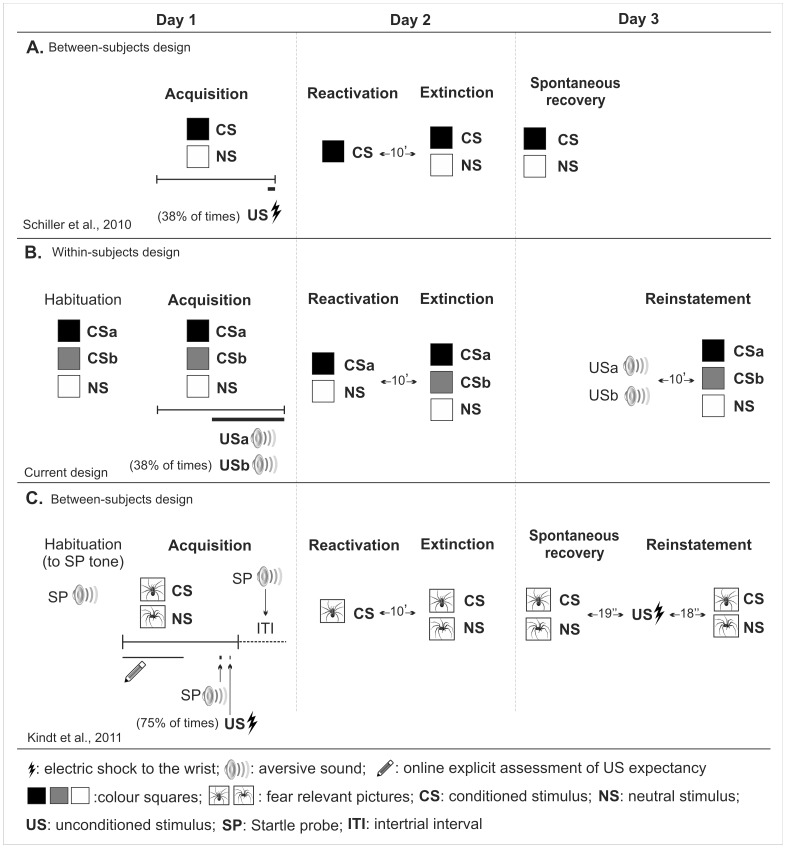
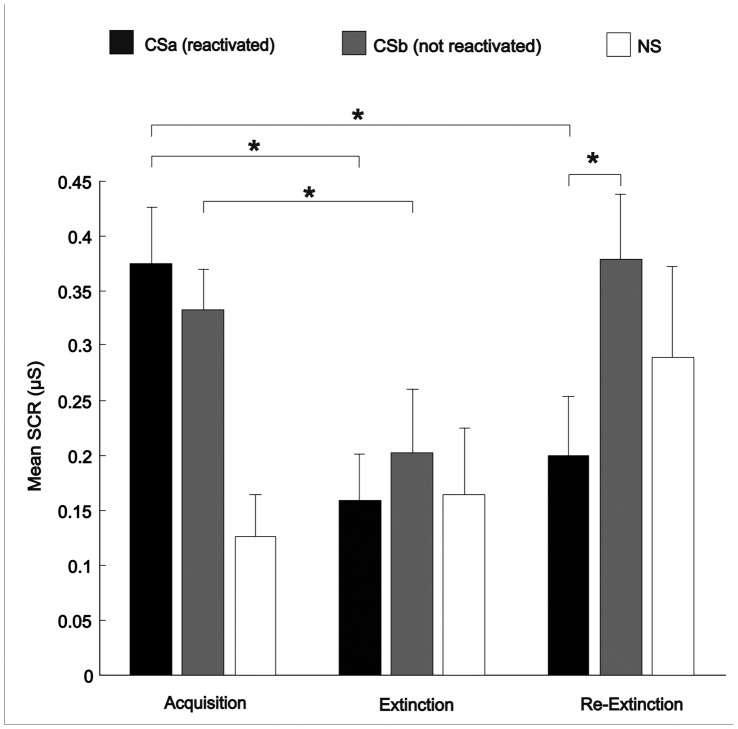
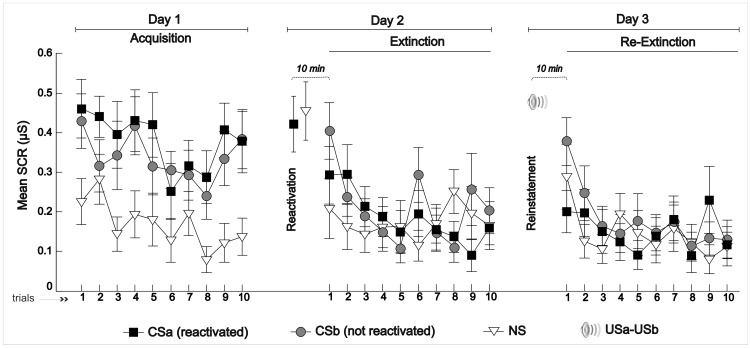
Learning to fear danger in the environment is essential to survival, but dysregulation of the fear system is at the core of many anxiety disorders. As a consequence, a great interest has emerged in developing strategies for suppressing fear memories in maladaptive cases. Recent research has focused in the process of reconsolidation where memories become labile after being retrieved. In a behavioral manipulation, Schiller et al., (2010) reported that extinction training, administrated during memory reconsolidation, could erase fear responses. The implications of this study are crucial for the possible treatment of anxiety disorders without the administration of drugs. However, attempts to replicate this effect by other groups have been so far unsuccessful. We sought out to reproduce Schiller et al., (2010) findings in a different fear conditioning paradigm based on auditory aversive stimuli instead of electric shock. Following a within-subject design, participants were conditioned to two different sounds and skin conductance response (SCR) was recorded as a measure of fear. Our results demonstrated that only the conditioned stimulus that was reminded 10 minutes before extinction training did not reinstate a fear response after a reminder trial consisting of the presentation of the unconditioned stimuli. For the first time, we replicated Schiller et al., (2010) behavioral manipulation and extended it to an auditory fear conditioning paradigm.
Overview
The claims and statistics of this paper haven’t been checked yet.
Run the check — free, no account needed. It reads the open-access text and checks the sources it cites.
Integrity signals
Registry
Cites
Statistics
Figures
Verification
Claims the paper makes
The claims and statistics of this paper haven’t been checked yet.
Run the check — free, no account needed. It reads the open-access text and checks the sources it cites.
Claims other papers make about this one
Each is checked against this paper’s own text: does it say what the citing paper says it does?
In the citing paper
“These conditions include, but are not limited to, the type of psychophysiological measure employed, the schedule of reinforcement used during acquisition, the fear-relevancy of the conditioned stimuli presented, the strength of the fear memory following acquisition, and the presence or absence of on-line measures of expectancy or fear ratings [see Ref. (37, 91–93)].”
From Conditioned fear associated phenotypes as robust, translational indices of trauma-, stressor-, and anxiety-related behaviors (2014) · cites this paper as [92]
Self-check
Percentages, sums and reported differences re-computed from the paper’s own numbers.
The self-check needs the paper’s full text.
Citations
Cites
Contributions of the Amygdala to Emotion Processing: From Animal Models to Human Behavior
Phelps, E. A., & LeDoux, J. E. (2005) · Neuron · doi:10.1016/j.neuron.2005.09.025 · Cited by 3,203 · cited 2×
“Learning to fear is critical for human survival because it impels us to quickly recognize and avoid stimuli that could represent a threat to our lives [1].”
Fears, phobias, and preparedness: toward an evolved module of fear and fear learning
Öhman, A., & Mineka, S. (2001) · Psychological Review · doi:10.1037/0033-295x.108.3.483 · Cited by 3,147 · cited 1×
“These fearrelevant stimuli, although successfully extinguished on day 2, generated a stronger conditioning [39] making this fear association more resistant to undergo reconsolidation [40].”
Fear memories require protein synthesis in the amygdala for reconsolidation after retrieval
Nader, K., Schafe, G. E., & Le Doux, J. E. (2000) · Nature · doi:10.1038/35021052 · Cited by 2,706
Context, ambiguity, and unlearning: sources of relapse after behavioral extinction
Bouton, M. E. (2002) · Biological Psychiatry · doi:10.1016/s0006-3223(02)01546-9 · Cited by 1,662
Neural Mechanisms of Extinction Learning and Retrieval
Quirk, G. J., & Mueller, D. (2008) · Neuropsychopharmacology · doi:10.1038/sj.npp.1301555 · Cited by 1,645
Neurobiology of Pavlovian fear conditioning
Maren, S. (2001) · Annual Review of Neuroscience · doi:10.1146/annurev.neuro.24.1.897 · Cited by 1,543
Fear Extinction as a Model for Translational Neuroscience: Ten Years of Progress
Milad, M. R., & Quirk, G. J. (2012) · Annual Review of Psychology · doi:10.1146/annurev.psych.121208.131631 · Cited by 1,466
Bechara, A., Tranel, D., Damasio, H., Adolphs, R., Rockland, C., & Damasio, A. R. (1995) · Science · doi:10.1126/science.7652558 · Cited by 1,400
Rauch, S. L., Shin, L. M., & Phelps, E. A. (2006) · Biological Psychiatry · doi:10.1016/j.biopsych.2006.06.004 · Cited by 1,397
Myers, K. M., & Davis, M. (2007) · Molecular Psychiatry · doi:10.1038/sj.mp.4001939 · Cited by 1,277
Preventing the return of fear in humans using reconsolidation update mechanisms
Schiller, D., Monfils, M.-H., Raio, C. M., Johnson, D. C., LeDoux, J. E., & Phelps, E. A. (2010) · Nature · doi:10.1038/nature08637 · Cited by 1,248
Fear and anxiety: Animal models and human cognitive psychophysiology
Lang, P. J., Davis, M., & Öhman, A. (2000) · Journal of Affective Disorders · doi:10.1016/s0165-0327(00)00343-8 · Cited by 1,162
Memory Reconsolidation and Extinction Have Distinct Temporal and Biochemical Signatures
Suzuki, A., Josselyn, S. A., Frankland, P. W., Masushige, S., Silva, A. J., & Kida, S. (2004) · The Journal of Neuroscience · doi:10.1523/jneurosci.5491-03.2004 · Cited by 1,127
Extinction-Reconsolidation Boundaries: Key to Persistent Attenuation of Fear Memories
Monfils, M.-H., Cowansage, K. K., Klann, E., & LeDoux, J. E. (2009) · Science · doi:10.1126/science.1167975 · Cited by 960
Beyond extinction: erasing human fear responses and preventing the return of fear
Kindt, M., Soeter, M., & Vervliet, B. (2009) · Nature Neuroscience · doi:10.1038/nn.2271 · Cited by 826
A single standard for memory: The case for reconsolidation
Nader, K., & Hardt, O. (2009) · Nature Reviews Neuroscience · doi:10.1038/nrn2590 · Cited by 811
Bouton, M. E., & King, D. A. (1983) · Journal of Experimental Psychology Animal Behavior Processes · doi:10.1037/0097-7403.9.3.248 · Cited by 796
Reinstatement of fear to an extinguished conditioned stimulus.
Rescorla, R. A., & Heth, C. D. (1975) · Journal of Experimental Psychology Animal Behavior Processes · doi:10.1037/0097-7403.1.1.88 · Cited by 768
Impaired fear conditioning following unilateral temporal lobectomy in humans
LaBar, K., LeDoux, J., Spencer, D., & Phelps, E. (1995) · The Journal of Neuroscience · doi:10.1523/jneurosci.15-10-06846.1995 · Cited by 631
Olsson, A., & Phelps, E. A. (2007) · Nature Neuroscience · doi:10.1038/nn1968 · Cited by 622
Brunet, A., Orr, S. P., Tremblay, J., Robertson, K., Nader, K., & Pitman, R. K. (2008) · Journal of Psychiatric Research · doi:10.1016/j.jpsychires.2007.05.006 · Cited by 548
Reconsolidation: maintaining memory relevance
Lee, J. L. C. (2009) · Trends in Neurosciences · doi:10.1016/j.tins.2009.05.002 · Cited by 516
Calcium-Permeable AMPA Receptor Dynamics Mediate Fear Memory Erasure
Clem, R. L., & Huganir, R. L. (2010) · Science · doi:10.1126/science.1195298 · Cited by 496
Rites of Passage of the Engram
Dudai, Y., & Eisenberg, M. (2004) · Neuron · doi:10.1016/j.neuron.2004.09.003 · Cited by 476
Prolonged Exposure versus Eye Movement Desensitization and Reprocessing (EMDR) for PTSD rape victims
ROTHBAUM, B. O., Astin, M. C., & Marsteller, F. (2005) · Journal of Traumatic Stress · doi:10.1002/jts.20069 · Cited by 458
Post-traumatic stress disorder, hormones, and memory.
Pitman, R. (1989) · Biological Psychiatry · doi:10.1016/0006-3223(89)90033-4 · Cited by 447
Phobias and preparedness: the selective, automatic, and encapsulated nature of fear
Mineka, S., & Öhman, A. (2002) · Biological Psychiatry · doi:10.1016/s0006-3223(02)01669-4 · Cited by 414
Protein Synthesis Subserves Reconsolidation or Extinction Depending on Reminder Duration
Pedreira, M. E., & Maldonado, H. (2003) · Neuron · doi:10.1016/s0896-6273(03)00352-0 · Cited by 406
Rescorla, R. A. (2004) · Learning & Memory · doi:10.1101/lm.77504 · Cited by 380
Characterization of fear memory reconsolidation
Duvarci, S., & Nader, K. (2004) · The Journal of Neuroscience · doi:10.1523/jneurosci.2971-04.2004 · Cited by 379 · cited 1×
“There is a vast literature in rats reporting erasing of fear by targeting the amygdala with protein synthesis inhibitors after memory retrieval [24].”
Memory reconsolidation: an update
Nader, K., & Einarsson, E. Ö. (2010) · Annals of the New York Academy of Sciences · doi:10.1111/j.1749-6632.2010.05443.x · Cited by 374
Pedreira, M. E., Pérez-Cuesta, L. M., & Maldonado, H. (2004) · Learning & Memory · doi:10.1101/lm.76904 · Cited by 367
Virtual reality exposure therapy for PTSD Vietnam veterans: A case study
Rothbaum, B. O., Hodges, L., Alarcon, R., Ready, D., Shahar, F., Graap, K., Pair, J., Hebert, P., Gotz, D., Wills, B., et al. (1999) · Journal of Traumatic Stress · doi:10.1023/a:1024772308758 · Cited by 328
Noradrenergic dysfunction and the psychopharmacology of posttraumatic stress disorder
Strawn, J. R., & Geracioti, T. D. (2007) · Depression and Anxiety · doi:10.1002/da.20292 · Cited by 325
Cellular and systems mechanisms of memory strength as a constraint on auditory fear reconsolidation
Wang, S., Alvares, L. D. O., & Nader, K. (2009) · Nature Neuroscience · doi:10.1038/nn.2350 · Cited by 321
Fear-Conditioning Mechanisms Associated with Trait Vulnerability to Anxiety in Humans
Indovina, I., Robbins, T. W., Núñez-Elizalde, A. O., Dunn, B. D., & Bishop, S. J. (2011) · Neuron · doi:10.1016/j.neuron.2010.12.034 · Cited by 310
Context modulation of memory for fear extinction in humans
Milad, M. R., Orr, S. P., Pitman, R. K., & Rauch, S. L. (2005) · Psychophysiology · doi:10.1111/j.1469-8986.2005.00302.x · Cited by 297
Akirav, I., & Maroun, M. (2007) · Neural Plasticity · doi:10.1155/2007/30873 · Cited by 293
Dissociating response systems: Erasing fear from memory
Soeter, M., & Kindt, M. (2010) · Neurobiology of Learning and Memory · doi:10.1016/j.nlm.2010.03.004 · Cited by 290
Krystal, J. H., & Neumeister, A. (2009) · Brain Research · doi:10.1016/j.brainres.2009.03.044 · Cited by 264
Disrupting reconsolidation: Pharmacological and behavioral manipulations
Soeter, M., & Kindt, M. (2011) · Learning & Memory · doi:10.1101/lm.2148511 · Cited by 262
Drug enhancement of memory consolidation: historical perspective and neurobiological implications
McGaugh, J. L., & Roozendaal, B. (2008) · Psychopharmacology · doi:10.1007/s00213-008-1285-6 · Cited by 250
Norepinephrine Release in the Amygdala in Response to Footshock Stimulation
Galvez, R., Mesches, M. H., & McGaugh, J. L. (1996) · Neurobiology of Learning and Memory · doi:10.1006/nlme.1996.0067 · Cited by 242
Reconsolidation in a human fear conditioning study: A test of extinction as updating mechanism
Kindt, M., & Soeter, M. (2013) · Biological Psychology · doi:10.1016/j.biopsycho.2011.09.016 · Cited by 240
Retrieval per se is not sufficient to trigger reconsolidation of human fear memory
Sevenster, D., Beckers, T., & Kindt, M. (2012) · Neurobiology of Learning and Memory · doi:10.1016/j.nlm.2012.01.009 · Cited by 238
Event representation in Pavlovian conditioning: Image and action
Holland, P. C. (1990) · Cognition · doi:10.1016/0010-0277(90)90020-k · Cited by 229
Dębiec, J., Bush, D. E. A., & LeDoux, J. E. (2011) · Depression and Anxiety · doi:10.1002/da.20803 · Cited by 227
Does Reconsolidation Occur in Humans?
Schiller, D., & Phelps, E. A. (2011) · Frontiers in Behavioral Neuroscience · doi:10.3389/fnbeh.2011.00024 · Cited by 211
Retrieval-specific endocytosis of GluA2-AMPARs underlies adaptive reconsolidation of contextual fear
Rao-Ruiz, P., Rotaru, D. C., van der Loo, R. J., Mansvelder, H. D., Stiedl, O., Smit, A. B., & Spijker, S. (2011) · Nature Neuroscience · doi:10.1038/nn.2907 · Cited by 192
Noradrenergic Mechanisms in the Pathophysiology of Post-Traumatic Stress Disorder
O'Donnell, T., Hegadoren, K., & Coupland, N. (2004) · Neuropsychobiology · doi:10.1159/000080952 · Cited by 166
Forcato, C., Argibay, P. F., Pedreira, M. E., & Maldonado, H. (2008) · Neurobiology of Learning and Memory · doi:10.1016/j.nlm.2008.09.011 · Cited by 166
Fear acquisition requires awareness in trace but not delay conditioning
Weike, A. I., Schupp, H. T., & Hamm, A. O. (2007) · Psychophysiology · doi:10.1111/j.1469-8986.2006.00469.x · Cited by 163
Effects of recent exposure to a conditioned stimulus on extinction of Pavlovian fear conditioningPreprint
Chan, W. Y. M., Leung, H. T., Westbrook, R. F., & McNally, G. P. (2010) · Learning & Memory · doi:10.1101/lm.1912510 · Cited by 156
Limited efficacy of propranolol on the reconsolidation of fear memories
Muravieva, E. V., & Alberini, C. M. (2010) · Learning & Memory · doi:10.1101/lm.1794710 · Cited by 135
Reinstatement of fear to an extinguished conditioned stimulus: Two roles for context.
Westbrook, R. F., Iordanova, M. D., McNally, G. P., Richardson, R., & Harris, J. A. (2002) · Journal of Experimental Psychology Animal Behavior Processes · doi:10.1037/0097-7403.28.1.97 · Cited by 128
Dirikx, T., Hermans, D., Vansteenwegen, D., Baeyens, F., & Eelen, P. (2004) · Learning & Memory · doi:10.1101/lm.78004 · Cited by 123
Hygge, S., & Öhman, A. (1978) · Journal of Personality and Social Psychology · doi:10.1037/0022-3514.36.3.271 · Cited by 105
Will Reconsolidation Blockade Offer a Novel Treatment for Posttraumatic Stress Disorder?
Pitman, R. K. (2011) · Frontiers in Behavioral Neuroscience · doi:10.3389/fnbeh.2011.00011 · Cited by 103
Reinstatement of conditioned responses in human differential fear conditioning
Dirikx, T., Hermans, D., Vansteenwegen, D., Baeyens, F., & Eelen, P. (2007) · Journal of Behavior Therapy and Experimental Psychiatry · doi:10.1016/j.jbtep.2006.04.001 · Cited by 87
Leaton, R. N., & Cranney, J. (1990) · Journal of Experimental Psychology Animal Behavior Processes · doi:10.1037/0097-7403.16.3.279 · Cited by 81
Hygge, S., & �hman, A. (1978) · Journal of Personality and Social Psychology · doi:10.1037//0022-3514.36.3.271 · Cited by 77
Non-differential return of fear in humans after a reinstatement procedure
Dirikx, T., Vansteenwegen, D., Eelen, P., & Hermans, D. (2009) · Acta Psychologica · doi:10.1016/j.actpsy.2008.12.002 · Cited by 53
Tollenaar, M. S., Elzinga, B. M., Spinhoven, P., & Everaerd, W. T. A. M. (2009) · Psychopharmacology · doi:10.1007/s00213-008-1427-x · Cited by 49
Reinstatement of conditioned fear and the hippocampus: An attentional-associative model
Schmajuk, N. A., LARRAURI, J., & LaBar, K. S. (2006) · Behavioural Brain Research · doi:10.1016/j.bbr.2006.11.026 · Cited by 25
Yang, C., Huang, C., & Hsu, K. (2011) · Neuropsychopharmacology · doi:10.1038/npp.2011.87 · Cited by 15
Cited by
Sorted by citations
Fear Extinction and Relapse: State of the Art
Vervliet, B., Craske, M. G., & Hermans, D. (2013) · Annual Review of Clinical Psychology · doi:10.1146/annurev-clinpsy-050212-185542 · Cited by 671
An Update on Memory Reconsolidation Updating
Lee, J. L. C., Nader, K., & Schiller, D. (2017) · Trends in Cognitive Sciences · doi:10.1016/j.tics.2017.04.006 · Cited by 557
Extinction during reconsolidation of threat memory diminishes prefrontal cortex involvement
Schiller, D., Kanen, J. W., LeDoux, J. E., Monfils, M., & Phelps, E. A. (2013) · Proceedings of the National Academy of Sciences · doi:10.1073/pnas.1320322110 · Cited by 310
Reconsolidation of Human Memory: Brain Mechanisms and Clinical Relevance
Schwabe, L., Nader, K., & Pruessner, J. C. (2014) · Biological Psychiatry · doi:10.1016/j.biopsych.2014.03.008 · Cited by 261
Human memory reconsolidation: A guiding framework and critical review of the evidence.
Elsey, J. W. B., Van Ast, V. A., & Kindt, M. (2018) · Psychological Bulletin · doi:10.1037/bul0000152 · Cited by 199
Metadata
- Authors
- Oyarzún, J. P., Lopez-Barroso, D., Fuentemilla, L., Cucurell, D., Pedraza, C., Rodriguez-Fornells, A., & de Diego-Balaguer, R.
- Affiliations
- Institut d'Investigació Biomédica de Bellvitge (ES)
- Universidad de Málaga (ES)
- Venue
- PLoS ONE
- Publisher
- Public Library of Science (PLoS)
- Published
- 2012-06-29
- Volume
- 7
- Issue
- 6
- Pages
- e38849
- ISSN
- 1932-6203 (ISSN-L)
- PMC
- PMC3387215
- OpenAlex
- W2091957319
- Cited by
- 125
- References
- 64
- Citations by year
- 2025: 6 · 2024: 3 · 2023: 4 · 2022: 11 · 2021: 7 · 2020: 6 · 2019: 11 · 2018: 14 · 2017: 14 · 2016: 11 · 2015: 11 · 2014: 17 · 2013: 8 · 2012: 2
- FWCI
- 6.22
- Type
- journal article
- Language
- en
- Open access
- gold
- doi.org
- Locations
- PLoS ONE (publishedVersion, cc-by)
- Europe PMC (PubMed Central) (publishedVersion, cc-by)
- PubMed Central (publishedVersion, cc-by)
- PubMed (publishedVersion)
- RECERCAT (Consorci de Serveis Universitaris de Catalunya) (publishedVersion, other-oa)
- RePEc: Research Papers in Economics (submittedVersion, cc-by)
- Dipòsit Digital de la Universitat de Barcelona (Universitat de Barcelona) (submittedVersion, cc-by)
- DOAJ (DOAJ: Directory of Open Access Journals) (submittedVersion, cc-by-sa)
- Funders
- Generalitat de Catalunya (2009 SGR 93)
- Ministerio de Ciencia e Innovación
- Universitat de Barcelona
- Topics
- Life Sciences › Neuroscience › Cognitive Neuroscience › Memory and Neural Mechanisms
- Life Sciences › Neuroscience › Cognitive Neuroscience › Memory Processes and Influences
- Social Sciences › Psychology › Clinical Psychology › Posttraumatic Stress Disorder Research
- Keywords
- fear memory reconsolidation, extinction training, fear extinction, auditory fear conditioning, anxiety disorders, skin conductance response, fear reinstatement, replication, aversive sounds
- MeSH terms
- Acoustic Stimulation, Extinction, Psychological, Fear, Female, Galvanic Skin Response, Humans, Male, Memory, Photic Stimulation, Young Adult
About these checks
Registry, retraction, Cites and statistics results are computed, not judged, with one exception: a printed reference that no index lists is read once by a model before it counts as a citation error. Claims are extracted by a model and kept only when their quote appears verbatim in the text; each cited source is then checked, with a model’s help, for whether it says what the claim relies on. Those verdicts can be wrong — read the claim’s quote and the cited source before relying on one.
Statistics and arithmetic are recomputed, not judged.
Confidence bands are shown only for fields calibrated on our annotated test set. None is calibrated yet, so no band is shown.
What counts as a claim ›How we measure confidence ›How we check this ›
Are you an author, or do you see a problem with this page? Request a review
