

I Should but I Won’t: Why Young Children Endorse Norms of Fair Sharing but Do Not Follow Them
Open accessThe DOI matches its Crossref record; 49 of the 49 references it cites were found in a registry or an index.
Abstract
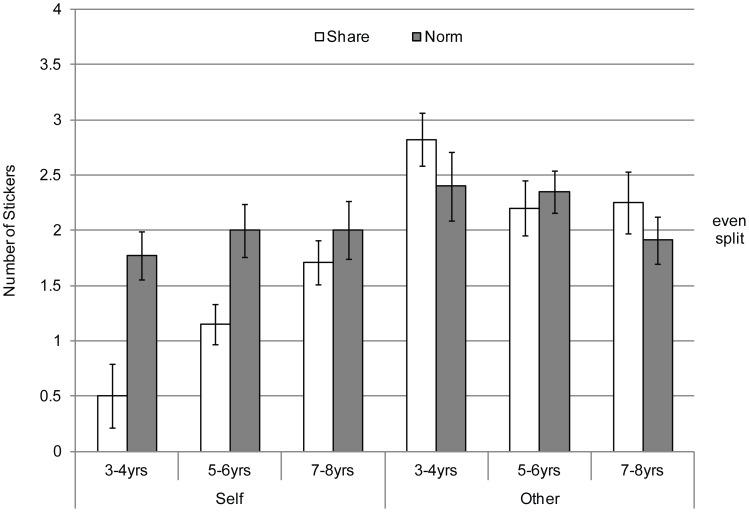
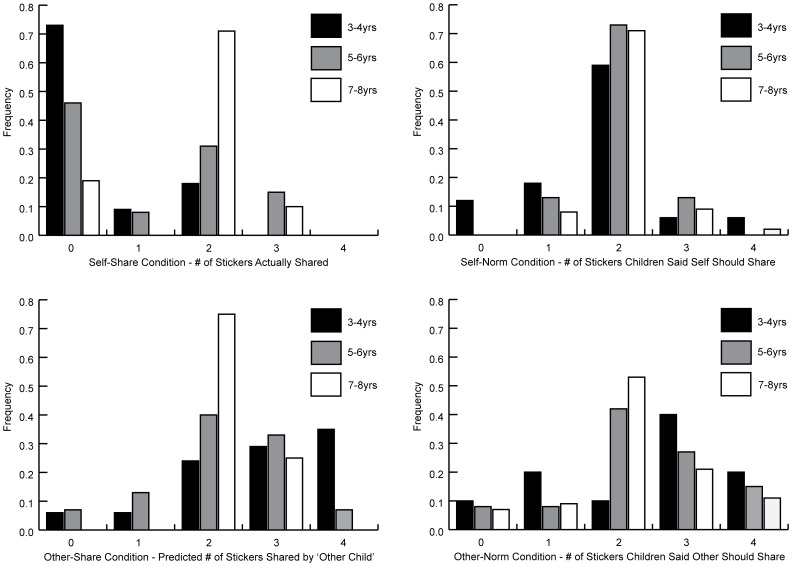
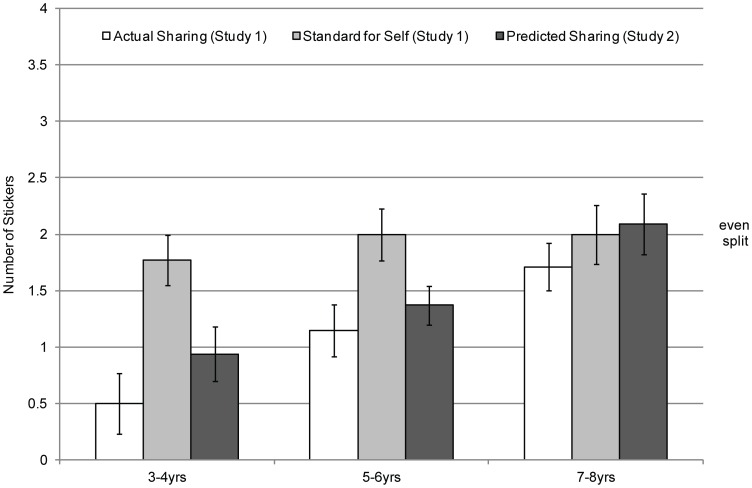
Young children endorse fairness norms related to sharing, but often act in contradiction to those norms when given a chance to share. This phenomenon has rarely been explored in the context of a single study. Using a novel approach, the research presented here offers clear evidence of this discrepancy and goes on to examine possible explanations for its diminution with age. In Study 1, 3-8-year-old children readily stated that they themselves should share equally, asserted that others should as well, and predicted that others had shared equally with them. Nevertheless, children failed to engage in equal sharing until ages 7-8. In Study 2, 7-8-year-olds correctly predicted that they would share equally, and 3-6-year-olds correctly predicted that they would favor themselves, ruling out a failure-of-willpower explanation for younger children's behavior. Similarly, a test of inhibitory control in Study 1 also failed to explain the shift with age toward adherence to the endorsed norm. The data suggest that, although 3-year-olds know the norm of equal sharing, the weight that children attach to this norm increases with age when sharing involves a cost to the self.
Overview
The claims and statistics of this paper haven’t been checked yet.
Free: it reads the open-access text and checks the first 5 claims that cite a source we can check. Create a free account to check every claim.
Integrity signals
Registry
Cites
Statistics
Figures
Verification
Claims the paper makes
The claims and statistics of this paper haven’t been checked yet.
Free: it reads the open-access text and checks the first 5 claims that cite a source we can check. Create a free account to check every claim.
Claims other papers make about this one
Each is checked against this paper’s own text: does it say what the citing paper says it does?
The source backs part of the claim, not all of it — or backs it for a different population, condition or comparison.
In the citing paper
“With increasing age, children typically share equally and sharing equally becomes affectively rewarding (Kogut, 2012; Smith, Blake, & Harris, 2013).”
From Emotion understanding and the moral self-concept as motivators of prosocial behavior in middle childhood (2020) · cites this paper as Smith et al., 2013
Experimental — accuracy not yet measuredThe cited source says what the claim attributes to it.
In the citing paper
“With increasing age, children typically share equally and sharing equally becomes affectively rewarding (Kogut, 2012; Smith, Blake, & Harris, 2013).”
From Emotion understanding and the moral self-concept as motivators of prosocial behavior in middle childhood (2020) · cites this paper as Smith et al., 2013
The cited source says what the claim attributes to it.
In the citing paper
“Our finding corresponds to work by Smith and colleagues (2013) who reported that younger children knew that sharing equally would be required, but actually shared less than half.”
From Emotion understanding and the moral self-concept as motivators of prosocial behavior in middle childhood (2020) · cites this paper as Smith et al., 2013
Self-check
Percentages, sums and reported differences re-computed from the paper’s own numbers.
The self-check needs the paper’s full text.
Citations
Cites
Baron, R. M., & Kenny, D. A. (1986) · Journal of Personality and Social Psychology · doi:10.1037/0022-3514.51.6.1173 · Cited by 91,532 · cited 1×
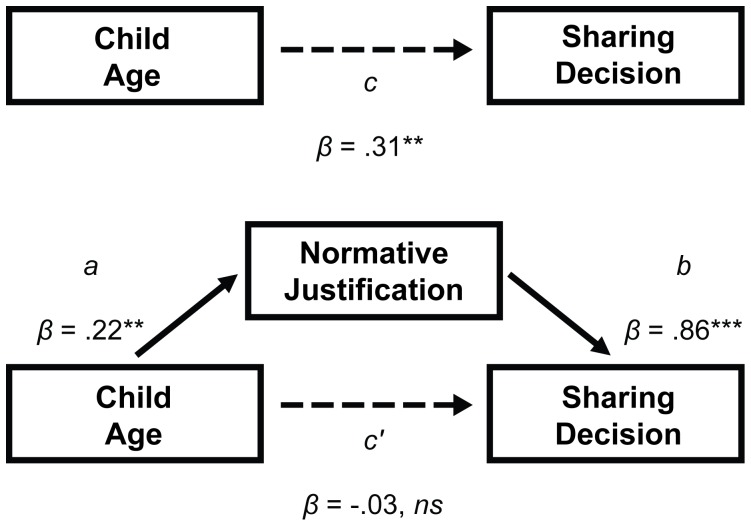
“Following Baron and Kenny [33], we tested the possibility that inhibitory control mediated the link between age and sharing.”
MethodThe emotional dog and its rational tail: A social intuitionist approach to moral judgment.
Haidt, J. (2001) · Psychological Review · doi:10.1037/0033-295x.108.4.814 · Cited by 8,048
Behavioral Game Theory: Experiments in Strategic Interaction
Camerer, C. F. (2003) · Cited by 3,722
Estimating Mediated Effects in Prevention Studies
Mackinnon, D. P., & Dwyer, J. H. (1993) · Evaluation Review · doi:10.1177/0193841x9301700202 · Cited by 1,937 · cited 1×
“Again, a series of regression models (see Figure 3) was calculated using equations designed for testing mediation models containing dichotomous mediators [34].”
MethodPreferences, property rights, and anonymity in bargaining games.
Hoffman, E., McCabe, K., Shachat, K., & Smith, V. (1994) · Games and Economic Behavior · doi:10.1006/game.1994.1056 · Cited by 1,674
Gerstadt, C. L., Hong, Y. J., & Diamond, A. (1994) · Cognition · doi:10.1016/0010-0277(94)90068-x · Cited by 1,598
Egalitarianism in young children
Fehr, E., Bernhard, H., & Rockenbach, B. (2008) · Nature · doi:10.1038/nature07155 · Cited by 1,475 · cited 4×
“Inhibitory control cannot fully explain age-related increases in fair sharing, because positive age-sharing associations are observed even when sharing is not costly for children [16,26].”
BackgroundInfluentialGod Is Watching You: Priming God Concepts Increases Prosocial Behavior in an Anonymous Economic Game
Shariff, A. F., & Norenzayan, A. (2007) · Psychological Science · doi:10.1111/j.1467-9280.2007.01983.x · Cited by 1,136
Inhibitory Control in Young Children and Its Role in Emerging Internalization
Kochanska, G., Murray, K. T., Jacques, T. Y., Koenig, A. L., & Vandegeest, K. A. (1996) · Child Development · doi:10.1111/j.1467-8624.1996.tb01747.x · Cited by 940 · cited 4×
“Next, children in the Self-Share/Other-Norm group received two measures of inhibitory control: the Day-Night Task [29] and the Bear-Dragon Task [30].”
MethodInfluentialNicholas Epley, A., & Dunning, D. A. (2000) · Journal of Personality and Social Psychology · doi:10.1037//0022-3514.79.6.861 · Cited by 820 · cited 1×
“, [43,44]).”
Research works printed but not linked: 1
- Burford HC, Foley LA, Rollins PG, Rosario KS (1996) Gender differences in preschoolers' sharing behavior. J Soc Behav Pers 11: 17– 25.
Cited by
Items 301–400 of 513
Likely stories: Young children favor typical over atypical story events
Thorburn, R., Bowman‐Smith, C. K., & Friedman, O. (2020) · Cognitive Development · doi:10.1016/j.cogdev.2020.100950 · Cited by 4
Asymmetry between cost and benefit: The role of social value orientation, attention, and age
Franchin, L., Agnoli, S., & Rubaltelli, E. (2023) · Current Research in Behavioral Sciences · doi:10.1016/j.crbeha.2023.100138 · Cited by 4
Contingency, novelty and choice. Cultural evolution as internal selection
Baldus, B. (2014) · Journal for the Theory of Social Behaviour · doi:10.1111/jtsb.12065 · Cited by 4
Chernyak, N., Leimgruber, K. L., Dunham, Y. C., Hu, J., & Blake, P. R. (2019) · PsyArXiv (OSF Preprints) · doi:10.31234/osf.io/vjb6q · Cited by 4
“However, recent work has also shown that children in the age range tested can recognize resource distribution norms for others but not use those norms to guide their own behavior (a phenomenon referred to as the knowledge-behavior gap; see (Smith et al., 2013).”
BackgroundSelf-citationThe role of social motivation in sharing and fairness: insights from Williams syndrome
Foti, F., Costanzo, F., Fabrizio, C., Termine, A., Menghini, D., Iaquinta, T., Vicari, S., Petrosini, L., & Blake, P. R. (2024) · Journal of Neurodevelopmental Disorders · doi:10.1186/s11689-024-09568-3 · Cited by 3
“Toddlers engage in acts of sharing with adults [32, 33] and by 3–4 years of age children share some items with peers when they receive a windfall gain of resources [34–39].”
BackgroundSelf-citationLiu, S., Hu, X., Ge, W., & Mai, X. (2024) · PsyCh Journal · doi:10.1002/pchj.800 · Cited by 3
Children Cheat to Return a Favor
Tietz, L., Warneken, F., & Grueneisen, S. (2025) · Developmental Science · doi:10.1111/desc.70059 · Cited by 4
“Moreover, children’s judgments of what one should do do not always match their own behavior (Smith et al. 2013).”
Priming Behavioral Control Enhances Sharing in Preschoolers
Lee, C., & Song, H.-J. (2022) · Frontiers in Psychology · doi:10.3389/fpsyg.2022.892382 · Cited by 3
Wang, Z., Wang, L.-M., Gao, X., & Zhu, L. (2023) · Journal for the Study of Education and Development Infancia y Aprendizaje · doi:10.1080/02103702.2022.2159618 · Cited by 3
“Pese a que los niños, desde los tres años, declaran que compartirían la mitad de sus recursos en el juego, en realidad no lo hacen hasta alcanzar la adolescencia (Smith et al., 2013).”
BackgroundCheng, T., Lin, Q., & Fu, H. C. (2023) · Current Psychology · doi:10.1007/s12144-023-05110-1 · Cited by 3
“They know early on what is right, but they need to work to overcome their self-interest preferences (Smith et al., 2013).”
InfluentialUnderstanding Public Support for Nonprofit Organizations During the COVID-19 Pandemic
Choi, M., Song, B., & Moon, W.-K. (2024) · International Journal of Strategic Communication · doi:10.1080/1553118x.2024.2331006 · Cited by 3
“On the one hand, several studies have highlighted the disconnect between knowledge and behaviors (Blake et al., 2014; Smith et al., 2013).”
BackgroundLevy‐Friedman, B., & Kogut, T. (2025) · Child Development · doi:10.1111/cdev.14171 · Cited by 3
Moral stories reading with internal negative reinforcement enhance children’s sharing behavior
Yu, H., Gai, X., Chen, X., Xu, J., & Zhang, P. (2024) · Journal of Moral Education · doi:10.1080/03057240.2024.2411960 · Cited by 3
“…with decisions that involve relinquishing possessions, a deviation towards self-serving actions is commonly observed in young children, resulting in a gap between their actual sharing behavior and the sharing principles they endorse (Blake et al., 2014; Rochat et al., 2009; Smith et al., 2013).”
Sampaio, L. R., & Camino, C. P. D. S. (2017) · Psico · doi:10.15448//1980-8623.2017.3.25746 · Cited by 3
PROSOCIAL DEVELOPMENT IN TODDLERHOOD
Yudina, T. A., & Kotova, T. N. (2015) · Shagi / Steps · doi:10.22394/2412-9410-2015-1-1-108-121 · Cited by 3
The development of coordination via joint expectations for shared benefits.
Grueneisen, S., & Tomasello, M. (2020) · Developmental Psychology · doi:10.1037/dev0000936 · Cited by 4
“In line with this possibility, there seems to be a discrepancy between children’s expectation of how much another child will share with them, how much they think one should share, and children’s own sharing behavior (Blake, McAuliffe, & Warneken, 2014; Smith et al., 2013).”
BackgroundCerda, C. D. L., Clegg, J. M., & Warnell, K. R. (2022) · The Journal of Genetic Psychology · doi:10.1080/00221325.2022.2158439 · Cited by 3
“…‘really thought’ suggest that they understood the hypothetical drawing was bad, but viewing an actual bad drawing may have made it more difficult to inhibit expressing their true feelings (but see Smith et al., 2013 for limitations of an inhibitory control account of the knowledge-behavior gap).”
BackgroundAltruism and hyperaltruism in children of three cultures
Zhang, J., Botto, S. V., & Rochat, P. (2023) · Journal of Experimental Child Psychology · doi:10.1016/j.jecp.2023.105708 · Cited by 4
Xiao, X., Zhao, D., & Li, Y. (2023) · Cognitive Development · doi:10.1016/j.cogdev.2023.101387 · Cited by 3
Söldner, L., & Paulus, M. (2023) · British Journal of Developmental Psychology · doi:10.1111/bjdp.12464 · Cited by 5
Beyond empathy: Cognitive capabilities increase or curb altruism in middle childhood
Rose, L., Kovarski, K., Caetta, F., Makowski, D., & Chokron, S. (2023) · Journal of Experimental Child Psychology · doi:10.1016/j.jecp.2023.105810 · Cited by 3
Razpurker‐Apfeld, I., Shamoa‐Nir, L., Taylor, L. K., & Dautel, J. B. (2024) · European Journal of Social Psychology · doi:10.1002/ejsp.3065 · Cited by 3
Children’s beliefs about the emotional consequences of norm adherence and violation
Riggs, A. E., & Fast, A. A. (2024) · Journal of Experimental Child Psychology · doi:10.1016/j.jecp.2024.106071 · Cited by 3
Young Children’s Understanding of Helping as Increasing Another Agent’s Utility
Schlingloff, L., Pomiechowska, B., Tatone, D., Revencu, B., Mészégető, D., & Csibra, G. (2025) · Open Mind · doi:10.1162/opmi_a_00183 · Cited by 6
“Previous studies have often found a “ knowledge-behavior gap ” , such that children ’ s understanding and evaluation of sociomoral actions do not always align with their own behavior (e.g., Blake et al., 2014; Smith et al., 2013).”
Wealth promotes generosity? The role of individual wealth on children’s allocation decisions
Peng, Q., Li, M., & Li, H. (2025) · International Journal of Behavioral Development · doi:10.1177/01650254251314761 · Cited by 4
“Previous research has shown that children tend to prefer advantages over others (Sheskin et al., 2014; Smith et al., 2013).”
Fairness Through Mathematical Problem Solving in Preschool Education
Nikiforidou, Z., & Pange, J. (2015) · Advances in mathematics education · doi:10.1007/978-3-319-15410-7_9 · Cited by 3
The sense of distributive justice in children from 6 to 10
Forsé, M., Richardot, S., Frénod, A., Lafaye, C. G., & Parodi, M. (2016) · Revue européenne des sciences sociales · doi:10.4000/ress.3403 · Cited by 3
Ingram, G., & Moreno, C. (2019) · PsyArXiv (OSF Preprints) · doi:10.31234/osf.io/zpv6h · Cited by 3
Vonk, J. M., Tomeny, T. S., Jett, S. E., Mercer, S. H., & Cwikla, J. (2024) · Cognitive Development · doi:10.1016/j.cogdev.2024.101460 · Cited by 2
Preschoolers prioritize humans over robots less than adults do: An eye-tracking study
Zhou, K., Chen, M., Xu, H., Cao, Y., & Yan, Z. (2024) · Cognitive Development · doi:10.1016/j.cogdev.2024.101505 · Cited by 2
Age-related changes in information-seeking behavior about morally relevant events
Yonas, D., & Solomon, L. H. (2024) · Child Development · doi:10.1111/cdev.14200 · Cited by 3
The Role of Harm Salience on Children's and Adults' Perceptions of Unfairness
Yucel, M., & Vaish, A. (2026) · Social Cognition · doi:10.1521/soco.2026.44.2.170 · Cited by 3
Doshi, A. R., Weinert, S., & Huang, W. (2026) · Journal of Applied Developmental Psychology · doi:10.1016/j.appdev.2026.101924 · Cited by 4
Aktas, B. E. (2021) · Psikoloji Çalışmaları / Studies in Psychology · doi:10.26650/sp2020-816658 · Cited by 2
Children think differently from adults when reasoning about resources acquired from parents
Aldan, P., & Dunham, Y. C. (2024) · Journal of Experimental Child Psychology · doi:10.1016/j.jecp.2024.105910 · Cited by 2
Chen, R., & Zhu, H. (2024) · Frontiers in Psychology · doi:10.3389/fpsyg.2024.1368224 · Cited by 2
Yan, X., Duan, S., Liang, Q., & Yang, Y. (2024) · Infant and Child Development · doi:10.1002/icd.2546 · Cited by 2
Children’s developing disability concepts: A review and recommendations for continued research
Granata, N., & Lane, J. D. (2025) · Cognitive Development · doi:10.1016/j.cogdev.2025.101566 · Cited by 4
The Evolution of Moral Development
Sheskin, M. (2017) · Springer eBooks · doi:10.1007/978-3-319-58993-0_3 · Cited by 2
The influence of in-group favoritism on 5 to 6-year-olds’ resource-allocation decisions
Cha, M., & Song, H.-J. (2015) · 인지과학 · doi:10.19066/cogsci.2015.26.2.005 · Cited by 2
Viewing Others as Equals: the Non-cognitive Roots of Shared Intentionality
Rosas, A., & Bermúdez, J. P. (2018) · Review of Philosophy and Psychology · doi:10.1007/s13164-018-0394-3 · Cited by 2
Keshvari, F., Lotfabadi, H., Imani, S., & Habibi, M. (2019) · Advances in Cognitive Science · doi:10.30699/icss.21.3.1 · Cited by 2
The Development of Moral Foundations in 2- and 4-Year-Olds
Peverill, S. (2020) · DalSpace (Dalhousie University) · Cited by 3
Ebersbach, M., Krupa, J., & Vogelsang, M. (2022) · Acta Psychologica · doi:10.1016/j.actpsy.2022.103579 · Cited by 2
Cash transfers and social preferences of children
Haushofer, J., Larreboure, M., Lowes, S., & Mait, L. (2026) · Journal of Development Economics · doi:10.1016/j.jdeveco.2026.103945 · Cited by 2
Sibling Relationship Development and Sharing Behaviors in Early Childhood
Carlson, E. B. (2018) · Deep Blue (University of Michigan) · Cited by 2
Reichelson, S., Zax, A., Patalano, A. L., & Barth, H. C. (2018) · PsyArXiv (OSF Preprints) · doi:10.31234/osf.io/fj9x5 · Cited by 2
Cash Transfers and Social Preferences of Children
Haushofer, J., Larreboure, M., Lowes, S., & Mait, L. (2023) · National Bureau of Economic Research · doi:10.3386/w31720 · Cited by 2
Do social descriptive norms about generosity change children's sharing decisions and beliefs?Preprint
González-Gadea, M. L., Schlotthauer, J., Aquino, A., & Gattei, C. (2024) · doi:10.22541/au.170663527.78697210/v1 · Cited by 2
Development of beliefs about censorship
Anderson, R. A., Heck, I. A., Young, K. L., & Kinzler, K. D. (2023) · Cognition · doi:10.1016/j.cognition.2023.105500 · Cited by 1
Common and distinct equity preferences in children and adults
Xu, H., Luo, L., Zhu, R., Zhao, Y., Zhang, L., Zhang, Y., Feng, C., & Guan, Q. (2024) · Frontiers in Psychology · doi:10.3389/fpsyg.2024.1330024 · Cited by 2
Young dictators—Speaking about oneself decreases generosity in children from two cultural contexts
Weltzien, S. M., Marsh, L. E., Kanngießer, P., & Hood, B. M. (2024) · PLoS ONE · doi:10.1371/journal.pone.0300200 · Cited by 1
“Developmentally, there appears to be a consistent pattern where young children initially show a bias towards not sharing with others, but are increasingly more likely to share and to share more resources as they get older [4–7].”
BackgroundUnmasking Moral Hypocrisy: How Preschoolers Perceive and Judge Moral Hypocrites
Myślińska Szarek, K., & Baryła, W. (2025) · Developmental Science · doi:10.1111/desc.13580 · Cited by 1
Schroeder, K. B., Darling, L. N., & Blake, P. R. (2025) · PLoS ONE · doi:10.1371/journal.pone.0325984 · Cited by 1
“…giving away considerably more than half their endowment to the DG recipient, which would have conflicted with a strong preference for equitable distributions that is present even in young children [41,66–68] in so-called WEIRD (western, educated, industrialized, rich, democratic) populations [69].”
Self-citationSabato, H., & Ritov, I. (2025) · British Journal of Psychology · doi:10.1111/bjop.70011 · Cited by 1
“…with age is also reflected in their emotional reactions and hypothetical perceptions (e.g. Kogut, 2012; Sabato & Eyal, 2022; Sabato & Kogut, 2019; Smith et al., 2013; Weller & Lagattuta, 2014), we included an exploratory examination of children's feelings and perceptions following their sharing…”
Kapitány, R., Francis, K., Wilks, M., Kavanagh, C. M., & Whitehouse, H. (2025) · Current Research in Behavioral Sciences · doi:10.1016/j.crbeha.2025.100188 · Cited by 1
Surma, B., & Prusak, J. (2025) · Journal of Preschool and Elementary School Education/Multidisciplinary Journal of School Education · doi:10.35765/mjse.2025.1428.30 · Cited by 2
The role of empathy in prosocial behavior in autistic and neurotypical children
Li, T., Decety, J., Hua, Z., Peng, X., Shi, R., & Yi, L. (2026) · Child Development · doi:10.1093/chidev/aacag007 · Cited by 3
A Bayesian perspective on observers’ inference of group norms
Duan, J., Guo, X., Zheng, L., & Jun, Y. I. N. (2026) · npj Science of Learning · doi:10.1038/s41539-026-00405-x · Cited by 1
“This ability allows individuals to regard behaviors exhibited by multiple members as indicators of group identi fi cation and perceive these behaviors as group norms, which they accept upon joining the group 27 , sometimes even overriding personal desires 28 – 30 .”
Didactical model for developing children’s mathematical and ethical reasoning
Sumpter, L., Hedefalk, M., Eriksson, H., & Markkanen, P. (2026) · Frontiers in Education · doi:10.3389/feduc.2026.1856503 · Cited by 1
“…on values, contextual norms, and personal differences, such as children sharing differently based on their or a friend’s need (Carson and Banuazizi, 2008; Enright et al., 1984; Hestner and Sumpter, 2018; Huntsman, 1984; Sigelman and Waitzman, 1991; Smith et al., 2013; Wong and Nunes 2003, 2014).”
Schiele, T., Jiménez, M. V., Camligüney, Ö., & Niklas, F. (2026) · Child Development · doi:10.1093/chidev/aacag140 · Cited by 1
Psychological Determinants of Social Behavior at Volunteers
Kozlovskii, P., Tabolina, A. V., Bolsunovskaya, M. V., Kunina, O. O., Andreeva, S., & Yudina, I. (2020) · Lecture notes in networks and systems · doi:10.1007/978-3-030-47415-7_91 · Cited by 1
Byun, H.-W., & Sung, J. (2021) · Korean Journal of Child Studies · doi:10.5723/kjcs.2021.42.3.399 · Cited by 1
“이는 독재자 게임에서 3세 는 대부분 이기적 분배를 주로 한다는 선행연구 결과(Fehr et al., 2008; Smith et al., 2013)와 동일하며, 유아들은 자기-타인 분배 상황에서 내집단 편향성을 나타낸다는 선행연구 결과 (Olson & Spelke, 2008)를 지지하는 결과이다.”
Chernyak, N., & Gary, H. E. (2014) · eScholarship (California Digital Library) · Cited by 1
The relationship between fairness, cognitive control, and numerical encoding.
Chernyak, N., & Blake, P. R. (2017) · eScholarship (California Digital Library) · Cited by 9
Self-citationNo Signs of Inclusive Fitness or Reciprocal Altruism in Advantageous Inequity Aversion
Antfolk, J., Marklund, E., Nylund, I., & Gunst, A. (2023) · Evolutionary Psychology · doi:10.1177/14747049231173401 · Cited by 2
“Our results are also in line with Smith et al. (2013), who found that only 7–8-year-olds shared equally when given the option to keep or share stickers with another child, even though younger children also seemed to be aware of norms of fairness.”
ResultFair distribution in early childhood: Stuck between friends and needy strangers
Kaya, G. N. (2023) · Journal of Childhood Education & Society · doi:10.37291/2717638x.202342210 · Cited by 1
“Aside from the human species' capacity to react emotionally to painful experiences associated with injustice and unfairness, some researchers discuss the findings that norms of fair behavior exist from infancy, but that these norms become more enforced with learning and age (Smith et al., 2013).”
BackgroundNature And Determinants of Socio-Moral Development: Theories, Methods and Applications
Geraci, A., Rigo, P., Franchin, L., & Govrin, A. (2023) · Frontiers research topics · doi:10.3389/978-2-8325-3868-5 · Cited by 1
Development of altruism in preschoolers: From empathic concern to compliance with fairness norms
Yu, H., Hu, X., Zhang, Y., Fan, X., & Mai, X. (2023) · Chinese Science Bulletin (Chinese Version) · doi:10.1360/tb-2023-1004 · Cited by 1
Give some, keep some, put some: The language of sharing in children
Jensen, K., Rouvroye, L., Eiteljoerge, S. F. V., Lieven, E., Fé, E., & Pouscoulous, N. (2024) · Journal of Experimental Child Psychology · doi:10.1016/j.jecp.2024.106066 · Cited by 1
“Still others used the potentially more normative verb share, which might implicitly prime equitable distributions (Moore, 2009; Smith et al., 2013).”
Children’s socio-moral reasoning about vaccine-like behaviors
Probst, S., & Warneken, F. (2025) · Journal of Health Psychology · doi:10.1177/13591053251314684 · Cited by 1
“Over middle childhood, children become more likely to regulate their own behavior in a way that aligns with moral norms (such as how to share fairly; Smith et al., 2013) and also intervene against third parties who violate cooperative norms (Marshall and McAuliffe, 2022).”
Planting the Seeds of Sustainability: The Promise of Dynamic Norms
Fish, L. R., & Tasimi, A. (2025) · Journal of Cognition and Development · doi:10.1080/15248372.2025.2525165 · Cited by 1
“After all, there are multiple cases in the developmental literature showing that children’s sensitivity to something (e.g., detecting fairness) precedes their engagement in it (e.g., acting fairly, see Chernyak et al., 2019; Smith et al., 2013).”
Lee, Y.-E., Jung, S.-K., Song, H.-J., & Warneken, F. (2025) · Journal of Experimental Child Psychology · doi:10.1016/j.jecp.2025.106375 · Cited by 1
Developing a Concept of Social Power Relationships.
Gülgöz, S. (2015) · Deep Blue (University of Michigan) · Cited by 11
Bridging the Attitude-Preference-Gap: A Cognitive Approach To Preference Formation
Schmitt, R. (2015) · Munich Personal RePEc Archive (Ludwig Maximilian University of Munich) · Cited by 2
Family Matters: Tracing the Social Cognitive Development of Kinship Understanding
Frost, A. S. (2018) · Digital Access to Scholarship at Harvard (DASH) (Harvard University) · Cited by 1
Children use ownership to understand actions and preferences
Pesowski, M. L. (2019) · UWSpace (University of Waterloo) · Cited by 1
Does Screen Time Help or Hinder Toddlers' Development of Prosocial Behaviour?
McHarg, G. (2019) · Apollo (University of Cambridge) · doi:10.17863/cam.51501 · Cited by 1
Trustworthiness is Distinct from Generosity in ChildrenPreprint
Amir, D., Parsons, W. S., Ahl, R. E., & McAuliffe, K. (2021) · OSF Preprints (OSF Preprints) · doi:10.31219/osf.io/c2by7 · Cited by 1
Children are more forgiving of accidental harms across developmentPreprint
Amir, D., Ahl, R. E., Parsons, W. S., & McAuliffe, K. (2020) · OSF Preprints (OSF Preprints) · doi:10.31219/osf.io/2rzfs · Cited by 2
Beyond Our Tribe: Developing a Normative Sense of Group-Transcendent FairnessPreprint
Yang, F., Yang, X., & Dunham, Y. C. (2022) · SSRN Electronic Journal · doi:10.2139/ssrn.4177622 · Cited by 1
Descriptive Norms Influence Children’s Injunctive and Moral Norm BeliefsPreprint
Deutchman, P. (2023) · PsyArXiv (OSF Preprints) · doi:10.31234/osf.io/2vd5t · Cited by 1
Wilke, J. (2024) · Carl von Ossiezky University of Oldenburg · Cited by 3
Investigating the development of creativity : The Sahlin hypothesis
Brinck, I. (2015) · PhilPapers (PhilPapers Foundation)
Kindernomics: The Developmental Origins of Other-Regarding Preferences in Children
Pollock, L. (2015) · Queen Mary Research Online (Queen Mary University of London)
Functions of Guilt and Reparative Behaviors in Middle Childhood
Donohue, M. R. (2018) · Digital Archive @ GSU · doi:10.57709/10213365
Valcke, A. (2017) · UWSpace (University of Waterloo) · Cited by 2
The Influence of Reputation Concerns and Social Biases on Children's Sharing Behavior.
Yazdi, H., Barner, D., & Heyman, G. D. (2016) · eScholarship (California Digital Library)
Solving the knowledge-behavior gap: Numerical cognition explains age-related changes in fairness.
Chernyak, N., Sandham, B., Harris, P. L., & Cordes, S. (2016) · eScholarship (California Digital Library)
Self-citationYoung Children’s Pro-Social Behavioural Intentions towards Obese Peers
Dearing, G. (2018) · White Rose eTheses Online (University of Leeds, The University of Sheffield, University of York)
Fairness expectations in the first year of life
Dawkins, B., & Paula, M. (2018)
Šipošová, B. (2018) · St Andrews Research Repository (St Andrews Research Repository)
Dutra, N. B. (2018) · Durham e-Theses (Durham University)
Implicit Inequity Aversion in Children and Adults
Burns, M. P. (2019) · Digital Access to Scholarship at Harvard (DASH) (Harvard University)
The effect of collaboration on children’s sharing
Corbit, J. D. (2018) · Summit (Simon Fraser University)
Children's response biases to results of object sharing
Okanda, M., & Taniguchi, K. (2020) · Applied Cognitive Psychology · doi:10.1002/acp.3680
Exposure to economic inequality at the age of 8 enhances prosocial behavior in adult lifePreprint
Brañas‐Garza, P., Caldentey, P., Espín, A. M., García‐Muñoz, T., & Hernandez, A. (2020) · PsyArXiv (OSF Preprints) · doi:10.31234/osf.io/nkz5a
Braicovich, R. S. (2020) · Psicología Conocimiento y Sociedad · doi:10.26864/pcs.v10.n2.7
Han, A.-R., & Han, S. (2021) · Korean Journal of Child Studies · doi:10.5723/kjcs.2021.42.1.75
To What Extent is Social Media Use Related to Online Prosocial Behavior Among Adolescents
Lysenstøen, C. (2020) · NVA (Nasjonalt vitenarkiv)
Metadata
- Authors
- Smith, C. E., Blake, P. R., & Harris, P. L.
- Affiliations
- University of Michigan (US)
- Boston University (US)
- Harvard University (US)
- Corresponding author
- Smith, Craig E.
- Venue
- PLoS ONE
- Publisher
- Public Library of Science (PLoS)
- Published
- 2013-03-20
- Volume
- 8
- Issue
- 3
- Pages
- e59510
- ISSN
- 1932-6203 (ISSN-L)
- PMC
- PMC3603928
- OpenAlex
- W1965699991
- Semantic Scholar
- 6d59a9f7bcfc05d46d6df3cc23213408ce0137cc
- Cited by
- 482
- References
- 49
- Citations by year
- 2026: 30 · 2025: 31 · 2024: 73 · 2023: 41 · 2022: 42 · 2021: 40 · 2020: 40 · 2019: 30 · 2018: 40 · 2017: 36 · 2016: 28 · 2015: 26 · 2014: 21 · 2013: 4
- FWCI
- 54.44
- Type
- journal article
- Language
- en
- Update notices
- correction (2013-08-21)
- Open access
- gold
- doi.org
- Locations
- PLoS ONE (publishedVersion, cc-by)
- Europe PMC (PubMed Central) (publishedVersion, cc-by)
- PubMed Central (publishedVersion, cc-by)
- PubMed (publishedVersion)
- RePEc: Research Papers in Economics (submittedVersion)
- DOAJ (DOAJ: Directory of Open Access Journals) (submittedVersion)
- Funders
- John Templeton Foundation
- Topics
- Social Sciences › Psychology › Developmental and Educational Psychology › Child and Animal Learning Development
- Life Sciences › Neuroscience › Cognitive Neuroscience › Psychology of Moral and Emotional Judgment
- Social Sciences › Economics, Econometrics and Finance › Economics and Econometrics › Experimental Behavioral Economics Studies
- Keywords
- fair sharing, fairness norms, rule compliance, young children, age differences, self-other bias, self-serving bias, inhibitory control, willpower, moral development, prosocial behavior
- MeSH terms
- Age Factors, Analysis of Variance, Child, Child Development, Child, Preschool, Cooperative Behavior, Games, Experimental, Humans, Interpersonal Relations, Massachusetts, Surveys and Questionnaires, Social Behavior, Moral Development
About these checks
Registry, retraction, Cites and statistics results are computed, not judged, with one exception: a printed reference that no index lists is read once by a model before it counts as a citation error. Claims are extracted by a model and kept only when their quote appears verbatim in the text; each cited source is then checked, with a model’s help, for whether it says what the claim relies on. Those verdicts can be wrong — read the claim’s quote and the cited source before relying on one.
Statistics and arithmetic are recomputed, not judged.
Confidence bands are shown only for fields calibrated on our annotated test set. None is calibrated yet, so no band is shown.
What counts as a claim ›How we measure confidence ›How we check this ›
Are you an author, or do you see a problem with this page? Request a review
Data sources
Bibliographic data: Semantic Scholar, OpenAlex, Crossref.
Contains information from the Semantic Scholar Academic Graph Datasets, made available under the ODC Attribution License (ODC-BY 1.0).
Semantic Scholar’s data is described in: Kinney, R., et al. (2023). The Semantic Scholar Open Data Platform. arXiv:2301.10140.
